Withholding of Removal Explained: Florida Defense in 2026
For those in Florida facing deportation and fearing persecution or torture in their home country, understanding withholding of removal is critical. This form of protection prevents removal to a dangerous country, though it differs significantly from asylum in its eligibility criteria and benefits. It requires proving a "more likely than not" chance of persecution based on protected grounds or torture, a higher standard than asylum's "well-founded fear." While withholding of removal does not lead to a Green Card, it offers mandatory protection if the stringent criteria are met, even for some individuals barred from asylum. The process involves complex legal proceedings before an immigration judge, often in Miami or Orlando immigration courts. A comprehensive application, detailed testimony, and robust supporting evidence, including country conditions reports and affidavits, are essential. Given the high stakes and intricate legal requirements, securing the expertise of a Florida immigration lawyer is paramount to building a strong defense and navigating the path to safety.

Withholding of removal is a form of protection granted to non-citizens who demonstrate a clear probability that their life or freedom would be threatened in their home country due to race, religion, nationality, membership in a particular social group, or political opinion, or that they would be tortured. Unlike asylum, it does not lead to permanent residency, but it prevents deportation to the dangerous country. Eligibility is strict, requiring a 'more likely than not' standard of proof, and it is mandatory once established, even for individuals with certain criminal convictions that might bar asylum. Individuals in Florida facing deportation should consult with an experienced immigration attorney to assess their eligibility and build a robust defense.
- Withholding of removal offers protection from deportation to a specific country.
- It requires a 'more likely than not' probability of persecution or torture.
- Eligibility is mandatory if criteria are met, even with certain criminal issues.
- It does not provide a direct path to a Green Card or U.S. citizenship.
- Legal counsel is crucial for navigating this complex defense in Florida.
Facing deportation can be one of the most terrifying experiences for an immigrant and their family in Florida. The thought of being sent back to a country where your life or freedom is at risk is unimaginable. Fortunately, U.S. immigration law provides crucial protections for individuals in such dire circumstances, one of which is withholding of removal. This form of relief is a lifeline for many, offering a shield against persecution or torture in their home country. Understanding your rights and the intricate process involved is paramount to securing your safety and future.
At Florida Immigration Lawyers, we understand the profound fear and uncertainty that deportation proceedings bring, especially when your safety is at stake. Our dedicated team of immigration attorneys in Hollywood, Florida, and across the state, is committed to providing compassionate and effective legal representation. We guide our clients through every step of the complex immigration system, ensuring their voices are heard and their rights protected. If you or a loved one are facing deportation and believe you may be eligible for withholding of removal, do not hesitate to seek expert legal counsel. Call Florida Immigration Lawyers at 1-844-967-3536 for a free consultation today.
What is Withholding of Removal, and How Does it Differ from Asylum?
Withholding of removal is a form of protection under U.S. immigration law that prevents an individual from being deported to a country where their life or freedom would be threatened. It is distinct from asylum, though both offer protection based on similar fears of persecution. As of 2026, the core difference lies in their eligibility standards, the nature of the relief granted, and the discretionary power of immigration judges.
Specifically, to qualify for withholding of removal under INA Section 241(b)(3), an applicant must demonstrate that it is "more likely than not" (a 50.1% or greater chance) that they would be persecuted on account of race, religion, nationality, membership in a particular social group, or political opinion, or that they would be tortured. This is a higher burden of proof than for asylum, which requires only a "well-founded fear" (a 10% chance). Once withholding of removal is granted, it is mandatory; the immigration judge must grant it if the eligibility criteria are met. In contrast, asylum is discretionary, meaning a judge can deny it even if the applicant meets the eligibility requirements.
Another critical distinction is the scope of relief. Asylum provides a path to lawful permanent residency (a Green Card) after one year, eventually leading to U.S. citizenship. Withholding of removal, however, only prevents deportation to the specific country where the threat exists. It does not lead to a Green Card or citizenship, nor does it allow for family members to automatically join the applicant in the U.S. While a person granted withholding of removal can work in the U.S. and may be able to travel with advance parole, their status is more limited. This makes understanding the nuances of these protections vital for anyone facing deportation proceedings in Florida.
Understanding Convention Against Torture (CAT) Protection in Florida
Protection under the Convention Against Torture (CAT) is another critical form of relief from removal, often sought alongside or as an alternative to withholding of removal or asylum. It offers a lifeline to individuals who fear torture in their home country, regardless of the persecutor's motive. As of 2026, CAT protection is governed by 8 CFR 208.16(c) and ensures that the U.S. does not return individuals to a country where they would more likely than not be tortured.
To qualify for CAT protection, an applicant must prove that it is "more likely than not" that they would be tortured if removed to their home country. This standard is identical to the "more likely than not" standard for statutory withholding of removal. However, a key difference is that CAT protection does not require the torture to be on account of a protected ground (race, religion, etc.). The harm must be inflicted by, or at the instigation of, or with the consent or acquiescence of, a public official or other person acting in an official capacity. This broad definition can cover a range of scenarios where state actors are involved in or complicit in torture.
CAT protection is particularly vital in cases where an individual might not qualify for asylum or statutory withholding due to certain bars, such as serious criminal convictions or national security concerns, but still faces a genuine risk of torture. Like statutory withholding, CAT relief is mandatory once the eligibility criteria are met. While it does not provide a pathway to a Green Card, it effectively stops deportation to the dangerous country. For those in Florida facing removal and a credible fear of torture, understanding and pursuing CAT protection can be a life-saving legal strategy. Our attorneys at Florida Immigration Lawyers are adept at building strong CAT claims for our clients.
What are the Eligibility Requirements for Withholding of Removal?
To be eligible for withholding of removal in 2026, an applicant must meet stringent criteria. The primary requirement is demonstrating that it is "more likely than not" that their life or freedom would be threatened in the country of removal due to one of five protected grounds: race, religion, nationality, membership in a particular social group, or political opinion. This means providing compelling evidence that there is a greater than 50% chance of future persecution if returned.
The burden of proof rests entirely on the applicant. This often involves submitting detailed affidavits, country condition reports, expert witness testimony, and any other evidence that corroborates the fear of persecution. Unlike asylum, there are fewer discretionary bars to withholding of removal. Even individuals with certain criminal convictions, such as aggravated felonies, might still be eligible for withholding if they can prove the "more likely than not" standard and that the persecution would be on account of a protected ground. However, certain severe criminal offenses, like particularly serious crimes, or national security grounds can still bar an individual from this relief. The legal landscape for these bars is complex and frequently debated in immigration courts, including those in Florida like the Krome Service Processing Center in Miami or the Orlando Immigration Court.
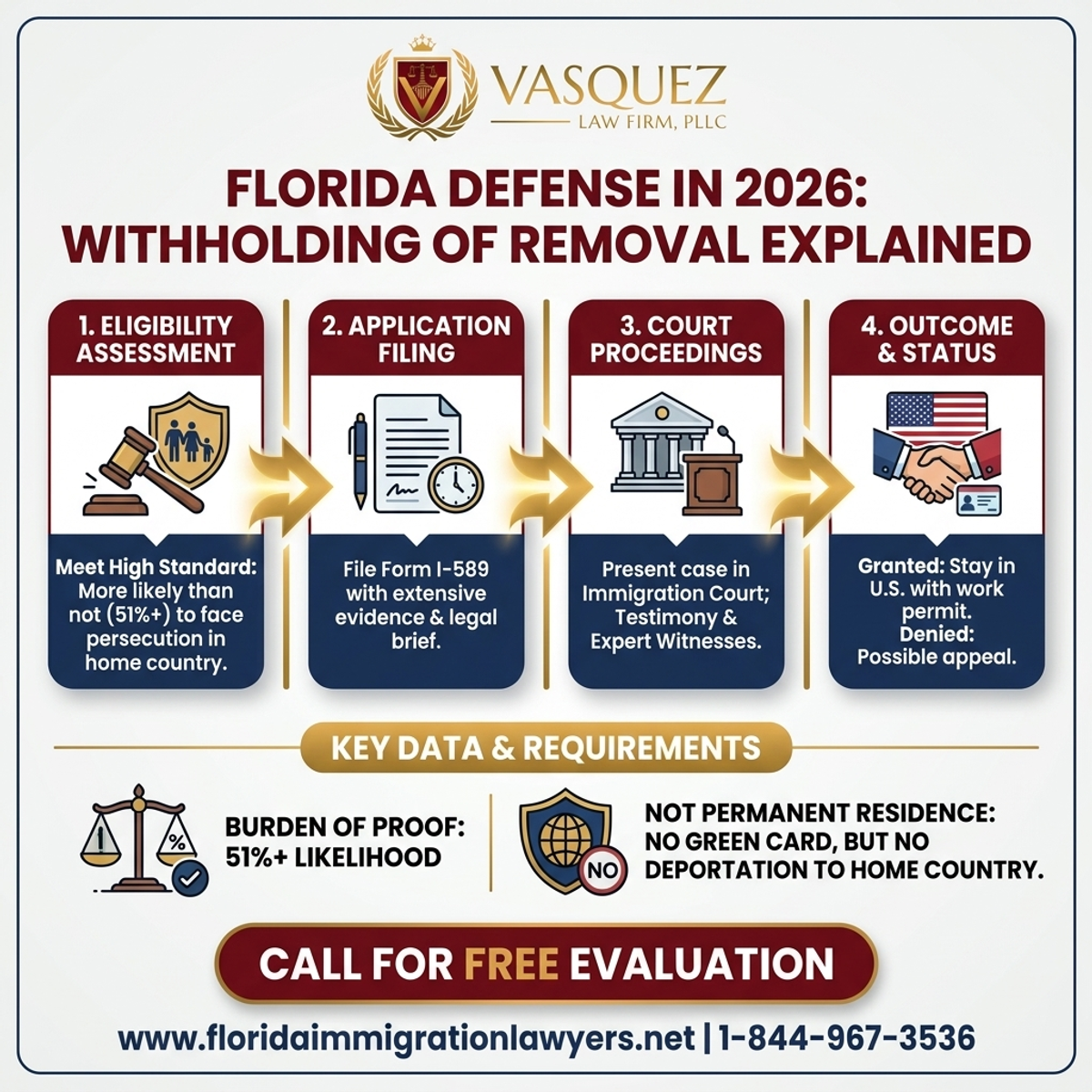
Step-by-Step Process — Withholding of Removal Explained: Florida Defense in 2026
It is also important to note that withholding of removal is country-specific. If an applicant is granted withholding against removal to Country A, but there is another country, Country B, to which they could be removed without fear of persecution or torture, the immigration judge may order removal to Country B instead. This highlights the importance of a thorough legal analysis of all potential removal destinations. An experienced immigration lawyer from Florida Immigration Lawyers can help you navigate these complex eligibility requirements and present the strongest possible case.
How Do I Apply for Withholding of Removal in Florida? A Step-by-Step Guide
Applying for withholding of removal is a complex legal process that typically occurs within the context of deportation (removal) proceedings before an immigration judge. For individuals in Florida, these proceedings often take place at the Miami Immigration Court or the Orlando Immigration Court, both part of the Executive Office for Immigration Review (EOIR). As of 2026, navigating this path requires precision and meticulous preparation.
-
Initiation of Removal Proceedings: The process begins when the Department of Homeland Security (DHS) issues a Notice to Appear (NTA), formally charging you as removable from the U.S. You will then have a hearing before an immigration judge.
-
Pleading and Requesting Relief: At an initial master calendar hearing, you will typically admit or deny the factual allegations in the NTA and concede or deny removability. This is the stage where you formally request forms of relief from removal, including asylum, statutory withholding of removal, and CAT protection.
-
Filing Form I-589, Application for Asylum and for Withholding of Removal: You must file Form I-589 with the immigration court. While this form is primarily for asylum, it also serves as the application for withholding of removal and CAT protection. It must be filed within one year of your last arrival in the U.S. or within a reasonable period if you qualify for an exception to the one-year filing deadline (though the one-year deadline does not apply to withholding of removal or CAT protection if filed defensively in removal proceedings).
-
Gathering Supporting Documentation: This is perhaps the most crucial step. You will need to collect all evidence proving your claim, including personal declarations, witness statements, medical records, police reports, human rights reports from your home country, news articles, and any other documentation that supports your fear of persecution or torture. Florida Immigration Lawyers can assist in identifying and compiling this critical evidence.
-
Individual Hearing (Merits Hearing): During this hearing, you will testify before the immigration judge, explaining your fear and providing details of past persecution or reasons for future fear. Your attorney will present your evidence, cross-examine government witnesses, and make legal arguments on your behalf. The government attorney will also have the opportunity to question you and present evidence against your claim.
-
Decision and Appeals: After the individual hearing, the immigration judge will issue a decision. If denied, you generally have the right to appeal the decision to the Board of Immigration Appeals (BIA), and further, to a U.S. Circuit Court of Appeals. Successfully navigating these appeals requires specialized legal expertise.
Crucial Documents for a Withholding of Removal Case
Building a strong withholding of removal case in Florida requires a comprehensive collection of documents to substantiate your claim of persecution or torture. The stronger and more consistent your evidence, the higher your chances of success. As of 2026, gathering these documents meticulously is non-negotiable for anyone seeking this vital protection.
- Form I-589, Application for Asylum and for Withholding of Removal: The primary application form, accurately completed and submitted to the immigration court.
- Personal Declaration/Affidavit: A detailed, first-person account of your experiences, fears, and reasons for seeking protection. This is often the most critical piece of evidence.
- Witness Affidavits: Statements from individuals who can corroborate your story, such as family members, friends, or colleagues who witnessed persecution or are aware of the threats you face.
- Country Conditions Reports: Official reports from human rights organizations (e.g., Amnesty International, Human Rights Watch), the U.S. Department of State, or academic sources detailing the human rights situation in your home country, particularly regarding the protected ground relevant to your case.
- Medical and Psychological Evaluations: Documentation from doctors or therapists detailing any physical or psychological harm you have suffered due as a result of past persecution or the trauma associated with your experiences.
- Police Reports or Court Documents: Any official records of incidents of persecution, arrests, or legal proceedings against you or your family in your home country.
- News Articles and Media Reports: Relevant news clippings or online articles that highlight the persecution of individuals sharing your protected characteristics in your home country.
- Membership Documentation: Proof of your affiliation with a particular social group, political party, religious organization, or other group that is a target of persecution (e.g., membership cards, letters, photos).
- Identification Documents: Passport, birth certificate, national ID, and any other documents proving your identity and nationality.
- Photographs and Videos: Any visual evidence supporting your claims of persecution or your involvement with a protected group.
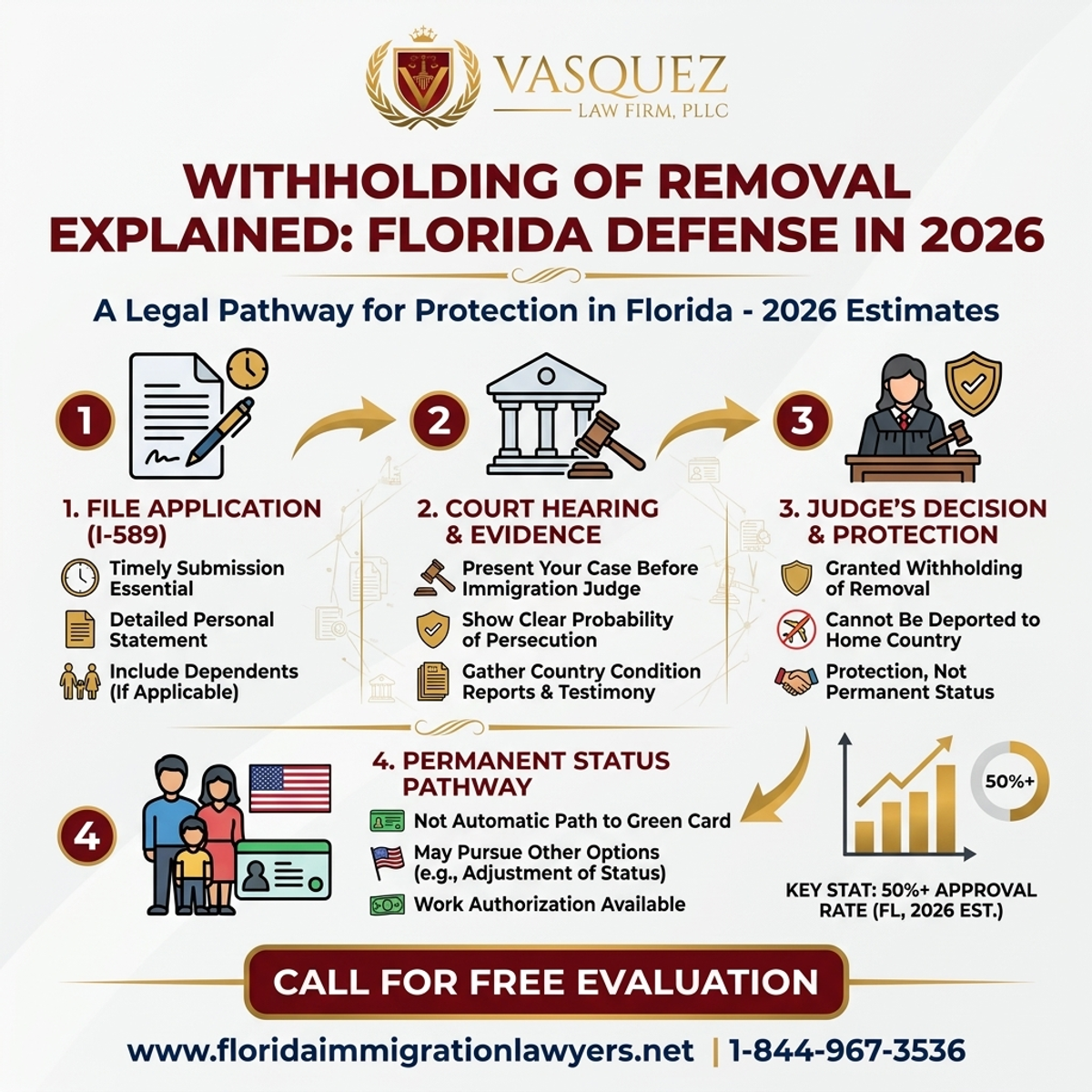
Key Statistics — Withholding of Removal Explained: Florida Defense in 2026
Typical Timelines and Processing Expectations for Withholding of Removal in 2026
The timeline for a withholding of removal case in Florida can vary significantly depending on the caseload of the immigration court, the complexity of your case, and whether appeals are necessary. As of 2026, the immigration court system, particularly in high-volume locations like Miami and Orlando, continues to face backlogs, which can extend processing times considerably. Understanding these typical timeframes can help manage expectations.
While some cases may move faster, many will take longer, especially if there are complications or if the case proceeds to the Board of Immigration Appeals or federal courts. Factors such as the judge's schedule, the need for continuances, and the availability of expert witnesses can all impact the overall duration. Our attorneys at Florida Immigration Lawyers work diligently to prepare your case efficiently and advocate for timely resolutions, while also being prepared for potential delays.
| Stage | Typical Timeframe | Notes |
|---|---|---|
| Notice to Appear (NTA) to First Master Calendar Hearing | 1-6 months | Initial appearance, pleading to charges, requesting relief. |
| Filing Form I-589 | Within 1 year of last entry (for asylum), but generally filed soon after requesting relief in removal proceedings. | Must be submitted to the immigration court. |
| Master Calendar Hearings to Individual Hearing Scheduling | 6-18 months | Multiple preliminary hearings may be scheduled to manage the case and set deadlines. |
| Individual Hearing (Merits Hearing) | 1 day to several days (spread out) | The actual hearing where testimony and evidence are presented. |
| Immigration Judge Decision | Immediately after hearing or within a few weeks | Decision can be oral or written. |
| Board of Immigration Appeals (BIA) Review (if appealed) | 1-3 years | Appeals are common and add significant time. |
| Federal Circuit Court Review (if appealed further) | 2-5+ years | Rare, but possible for complex cases. |
Do not navigate this complex and often lengthy process alone. The stakes are incredibly high when your safety and future are on the line. Contact Florida Immigration Lawyers today to ensure you have experienced and dedicated legal representation fighting for your rights.
Cost Factors and Fee Breakdown for Withholding of Removal Cases
Understanding the potential costs associated with a withholding of removal case is crucial for planning and preparation. While there is generally no government filing fee for Form I-589 when filed defensively in removal proceedings, significant expenses arise from legal representation and related administrative costs. As of 2026, these costs can vary widely depending on the complexity of the case, the amount of evidence required, and the duration of the proceedings.
Legal fees constitute the largest portion of the expenses. An experienced immigration attorney will charge for their time, expertise, and the extensive work involved in preparing and presenting your case. This includes initial consultations, in-depth interviews, evidence gathering, drafting declarations, legal research, court appearances, and potential appeals. Some firms offer flat fees for certain stages, while others charge hourly. It is essential to discuss fee structures transparently with your chosen legal counsel.
Beyond legal fees, applicants should anticipate other costs such as fees for obtaining country conditions reports, expert witness testimony (if needed), medical or psychological evaluations, translation services for documents not in English, and travel expenses for court appearances. These ancillary costs, though seemingly small individually, can accumulate. Investing in a robust legal defense is an investment in your safety and future, and while costs are a concern, the potential outcome of being deported to a dangerous situation far outweighs the financial considerations. Florida Immigration Lawyers offers free consultations to discuss your case and provide a clear understanding of potential costs involved.
| Item | Typical Fee (Range) | Notes |
|---|---|---|
| USCIS Filing Fee (Form I-589) | $0 | No fee when filed defensively in removal proceedings. |
| Attorney Legal Fees | $5,000 - $15,000+ | Highly variable based on case complexity, attorney experience, and duration. May be structured as flat fee or hourly. |
| Translation Services | $20 - $50 per page | For any documents not in English. Official certified translations required. |
| Medical/Psychological Evaluations | $500 - $2,000+ | If needed to document physical or mental trauma from persecution/torture. |
| Expert Witness Testimony | $1,000 - $5,000+ | For country conditions experts or other specialists (if deemed necessary). |
| Document Retrieval/Copies | Variable | Costs for obtaining official records, police reports, etc. |
| Travel Expenses | Variable | For client and attorney to attend court hearings (especially if far from counsel's office). |
Common Mistakes to Avoid in Withholding of Removal Cases
Navigating the complexities of withholding of removal demands meticulous attention to detail. Even minor errors can jeopardize your case and lead to severe consequences, including deportation. Avoiding these common pitfalls is crucial for anyone seeking this protection in Florida.
-
Failing to Meet the "More Likely Than Not" Burden: This is the highest hurdle. Many applicants fail to provide sufficient, compelling evidence that they will "more likely than not" face persecution or torture. Consequences: Denial of relief, leading to a removal order.
-
Inconsistent Testimony or Declarations: Providing contradictory statements across different applications, interviews, or hearings can severely undermine your credibility. Consequences: Loss of credibility, leading to denial of your claim by the immigration judge.
-
Not Filing Form I-589 Correctly or on Time: While the one-year deadline for asylum doesn't strictly apply to defensive withholding, errors in completing the form or delays in submission can still cause problems. Consequences: Rejection of the application, delays, or even a bar to relief.
-
Insufficient Supporting Documentation: Relying solely on your testimony without corroborating evidence (country reports, witness affidavits, medical records) significantly weakens your case. Consequences: Inability to meet the burden of proof, resulting in denial.
-
Not Disclosing All Relevant Information: Withholding information, especially about prior criminal history or immigration violations, can be detrimental even if you believe it's irrelevant. Consequences: Adverse credibility findings, potential bars to relief, and even accusations of fraud.
-
Failing to Understand the Differences Between Asylum, Withholding, and CAT: Misunderstanding the specific requirements and benefits of each form of relief can lead to an unfocused or improperly argued case. Consequences: Pursuing the wrong relief, leading to denial of available protections.
-
Ignoring Expert Witness or Country Conditions Evidence: Not incorporating robust, up-to-date country conditions reports or expert testimony can leave gaps in demonstrating the "more likely than not" standard. Consequences: Incomplete presentation of facts, making it harder for the judge to rule in your favor.
-
Attempting to Self-Represent: Immigration law is incredibly complex, with constantly evolving statutes and case law. Representing yourself without legal training is a significant risk. Consequences: Missed deadlines, procedural errors, failure to present a strong legal argument, and almost certain denial.
-
Failing to Prepare for Cross-Examination: The government attorney will rigorously question your testimony. Being unprepared for difficult questions can damage your case. Consequences: Appearing inconsistent or untruthful, leading to a negative credibility assessment.
-
Not Appealing an Unfavorable Decision: If your case is denied, you generally have a limited timeframe to appeal to the Board of Immigration Appeals. Missing this window means losing your chance for review. Consequences: Final order of removal becomes effective, with few remaining options.
When to Call a Florida Immigration Lawyer for Withholding of Removal Defense
The moment you receive a Notice to Appear (NTA) or realize you are in removal proceedings, it is critical to seek legal counsel immediately. Defending against deportation, particularly when seeking complex relief like withholding of removal or CAT protection, is not something you should attempt alone. The stakes are incredibly high, and the legal framework is exceptionally intricate. An experienced Florida immigration lawyer from Florida Immigration Lawyers can make a profound difference in the outcome of your case.
You should call an attorney if you:
- Have received a Notice to Appear (NTA) in immigration court.
- Fear persecution or torture if returned to your home country.
- Have a complex immigration history, including prior arrests or criminal convictions.
- Are unsure about your eligibility for asylum, withholding of removal, or CAT protection.
- Need help gathering compelling evidence and country conditions reports.
- Require assistance preparing for testimony and cross-examination in court.
- Have already been denied asylum and are considering withholding of removal as an alternative.
- Are facing an appeal of an immigration judge's decision.
Our attorneys at Florida Immigration Lawyers are adept at handling even the most challenging deportation defense cases. We serve clients throughout Florida, including Hollywood, Miami, Orlando, and Tampa, offering comprehensive legal strategies tailored to your unique situation. Do not leave your future to chance; secure experienced legal representation.
About Florida Immigration Lawyers
Florida Immigration Lawyers is a leading immigration law firm dedicated to serving individuals and families across the entire state of Florida. With a deep understanding of U.S. immigration law and a compassionate approach, our experienced attorneys provide comprehensive legal services, including deportation defense, asylum claims, family-based immigration, business immigration, and naturalization. We are committed to protecting the rights and futures of our clients, offering personalized strategies and tireless advocacy.
Our firm prides itself on being accessible, responsive, and effective. We understand that immigration matters are often urgent and emotionally charged, which is why we are available 24/7 to address your concerns. We offer free consultations to discuss your case and provide clear guidance on your best path forward. Whether you are in Hollywood, Miami, Orlando, or anywhere else in Florida, our bilingual team is here to help. Trust Florida Immigration Lawyers to be your steadfast advocate in the complex world of immigration law. Call us today at 1-844-967-3536 or visit https://www.floridaimmigrationlawyers.net.
Sources and References
- U.S. Citizenship and Immigration Services (USCIS) - Withholding of Removal
- Executive Office for Immigration Review (EOIR) - Florida Immigration Courts
- 8 U.S.C. § 1231(b)(3) - Withholding of Removal (Immigration and Nationality Act Section 241(b)(3))
- 8 U.S.C. § 1158 - Asylum (Immigration and Nationality Act Section 208)
- 8 CFR § 208.16 - Withholding of removal under section 241(b)(3)(A) of the Act and withholding of removal and deferral of removal under the Convention Against Torture.
- Convention Against Torture and Other Cruel, Inhuman or Degrading Treatment or Punishment (CAT)
Related services: asylum and refugee protection, immigration waivers, humanitarian protection programs, DACA renewal and applications.
This article provides general legal information and is not intended as legal advice. Every case is unique, and outcomes depend on specific facts and circumstances. Contact an attorney for advice about your particular situation.
If you are facing the daunting prospect of deportation and believe your life is at risk, remember that you have rights and options. Florida Immigration Lawyers is here to provide the expert legal guidance and representation you need to fight for your safety and future. Do not face this challenge alone. Contact us for a free consultation at 1-844-967-3536. Se Habla Espanol - Estamos aqui para ayudarle.
If you need legal assistance, learn more about learn about deportation defense options, or call us at 1-844-967-3536 for a free consultation.
Do Not Navigate This Process Alone
Our experienced immigration attorneys are ready to fight for you. Get a free, confidential consultation today.
Se Habla Español
Frequently Asked Questions

William J. Vásquez
Founding Attorney · Vasquez Law Firm
U.S. Air Force veteran and immigration attorney with thousands of cases resolved. J.D., NCCU School of Law. AILA member. Admitted to the 4th, 5th, and 11th Circuit Courts.
Available 24/7 - Free Evaluations
Related Legal Services
Our Florida immigration attorneys can help you with free immigration consultation, experienced immigration attorneys and business immigration. Call today at 1-844-967-3536 for a free consultation.
Related Links
Related Topics
Free Legal Consultation
Discuss your case with our experienced attorneys. We're available 24/7.
Se Habla Español - Estamos aquí para ayudarle.
Related Articles
Biometrics Appointment in Florida: What to Expect in 2026
Navigating a biometrics appointment in Florida is crucial for your USCIS process. Learn what to expect, how to prepare, and common pitfalls to avoid. Florida Immigration Lawyers are here to help with personalized guidance and support.
US Visa Policy Changes July 2026: What Students in Florida
As of July 2026, international students in Florida seeking a change of status to an F-1 student visa must prepare for potential adjustments to U.S. visa policies. This comprehensive guide from Florida Immigration Lawyers explores the anticipated policy changes, detailing their potential impact on application requirements, processing times, and eligibility criteria. We provide a step-by-step overview of the change of status process, including a document checklist, expected timelines, and cost considerations. Understanding these complexities and avoiding common mistakes is crucial for a successful application. With potential changes approaching, proactive planning and expert legal guidance are more important than ever. Our firm is dedicated to helping students in Tampa and across Florida navigate these challenges, offering tailored advice and robust representation. Learn how to protect your academic future and ensure a smooth transition to F-1 student status.
Dual Citizenship Lawyer: Your 2026 Guide to Naturalization
Achieving U.S. citizenship is a profound milestone, but the path to naturalization, especially with dual citizenship in mind, is fraught with legal intricacies and a critical interview process. This comprehensive guide from Florida Immigration Lawyers demystifies the journey, offering essential citizenship interview tips and highlighting the invaluable role of a dual citizenship lawyer. We cover eligibility, document preparation, timelines, and common pitfalls, all tailored for Florida residents in areas like Pembroke Pines. Discover how expert legal counsel can prepare you for your naturalization interview, address dual nationality concerns, and ensure a smooth, successful application. From initial assessment to interview representation, we provide the support needed to navigate USCIS requirements confidently. Call Florida Immigration Lawyers for a free consultation to start your journey.
USCIS Stokes Interview for Marriage Fraud in Florida 2026
A USCIS Stokes interview for marriage fraud in Florida is a high-stakes process for couples whose marriage-based green card petition has raised suspicions. This intensive, separate interview aims to uncover inconsistencies in spouses' testimonies, often triggered by red flags in the I-130 petition or initial interview. Understanding the detailed questions, gathering comprehensive evidence, and preparing meticulously are crucial. A finding of marriage fraud carries severe consequences, including permanent immigration bars and potential deportation. This guide provides an in-depth look at the Stokes interview process, preparation strategies, common mistakes to avoid, and the importance of expert legal representation from Florida Immigration Lawyers to navigate this challenging situation effectively in Hialeah and across Florida in 2026.
