TPS Honduras Updates 2026: Re-registration Deadlines in
For thousands of Honduran nationals in Florida, understanding the 2026 TPS re-registration deadlines is paramount. This guide from Florida Immigration Lawyers details the step-by-step process, critical documents, and expected timelines for maintaining your Temporary Protected Status. Learn about eligibility requirements, how to avoid common mistakes, and when to seek legal counsel to protect your right to live and work in the U.S. We cover USCIS updates, fee structures, and the importance of timely filing to prevent loss of status. Ensure your future is secure by preparing diligently for the upcoming re-registration period.

To maintain your Temporary Protected Status (TPS) for Honduras in Florida for 2026, eligible individuals must complete the re-registration process within the specific window announced by USCIS. As of 2026, this typically involves filing Form I-821, Application for Temporary Protected Status, and Form I-765, Application for Employment Authorization, along with all required supporting documents and fees. It is crucial to monitor official USCIS announcements for the exact re-registration period and any updated requirements, as failing to re-register on time can lead to the loss of your protected status and employment authorization.
- Re-registration is mandatory to maintain TPS benefits.
- Always file Form I-821 and Form I-765 within the designated window.
- Gather all necessary supporting documents, including proof of continuous residence.
- Pay all required fees or apply for a fee waiver if eligible.
- Consult an immigration attorney, especially if you have any changes in your circumstances or a criminal record.
Navigating the complexities of immigration law, especially concerning programs like Temporary Protected Status (TPS), can be daunting. For thousands of Honduran nationals residing in Florida, the upcoming 2026 re-registration deadlines for TPS are a critical concern. These deadlines are not merely administrative dates; they represent the continued ability to live and work legally in the United States, free from the constant fear of deportation. Understanding the specific requirements, timelines, and potential pitfalls is essential to safeguarding your future and that of your family.
This comprehensive guide will walk you through everything you need to know about TPS re-registration for Honduran nationals in Florida for 2026. We will cover the step-by-step process, crucial documents, anticipated timelines, and common mistakes to avoid. Our goal is to provide clear, actionable information to help you prepare effectively and maintain your protected status. Do not risk your legal standing by missing a critical deadline or making an error in your application. For personalized guidance and expert legal assistance, call Florida Immigration Lawyers at 1-844-967-3536 for a free consultation today.
What is Temporary Protected Status (TPS) for Honduras, and Who is Eligible?
Temporary Protected Status (TPS) is a humanitarian immigration benefit granted by the U.S. government to eligible foreign nationals from designated countries. This status is extended when conditions in their home country, such as armed conflict, environmental disaster, or other extraordinary and temporary conditions, prevent their safe return. For Honduras, TPS was initially designated in 1999 following Hurricane Mitch. Since then, the designation has been extended multiple times, allowing eligible Honduran nationals to live and work legally in the U.S. and protecting them from deportation. The program also offers a pathway to apply for employment authorization.
Eligibility for TPS is specific. To qualify, individuals must generally be a national of the designated country, have been continuously physically present in the U.S. since the effective date of the most recent designation, and have continuously resided in the U.S. since a specific date. Furthermore, applicants must meet certain admissibility requirements, meaning they cannot have been convicted of certain crimes or be deemed a threat to U.S. national security. For Honduran TPS holders in Florida, maintaining this status requires diligent adherence to re-registration requirements. Any changes in your criminal record or residency status could impact your eligibility, making legal counsel invaluable. For more information on eligibility, consult the official USCIS website.
The stability offered by TPS is incredibly significant for families across Florida, including those in Tampa, Orlando, and Miami. It allows individuals to contribute to the economy, pursue education, and build lives without the constant threat of removal. However, the temporary nature of TPS means that extensions and re-registrations are regular occurrences, each carrying its own set of rules and deadlines. Staying informed about these updates, particularly as we approach 2026, is paramount. Many families rely on this status for their economic and emotional well-being, and losing it can have devastating consequences, potentially leading to detention and deportation proceedings. Understanding the legal framework, specifically under 8 U.S.C. § 1254a of the Immigration and Nationality Act (INA), is crucial for all beneficiaries.
What are the TPS Re-registration Deadlines for Honduran Nationals in Florida for 2026?
As of early 2026, specific re-registration deadlines for Honduran TPS beneficiaries in Florida will be announced by U.S. Citizenship and Immigration Services (USCIS) via a Federal Register Notice. Historically, these re-registration periods typically last between 60 to 90 days. It is critical for all eligible individuals to file their applications within this specific window to maintain their Temporary Protected Status.
While the exact dates for the 2026 re-registration period are pending official announcement, beneficiaries should anticipate a similar timeframe to previous extensions. USCIS usually publishes these notices several months in advance of the start date. For instance, if the current TPS designation for Honduras is set to expire in mid-2026, the re-registration period could open in late 2025 or early 2026. It is crucial to sign up for email updates from USCIS or consult with an immigration attorney to ensure you do not miss the official announcement. Missing the deadline, even by a single day, can result in the loss of your TPS benefits and employment authorization, potentially leading to severe immigration consequences. The Executive Office for Immigration Review (EOIR) also provides resources regarding immigration court proceedings which can become relevant if status is lost.
Florida is home to a significant Honduran population, particularly in areas like Miami, Orlando, and Tampa. USCIS field offices in these cities, such as the Miami Field Office or the Tampa Field Office, process various immigration applications, including those related to TPS. However, TPS re-registration applications are generally mailed directly to designated USCIS lockbox facilities, not submitted at local field offices. It is vital to confirm the correct filing address as specified in the Federal Register Notice. The current political climate and discussions regarding immigration policy, as reported by outlets like CBS News on the uncertainty of TPS for other nations, underscore the importance of strict adherence to these deadlines. Proactive preparation, including gathering documents and consulting legal counsel, can make a significant difference in navigating this process successfully. This proactive approach helps avoid the mental toll and uncertainty faced by immigrant families, as highlighted by reports from Documented and the Atlanta Journal-Constitution concerning immigrant children.
How Do I Re-register for TPS in Florida? A Step-by-Step Guide for 2026
Re-registering for Temporary Protected Status (TPS) in Florida for 2026 involves a precise series of steps to ensure your application is processed correctly. It is not merely a formality but a critical legal procedure. Failure to follow these steps can jeopardize your status.
- Monitor Official Announcements: The first and most crucial step is to stay informed about the official re-registration period and instructions released by USCIS. This information will be published in the Federal Register and on the USCIS website. Pay close attention to the start and end dates of the re-registration window, as well as any updated forms or requirements specific to 2026.
- Complete Form I-821, Application for Temporary Protected Status: This is the primary application form for TPS. Ensure you fill out every section accurately and completely. Any omissions or errors can cause delays or even rejection. As of 2026, always use the most current version of the form available on the USCIS website.
- Complete Form I-765, Application for Employment Authorization: If you wish to continue working legally in the U.S., you must also file Form I-765. This form allows you to obtain or renew your Employment Authorization Document (EAD). Make sure the information on your I-765 matches your I-821.
- Gather Supporting Documents: Collect all required supporting documentation. This typically includes proof of identity and nationality (e.g., passport, birth certificate), proof of continuous residence in the U.S. since the initial designation date (e.g., utility bills, rent receipts, school records, employment records), and proof of continuous physical presence (e.g., entry stamps, travel records). For re-registration, you must also provide evidence that you have maintained your eligibility since your last approval.
- Pay Required Fees or Apply for a Fee Waiver: As of 2026, filing fees for Form I-821 and Form I-765 are generally required. USCIS fees can change, so always check the latest fee schedule on their website. If you cannot afford the fees, you may be eligible to apply for a fee waiver by filing Form I-912, Request for Fee Waiver. Provide strong evidence of your financial hardship.
- Submit Your Application Package: Organize your application forms and supporting documents neatly. Follow USCIS instructions regarding the order of documents. Mail your complete package to the designated USCIS lockbox facility. Do not send it to a local USCIS office unless specifically instructed. It is advisable to send your application via certified mail with a return receipt requested to have proof of submission.
- Attend Biometrics Appointment (if required): After filing, you may receive a notice to attend a biometrics appointment at an Application Support Center (ASC) in Florida, such as those in Orlando, Jacksonville, or Fort Myers. This appointment is for fingerprinting and photographs, which are used for background checks. Missing this appointment without rescheduling can lead to your application being denied.
- Monitor Application Status: You can track the status of your application online using the receipt number provided by USCIS. Be prepared for processing times that can extend for several months.
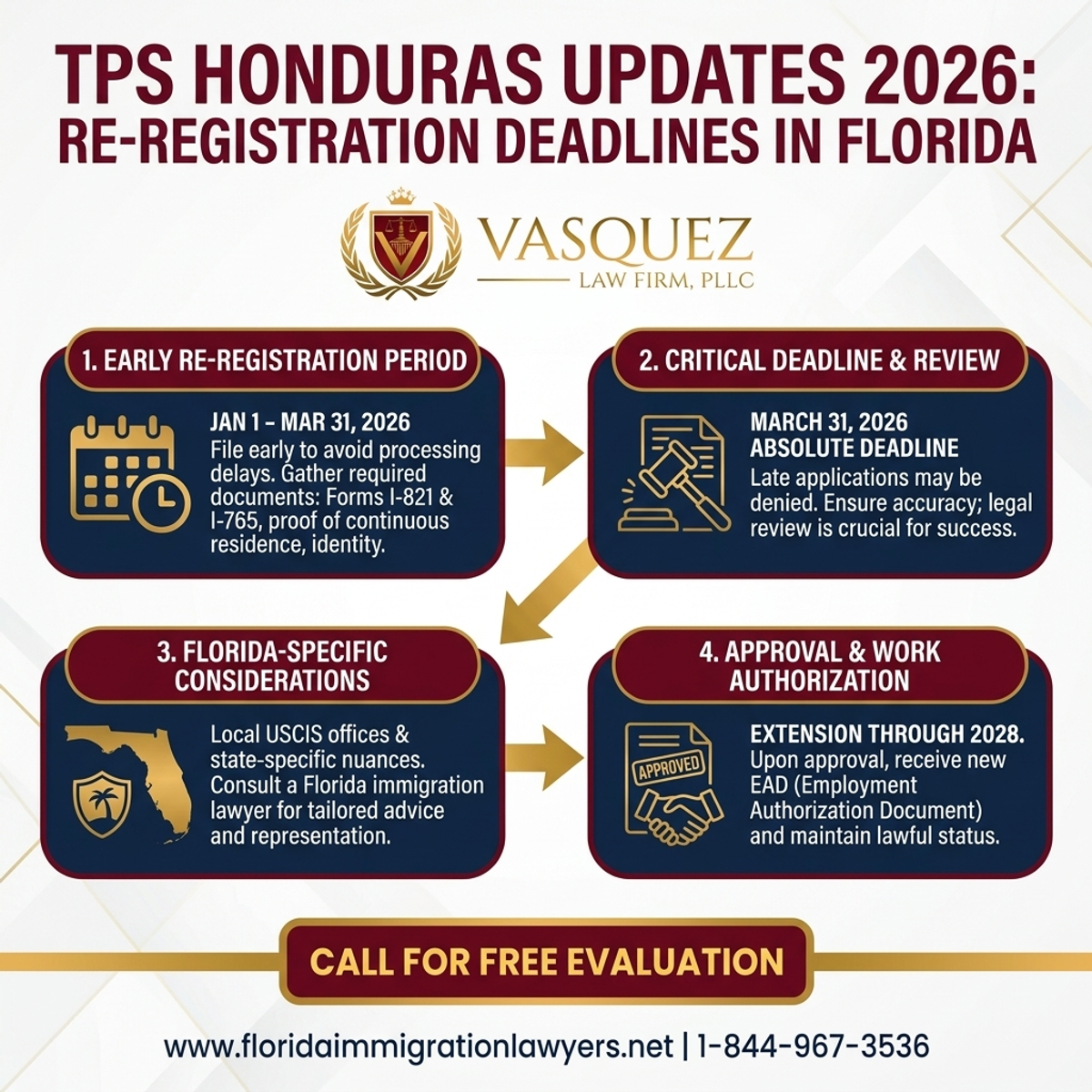
Step-by-Step Process — TPS Honduras Updates 2026: Re-registration Deadlines in Florida
Key Documents and Evidence for TPS Re-registration in 2026
A successful TPS re-registration application hinges on providing comprehensive and accurate documentation. Preparing these documents in advance of the 2026 re-registration window will save you time and reduce stress. The following is a general checklist of documents you will likely need:
- Proof of Identity and Nationality:
- Passport from Honduras (valid or expired)
- Birth certificate from Honduras, accompanied by photo identification (e.g., national identity document)
- Any previous TPS approval notices or EADs
- Proof of Continuous Residence in the U.S. (since the last designated date for Honduras):
- Utility bills (electricity, water, gas) in your name
- Rent receipts or mortgage statements
- Employment records (pay stubs, W-2 forms, letters from employers)
- School records (transcripts, enrollment letters)
- Medical records or hospital bills
- Bank statements
- Affidavits from friends, family, or employers attesting to your residence
- Any government-issued documents (tax returns, driver's license/ID card from Florida)
- Proof of Continuous Physical Presence in the U.S. (since the last designated date for Honduras):
- Entry stamps in passport
- I-94 Arrival/Departure Record
- Travel records (if applicable, demonstrating no extended absences)
- Previous Immigration Documents:
- Copies of all previous I-821 and I-765 applications and approval notices
- Previous Employment Authorization Documents (EADs)
- Biographical Documentation:
- Two passport-style photographs
- Fee Waiver Documentation (if applicable):
- Form I-912, Request for Fee Waiver, with supporting financial documents (e.g., tax returns, proof of public benefits, bank statements)
Ensure all documents are legible. If any document is not in English, it must be accompanied by a certified English translation. USCIS is very particular about documentation, and incomplete submissions are a leading cause of delays or denials. Organizing your documents meticulously will streamline the process.
What are the Typical Timelines and Processing Expectations for TPS Re-registration in 2026?
As of 2026, the timelines for TPS re-registration can vary significantly depending on several factors, including the volume of applications, current USCIS backlogs, and any unforeseen policy changes. While exact processing times are unpredictable, we can outline typical expectations based on past re-registration cycles. It is important to note that these are estimates, and individual cases may differ.
Generally, the entire re-registration process, from filing to receiving a new Employment Authorization Document (EAD), can take several months. USCIS provides an automatic extension of existing EADs for a certain period (often 180 or 540 days) for timely filed re-registration applications, which helps prevent gaps in employment authorization. Always check the Federal Register Notice for the exact extension period applicable to your situation. This automatic extension is a critical benefit that allows TPS holders to continue working while their new EAD is being processed. It is vital to carry your expired EAD, your I-797C receipt notice for the re-registration application, and the Federal Register Notice with you to show employers.
Here is a typical timeline expectation for the TPS re-registration process:
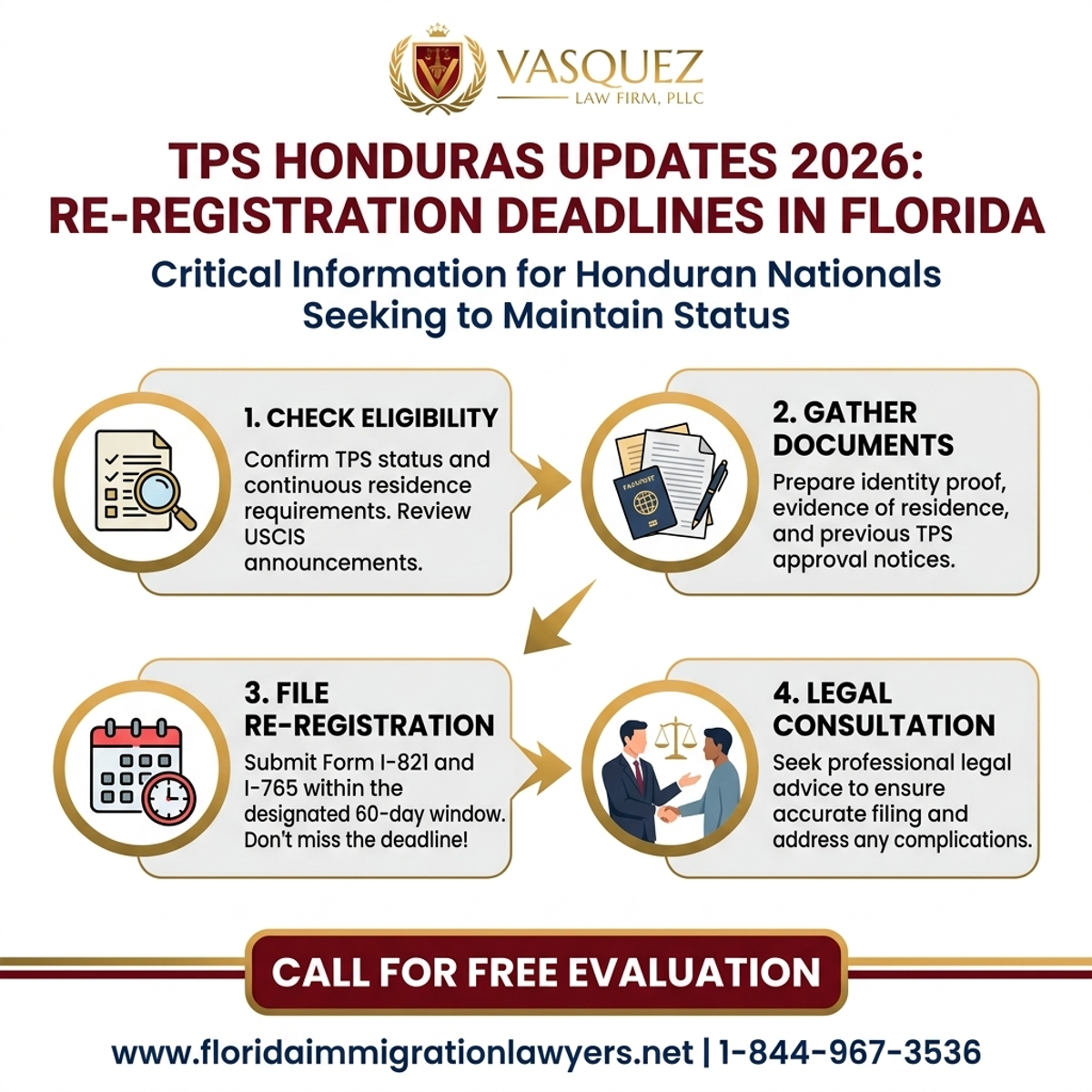
Key Statistics — TPS Honduras Updates 2026: Re-registration Deadlines in Florida
| Stage | Typical Timeframe | Notes |
|---|---|---|
| Official Re-registration Window Opens | 60-90 days | Announced via Federal Register Notice by USCIS. Critical to file within this period. |
| Application Submission to Receipt Notice | 2-4 weeks | USCIS sends I-797C receipt notice after receiving your application. |
| Biometrics Appointment Scheduling | 4-8 weeks after receipt | Notice for fingerprinting and photos at an Application Support Center (ASC). |
| Application Review and Decision | 6-12+ months | Processing times can vary widely. Check USCIS processing times online. |
| New EAD Card Issuance | Upon approval of I-765 | If approved, a new Employment Authorization Document is mailed. Automatic extension may apply. |
While awaiting your new EAD, remember to keep copies of all submitted documents and receipt notices. If your case takes longer than the posted processing times, you may submit an inquiry with USCIS. However, it's often best to consult with an immigration attorney before doing so, especially if there are any complexities in your case or if you have previously encountered issues. Legal citations from the Code of Federal Regulations, specifically 8 CFR § 244, govern these processing procedures and extensions. The U.S. Department of State also provides country conditions reports that influence TPS designations.
Understanding Cost Factors and Fee Breakdown for TPS Re-registration in Florida
The cost associated with TPS re-registration in Florida for 2026 primarily involves USCIS filing fees. It is crucial to understand these fees, as they are a mandatory part of the application process unless you qualify for a fee waiver. As of 2026, USCIS fees are subject to change, so always refer to the most current USCIS Fee Schedule on their official website.
Typically, there are two main fees associated with TPS re-registration:
| Item | Typical Fee (As of 2026 - Check USCIS for current rates) | Notes |
|---|---|---|
| Form I-821, Application for Temporary Protected Status | No fee for re-registration (typically) | For initial TPS applications, there is a fee. For re-registration, often only the biometrics fee is required if filing I-821 alone. |
| Form I-765, Application for Employment Authorization | Check USCIS Fee Schedule | This fee is required if you are requesting an Employment Authorization Document (EAD). |
| Biometrics Services Fee | Check USCIS Fee Schedule | Required for applicants aged 14 to 79. This fee is often combined with the I-765 fee or paid separately if only filing I-821. |
| Attorney Fees (Optional) | Varies by firm and complexity | Highly recommended for professional guidance and to avoid mistakes. Florida Immigration Lawyers offers free consultations. |
It is important to note that if you are filing both Form I-821 and Form I-765, and you are between the ages of 14 and 79, you will typically pay the Form I-765 fee and the biometrics fee. If you are only filing Form I-821 for re-registration and not requesting an EAD, you may only need to pay the biometrics fee. Always verify the exact fees for your specific situation on the USCIS website or with an attorney.
For individuals who cannot afford the filing fees, USCIS offers a fee waiver process. You can apply for a fee waiver by submitting Form I-912, Request for Fee Waiver, along with supporting documentation that demonstrates your inability to pay. This might include proof of receiving means-tested public benefits, household income below 150% of the poverty level, or financial hardship. Seeking assistance from Florida Immigration Lawyers can ensure your fee waiver application is strong and properly documented, increasing your chances of approval. This can significantly reduce the financial burden of the re-registration process, making it accessible to more individuals in Florida.
Common Mistakes to Avoid During TPS Re-registration
The TPS re-registration process is fraught with potential pitfalls that can lead to delays or even denial. Avoiding these common mistakes is crucial for maintaining your protected status.
- Missing the Re-registration Deadline: This is arguably the most critical error. Failing to file your application within the designated USCIS window will almost certainly result in the loss of your TPS status and employment authorization. Always mark your calendar and set reminders.
- Filing an Outdated Form: USCIS frequently updates its forms. Using an old version of Form I-821 or I-765 will lead to rejection. Always download the latest forms directly from the USCIS website as of 2026.
- Incomplete or Inaccurate Information: Any missing fields, incorrect dates, or inconsistent information can cause delays. Double-check every entry for accuracy and completeness.
- Insufficient Supporting Documentation: Not providing all required evidence, such as proof of continuous residence or identity, is a common reason for Requests for Evidence (RFEs) or denials. Ensure you have a robust set of documents.
- Failing to Pay Correct Fees or Submit a Proper Fee Waiver: Sending the wrong fee amount or omitting the fee entirely will result in your application being rejected. If applying for a waiver, ensure Form I-912 is fully completed and supported by strong evidence.
- Not Attending the Biometrics Appointment: If you receive a notice for a biometrics appointment, you must attend it or reschedule properly. Missing it without valid reason can lead to denial.
- Not Disclosing Criminal History: Even minor offenses or arrests that did not lead to convictions must be disclosed. Failure to do so can be considered misrepresentation and lead to severe immigration consequences. Consult an attorney if you have any criminal record.
- Mailing to the Wrong Address: USCIS has specific lockbox facilities for different form types and states. Always verify the correct mailing address in the Federal Register Notice or on the USCIS website.
- Assuming Automatic Renewal: While EADs may have automatic extensions for timely re-registrants, the TPS status itself is not automatically renewed. Re-registration is a mandatory, active step.
- Not Keeping Copies: Always make and keep a complete copy of your entire application package, including all forms, supporting documents, and the mailing receipt. This is vital for your records and if USCIS requests additional information.
- Not Seeking Legal Counsel for Complex Cases: If you have any criminal history, previous immigration violations, or significant changes in your personal circumstances, attempting to re-register without legal advice can be extremely risky.
When to Call a Florida Immigration Lawyer for TPS Re-registration
While the TPS re-registration process can seem straightforward, certain situations warrant the immediate attention of an experienced immigration attorney. Florida Immigration Lawyers are here to provide the expert guidance you need to navigate these complexities successfully.
You should call an attorney if:
- You have a criminal record: Any past arrests, charges, or convictions, no matter how minor or old, can affect your TPS eligibility. An attorney can assess the impact and advise on proper disclosure and potential waivers.
- You have previous immigration violations: If you have ever been in deportation proceedings, had a prior denial for an immigration benefit, or entered the U.S. without inspection, legal counsel is essential to understand how these issues affect your re-registration.
- You have gaps in your continuous residence or physical presence: If you have left the U.S. for extended periods since your initial TPS designation, an attorney can help determine if you still meet the continuous residence/physical presence requirements.
- You received a Request for Evidence (RFE) or Notice of Intent to Deny (NOID): These notices indicate that USCIS requires more information or intends to deny your application. Responding correctly and comprehensively is critical, and an attorney can help craft a strong response.
- You missed the re-registration deadline: While challenging, there might be limited circumstances where an attorney can argue for an exception to late filing. Do not assume your case is hopeless without consulting legal counsel.
- You need a fee waiver: An attorney can help you prepare a robust Form I-912 application with proper supporting evidence, increasing your chances of approval.
- You are unsure about any part of the application: If you have questions about specific forms, required documents, or your eligibility, it is always safer to consult an expert than to risk making a mistake.
- You are facing an immigration court appearance: If losing TPS might put you in removal proceedings, an attorney specializing in deportation defense can represent you.
Florida Immigration Lawyers can provide comprehensive support, from reviewing your eligibility and preparing your application to responding to USCIS inquiries and representing you in complex situations. We are committed to protecting your rights and ensuring your TPS re-registration is handled with the utmost care and professionalism.
About Florida Immigration Lawyers
Florida Immigration Lawyers is a leading law firm dedicated to providing comprehensive and compassionate immigration legal services throughout the state of Florida. With a deep understanding of U.S. immigration law and its impact on individuals and families, our experienced attorneys are committed to helping clients navigate complex legal challenges. We serve clients across all of Florida, including major metropolitan areas like Miami, Orlando, Tampa, and Jacksonville, as well as smaller communities.
Our firm specializes in a wide range of immigration matters, including Temporary Protected Status (TPS), asylum, deportation defense, family-based immigration, business immigration, and naturalization. We pride ourselves on offering personalized legal strategies tailored to each client's unique situation, ensuring that every case receives the attention and expertise it deserves. Our team is available 24/7 to answer your questions and provide support, offering free, no-obligation consultations to discuss your immigration needs.
Choosing Florida Immigration Lawyers means partnering with a team that genuinely cares about your future. We are known for our diligent advocacy, ethical practice, and a track record of successful outcomes. Our bilingual staff ensures clear communication and comfortable interactions for our diverse clientele. Let us be your trusted legal partner in achieving your immigration goals. Visit our website at floridaimmigrationlawyers.net or call us directly at 1-844-967-3536.
Sources and References
- U.S. Citizenship and Immigration Services (USCIS)
- Executive Office for Immigration Review (EOIR)
- U.S. Department of State
- 8 U.S.C. Chapter 12 - Immigration and Nationality Act (INA) § 244 (8 U.S.C. § 1254a)
- 8 CFR § 244 - Temporary Protected Status
- USCIS Policy Manual - Volume 7, Part B, Chapter 5 - Temporary Protected Status
Related services: immigration practice areas, family immigration services.
This article provides general legal information and is not intended as legal advice. Every case is unique, and outcomes depend on specific facts and circumstances. Contact an attorney for advice about your particular situation.
The re-registration for TPS in Florida for Honduran nationals in 2026 is a critical process that demands careful attention to detail and adherence to strict deadlines. Do not leave your future to chance. Ensure your application is accurate, complete, and submitted on time. For expert legal assistance and peace of mind, contact Florida Immigration Lawyers today for a free consultation. Our dedicated team is ready to help you every step of the way.
Call us now at 1-844-967-3536. Se Habla Español - Estamos aquí para ayudarle.
If you need legal assistance, learn more about learn about our immigration practice, or call us at 1-844-967-3536 for a free consultation.
Do Not Navigate This Process Alone
Our experienced immigration attorneys are ready to fight for you. Get a free, confidential consultation today.
Se Habla Español
Frequently Asked Questions
Harold Estrada-Rodriguez
Florida Immigration Attorney · FL Bar No. 1041171
Florida Bar attorney handling Florida-jurisdiction immigration matters. Bilingual representation, free consultations.
Available 24/7 - Free Evaluations
Related Legal Services
Our Florida immigration attorneys can help you with immigration practice areas, free immigration consultation and experienced immigration attorneys. Call today at 1-844-967-3536 for a free consultation.
Related Links
Related Topics
Free Legal Consultation
Discuss your case with our experienced attorneys. We're available 24/7.
Se Habla Español - Estamos aquí para ayudarle.
Related Articles
USCIS Stokes Interview for Marriage Fraud in Florida 2026
A USCIS Stokes interview for marriage fraud in Florida is a high-stakes process for couples whose marriage-based green card petition has raised suspicions. This intensive, separate interview aims to uncover inconsistencies in spouses' testimonies, often triggered by red flags in the I-130 petition or initial interview. Understanding the detailed questions, gathering comprehensive evidence, and preparing meticulously are crucial. A finding of marriage fraud carries severe consequences, including permanent immigration bars and potential deportation. This guide provides an in-depth look at the Stokes interview process, preparation strategies, common mistakes to avoid, and the importance of expert legal representation from Florida Immigration Lawyers to navigate this challenging situation effectively in Hialeah and across Florida in 2026.
"INA 208(a)(2)" One-Year Filing Deadline in Florida
Learn about the "INA 208(a)(2)" one-year filing deadline for asylum in Florida, including exceptions and steps to file. Understand the importance of timely filing and how to navigate the process effectively with the help of Florida Immigration Lawyers.
Refugee Lawyer: Navigating Resettlement in Florida
Navigating refugee resettlement in Florida can be complex. This guide provides insights into the process, legal requirements, and how a refugee lawyer can assist. Explore the steps, common mistakes, and how to get help in Tampa.
Immigration Lawyer Orlando Free Consultation Guide
Discover how an immigration lawyer in Orlando offering free consultations can assist with your immigration needs. Learn about services, costs, and how to avoid common mistakes. Contact Florida Immigration Lawyers at 1-844-967-3536 for personalized assistance.
