"INA 208(a)(2)" One-Year Filing Deadline in Florida
Understanding the "INA 208(a)(2)" one-year filing deadline is crucial for asylum seekers in Florida. Learn how to navigate this process and explore your options with the help of Florida Immigration Lawyers.

- Asylum must be claimed within one year of entering the U.S.
- Exceptions exist for changed circumstances or extraordinary conditions.
- Legal guidance is vital to navigate these complexities.
- Consult with Florida Immigration Lawyers for personalized advice.
Introduction
Every year, thousands seek asylum in the U.S., fleeing persecution. However, many are unaware of the strict "INA 208(a)(2)" one-year filing deadline. Missing this deadline can jeopardize your chance for protection. This article explores this critical aspect of asylum law, focusing on Kissimmee, Florida. Call Florida Immigration Lawyers at 1-844-967-3536 for a free consultation.
The journey to safety in a new country is often fraught with peril, and once on U.S. soil, asylum seekers face a complex legal landscape. The one-year filing deadline is arguably one of the most significant hurdles, designed to ensure that claims are brought forward promptly. Failure to adhere to this strict timeframe, without a valid exception, can lead to the outright denial of an asylum application, effectively closing the door to protection.
Understanding the nuances of this deadline is not just about ticking a box; it's about safeguarding your future and ensuring that your plea for protection is heard. For individuals and families in Kissimmee and across Florida, navigating these regulations requires precise knowledge and often, the guidance of experienced legal counsel. Florida Immigration Lawyers are dedicated to helping you understand and meet these critical requirements, providing comprehensive support every step of the way.
What is the "INA 208(a)(2)" One-Year Filing Deadline?
The "INA 208(a)(2)" mandates asylum applications within one year of entering the U.S. As of 2026, this rule remains crucial for asylum seekers. Exceptions include significant changes in circumstances or extraordinary conditions that affect eligibility.
This statutory requirement is rooted in the Immigration and Nationality Act (INA) and serves several purposes, including preventing the filing of stale claims, ensuring the credibility of persecution claims, and promoting administrative efficiency. While the rule is strict, Congress recognized that life circumstances are not always predictable, hence the provisions for exceptions. These exceptions are not automatic and require compelling evidence and a strong legal argument to be successfully invoked.
For anyone considering applying for asylum in Kissimmee, Florida, it is imperative to calculate your entry date accurately and understand the precise window you have to file. Even a single day past the deadline can be fatal to a claim if an exception cannot be clearly established. This is why early engagement with an immigration attorney, such as Florida Immigration Lawyers, is highly recommended to assess your eligibility and ensure timely submission.
The definition of "entering the U.S." for the purpose of this deadline can also be complex, especially for individuals who may have entered without inspection or had multiple entries. A qualified attorney can help clarify your specific entry date and advise on how it impacts your one-year clock, ensuring that you don't inadvertently miss your opportunity for protection.
How to Prove Changed Circumstances in Florida?
Changed circumstances can extend the filing deadline. This includes changes in personal conditions or country conditions that affect your eligibility. As of 2026, demonstrating these changes requires substantial evidence.
Proving changed circumstances is a critical aspect for many asylum seekers who find themselves past the one-year mark. "Changed circumstances" can refer to a significant alteration in the conditions in your home country that now make you eligible for asylum, even if you weren't before. For example, a political coup, the rise of a new persecuting regime, or the discovery of a new law targeting your particular social group could all qualify. Similarly, new evidence of persecution that was not available or discoverable at the time of your arrival, or a significant change in your personal circumstances (such as a new diagnosis of a condition that makes you vulnerable to persecution), could also be considered.
The burden of proof rests squarely on the applicant to demonstrate these changes. This means providing concrete, verifiable evidence. For country conditions, this might include recent news articles, human rights reports from reputable organizations (like Amnesty International or Human Rights Watch), government reports, or expert witness testimony. For personal circumstances, medical records, new affidavits from witnesses, or updated personal statements detailing the change are essential. Gathering and presenting this evidence effectively is a complex task that greatly benefits from legal expertise. Florida Immigration Lawyers possess the experience to help you identify, collect, and present the necessary documentation to bolster your claim in Kissimmee.
Another category of exceptions is "extraordinary circumstances," which generally refers to severe events that prevented you from filing within the one-year period, such as a serious illness, mental or physical disability, or ineffective assistance of counsel in a prior immigration proceeding. These circumstances must be directly linked to your inability to file on time and must be proven with clear and convincing evidence. Consulting with an attorney can help gather the necessary documentation to support your claim effectively.
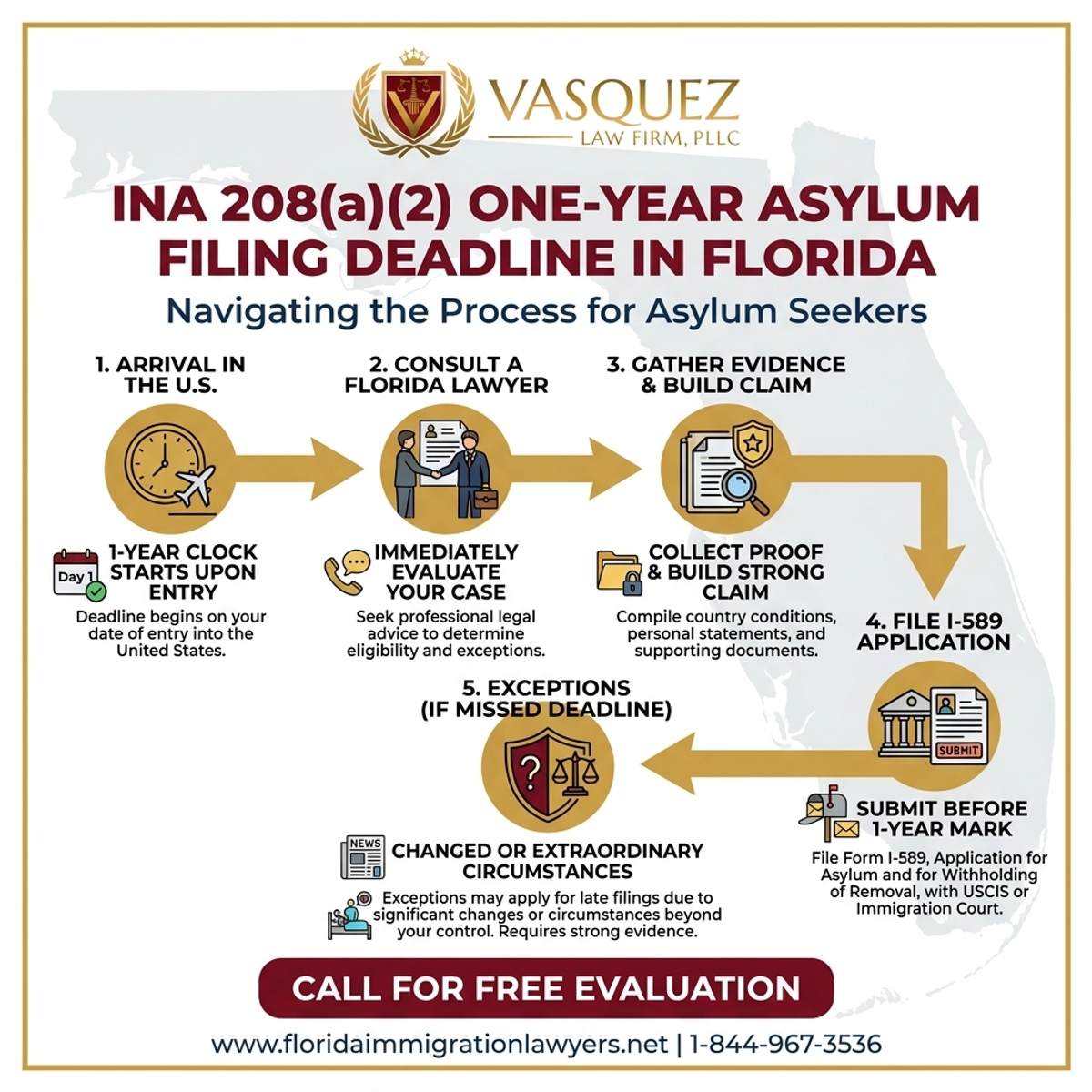
Step-by-Step Process — "INA 208(a)(2)" One-Year Filing Deadline in Florida
Step-by-Step Guide to Filing Form I-589
Filing Form I-589 is the first step in seeking asylum. Here's a step-by-step guide:
The Form I-589, Application for Asylum and for Withholding of Removal, is the cornerstone of your asylum claim. Its accurate and comprehensive completion is paramount, as any inconsistencies or omissions can be detrimental to your case. This form requires you to articulate your fear of persecution and provide a detailed narrative of events, serving as the primary document reviewed by USCIS officers and immigration judges.
- Gather Evidence: Collect documents proving your identity and the persecution faced. This includes personal identification, birth certificates, marriage certificates, and any documents from your home country. Crucially, gather evidence of the persecution itself, which can range from police reports, medical records of injuries, threats, news articles, human rights reports, and affidavits from witnesses or experts. A detailed personal statement outlining your experiences is also vital.
- Complete Form I-589: Fill out the application accurately, providing all required information. Be meticulous in answering every question, ensuring that your narrative is consistent and detailed. Any discrepancies between your form and your testimony during an interview can raise credibility concerns. If you do not speak English, ensure all responses are accurately translated.
- Submit the Form: Send your completed form to the appropriate USCIS service center. Always make copies of the entire application package for your records before mailing. It is highly recommended to send the application via certified mail with a return receipt requested, providing proof of submission and tracking information.
- Attend the Interview: Prepare for your interview by reviewing your application and gathering additional evidence. This interview is a critical stage where you will explain your claim in detail to an asylum officer. Honesty, consistency, and a clear understanding of your own story are essential. An attorney from Florida Immigration Lawyers can help you prepare thoroughly, conducting mock interviews and advising on how to present your case effectively.
- Receive Decision: Await the decision, which may take several months. After your interview, USCIS will review your case. If your application is granted, you will receive asylum status. If it's not granted by USCIS, your case may be referred to an immigration judge for defensive asylum proceedings, especially if you are in removal proceedings.
Timely filing and accurate documentation are crucial. Legal assistance can ensure compliance with all requirements, significantly increasing your chances of a favorable outcome. For specific guidance in Kissimmee, Florida, reach out to Florida Immigration Lawyers at 1-844-967-3536.
Document Checklist for Asylum Applications
- Valid passport or ID
- Form I-589
- Proof of entry date into the U.S.
- Affidavits and written testimonies
- Country condition reports
- Medical and psychological records (if applicable)
Having a comprehensive checklist helps streamline the application process and ensures no critical documents are missing. This organized approach minimizes delays and demonstrates diligence to immigration authorities. Beyond the basic identification and application forms, the strength of your asylum claim often hinges on the quality and quantity of supporting evidence you provide.
It's important to remember that this list is not exhaustive and may vary depending on the specifics of your case. For instance, if you are claiming persecution based on your political opinion, you might need evidence of your political activities, such as membership cards, photos, or publications. If you experienced physical harm, detailed medical records and forensic reports are essential. Working with an experienced immigration attorney can help you tailor your document checklist to your unique situation, ensuring that all relevant evidence is meticulously prepared and submitted.
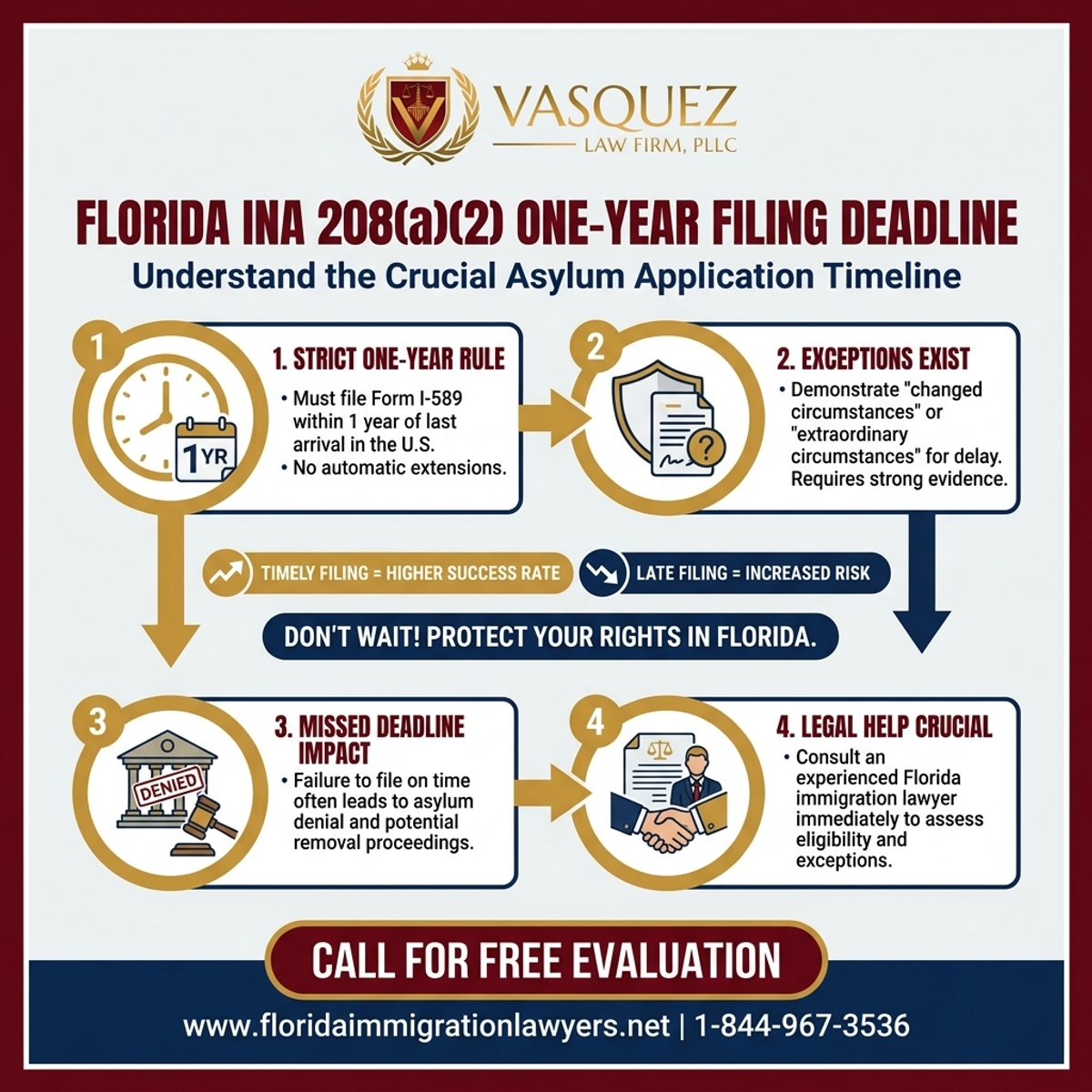
Key Statistics — "INA 208(a)(2)" One-Year Filing Deadline in Florida
Asylum Application Timeline and Processing Expectations
| Stage | Typical Timeframe | Notes |
|---|---|---|
| Application Submission | 1-2 months | Initial processing of Form I-589 |
| Interview Scheduling | 6-8 months | Based on caseload and backlog |
| Interview and Decision | 3-6 months | Depends on case complexity |
Processing times can vary significantly due to several factors, including the volume of applications, staffing levels at USCIS asylum offices, and changes in immigration policies. While the table provides typical timeframes, it's not uncommon for some cases to take much longer, sometimes years, particularly if there are extensive backlogs. Staying informed about the status of your application is crucial, and your attorney can help monitor its progress through official channels.
It's also important to distinguish between affirmative asylum applications filed directly with USCIS and defensive asylum applications filed in immigration court. The timelines and procedures for these two paths can differ. If your affirmative asylum application is not granted by USCIS, and you are not in lawful status, your case will typically be referred to an immigration judge for defensive proceedings. This adds another layer of complexity and can significantly extend the overall timeline.
Given these potential delays, it is vital for asylum seekers to maintain accurate records, update their contact information with USCIS, and continue to gather any new evidence that may strengthen their case. An experienced immigration lawyer from Florida Immigration Lawyers can provide realistic expectations regarding processing times and guide you through the process, ensuring you are prepared for each stage, whether in Kissimmee or elsewhere in Florida.
Cost Factors and Fee Breakdown
| Item | Typical Fee | Notes |
|---|---|---|
| Form I-589 Filing | No fee | |
| Attorney Fees | Varies | Depends on case complexity |
| Document Translation | Varies | Necessary for non-English documents |
While filing Form I-589 is free, other costs may arise. Discussing fees with a legal professional can provide clarity. It is a common misconception that seeking asylum in the U.S. is entirely free. While the government does not charge a filing fee for Form I-589, the associated costs, particularly legal fees, can be substantial but are often a worthwhile investment.
Attorney fees can vary widely based on the complexity of your case, the attorney's experience, and the services required. A straightforward asylum case might incur lower fees than one involving complex legal arguments, multiple exceptions to the one-year deadline, or appeals. These fees typically cover legal research, document preparation, client consultations, representation at interviews or court hearings, and communication with USCIS or EOIR. Many firms, including Florida Immigration Lawyers, offer payment plans or initial free consultations to help clients understand the financial commitment.
Beyond attorney fees and translation costs, other expenses might include fees for obtaining official documents from your home country, expert witness fees (e.g., for country conditions or psychological evaluations), travel expenses for interviews, and postage/courier services. It is crucial to have a clear understanding of all potential costs upfront. A transparent discussion with your legal team at Florida Immigration Lawyers can help you budget and plan for these necessary expenditures, ensuring no surprises along your asylum journey in Florida.
Common Mistakes to Avoid When Filing for Asylum
- Missing the One-Year Deadline: Leads to denial without exceptions. This is perhaps the most critical error, as it can result in an outright denial of your asylum claim, making it incredibly difficult to obtain protection without proving a valid exception.
- Incomplete Documentation: Weakens the application, risking rejection. Submitting an application without all required forms or supporting evidence can lead to delays, requests for evidence, or even denial if critical information is missing.
- Inconsistent Story: May lead to credibility issues during interviews. Any discrepancies between your written application, personal statement, and oral testimony can severely undermine your credibility, which is paramount in asylum cases.
- Ignoring Legal Advice: Risks non-compliance with procedural requirements. Immigration law is highly complex and constantly evolving; disregarding professional guidance can lead to procedural missteps that are difficult to rectify.
- Submitting Illegible Documents: Causes delays or denials. Ensure all documents are clear, readable, and properly formatted. Illegible submissions can be rejected or cause significant processing delays.
- Not Preparing for the Interview: Results in poor presentation of the case. The asylum interview is your opportunity to present your story and evidence. Lack of preparation can lead to nervousness, forgotten details, and an inability to articulate your fears clearly.
- Failing to Update Address: Misses crucial USCIS correspondence. If USCIS cannot reach you, you may miss interview notices, requests for evidence, or even a decision, which can lead to your case being closed or denied without your knowledge.
- Overlooking Evidence of Changed Circumstances: Fails to justify delayed filings. If you've missed the one-year deadline, failing to meticulously document and present evidence of changed or extraordinary circumstances will result in your application being denied.
Avoiding these common pitfalls is paramount to a successful asylum claim. Each mistake, particularly missing the one-year deadline, can have severe and often irreversible consequences for your pursuit of protection in the United States. The complexities of immigration law demand meticulous attention to detail and a strategic approach.
By understanding these potential errors and proactively working to prevent them, asylum seekers can significantly strengthen their applications. Engaging with knowledgeable legal counsel from Florida Immigration Lawyers is one of the most effective ways to mitigate these risks, ensuring that your application is robust, accurate, and compliant with all legal requirements in Kissimmee, Florida.
When to Call a Lawyer
Legal help is crucial if facing complex asylum issues, such as missed deadlines or need for evidence of changed circumstances. Seek assistance if unsure about procedural requirements or facing deportation risks. Florida Immigration Lawyers offer comprehensive services tailored to your needs.
The intricate nature of U.S. asylum law means that even seemingly minor details can have significant implications for your case. An experienced immigration attorney provides invaluable assistance, from accurately completing the complex Form I-589 to preparing you for the asylum interview and representing you in court if necessary. They can help identify the strongest arguments for your claim, gather compelling evidence, and navigate the bureaucratic hurdles of USCIS and the immigration courts.
Moreover, if you are already in removal proceedings, or if your asylum application has been denied and you face deportation, the need for legal representation becomes even more urgent. An attorney can explore all available legal avenues, including appeals or other forms of relief, to protect your right to remain in the U.S. Don't wait until it's too late; proactive engagement with legal counsel can make a profound difference in the outcome of your asylum case. Call Florida Immigration Lawyers at 1-844-967-3536 for a free consultation to discuss your options.
Frequently Asked Questions About Asylum in Florida
What if I missed the one-year deadline and don't have changed circumstances?
If you missed the one-year deadline and cannot prove changed or extraordinary circumstances, your asylum application will likely be denied. However, you might still be eligible for other forms of protection, such as Withholding of Removal or protection under the Convention Against Torture (CAT). These forms of relief have higher burdens of proof but do not have a one-year filing deadline. It's crucial to consult with Florida Immigration Lawyers to explore all possible avenues for protection based on your specific situation.
Can I apply for asylum if I entered the U.S. illegally?
Yes, you can apply for asylum regardless of your manner of entry into the U.S. The law allows individuals present in the U.S. to seek asylum, whether they entered through a port of entry or crossed the border without inspection. However, your manner of entry might affect how your case is processed (e.g., through an affirmative asylum interview with USCIS or a defensive asylum hearing in immigration court). An attorney can guide you through the process applicable to your entry circumstances.
How long does the asylum process typically take in Florida?
The asylum process in Florida can vary significantly, ranging from several months to several years. Factors influencing the timeline include the volume of applications at the local USCIS asylum office, national backlogs, the complexity of your case, and whether your case proceeds to immigration court. While USCIS aims to complete cases within 180 days, this is rarely achieved. Patience and consistent follow-up with your legal team from Florida Immigration Lawyers are essential throughout this extended process.
What happens during an asylum interview?
During an asylum interview, you will meet with a USCIS asylum officer who will ask detailed questions about your application, your fear of persecution, and your personal history. You will be under oath, and an interpreter will be provided if you don't speak English. Your attorney can be present to clarify questions, object to inappropriate inquiries, and ensure your rights are protected. It's vital to be honest, consistent, and prepared to articulate your story clearly. Preparation with Florida Immigration Lawyers is key.
Can my family be included in my asylum application?
Yes, if you are granted asylum, your spouse and unmarried children under 21 who are in the U.S. can be included in your application, or you can file a separate petition (Form I-730, Refugee/Asylee Relative Petition) for them. If your family members are outside the U.S., they may be able to join you through this petition. It's important to list all eligible family members on your initial Form I-589. Your attorney can advise on the best strategy for including your family members in your asylum claim.
About Florida Immigration Lawyers
Florida Immigration Lawyers is a leading firm dedicated to assisting immigrants across Florida. We offer expert legal advice, personalized consultations, and 24/7 availability. Contact us at 1-844-967-3536 or visit our website for help.
Sources and References
- U.S. Citizenship and Immigration Services (USCIS)
- Executive Office for Immigration Review (EOIR)
- 8 U.S.C. Chapter 12 - Immigration and Nationality Act
Related services: asylum application process, refugee status and resettlement, withholding of removal, humanitarian protection programs.
This article provides general legal information and is not intended as legal advice. Every case is unique, and outcomes depend on specific facts and circumstances. Contact an attorney for advice about your particular situation.
For personalized legal assistance, contact Florida Immigration Lawyers at 1-844-967-3536 for a free consultation. Se Habla Espanol - Estamos aqui para ayudarle.
If you need legal assistance, learn more about speak with an asylum lawyer, or call us at 1-844-967-3536 for a free consultation.
Do Not Navigate This Process Alone
Our experienced immigration attorneys are ready to fight for you. Get a free, confidential case review today.
Se Habla Español
Or leave your details and we’ll call you:
Free Evaluation in 24 Hours
Or talk to us right now

AI voice assistant — available 24/7
FreeFrequently Asked Questions

William J. Vásquez
Founding Attorney · Vasquez Law Firm
U.S. Air Force veteran and immigration attorney with years of hands-on U.S. immigration experience. J.D., NCCU School of Law. AILA member. Admitted to the 4th, 5th, and 11th Circuit Courts.
Available 24/7 - Free Evaluations
Reviewed for legal accuracy by William J. Vásquez
Licensed in North Carolina; U.S. immigration is federal practice.
Related Legal Services
Our Florida immigration attorneys can help you with family immigration services, immigration lawyer cost in Florida and experienced immigration attorneys. Call today at 1-844-967-3536 for a free case review.
Related Links
Related Topics
Free Legal Case Review
Discuss your case with our experienced attorneys. We're available 24/7.
Se Habla Español - Estamos aquí para ayudarle.
Related Articles
Immigration Lawyer Orlando Free Consultation in Florida
For individuals and families in Orlando, Florida, navigating the complexities of U.S. immigration law requires expert guidance. An immigration lawyer in Orlando offers crucial support for everything from visa applications and green card processes to naturalization and deportation defense. This comprehensive guide details what a free consultation covers, providing a step-by-step overview of immigration pathways, essential document checklists, and expected timelines in 2026. We also highlight common mistakes to avoid, discuss the critical role of legal counsel in deportation and asylum cases, and explain why choosing a local Orlando immigration attorney is beneficial. Florida Immigration Lawyers is dedicated to serving the diverse community of Orlando with compassionate, effective legal solutions, ensuring you receive personalized advice and robust representation for a successful immigration journey.
Orlando Cancellation of Removal Attorney: Your Guide
Facing deportation in Orlando, Florida? Learn about cancellation of removal, a form of relief available in immigration court. Understand eligibility requirements, application processes, and the importance of legal representation. Discover common mistakes to avoid and when to seek legal help. Call Florida Immigration Lawyers for expert guidance.
K3 Visa Processing Time 2026: Your Florida Guide
For U.S. citizens in Florida hoping to reunite with their foreign spouses, understanding the K3 visa processing time in 2026 is essential. This non-immigrant visa allows spouses to enter the U.S. while their immigrant visa petition (Form I-130) is pending, bridging the gap to permanent residency. While processing times for the K-3 visa can range from 12 to 24 months, various factors, including USCIS caseloads and the completeness of your application, play a significant role. This comprehensive guide details K-3 visa eligibility, the step-by-step application process, required documentation, and associated costs. We also address how the Visa Bulletin and priority dates factor into the subsequent adjustment of status. Navigating this intricate legal journey requires precision and expertise. Florida Immigration Lawyers is here to provide the support and guidance you need, ensuring your application is meticulously prepared and strategically managed. Don't hesitate to reach out for a free case review to discuss your specific circumstances and plan your path forward.
Florida Refugee Immigration Help: 2026 Guide
For those seeking Florida refugee immigration help, understanding the path to safety and resettlement is critical. Refugee status is granted to individuals facing persecution in their home countries, and the process typically begins overseas, involving referrals from UNHCR or U.S. Embassies. This guide clarifies eligibility criteria, the multi-step application process, and the vital role of resettlement agencies in Florida, particularly in the Orlando area. We detail the necessary documentation, provide an estimated timeline for the various stages, and break down potential costs, emphasizing that government application fees for refugees are generally waived. Avoiding common mistakes like inconsistent information or missed deadlines is paramount. Florida Immigration Lawyers offers compassionate, expert legal counsel to navigate these complexities, from preparing for USCIS interviews to addressing family reunification concerns. We are dedicated to advocating for your rights and helping you build a secure future in Florida. Contact us for a free case review.