Refugee Lawyer: Navigating Resettlement in Florida
Navigating refugee resettlement in Florida can be complex. This guide provides insights into the process, legal requirements, and how a refugee lawyer can assist. Explore the steps, common mistakes, and how to get help in Tampa.

Finding a refugee lawyer is crucial for navigating resettlement in Florida, particularly in areas like Tampa. A legal expert can help you understand your rights, guide you through the asylum process, and connect you with resources. Key points include:
- Understanding the asylum process and eligibility
- Access to local resources and support networks
- Guidance through legal documentation
Introduction
Imagine arriving in a new country, seeking safety and a fresh start, only to face a labyrinth of legal procedures. For refugees in Florida, particularly in Tampa, understanding resettlement is crucial. This article will explore the challenges and processes involved in refugee resettlement, providing essential information for those seeking asylum. Call Florida Immigration Lawyers at 1-844-967-3536 for a free consultation.
What is Refugee Resettlement?
Refugee resettlement involves relocating individuals from their home country due to persecution. In Florida, the process is guided by international standards and U.S. immigration laws. As of 2026, the U.S. continues to provide refuge to those fleeing danger, though approval rates have recently declined.
Refugees must apply through the United Nations High Commissioner for Refugees (UNHCR) or directly with U.S. agencies. Once approved, they receive assistance in housing, employment, and integration. The process includes thorough background checks and interviews to ensure eligibility.
Refugee status is distinct from asylum. While both involve seeking protection from persecution, refugees typically apply from outside the U.S. and are resettled through a formal process, often with the involvement of international bodies like the UNHCR. Asylum seekers, on the other hand, apply from within the U.S. or at a port of entry. The U.S. resettlement program is a testament to its humanitarian commitment, offering a lifeline to those who have lost everything due to conflict, political unrest, or other forms of severe persecution.
The U.S. government works closely with various non-governmental organizations (NGOs) and state agencies to facilitate the integration of approved refugees. This comprehensive support system aims to help new arrivals become self-sufficient members of society. Services often include initial housing, cultural orientation, English language classes, job placement assistance, and access to healthcare. For example, a family fleeing war-torn Syria might first be identified by the UNHCR, undergo rigorous vetting, and then be matched with a resettlement agency in a city like Tampa, Florida, which has a history of welcoming diverse refugee populations.
Despite the humanitarian intent, the process can be complex and emotionally taxing. Understanding the specific criteria for refugee status – a well-founded fear of persecution on account of race, religion, nationality, political opinion, or membership in a particular social group – is paramount. A skilled refugee lawyer, such as those at Florida Immigration Lawyers, can help individuals articulate their claims effectively, ensuring that their narratives align with legal requirements and are presented compellingly to immigration authorities. Call 1-844-967-3536 for expert guidance.
How to Apply for Refugee Status in Florida?
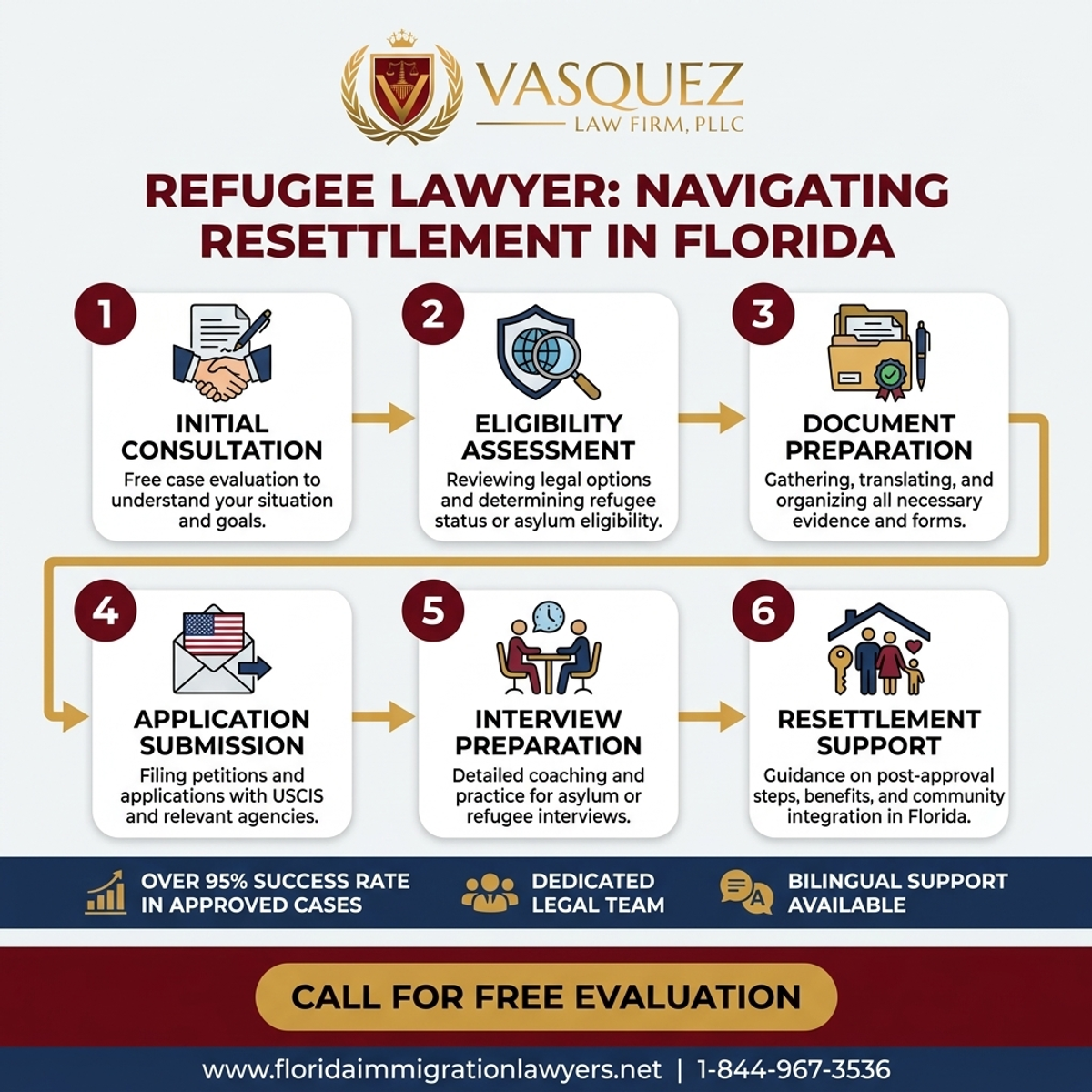
Applying for refugee status involves several steps. First, an individual must register with the UNHCR or a local refugee agency. The application process is rigorous, requiring detailed documentation of persecution and personal history.
- Register with UNHCR or a local agency.
- Submit necessary documents and personal history.
- Undergo interviews and background checks.
- Await determination from immigration authorities.
In Florida, the Tampa USCIS office plays a significant role in processing these applications. Applicants should prepare for a lengthy process, often taking months or years.
The initial registration with the UNHCR or a local refugee agency is just the beginning. This step often involves providing a preliminary account of one's experiences and reasons for seeking refuge. It's crucial to be as honest and detailed as possible, even at this early stage, as inconsistencies can later raise doubts about credibility. The information gathered forms the foundation of your case, which will be reviewed by multiple agencies, including the Department of Homeland Security (DHS) and the Department of State (DOS).
Following registration and document submission, applicants will undergo multiple interviews. These interviews are designed to verify the applicant's story, assess their credibility, and determine if they meet the legal definition of a refugee. Preparing for these interviews is vital; applicants should be ready to recount their experiences in detail, answer follow-up questions, and maintain consistency across all statements. A refugee lawyer can provide invaluable assistance in preparing for these critical interviews, helping you anticipate questions and articulate your narrative clearly and confidently. They can also ensure that your rights are protected throughout the process.
While the Tampa USCIS office is a key processing center, the journey involves many federal and international layers. Each step, from initial screening to final approval, is meticulously designed to protect both the applicant and national security. The lengthy nature of the process, often spanning several years, underscores the importance of persistent and accurate engagement. For instance, a refugee from Venezuela might spend years in a neighboring country's refugee camp before being referred for U.S. resettlement, highlighting the global scale and patience required.
What Documents Are Needed for Refugee Resettlement?
- Identity documents (passport, birth certificate)
- Proof of persecution (letters, photos, reports)
- Medical records
- Financial statements
- Legal documents (marriage certificates, affidavits)
These documents must be translated into English and verified by authorities. Accurate and complete documentation is vital to avoid delays or rejections.
Beyond basic identity documents, the 'proof of persecution' is arguably the most critical component. This can include a wide array of evidence: police reports detailing incidents of violence, medical records documenting injuries sustained, news articles reporting on political unrest in your region, human rights reports, or even letters from witnesses. The more corroborating evidence you can provide, the stronger your case will be. For example, if you were persecuted for your political activism, photographs of you at protests, arrest warrants, or testimonials from fellow activists could be highly persuasive.
Financial statements and legal documents, such as marriage certificates or birth certificates for dependents, are essential for establishing your family unit and demonstrating your financial situation prior to fleeing. These documents help paint a complete picture of your life and the circumstances that forced you to seek refuge. It is also common to submit affidavits from individuals who can attest to your persecution or your good character. These sworn statements add significant weight to your claim, especially if direct documentary evidence is scarce.
The requirement for all documents to be translated into English by certified translators cannot be overstated. A poorly translated document can lead to misunderstandings, delays, or even rejection. Furthermore, ensuring that all copies are clear, legible, and organized will significantly streamline the review process. Florida Immigration Lawyers can assist in identifying reputable translation services and ensuring that all documentation meets USCIS standards, minimizing the risk of administrative errors that could jeopardize your application.
Step-by-Step Process — Refugee Lawyer: Navigating Resettlement in Florida
Refugee Resettlement Timeline and Expectations
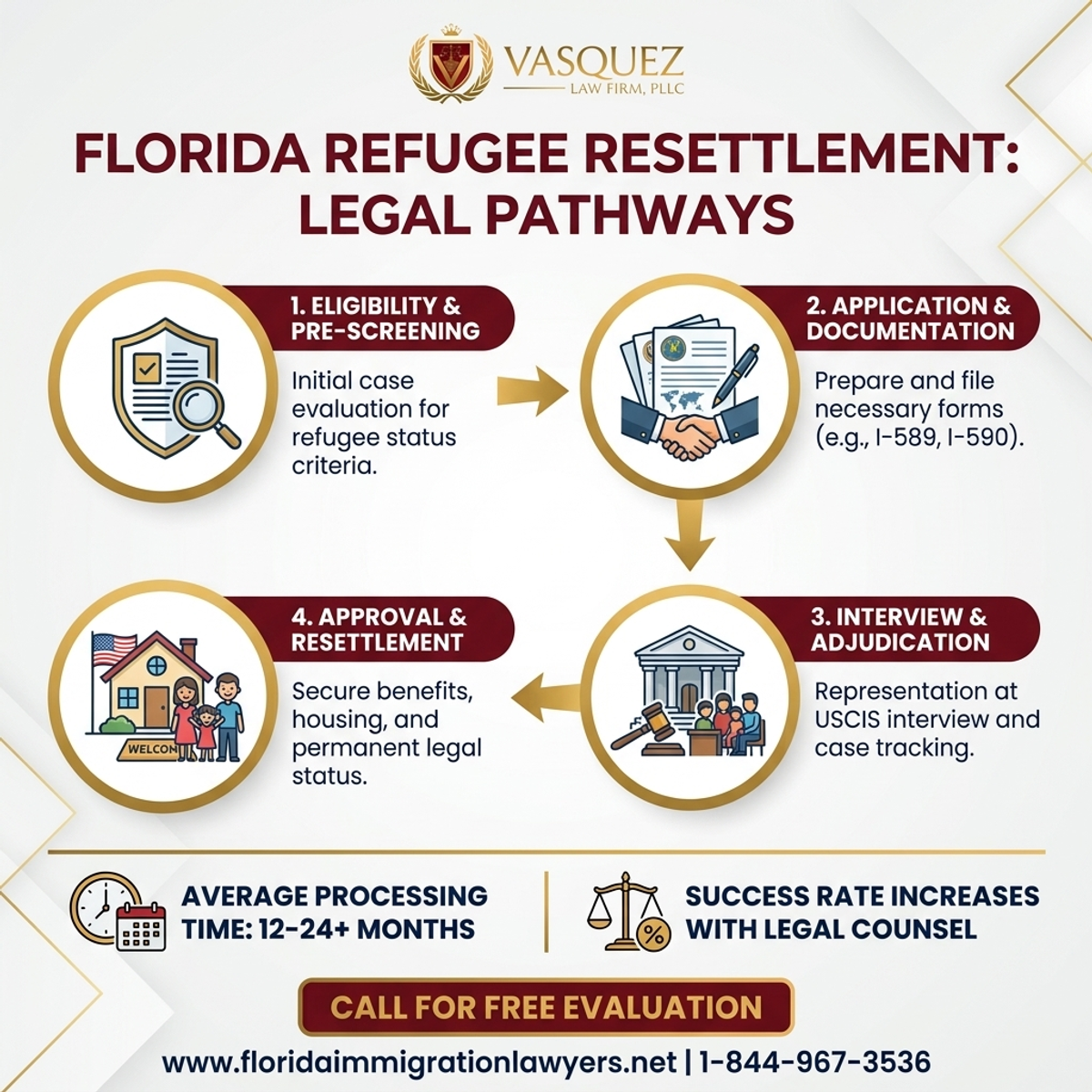
The resettlement timeline varies, but here is a typical overview:
| Stage | Typical Timeframe | Notes |
|---|---|---|
| Registration and Submission | 1-3 months | Initial application submission |
| Interview and Background Checks | 6-12 months | In-depth vetting process |
| Approval and Travel Arrangements | 3-6 months | Final steps before relocation |
Patience is essential, as each case is unique. Regular communication with your refugee lawyer can provide updates and peace of mind.
The 'Typical Timeframe' provided in the table represents an average, but individual cases can deviate significantly. Factors such as the complexity of your persecution claim, the country you are fleeing from, the current refugee intake quotas, and even global political events can all influence the speed of processing. For instance, individuals from regions experiencing acute crises might be prioritized, while others might face longer waits due to extensive background checks or limited resources. Managing these expectations is crucial for maintaining hope and resilience throughout the journey.
Beyond the formal stages, the resettlement process also includes pre-departure cultural orientation. This vital component prepares refugees for life in the United States, covering topics such as American laws, cultural norms, employment expectations, and the education system. This orientation aims to ease the transition and reduce culture shock upon arrival. Understanding what to expect in your new home can significantly impact your initial adjustment and integration into the community.
While waiting, it is important to stay informed and maintain communication with your legal representative. Your refugee lawyer can provide updates, explain any requests for additional information, and advise on how to respond promptly. They can also help you understand the next steps and potential challenges, offering a sense of control and clarity in an otherwise uncertain period. Florida Immigration Lawyers are committed to keeping clients informed every step of the way, providing support and advocacy during this often protracted process. For personalized updates, call 1-844-967-3536.
Cost Factors and Fee Breakdown for Refugee Resettlement
While applying for refugee status generally incurs no direct fees, associated costs can arise:
| Item | Typical Fee | Notes |
|---|---|---|
| Document Translation | Varies | Depends on document length and language |
| Legal Assistance | Varies | Based on lawyer's rate and case complexity |
| Travel Expenses | Varies | Flights and accommodations if necessary |
Understanding these costs can help manage expectations and plan financially for the resettlement process.
While the U.S. government does not charge fees for filing a refugee application, the indirect costs can accumulate. Legal assistance, for example, can vary widely. Some attorneys offer pro bono (free) services, especially through non-profit organizations, while others charge hourly rates or flat fees depending on the complexity of the case. Investing in legal counsel, however, can be a cost-effective decision in the long run, as it significantly increases the likelihood of a successful application and avoids costly delays or rejections due to errors. Florida Immigration Lawyers offers free consultations to discuss your specific needs and potential fee structures.
Beyond legal and translation costs, applicants should consider initial settlement expenses. Although resettlement agencies provide some support, refugees often need funds for personal items, transportation, and supplementary living expenses until they secure stable employment. Planning for these initial out-of-pocket costs can alleviate significant stress during the critical first few months in Florida. This might involve saving what little funds are available or seeking assistance from family or community networks abroad.
Understanding what is covered by resettlement agencies versus what falls to the individual is key. Agencies typically cover initial rent, basic furnishings, and a small stipend for a few months, but long-term financial stability requires careful planning. A refugee lawyer can help connect you with resources that offer financial literacy programs or additional support services, ensuring a smoother transition into your new life.
Key Statistics — Refugee Lawyer: Navigating Resettlement in Florida
Do not navigate this process alone. Contact Florida Immigration Lawyers today.
Common Mistakes to Avoid in Refugee Resettlement
- Submitting incomplete applications, leading to delays.
- Failing to provide accurate personal information.
- Not keeping copies of all submitted documents.
- Ignoring requests for additional information.
- Missing deadlines, risking application rejection.
- Underestimating the need for legal assistance.
- Failing to prepare for interviews, resulting in poor representation.
- Not understanding the importance of cultural integration.
- Lack of financial planning for initial settlement expenses.
- Assuming all resettlement processes are uniform across states.
Each of these common mistakes can have severe consequences, ranging from prolonged delays to outright denial of your application. For instance, submitting an incomplete application (mistake #1) is one of the most frequent pitfalls. USCIS requires specific forms and supporting documents, and even a minor omission can lead to a Request for Evidence (RFE), significantly extending your waiting period. It's not enough to just submit documents; they must be accurate and truthful. Providing inaccurate personal information (mistake #2) can severely damage your credibility and lead to accusations of fraud, which can result in permanent bars from immigration benefits.
Failing to keep copies of all submitted documents (mistake #3) and ignoring requests for additional information (mistake #4) are equally detrimental. Imagine a scenario where USCIS claims they never received a crucial document, or you forget what you submitted months ago. Without your own copies, it's nearly impossible to verify or resubmit. Similarly, missed deadlines (mistake #5) are non-negotiable in immigration law; they can lead to an automatic rejection of your case, forcing you to start over or lose your opportunity entirely.
Underestimating the need for legal assistance (mistake #6) is perhaps the most significant error. The U.S. immigration system is incredibly complex, with constantly evolving laws and procedures. Navigating it without expert guidance is like trying to cross a minefield blindfolded. A refugee lawyer can ensure your application is complete, accurate, and compelling, significantly improving your chances of success. Furthermore, failing to prepare for interviews (mistake #7) can lead to inconsistencies in your testimony, which adjudicators are trained to spot. Cultural integration (mistake #8), financial planning (mistake #9), and understanding state-specific processes (mistake #10) are all crucial for a successful resettlement beyond just legal approval. Florida Immigration Lawyers can offer comprehensive support, addressing not just the legal aspects but also guiding you through the practicalities of starting anew.
When to Call a Lawyer for Refugee Resettlement
Engaging a lawyer is crucial when facing complex legal procedures or encountering obstacles. Warning signs include receiving a notice of application denial or missing documentation. Florida Immigration Lawyers can provide the necessary guidance and representation to navigate these challenges.
The decision to engage a lawyer should ideally be made at the earliest possible stage, even before you begin compiling documents. An experienced refugee lawyer can help you assess your eligibility, understand the nuances of your claim, and strategize the most effective way to present your case. This proactive approach can prevent common errors that often lead to delays or denials, saving you time, stress, and potential future costs. For example, if your case involves complex legal arguments, such as proving persecution based on 'membership in a particular social group,' a lawyer's expertise is indispensable in framing your narrative within established legal precedents.
Specific warning signs that unequivocally indicate the need for legal intervention include receiving a Notice of Intent to Deny (NOID), a Request for Evidence (RFE) that seems overwhelming, or any communication from immigration authorities that you do not fully understand. If you have a criminal history, even minor offenses, or if you have previously been denied any immigration benefit, your case will be significantly more complicated and absolutely requires expert legal counsel. A lawyer can analyze your specific situation, identify potential legal hurdles, and develop a robust strategy to overcome them.
Furthermore, if you face language barriers, have experienced severe trauma that makes it difficult to recount your story, or fear interacting with government officials, a lawyer can act as your advocate and intermediary. They can ensure your voice is heard accurately and respectfully, protecting your rights throughout the process. Florida Immigration Lawyers are available to provide this critical support, offering a free consultation to discuss your unique circumstances and determine how best to assist you. Don't hesitate to call 1-844-967-3536 when you need a trusted legal partner.
Frequently Asked Questions About Refugee Resettlement
Beyond the primary application process, many questions arise as individuals and families navigate the path to resettlement. Here are some frequently asked questions with practical advice to help you prepare.
How long does it take to get a work permit after arriving as a refugee?
Upon arrival, refugees are typically eligible to apply for an Employment Authorization Document (EAD), commonly known as a work permit. The application process usually takes a few months, but you can apply immediately. While waiting for the EAD, resettlement agencies often provide initial financial support and guidance on finding employment. It's advisable to start job searching and networking as soon as possible, even before receiving the physical card.
Can I choose where I resettle in Florida?
While you can express preferences, the final decision on your resettlement location is made by the U.S. Department of State, in coordination with resettlement agencies. Factors considered include family ties, availability of services, housing, and community support in a particular area. Tampa is a common destination due to its established refugee support networks, but flexibility is often required. Discussing your preferences with your case worker or lawyer can help.
What kind of support do resettlement agencies provide?
Resettlement agencies offer a wide range of crucial support services for newly arrived refugees. This typically includes initial housing assistance, cultural orientation, enrollment in English language classes, job placement services, and access to medical care. They also help with school enrollment for children and provide guidance on navigating public transportation and other essential services. This comprehensive support aims to facilitate self-sufficiency and integration into American society.
What happens if my refugee application is denied?
If your refugee application is denied, it's not necessarily the end of your journey. You may have the right to appeal the decision, depending on the specific reasons for denial. This is a critical juncture where legal counsel is absolutely essential. A refugee lawyer can review the denial notice, identify legal errors, and help you prepare a compelling appeal. Do not delay in seeking legal advice from Florida Immigration Lawyers if you receive a denial.
Can I bring my family members to the U.S. after I am granted refugee status?
Yes, once you are granted refugee status, you can apply to bring certain qualifying family members to the U.S. through a process called 'refugee derivative petitions' or 'follow-to-join' petitions. This typically includes your spouse and unmarried children under 21. The process involves submitting specific forms and providing proof of your relationship. An immigration lawyer can guide you through this complex family reunification process to ensure all requirements are met.
About Florida Immigration Lawyers
Florida Immigration Lawyers is dedicated to assisting clients with all aspects of immigration law. Offering services in English and Spanish, our team is available 24/7 for your legal needs. With a focus on personalized service, we are committed to helping you achieve your immigration goals. Contact us at 1-844-967-3536 or visit our website at https://www.floridaimmigrationlawyers.net for a free consultation.
Sources and References
- U.S. Citizenship and Immigration Services (USCIS)
- Executive Office for Immigration Review (EOIR)
- 8 U.S.C. Chapter 12 - Immigration and Nationality Act
Related services: asylum application process, refugee status and resettlement, withholding of removal, humanitarian protection programs.
This article provides general legal information and is not intended as legal advice. Every case is unique, and outcomes depend on specific facts and circumstances. Contact an attorney for advice about your particular situation.
For personalized assistance, contact Florida Immigration Lawyers at 1-844-967-3536 for a free consultation. Se Habla Espanol - Estamos aqui para ayudarle.
If you need legal assistance, learn more about learn about asylum protection options, or call us at 1-844-967-3536 for a free consultation.
Do Not Navigate This Process Alone
Our experienced immigration attorneys are ready to fight for you. Get a free, confidential consultation today.
Se Habla Español
Frequently Asked Questions
Harold Estrada-Rodriguez
Florida Immigration Attorney · FL Bar No. 1041171
Florida Bar attorney handling Florida-jurisdiction immigration matters. Bilingual representation, free consultations.
Available 24/7 - Free Evaluations
Related Legal Services
Our Florida immigration attorneys can help you with asylum protection, deportation defense and citizenship and naturalization. Call today at 1-844-967-3536 for a free consultation.
Related Links
Related Topics
Free Legal Consultation
Discuss your case with our experienced attorneys. We're available 24/7.
Se Habla Español - Estamos aquí para ayudarle.
Related Articles
Immigration Lawyer Orlando Free Consultation Guide
Discover how an immigration lawyer in Orlando offering free consultations can assist with your immigration needs. Learn about services, costs, and how to avoid common mistakes. Contact Florida Immigration Lawyers at 1-844-967-3536 for personalized assistance.
Naturalization Ceremony Locations and Schedule 2026
Discover the essential details about naturalization ceremony locations and schedules in Florida for 2026. This guide provides comprehensive information on where ceremonies are held, how USCIS schedules them, and a step-by-step process for attending your oath ceremony. Learn about required documents, typical timelines, and what to expect during this momentous event. We also cover common mistakes to avoid and highlight when legal assistance from Florida Immigration Lawyers can be invaluable. Prepare for your U.S. citizenship journey with confidence and expert guidance. Contact us for a free consultation.
Dual Citizenship Lawyer: Interview Tips for Naturalization
Preparing for your naturalization interview in Florida is a critical step towards U.S. citizenship. This comprehensive guide from Florida Immigration Lawyers provides essential tips for a successful USCIS interview, covering what to expect, how to prepare, required documents, timelines, and costs. Learn about the English and civics tests, common mistakes to avoid, and when to seek legal assistance from a dual citizenship lawyer to navigate complexities. We serve clients across Florida, including Tallahassee, Miami, Orlando, and Tampa, offering expert guidance for a smooth path to citizenship and understanding dual nationality implications.
USCIS Application Support Center (ASC) Jacksonville in
For those navigating the U.S. immigration system in Florida, understanding the role of the USCIS Application Support Center (ASC) in Jacksonville is vital. This center is crucial for biometrics collection—fingerprints, photos, and signatures—a mandatory step for most immigration applications. Unlike full USCIS field offices in Orlando or Miami, the Jacksonville ASC focuses solely on biometrics and does not conduct interviews or provide direct case assistance. This comprehensive guide details how appointments are scheduled by USCIS, the essential documents you must bring, and what to expect during and after your visit. We also clarify the distinctions between ASCs and field offices across Florida and outline common mistakes to avoid. Whether you're applying for a green card, naturalization, or an employment authorization document, precise adherence to USCIS procedures is key. Florida Immigration Lawyers offers expert guidance to help you through every stage, ensuring your application progresses smoothly and effectively in 2026.