US Visa Policy Changes July 2026: What Students in Florida
As of July 2026, international students in Florida seeking a change of status to an F-1 student visa must prepare for potential adjustments to U.S. visa policies. This comprehensive guide from Florida Immigration Lawyers explores the anticipated policy changes, detailing their potential impact on application requirements, processing times, and eligibility criteria. We provide a step-by-step overview of the change of status process, including a document checklist, expected timelines, and cost considerations. Understanding these complexities and avoiding common mistakes is crucial for a successful application. With potential changes approaching, proactive planning and legal guidance are more important than ever. Our firm is dedicated to helping students in Tampa and across Florida navigate these challenges, offering tailored advice and robust representation. Learn how to protect your academic future and ensure a smooth transition to F-1 student status.
As of July 2026, while comprehensive visa policy changes are subject to ongoing legislative and executive developments, international students in Florida seeking a change of status to an F-1 student visa should anticipate potential adjustments to application requirements, processing times, and eligibility criteria. These potential changes underscore the importance of meticulous preparation and staying informed about the latest USCIS guidelines. Understanding the current change of status process, including required documentation and common pitfalls, is crucial for a successful application, especially amidst evolving immigration landscapes. Consulting with an experienced immigration attorney is highly recommended to navigate these complexities effectively.
- Potential policy shifts in July 2026 may impact F-1 change of status applications.
- Meticulous documentation and adherence to current USCIS guidelines are paramount.
- Processing times for change of status applications can vary significantly.
- Maintaining valid nonimmigrant status throughout the process is critical.
- Seek legal counsel for personalized guidance on your student visa journey.
US Visa Policy Changes July 2026: What Students in Florida Need to Know
The landscape of U.S. immigration law is constantly evolving, and for international students in Florida, staying abreast of potential policy shifts is paramount. As we approach July 2026, many are looking ahead to anticipated US visa policy changes and their potential impact on crucial processes like a change of status to an F-1 student visa. Whether you are currently in Florida on a different nonimmigrant visa or planning your academic future, understanding these dynamics is essential for a smooth transition to student life.
Navigating the complexities of immigration regulations can be daunting, especially when facing potential policy adjustments. This comprehensive guide will delve into the current change of status process for students, explore anticipated policy changes for July 2026, outline essential documentation, discuss timelines, and highlight common mistakes to avoid. Our goal is to equip you with the knowledge needed to pursue your educational aspirations in Florida with confidence. Do not navigate this intricate process alone; call Florida Immigration Lawyers at 1-844-YO-PELEO for a free consultation and guidance tailored to your unique situation.
What Are the Expected US Visa Policy Changes in July 2026?
As of July 2026, while specific comprehensive policy overhauls are subject to legislative action and executive directives, experts anticipate potential adjustments to student visa regulations and change of status processes. These changes could stem from ongoing discussions regarding immigration reform, national security, and economic priorities, potentially affecting eligibility criteria, application procedures, and processing times for international students in Florida and nationwide. These discussions often involve balancing national interests with the desire to attract global talent.
Historically, immigration policy shifts can include stricter vetting procedures, revised financial requirements, or changes to the Student and Exchange Visitor Program (SEVP) guidelines. For instance, recent Supreme Court decisions, while not directly impacting student visas, often signal a broader shift in immigration enforcement and interpretation, as seen in rulings concerning Temporary Protected Status (TPS). These broader trends can indirectly influence the bureaucratic environment surrounding all visa categories, including the F-1 student visa. Applicants for a change of status must be prepared for increased scrutiny and potentially longer processing periods. It is crucial to monitor official sources like USCIS for the most up-to-date information regarding any announced policy changes. Preparing for potential changes means ensuring all aspects of your application are robust and compliant with existing, and potentially new, regulations.
How Does a Student Change Status to F-1 Visa in Florida?
To change status to an F-1 student visa in Florida, individuals typically file Form I-539, Application to Extend/Change Nonimmigrant Status, with USCIS. This process involves proving nonimmigrant intent, financial capability, and acceptance into a Student and Exchange Visitor Program (SEVP) approved school. The application must be filed while maintaining valid nonimmigrant status. This means you must not have overstayed your current visa or violated its terms before applying for the change of status.
The process generally involves several key steps:
- Gain Admission to an SEVP-Approved School: First, you must apply to and be accepted by a U.S. school approved by the Student and Exchange Visitor Program (SEVP). Once accepted, the school will issue you a Form I-20, Certificate of Eligibility for Nonimmigrant Student Status. This form is critical as it confirms your enrollment and the school's SEVP certification.
- Pay the SEVIS I-901 Fee: After receiving your Form I-20, you must pay the SEVIS I-901 fee. This fee supports the Student and Exchange Visitor Information System (SEVIS), which tracks F-1 students. Ensure you keep the payment receipt as proof.
- File Form I-539 with USCIS: Complete and accurately fill out Form I-539, Application to Extend/Change Nonimmigrant Status. This form is your official request to USCIS for the change of status. You will need to attach your Form I-20, SEVIS fee payment receipt, and other supporting documents.
- Gather Supporting Documentation: Collect all necessary documents, including copies of your passport, current visa, I-94 arrival record, financial evidence, academic transcripts, and a personal statement explaining your intent to study. More details on required documents are provided below.
- Submit the Application: Mail your complete application package to the appropriate USCIS Lockbox Facility. The specific address depends on your current residence and the type of application. Always check the USCIS website for the most current filing addresses.
- Maintain Legal Status: It is crucial to maintain your current nonimmigrant status while your change of status application is pending. Do not let your current visa expire before a decision is made, or you could accrue unlawful presence.
- Receive a Decision: USCIS will process your application and send you a receipt notice. Eventually, you will receive a decision notice. If approved, your new I-94 will reflect F-1 status. If denied, you may need to depart the U.S. or explore other legal options.
What is the Impact of Timeliness on Your Application?
The timing of your change of status application is critical. USCIS generally requires that you file Form I-539 well in advance of your current nonimmigrant status expiration date. Filing too close to the expiration can lead to complications, including accruing unlawful presence if your current status expires before USCIS makes a decision. This is particularly important for individuals in Florida, where USCIS processing centers can experience high volumes. Proactive filing demonstrates your commitment to maintaining legal status and can prevent unnecessary stress and potential legal issues.
What Documents Are Required for a Student Change of Status Application?
For a student change of status, essential documents include Form I-539, a valid passport, current visa, I-94 arrival record, proof of financial support, Form I-20 from an SEVP-approved school, and a personal statement explaining the intent to study. Additional supporting evidence may be required based on individual circumstances. Preparing a thorough and accurate document checklist is vital for a successful application to an F-1 student visa.
A comprehensive list of documents typically required includes:
- Completed Form I-539: Application to Extend/Change Nonimmigrant Status. Ensure all sections are filled out accurately and signed.
- USCIS Filing Fee: Check the USCIS website for the current fee for Form I-539, payable by check or money order.
- Copy of Form I-20: Certificate of Eligibility for Nonimmigrant Student Status, issued by your SEVP-approved school.
- SEVIS I-901 Fee Payment Receipt: Proof that you have paid the Student and Exchange Visitor Information System (SEVIS) fee.
- Copy of Passport: Include the biographic page and any pages with visas or stamps. Your passport must be valid for at least six months beyond your intended period of stay.
- Copy of Current U.S. Visa: If applicable, a copy of your current nonimmigrant visa stamp.
- Copy of Form I-94 Arrival/Departure Record: This record proves your legal entry into the U.S. and your authorized period of stay. You can obtain this online from the U.S. Customs and Border Protection (CBP) website.
- Proof of Financial Support: Documents demonstrating you have sufficient funds to cover your tuition, living expenses, and other costs for the duration of your studies. This can include bank statements, scholarship letters, or affidavits of support from sponsors.
- Academic Transcripts and Diplomas: Copies of your academic records from previous institutions, both U.S. and foreign, if relevant.
- Personal Statement/Letter of Intent: A letter explaining why you wish to change your status to F-1, your academic goals, and how your studies relate to your future plans. This helps demonstrate nonimmigrant intent.
- Evidence of Nonimmigrant Intent: Documents demonstrating ties to your home country, such as property ownership, family ties, or job offers, proving your intent to return after completing your studies.
- Any Previous USCIS Correspondence: Copies of any prior applications, approvals, or denials from USCIS.
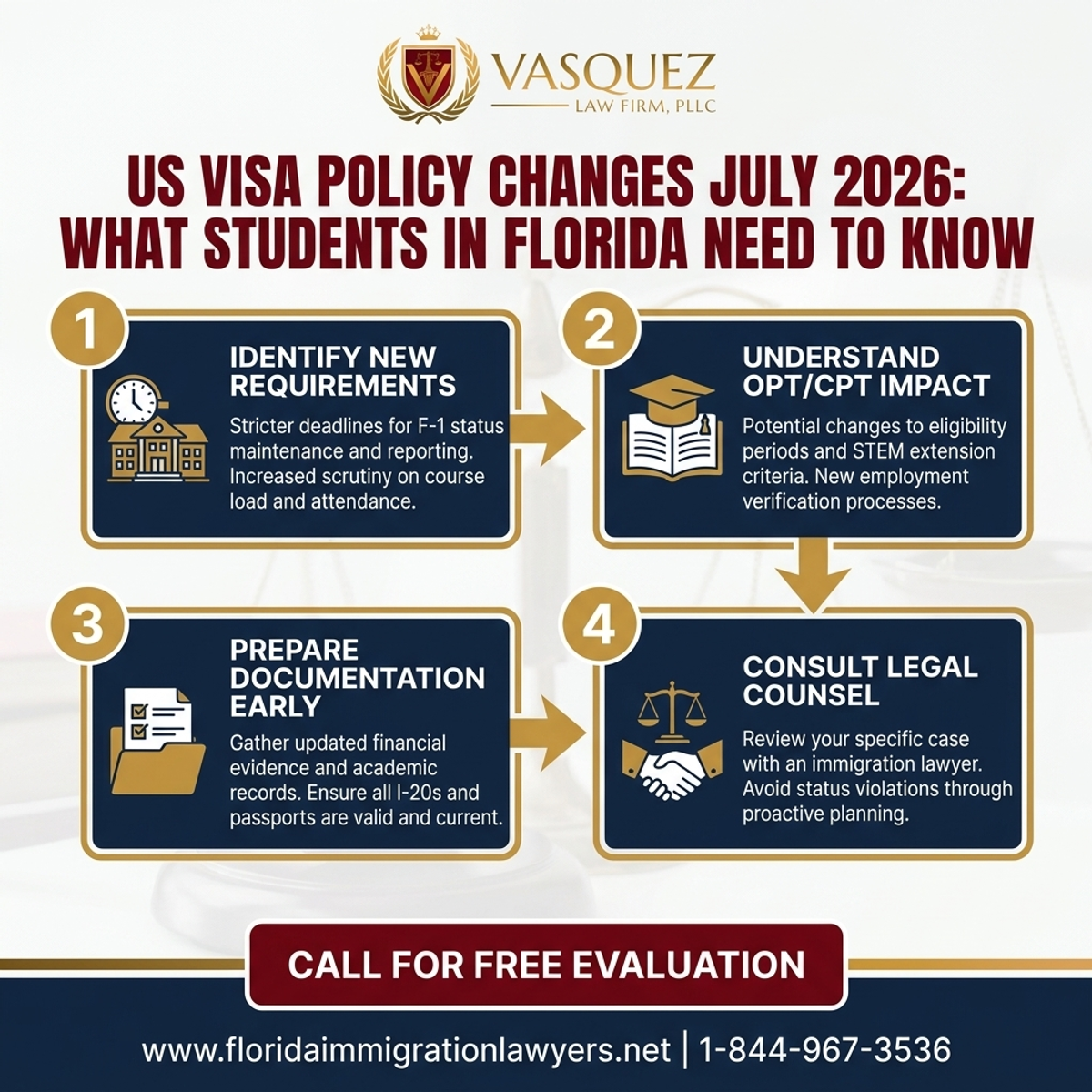
Step-by-Step Process — US Visa Policy Changes July 2026: What Students in Florida Need to Know
Florida-Specific Considerations for Documentation
When preparing your documents in Florida, ensure all financial statements from local banks are clearly legible and translated if necessary. For students applying from areas like Tampa, Orlando, or Miami, maintaining organized records is particularly important due to the volume of applications processed through regional USCIS offices. A well-organized application package can help expedite the review process and reduce the likelihood of Requests for Evidence (RFEs).
What are the Timelines and Processing Expectations for F-1 Change of Status in 2026?
As of 2026, USCIS processing times for Form I-539 change of status applications can vary significantly, typically ranging from 6 to 18 months or more. Factors like the specific service center, application volume, and the complexity of the case influence these timelines. Expedited processing is generally not available for this application type, making early application crucial. It is important to continuously check the USCIS processing times website for the most current estimates.
Understanding these timelines is essential for planning your academic journey. For example, if you are currently on a B-2 visitor visa in Florida and wish to pursue a degree, you must account for these extensive processing periods. During this time, you are generally permitted to remain in the U.S. while your application is pending, provided you filed it before your authorized stay expired. However, you cannot begin your F-1 studies until your change of status is approved. This waiting period can be a source of anxiety for many applicants in Florida, highlighting the need for careful planning and legal advice.
| Stage | Typical Timeframe (As of 2026) | Notes |
|---|---|---|
| Application Preparation | 2-4 weeks | Gathering documents, completing forms, obtaining Form I-20. |
| USCIS Receipt Notice | 2-4 weeks after filing | Confirmation that USCIS has received your Form I-539. |
| Biometrics Appointment | 3-8 weeks after receipt | Required for identity verification and background checks. |
| Case Review & Decision | 6-18+ months | Highly variable, depends on service center workload and case complexity. |
| Approval & New I-94 | Immediately upon approval | Your new F-1 status will be reflected on your I-94 record. |
What to Expect During the Waiting Period in Florida
During the lengthy waiting period for your change of status application, you generally cannot begin your F-1 program of study. Engaging in F-1 activities before approval can jeopardize your application. It is advisable to maintain your current nonimmigrant status and continue to abide by its terms. For those in Florida, particularly near educational hubs like Gainesville, Tallahassee, or Miami, this waiting period requires careful planning regarding accommodation and finances. Consulting with an immigration attorney can help you understand the permissible activities while your application is pending.
What Are the Costs Involved in a Student Change of Status Application?
The primary cost for a student change of status application is the USCIS filing fee for Form I-539. Additional expenses may include SEVIS I-901 fees, school application fees, tuition, and attorney fees for legal assistance. These fees are subject to change, and applicants should verify current amounts directly with USCIS and their chosen educational institution. Understanding the full financial commitment is crucial for international students planning their academic future in Florida.
Beyond the direct application fees, students must also consider the cost of living in Florida, which can vary significantly depending on the city. For example, living expenses in Tampa or Miami might be higher than in smaller university towns. These financial considerations are part of the overall requirement to demonstrate sufficient funds for your studies and living expenses, a critical component for any F-1 visa or change of status application. It is important to budget comprehensively to avoid financial distress during your academic journey.
| Item | Typical Fee (As of 2026, Subject to Change) | Notes |
|---|---|---|
| USCIS Form I-539 Filing Fee | $470 (for paper filing) | Check USCIS website for current fees and online filing discounts. |
| SEVIS I-901 Fee | $350 | Required for all F-1 students. |
| School Application Fees | $50 - $150+ | Varies by institution. |
| Attorney Fees | Varies widely | For legal assistance with the application; highly recommended. |
| Biometrics Fee | Included in I-539 fee | No separate fee for I-539 applicants. |
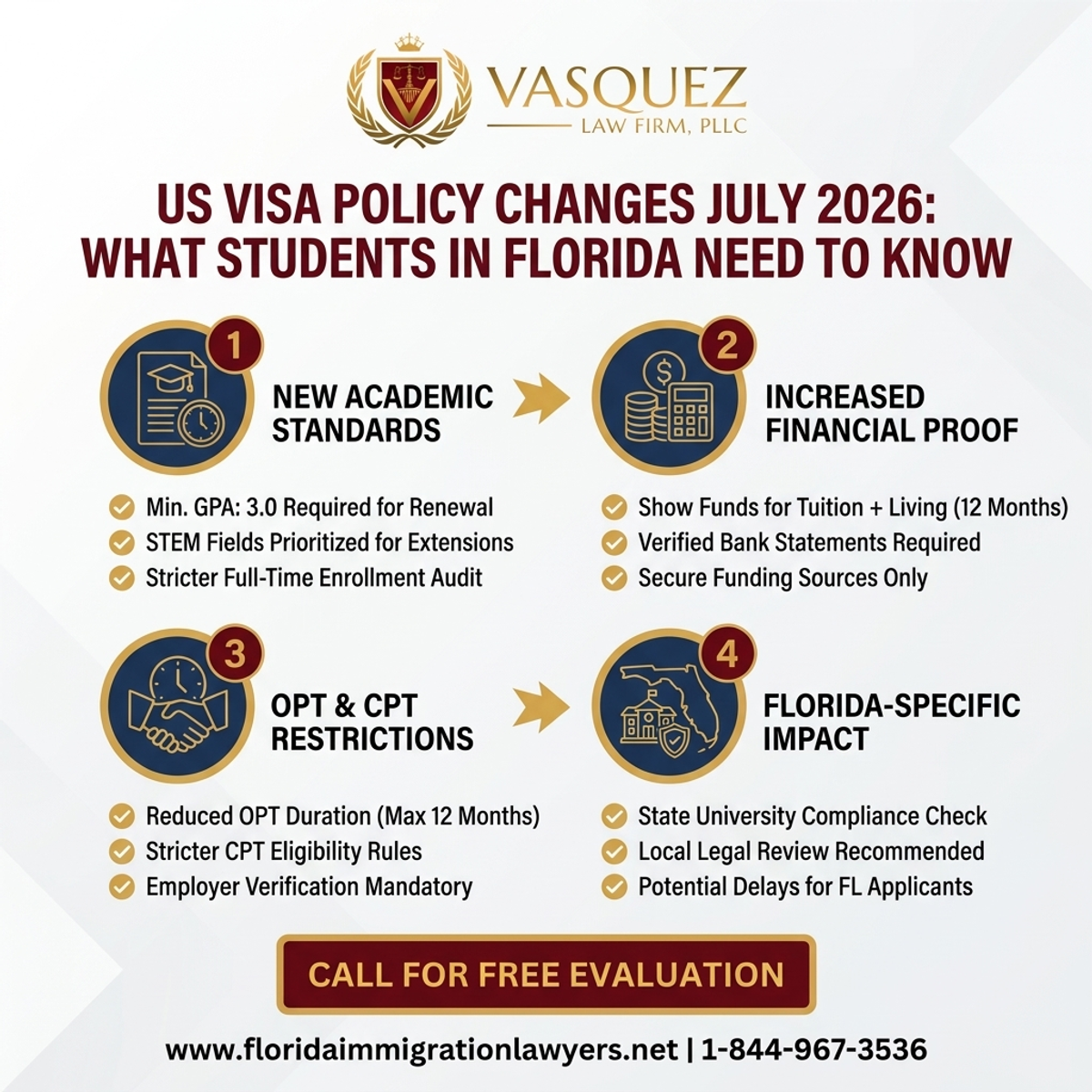
Key Statistics — US Visa Policy Changes July 2026: What Students in Florida Need to Know
Budgeting for Your F-1 Student Journey in Florida
When planning your budget for an F-1 change of status, remember to factor in not just the application fees but also tuition, living expenses (rent, utilities, food, transportation), health insurance, and personal costs. Many Florida universities require proof of funds covering at least the first year of study and living expenses. For students in areas like Orlando or Fort Lauderdale, understanding the local cost of living is vital. A well-prepared financial plan strengthens your application and ensures a stable academic experience.
Navigating the F-1 Change of Status in Florida: Local Insights
Florida is a popular destination for international students, boasting numerous SEVP-approved universities and colleges across the state. From the vibrant urban centers of Miami and Orlando to the academic hubs of Gainesville and Tallahassee, students seeking an F-1 change of status find diverse educational opportunities. However, navigating the immigration process within a specific state like Florida comes with its own nuances, particularly concerning local USCIS field offices and community resources.
The state's large immigrant population means that USCIS offices in Florida, such as those in Miami, Orlando, and Tampa, process a significant volume of applications. This can sometimes lead to localized variations in processing times or specific requirements for certain documents. For example, applicants in Tampa may find it beneficial to work with local attorneys familiar with the tendencies of the USCIS Tampa Field Office. Moreover, Florida's diverse demographics mean that bilingual support and culturally sensitive legal advice are often invaluable, especially when dealing with complex immigration forms and interviews. Understanding these local dynamics can significantly enhance the efficiency and success of your change of status application. Engaging with local resources and legal experts provides a distinct advantage in this detailed process. Florida Immigration Lawyers has deep roots in the community, offering insights into these specific local conditions.
Specific Challenges for Students in Florida
Students in Florida often face unique challenges, such as understanding state-specific tuition regulations for international students versus residents, or finding appropriate housing that aligns with their student budget while complying with visa rules. Additionally, Florida's climate and geographical considerations, particularly during hurricane season, can sometimes impact communication or travel related to immigration appointments. Having a local legal team familiar with these regional factors can provide crucial support throughout your change of status journey, from initial application to final approval. Our firm is well-versed in these specific Florida-centric issues.
Potential Challenges and How Florida Immigration Lawyers Can Help
The journey to obtaining an F-1 student visa through a change of status can be fraught with potential challenges, especially in the context of evolving U.S. visa policies. From ensuring all documents are meticulously prepared to understanding complex legal requirements, applicants often face hurdles that can delay or even derail their academic plans. Common issues include insufficient proof of funds, failure to demonstrate nonimmigrant intent, or misinterpreting USCIS instructions. These challenges are amplified when dealing with potential policy shifts like those anticipated in July 2026, which could introduce new rules or stricter enforcement.
Florida Immigration Lawyers stands ready to assist you through every step of this intricate process. Our experienced team understands the nuances of U.S. immigration law and the specific challenges faced by international students in Florida. We can help you:
- Assess Eligibility: Determine if you meet all requirements for an F-1 change of status and advise on potential alternatives.
- Prepare a Robust Application: Ensure all forms, including Form I-539, and supporting documents are accurate, complete, and compelling.
- Address RFEs: Respond effectively to Requests for Evidence (RFEs) from USCIS, providing additional information to strengthen your case.
- Navigate Policy Changes: Keep you informed about any US visa policy changes July 2026 and adjust your strategy accordingly.
- Represent You: Advocate on your behalf with USCIS, addressing any issues that arise during processing.
Our commitment is to provide personalized, compassionate, and effective legal representation, helping you achieve your educational goals in the Sunshine State. We understand the importance of your academic future and strive to make the immigration process as smooth as possible. For those facing deportation concerns, our experience extends to deportation defense, providing a holistic approach to your immigration needs.
Do not navigate this process alone. Contact Florida Immigration Lawyers today at 1-844-YO-PELEO for a free consultation. Our dedicated team is here to provide the guidance you need for a successful change of status to an F-1 student visa in Florida.
Common Mistakes to Avoid in Your Change of Status Application
Applying for a change of status to an F-1 student visa can be complex, and even minor errors can lead to significant delays or outright denials. Avoiding these common mistakes is crucial for a successful application, especially with potential policy changes on the horizon for July 2026.
- Failing to Maintain Legal Status: One of the most critical errors is allowing your current nonimmigrant status to expire before USCIS receives your I-539 application. This can lead to unlawful presence and make you ineligible for a change of status.
- Not Demonstrating Nonimmigrant Intent: USCIS requires proof that you intend to return to your home country after completing your studies. Lack of ties to your home country (property, family, job prospects) can raise red flags.
- Insufficient Proof of Financial Support: Failing to provide clear, verifiable evidence that you have sufficient funds to cover your tuition and living expenses for the entire duration of your studies is a common reason for denial. This is a strict requirement for the F-1 visa.
- Incomplete or Inaccurate Forms: Any missing information, inconsistent data, or incorrect signatures on Form I-539 can result in a Request for Evidence (RFE) or outright denial. Double-check every field.
- Applying Too Late: Filing your application too close to your current visa's expiration date leaves little room for processing delays and can lead to overstaying if USCIS doesn't make a decision promptly.
- Starting Studies Before Approval: You cannot begin your F-1 program of study until your change of status application is approved. Engaging in F-1 activities prematurely is a violation of status.
- Not Responding to RFEs on Time: If USCIS issues a Request for Evidence, you must respond within the specified timeframe with all requested documentation. Failure to do so will almost certainly lead to a denial.
- Misunderstanding Eligibility Requirements: Not fully understanding the specific criteria for a change of status to F-1, such as the requirement for an SEVP-approved school or the '90-day rule' for certain visa holders, can lead to an ineligible application.
- Ignoring SEVIS Fee Payment: Failing to pay the SEVIS I-901 fee and include proof of payment with your application will result in a rejection or denial.
- Lack of a Compelling Personal Statement: A poorly written or unconvincing personal statement that fails to articulate your academic goals and nonimmigrant intent can weaken your application.
When to Call a Lawyer for Your Change of Status Application
While some individuals may attempt to navigate the change of status process independently, certain situations strongly warrant the expertise of an experienced immigration attorney. Given the potential US visa policy changes July 2026 and the inherent complexities of immigration law, legal counsel can be invaluable in safeguarding your academic future in Florida. You should consider contacting Florida Immigration Lawyers if any of the following scenarios apply to you:
- Complex Immigration History: If you have any previous visa denials, overstays, or other immigration violations, your case is inherently more complicated.
- Tight Deadlines: If your current nonimmigrant status is nearing expiration and you need to file your change of status application urgently.
- Previous Denials: If a prior change of status application was denied, an attorney can help identify the reasons and strategize for a stronger reapplication.
- Unusual Circumstances: If your situation involves unique factors, such as a criminal record, health issues, or dependency on a sponsor with a complex financial background.
- Receipt of an RFE: If USCIS issues a Request for Evidence (RFE), an attorney can help you understand what is being asked and compile a comprehensive response.
- Concerns About Nonimmigrant Intent: If you find it challenging to clearly demonstrate your intent to return to your home country after your studies.
- Navigating Policy Changes: With potential changes in July 2026, an attorney can provide up-to-date advice and help you adapt your application strategy.
Florida Immigration Lawyers possesses a deep understanding of family immigration and business immigration, extending our experience to student visas. We can help you prepare a meticulous application, anticipate potential issues, and represent your interests throughout the entire process. Our firm offers comprehensive support, ensuring your application for an F-1 student visa is as strong as possible, allowing you to focus on your studies in Florida.
About Florida Immigration Lawyers
Florida Immigration Lawyers is an immigration law firm dedicated to serving individuals and families across the entire state of Florida. With a deep understanding of U.S. immigration law and a commitment to client success, our experienced attorneys provide personalized and effective legal solutions. We focus on a wide range of immigration matters, including asylum, deportation defense, family-based visas, business immigration, and change of status applications for students like the F-1 student visa. Our firm prides itself on its compassionate approach, clear communication, and unwavering advocacy for our clients.
We understand the profound impact immigration issues have on individuals and their families. That is why we offer accessible and responsive legal services, available 24/7. Our team is fluent in both English and Spanish, ensuring that language is never a barrier to receiving quality legal representation. We offer free, no-obligation consultations to discuss your case and provide an honest assessment of your options. Whether you are in Tampa, Miami, Orlando, or any other part of Florida, Florida Immigration Lawyers is here to guide you through every step of your immigration journey. Call us today at 1-844-YO-PELEO or visit our website at Vasquez Law Firm to learn more about how we can help you achieve your immigration goals.
Sources and References
- U.S. Citizenship and Immigration Services (USCIS)
- Executive Office for Immigration Review (EOIR)
- U.S. Department of State (Travel.State.Gov)
- 8 U.S.C. Chapter 12 - Immigration and Nationality Act (INA), specifically INA 101(a)(15)(F)(i) for F-1 visa definition.
- 8 U.S.C. § 1258 - Adjustment of status of nonimmigrant to that of person admitted for permanent residence. (Note: INA 248 for Change of Nonimmigrant Status).
- 8 CFR Part 214 - Nonimmigrant Classes, specifically 8 CFR 214.2(f) for F-1 students.
- 8 CFR Part 248 - Change of Nonimmigrant Status.
Related services: immigration practice areas, citizenship and naturalization, experienced immigration attorneys, free immigration consultation.
This article provides general legal information and is not intended as legal advice. Every case is unique, and outcomes depend on specific facts and circumstances. Contact an attorney for advice about your particular situation.
Embarking on a change of status to an F-1 student visa in Florida requires careful planning and a thorough understanding of U.S. immigration law. With potential US visa policy changes July 2026 on the horizon, legal guidance is more critical than ever. Let Florida Immigration Lawyers be your trusted partner in navigating these complexities. We are committed to helping you achieve your academic dreams in the United States. Do not hesitate to reach out for professional assistance.
Call Florida Immigration Lawyers today for a free consultation: 1-844-YO-PELEO. Se Habla Español - Estamos aqui para ayudarle.
Do Not Navigate This Process Alone
Our experienced immigration attorneys are ready to fight for you. Get a free, confidential case review today.
Se Habla Español
Or leave your details and we’ll call you:
Free Evaluation in 24 Hours
Or talk to us right now

AI voice assistant — available 24/7
FreeFrequently Asked Questions

William J. Vásquez
Founding Attorney · Vasquez Law Firm
U.S. Air Force veteran and immigration attorney with years of hands-on U.S. immigration experience. J.D., NCCU School of Law. AILA member. Admitted to the 4th, 5th, and 11th Circuit Courts.
Available 24/7 - Free Evaluations
Reviewed for legal accuracy by William J. Vásquez
Licensed in North Carolina; U.S. immigration is federal practice.
Related Legal Services
Our Florida immigration attorneys can help you with business immigration, deportation defense and family immigration services. Call today at 1-844-YO-PELEO for a free case review.
Related Links
Related Topics
Free Legal Case Review
Discuss your case with our experienced attorneys. We're available 24/7.
Se Habla Español - Estamos aquí para ayudarle.
Related Articles
EAD Advance Parole Combo Card in Florida: What You Need
An EAD advance parole combo card allows individuals with pending adjustment applications to both work and travel abroad without jeopardizing their green card application. Learn how to apply in Florida, what documents you need, and common mistakes to avoid.
PERM Labor Certification in Florida: A 2026 Guide
Learn all about the PERM labor certification process in Florida, essential for employers sponsoring green card applicants. Understand the steps, document requirements, and common mistakes to avoid in this 2026 guide.
Dual Citizenship Lawyer in Florida: What You Need to Know
For Florida residents, the concept of dual citizenship, or holding two passports, offers a compelling blend of opportunities and challenges. While the U.S. generally permits dual nationality, the path to achieving this status requires a meticulous understanding of both U.S. immigration laws and the citizenship policies of your country of origin. This guide explores the definition of dual citizenship, the detailed step-by-step process for U.S. naturalization, and the significant benefits and potential pitfalls involved. We cover essential documentation, typical timelines, and cost considerations for 2026, providing crucial insights for anyone in Orlando, Miami, or across Florida considering this important legal step. Learn about common mistakes to avoid and understand when to seek professional legal counsel to navigate this complex process successfully. Florida Immigration Lawyers is here to provide expert, bilingual support for your dual citizenship journey.
Immigration Lawyer Orlando Free Consultation in Florida
For individuals and families in Orlando, Florida, navigating the complexities of U.S. immigration law requires expert guidance. An immigration lawyer in Orlando offers crucial support for everything from visa applications and green card processes to naturalization and deportation defense. This comprehensive guide details what a free consultation covers, providing a step-by-step overview of immigration pathways, essential document checklists, and expected timelines in 2026. We also highlight common mistakes to avoid, discuss the critical role of legal counsel in deportation and asylum cases, and explain why choosing a local Orlando immigration attorney is beneficial. Florida Immigration Lawyers is dedicated to serving the diverse community of Orlando with compassionate, effective legal solutions, ensuring you receive personalized advice and robust representation for a successful immigration journey.