F-1 Reinstatement Process for Students in Florida | VLF Flor
Navigating the F-1 reinstatement process in Florida is essential for students who have fallen out of status. Learn the steps, avoid common mistakes, and know when to seek legal help. Call Florida Immigration Lawyers at 1-844-967-3536 for a free consultation.

The F-1 reinstatement process is crucial for students in Florida who have fallen out of status. Understanding the steps and requirements can help you regain your student visa status. Key takeaways include:
- File Form I-539 for reinstatement.
- Provide a valid explanation for status violations.
- Consult an immigration lawyer for guidance.
As an international student in Miami, Florida, losing your F-1 visa status can be stressful. The reinstatement process, however, offers a pathway to regain your status. This article outlines the process, from filing Form I-539 to understanding common mistakes and when to consult a lawyer. Call Florida Immigration Lawyers at 1-844-967-3536 for a free consultation to ensure your reinstatement process goes smoothly.
Understanding F-1 Reinstatement
F-1 reinstatement is essential for students who have fallen out of status due to circumstances like not maintaining full-time enrollment or other violations. In Florida, this process involves filing Form I-539 with U.S. Citizenship and Immigration Services (USCIS). A successful reinstatement allows you to continue your studies without leaving the U.S.
Eligible students must prove their violation was due to circumstances beyond their control, such as medical emergencies. The Florida immigration landscape is constantly evolving, so staying informed about the latest policies is crucial. Recent news highlights stricter immigration enforcement, making it even more important to ensure compliance with visa regulations.
Falling out of F-1 status can happen for various reasons, including academic difficulties, unexpected financial hardships, or simply misunderstanding complex immigration regulations. For instance, a student might drop below a full course load without prior authorization from their Designated School Official (DSO), inadvertently violating their visa terms. Regardless of the cause, the consequences of losing F-1 status can be severe, potentially leading to deportation or an inability to re-enter the U.S. in the future.
The reinstatement process is designed to offer a second chance, but it's not guaranteed. USCIS evaluates each case meticulously, looking for compelling evidence that the violation was truly unavoidable and that the student intends to comply with all regulations going forward. This is where the guidance of experienced legal professionals, such as Florida Immigration Lawyers, becomes invaluable. They can help you articulate your circumstances effectively and gather the necessary proof to support your case.
Step-by-Step Guide to Reinstatement
- Consult an Immigration Attorney: Before starting, seek advice from an immigration lawyer to assess your case and ensure you meet eligibility criteria.
- Complete Form I-539: Gather necessary documentation, including proof of financial support and a detailed explanation of the status violation.
- Submit to USCIS: Send the completed form and supporting documents to the designated USCIS service center.
- Await Decision: Processing times can vary, but expect a decision within 3-6 months. Check USCIS processing times for updates.
- Maintain Status: Continue to comply with all F-1 regulations while awaiting a decision, including maintaining a full course load.
Navigating the F-1 reinstatement process requires precision and a thorough understanding of immigration law. Consulting an immigration attorney, like those at Florida Immigration Lawyers, should be your very first step. An attorney can help you determine if you are eligible for reinstatement, identify potential challenges, and develop a robust strategy for your application. This initial assessment can save you significant time and prevent costly errors.
Completing Form I-539, Application to Extend/Change Nonimmigrant Status, is more than just filling out a form; it's about presenting a compelling narrative supported by strong evidence. This includes not only your financial records but also a detailed, chronological letter explaining the circumstances that led to your status violation. For example, if a medical emergency caused you to withdraw from classes, you'll need medical records to substantiate your claim. Ensuring every section is accurately filled and all supporting documents are meticulously organized is paramount for a successful outcome.
Once your application is submitted to USCIS, the waiting period begins. During this time, it's crucial to continue adhering to all F-1 regulations to the best of your ability. This includes maintaining a full course of study, even if your previous enrollment was the cause of your status violation. Showing good faith and a commitment to your academic pursuits strengthens your case and demonstrates to USCIS your genuine intent to comply. Remember, Florida Immigration Lawyers can assist you throughout this entire process, offering peace of mind and expert guidance.
Document Checklist for Reinstatement
The success of your F-1 reinstatement application heavily relies on the completeness and accuracy of your documentation. Missing even a single required document or failing to provide sufficient evidence can lead to delays, requests for additional evidence (RFEs), or even outright denial. Treat this checklist as your essential guide to preparing a strong case.
- Completed Form I-539: This is the primary application form. Ensure all fields are accurately filled, signed, and dated. Any discrepancies or omissions can raise red flags with USCIS.
- Copy of Form I-20: Provide copies of all your Forms I-20, both current and previous. This document is crucial as it details your program of study, school endorsement, and financial information, demonstrating your academic intent and financial stability.
- Letter explaining status violation: This is perhaps the most critical document. Your letter must clearly and concisely explain the circumstances that led to your violation, demonstrating that they were beyond your control. For instance, if a sudden family emergency required you to return home, include supporting evidence like flight tickets, medical records, or death certificates. The letter should also express your commitment to maintaining F-1 status in the future.
- Proof of financial support: You must demonstrate that you have sufficient funds to cover your tuition, living expenses, and other costs for the duration of your studies. This can include bank statements, scholarship letters, or affidavits of support from sponsors, along with their financial documentation.
- Copies of all previous I-94 records: These records, available online from the U.S. Customs and Border Protection (CBP) website, provide a complete history of your entries and exits from the U.S. They are essential for USCIS to verify your immigration history and legal presence.
- Enrollment verification from your institution: Obtain an official letter from your Designated School Official (DSO) confirming your current enrollment status, your intent to pursue a full course of study, and that your school recommends your reinstatement. This letter from your DSO is a powerful endorsement of your case.
- Transcripts: Include official academic transcripts from all U.S. institutions you have attended. This helps demonstrate your academic progress and commitment to your education.
- Passport and Visa Copy: Provide copies of your passport biographical page and your F-1 visa stamp. These documents confirm your identity and legal entry into the U.S.
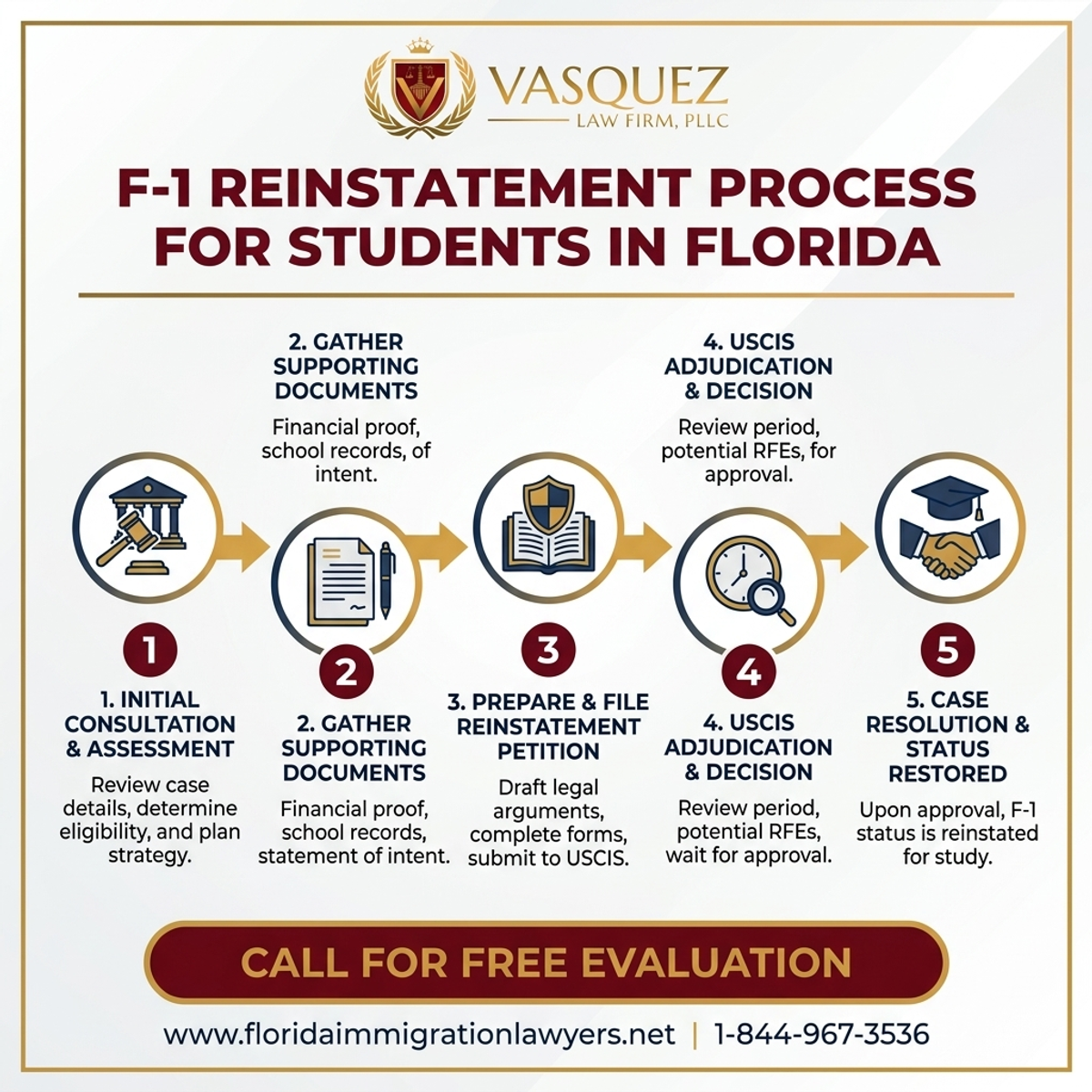
Step-by-Step Process — F-1 Reinstatement Process for Students in Florida
Timeline and Processing Expectations
The typical timeline for F-1 reinstatement involves preparing and submitting Form I-539, followed by a waiting period for USCIS's decision. While processing times can range from 3 to 6 months, delays may occur due to workload or requests for additional information. During this period, it's vital to comply with all student visa requirements to strengthen your case.
Florida's Miami USCIS office often handles numerous cases, reflecting the state's diverse international student population. Understanding the local immigration court processes can also be beneficial.
Several factors can influence the processing timeline for your F-1 reinstatement application. These include the current workload at the USCIS service center, the complexity of your case, and whether USCIS issues a Request for Evidence (RFE). An RFE can significantly extend the processing time, as you will need to gather and submit additional documents, which then require further review by USCIS. It is crucial to respond to any RFE promptly and thoroughly, ideally with the assistance of an attorney from Florida Immigration Lawyers.
While waiting for a decision, students should continue to monitor their case status online through the USCIS website using their receipt number. It's also advisable to maintain regular communication with your Designated School Official (DSO), who can offer guidance and support during this uncertain period. For instance, if your I-20 is nearing expiration while your application is still pending, your DSO can issue a new I-20 to ensure your record remains active. Proactive communication and compliance are key to navigating this waiting period successfully.
Cost Factors and Fee Breakdown
Filing fees for Form I-539 are set by USCIS and may change, so verify the current fee on their website. Additional costs might include legal fees for professional assistance, which can enhance your chances of a successful reinstatement. Consider these expenses as investments in your educational future.
Do not navigate this process alone. Contact Florida Immigration Lawyers today for expert guidance.
Beyond the primary USCIS filing fee for Form I-539, which typically includes a biometrics fee, applicants should anticipate other potential expenses. These can include costs for gathering supporting documents, such as obtaining official transcripts or medical records, translation services for any documents not in English, and mailing costs for certified mail to USCIS. While some students might consider managing the application themselves to save money, the complexity of immigration law often makes professional legal assistance a wise investment.
Legal fees for an immigration attorney, like those at Florida Immigration Lawyers, cover a range of services from initial consultation and case assessment to document preparation, drafting compelling explanation letters, and responding to RFEs. These fees reflect the attorney's expertise in navigating intricate regulations and their commitment to maximizing your chances of a successful outcome. Investing in legal counsel can ultimately save you from potential denials, prolonged delays, and the significant stress associated with the reinstatement process. We offer transparent fee structures, and you can call us at 1-844-967-3536 for a free consultation to discuss your specific needs.
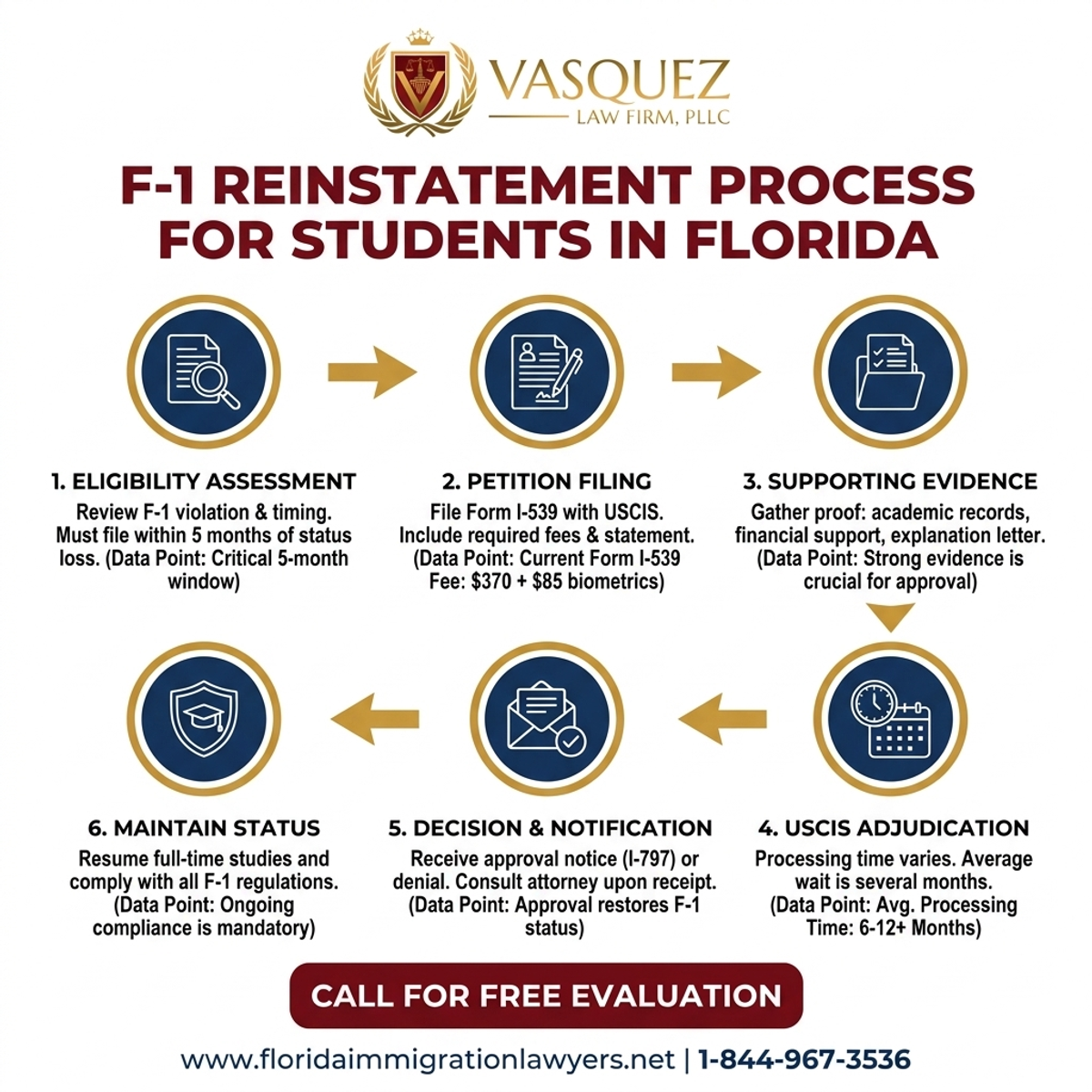
Key Statistics — F-1 Reinstatement Process for Students in Florida
Common Mistakes to Avoid
- Incomplete Form I-539: Missing information can lead to delays or denials. Ensure all sections are accurately completed.
- Insufficient Documentation: Failing to provide necessary documents or evidence can weaken your case.
- Ignoring Deadlines: Delays in filing can result in ineligibility for reinstatement.
- Not Consulting a Lawyer: Many students underestimate the complexity of reinstatement. Expert guidance is crucial.
- Failure to Maintain Enrollment: Continuing to neglect full-time study requirements can complicate your case.
- Inadequate Explanation for Violation: Providing a vague or unsupported explanation can result in denial.
- Not Checking USCIS Updates: Policies change frequently. Stay informed to ensure compliance.
The F-1 reinstatement process is fraught with potential pitfalls, and even minor errors can have significant consequences for your academic future in the U.S. One of the most common and damaging mistakes is submitting an incomplete or inaccurately filled Form I-539. USCIS is strict about application completeness, and any missing information or inconsistent data can lead to immediate rejection or an RFE, significantly delaying your process and potentially jeopardizing your chances.
Another critical error is failing to provide a robust and well-supported explanation for your status violation. A vague statement like "I was sick" without accompanying medical documentation is unlikely to be convincing. USCIS requires clear, compelling evidence that the circumstances were truly beyond your control and that you acted promptly to rectify the situation. This is where an experienced attorney can help you craft a persuasive narrative backed by solid proof, ensuring your case is presented in the strongest possible light.
Furthermore, many students underestimate the importance of deadlines, particularly the general rule that the I-539 application should be filed within five months of falling out of status. While exceptions exist for extraordinary circumstances, adhering to this timeframe is crucial. Continuously neglecting to maintain your full-time enrollment while your application is pending also signals a lack of commitment to your F-1 status, which can be detrimental. Staying informed about USCIS policy changes, which occur frequently, is also vital for compliance and avoiding new mistakes. Florida Immigration Lawyers can help you understand these nuances and avoid common pitfalls.
When to Call a Lawyer
Seek legal assistance if you face complex issues like multiple status violations, previous denials, or if you're unsure about documentation. Florida Immigration Lawyers can provide personalized guidance to navigate these challenges effectively.
While some straightforward F-1 reinstatement cases might be handled independently, the vast majority benefit immensely from professional legal counsel. You should strongly consider contacting Florida Immigration Lawyers if your situation involves any complexities beyond a simple, one-time oversight. For example, if you have a history of multiple status violations, even minor ones, or if you've had a previous immigration application denied, an attorney can help untangle these issues and present a coherent, compelling case to USCIS.
Furthermore, if you are unsure about the specific documentation required, how to write a convincing explanation letter, or how to respond to a Request for Evidence (RFE), a lawyer's expertise is indispensable. They can help you gather the correct evidence, ensure all forms are accurately completed, and articulate your circumstances in a way that aligns with USCIS requirements. For instance, if you experienced a severe family crisis overseas that prevented you from returning to school, an attorney can help you compile the necessary international documents and translate them, ensuring their admissibility and impact.
An immigration attorney also provides crucial support during the stressful waiting period and can represent you if an interview or further action is required. Their knowledge of immigration law and USCIS procedures can significantly increase your chances of a successful reinstatement, helping you avoid potential deportation and secure your academic future in Florida. Don't hesitate to call Florida Immigration Lawyers at 1-844-967-3536 for a free consultation if you feel overwhelmed or your case has any unusual circumstances.
About Florida Immigration Lawyers: We offer comprehensive immigration services, including student visa assistance, asylum, deportation defense, and more. Contact us at 1-844-967-3536 or visit our website for a free consultation. Available 24/7, we are dedicated to serving all of Florida.
Sources and References
- U.S. Citizenship and Immigration Services (USCIS)
- Executive Office for Immigration Review (EOIR)
- 8 U.S.C. Chapter 12 - Immigration and Nationality Act
Related services: immigration practice areas, family immigration services, citizenship and naturalization.
This article provides general legal information and is not intended as legal advice. Every case is unique, and outcomes depend on specific facts and circumstances. Contact an attorney for advice about your particular situation.
Ready to take the next step? Call Florida Immigration Lawyers at 1-844-967-3536 for a free consultation. Se Habla Español - Estamos aquí para ayudarle.
If you need legal assistance, learn more about Florida immigration legal team, or call us at 1-844-967-3536 for a free consultation.
Do Not Navigate This Process Alone
Our experienced immigration attorneys are ready to fight for you. Get a free, confidential consultation today.
Se Habla Español
Frequently Asked Questions
Florida Immigration Lawyers
Immigration Attorney | Founder, Vasquez Law Firm
U.S. Air Force veteran and immigration attorney with thousands of cases resolved. J.D., NCCU School of Law. AILA member. Admitted to the 4th, 5th, and 11th Circuit Courts.
Available 24/7 - Free Evaluations
Related Legal Services
Our Florida immigration attorneys can help you with asylum protection, deportation defense and citizenship and naturalization. Call today at 1-844-967-3536 for a free consultation.
Related Links
Related Topics
Free Legal Consultation
Discuss your case with our experienced attorneys. We're available 24/7.
Se Habla Español - Estamos aquí para ayudarle.
Related Articles
Understanding BIA Remand in Florida Immigration Appeals
Learn about BIA remands in Florida immigration appeals and how to navigate this complex process. Understand common mistakes, timelines, and when to seek legal assistance.
Deportation Defense Lawyers in Orlando | VLF Florida
Facing deportation in Orlando can be overwhelming. Learn how a deportation defense lawyer can help you navigate removal proceedings and protect your rights. Contact Florida Immigration Lawyers for a free consultation.
Green Card Through Marriage Florida: Your 2026 Guide
For couples in Florida seeking a green card through marriage, the process involves intricate steps, extensive documentation, and careful adherence to USCIS regulations. This comprehensive 2026 guide from Florida Immigration Lawyers details eligibility, the step-by-step application, required documents, interview preparation, and potential challenges. Whether you reside in Kissimmee or elsewhere in Florida, understanding the nuances of proving a bona fide marriage and navigating federal immigration law is crucial. Our expert team provides essential insights and support to help you achieve permanent residency. Learn how to avoid common mistakes and when to seek professional legal assistance for your marriage-based green card application.
Understanding Public Charge Rule for Florida Immigrants
Explore how the public charge rule affects Florida immigrants, particularly in Homestead. This guide covers the essentials of navigating this complex immigration rule, offering practical advice and legal support options.