Dual Citizenship Florida: Your Guide to Two Passports
Discover the path to dual citizenship in Florida, allowing you to hold two passports and enjoy expanded rights in both the U.S. and your country of origin. This comprehensive guide covers naturalization requirements, the step-by-step application process for Florida residents, essential documents, and what to expect regarding timelines and costs. Learn about the significant benefits, such as enhanced travel freedom and career opportunities, as well as crucial considerations like tax obligations. We also highlight common mistakes to avoid and when it's critical to seek professional legal assistance. Florida Immigration Lawyers offers expert guidance for your dual citizenship journey, ensuring a smooth and successful application process. Contact us for a free consultation to understand your eligibility and navigate the complexities of immigration law in Florida.

Dual citizenship in Florida allows individuals to hold citizenship in both the United States and another country simultaneously. The U.S. government generally permits dual nationality, meaning you do not typically have to renounce your previous citizenship when becoming a U.S. citizen through naturalization, provided your other country also allows it. This status offers significant benefits, including enhanced travel freedom, property rights, and political participation in both nations. Navigating the naturalization process, especially in Florida with its diverse population centers like Tallahassee, Miami, and Orlando, requires careful attention to eligibility, documentation, and legal procedures. Consulting with an experienced immigration attorney is highly recommended to ensure a smooth and successful application.
- The U.S. government generally allows dual citizenship.
- Acquiring U.S. citizenship through naturalization does not typically require renouncing other citizenships.
- Benefits include increased travel, work, and property rights in both countries.
- The naturalization process in Florida involves specific eligibility and documentation.
- Professional legal guidance is crucial for a successful application.
Are you a Florida resident dreaming of the freedom and flexibility that comes with holding citizenship in two nations? The concept of dual citizenship Florida offers a unique pathway for many immigrants to maintain deep ties with their country of origin while fully embracing life in the United States. In a state as diverse and globally connected as Florida, understanding how to navigate the complexities of acquiring or maintaining dual nationality is incredibly valuable. Many individuals, from the bustling streets of Miami to the quieter communities around Tallahassee, seek to secure their future with the benefits of two passports.
At Florida Immigration Lawyers, we understand the profound significance of this journey. Our dedicated team helps individuals throughout Florida understand the requirements, benefits, and potential challenges of dual citizenship. We are committed to providing clear, compassionate, and effective legal guidance for every step of your naturalization process. This comprehensive guide will explore what dual citizenship entails, the naturalization process in Florida, essential documents, timelines, costs, and common pitfalls to avoid. If you are ready to explore your options, we invite you to call Florida Immigration Lawyers at 1-844-967-3536 for a free consultation today.
Understanding Dual Citizenship in Florida
Dual citizenship, also known as dual nationality, occurs when a person is a citizen of two countries simultaneously. The United States generally permits dual nationality. This means that if you become a U.S. citizen, you typically do not have to renounce your citizenship of another country, as long as that country also allows you to retain both nationalities. The U.S. government's position is that while it does not actively encourage dual nationality, it also does not prohibit it. This stance is rooted in the Immigration and Nationality Act (INA), which outlines the process for becoming a U.S. citizen.
For Florida residents, understanding dual citizenship is especially relevant given the state's vibrant multicultural population. Many individuals who have made Florida their home, whether in Orlando, Tampa, or smaller towns, wish to maintain their heritage and connections abroad while fully integrating into American society. Dual citizenship can arise in several ways: a child born in the U.S. to foreign national parents may be a U.S. citizen by birth and a citizen of their parents' country by descent; an individual may acquire U.S. citizenship through naturalization while retaining their original citizenship; or a person may be born in another country to U.S. citizen parents. The key is that both countries must recognize the individual as a citizen.
It's important to distinguish between acquiring U.S. citizenship and the concept of dual citizenship itself. The U.S. naturalization process focuses on meeting the requirements to become a U.S. citizen. What happens to your previous citizenship depends on the laws of your country of origin. Some countries automatically revoke citizenship upon naturalization elsewhere, while others allow you to keep it. Our team at Florida Immigration Lawyers can help you understand these complex interactions and ensure you are well-informed about the implications of pursuing dual citizenship Florida. We ensure you understand both U.S. law and how it might interact with the laws of your home country.
Eligibility for Dual Citizenship Through U.S. Naturalization in Florida
For most Florida residents seeking dual citizenship, the path involves becoming a naturalized U.S. citizen while retaining their original nationality. The eligibility requirements for naturalization are set forth in the Immigration and Nationality Act (INA), specifically INA Section 316 (8 U.S.C. § 1427). Meeting these criteria is fundamental to a successful application. You must be at least 18 years old at the time of filing Form N-400, Application for Naturalization. You must also be a lawful permanent resident (Green Card holder) for a specified period, typically five years, or three years if married to a U.S. citizen.
Residency requirements extend beyond just holding a Green Card. You must demonstrate continuous residence in the U.S. for at least half of the required period (e.g., 2.5 years out of 5 years). Furthermore, you must have resided for at least three months in the state or USCIS district where you file your application. For Florida residents, this means having established a domicile within areas served by USCIS field offices in Miami, Orlando, or Tampa, depending on your address. You must also be a person of good moral character for the statutory period leading up to your application and until you take the Oath of Allegiance. This involves disclosing any criminal history, even minor offenses, as they can impact your eligibility.
Applicants must also demonstrate an ability to read, write, and speak basic English. They must also show knowledge and understanding of U.S. history and government (civics). Exceptions to these requirements exist for older applicants or those with certain disabilities. Finally, you must demonstrate an attachment to the principles and ideals of the U.S. Constitution. Our attorneys at Florida Immigration Lawyers can assess your specific situation, including any potential complexities such as extended travel abroad or past legal issues, to determine your eligibility and prepare a robust application for Florida naturalization requirements.
The U.S. Naturalization Process: A Step-by-Step Guide for Florida Residents
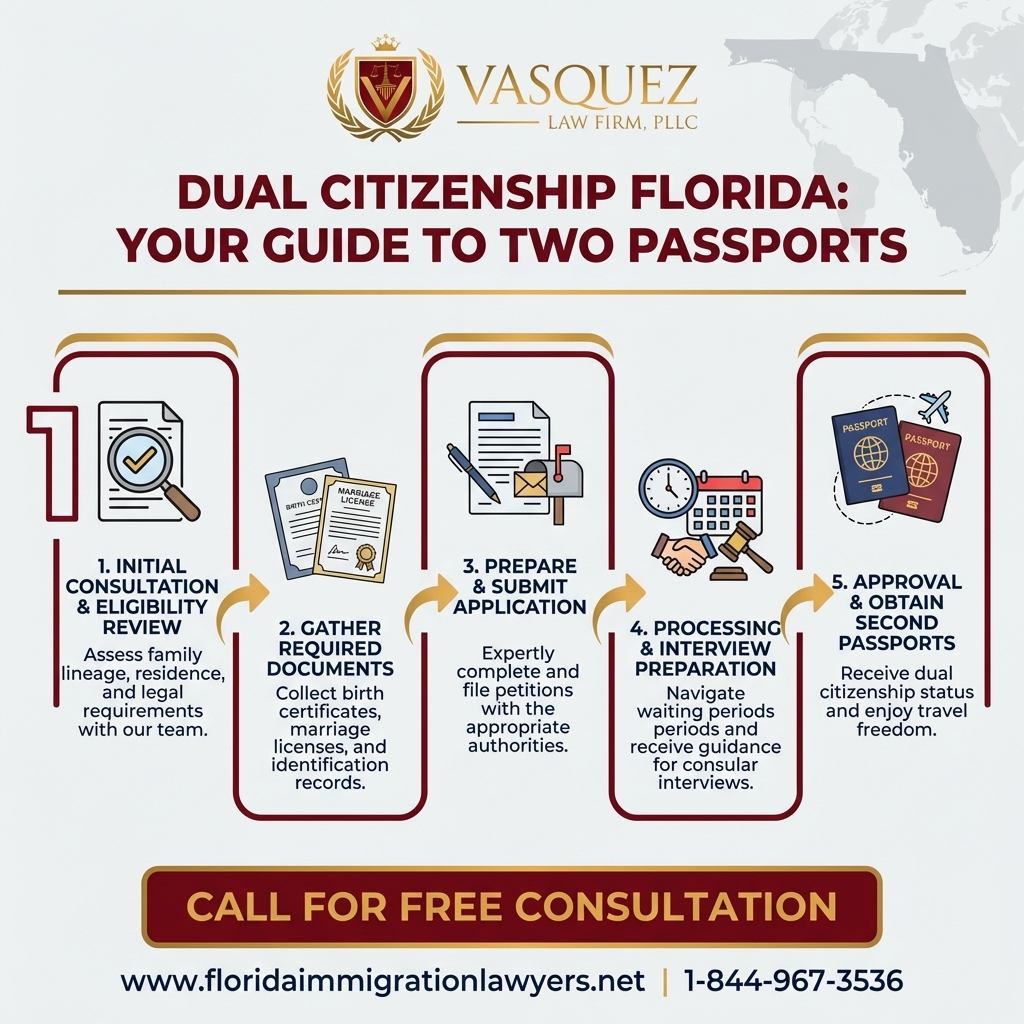
Obtaining U.S. citizenship through naturalization, which can lead to dual citizenship Florida, is a multi-step process that requires careful attention to detail. Here is a general outline of the steps involved for residents across Florida, from Tallahassee to Fort Lauderdale:
-
Determine Your Eligibility: Before beginning, ensure you meet all the basic requirements, including age, continuous residence, physical presence, good moral character, English proficiency, and civics knowledge. Our firm can help you review your eligibility and identify any potential issues that may arise during the process. We encourage you to seek a preliminary assessment to avoid unnecessary delays or denials.
-
Prepare and File Form N-400, Application for Naturalization: This is the core application form. It is extensive and requires detailed personal information, residency history, employment, travel, and criminal records. Accuracy is paramount. Any discrepancies or omissions can lead to significant delays or even denial. Ensure all questions are answered truthfully and completely, even if they seem minor.
-
Gather Supporting Documents: Along with your N-400, you will need to submit various documents proving your eligibility. This includes copies of your Green Card, marriage certificate (if applicable), tax returns, birth certificates, and any court or police records. Organizing these documents meticulously is crucial for a smooth process. We will provide a comprehensive checklist to ensure nothing is missed.
-
Submit Your Application to USCIS: Once your N-400 and supporting documents are complete, you will mail the package to the appropriate USCIS lockbox facility. The filing fee must be included unless you qualify for a fee waiver. After submission, you will receive a receipt notice (Form I-797C) acknowledging that USCIS has received your application. This notice will also contain your case number.
-
Attend Your Biometrics Appointment: A few weeks after filing, USCIS will send you an appointment notice for biometrics collection. This involves providing fingerprints, photographs, and a signature at an Application Support Center (ASC). In Florida, ASCs are located in cities such as Orlando, Miami, and Jacksonville. This data is used for background checks.
-
Attend Your Naturalization Interview: USCIS will schedule an interview at a local field office, such as the ones in Miami, Orlando, or Tampa. During the interview, an immigration officer will review your N-400, verify your eligibility, test your English and civics knowledge, and ask questions about your application. It is vital to be prepared, honest, and bring all original supporting documents.
-
Receive a Decision: After the interview, the officer will either recommend approval, put the decision on hold for further review (N-14 request for additional documents), or deny the application. If approved, you will typically receive a notice for the Oath of Allegiance ceremony.
-
Attend the Oath of Allegiance Ceremony: This is the final step where you officially become a U.S. citizen. You will take an oath pledging allegiance to the United States. Many ceremonies for Florida residents are held at federal courthouses or USCIS facilities, including in larger cities like Tallahassee, Miami, and Orlando. Upon taking the oath, you will receive your Certificate of Naturalization, which serves as proof of your U.S. citizenship.
Essential Documents for Your Dual Citizenship Application
A critical component of a successful naturalization application, which can lead to dual citizenship Florida, is the meticulous preparation and submission of all required documents. Missing or incorrect documents can significantly delay your process or even lead to a denial. Here is a comprehensive checklist of documents you will typically need to gather:
- Form N-400, Application for Naturalization: The completed and signed application form.
- Photocopy of Your Green Card (Front and Back): Proof of your lawful permanent resident status.
- Two Passport-Style Photos: Ensure they meet USCIS specifications.
- Photocopy of Your Current and Expired Passports: Especially important for demonstrating travel history.
- Proof of Marital Status (if applicable): Original or certified copy of marriage certificate, divorce decrees, or death certificates for previous spouses.
- Birth Certificates: For yourself and any children, if they are included in your application or to prove relationships.
- Tax Transcripts or Returns: For the last five years (or three years if married to a U.S. citizen) to prove financial responsibility and continuous residence.
- Proof of Selective Service Registration (for males 18-26): If applicable, you must prove registration or provide an explanation for non-registration.
- Travel Records: A detailed list of all trips outside the U.S., including dates of departure and return.
- Court, Police, and Prison Records: Certified copies of any arrest records, court dispositions, or probation documents, even if charges were dismissed or expunged.
- Proof of Payment of Child Support/Alimony (if applicable): To demonstrate good moral character.
- Medical Documentation: For disability exceptions to the English and civics requirements.
All documents not in English must be accompanied by a certified English translation. It is always wise to keep copies of everything you submit. Our team at Florida Immigration Lawyers will help you organize and review all your documentation, ensuring compliance with USCIS requirements and strengthening your application for two passports USA.
Navigating Timelines and Costs for Dual Citizenship in Florida
Understanding the potential timelines and costs associated with the naturalization process is crucial for anyone pursuing dual citizenship Florida. The processing time for Form N-400 can vary significantly based on the USCIS field office jurisdiction and the current caseload. For Florida residents, applications processed through offices in Miami, Orlando, or Tampa may experience different processing durations. You can check the USCIS website for current processing times by form type and field office. Generally, the entire process, from filing the N-400 to taking the Oath of Allegiance, can take anywhere from 8 months to over 2 years. Factors like the completeness of your application, response to Requests for Evidence (RFEs), and scheduling availability at your local USCIS office can all influence this timeline.
The costs associated with naturalization primarily consist of government filing fees and, optionally, legal fees for attorney assistance. USCIS charges a fee for filing Form N-400, which includes the biometrics services fee. It is important to note that these fees are subject to change, so always refer to the official USCIS website for the most current fee schedule. Some applicants may be eligible for a fee waiver if they meet certain income-based guidelines or receive public benefits. Our firm can help you determine if you qualify for a fee waiver and assist with the application process.
Beyond government fees, consider the cost of obtaining certified copies of documents, translations, and travel expenses for appointments. Investing in legal representation from Florida Immigration Lawyers can be a wise decision. While not mandatory, an experienced immigration attorney can help you prepare a thorough application, ensure all documents are correctly submitted, prepare you for your interview, and address any complex issues that may arise. This professional guidance can save you time, reduce stress, and significantly increase the likelihood of a successful outcome, especially if your case presents unique challenges.
Benefits and Considerations of Holding Dual Citizenship
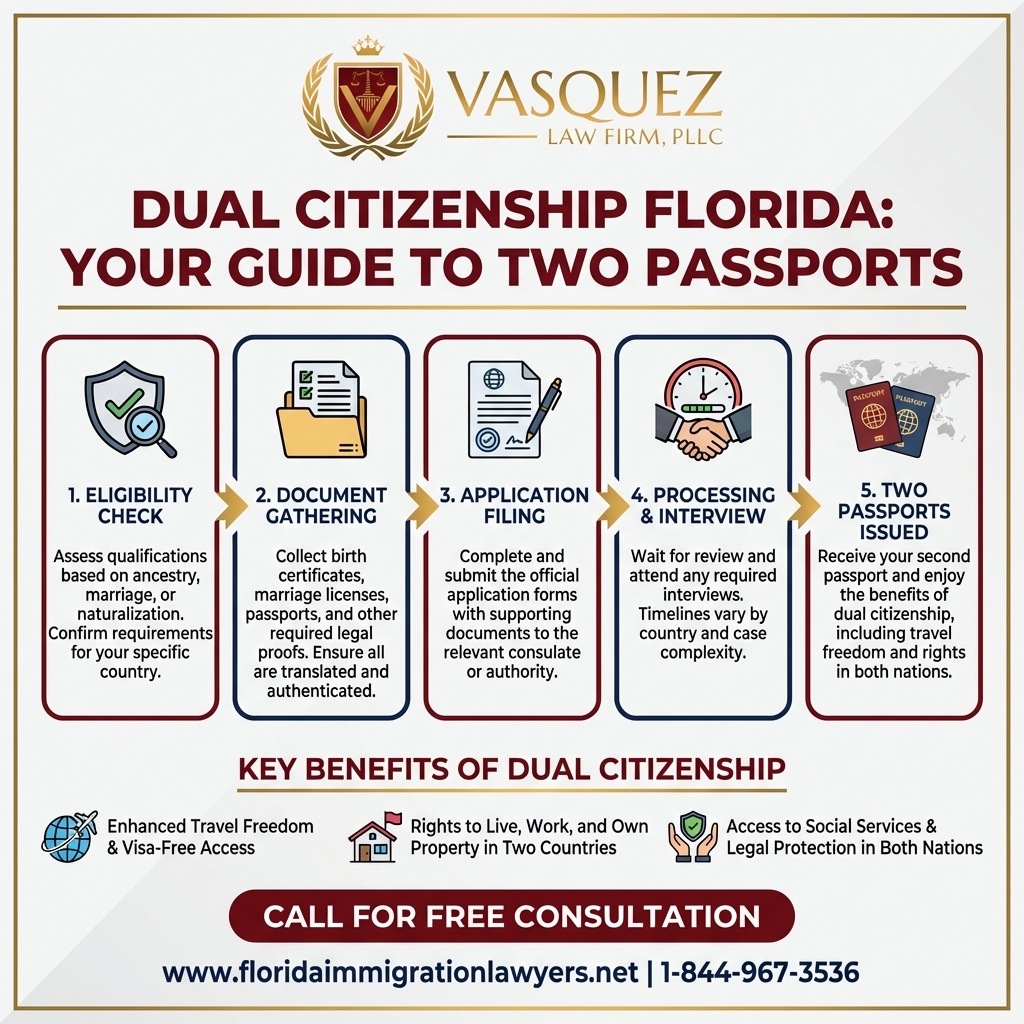
Acquiring dual citizenship Florida status offers a wide array of benefits that can significantly enhance your life and opportunities. One of the most prominent advantages is increased travel freedom. With two passports, you can often enter and exit both countries more easily, avoid visa requirements, and potentially stay for longer periods without bureaucratic hurdles. This is particularly beneficial for individuals with family, business, or property interests in both the U.S. and their country of origin. Imagine the ease of visiting relatives in your homeland without the constant worry of visa applications or overstaying your welcome as a non-citizen.
Beyond travel, dual citizenship can open doors to expanded employment and educational opportunities. You may have the right to work, own property, and participate in political processes, such as voting or even holding public office, in both nations. This can be a game-changer for career advancement or establishing a secure future. For instance, a Florida resident with dual citizenship might find it easier to accept a job offer in their country of origin without needing a work visa, or they might be able to purchase real estate more freely. Dual citizenship also offers a layer of security, providing a fallback option in times of political or economic instability in either country.
However, it is also important to consider the potential responsibilities and complexities that come with holding dual nationality. Dual citizens are generally subject to the laws of both countries. This can include tax obligations, as the U.S. taxes its citizens on worldwide income, regardless of where they reside. There may also be military service obligations in your country of origin, depending on their laws. Furthermore, in certain situations, such as when traveling, you may be required to use your U.S. passport when entering and exiting the United States, as per U.S. law (8 CFR 215.1). Understanding these implications is crucial. Our team at Florida Immigration Lawyers can provide comprehensive advice on the benefits and potential considerations, ensuring you make informed decisions about pursuing immigration law Florida.
Common Mistakes to Avoid in Your Dual Citizenship Journey
Navigating the complex path to dual citizenship Florida requires precision and careful adherence to regulations. Even minor errors can lead to significant delays or even denial of your naturalization application. Here are some common mistakes to avoid:
-
Incomplete or Inaccurate Application (Form N-400): Failing to fill out every section of the N-400, providing inconsistent information, or making simple typographical errors can cause USCIS to return your application or issue a Request for Evidence (RFE). This delays the entire process and can raise red flags about your attention to detail.
-
Not Disclosing All Criminal History: Many applicants mistakenly believe that minor infractions, expunged records, or incidents from long ago do not need to be disclosed. USCIS conducts thorough background checks. Failure to disclose any arrest, citation, or conviction, regardless of outcome, can be considered a misrepresentation and lead to denial based on lack of good moral character. Even a dismissed case should be disclosed.
-
Insufficient Continuous Residence or Physical Presence: Miscalculating the time spent outside the U.S. or failing to meet the continuous residence and physical presence requirements is a common pitfall. Extended trips abroad can break continuous residence, requiring applicants to restart the clock or face denial. Keep meticulous records of all travel dates.
-
Poor English Language Skills or Civics Knowledge: Underestimating the English and civics test requirements can lead to failure during the interview. While exceptions exist for age or disability, most applicants must demonstrate basic proficiency. Practice regularly and consider classes if needed to ensure you are well-prepared for the verbal and written components.
-
Failing to Update Your Address with USCIS: If you move while your N-400 application is pending, you must notify USCIS of your new address promptly using Form AR-11. Failure to do so can result in missed appointment notices or important correspondence, leading to delays or even abandonment of your application.
-
Not Filing Taxes or Paying Child Support/Alimony: Good moral character includes fulfilling financial obligations. Failing to file income taxes, evading taxes, or neglecting child support or alimony payments can all be reasons for denial of naturalization. USCIS will scrutinize your financial history as part of your application.
-
Excessive Travel Abroad: While some travel is permitted, prolonged absences from the U.S. can jeopardize your continuous residence requirement. Even if an absence doesn't break continuous residence, too much time outside the country can indicate a lack of attachment to the U.S., which USCIS considers. Consult an attorney if you plan significant travel during your application.
-
Ignoring USCIS Requests for Evidence (RFEs): If USCIS requests additional documents or information, it is critical to respond fully and within the specified deadline. Ignoring an RFE or providing an incomplete response will almost certainly lead to a denial of your application. Always read these requests carefully and seek legal advice if unsure.
-
Misunderstanding Your Home Country's Laws: While the U.S. allows dual citizenship, your country of origin may not. Becoming a U.S. citizen could automatically revoke your original citizenship if you are not careful. Research your home country's laws or consult with legal counsel in that country before proceeding with U.S. naturalization if retaining your original citizenship is important to you.
When to Call a Lawyer for Dual Citizenship in Florida
While the naturalization process leading to dual citizenship Florida may seem straightforward for some, many situations warrant the expert guidance of an immigration attorney. Attempting to navigate complex legal waters alone can lead to costly mistakes and significant delays. You should consider contacting Florida Immigration Lawyers if your case involves any of the following scenarios:
- Complex Eligibility Issues: If you have doubts about meeting continuous residence, physical presence, or good moral character requirements due to extended international travel, past legal issues, or significant changes in your life.
- Criminal History: Any arrest, charge, or conviction, no matter how minor or old, can complicate your application. An attorney can assess the impact of your record and help you prepare the necessary documentation and explanations to present to USCIS.
- Previous Denials or Immigration Issues: If you have had a prior naturalization application denied, or if you have any history of immigration violations, legal counsel is essential to address these past issues effectively.
- Long Absences from the U.S.: If you have spent significant periods outside the United States, an attorney can help you determine if your continuous residence has been broken and advise on strategies to mitigate potential issues.
- Medical Waivers: If you believe you qualify for an exception to the English or civics test due to a medical condition, an attorney can assist in preparing Form N-648, Medical Certification for Disability Exceptions, and ensure it is properly supported.
- Language Barriers or Difficulty Understanding Legal Terms: If English is not your primary language and you find it challenging to comprehend the legal jargon and requirements, an attorney can ensure clarity and accuracy throughout the process.
- Concerns About Your Home Country's Citizenship Laws: If you are unsure how U.S. naturalization will affect your original citizenship, an attorney can help you understand the general implications and advise on steps to take.
- Need for Expedited Processing: In rare, urgent circumstances, an attorney can help determine if your case qualifies for expedited processing and assist in submitting the necessary requests.
Our attorneys at Florida Immigration Lawyers have extensive experience with naturalization cases and can provide personalized advice tailored to your specific circumstances. We serve clients across Florida, including Tallahassee, Miami, Orlando, and Tampa, offering dedicated support every step of the way.
About Florida Immigration Lawyers
Florida Immigration Lawyers is a premier immigration law firm dedicated to serving individuals and families across the entire state of Florida. With a deep understanding of U.S. immigration law and a compassionate approach, our experienced attorneys are committed to guiding clients through even the most complex immigration challenges. We believe in providing personalized, strategic legal solutions that put our clients' needs first. Our firm specializes in a wide range of immigration services, including naturalization and citizenship applications, asylum claims, deportation defense, family immigration, and business immigration. We pride ourselves on our accessibility, offering free consultations and being available 24/7 to address your urgent questions and concerns. When you choose Florida Immigration Lawyers, you choose a partner who will fight tirelessly for your American dream. We are here to help you achieve your goals, whether it's securing two passports USA or navigating any other immigration matter. Call us today at 1-844-967-3536 or visit https://www.floridaimmigrationlawyers.net to learn more.
Sources and References
- U.S. Citizenship and Immigration Services (USCIS)
- U.S. Department of State - Advice about Possible Loss of U.S. Nationality and Dual Nationality
- Executive Office for Immigration Review (EOIR)
- Immigration and Nationality Act (INA) Section 316 - 8 U.S.C. § 1427 (Requirements for Naturalization)
- 8 Code of Federal Regulations (CFR) Part 316 - General Requirements for Naturalization
- 8 Code of Federal Regulations (CFR) 215.1 - Travel Control of Citizens and Aliens
Related services: citizenship test preparation, dual citizenship guidance, family-based immigration.
This article provides general legal information and is not intended as legal advice. Every case is unique, and outcomes depend on specific facts and circumstances. Contact an attorney for advice about your particular situation.
The journey to dual citizenship Florida can be life-changing, offering expanded opportunities and a deeper connection to multiple cultures. Do not leave your future to chance. Let the experienced immigration attorneys at Florida Immigration Lawyers guide you through every step of the naturalization process with confidence and expertise. We are here to answer your questions, prepare your application, and represent your best interests. Reach out for a free, confidential consultation today.
Call Florida Immigration Lawyers at 1-844-967-3536. Se Habla Español - Estamos aquí para ayudarle.
If you need legal assistance, learn more about speak with a citizenship lawyer, or call us at 1-844-967-3536 for a free consultation.
Do Not Navigate This Process Alone
Our experienced immigration attorneys are ready to fight for you. Get a free, confidential consultation today.
Se Habla Español
Frequently Asked Questions

William J. Vásquez
Founding Attorney · Vasquez Law Firm
U.S. Air Force veteran and immigration attorney with thousands of cases resolved. J.D., NCCU School of Law. AILA member. Admitted to the 4th, 5th, and 11th Circuit Courts.
Available 24/7 - Free Evaluations
Related Legal Services
Our Florida immigration attorneys can help you with family immigration services, immigration practice areas and free immigration consultation. Call today at 1-844-967-3536 for a free consultation.
Related Links
Related Topics
Free Legal Consultation
Discuss your case with our experienced attorneys. We're available 24/7.
Se Habla Español - Estamos aquí para ayudarle.
Related Articles
TPS Florida Eligible Countries 2026 | FL Immigration Lawyers
Explore Temporary Protected Status (TPS) eligibility for Florida in 2026, focusing on countries facing turmoil and how to apply. Contact Florida Immigration Lawyers for personalized assistance.
Understanding the Asylum One-Year Deadline in Florida
The asylum one-year filing deadline is critical for those seeking refuge in the U.S. Understanding exceptions and preparing your application carefully can influence the outcome of your asylum case. Contact Florida Immigration Lawyers for expert guidance.
Citizenship Application Delay in Florida: What to Know
Facing citizenship application delays in Florida? Discover the key reasons behind N-400 processing backlogs in 2026 and learn how to navigate them effectively. Whether you're in Homestead or elsewhere in Florida, our guide provides actionable insights and tips to help manage your citizenship journey. Contact Florida Immigration Lawyers for personalized support.
F-1 Reinstatement Student Visa Process in Florida | VLF Florida
F-1 reinstatement allows students in Coral Springs, Florida, to regain their student visa status if they have fallen out of status. This comprehensive guide covers eligibility, application steps, and common pitfalls, ensuring you are well-prepared. Contact Florida Immigration Lawyers at 1-844-967-3536 for a free consultation.