Derived Citizenship in Florida: Your Path Through Parents
Discover how children born abroad can gain U.S. citizenship automatically through their parents in Florida. Our comprehensive guide covers eligibility, the step-by-step N-600 application process, essential documents, and common mistakes to avoid. Understand the specific requirements for derived citizenship under INA Section 320, including age limits, lawful permanent resident status, and physical custody. Learn about typical processing timelines and cost factors involved, and find out when consulting a Florida immigration lawyer is crucial to ensure a smooth and successful outcome for your family. Florida Immigration Lawyers offers free consultations to discuss your unique situation.

Quick Answer: Derived Citizenship in Florida
Derived citizenship allows a child born outside the United States to automatically become a U.S. citizen when one or both parents naturalize, provided certain conditions are met. This process typically applies to children under 18 who are lawful permanent residents and are residing in the U.S. in the legal and physical custody of the U.S. citizen parent. In Florida, understanding these specific requirements and navigating the application process, often involving Form N-600, Certificate of Citizenship, is crucial. Consulting with an experienced Florida immigration lawyer can help ensure all criteria are met and the application is correctly submitted to USCIS.
- Derived citizenship is automatic for eligible children under 18.
- Requires the child to be a lawful permanent resident and in a parent's custody.
- One parent must be a U.S. citizen, either by birth or naturalization.
- The process often involves filing Form N-600 with USCIS.
- Legal guidance is highly recommended to avoid common pitfalls.
Are you a parent in Florida who recently became a U.S. citizen, wondering if your child born abroad also gained citizenship? Or perhaps you are a young adult, born outside the U.S., now a lawful permanent resident, and believe you may have automatically become a citizen through your parents? The concept of derived citizenship is a powerful and often overlooked pathway to U.S. citizenship for children of naturalized citizens. Understanding the specific requirements and processes is vital, especially when navigating the complex immigration landscape in Florida.
This comprehensive guide from Florida Immigration Lawyers will delve into the intricacies of derived citizenship, explaining who is eligible, the steps involved, and how to avoid common mistakes. We understand the profound impact U.S. citizenship has on families and futures. Our goal is to provide clear, actionable information to help you determine if you or your child qualifies for this significant benefit. If you have questions or need personalized assistance, do not hesitate to call Florida Immigration Lawyers at 1-844-967-3536 for a free consultation.
Understanding Derived Citizenship and Its Importance in Florida
Derived citizenship refers to the process by which a child automatically acquires U.S. citizenship through the naturalization of one or both parents. This is distinct from naturalization, which requires an individual to file an application and meet specific residency and other requirements, and from birthright citizenship, which applies to those born on U.S. soil. For many families in Florida, particularly those in diverse communities like Pembroke Pines, Miami, and Orlando, understanding derived citizenship can be life-changing. It offers a direct path to full participation in American society for children who might otherwise face a longer, more arduous immigration journey.
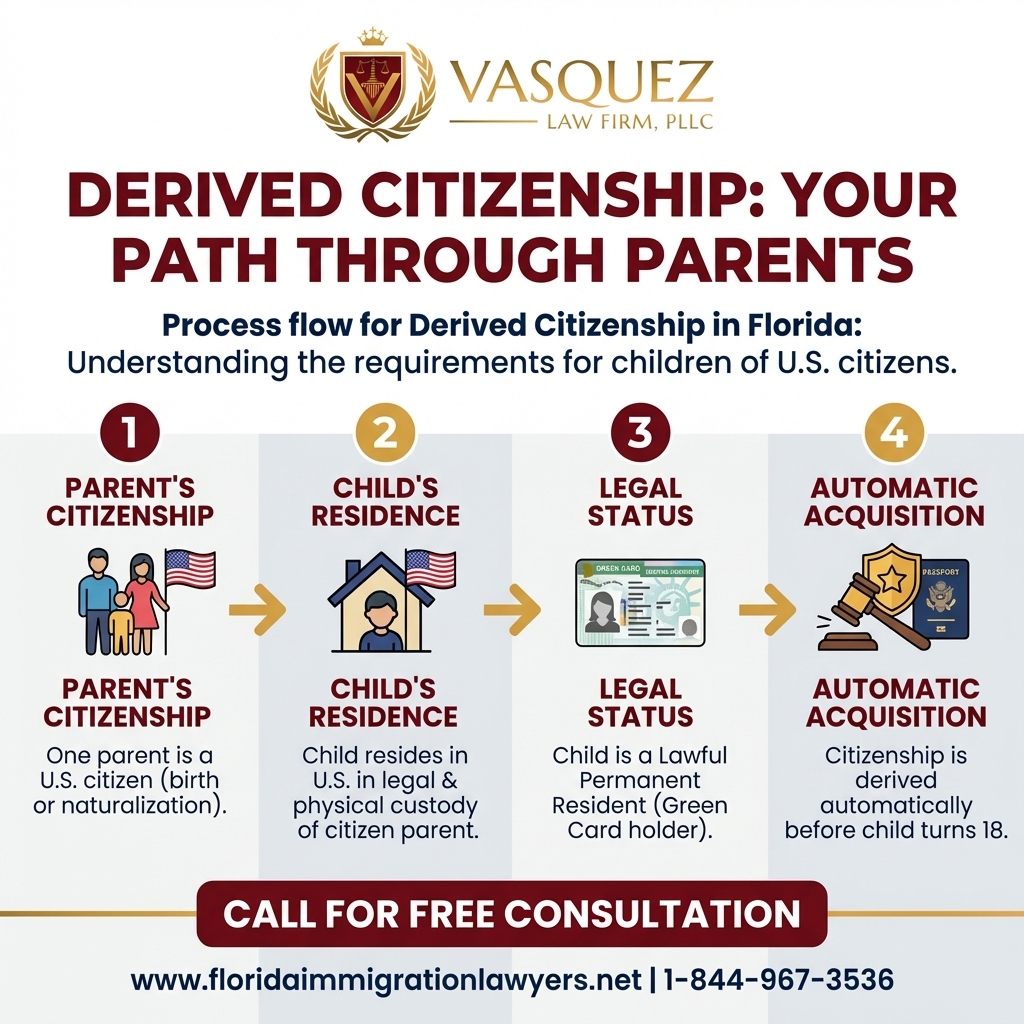
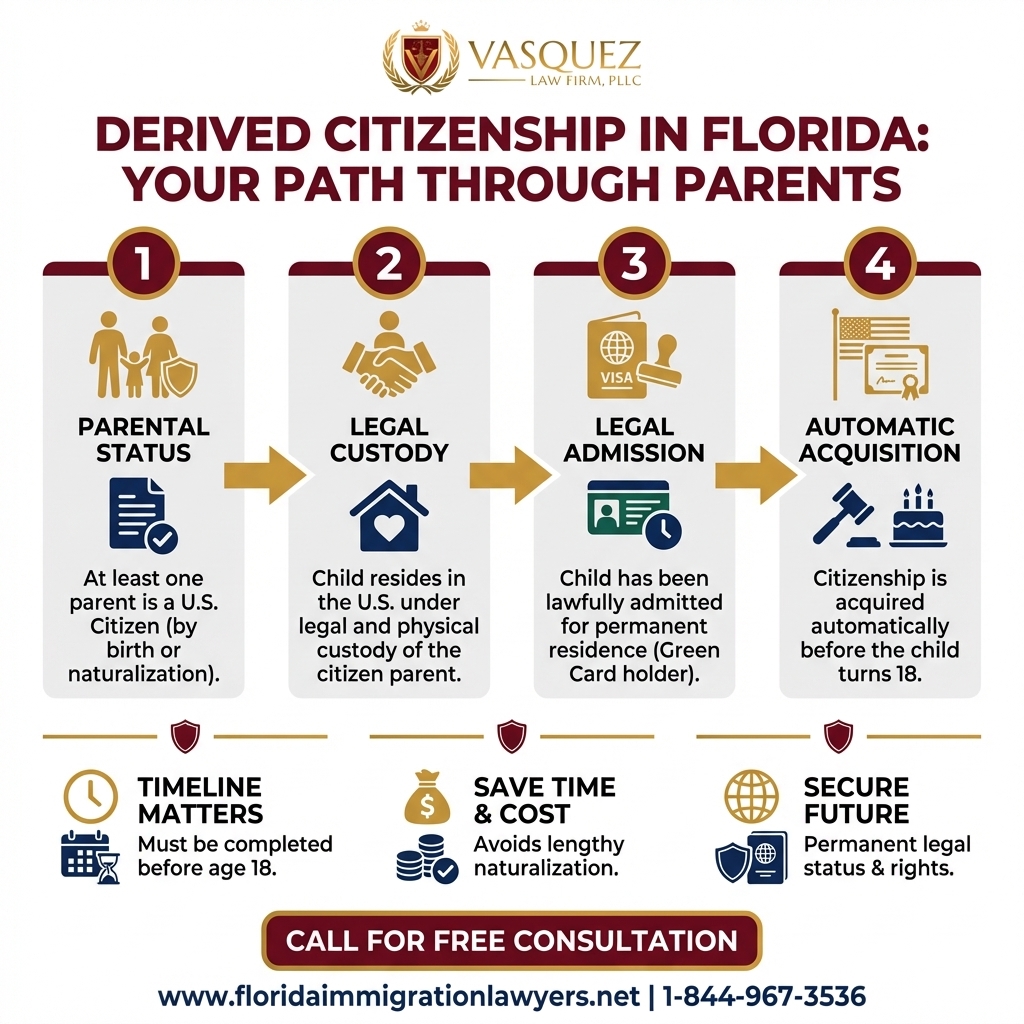
The legal framework for derived citizenship is primarily found in the Immigration and Nationality Act (INA), specifically INA Section 320 (8 U.S.C. 1431) and INA Section 322 (8 U.S.C. 1433). These sections outline the conditions under which a child can automatically acquire citizenship. For a child to derive citizenship under INA 320, three main conditions must be met: at least one parent must be a U.S. citizen (by birth or naturalization), the child must be under 18 years of age, and the child must be residing in the U.S. as a lawful permanent resident in the legal and physical custody of the U.S. citizen parent. This automatic acquisition means no application is necessary for the citizenship itself, though an application for a Certificate of Citizenship (Form N-600) or a U.S. passport is often filed as proof. Knowing these details is crucial for families navigating immigration matters in Florida.
Key Differences: Derived vs. Acquired Citizenship
While often used interchangeably, there is a subtle but important distinction between derived and acquired citizenship. Derived citizenship typically refers to a child gaining citizenship through a parent's naturalization while the child is a lawful permanent resident residing in the U.S. Acquired citizenship, on the other hand, generally refers to a child born outside the U.S. to at least one U.S. citizen parent who meets specific physical presence requirements in the U.S. before the child's birth. This usually occurs at birth or shortly thereafter, often documented through a Consular Report of Birth Abroad (CRBA) if born overseas. Both pathways lead to U.S. citizenship, but the eligibility criteria and timing differ. Understanding which category applies to your situation is the first step toward confirming your or your child's citizenship status.
Eligibility Requirements for Derived Citizenship in Florida
To qualify for derived citizenship, a child must meet several strict criteria on or after February 27, 2001. These conditions ensure that the child has a clear and recognized connection to a U.S. citizen parent. Failure to meet even one of these requirements can prevent the automatic acquisition of citizenship. It is important to review each point carefully to determine eligibility.
- At Least One Parent is a U.S. Citizen: The child's parent must be a U.S. citizen, either by birth in the U.S. or by naturalization. If the parent became a U.S. citizen through naturalization, the child's citizenship derives at the moment the parent naturalizes, provided all other conditions are met. This is a foundational requirement for the process.
- Child is Under 18 Years of Age: The child must be under 18 years old at the time all other conditions are met. If the child turns 18 before the last condition is satisfied, they cannot derive citizenship under INA 320 and may need to pursue other avenues, such as applying for naturalization themselves.
- Child is a Lawful Permanent Resident (Green Card Holder): The child must have been admitted to the U.S. for lawful permanent residence. This means they must possess a valid green card. If the child is in the U.S. on a non-immigrant visa or another temporary status, they are not eligible for derived citizenship until they obtain lawful permanent resident status.
- Child is Residing in the U.S.: The child must be physically residing in the United States. This typically means living in the U.S. with the intent to make it their home. Brief trips abroad are usually acceptable, but extended absences could raise questions about residency.
- Child is in the Legal and Physical Custody of the U.S. Citizen Parent: This is a critical requirement. Legal custody refers to the right to make decisions about the child's upbringing, often granted by a court. Physical custody means the child lives with the U.S. citizen parent. For children of divorced or separated parents in Florida, court orders documenting legal and physical custody are often required. USCIS will scrutinize these arrangements carefully, especially in cases of joint custody or sole custody by a non-citizen parent.
For children adopted by U.S. citizens, similar rules apply, but there are additional requirements related to the adoption process itself. It is crucial to gather all relevant documentation, including birth certificates, marriage certificates, naturalization certificates, green cards, and custody orders, to prove eligibility. Given the precise nature of these requirements, seeking advice from a Florida immigration attorney is highly recommended to confirm your child's eligibility and prepare a strong case.
The Step-by-Step Process to Claim Derived Citizenship
While derived citizenship is automatic upon meeting all criteria, proving that citizenship and obtaining official documentation requires a specific process. The primary method is to file Form N-600, Application for Certificate of Citizenship, with U.S. Citizenship and Immigration Services (USCIS). This certificate serves as official proof of U.S. citizenship, similar to a birth certificate for those born in the U.S.
-
Determine Eligibility:
Before anything else, carefully review the eligibility requirements discussed above. Ensure that the child was under 18, a lawful permanent resident, and in the legal and physical custody of the U.S. citizen parent at the moment the parent naturalized or became a U.S. citizen. If the child meets the criteria, proceed to the next step. If unsure, a consultation with an immigration lawyer at Florida Immigration Lawyers is advisable.
-
Gather Required Documents:
Collect all necessary supporting documentation. This includes proof of the parent's U.S. citizenship (naturalization certificate, U.S. birth certificate, or U.S. passport), the child's birth certificate, the child's green card (Form I-551), marriage certificates (if applicable), divorce decrees or custody orders (if applicable), and any other relevant identification or immigration documents. Accuracy and completeness are paramount.
-
Complete Form N-600:
Fill out Form N-600, Application for Certificate of Citizenship, accurately and completely. This form requests detailed information about the child, the U.S. citizen parent, and their immigration history. Pay close attention to all sections, ensuring consistency with supporting documents. Incorrect or incomplete information can lead to delays or denials. The form can be downloaded from the USCIS website.
-
Pay the Filing Fee:
Submit the required filing fee with your N-600 application. USCIS fees can change, so always check the most current fee schedule on the USCIS website. Fee waivers may be available for eligible applicants, but specific income and hardship criteria must be met.
-
Mail the Application:
Mail the completed Form N-600, all supporting documents, and the filing fee to the appropriate USCIS Lockbox facility. The mailing address depends on where you reside. For Florida residents, this will typically be a lockbox in a different state, which then forwards it to a service center for processing. Always use certified mail with a return receipt to track your submission.
-
Attend Biometrics Appointment (If Required):
After USCIS receives your application, they will send a receipt notice (Form I-797C). Later, they may send an appointment notice for biometrics (fingerprints, photograph, and signature) at a local Application Support Center (ASC). For Florida residents, these centers are located in cities like Miami, Orlando, Tampa, and Fort Myers. It is crucial to attend this appointment.
-
Attend Interview (If Required):
While an interview for Form N-600 is not always required, USCIS may schedule one, particularly if there are complexities in the case or if additional information is needed. The interview would typically take place at a local USCIS field office, such as the Miami Field Office, Orlando Field Office, or Tampa Field Office. The child and the U.S. citizen parent should attend the interview, bringing all original documents.
-
Receive Decision and Certificate of Citizenship:
Once USCIS reviews the application and all supporting evidence, they will issue a decision. If approved, the child will receive a Certificate of Citizenship, which is proof of their U.S. citizenship. This document is essential for obtaining a U.S. passport and other citizenship-related benefits. If denied, USCIS will provide a reason, and you may have options to appeal or reapply, especially with legal guidance.
Essential Document Checklist for Your Application
Preparing a thorough and accurate package of documents is perhaps the most critical part of applying for a Certificate of Citizenship (Form N-600). Missing or incorrect documents can significantly delay your application or even lead to a denial. This checklist will help you organize the necessary paperwork for derived citizenship. Always provide certified copies of original documents, and be prepared to present the originals at an interview if requested by USCIS.
- Child's Documents:
- Child's original birth certificate (with certified translation if not in English).
- Child's Permanent Resident Card (Green Card, Form I-551).
- Child's foreign passport with U.S. entry stamp (if applicable).
- Any previous immigration documents for the child (e.g., I-94 arrival/departure record).
- Two passport-style photos of the child (meeting USCIS specifications).
- U.S. Citizen Parent's Documents:
- Parent's proof of U.S. citizenship (U.S. birth certificate, naturalization certificate, or U.S. passport).
- Parent's marriage certificate (if applicable, to prove relationship with the child's other parent).
- Parent's divorce decrees or death certificates of previous spouses (if applicable).
- Parent's adoption decree (if the child was adopted).
- Custody Documents (if parents are divorced or separated):
- Certified copies of court orders granting legal and physical custody of the child to the U.S. citizen parent.
- Evidence of cohabitation (e.g., utility bills, school records, medical records showing the child resides with the U.S. citizen parent).
- Additional Supporting Evidence:
- Proof of the child's residence in the U.S. with the U.S. citizen parent (e.g., school enrollment records, medical records, tax documents listing the child as a dependent).
- Any other documents requested by USCIS during the process.
Organizing these documents meticulously before filing is a best practice. Creating a detailed index and making copies for your records is also highly recommended. A Florida immigration lawyer can assist in reviewing your documents to ensure everything is in order before submission, minimizing potential issues.
Navigating Timelines and Processing Expectations in Florida
Understanding the potential timelines for a derived citizenship application, specifically Form N-600, is crucial for managing expectations. While USCIS strives for efficiency, processing times can vary significantly based on several factors, including the specific USCIS service center handling the case, the volume of applications, and the complexity of your individual situation. For residents of Florida, applications are typically processed by a national service center, though interviews may occur at local field offices such as Miami, Orlando, or Tampa.
Typical Processing Stages and Timeframes:
- Filing and Receipt: Within 1-3 weeks of mailing your N-600, you should receive a Form I-797C, Notice of Action, confirming receipt of your application. This notice will include a receipt number you can use to track your case online.
- Biometrics Appointment: If required, a biometrics appointment notice typically arrives 3-8 weeks after the receipt notice. The appointment itself usually takes place within 2-4 weeks after receiving the notice.
- Case Review and Interview Scheduling: After biometrics, your case enters a review queue. This stage can vary greatly, from a few months to over a year. If an interview is deemed necessary, you will receive an interview notice.
- Interview and Decision: The interview, if scheduled, is usually straightforward for derived citizenship cases, focusing on verifying documents and eligibility. A decision may be made on the same day or within a few weeks after the interview.
- Certificate Issuance: Once approved, the Certificate of Citizenship is typically mailed within a few weeks after the decision.
Overall, from filing Form N-600 to receiving a Certificate of Citizenship, the process can take anywhere from 6 months to 18 months, or sometimes even longer in complex cases. It is important to regularly check the USCIS website for current processing times for Form N-600 at the relevant service center. These times are estimates and can change without notice. An experienced immigration lawyer can help monitor your case status and address any unexpected delays or requests for additional evidence from USCIS, ensuring your application for parents citizenship proceeds as smoothly as possible.
Understanding Cost Factors and Government Fees
Pursuing derived citizenship involves certain financial considerations, primarily government filing fees and potentially legal fees if you choose to hire an attorney. It is essential to budget for these costs to ensure a smooth application process. While the citizenship itself is automatic, the official documentation through Form N-600 incurs a fee.
USCIS Filing Fees:
The main government fee associated with proving derived citizenship is the filing fee for Form N-600, Application for Certificate of Citizenship. USCIS fees are subject to change, so always consult the official USCIS website for the most up-to-date fee schedule. It is critical not to send an incorrect fee amount, as this can lead to your application being rejected and returned, causing significant delays.
Fee Waivers:
In certain circumstances, applicants may be eligible for a fee waiver. USCIS offers fee waivers for individuals who can demonstrate an inability to pay the filing fee. Eligibility for a fee waiver typically depends on meeting specific income guidelines (e.g., household income at or below 150% of the Federal Poverty Guidelines) or receiving certain means-tested public benefits. If you believe you qualify for a fee waiver, you must submit Form I-912, Request for Fee Waiver, along with your N-600 application and supporting documentation. A lawyer can help you determine if you are eligible and assist with the fee waiver request.
Legal Fees:
While hiring an attorney for derived citizenship is not legally required, it is highly recommended, especially for complex cases or if you wish to ensure the process is handled correctly and efficiently. Legal fees will vary depending on the complexity of your case, the services required, and the attorney's experience. Florida Immigration Lawyers offers transparent fee structures and provides free consultations to discuss your specific needs. Investing in legal counsel can save time, reduce stress, and prevent costly mistakes that could arise from incorrect filings or misunderstandings of immigration law.
Common Mistakes to Avoid When Claiming Derived Citizenship
Navigating immigration law can be complex, and claiming derived citizenship is no exception. Even though citizenship may be automatic, proving it and obtaining the necessary documentation involves strict procedures. Avoiding common pitfalls can save you significant time, stress, and potential denial. Here are some of the most frequent mistakes applicants make:
- Missing the Age Requirement: The child must be under 18 years old when all other conditions are met (parent naturalizes, child becomes an LPR, child is in custody). If the child turns 18 even a day before the last condition is fulfilled, they generally cannot derive citizenship. This is a strict cutoff.
- Not Being a Lawful Permanent Resident (LPR): A common misconception is that simply having a visa or being in the U.S. in another status is sufficient. The child MUST be a green card holder (LPR) for derived citizenship to occur. Without LPR status, citizenship cannot be derived under INA 320.
- Failure to Prove Legal and Physical Custody: Especially in cases of divorce or separation, applicants often fail to provide clear, court-issued documentation proving that the U.S. citizen parent has sole or joint legal and physical custody. USCIS scrutinizes these documents closely.
- Incorrect or Incomplete Form N-600: Filling out the application form with errors, omissions, or inconsistencies with supporting documents is a frequent cause of delays or Request for Evidence (RFE) notices. Every question must be answered accurately.
- Insufficient Supporting Documentation: Not providing all required documents, or submitting uncertified copies when certified ones are needed, can halt the process. Always double-check the USCIS checklist and provide robust evidence for every claim.
- Incorrect Filing Fee: Sending the wrong fee amount, or failing to include payment, will result in the application being rejected and returned. Always verify the current fee on the USCIS website.
- Not Notifying USCIS of Address Changes: Moving without informing USCIS by filing Form AR-11 can lead to missed notices, interview appointments, or requests for evidence, potentially resulting in case abandonment or denial.
- Assuming Citizenship Without Documentation: While derived citizenship is automatic, without a Certificate of Citizenship or U.S. passport, proving it can be challenging for employment, travel, or other benefits. Always get official documentation.
- Failing to Respond to RFEs: If USCIS sends a Request for Evidence, failing to respond fully and within the given deadline will almost certainly lead to a denial. These requests require prompt and thorough action.
- Not Seeking Legal Advice for Complex Cases: Cases involving adopted children, stepchildren, children born out of wedlock, or complex custody arrangements often benefit significantly from legal counsel. Attempting these alone can lead to critical errors.
When to Call a Florida Immigration Lawyer
While the concept of derived citizenship appears straightforward, the application process for a Certificate of Citizenship (Form N-600) can be fraught with complexities. There are many scenarios where the expertise of a Florida immigration lawyer becomes invaluable. Florida Immigration Lawyers are here to help you navigate these challenges and ensure your child's path to citizenship is clear and secure.
You should consider calling an attorney if:
- You are unsure about eligibility: If you are not certain if your child meets all the criteria, especially regarding legal and physical custody, age, or LPR status, a lawyer can assess your specific situation.
- The child was adopted or is a stepchild: These cases often have additional requirements and complexities that need careful review under INA Section 322 or other relevant statutes.
- The U.S. citizen parent is deceased or resided abroad: Specific rules apply when the U.S. citizen parent has passed away or if the child's citizenship is acquired while the parent resided outside the U.S.
- There are issues with legal or physical custody: If there are complex divorce decrees, joint custody arrangements, or a history of non-custodial situations, proving legal and physical custody can be challenging without legal guidance.
- You have a criminal record: While derived citizenship is automatic, a child's criminal record could potentially complicate their LPR status, which is a prerequisite for derivation.
- Your application has been delayed or received a Request for Evidence (RFE): An RFE indicates USCIS needs more information or clarification. A lawyer can help you formulate a comprehensive and timely response.
- Your application was denied: If your N-600 was denied, a lawyer can review the reasons for denial and advise on potential appeals or options for re-filing.
- You need assistance with a fee waiver: Determining eligibility for and properly submitting a fee waiver request can be intricate.
- You prefer expert guidance: For peace of mind and to ensure all steps are followed correctly, having an experienced attorney like those at Florida Immigration Lawyers can make a significant difference. We can help you with general immigration matters, citizenship applications, and more.
About Florida Immigration Lawyers
Florida Immigration Lawyers is a leading immigration law firm dedicated to serving individuals and families across the entire state of Florida. With a deep understanding of U.S. immigration laws and policies, our experienced attorneys provide comprehensive legal services, from family-based petitions and employment visas to deportation defense and citizenship applications. We are committed to offering compassionate, client-focused representation, ensuring that each client receives personalized attention and strategic advice tailored to their unique circumstances.
Our firm prides itself on its accessibility and unwavering commitment to client success. We understand the challenges and anxieties that often accompany immigration processes, which is why we offer free consultations and are available 24/7 to address your concerns. Whether you are in Pembroke Pines, Miami, Orlando, Tampa, or anywhere else in Florida, our team is ready to assist. We speak both English and Spanish, ensuring effective communication and culturally sensitive support for our diverse clientele. Trust Florida Immigration Lawyers to be your steadfast advocate in all your immigration endeavors. Call us today at 1-844-967-3536.
Sources and References
- U.S. Citizenship and Immigration Services (USCIS)
- USCIS Policy Manual: Volume 12, Part H, Chapter 4 - Automatic Acquisition of Citizenship (INA 320)
- Executive Office for Immigration Review (EOIR)
- 8 U.S.C. § 1431 - Citizens and Nationals of United States at Birth
- 8 U.S.C. § 1433 - Children Born and Residing Outside United States of Citizen Parents
- 8 CFR Part 320 - Children of Citizen Parents
- Immigration and Nationality Act (INA)
Related services: naturalization process, citizenship test preparation, dual citizenship guidance, family-based immigration.
This article provides general legal information and is not intended as legal advice. Every case is unique, and outcomes depend on specific facts and circumstances. Contact an attorney for advice about your particular situation.
Securing derived citizenship for your child is a significant step toward their future in the United States. Do not leave this critical process to chance. The experienced legal team at Florida Immigration Lawyers is here to provide the guidance and support you need. We are dedicated to helping families across Florida achieve their immigration goals with confidence and clarity. Call us today at 1-844-967-3536 for a free, confidential consultation. Se Habla Espanol - Estamos aqui para ayudarle.
Do Not Navigate This Process Alone
Our experienced immigration attorneys are ready to fight for you. Get a free, confidential consultation today.
Se Habla Español
Frequently Asked Questions

William J. Vásquez
Founding Attorney · Vasquez Law Firm
U.S. Air Force veteran and immigration attorney with thousands of cases resolved. J.D., NCCU School of Law. AILA member. Admitted to the 4th, 5th, and 11th Circuit Courts.
Available 24/7 - Free Evaluations
Related Legal Services
Our Florida immigration attorneys can help you with family immigration services, immigration practice areas and free immigration consultation. Call today at 1-844-967-3536 for a free consultation.
Related Links
Related Topics
Free Legal Consultation
Discuss your case with our experienced attorneys. We're available 24/7.
Se Habla Español - Estamos aquí para ayudarle.
Related Articles
TPS Florida Eligible Countries 2026 | FL Immigration Lawyers
Explore Temporary Protected Status (TPS) eligibility for Florida in 2026, focusing on countries facing turmoil and how to apply. Contact Florida Immigration Lawyers for personalized assistance.
Understanding the Asylum One-Year Deadline in Florida
The asylum one-year filing deadline is critical for those seeking refuge in the U.S. Understanding exceptions and preparing your application carefully can influence the outcome of your asylum case. Contact Florida Immigration Lawyers for expert guidance.
Citizenship Application Delay in Florida: What to Know
Facing citizenship application delays in Florida? Discover the key reasons behind N-400 processing backlogs in 2026 and learn how to navigate them effectively. Whether you're in Homestead or elsewhere in Florida, our guide provides actionable insights and tips to help manage your citizenship journey. Contact Florida Immigration Lawyers for personalized support.
F-1 Reinstatement Student Visa Process in Florida | VLF Florida
F-1 reinstatement allows students in Coral Springs, Florida, to regain their student visa status if they have fallen out of status. This comprehensive guide covers eligibility, application steps, and common pitfalls, ensuring you are well-prepared. Contact Florida Immigration Lawyers at 1-844-967-3536 for a free consultation.