Derived Citizenship Florida: A Guide for Children of...
For children of U.S. citizens in Florida, understanding derived and acquired citizenship is crucial. This guide details eligibility, processes, and required documents for claiming U.S. citizenship through parents, whether born abroad or through parental naturalization. Learn about filing Form N-600, common mistakes to avoid, and when to seek legal assistance. Florida Immigration Lawyers offers expert guidance for navigating these complex laws, helping you secure your Certificate of Citizenship. Discover how our dedicated attorneys can support you in Fort Lauderdale and across Florida.

Derived citizenship in Florida allows children of U.S. citizens, typically born abroad or acquiring permanent residency, to automatically become citizens under specific legal conditions. This process often involves proving a qualifying parental relationship, the parent's U.S. citizenship, and the child's lawful permanent resident status or birth abroad to a U.S. citizen parent. It's crucial to understand the nuances of the Child Citizenship Act to establish your claim.
- Eligibility hinges on parent's citizenship, child's age, and residency status.
- The process may involve filing Form N-600 or obtaining a Consular Report of Birth Abroad (CRBA).
- Specific legal requirements apply to children born out of wedlock or adopted.
- Consulting an attorney is highly recommended to navigate complex cases.
- Gather comprehensive documentation to support your citizenship claim.
Derived Citizenship Florida: A Guide for Children of U.S. Citizens
Are you a child of a U.S. citizen, living in Florida, and wondering if you are already a U.S. citizen? The process of gaining U.S. citizenship through your parents can often seem complex and overwhelming. Many individuals, especially those born outside the United States or whose parents naturalized after their birth, may not realize they are already citizens or are eligible for a streamlined path to citizenship.
Understanding derived citizenship and acquired citizenship is vital for anyone in this situation. This comprehensive guide will walk you through the various pathways to becoming a U.S. citizen through your parents, focusing on the specific requirements and processes relevant to Florida residents. We will cover everything from eligibility criteria to the documentation needed, common pitfalls, and when professional legal assistance is indispensable.
At Florida Immigration Lawyers, we understand the profound impact U.S. citizenship has on your life and future. Our dedicated team is here to help you navigate these intricate laws with clarity and confidence. If you believe you may be eligible for derived citizenship Florida, do not hesitate to seek expert guidance. Call Florida Immigration Lawyers at 1-844-967-3536 for a free consultation and let us help you secure your rightful place as a U.S. citizen.
Understanding Citizenship Through Parents in Florida
U.S. citizenship can be obtained in several ways: by birth in the United States (birthright citizenship), through naturalization, or through parents. When we discuss citizenship through parents, we are generally referring to two categories: acquired citizenship and derived citizenship. While often used interchangeably, they have distinct legal meanings and requirements.
Acquired citizenship typically applies to children born outside the United States to at least one U.S. citizen parent. This form of citizenship is usually automatic at birth, provided certain conditions regarding the U.S. citizen parent's physical presence in the U.S. prior to the child's birth are met. For example, if a U.S. citizen parent lived in the U.S. for a certain period, their child born abroad may be a U.S. citizen from birth.
Derived citizenship, on the other hand, usually applies to children who are not U.S. citizens at birth but automatically become citizens after birth. This happens when their U.S. citizen parent naturalizes, or when a U.S. citizen parent adopts them, provided specific conditions are met before the child turns 18 years old. Both types of citizenship lead to the same rights and privileges, but the path to recognition differs.
For families living in Fort Lauderdale and across Florida, understanding these distinctions is crucial. The laws governing citizenship through parents are outlined in the Immigration and Nationality Act (INA), specifically sections like INA 301, INA 309, and INA 320. These statutes dictate who qualifies and under what circumstances. Our firm has extensive experience helping Florida families navigate these provisions, ensuring accurate interpretation and application of the law.
Eligibility Requirements for Derived and Acquired Citizenship
Eligibility for citizenship through parents is highly dependent on the specific circumstances of the child's birth and the parents' citizenship status. It is important to carefully review all criteria to determine the appropriate path.
Born Abroad to U.S. Citizens (Acquired Citizenship)
If you were born outside the U.S. to at least one U.S. citizen parent, you might have acquired citizenship at birth. The key factors include:
- Parent's Citizenship: At least one of your parents was a U.S. citizen at the time of your birth.
- Parent's Physical Presence: Your U.S. citizen parent must have resided in the U.S. or its outlying possessions for a specific period prior to your birth. The exact duration depends on whether one or both parents were U.S. citizens and the date of birth. For births on or after November 14, 1986, a U.S. citizen parent must have been physically present in the U.S. for five years, with at least two of those years after turning 14.
- Legitimation: If only your father was a U.S. citizen and you were born out of wedlock, additional requirements might apply, such as legitimation by the father.
This pathway is typically documented by obtaining a Consular Report of Birth Abroad (CRBA) at a U.S. embassy or consulate, or by filing Form N-600, Application for Certificate of Citizenship, with USCIS.
Children of Naturalized Parents (Derived Citizenship)
If you were not a U.S. citizen at birth but your parent(s) later naturalized, you might have derived citizenship automatically. The conditions for citizenship through parents before 18 are stringent:
- One Parent is a U.S. Citizen: At least one of your parents must be a U.S. citizen, either by birth or naturalization.
- Child Under 18: You must be under 18 years of age at the time your parent naturalizes.
- Lawful Permanent Resident (LPR) Status: You must be a lawful permanent resident (Green Card holder) when your parent naturalizes.
- Residing in U.S. Citizen Parent's Custody: You must be residing in the United States in the legal and physical custody of your U.S. citizen parent.
If all these conditions are met simultaneously, your citizenship is automatic. You do not need to file an application to become a citizen, but you may need to file Form N-600 to obtain a Certificate of Citizenship as proof. This is distinct from citizenship through parents after 21, which usually refers to a U.S. citizen petitioning for their adult parent to immigrate.
The Step-by-Step Process to Claim Your Citizenship
Once you determine your eligibility, the next step is to obtain official documentation of your U.S. citizenship. This typically involves filing Form N-600 or, for those born abroad, applying for a Consular Report of Birth Abroad.
-
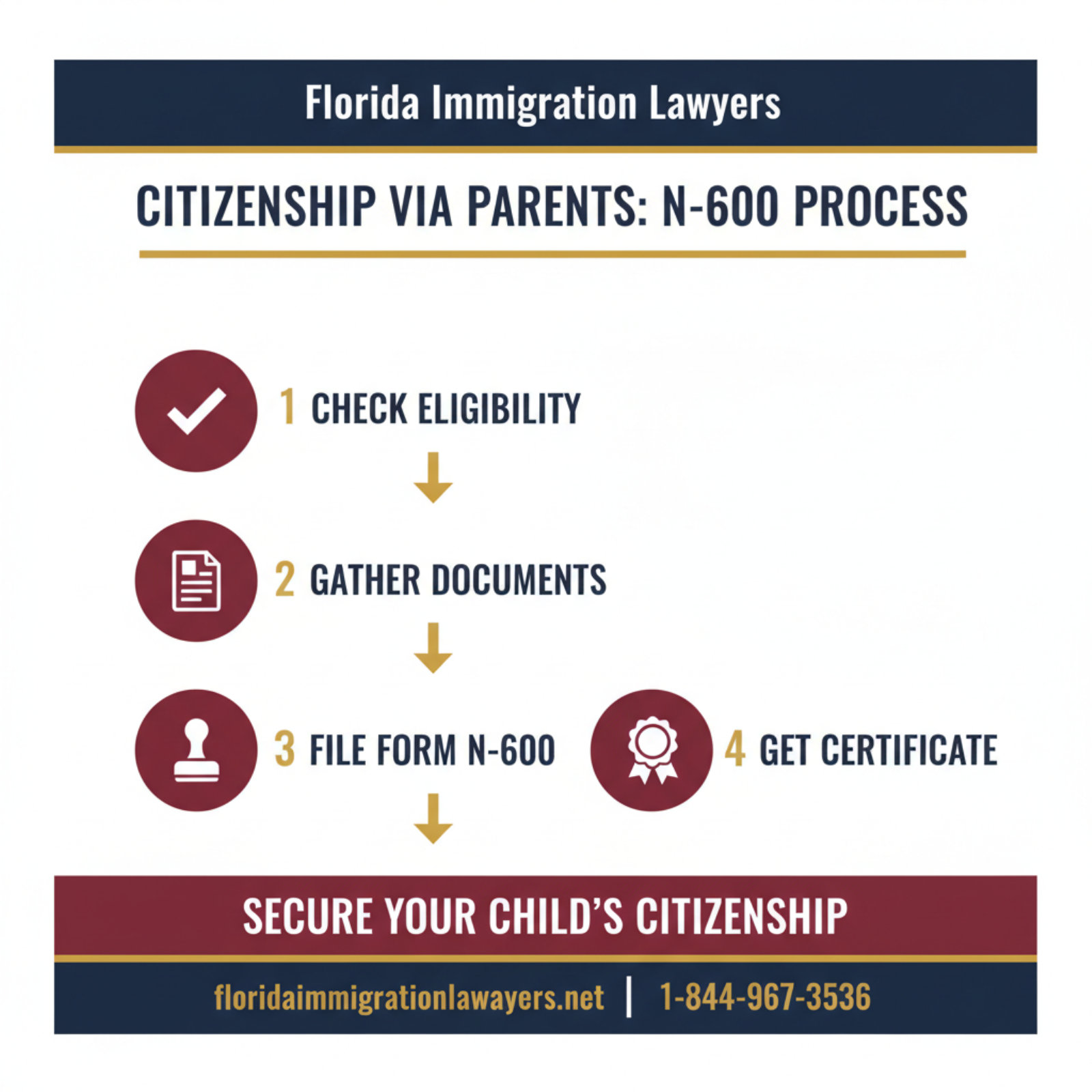
Determine Your Eligibility: Carefully review the criteria for both acquired and derived citizenship. This is the most critical initial step, as it dictates the forms and evidence you will need. Consider factors like your date of birth, your parents' citizenship status at your birth or naturalization date, their physical presence in the U.S., and your lawful permanent resident status if applicable. Legal counsel can provide an accurate assessment.
-
Gather Required Documentation: Collect all necessary documents to support your claim. This includes birth certificates, marriage certificates, divorce decrees, parents' naturalization certificates, proof of U.S. citizen parent's physical presence, your Green Card (if applicable), and any other supporting evidence. Accuracy and completeness are paramount.
-
Complete Form N-600, Application for Certificate of Citizenship: If you are seeking official proof of your acquired or derived citizenship, you will need to file Form N-600 with U.S. Citizenship and Immigration Services (USCIS). This form is used to apply for a Certificate of Citizenship, which serves as official proof of your U.S. citizenship. Complete the form accurately and thoroughly, answering all questions honestly.
-
Pay the Filing Fee: There is a fee associated with filing Form N-600. Ensure you submit the correct fee, payable to the U.S. Department of Homeland Security. USCIS fee schedules can change, so always check the most current information on their official website. Fee waivers may be available for eligible low-income applicants.
Step-by-Step Process Guide -
Attend Biometrics Appointment: After filing, USCIS will send you an appointment notice for biometrics collection. This involves fingerprinting and photographing, which are used for background checks. Attend this appointment promptly at the designated USCIS Application Support Center (ASC) in Florida, such as those serving Fort Lauderdale or Miami.
-
Attend the Interview (if required): In some cases, USCIS may require an interview to verify information or clarify aspects of your application. Both the applicant and the U.S. citizen parent(s) may need to attend. Prepare to answer questions about your family history, your parents' citizenship, and your residency. An attorney can help you prepare for this crucial step.
-
Receive Decision and Certificate of Citizenship: If your application is approved, USCIS will mail you a Certificate of Citizenship. This document serves as definitive proof of your U.S. citizenship and can be used to apply for a U.S. passport. If your application is denied, it is critical to understand the reasons and consult with an immigration attorney immediately to explore your options.
Essential Documents for Your Citizenship Application
A successful application for a Certificate of Citizenship hinges on providing comprehensive and accurate documentation. Missing or incorrect documents can lead to delays or even denial. Here is a general checklist of documents you may need:
- Your birth certificate (original or certified copy).
- Your parents' marriage certificate (if applicable).
- Any divorce decrees or death certificates for parents (if applicable).
- Your U.S. citizen parent's birth certificate or naturalization certificate (Form N-550 or N-570).
- Evidence of your U.S. citizen parent's physical presence in the U.S. prior to your birth (e.g., school records, employment records, tax returns, utility bills).
- If applicable, your lawful permanent resident card (Green Card).
- Your parents' passport photos.
- If applicable, adoption decree and evidence of legal and physical custody by the adoptive U.S. citizen parent.
- If born out of wedlock, evidence of legitimation (e.g., subsequent marriage of parents, court order).
- Any previous U.S. passports or Consular Reports of Birth Abroad (CRBA) if you have them.
- Certified English translations of any foreign language documents.
It is important to submit copies of these documents, but be prepared to present originals at an interview if requested. Always keep certified copies of everything you submit.
Timeline and Processing Expectations for Florida Applicants
The processing time for Form N-600 can vary significantly based on the specific USCIS service center handling your application and the volume of cases. While USCIS provides estimated processing times on their website, these are just averages and not guarantees. For applicants in Florida, cases are typically processed through the USCIS field offices in Miami, Orlando, or Tampa, depending on your residence.
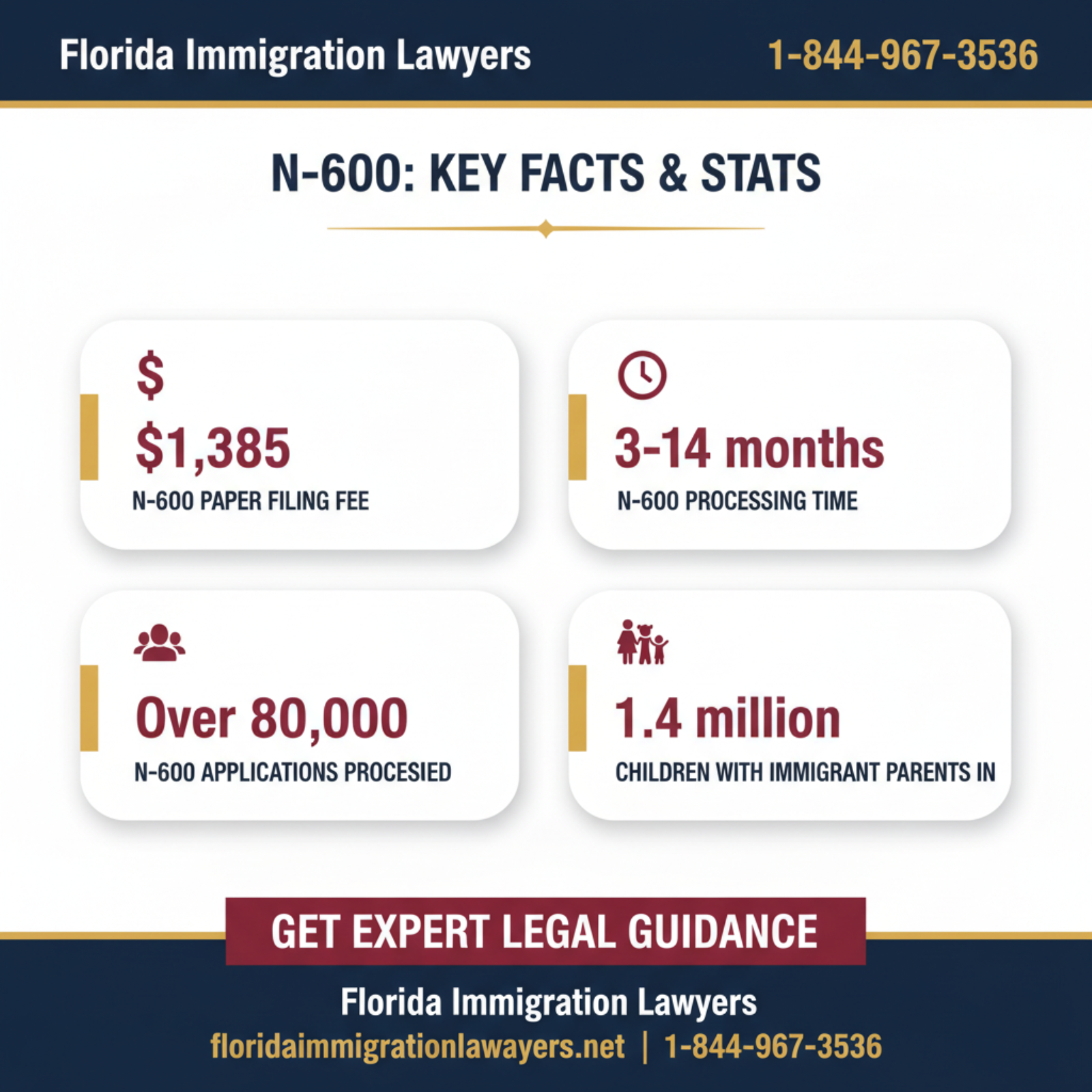
Generally, you can expect the process to take anywhere from 6 to 18 months, or sometimes longer. Factors that can influence the timeline include the complexity of your case, the completeness of your application, and whether an interview is required. Delays can also occur if USCIS issues a Request for Evidence (RFE), requiring you to submit additional documentation.
It is crucial to monitor your case status online using the receipt number provided by USCIS. If your case falls outside the normal processing times, you may be able to make an inquiry. However, patience and thorough preparation are key to minimizing delays. Our firm helps clients in Fort Lauderdale and across Florida manage these expectations and track their applications diligently.
Cost Factors and Fee Breakdown for Citizenship Applications
Applying for a Certificate of Citizenship involves certain fees that applicants should be prepared for. The primary cost is the USCIS filing fee for Form N-600, Application for Certificate of Citizenship. This fee is subject to change, so always verify the current amount on the official USCIS website before filing. As of early 2026, the fee is substantial, and it is non-refundable, even if your application is denied.
In addition to the filing fee, other potential costs may include:
- Biometrics Fee: This fee is typically included in the N-600 filing fee, but verify this on the USCIS fee schedule.
- Document Translation Fees: If any of your supporting documents are not in English, you will need to pay for certified translations.
- Photocopying and Postage: Costs associated with preparing and mailing your application package.
- Legal Fees: Hiring an experienced immigration attorney, like those at Florida Immigration Lawyers, is an investment that can significantly improve your chances of success. While not mandatory, legal representation helps ensure your application is complete, accurate, and properly presented, potentially saving you time and preventing costly errors.
USCIS offers fee waivers for certain low-income applicants who meet specific federal poverty guidelines. If you believe you may qualify for a fee waiver, you must file Form I-912, Request for Fee Waiver, along with your Form N-600 and supporting documentation. Consulting with a legal professional can help you understand your eligibility for a fee waiver and ensure proper submission.
Do not navigate this process alone. The complexities of immigration law require careful attention to detail and a deep understanding of ever-changing regulations. Contact Florida Immigration Lawyers today for expert guidance tailored to your unique situation. We are ready to help you every step of the way.
Common Mistakes to Avoid When Claiming Citizenship Through Parents
Navigating the path to citizenship through your parents can be fraught with potential pitfalls. Avoiding these common mistakes can save you significant time, money, and stress.
-
Misinterpreting Eligibility Requirements: Many applicants mistakenly believe they are citizens when they do not meet all the stringent legal criteria, or conversely, fail to realize they are eligible. This often happens with the physical presence requirements for parents or the legal/physical custody rules for derived citizenship. Incorrectly assessing eligibility can lead to filing the wrong form or a direct denial.
-
Filing the Wrong Form: Depending on whether you acquired citizenship at birth or derived it later, and whether you are simply seeking proof, you might need Form N-600 or a Consular Report of Birth Abroad (CRBA). Filing the incorrect form will inevitably lead to rejection and delays.
-
Incomplete or Inaccurate Documentation: Failing to submit all required documents, or providing documents with errors or inconsistencies, is a leading cause of delays and denials. Every piece of evidence must directly support your claim and be properly presented. For example, not having sufficient proof of a U.S. citizen parent's physical presence.
-
Failure to Provide Certified Translations: Any document not in English must be accompanied by a complete and certified English translation. Without this, USCIS will not accept the document, halting your application process.
-
Not Disclosing All Relevant Information: Hiding or omitting information, even if seemingly minor, can be considered misrepresentation and lead to severe immigration consequences, including denial and potential bars to future benefits. Always be truthful and transparent.
-
Ignoring Criminal History: Any criminal record, even minor infractions, for either the child or the petitioning parent, must be disclosed. While a criminal record might not always prevent citizenship, failure to disclose it will almost certainly lead to denial. Seek legal advice on how to present such information.
-
Missing Deadlines or Appointments: USCIS operates on strict timelines for responses to Requests for Evidence (RFEs) or interview notices. Missing these deadlines can result in your application being considered abandoned or denied. Always keep track of all correspondence.
-
Assuming Automatic Proof: While citizenship might be automatic, the proof is not. You still need to apply for a Certificate of Citizenship (N-600) or a U.S. Passport to have official documentation. Without it, you cannot fully exercise your rights as a citizen.
-
Not Understanding the Custody Requirements: For derived citizenship, the child must be residing in the legal and physical custody of the U.S. citizen parent when the parent naturalizes. Misunderstanding what constitutes legal and physical custody can invalidate a claim.
-
Failing to Seek Legal Counsel: The laws surrounding citizenship through parents are intricate and frequently updated. Attempting to navigate this without professional legal advice can lead to costly mistakes. An experienced immigration attorney can identify potential issues, ensure proper documentation, and represent your best interests.
When to Call a Lawyer for Citizenship Through Parents
While some cases of citizenship through parents may seem straightforward, many situations present unique challenges that warrant the expertise of an immigration attorney. Florida Immigration Lawyers is here to provide the guidance you need, especially in complex scenarios.
Consider seeking legal assistance if:
- Your eligibility is unclear: If you are unsure whether you meet all the requirements for acquired or derived citizenship, particularly regarding your parents' physical presence or your custody status.
- You were born out of wedlock: The rules for children born out of wedlock to U.S. citizen fathers can be particularly complex and require specific proof of legitimation.
- You were adopted: Adoption cases have distinct requirements under the Child Citizenship Act (CCA), and proving a valid adoption can be challenging.
- Your parents were divorced or separated: Issues of legal and physical custody become critical in these situations and must be carefully documented.
- You have a criminal record: Any past legal issues, even minor ones, can complicate your application. An attorney can advise you on how to address these and their potential impact.
- USCIS has issued a Request for Evidence (RFE) or Notice of Intent to Deny (NOID): These indicate that USCIS requires more information or intends to deny your application. Responding effectively requires legal expertise.
- Your application has been denied: If your N-600 application is denied, an attorney can help you understand the reasons for denial and explore options for appeal or refiling.
- You need assistance gathering documentation: Locating and organizing all necessary birth records, naturalization certificates, and proof of physical presence can be daunting.
Our attorneys at Florida Immigration Lawyers regularly assist clients in Fort Lauderdale, Miami, Orlando, and throughout Florida with these precise issues. We can help you prepare for interviews, respond to USCIS inquiries, and represent you in all aspects of your citizenship claim. We are committed to protecting your rights and ensuring a smooth process.
About Florida Immigration Lawyers
Florida Immigration Lawyers is a leading immigration law firm dedicated to serving individuals and families across the entire state of Florida. With a deep understanding of U.S. immigration laws and a passion for helping our clients achieve their American dreams, we provide comprehensive legal services tailored to your unique needs.
Our firm specializes in a wide range of immigration matters, including citizenship applications, family-based immigration, deportation defense, asylum, and business immigration. We pride ourselves on offering compassionate, client-focused representation, ensuring that you feel supported and informed at every stage of your legal journey. Our team of experienced attorneys is committed to delivering exceptional results.
Why choose Florida Immigration Lawyers? We offer personalized attention, strategic legal advice, and a relentless pursuit of justice for our clients. We understand the specific challenges faced by immigrants in Florida and are equipped to provide effective solutions. Our services are available 24/7, and we offer free consultations to discuss your case and outline your best path forward. For reliable and dedicated legal assistance, reach out to us today.
Phone: 1-844-967-3536
Website: https://www.floridaimmigrationlawyers.net
Serving all of Florida, including Fort Lauderdale, Miami, Orlando, and Tampa.
Sources and References
- U.S. Citizenship and Immigration Services (USCIS) - Certificate of Citizenship
- U.S. Department of State - Acquisition of U.S. Citizenship by a Child Born Abroad
- 8 U.S.C. § 1401 (INA 301) - Nationals and citizens of United States at birth
- 8 U.S.C. § 1409 (INA 309) - Children born out of wedlock
- 8 U.S.C. § 1431 (INA 320) - Children born outside United States and residing permanently in United States; conditions for automatic citizenship
- 8 CFR Part 320 - Revocation of Certificates of Citizenship
This article provides general legal information and is not intended as legal advice. Every case is unique, and outcomes depend on specific facts and circumstances. Contact an attorney for advice about your particular situation. Immigration laws are subject to change, and this information may not reflect the most current legal developments.
Securing your U.S. citizenship through your parents is a significant milestone that can open many doors for your future in Florida and beyond. Whether you are seeking to confirm your existing citizenship or navigate the application process for the first time, having knowledgeable legal support is invaluable. The team at Florida Immigration Lawyers is dedicated to helping you achieve your citizenship goals with confidence and peace of mind.
Do not let the complexities of immigration law deter you from claiming your rightful place as a U.S. citizen. We offer free consultations to assess your unique situation and provide clear, actionable advice. Contact Florida Immigration Lawyers today at 1-844-967-3536 to schedule your free consultation. Se Habla Español - Estamos aquí para ayudarle.
Do Not Navigate This Process Alone
Our experienced immigration attorneys are ready to fight for you. Get a free, confidential consultation today.
Se Habla Español
Frequently Asked Questions
Florida Immigration Lawyers
Immigration Attorney | Founder, Vasquez Law Firm
U.S. Air Force veteran and immigration attorney with thousands of cases resolved. J.D., NCCU School of Law. AILA member. Admitted to the 4th, 5th, and 11th Circuit Courts.
Available 24/7 - Free Evaluations
Related Legal Services
Our Florida immigration attorneys can help you with asylum protection, deportation defense and citizenship and naturalization. Call today at 1-844-967-3536 for a free consultation.
Related Links
Related Topics
Free Legal Consultation
Discuss your case with our experienced attorneys. We're available 24/7.
Se Habla Español - Estamos aquí para ayudarle.
Related Articles
Stokes Interview: Navigating Marriage Fraud in Florida
A Stokes interview is a specialized, separate interview conducted by USCIS when there are suspicions of marriage fraud in a green card application. This rigorous process involves individual questioning of spouses, focusing on inconsistencies in their testimonies to determine the authenticity of their marital bond. For couples in Florida, navigating this high-stakes interview requires meticulous preparation, extensive documentation, and often the strategic guidance of an experienced immigration lawyer. Understanding the process, preparing for detailed questions, and presenting a strong case are crucial for overcoming marriage fraud allegations and securing your immigration future. Florida Immigration Lawyers stands ready to assist you.
Immigration Attorney Gainesville: North Florida Legal Help
For those in Gainesville, Alachua County, and throughout North Florida, navigating U.S. immigration law requires expert guidance. An experienced immigration attorney can simplify complex processes, from family-based petitions and employment visas to critical asylum claims and deportation defense. This comprehensive guide outlines the essential services provided by an immigration attorney, details necessary documentation, clarifies processing timelines, and discusses associated costs. We also highlight common mistakes to avoid and crucial scenarios where legal counsel is indispensable. Florida Immigration Lawyers serves all of Florida, including Gainesville and St. Petersburg, providing dedicated legal support to help you achieve your immigration goals. Contact us for a free consultation to discuss your specific needs.
Military Naturalization Expedited at Florida Bases
Explore expedited military naturalization processes for service members at Florida bases like MacDill. Learn about eligibility, steps, and common mistakes. Contact Florida Immigration Lawyers for a free consultation.
Protect Yourself from Immigration Scams in Florida
Learn how to protect against immigration scams in Florida, focusing on St. Petersburg. This guide covers identifying scams, verifying credentials, and getting legal help. Call Florida Immigration Lawyers at 1-844-967-3536 for assistance.