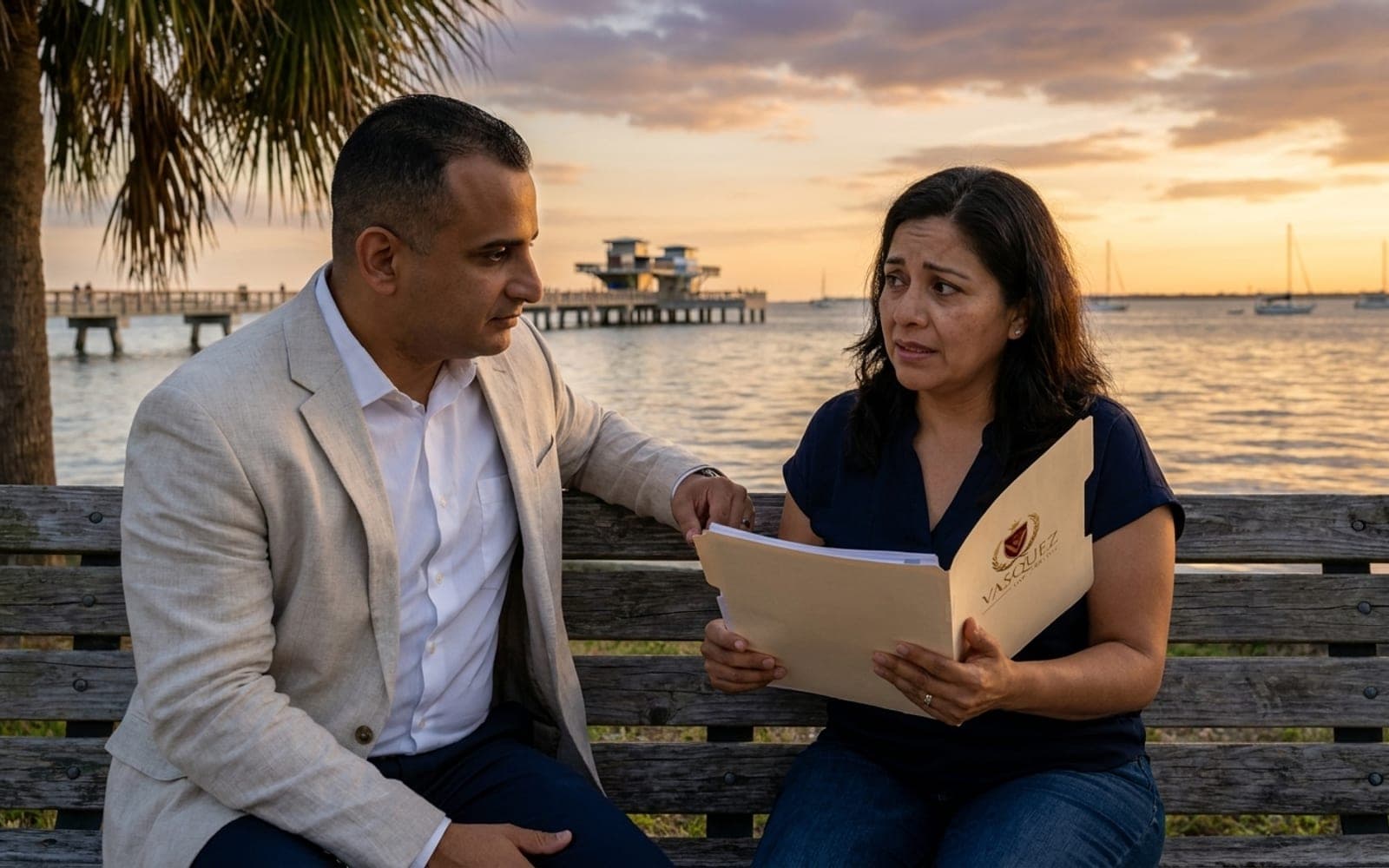
Removal proceedings are civil cases in immigration court, but the consequences can be permanent: a removal order can separate a family and bar return for years. If you live in Gulfport, St. Petersburg or Clearwater and received a Notice to Appear, were detained, or were charged with a crime as a noncitizen, speak with an immigration lawyer before your next court date or plea. The lawyer tests the allegations, requests your file and looks for relief such as cancellation of removal, asylum or waivers. We serve Pinellas by phone and video.
- Speak with a lawyer before your next court date or any plea.
- Lawyers test government allegations and request immigration and criminal records.
- Possible relief includes cancellation of removal, asylum and waivers.
- Pinellas clients are served by phone, video and Orlando meetings.
Introduction
If you live in Gulfport, St. Petersburg, or Clearwater and have received a Notice to Appear, been detained, or been charged with a crime while not a U.S. citizen, speak with an immigration lawyer before your next court date or plea. This guide is for Pinellas County families who are looking for a deportation defense attorney and want to understand the process, the questions to ask, and what to gather first. To discuss your situation, call 1-844-YO-PELEO or contact us.
Vasquez Law Firm represents Pinellas County clients in deportation and criminal-immigration matters by phone and secure video, and meets clients in person at our office in Orlando. We have no office in Gulfport, St. Petersburg, or Clearwater, and we say so plainly.
This article is general information, not legal advice. Every case depends on its facts and on the rules in force, which change, so a lawyer must review your papers before telling you what may be possible.
What a Deportation Defense Lawyer Does in Pinellas County
Removal proceedings are civil cases in immigration court, but the consequences can be permanent: a removal order can separate a family and bar a return to the United States for years. A lawyer's job is to understand exactly what the government is alleging, to test whether those allegations can be proven, and to find every form of relief the law allows for the client's facts. In practice, that work usually includes the following.
- Reviewing the Notice to Appear for errors in the factual allegations and the charges of removability.
- Requesting the client's immigration file and, when relevant, the full criminal court record.
- Identifying relief such as cancellation of removal, adjustment of status, asylum, withholding of removal, Convention Against Torture protection, waivers, or voluntary departure.
- Preparing the client and witnesses for testimony and filing evidence on time.
- Asking for a bond hearing when the client is detained and eligible.
You can read more about each type of relief on our deportation defense practice page.
Immigration Help for Gulfport Residents
Gulfport is a small city, and many of the families who contact us from there have deep roots: children in local schools, long work histories, and homes they have owned for years. Those roots matter in court. Some forms of relief, such as cancellation of removal for non-permanent residents, depend on years of continuous presence, good moral character, and the hardship a removal would cause to a U.S. citizen or permanent resident spouse, parent, or child.
A deportation defense attorney should start by building a timeline of the client's entries, exits, immigration filings, and any arrests. Small details, such as a trip abroad or the date a Notice to Appear was served, can change which relief is available. When a person asks us what a lawyer can realistically do, our honest answer is that it depends on that timeline and on the record, which is why we review documents before giving an opinion.
We also hear from relatives who are searching for help after a family member was picked up unexpectedly. In that situation, the first questions are where the person is being held, whether a bond is possible, and whether there is an old removal order that could be reinstated. A lawyer should be able to answer those questions quickly and explain the next steps in plain language, in English or Spanish.
How the Removal Process Works in Florida
The sequence below is typical, although timing and details differ by court and by whether the person is detained.
- The government serves a Notice to Appear, which states the allegations and the charges.
- The person appears at a master calendar hearing, answers the charges, and tells the judge what relief will be requested.
- The judge sets deadlines for applications and evidence and schedules an individual hearing.
- The lawyer prepares applications, testimony, witnesses, and documents.
- At the individual hearing, testimony is taken and a decision is made.
- Either side may appeal, and in limited situations a motion to reopen may be possible.
Hearings, Detention, and Bond for St. Petersburg Residents
For someone who lives in St. Petersburg, the case is heard by the immigration court assigned in the Notice to Appear, or by a detained docket if the person is in custody. The first appearances are master calendar hearings, where the respondent answers the charges and tells the judge what relief they will request. The judge then sets deadlines for applications and evidence and schedules an individual hearing, where testimony is taken and a decision is made.
A lawyer will usually focus on three early decisions: whether to contest the charges, which applications to file, and whether to request bond. Bond is not available to everyone, since certain criminal histories trigger mandatory detention and prior removal orders can limit options. When bond is available, the judge looks at flight risk and danger to the community, so evidence of family ties, employment, and community support matters. Our immigration bond page explains that process.
Anyone looking for an attorney for deportation should also know that missing a hearing can result in an order of removal entered in absentia. If you have moved, the court and immigration authorities must have your current address. If an in-absentia order already exists, a motion to reopen may be possible in limited circumstances, and timing is critical.
Criminal Charges and Immigration Status in Clearwater
Many of the calls we receive from Clearwater start with an arrest rather than an immigration notice. A person who is not a U.S. citizen, including a green card holder, can face deportation or be blocked from future benefits because of certain convictions. Categories that often matter include aggravated felonies, crimes involving moral turpitude, controlled substance offenses, firearm offenses, and domestic violence offenses. Whether a specific Florida offense falls into one of these categories depends on the statute and the record, not just the name of the charge.
Florida practice adds a complication. A withhold of adjudication, which many people believe is not a conviction, can still count as a conviction for immigration purposes when there was a plea and some form of punishment or restraint was imposed. That is why the immigration analysis should happen before a plea is entered, not after.
People sometimes search for one lawyer who can handle both the criminal charge and the immigration case. Our firm practices immigration law only, so we do not defend the criminal charge. What a criminal immigration lawyer does is advise on the immigration consequences of each possible outcome and coordinate with the client's criminal defense attorney, so that the plea, the sentence, and the record are evaluated with immigration status in mind.
Document Checklist for Your First Consultation
- The Notice to Appear, any hearing notices, and any prior immigration court decisions.
- Your passport, visas, I-94 record, green card, or work permit.
- Copies of any immigration applications you or a relative filed, and the receipts or decisions.
- For any arrest: the arrest report, charging document, plea form, judgment, and sentence, even for old or dismissed cases.
- Proof of family relationships, residence, employment, and taxes.
- For a detained family member: full name, date of birth, country of birth, and the alien registration number if you know it.
A consultation is far more useful when we can see the documents, but do not delay a call because something is missing. Bring what you have.
Timeline and Processing Expectations
There is no standard length for a removal case. The pace depends on the court's calendar, the judge, the relief requested, and whether the person is detained. The immigration courts and USCIS publish current information, and it changes often, so we do not predict how long a case will take.
What a client can control is preparation and attention to dates. The table below shows the usual stages and who acts at each one.
| Stage | What happens | Who acts |
|---|
| Notice to Appear | Allegations and charges are filed and served | DHS |
| Master calendar hearing | Charges answered; relief identified; deadlines set | Judge, respondent, lawyer |
| Case preparation | Applications, evidence, and witnesses are prepared | Lawyer, respondent |
| Individual hearing | Testimony taken; decision made | Judge, DHS attorney, respondent |
| After the decision | Appeal, motion to reopen, or compliance with an order | Lawyer, Board of Immigration Appeals |
How a Statement and a Strong Defense Are Prepared
At the individual hearing, what you say and the evidence you present often carry great weight. That is why preparation starts weeks ahead: the timeline is reviewed, documents are checked, and the questions the government's attorney might ask are practiced. Your statement should be clear, honest, and consistent with what you said in earlier applications and interviews, because the government compares every version.
Evidence matters too. For an application based on family ties, birth and marriage certificates, the children's school records, and letters from relatives or the community may help. To show years of residence, receipts, leases, medical records, and tax filings can help. Each application for relief has its own requirements, and a lawyer should explain which ones apply to your case and which evidence is most relevant.
Relief Based on Long Residence and Family Ties
Many Pinellas families have lived here for years, and a number of forms of relief look at exactly that. Cancellation of removal, for example, can be available to some people with long residence, subject to strict requirements about presence, character, and hardship to qualifying relatives. It is also discretionary, so meeting the requirements does not decide the case. Adjustment of status through a qualifying relative may be available in other situations, depending on how the person entered and the relationship involved.
A timeline of the person's life in the United States, with documents for each year, is one of the strongest tools a family can build. School records, medical records, leases, tax filings, and letters from people who know the family all help. Gaps in the timeline are not fatal, but they need to be explained.
Protecting Your Family While a Case Is Pending
Families with a removal case in progress often need to plan for more than court. Who will pick up the children if a parent is detained? Who has access to the bank account, the lease, and the car? Do the children's school and doctors have an emergency contact? A written plan, kept in a safe place and shared with a trusted adult, takes pressure off everyone if something happens suddenly. Keep copies of passports, birth certificates, and immigration papers where a relative can find them.
It also helps to know your rights when approached by an officer. Generally you may remain silent, you may ask whether you are allowed to leave, and you may ask to speak to a lawyer before answering questions about status. The details depend on the situation, so discuss your own circumstances with a lawyer in advance and not in the middle of an encounter.
How to Choose a Lawyer for a Removal Case
When comparing lawyers, ask how much of their practice involves immigration court, who will appear at your hearings, and how they will communicate with you between court dates. Ask them to explain the relief they see in your case and the risks they see, and be cautious about any lawyer who guarantees an outcome. No lawyer can promise what an immigration judge will decide. A clear written agreement about the scope of the representation also protects you.
Cost Factors and Fee Breakdown
The cost of a removal defense case depends on the stage, the relief requested, and whether the person is detained.
| Item | Amount | Notes |
|---|
| Attorney fees for review and hearing representation | Varies by case | Depends on the number of hearings and the relief sought |
| Immigration court application fees | Check the court or agency for current fees | Depend on the application or motion |
| USCIS filing fees, if needed | Check USCIS for the current fee | Fees differ by form and change over time |
| Bond | Check the court or agency for current fees | Set by ICE or the immigration judge |
| Criminal records and translations | Varies by case | Depend on how many records are needed |
Ask for a written fee agreement that explains the stages covered and which government fees are paid separately.
Government fees change, so read the current instructions before filing anything.
Common Mistakes to Avoid
- Missing a hearing or failing to update your address with the court.
- Pleading in a criminal case without asking about the immigration consequences.
- Assuming a withhold of adjudication is not a conviction for immigration purposes.
- Waiting until the week of a hearing to look for a lawyer.
- Signing papers without understanding them, including at a detention facility.
- Failing to collect proof of long residence and family ties early.
- Trusting a notario or anyone who promises a result.
When to Call a Lawyer
Call as soon as you receive a Notice to Appear, as soon as a relative is detained, and before you plead in any criminal case if you are not a U.S. citizen. Call also if you learn that an old order may exist or if you missed a hearing. Early advice leaves more options open, and every deadline in immigration court is easier to meet when a lawyer has time to prepare.
How We Work With Pinellas County Clients From Orlando
Our only office is at 1111 E Amelia Street in Orlando. Clients from Gulfport, St. Petersburg, Clearwater, and the rest of Pinellas County work with us through phone calls, secure video consultations, and electronic document sharing, and they are welcome to meet with us in person in Orlando. Consultations are available in English and Spanish. To schedule a review of your case, contact our team, or read our related guide for St. Petersburg and Pinellas County.
About Vasquez Law Firm
Vasquez Law Firm practices immigration law only. Our only office is at 1111 E Amelia Street in Orlando. We serve clients across Florida by phone and secure video, and we meet in person at the Orlando office. William J. Vásquez is the founding attorney, and consultations are available in English and Spanish. To talk about your situation, call 1-844-YO-PELEO or contact us.
Sources and References
Related services: deportation defense, immigration lawyers in Florida
Other ways people search for this
People look for this help under different names. Related searches include deportation lawyer in st. petersburg; st. petersburg deportation law office; st. petersburg deportation lawyer; deportation lawyer st. petersburg; deportation law office st. petersburg; deportation attorney st petersburg florida; deportation attorney st. petersburg; deportation defense attorney gulfport florida; deportation defense lawyer gulfport fl; deportation defense lawyer gulfport florida; st. petersburg attorney for deportation; immigration and criminal lawyer clearwater; criminal immigration lawyer clearwater; clearwater immigration lawyer; deportation defense attorney st petersburg; deportation defense attorney st. petersburg; immigration lawyer in clearwater florida; st. petersburg deportation attorney.
This article is general information, not legal advice. Every case is different; speak with an immigration lawyer about your situation.