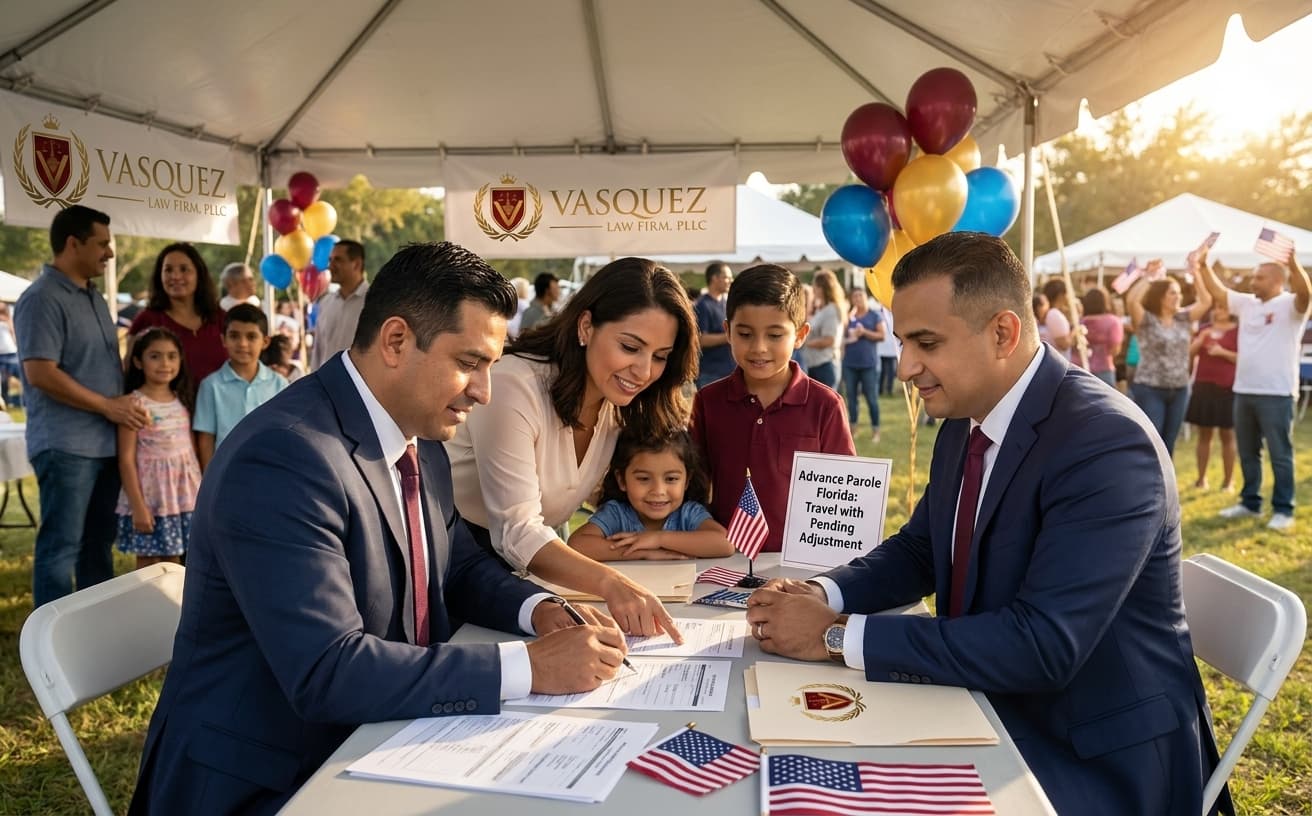
Plantation and Broward County residents bring a mix of humanitarian and defense questions: Cuban parole and adjustment, parole in place, asylum, ICE detention and bond, supervision check-ins and prosecutorial discretion requests. These matters often overlap, since a Cuban family member with a parole document may also have an old removal order, so looking at the whole picture early usually supports better decisions. The guide gives a plain-language overview of each matter and what to do first. We serve Plantation from Orlando by phone, video and in-person meetings.
- Topics include Cuban parole, parole in place, asylum, bond and removal defense.
- These matters often overlap, sometimes within a single family's situation.
- Review the whole picture early rather than one form at a time.
- Humanitarian and enforcement rules change often, so check current law.
Introduction
Residents of Plantation and the rest of Broward County bring us a wide range of humanitarian and defense questions: Cuban parole and adjustment, parole in place, asylum, ICE detention and bond, check-ins under an order of supervision, and requests for prosecutorial discretion. This guide gives a plain-language overview of each matter and what to do first. If you want to discuss your own situation, call 1-844-YO-PELEO or contact us.
These matters often overlap. A Cuban family member who entered with a parole document may also have an old removal order, or a person with a pending asylum case may have a relative in detention. Looking at the whole picture early, rather than one form at a time, usually leads to better decisions.
Vasquez Law Firm serves Plantation clients from our Orlando office by phone and secure video, with in-person meetings in Orlando. This article is general information, not legal advice, and the rules in humanitarian and enforcement matters change often, so the details of your case must be checked against the current law.
Immigration Help for Plantation Residents
Plantation is part of Broward County, a community with many families from Cuba, the Caribbean, and Latin America. The questions that reach us from the area usually fall into a few groups.
- Parole and the Cuban Adjustment Act for people who entered from Cuba.
- Parole in place for certain relatives of U.S. military members and veterans.
- Asylum for people who fear returning to their home countries.
- Removal (deportation) defense in immigration court.
- Detention, bond, orders of supervision, and stays of removal.
- Requests that DHS or ICE use prosecutorial discretion.
Our humanitarian protection page explains parole and related relief in more detail.
Parole and Cuban Adjustment for Plantation Families
Parole lets a person enter or remain in the U.S. temporarily for humanitarian reasons or significant public benefit, without being formally admitted. For Cuban nationals, parole matters because the Cuban Adjustment Act allows Cubans who were inspected and admitted or paroled, and who have been physically present for at least one year, to apply for permanent residence.
A Cuban parole lawyer in Plantation will look closely at the exact document you received at entry, because a parole document and certain release papers, such as Form I-220A, are treated differently and have been the subject of litigation. Two people who arrived on the same day can have different paperwork and therefore different options. Bring every paper you were handed at the border or at the processing center.
Parole in place is a separate tool used for certain people already inside the U.S., most commonly the spouses, parents, and children of U.S. military members and veterans. It is discretionary, and the availability of broader parole in place programs has changed through government action and court decisions. If you are looking for a parole in place lawyer in Plantation, FL, bring proof of the family member's military service and your full entry history.
Asylum for People Living in Broward County
Asylum protects people who fear persecution in their home country because of race, religion, nationality, political opinion, or membership in a particular social group. In most cases it must be requested within one year of the person's last arrival in the U.S., with limited exceptions. If you are not in removal proceedings, the application on Form I-589 goes to USCIS. If you are in removal proceedings, it is presented to the immigration judge.
An asylum attorney in Plantation, FL helps organize the written declaration, country conditions evidence, and identity documents, and prepares the applicant for the interview or hearing. A consistent account matters: differences between what was said at the border, in a declaration, and in court are a common source of trouble. Related protections, such as withholding of removal and protection under the Convention Against Torture, have different standards and are sometimes requested alongside asylum. See our asylum services page for more.
How the Process Works in Florida for a Parole or Asylum Case
The exact path depends on the person's entry, history, and whether a court case is pending, but the usual sequence looks like this.
- Review the entry documents, any notices, and any earlier applications to decide which relief fits.
- Check whether a Notice to Appear has been filed, because that decides whether USCIS or the immigration judge handles the request.
- Gather identity, entry, and supporting evidence, and prepare any written declaration.
- File the application or motion with the correct agency and follow the filing instructions in force at that time.
- Attend biometrics, an interview, or hearings at the locations listed on each notice.
- Respond to any request for evidence, and decide on next steps after the decision.
Document Checklist for Parole, Asylum, and Removal Cases
- Passport, national identity documents, and birth certificate, with translations where needed.
- The parole document, I-94 record, or release papers you received at entry, including Form I-220A if you have one.
- Every notice from USCIS, ICE, or the immigration court, including the Notice to Appear.
- For parole in place: proof of the family member's military service and of your relationship to that person.
- For asylum: anything showing what happened, such as threats, police or medical reports, photos, and news articles.
- Any arrest or court records, even for dismissed cases.
- Proof of address, work, and community ties, which also help in bond and discretion requests.
- Copies of anything you filed before, even if it was denied.
If a family member has been detained, also have the person's full name, date of birth, country of birth, and A-number, if known.
Timeline and Processing Expectations
Humanitarian and defense cases do not follow one schedule. A request for a bond hearing or a stay of removal can be urgent, while an asylum case or an adjustment application can take much longer. USCIS and the immigration courts publish current processing information, and those times change, so we do not predict them here.
What you can control is preparation. Keeping a current address on file, tracking every date on every notice, and gathering evidence early prevents the most common delays. The table shows the main stages.
| Stage | What happens | Who acts |
|---|
| Case review | Entry documents and history are reviewed; relief is identified | Lawyer, client |
| Filing | Application, motion, or request is submitted | Lawyer, USCIS or court |
| Biometrics or interview | Fingerprints, questions about the application | Applicant, USCIS |
| Hearings in immigration court | Master calendar and individual hearings | Immigration judge, DHS, lawyer |
| Decision and follow-up | Approval, denial, request for evidence, or appeal options | USCIS, judge, lawyer |
Deportation Defense in Immigration Court
Removal (deportation) cases begin with a Notice to Appear and are heard by an immigration judge. The immigration court that hears your case is listed on your notices, and you should always follow those notices, since hearing locations can change. A deportation defense lawyer reviews whether the government's charges are correct and which relief may apply, such as asylum, cancellation of removal, adjustment of status, or voluntary departure.
When comparing an immigration court attorney, ask how the lawyer prepares witnesses and evidence for the individual hearing. Be cautious about any lawyer who guarantees an outcome, because each case depends on the facts, the law, and the judge. We are based in Orlando and represent clients in immigration court remotely or in person as the court allows. More about this work is on our deportation defense page.
ICE Detention and Immigration Bond
If a family member is detained by ICE, act quickly. ICE may set a bond, and if it does not or the amount is too high, the detained person can often ask an immigration judge for a bond hearing. Some people are subject to mandatory detention because of their criminal history or how they entered, and recent policy and court decisions have changed who can receive a bond hearing, so a lawyer must check the current rules.
A bond request is built on evidence of community ties, employment, and family responsibilities, to show the person is not a flight risk or a danger. A lawyer will also explain how bond is paid and what conditions may come with release. Our immigration bond page has more detail.
Orders of Supervision, Stays of Removal, and Prosecutorial Discretion
People with a final removal order who cannot be removed right away are often released on an order of supervision and must check in with ICE. A lawyer can prepare you for check-ins, review whether any relief or a motion to reopen is possible, and discuss risks before each appointment. A stay of removal temporarily stops ICE from carrying out a removal order. It can be requested from ICE on Form I-246, or from the immigration court or the Board of Immigration Appeals while a motion or appeal is pending.
DHS and ICE attorneys have discretion over how they use enforcement resources. In some cases they may agree to dismiss a case, not oppose relief, or support other outcomes. Policies on prosecutorial discretion change with each administration, so a lawyer will check current guidance and decide whether a request is worth making. A request is usually supported by evidence of long residence, family ties, and good conduct, and a lawyer should also tell you honestly when a request is unlikely to help.
Related Options to Ask About
People often come in with one question and leave with a list of several. A family member who asks about Cuban adjustment may also be eligible for a spouse or child to be included, or may have a relative who can file a family petition. Someone with a pending asylum case may be able to apply for a work permit while the case is waiting. A person with an old removal order may still be able to seek a stay or, in limited situations, a motion to reopen.
Advance parole is another topic that comes up. Leaving the country without the right travel permission can end a pending application or create new problems at the border, so ask before you book any trip. Our article on advance parole explains how the different kinds of parole differ.
The honest answer in many cases is "it depends," and a lawyer should explain what it depends on, what documents would settle the question, and what the risks are if the answer turns out badly.
How We Work With Plantation Clients
We do not have an office in Plantation or anywhere else in Broward County. Our only office is in Orlando, and Plantation clients work with us by phone and secure video, in English or Spanish, with in-person meetings available in Orlando. Documents can be shared electronically, so most of the work does not require travel. If a family member has been detained or has a hearing soon, contact us right away and tell us the date.
Cost Factors and Fee Breakdown
The cost of a humanitarian or defense case depends on the relief sought, the number of hearings, and whether detention is involved.
| Item | Amount | Notes |
|---|
| Attorney fees for case review and filing | Varies by case | Depends on the relief and the amount of evidence |
| USCIS filing fees | Check USCIS for the current fee | Some forms carry fees, others do not; check the form instructions |
| Immigration court filing fees | Check the court or agency for current fees | Varies with the application or motion |
| Bond | Check the court or agency for current fees | Set by ICE or the immigration judge, and conditions may apply |
| Translations and document gathering | Varies by case | Foreign-language records usually need translation |
Government fees and fee waiver rules change, so read the current form instructions before filing. Ask for a written fee agreement that explains which stages are covered.
Prices should never be the only factor in choosing a lawyer. A missed deadline or a form filed with the wrong agency can cost far more than the difference between two fee quotes.
Common Mistakes to Avoid
- Missing the one-year asylum deadline without asking whether an exception applies.
- Assuming a parole document and release papers such as Form I-220A have the same legal effect.
- Skipping a hearing or failing to update your address with the immigration court.
- Paying anyone who is not a licensed attorney or accredited representative to prepare immigration forms.
- Going to an ICE check-in without understanding the risks or what relief might be available.
- Filing a request for prosecutorial discretion without evidence or without checking current policy.
- Delaying a bond request while evidence is still being collected.
When to Call a Lawyer
Call as soon as a family member is detained, a Notice to Appear arrives, or an ICE check-in or removal order is involved. Call before you file for asylum, parole in place, or adjustment if you have any entry or arrest history you are unsure about, and call before the one-year asylum deadline passes. A short review early on often shows which option fits and which one could cause harm.
About Vasquez Law Firm
Vasquez Law Firm practices immigration law only. Our only office is at 1111 E Amelia Street in Orlando. We serve clients across Florida by phone and secure video, and we meet in person at the Orlando office. William J. Vásquez is the founding attorney, and consultations are available in English and Spanish. To talk about your situation, call 1-844-YO-PELEO or contact us.
Sources and References
Related services: humanitarian protection, immigration lawyers in Florida
Other ways people search for this
People look for this help under different names. Related searches include deportation defense immigration lawyer; cuban parole lawyer plantation; parole in place lawyer plantation fl; asylum attorney plantation fl; deportation defense lawyer plantation; deportation attorney near plantation; deportation defense attorney plantation; deportation supervision lawyer plantation; dhs prosecutorial discretion lawyer plantation; emergency deportation attorney plantation; immigration court attorney plantation fl; prosecutorial discretion lawyer plantation; stay of deportation lawyer plantation fl; ice bond attorney plantation fl; ice prosecutorial discretion lawyer plantation; immigration bond lawyer plantation.
This article is general information, not legal advice. Every case is different; speak with an immigration lawyer about your situation.