Criminal Waiver Immigration Florida: Overcoming...
A criminal record can pose a significant barrier to immigration in Florida, but options like the I-601 criminal waiver exist to overcome inadmissibility. This guide from Florida Immigration Lawyers explains the process, eligibility criteria, and the critical role of demonstrating extreme hardship to a qualifying U.S. citizen or lawful permanent resident relative. Learn about the step-by-step application, necessary documentation, and typical timelines. We also highlight common mistakes to avoid and when to seek professional legal assistance to navigate these complex immigration challenges successfully. Your path to legal status in Florida may still be possible.

A criminal waiver in U.S. immigration law, primarily through Form I-601 (Application for Waiver of Grounds of Inadmissibility) or Form I-601A (Application for Provisional Unlawful Presence Waiver), allows certain individuals with specific criminal convictions or other inadmissibility issues to overcome these barriers and obtain a visa or adjustment of status. Eligibility often hinges on demonstrating extreme hardship to a qualifying U.S. citizen or lawful permanent resident relative. Navigating this complex process in Florida requires expert legal guidance.
- Criminal waivers help overcome inadmissibility for certain past offenses.
- Forms I-601 and I-601A are key applications for these waivers.
- Extreme hardship to a qualifying relative is often a critical requirement.
- The process is complex and benefits greatly from legal assistance.
- Florida residents can seek help from experienced immigration lawyers.
Criminal Waiver Immigration Florida: Overcoming Inadmissibility
Imagine building a life in Florida, with family, work, and community ties, only to discover that a past mistake – a criminal conviction – threatens your ability to achieve legal immigration status. This can be a devastating realization for many individuals and families across Kissimmee, Orlando, and the wider Sunshine State. Fortunately, U.S. immigration law offers pathways to overcome certain grounds of inadmissibility through a process known as a criminal waiver.
At Florida Immigration Lawyers, we understand the profound anxiety and uncertainty that a criminal history can cast over your immigration dreams. Our firm is dedicated to guiding individuals and families in Florida through the intricate waiver application process. We help you present the strongest possible case to U.S. Citizenship and Immigration Services (USCIS).
This comprehensive guide will explain what a criminal waiver is, who may be eligible, the application process, and why expert legal representation is crucial. Do not face this challenge alone. Call Florida Immigration Lawyers at 1-844-967-3536 for a free consultation to discuss your specific situation and explore your options.
Understanding Criminal Inadmissibility and Immigration Waivers
U.S. immigration law outlines various reasons why an individual might be deemed “inadmissible” to the United States. These grounds of inadmissibility can prevent someone from obtaining a visa, adjusting status to a lawful permanent resident, or even re-entering the country after travel abroad. Among the most common and challenging grounds are those related to certain criminal convictions.
Section 212(a)(2) of the Immigration and Nationality Act (INA), found at 8 U.S.C. § 1182(a)(2), details the criminal grounds of inadmissibility. These can include convictions for crimes involving moral turpitude (CIMT), drug-related offenses, multiple criminal convictions, and aggravated felonies. Even an admission of committing certain crimes or acts that constitute the essential elements of a crime can lead to inadmissibility.
An immigration waiver is essentially a request to USCIS or a consular officer to overlook a specific ground of inadmissibility. For criminal offenses, the most common waivers are the Form I-601, Application for Waiver of Grounds of Inadmissibility, and in certain circumstances, the Form I-601A, Application for Provisional Unlawful Presence Waiver. While the I-601A primarily addresses unlawful presence, it is often intertwined with other inadmissibility issues, including minor criminal infractions that might be overlooked alongside the unlawful presence waiver.
Who Qualifies for a Criminal Waiver?
Eligibility for a criminal waiver, particularly the I-601, depends heavily on the specific ground of inadmissibility and the applicant's relationship to a qualifying U.S. citizen (USC) or Lawful Permanent Resident (LPR) relative. Generally, to qualify for an I-601 waiver for criminal grounds under INA 212(h), you must demonstrate:
- Qualifying Relative: You must have a USC or LPR spouse, parent, or child who would experience “extreme hardship” if you were denied admission to the U.S.
- Time Since Conviction: At least 15 years must have passed since the commission of the act or release from confinement for the crime, and you must demonstrate rehabilitation.
- Not a Danger: You must show that your admission would not be contrary to the national welfare, safety, or security of the United States.
- Specific Crime Types: The waiver is generally available for a single conviction of a crime involving moral turpitude, or two or more convictions where the aggregate sentence was five years or more. It is NOT available for murder, torture, or certain high-level drug trafficking offenses.
The I-601A waiver, while primarily for unlawful presence, can also provisionally waive certain minor criminal offenses for individuals who are otherwise eligible for adjustment of status in the U.S. through a family-based petition. This provisional waiver allows applicants to remain in the U.S. while their waiver is processed, reducing the time spent abroad during consular processing.
The Step-by-Step Process for a Criminal Waiver (Form I-601)
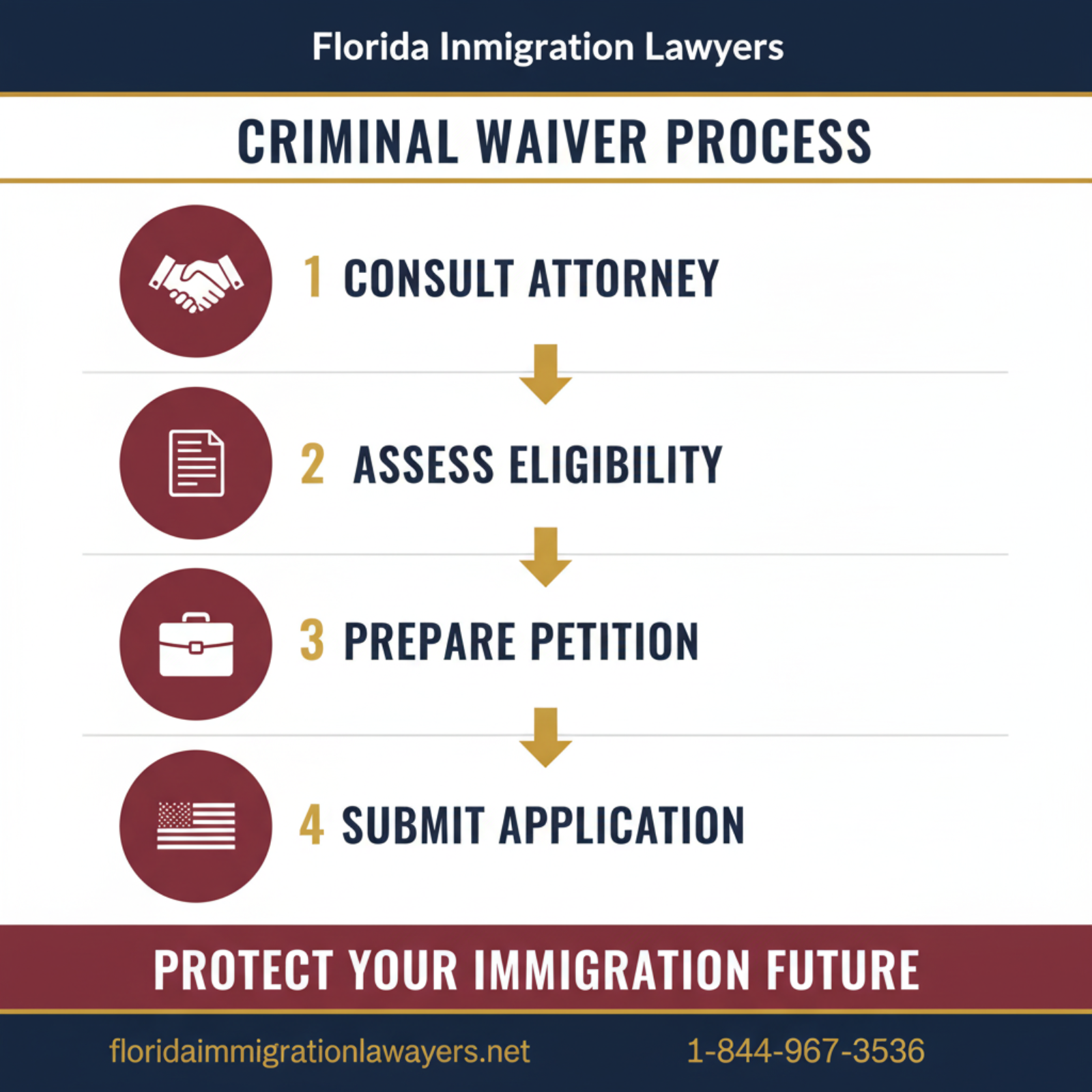
Navigating the I-601 criminal waiver process requires meticulous preparation and a deep understanding of immigration law. Here's a general overview of the steps involved:
-
Determine Inadmissibility: First, clearly identify the specific ground(s) of inadmissibility that apply to your case. This often involves a thorough review of your criminal record, including court dispositions and police reports from Florida and elsewhere. An experienced immigration attorney can help you understand the precise legal implications of your past conviction(s).
-
Identify a Qualifying Relative: Confirm you have a U.S. citizen or lawful permanent resident spouse, parent, or child who will suffer extreme hardship if your waiver is not granted. This relationship is fundamental to most criminal waivers.
-
Gather Evidence of Extreme Hardship: This is the most crucial and challenging part of the application. You must collect substantial documentation demonstrating that your qualifying relative would suffer extreme, unusual, or uncommon hardship beyond what is typically expected from family separation. This evidence can include financial records, medical reports, psychological evaluations, educational impacts, and community ties in Florida. For instance, if your LPR spouse in Kissimmee relies on your income for critical medical expenses, this would be compelling evidence.
-
Complete Form I-601: Accurately fill out Form I-601, Application for Waiver of Grounds of Inadmissibility. Pay close attention to all sections, ensuring consistency with your supporting documentation. Any discrepancies can lead to delays or denials.
-
Prepare a Detailed Legal Brief: Your attorney will prepare a comprehensive legal brief that argues how your case meets the legal standards for the waiver. This brief synthesizes all your evidence, cites relevant legal authority (such as INA 212(h) and BIA precedents), and persuasively explains why your waiver should be approved. This brief is essential for presenting your case effectively to USCIS or the Department of State.
-
Submit the Application: File the completed Form I-601, all supporting documentation, and the required filing fee with the appropriate USCIS office. The filing location depends on whether you are applying for adjustment of status within the U.S. or through consular processing abroad. For consular processing, the waiver is typically filed after an interview at a U.S. embassy or consulate.
-
Attend Biometrics Appointment: You will likely receive an appointment notice to attend a biometrics (fingerprinting) appointment at a local Application Support Center (ASC) in Florida, such as those in Orlando or Miami. This is for background checks.
-
Respond to Requests for Evidence (RFE) or Notices of Intent to Deny (NOID): USCIS may issue an RFE if they need more information or a NOID if they are considering denying your application. Prompt and thorough responses are critical. Your attorney will help you prepare a robust reply.
-
Receive Decision: USCIS will issue a decision on your I-601 waiver application. If approved, you can proceed with your visa application or adjustment of status. If denied, your attorney can discuss options for appeal or reconsideration.
Essential Document Checklist for a Criminal Waiver
A well-organized and complete application package is vital for a successful criminal waiver. While specific documents vary by case, here's a general checklist of what you will typically need for an I-601 application:
- Completed Form I-601, Application for Waiver of Grounds of Inadmissibility.
- Proof of U.S. citizen or lawful permanent resident status for the qualifying relative (e.g., birth certificate, U.S. passport, green card).
- Proof of relationship to the qualifying relative (e.g., marriage certificate, birth certificates).
- All criminal records: Certified court dispositions, police reports, sentencing documents, and any probation/parole records related to all arrests and convictions, even if expunged or dismissed.
- Evidence of rehabilitation (e.g., letters of recommendation, certificates of completion for rehabilitation programs, employment history, community service records).
- Extensive documentation proving extreme hardship to the qualifying relative, including but not limited to:
- Medical records and doctor's statements if the relative has health issues.
- Psychological evaluations for emotional or mental health impacts.
- Financial records (bank statements, tax returns, proof of income, debt statements) demonstrating financial dependence or severe financial strain.
- Evidence of property ownership, mortgages, or leases in the U.S.
- Children's school records, special needs documentation, and evidence of their integration into U.S. society.
- Letters from employers, teachers, community leaders, and religious figures attesting to your character and the impact of your absence.
- Country condition reports if the qualifying relative would have to relocate abroad, highlighting dangers or lack of resources.
Step-by-Step Process Guide - Any previous immigration applications or decisions.
- Photocopies of all documents submitted, translated into English if necessary, with a certified translator's statement.
Timeline and Processing Expectations for a Criminal Waiver
The processing times for Form I-601 waivers can vary significantly. They depend on factors such as the volume of applications, the complexity of your case, and the specific USCIS service center or consular post handling your application. It is important to manage your expectations and prepare for a potentially lengthy process.
Generally, I-601 processing can take anywhere from **several months to over a year**, or even longer in complex cases. USCIS publishes estimated processing times on its website, which can provide a general idea, but these are only estimates and can change frequently. For applicants undergoing consular processing, the waiver decision usually comes after the visa interview, adding another layer to the timeline.
Factors that can influence your timeline include:
- Completeness of Application: A fully prepared and well-documented application is less likely to receive an RFE, which can significantly delay processing.
- Case Complexity: Cases involving multiple criminal convictions, severe crimes, or complicated extreme hardship arguments may take longer to adjudicate.
- Service Center Workload: Different USCIS service centers have varying workloads, impacting their processing speed.
- Consular Post: If your waiver is related to consular processing abroad, the specific U.S. embassy or consulate's efficiency can affect the overall timeline.
It is crucial to submit your application as thoroughly as possible from the outset. Rushing the process or submitting an incomplete application will almost certainly lead to delays or even a denial. Your Florida Immigration Lawyers attorney will help you prepare a robust application to optimize your processing time.
Cost Factors and Fee Breakdown for an Immigration Criminal Waiver
Understanding the financial aspects of an immigration criminal waiver is essential for proper planning. There are typically two main categories of costs involved: government filing fees and legal fees.
-
USCIS Filing Fees: USCIS charges a non-refundable fee for filing Form I-601. This fee is subject to change, so it is crucial to check the most current fee schedule on the USCIS website (uscis.gov/forms/fees) before filing. There are generally no fee waivers available for Form I-601.
-
Legal Fees: The cost of hiring an experienced immigration attorney to assist with your criminal waiver application will vary depending on the complexity of your case, the extent of criminal history, and the amount of evidence required to prove extreme hardship. Legal fees typically cover:
- Comprehensive legal analysis of your criminal record and inadmissibility grounds.
- Guidance on gathering all necessary documents.
- Assistance in preparing the extreme hardship argument and supporting brief.
- Preparation and filing of Form I-601 and all supporting documents.
- Representation in responding to RFEs or NOIDs.
- Preparation for consular interviews, if applicable.
Key Statistics & Data
Additional potential costs might include fees for obtaining certified court records, medical or psychological evaluations, document translations, and travel expenses for interviews or biometrics appointments. While legal fees represent an investment, the expertise of a knowledgeable attorney can significantly increase your chances of success and prevent costly mistakes that could lead to denials or lengthy delays. Many firms, including Florida Immigration Lawyers, offer free initial consultations to discuss fees and payment options.
Do not navigate this process alone. The complexities of criminal waivers demand professional legal insight. Contact Florida Immigration Lawyers today to ensure your case is handled with the diligence and expertise it deserves. Call us at 1-844-967-3536.
Common Mistakes to Avoid in Your Criminal Waiver Application
Applying for a criminal waiver is a high-stakes process where even minor errors can have significant consequences. Avoiding common pitfalls is crucial for a successful outcome. Here are some mistakes to watch out for:
-
Failure to Disclose All Criminal History: One of the most severe mistakes is omitting or misrepresenting any part of your criminal record, no matter how minor or old. USCIS has access to extensive databases, and any undisclosed information will likely be discovered, leading to an immediate denial and potentially accusations of misrepresentation, which carries its own severe penalties under INA 212(a)(6)(C).
-
Underestimating the “Extreme Hardship” Standard: Many applicants believe that any hardship from family separation qualifies. However, “extreme hardship” is a high legal standard requiring compelling evidence beyond typical emotional or financial difficulties. Failing to provide robust and specific documentation tailored to your qualifying relative's unique circumstances is a common reason for denial.
-
Incomplete or Uncertified Documents: Submitting an application with missing documents, uncertified court records, or un-translated foreign documents will lead to RFEs and significant delays. Ensure every required document is present, properly certified, and translated by a certified translator.
-
Lack of a Coherent Legal Argument: Simply submitting a stack of documents is insufficient. A waiver application requires a persuasive legal brief that ties all the evidence together, cites relevant case law, and clearly demonstrates how your case meets the legal criteria. Without this, USCIS adjudicators may not fully grasp the strength of your case.
-
Filing the Wrong Waiver Form: There are different types of waivers for various grounds of inadmissibility. Incorrectly identifying your specific ground of inadmissibility or filing the wrong waiver form (e.g., an I-601A when an I-601 is needed) will result in denial and loss of filing fees.
-
Not Addressing Rehabilitation: Especially for older convictions, demonstrating rehabilitation is often a critical factor. Failing to provide evidence of positive changes since the conviction, such as stable employment, community involvement, or completion of relevant programs, weakens your case.
-
Missing Deadlines or Ignoring RFEs: Immigration processes have strict deadlines. Failing to respond to an RFE or other USCIS notices by the specified date will almost certainly lead to a denial without further consideration.
-
Assuming All Crimes are Waivable: Not all criminal grounds of inadmissibility are waivable. Certain serious offenses, like murder, torture, or aggravated felonies (as defined by immigration law), generally do not qualify for a waiver. Misunderstanding this can lead to wasted time and resources.
-
Poorly Written Personal Statements: While supporting documents are key, a well-crafted personal statement from you and your qualifying relative can add a human element to your case. Generic or poorly written statements that lack sincerity and specific details can detract from your application.
-
Not Consulting an Attorney: Attempting to navigate the complex criminal waiver process without legal counsel is perhaps the biggest mistake. An experienced immigration attorney can identify all grounds of inadmissibility, strategize the best waiver option, prepare a compelling hardship argument, and ensure all procedural requirements are met, significantly improving your chances of success.
When to Call Florida Immigration Lawyers for a Criminal Waiver
The decision to seek a criminal waiver is rarely straightforward. Given the complexities of U.S. immigration law and the severe consequences of a denial, it is almost always advisable to consult with an experienced immigration attorney. Here are specific scenarios and warning signs that indicate you should immediately contact Florida Immigration Lawyers:
-
Any Criminal History: If you or a family member has any arrest, charge, conviction, or even an admission of a crime, regardless of how minor or long ago, you need legal advice. Even dismissed charges or expunged records can still impact immigration eligibility.
-
Facing Deportation or Removal Proceedings: If you are in immigration court in Orlando or Miami, facing deportation, and have a criminal conviction, a waiver may be your only path to remain in the U.S. Our deportation defense attorneys are skilled at identifying waiver opportunities within removal proceedings.
-
Denied a Visa or Green Card Due to Criminality: If you have already received a denial from USCIS or a U.S. consulate citing criminal inadmissibility, do not give up. An attorney can review the denial letter, assess the grounds, and help you strategize the next steps, which may include filing an I-601 waiver.
-
Planning to Apply for a Green Card or Visa with a Criminal Record: Before you even start your immigration application, if you have a criminal record, you must understand its implications. An attorney can pre-screen your eligibility, identify potential inadmissibility issues, and advise on the best strategy, including whether a waiver is necessary.
-
Unsure About “Extreme Hardship”: Proving extreme hardship is the most challenging aspect of a waiver application. If you are struggling to identify or articulate the specific hardships your qualifying relative would face, our lawyers can help you build a compelling case with strong evidence and expert arguments.
-
Complex Criminal History: If you have multiple convictions, convictions from different states or countries, or convictions involving serious offenses, your case is highly complex. Such situations demand the intricate legal analysis that only an experienced immigration lawyer can provide.
-
Need for a Provisional Waiver (I-601A): If you are in Florida and are considering applying for an I-601A provisional waiver for unlawful presence, and you have any minor criminal issues, it is crucial to consult with an attorney to ensure you meet all eligibility requirements and understand the risks involved.
At Florida Immigration Lawyers, we have a deep understanding of the intricacies of criminal waiver applications and the specific requirements of USCIS and consular offices. Our attorneys are here to provide compassionate, effective legal representation for clients across Florida, including Kissimmee, Orlando, and Tampa. We are committed to helping you navigate these challenges and secure your immigration future.
About Florida Immigration Lawyers
Florida Immigration Lawyers is a leading law firm dedicated exclusively to providing exceptional immigration legal services across the entire state of Florida. With a profound understanding of both federal immigration law and the unique needs of our diverse Florida communities, we stand as a beacon of hope and guidance for individuals and families navigating the U.S. immigration system.
Our firm offers a comprehensive range of immigration services, including family-based immigration, business immigration, asylum claims, deportation defense, citizenship applications, and complex waiver cases like the criminal waiver. We pride ourselves on our client-focused approach, ensuring that every individual receives personalized attention and strategic legal advice tailored to their unique circumstances.
Why choose Florida Immigration Lawyers? Our team of dedicated professionals is available 24/7, offering free consultations to assess your case and provide clear, actionable steps. We are committed to transparency, integrity, and achieving the best possible outcomes for our clients. Serving all of Florida, from Kissimmee to Miami, Jacksonville to Tampa, we are your trusted partners in immigration law.
Contact us today to schedule your free consultation: 1-844-967-3536 or visit our website: https://www.floridaimmigrationlawyers.net.
Sources and References
- U.S. Citizenship and Immigration Services (USCIS) - Form I-601, Application for Waiver of Grounds of Inadmissibility
- USCIS Policy Manual - Volume 9, Part O - Waivers
- Executive Office for Immigration Review (EOIR)
- 8 U.S.C. Chapter 12 - Immigration and Nationality Act (INA)
- INA Section 212(a)(2) - Criminal and Related Grounds of Inadmissibility
- INA Section 212(h) - Waiver of Certain Criminal Grounds of Inadmissibility
- INA Section 212(i) - Waiver of Grounds of Inadmissibility for Misrepresentation
- 8 CFR Part 212 - Documentary Requirements: Nonimmigrants; Waivers; Admission of Certain Inadmissible Aliens; Parole
This article provides general legal information and is not intended as legal advice. Every case is unique, and outcomes depend on specific facts and circumstances. Contact an attorney for advice about your particular situation. Immigration laws are subject to change.
Navigating the complexities of a criminal waiver in Florida requires precise legal knowledge and strategic planning. Do not leave your immigration future to chance. Let the experienced team at Florida Immigration Lawyers advocate for you. We offer free consultations to evaluate your case and provide the dedicated support you need. Call us today at 1-844-967-3536. Se Habla Español - Estamos aquí para ayudarle.
Do Not Navigate This Process Alone
Our experienced immigration attorneys are ready to fight for you. Get a free, confidential consultation today.
Se Habla Español
Frequently Asked Questions
Florida Immigration Lawyers
Immigration Attorney | Founder, Vasquez Law Firm
U.S. Air Force veteran and immigration attorney with thousands of cases resolved. J.D., NCCU School of Law. AILA member. Admitted to the 4th, 5th, and 11th Circuit Courts.
Available 24/7 - Free Evaluations
Related Legal Services
Our Florida immigration attorneys can help you with immigration practice areas, free immigration consultation and experienced immigration attorneys. Call today at 1-844-967-3536 for a free consultation.
Related Links
Related Topics
Free Legal Consultation
Discuss your case with our experienced attorneys. We're available 24/7.
Se Habla Español - Estamos aquí para ayudarle.
Related Articles
Immigration Attorney Gainesville: North Florida Guide
Navigating the U.S. immigration process can be daunting, especially with recent policy changes. Our guide focuses on finding the right immigration attorney in Gainesville, North Florida, to help you through the complexities. Contact Florida Immigration Lawyers for expert advice and support.
Parole in Place for Military Families in Florida | VLF Florida
Explore Parole in Place for military families in Florida. Learn about eligibility, application steps, and common mistakes to avoid. Contact Florida Immigration Lawyers for a free consultation.
Unlawful Presence Waiver: Florida Guide | VLF Florida
Explore the unlawful presence waiver process in Florida, focusing on the I-601A provisional waiver. This guide helps immigrants in Tampa navigate their path to lawful status. For personalized assistance, contact Florida Immigration Lawyers today.
How to Choose an Immigration Lawyer Florida | VLF Florida
Choosing the right immigration lawyer in Florida is crucial for navigating complex immigration laws and procedures. Learn how to select the best lawyer for your needs with our comprehensive guide. Call Florida Immigration Lawyers at 1-844-967-3536 for a free consultation.