Citizenship Test Preparation in Florida: Essential Guide
Prepare for the citizenship test in Florida with our comprehensive guide. Learn about the test format, essential steps, and resources available in Tallahassee. Contact Florida Immigration Lawyers for expert assistance.

Becoming a U.S. citizen is a monumental step, opening doors to new opportunities, rights, and responsibilities. For residents of Florida, navigating the naturalization process and successfully passing the citizenship test requires diligent preparation and a clear understanding of the requirements. This comprehensive guide is designed to equip you with the knowledge, resources, and strategies needed to confidently approach your U.S. citizenship journey in the Sunshine State.
Understanding the Naturalization Process: Your Path to Citizenship
The journey to U.S. citizenship, known as naturalization, involves several key stages, each with its own set of requirements and procedures. While the process can seem daunting, breaking it down into manageable steps can make it less overwhelming. Here’s an overview of what to expect:
Eligibility Requirements
Before you even begin the application, it's crucial to determine if you meet the basic eligibility criteria. Generally, you must be at least 18 years old, be a lawful permanent resident (Green Card holder) for a specific period (usually five years, or three years if married to a U.S. citizen), demonstrate continuous residence and physical presence in the U.S., show good moral character, and be able to read, write, and speak basic English. You must also have a fundamental understanding of U.S. history and government. Understanding these initial requirements is the first critical step in your naturalization journey. For more detailed information on various pathways to legal residency and citizenship, explore our immigration practice areas.
Form N-400, Application for Naturalization
The official application for naturalization is Form N-400. This extensive form requires detailed personal information, including your residential history, employment, family details, and any trips outside the U.S. It’s essential to complete this form accurately and truthfully. Any discrepancies or omissions can lead to delays or even denial of your application. Gathering all necessary documentation, such as your Green Card, marriage certificates, and tax records, is vital before you start filling out the N-400.
Biometrics Appointment
After submitting your N-400, you will receive an appointment notice for biometrics collection. This typically involves fingerprinting, photographs, and a signature. These biometrics are used for background checks by the FBI and other government agencies to verify your identity and ensure you meet the good moral character requirement. This is a standard part of the process for all naturalization applicants.
The Naturalization Interview
The naturalization interview is a pivotal stage where a USCIS officer will review your N-400 application, test your English proficiency, and administer the civics test. During the interview, the officer will ask questions about your application, your background, and your commitment to the U.S. Constitution. It's crucial to be honest, prepared, and able to communicate effectively. This is where your preparation truly pays off. If you have concerns about potential issues, such as past legal troubles or complex immigration history, consulting with an experienced attorney can provide invaluable guidance. Issues like past arrests or even minor infractions can sometimes trigger concerns, and understanding how these might impact your application is crucial. In some severe cases, unresolved legal issues could even lead to deportation defense proceedings, making legal counsel even more critical.
The Citizenship Test
Administered during your naturalization interview, the citizenship test consists of two main parts: an English test and a civics test. Your ability to pass these tests is a direct requirement for becoming a U.S. citizen. We'll delve deeper into each component below.
Oath of Allegiance Ceremony
If your application is approved, the final step is attending the Oath of Allegiance Ceremony. This is a formal event where you take an oath to support the U.S. Constitution and laws. Upon taking the oath, you officially become a U.S. citizen and receive your Certificate of Naturalization. This certificate is proof of your U.S. citizenship and should be kept in a safe place.
Deep Dive into the Citizenship Test Components
Success on the citizenship test hinges on understanding its two core components:
The English Test
The English test assesses your ability to read, write, and speak basic English. The USCIS officer will evaluate your speaking ability during the interview itself, observing how you answer questions about your N-400 application. For the reading portion, you will be asked to read one out of three sentences correctly. For the writing portion, you will be asked to write one out of three sentences correctly. The sentences are typically simple and relate to civics or U.S. history. Practice with sample sentences is highly recommended.
The Civics Test
The civics test evaluates your knowledge of U.S. history, government, and civics. You will be asked up to 10 questions from a predefined list of 100 civics questions. To pass, you must answer at least 6 out of 10 questions correctly. The questions cover topics such as American democracy, the system of government, rights and responsibilities, colonial period and independence, the 1800s, and recent American history and other important historical information. Memorizing the answers is a start, but truly understanding the concepts behind them will serve you better.
Preparing for the Civics Test in Florida: Strategies for Success
Preparing for the civics test requires a focused and consistent approach. While the test content is standardized across the U.S., Florida residents have access to numerous resources and can benefit from specific study strategies to excel. This section will guide you through effective preparation methods to master the 100 civics questions.
Leveraging Official USCIS Resources
The most authoritative resource for the civics test is the official USCIS website. They provide the full list of 100 civics questions and answers, study materials, and even flashcards. It is crucial to use the most current version of these materials, as questions can occasionally be updated. The USCIS also offers a "Civics Practice Test" online, which simulates the actual test experience and can help you gauge your readiness. Many local libraries in Florida also stock these materials or provide access to online learning platforms that feature civics test preparation tools.
Effective Study Techniques
- Active Recall: Instead of passively reading, actively quiz yourself. Cover the answers and try to recall them.
- Spaced Repetition: Review questions at increasing intervals. This helps solidify information in your long-term memory.
- Group Study: Consider joining a study group. Explaining answers to others can reinforce your own understanding, and hearing different perspectives can clarify complex topics. Many community centers and non-profit organizations in Florida offer free or low-cost citizenship classes.
- Flashcards: Create physical or digital flashcards for each question and answer. This is an excellent way to drill yourself on the facts.
- Contextual Learning: Don't just memorize. Understand why certain events happened or how government branches function. For example, when learning about the Constitution, understand its purpose and key principles, not just the number of amendments.
Practice Tests and Mock Interviews
Regularly taking practice tests is essential. Many online platforms and mobile apps offer civics practice tests that mimic the format of the actual exam. Pay attention to the questions you consistently get wrong and dedicate extra study time to those areas. Additionally, practicing mock interviews with a friend, family member, or even a mirror can significantly boost your confidence for the speaking and civics portions of the interview. Have someone ask you questions from the N-400 and the civics list, and practice articulating your answers clearly and confidently. This practice is invaluable for reducing anxiety on the actual test day.
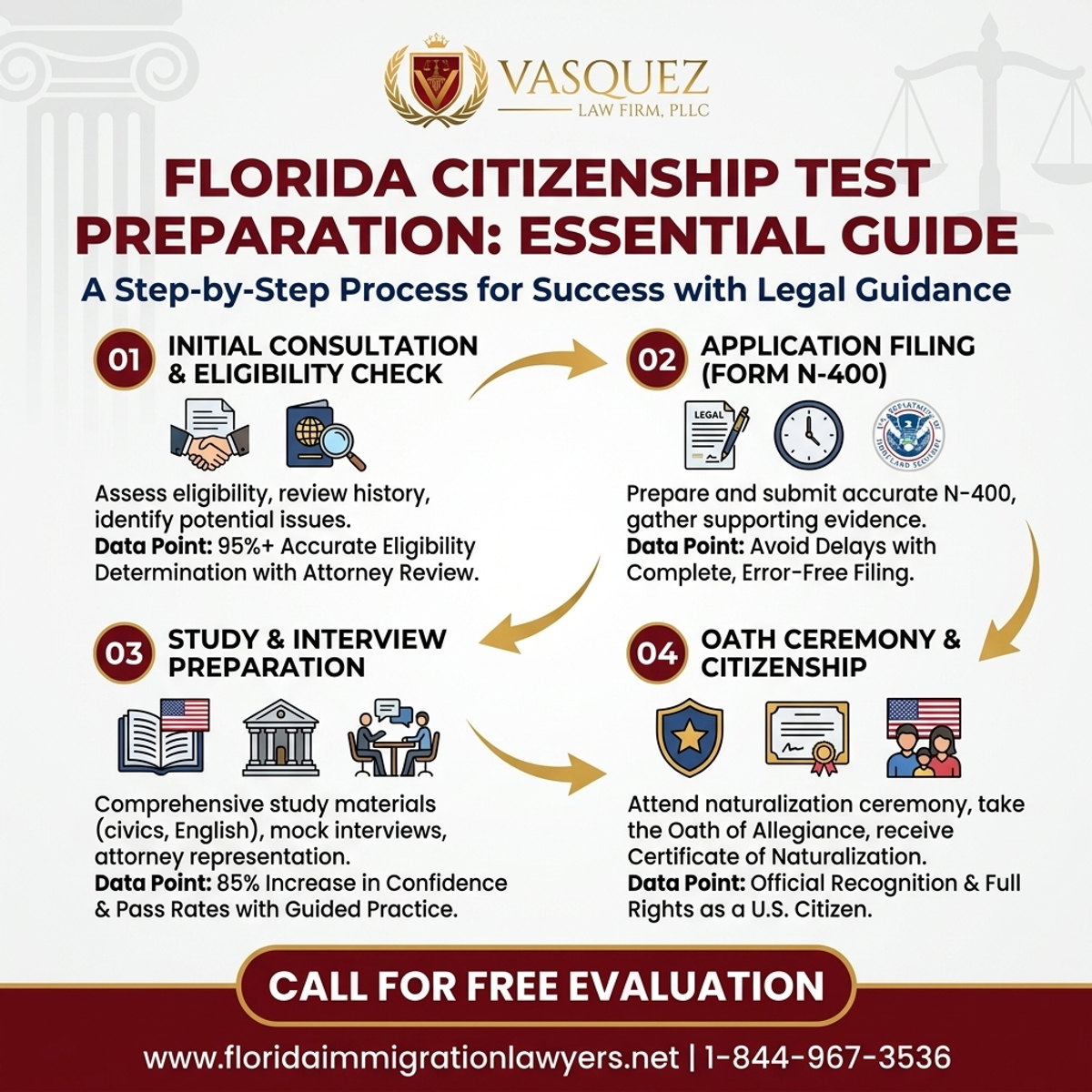
Step-by-Step Process — Citizenship Test Preparation in Florida: Essential Guide
Focusing on Florida-Specific Information (Where Applicable)
While the civics test is national, some questions may touch upon state-level government or representatives. For instance, knowing your current U.S. Senator or Representative from Florida is a common question. Ensure you know the names of your current state Governor and your U.S. Senators representing Florida. This demonstrates your engagement with local and national governance. Staying informed about current events, particularly those related to U.S. government and civics, can also provide a broader understanding that aids in answering questions.
By combining these study strategies with consistent effort, you can build a strong foundation of knowledge and confidently approach the civics test, moving one step closer to achieving your dream of U.S. citizenship.
Common Challenges and How to Overcome Them
The path to citizenship isn't always smooth. Many applicants face common hurdles, but with the right approach, these can be successfully overcome.
Language Barriers
For many, the English test is the most challenging part. If English is not your first language, dedicate extra time to improving your reading, writing, and speaking skills. Consider ESL (English as a Second Language) classes, language exchange programs, or practicing with native English speakers. Don't be afraid to speak slowly and clearly during your interview. USCIS officers are trained to understand various accents.
Anxiety and Stress
The naturalization interview can be a high-pressure situation. To manage anxiety, practice relaxation techniques, prepare thoroughly, and visualize success. Remember, the officers are there to assess your eligibility, not to trick you. Being well-prepared is the best antidote to stress.
Difficulty with Civics Concepts
Some civics concepts can be abstract or complex. If you're struggling, try to find explanations that use simpler language or visual aids. Relate historical events to current affairs to make them more tangible. Educational videos and documentaries can also be helpful tools for understanding complex topics.
Disability Accommodations
If you have a medical condition or disability that prevents you from meeting the English or civics requirements, you may be eligible for an exception. You will need to file Form N-648, Medical Certification for Disability Exceptions, completed by a licensed medical professional. It's crucial to discuss this with a legal professional to ensure proper documentation and submission.
The Role of an Immigration Attorney in Your Naturalization Journey
While many individuals successfully navigate the naturalization process on their own, seeking legal counsel can provide invaluable support, especially in complex cases or when unforeseen issues arise. An experienced immigration attorney can offer a range of services to streamline your path to citizenship.
Guidance Through Complex Forms
The N-400 application is detailed and requires precise information. An attorney can help you accurately complete the form, ensuring all necessary documentation is included and avoiding common errors that could lead to delays or denials. They can also assist in compiling supporting evidence, which is crucial for a strong application.
Preparation for the Interview
An attorney can conduct mock interviews, helping you practice your English and civics answers, and prepare you for the types of questions a USCIS officer might ask. This preparation can significantly boost your confidence and reduce anxiety on the day of your actual interview.
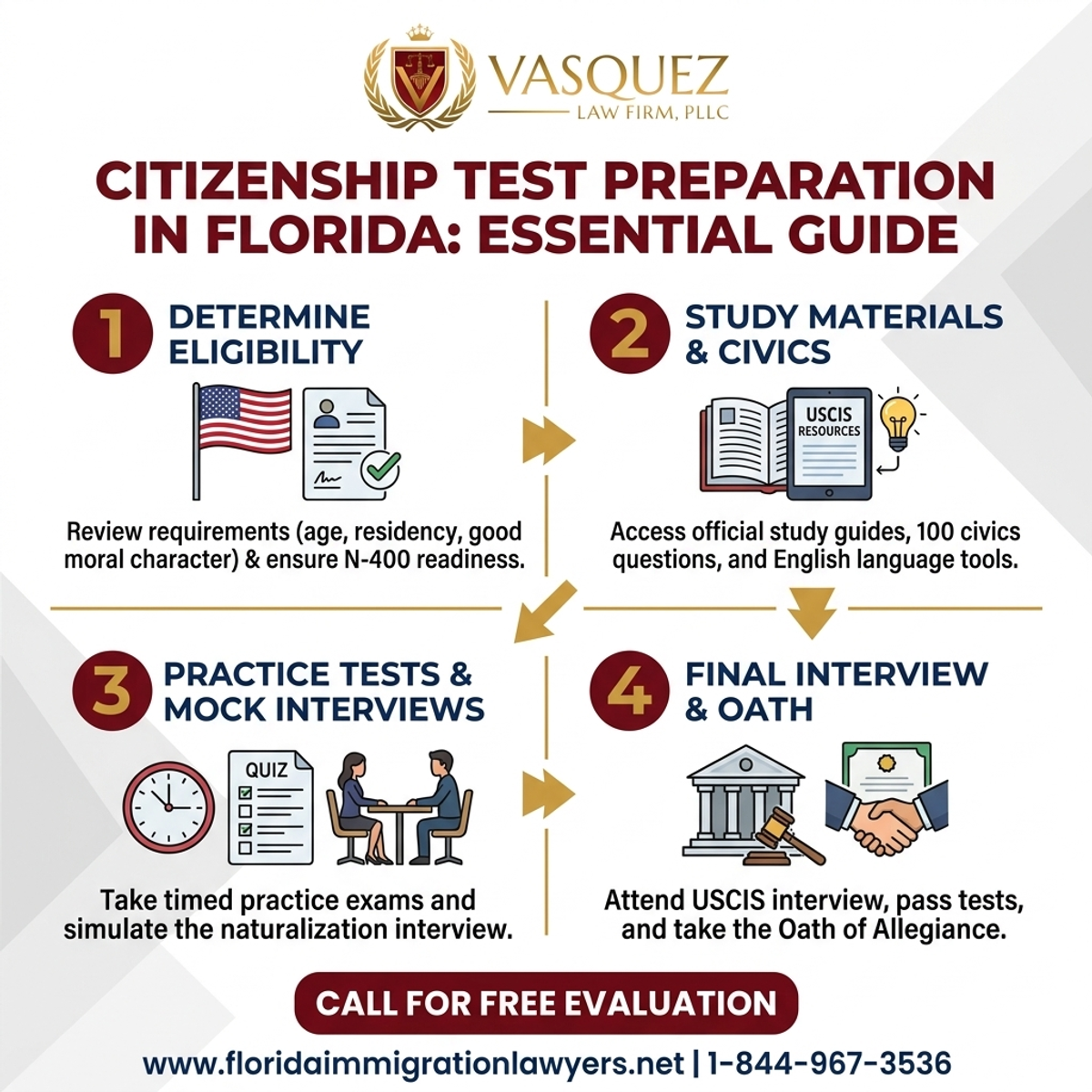
Key Statistics — Citizenship Test Preparation in Florida: Essential Guide
Addressing Potential Issues
If you have a complex immigration history, such as previous visa overstays, criminal convictions, or a history of asylum applications, an attorney can assess your situation, advise on potential challenges, and help you prepare explanations or necessary waivers. They can anticipate potential problems and strategize the best approach to present your case to USCIS, mitigating risks that could otherwise jeopardize your application. This proactive approach is critical for ensuring good moral character requirements are met and any past issues are properly addressed.
Assistance with Waivers or Special Circumstances
In certain situations
Sources and References
- U.S. Citizenship and Immigration Services (USCIS)
- Executive Office for Immigration Review (EOIR)
- U.S. Department of State - Bureau of Consular Affairs
- Immigration and Nationality Act (INA), 8 U.S.C. Chapter 12
Do Not Navigate This Process Alone
Our experienced immigration attorneys are ready to fight for you. Get a free, confidential consultation today.
Se Habla Español
Frequently Asked Questions
Florida Immigration Lawyers
Immigration Attorney | Founder, Vasquez Law Firm
U.S. Air Force veteran and immigration attorney with thousands of cases resolved. J.D., NCCU School of Law. AILA member. Admitted to the 4th, 5th, and 11th Circuit Courts.
Available 24/7 - Free Evaluations
Related Legal Services
Our Florida immigration attorneys can help you with family immigration services, immigration practice areas and free immigration consultation. Call today at 1-844-967-3536 for a free consultation.
Related Links
Related Topics
Free Legal Consultation
Discuss your case with our experienced attorneys. We're available 24/7.
Se Habla Español - Estamos aquí para ayudarle.
Related Articles
Immigration Services Jacksonville Florida: Your Guide
Navigating immigration services in Jacksonville, Florida, requires a thorough understanding of federal laws and local procedures. This comprehensive guide from Florida Immigration Lawyers covers everything from family-based visas and employment green cards to naturalization and deportation defense. We provide a step-by-step overview, essential document checklists, and insights into processing timelines and costs. Learn about common mistakes to avoid and understand when expert legal counsel is indispensable. Our firm is dedicated to assisting individuals and families throughout Florida, including Jacksonville and Orlando, offering personalized strategies and empathetic support. Contact us for a free consultation to discuss your immigration needs and secure your future in the U.S.
Unlawful Presence Waiver in Florida: What You Need to Know
Learn about the I-601A unlawful presence waiver in Florida, including eligibility, application steps, and common mistakes to avoid. Contact Florida Immigration Lawyers for expert guidance.
H-2A Visa for Agricultural Workers in Florida | VLF Florida
Explore the H-2A visa program essential for Florida's agriculture. Learn application steps, common mistakes, and when to seek legal help.
Immigration Lawyer in Fort Lauderdale Florida | VLF Florida
Navigating immigration law in Fort Lauderdale can be complex. Learn how to find the right immigration lawyer, understand the process, and ensure your case is handled effectively. Contact Florida Immigration Lawyers for expert guidance.