H-2A Visa for Agricultural Workers in Florida | VLF Florida
Explore the H-2A visa program essential for Florida's agriculture. Learn application steps, common mistakes, and when to seek legal help.

H-2A Visa for Agricultural Workers in Florida | VLF Florida
Florida's vibrant agricultural sector, a cornerstone of its economy, relies heavily on a dedicated workforce to cultivate and harvest its diverse range of crops. From citrus groves to vast vegetable farms, the demand for seasonal agricultural labor is constant and critical. To meet this demand, the U.S. government offers the H-2A temporary agricultural worker program, a vital pathway for foreign nationals to fill temporary or seasonal agricultural jobs when U.S. workers are unavailable.
For Florida farmers and agricultural businesses, understanding and navigating the complexities of the H-2A visa program is essential for maintaining operations and ensuring a steady supply of labor. For workers, it represents an opportunity for lawful employment and fair wages. At VLF Florida, we specialize in immigration law, providing comprehensive guidance to both employers and workers throughout the H-2A visa process, ensuring compliance and successful outcomes.
Understanding the H-2A Visa Program
The H-2A visa program allows U.S. employers who meet specific regulatory requirements to bring foreign nationals to the United States to fill temporary agricultural jobs. These jobs must be seasonal, peak load, intermittent, or one-time occurrences. The program is designed to supplement the domestic workforce, not replace it, ensuring that U.S. workers are considered first for available positions.
Key characteristics of the H-2A program include:
- Temporary or Seasonal Need: The employer's need for the workers must be temporary or seasonal, generally lasting no longer than one year.
- Agricultural Work: The jobs must be agricultural in nature, as defined by the Department of Labor (DOL) regulations. This includes a wide range of activities from planting and cultivating to harvesting and packing.
- No Adverse Effect: The employment of H-2A workers must not adversely affect the wages and working conditions of similarly employed U.S. workers.
- Certified Shortage: Employers must demonstrate that there are not enough U.S. workers who are able, willing, qualified, and available to perform the temporary agricultural labor.
The H-2A program is a lifeline for many Florida farms, enabling them to sustain production and contribute significantly to the state's economy. However, its stringent requirements and multi-agency approval process necessitate careful planning and execution.
Eligibility Requirements for Employers
To qualify for the H-2A program, Florida agricultural employers must meet several critical criteria:
Demonstrate a Temporary or Seasonal Need
The employer must prove that their need for agricultural workers is temporary or seasonal. This means the job is tied to a certain time of year by an event or pattern, such as a growing season, or for a period of no more than one year.
Offer a Bona Fide Job Opportunity
Employers must offer a legitimate job that is agricultural in nature and provides specific wages, working conditions, and terms of employment that meet or exceed federal and state standards. This includes offering the prevailing wage or the Adverse Effect Wage Rate (AEWR), whichever is higher.
Recruit U.S. Workers First
Before petitioning for H-2A workers, employers must conduct extensive recruitment efforts to find qualified U.S. workers. This typically involves advertising in local newspapers, posting job orders with state workforce agencies, and engaging in other recruitment activities as prescribed by the Department of Labor. The employer must be able to demonstrate that despite these efforts, there are insufficient U.S. workers available to fill the positions.
Provide Housing and Transportation
Employers are generally required to provide free, safe, and sanitary housing to H-2A workers who cannot reasonably return to their permanent residence at the end of the workday. They must also provide transportation from the housing to the worksite and, in some cases, reimbursement for the workers' inbound and outbound transportation costs.
Eligibility Requirements for Workers
Foreign nationals seeking an H-2A visa must meet specific criteria:
- Foreign Residence: Applicants must have a foreign residence they do not intend to abandon. The H-2A visa is for temporary employment, and workers are expected to return to their home country upon its expiration.
- Job Offer: They must have a legitimate offer of temporary agricultural employment from a U.S. employer that has received an approved H-2A petition.
- Qualifications: Workers must meet the minimum job qualifications specified by the employer.
- Admissibility: Applicants must be admissible to the United States. Certain criminal convictions, immigration violations, or health issues can make an individual inadmissible.
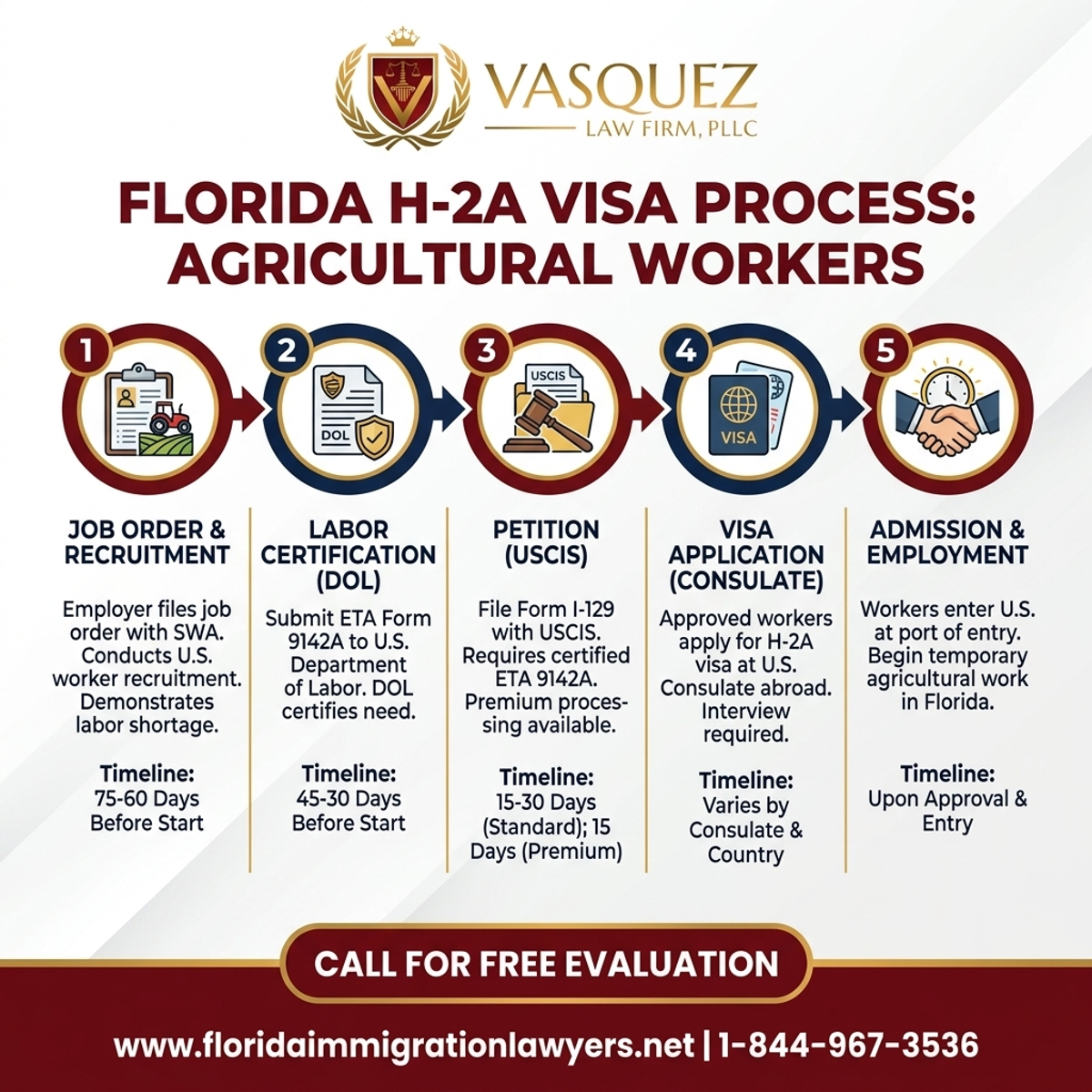
Step-by-Step Process — H-2A Visa for Agricultural Workers in Florida | VLF Florida
The H-2A Application Process: A Step-by-Step Guide
The H-2A visa application is a multi-stage process involving several government agencies:
1. Labor Certification from the Department of Labor (DOL)
The first crucial step for an employer is to obtain a temporary labor certification from the DOL. This involves:
- Filing Form ETA-9142A: The employer submits an Application for Temporary Employment Certification to the DOL, outlining the job offer, wages, and working conditions.
- Recruitment: The employer must conduct a rigorous recruitment campaign to test the U.S. labor market, including placing job orders with state workforce agencies and advertising. This demonstrates that there are not enough U.S. workers available to perform the work.
- Prevailing Wage Determination: The DOL ensures that the wages offered meet the Adverse Effect Wage Rate (AEWR) or the prevailing wage for the occupation in the specific geographic area, whichever is higher, to protect U.S. workers' wages.
- Certification: If the DOL is satisfied that all requirements are met and no qualified U.S. workers are available, it issues a temporary labor certification.
2. Petition Filing with U.S. Citizenship and Immigration Services (USCIS)
Once the labor certification is approved, the employer files Form I-129, Petition for a Nonimmigrant Worker, with USCIS. This petition includes the approved labor certification and other supporting documentation, demonstrating the employer's eligibility and the temporary nature of the work. USCIS reviews the petition to ensure all immigration requirements are met.
3. Consular Processing and Visa Interview
Upon approval of the I-129 petition, foreign workers located outside the U.S. must apply for an H-2A visa at a U.S. embassy or consulate in their home country. This typically involves:
- Form DS-160: Completing the Online Nonimmigrant Visa Application.
- Scheduling an Interview: Attending a visa interview with a consular officer.
- Required Documents: Providing necessary documents such as a valid passport, the approved I-129 petition receipt, and any other requested information.
During the interview, the consular officer will determine if the applicant is eligible for the H-2A visa and admissible to the United States.
4. Entry into the U.S.
After receiving the H-2A visa, workers can travel to the U.S. and seek admission at a port of entry. Customs and Border Protection (CBP) officers will review their documents and make the final determination on their entry and period of stay.
Employer Responsibilities and Worker Protections
The H-2A program places significant responsibilities on employers to ensure fair treatment and safe working conditions for their temporary agricultural workers. These responsibilities are not merely suggestions but legally binding obligations designed to protect vulnerable workers and maintain the integrity of the program.
Fair Wages and Payment
Employers must pay H-2A workers at least the Adverse Effect Wage Rate (AEWR) or the prevailing wage, whichever is higher, for all hours worked. Wages must be paid no less frequently than bi-weekly. Detailed records of hours worked and wages paid must be maintained and provided to workers. Any unauthorized deductions from wages are strictly prohibited.
Housing Standards
As mentioned, employers are generally required to provide free housing that meets specific federal and state safety and health standards. This housing must be inspected and certified by the appropriate state agency. It must be clean, sanitary, and provide adequate space and facilities for cooking, sleeping, and personal hygiene. Failure to provide suitable housing can lead to severe penalties and program disqualification.
Transportation Provisions
Employers are responsible for providing transportation from the workers' living quarters to the worksite each day. Furthermore, if workers complete 50% of the contract period, the employer must reimburse them for their inbound transportation and subsistence costs. If workers complete the entire contract, the employer must also pay for their outbound transportation and subsistence costs. This ensures that workers are not stranded or financially burdened by travel expenses.
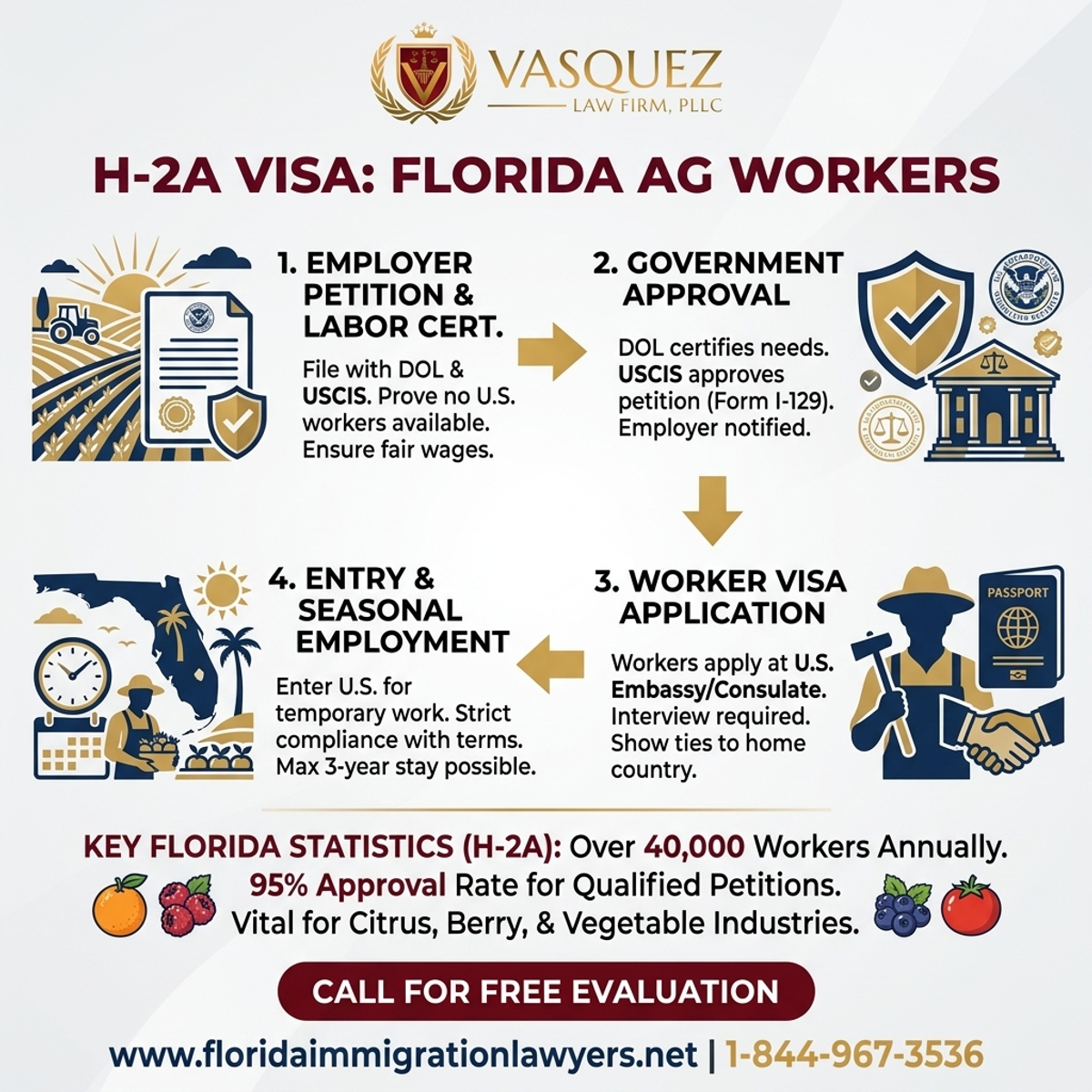
Key Statistics — H-2A Visa for Agricultural Workers in Florida | VLF Florida
Worker Rights and Protections
H-2A workers are afforded numerous rights under U.S. labor laws, including the right to a safe workplace, the right to complain about working conditions without fear of retaliation, and the right to access legal aid. They are protected by the Migrant and Seasonal Agricultural Worker Protection Act (MSPA) and other federal and state laws. Employers must provide workers with a copy of their work contract in a language understood by the worker, clearly outlining all terms and conditions of employment. If a worker feels their rights have been violated or they are facing unjust treatment, they have avenues for recourse, including reporting issues to the Department of Labor or seeking legal assistance. In extreme cases, where a worker faces severe exploitation or threats, they may even explore other immigration options, such as asylum, though this is rare for H-2A visa holders.
Adherence to these responsibilities is not just a legal requirement but also crucial for maintaining a productive and ethical workforce. Employers who prioritize the well-being of their H-2A workers often experience higher retention rates and a more stable labor force.
Challenges and Common Pitfalls in the H-2A Process
While the H-2A program offers significant benefits, it is not without its challenges. Both employers and workers can encounter pitfalls:
- Compliance Burden: The regulatory framework is extensive and complex. Non-compliance, even unintentional, can lead to significant fines, debarment from the program, and legal complications.
- Recruitment Difficulties: Demonstrating a lack of available U.S. workers can be challenging, especially in areas with fluctuating labor markets.
- Processing Delays: Applications can face delays at various stages, impacting planting or harvesting schedules.
- Housing and Transportation Logistics: Meeting the strict requirements for housing and transportation can be a significant logistical and financial burden for some employers.
- Worker Retention: Ensuring workers complete their contracts and do not abscond can be a concern for employers.
- Visa Overstays and Violations: For workers, understanding and adhering to the terms of their visa is paramount. Overstaying a visa or violating its terms can lead to serious consequences, including future bars from entering the U.S. and potential deportation defense proceedings.
Proactive planning and expert legal guidance are essential to mitigate these risks.
The Role of an Experienced Immigration Attorney
Navigating the H-2A visa program successfully requires a deep understanding of immigration law, labor regulations, and agricultural industry specifics. An experienced immigration attorney can be an invaluable asset for both employers and workers:
- For Employers: Attorneys can assist with preparing and filing all necessary applications, ensuring compliance with DOL and USCIS regulations, managing recruitment efforts, responding to government inquiries, and developing strategies to avoid common pitfalls. They can also represent employers in audits or investigations.
- For Workers: While employers typically initiate the H-2A process, workers can benefit from legal advice regarding their rights, contract terms, and options if issues arise. An attorney can help them understand their visa conditions and ensure they are treated fairly.
At VLF Florida, our team of dedicated attorneys provides comprehensive legal support, from initial consultation to final visa approval, ensuring a smooth and efficient process.
Why Choose VLF Florida for Your H-2A Needs?
VLF Florida is committed to serving the agricultural community and its workforce throughout the state. Our expertise in H-2A visas and broader immigration law makes us a trusted partner for:
- In-Depth Knowledge: We possess extensive knowledge of federal and Florida-specific H-2A regulations.
- Personalized Service: We understand that every farm and every worker's situation is unique, offering tailored solutions.
- Efficiency and Compliance: We streamline the application process, minimizing delays and ensuring full compliance to avoid costly errors.
- Advocacy: We advocate fiercely for our clients' interests, whether it's an employer seeking a vital workforce or a worker ensuring their rights are protected.
Let us help you navigate the complexities of the H-2A program with confidence and peace of mind.
Contact VLF Florida Today
The H-2A visa program is a powerful tool for Florida's agricultural industry, but its intricacies demand professional attention. Don't let the complexities of immigration law hinder your operations or your opportunity for lawful employment. Whether you are an employer seeking to secure your workforce or a worker with questions about your rights, VLF Florida is here to help.
For a free consultation and to discuss your specific H-2A visa needs, please contact us today. Call us directly at (844) 967-3536 to speak with an experienced immigration attorney. We are dedicated to providing clear, effective, and compassionate legal guidance for all your immigration matters in Florida.
Conclusion
The H-2A visa program is indispensable for Florida's agricultural sector, bridging the gap between labor demand and supply. While challenging, with the right legal expertise, employers can secure the workforce they need, and workers can find lawful, fair employment. VLF Florida stands ready to assist you in every step of this vital process.
Sources and References
- U.S. Citizenship and Immigration Services (USCIS)
- Executive Office for Immigration Review (EOIR)
- U.S. Department of State - Bureau of Consular Affairs
- Immigration and Nationality Act (INA), 8 U.S.C. Chapter 12
Do Not Navigate This Process Alone
Our experienced immigration attorneys are ready to fight for you. Get a free, confidential consultation today.
Se Habla Español
Frequently Asked Questions
Florida Immigration Lawyers
Immigration Attorney | Founder, Vasquez Law Firm
U.S. Air Force veteran and immigration attorney with thousands of cases resolved. J.D., NCCU School of Law. AILA member. Admitted to the 4th, 5th, and 11th Circuit Courts.
Available 24/7 - Free Evaluations
Related Legal Services
Our Florida immigration attorneys can help you with citizenship and naturalization, family immigration services and immigration practice areas. Call today at 1-844-967-3536 for a free consultation.
Related Links
Related Topics
Free Legal Consultation
Discuss your case with our experienced attorneys. We're available 24/7.
Se Habla Español - Estamos aquí para ayudarle.
Related Articles
Immigration Lawyer in Fort Lauderdale Florida | VLF Florida
Navigating immigration law in Fort Lauderdale can be complex. Learn how to find the right immigration lawyer, understand the process, and ensure your case is handled effectively. Contact Florida Immigration Lawyers for expert guidance.
Immigration Bond Hearing in Florida: Key Insights | VLF Florida
Learn about the immigration bond hearing process in Florida. Understand eligibility, costs, and common mistakes. Call Florida Immigration Lawyers at 1-844-967-3536 for guidance.
O-1 Visa for Extraordinary Ability in Florida | VLF Florida
Discover the opportunities provided by the O-1 visa for individuals with extraordinary abilities in Florida. Explore the application process, required documentation, and how Florida Immigration Lawyers can assist you. Contact us today for a free consultation!
VAWA Self-Petition for Abused Spouses in Florida | VLF Florida
VAWA self-petition helps abused spouses in Florida gain legal status independently. Learn about eligibility, process, and support available in Pembroke Pines.
