Understanding the Child Status Protection Act in Florida
Learn how the Child Status Protection Act helps protect children from aging out of eligibility for visas in Florida. Discover eligibility criteria, common mistakes, and when to call a lawyer.

Understanding the Child Status Protection Act in Florida
The Child Status Protection Act (CSPA) is a critical piece of U.S. immigration law designed to protect certain children from "aging out" of eligibility for immigration benefits. Without CSPA, many children who were eligible for a green card or other immigration status based on their parents' petitions would lose that eligibility upon turning 21, often due to lengthy visa processing times. For families in Florida navigating the intricate U.S. immigration system, understanding CSPA is paramount to securing their loved ones' future. This comprehensive guide delves into the nuances of CSPA, its application, and how it can safeguard your family's immigration journey.
What is the Child Status Protection Act (CSPA)?
Enacted in 2002, the CSPA aims to address the problem of children aging out of eligibility for immigrant visas or adjustment of status. Before CSPA, if a child turned 21 before their parent's visa petition became current, they would often lose their status as a "child" beneficiary and be reclassified into a less favorable, often much slower, visa category. This could separate families for many additional years. CSPA essentially "freezes" a child's age for immigration purposes, allowing them to retain their eligibility even if they turn 21 during the lengthy petition process. This protection applies to various family-sponsored and employment-based categories, as well as to derivative beneficiaries of asylum seekers and refugees. It is a cornerstone of U.S. immigration law designed to keep families together.
Who is Eligible for CSPA Protection?
CSPA protection extends to several categories of beneficiaries, primarily those who are derivative beneficiaries of a parent's immigrant visa petition. Key categories include:
- Family-Sponsored Preference Categories:
- F1 (Unmarried Sons and Daughters of U.S. Citizens): If the U.S. citizen parent files a petition for their unmarried child, and that child turns 21 before the visa becomes available, CSPA may prevent them from aging out.
- F2A (Spouses and Children of Lawful Permanent Residents - LPRs): This is one of the most common categories for CSPA application. If an LPR parent petitions for their child, and the child turns 21 while the petition is pending, CSPA can preserve their F2A classification.
- F2B (Unmarried Sons and Daughters (21 years of age or older) of LPRs): If a child ages out of F2A and is reclassified to F2B, CSPA can still be relevant for determining the original petition date.
- F3 (Married Sons and Daughters of U.S. Citizens): CSPA can apply if the child was unmarried when the petition was filed but subsequently married, and then divorced, while the petition was pending.
- F4 (Brothers and Sisters of U.S. Citizens): CSPA can protect the derivative children of the principal F4 beneficiary.
- Employment-Based Preference Categories: Derivative children of principal beneficiaries in EB-1, EB-2, EB-3, and EB-4 categories can also benefit from CSPA.
- Diversity Visa Lottery: Derivative children of Diversity Visa selectees.
- Asylum and Refugee Cases: Derivative children of principal asylum applicants or refugees.
Understanding which category applies to your situation is crucial, as the CSPA age calculation can vary slightly. It's important to note that CSPA does not apply to immediate relatives (spouses of U.S. citizens, unmarried children under 21 of U.S. citizens, and parents of U.S. citizens 21 or older) because these categories do not have visa backlogs, meaning there's no waiting period during which a child might age out.
How Does CSPA Prevent "Aging Out"? The CSPA Age Calculation
The core of CSPA lies in its unique age calculation formula. Instead of using the child's actual age on the day the visa becomes available, CSPA subtracts the "petition pending time" from the child's age on the date the visa becomes available. The formula is:
CSPA Age = Child's Age on Visa Availability Date - Petition Pending Time
Here's a breakdown:
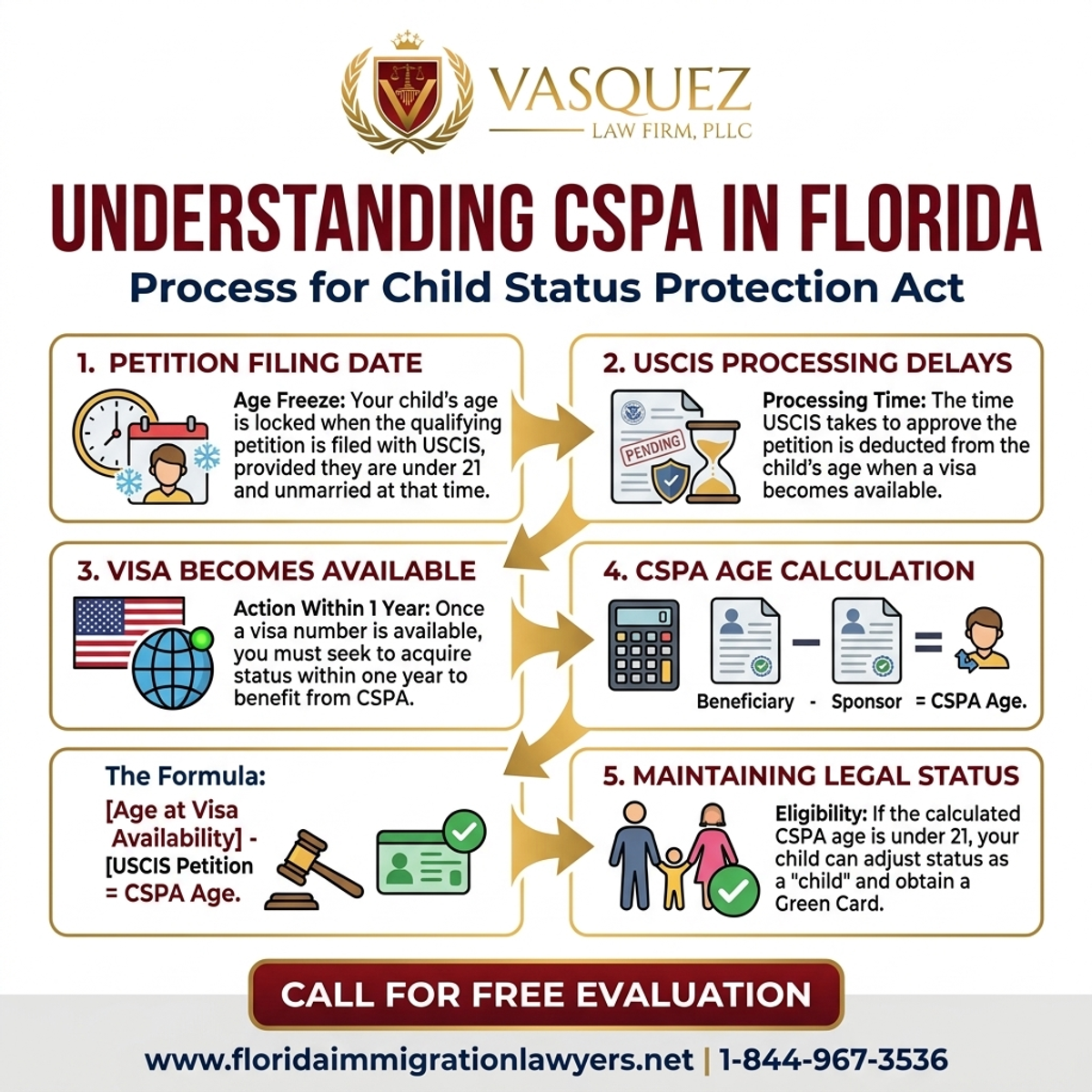
Step-by-Step Process — Understanding the Child Status Protection Act in Florida
- Child's Age on Visa Availability Date: This is the child's actual age on the first day of the month when their priority date becomes current according to the Visa Bulletin, or on the date the petition is approved, whichever is later.
- Petition Pending Time: This is the period during which the immigrant visa petition (e.g., Form I-130) was pending with USCIS. It's calculated from the date the petition was filed until the date it was approved.
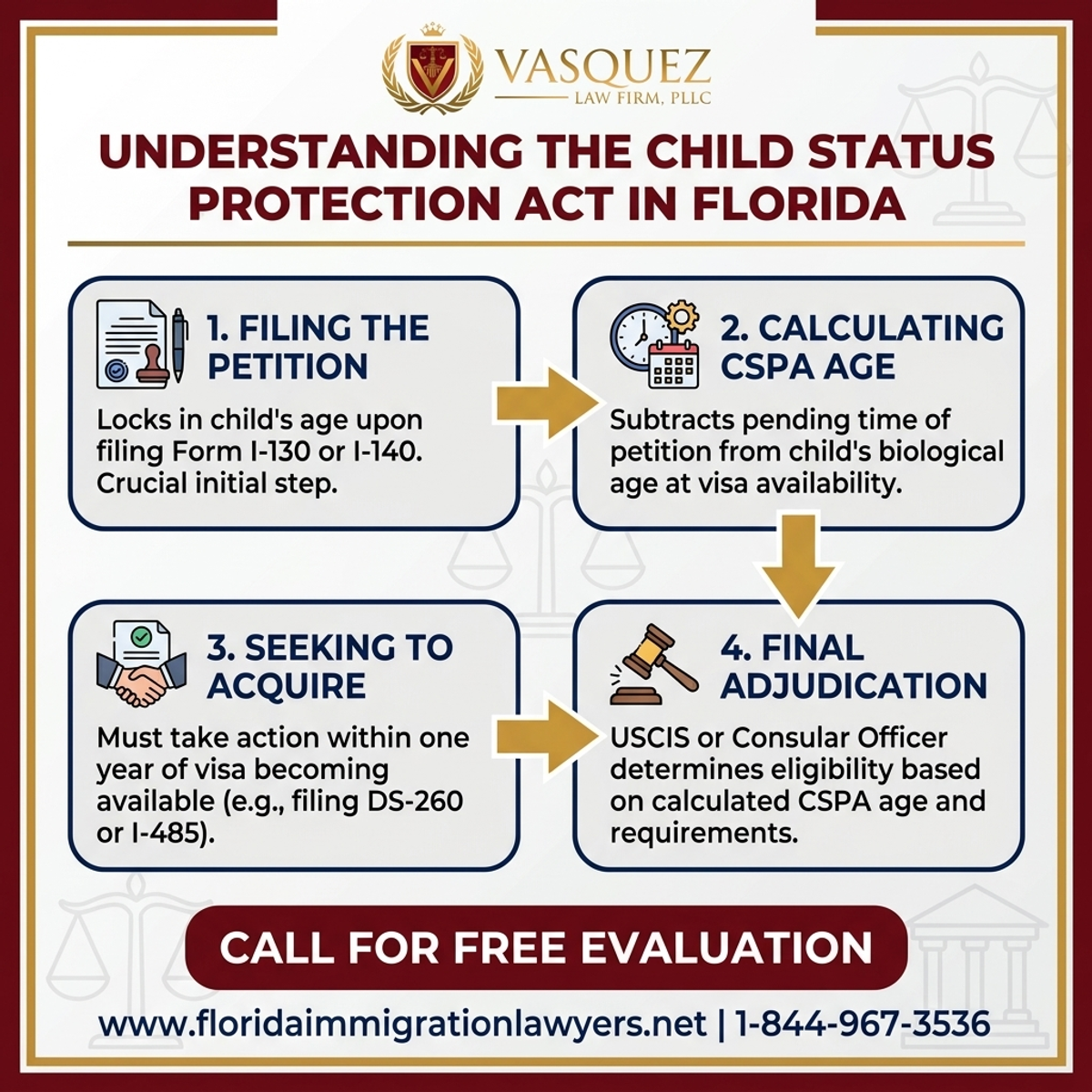
If the calculated CSPA age is less than 21, the child is protected and retains their "child" status. However, there's another critical requirement: the "sought to acquire" provision. The child must "seek to acquire" lawful permanent resident status within one year of the visa becoming available. This typically means filing Form I-485 (Application to Register Permanent Residence or Adjust Status) or submitting the DS-260 (Immigrant Visa Application) to the National Visa Center (NVC) within that one-year window. Failure to meet this deadline can result in the loss of CSPA protection, even if the age calculation is favorable.
CSPA and Adjustment of Status vs. Consular Processing
The application of CSPA can differ slightly depending on whether the beneficiary is pursuing Adjustment of Status (AOS) within the U.S. or Consular Processing abroad. For AOS, the "visa availability date" is typically when the priority date is current and the I-485 can be filed. For Consular Processing, it's when the NVC sends the fee bill or welcome letter, signaling that the case is ready for processing. Regardless of the path, meeting the "sought to acquire" requirement within one year is universally critical. Missing this deadline is a common pitfall that can lead to significant delays or even loss of eligibility.
Why is CSPA Important in Florida?
Florida is home to a vast and diverse immigrant population, with families from all over the world seeking to build new lives. Many of these families rely on family-sponsored immigration to reunite with their loved ones. Given the often lengthy visa backlogs, especially for certain countries and categories, CSPA serves as a vital safeguard for countless children in Florida. Without it, many families would face the heartbreaking reality of their children aging out and being forced to wait many more years, or even decades, to immigrate. Understanding and correctly applying CSPA is therefore not just a legal technicality; it's a matter of family unity and future stability for thousands of Floridians.
Key Statistics — Understanding the Child Status Protection Act in Florida
Navigating the Complexities: Common CSPA Challenges and Pitfalls
While CSPA offers crucial protection, its application is not always straightforward. Families often encounter various challenges that can jeopardize their eligibility if not properly addressed. Understanding these complexities is vital for a successful outcome.
Fluctuating Visa Bulletin Dates
One of the most significant challenges stems from the unpredictable nature of the Visa Bulletin. Priority dates can move forward, retrogress (move backward), or remain stagnant. The CSPA age is calculated based on the first date the visa becomes available. If a date retrogresses after a child's CSPA age was calculated as under 21, they generally retain their CSPA protection, provided they met the "sought to acquire" requirement. However, understanding when the visa truly became "available" for the first time can be tricky, especially with the introduction of "Dates for Filing" and "Final Action Dates." Incorrectly identifying this date can lead to miscalculation of the CSPA age and a mistaken belief of eligibility or ineligibility.
The "Sought to Acquire" Requirement
As mentioned, the one-year "sought to acquire" rule is a critical hurdle. Many families, unaware of this strict deadline, fail to file the necessary application (I-485 or DS-260) within the specified timeframe. This oversight, even if the CSPA age calculation is favorable, can lead to the loss of CSPA benefits. The one-year period begins when the visa becomes available, which can be triggered by the Visa Bulletin becoming current or by USCIS approving the underlying petition, depending on the specific circumstances and whether the beneficiary is inside or outside the U.S. It is imperative to monitor the Visa Bulletin closely and act promptly.
Changes in Marital Status
CSPA generally applies to unmarried children. If a child marries before their CSPA age is calculated and they acquire permanent residence, they typically lose eligibility. However, there are nuances. For instance, if a child was unmarried when the petition was filed, but then marries, and later divorces before the visa becomes available, CSPA might still apply, depending on the specific visa category. Such situations require careful legal analysis to determine continued eligibility.
Incorrect Age Calculation
Mistakes in calculating the CSPA age are common. This can arise from misinterpreting the "visa availability date," incorrectly calculating the "petition pending time," or overlooking specific rules that apply to different visa categories. Even a small error can have significant consequences, leading to an incorrect determination of eligibility. This is where the expertise of an experienced immigration attorney becomes invaluable, as they can accurately perform these calculations and advise on the best course of action.
Interaction with Other Immigration Processes
CSPA doesn't operate in a vacuum. It interacts with other complex immigration processes, such as waivers, inadmissibility issues, or even deportation defense if a person is already in removal proceedings. For example, a child who is CSPA-eligible might still face inadmissibility grounds that need to be addressed. Understanding how CSPA fits into the broader immigration landscape is crucial for a holistic strategy.
These challenges underscore the importance of seeking professional legal guidance. An attorney specializing in immigration law can help families navigate these complexities, ensure accurate calculations, meet deadlines, and advocate on their behalf.
Steps to Take if You Believe CSPA Applies to You
If you suspect that CSPA may apply to your child's immigration case, taking proactive steps is crucial:
- Gather Documentation: Collect all relevant documents, including the I-130 petition receipt and approval notices, birth certificates, marriage certificates (if applicable), and any correspondence from USCIS or the NVC.
- Monitor the Visa Bulletin: Regularly check the Department of State's Visa Bulletin for your priority date and category. Pay attention to both the "Dates for Filing" and "Final Action Dates."
- Calculate CSPA Age: Perform an initial calculation of your child's CSPA age. Remember to subtract the exact petition pending time from their age on the visa availability date.
- Understand the "Sought to Acquire" Rule: Be prepared to act quickly once your priority date becomes current. This means filing the I-485 or submitting the DS-260 within one year.
- Seek Legal Counsel: The most important step is to consult with an experienced immigration attorney. They can verify your CSPA eligibility, perform accurate calculations, advise on the "sought to acquire" requirement, and help prepare and submit all necessary documentation. Given the intricacies, relying on professional guidance can prevent costly errors and ensure your child's protection.
The Role of an Immigration Attorney in CSPA Cases
Navigating the Child Status Protection Act can
Sources and References
- U.S. Citizenship and Immigration Services (USCIS)
- Executive Office for Immigration Review (EOIR)
- U.S. Department of State - Bureau of Consular Affairs
- Immigration and Nationality Act (INA), 8 U.S.C. Chapter 12
Do Not Navigate This Process Alone
Our experienced immigration attorneys are ready to fight for you. Get a free, confidential consultation today.
Se Habla Español
Frequently Asked Questions
Florida Immigration Lawyers
Immigration Attorney | Founder, Vasquez Law Firm
U.S. Air Force veteran and immigration attorney with thousands of cases resolved. J.D., NCCU School of Law. AILA member. Admitted to the 4th, 5th, and 11th Circuit Courts.
Available 24/7 - Free Evaluations
Related Legal Services
Our Florida immigration attorneys can help you with asylum protection, deportation defense and citizenship and naturalization. Call today at 1-844-967-3536 for a free consultation.
Related Links
Related Topics
Free Legal Consultation
Discuss your case with our experienced attorneys. We're available 24/7.
Se Habla Español - Estamos aquí para ayudarle.
Related Articles
Adjustment of Status Guide for Florida | VLF Florida
Explore how to adjust your immigration status in Florida with our detailed guide, focusing on Jacksonville and recent policy changes. Call us for expert assistance!
Derived Citizenship Through Parents in Florida | VLF Florida
Explore how derived citizenship through parents can help you claim U.S. citizenship if born abroad. Learn the steps, requirements, and common mistakes to avoid. For personalized guidance, contact Florida Immigration Lawyers at 1-844-967-3536.
Understanding the Child Status Protection Act in Florida
The Child Status Protection Act (CSPA) is essential for families in Florida, preventing children from aging out of immigration benefits. Learn how CSPA works, common mistakes to avoid, and when to seek legal help. Contact Florida Immigration Lawyers for expert guidance.
Adjustment of Status Florida Guide: Your I-485 Green Card Path
For many immigrants in Florida, adjustment of status (Form I-485) offers a direct pathway to a green card without leaving the U.S. This comprehensive guide from Florida Immigration Lawyers details the eligibility requirements, the step-by-step application process, essential documents, expected timelines, and associated costs. We also highlight common mistakes to avoid and crucial scenarios where legal counsel is indispensable. Serving all of Florida, including Coral Springs, our firm provides expert guidance to help you navigate the complexities of immigration law and secure your permanent residency.