Adjustment of Status Florida Guide: Your I-485 Green Card Path
For many immigrants in Florida, adjustment of status (Form I-485) offers a direct pathway to a green card without leaving the U.S. This comprehensive guide from Florida Immigration Lawyers details the eligibility requirements, the step-by-step application process, essential documents, expected timelines, and associated costs. We also highlight common mistakes to avoid and crucial scenarios where legal counsel is indispensable. Serving all of Florida, including Coral Springs, our firm provides guidance to help you navigate the complexities of immigration law and secure your permanent residency.

Adjustment of status, often referred to by its primary form, Form I-485, is the process that allows eligible individuals already present in the United States to apply for lawful permanent resident status (a green card) without having to return to their home country for an immigrant visa interview. This process is crucial for many in Florida seeking to solidify their immigration status. It typically involves demonstrating a lawful entry, having an approved underlying immigrant petition (like an I-130 or I-140), and meeting various eligibility criteria set forth by USCIS. Navigating this complex legal pathway successfully often requires detailed documentation and a clear understanding of immigration law.
- Adjustment of status (I-485) allows you to get a green card while staying in the U.S.
- Eligibility often requires lawful entry and an approved immigrant petition.
- The process involves multiple forms, biometrics, and potentially an interview.
- Florida residents must adhere to specific USCIS guidelines and local office procedures.
- Legal counsel is highly recommended to avoid common pitfalls and delays.
Adjustment of Status Florida Guide: Your I-485 Green Card Path
Are you living in Florida, perhaps in areas like Coral Springs, Fort Lauderdale, or Orlando, and dreaming of making your stay permanent? The path to a green card can seem daunting, filled with complex forms, strict deadlines, and ever-changing regulations. For many individuals already in the United States, adjustment of status is the most direct route to lawful permanent residency. This process allows you to apply for your green card without having to leave the country, offering a sense of security and stability.
Understanding the intricacies of the I-485 application, especially with the unique considerations of Florida residents, is essential for a successful outcome. Recent policy discussions, such as those regarding "extraordinary discretion" in adjustment cases, highlight the dynamic nature of immigration law and the need for up-to-date information. This comprehensive guide from Florida Immigration Lawyers will walk you through everything you need to know about adjusting your status in the Sunshine State, from eligibility to common pitfalls.
We are here to demystify the process and help you achieve your immigration goals. Do not navigate this complex journey alone. For personalized guidance and to understand how recent policy changes might impact your case, call Florida Immigration Lawyers at 1-844-YO-PELEO for a free consultation today. Our dedicated team serves clients across all of Florida, including Orlando, ensuring you receive legal support.
Understanding Adjustment of Status (I-485) in Florida
Adjustment of status, governed primarily by Section 245 of the Immigration and Nationality Act (INA), found at 8 U.S.C. § 1255, is a powerful immigration benefit. It allows certain non-citizens physically present in the U.S. to transition from a nonimmigrant status (like a tourist, student, or temporary worker) to a lawful permanent resident status. This means you can obtain your green card without the need for consular processing abroad, which often involves travel and additional logistical challenges.
For individuals residing in Florida, the ability to adjust status locally provides significant advantages. It saves time, reduces travel expenses, and allows applicants to remain with their families and continue their lives during the processing period. While it offers immense benefits, the process is highly regulated and requires strict adherence to eligibility criteria. Failing to meet even one requirement can lead to delays or denial.
Many Floridians, particularly those with family members who are U.S. citizens or lawful permanent residents, or those sponsored by employers, find this pathway to be their best option. It is crucial to distinguish adjustment of status from consular processing. Consular processing is for individuals who apply for their immigrant visa at a U.S. embassy or consulate in their home country. Adjustment of status, on the other hand, is for those who are already in the U.S. and meet specific conditions to apply domestically. Understanding this distinction is the first step in determining your best path forward.
Eligibility Requirements for Adjustment of Status in Florida
Not everyone in the U.S. is eligible to adjust their status. The law outlines specific criteria that must be met. The most fundamental requirement is that you must have been inspected and admitted or paroled into the United States. This means you entered the country legally, typically with a visa, or were granted parole at a port of entry. Individuals who entered without inspection (EWI) are generally not eligible for adjustment of status, though some exceptions exist for immediate relatives of U.S. citizens under specific circumstances.
Beyond lawful entry, you must have an approved immigrant visa petition. This is usually Form I-130 (Petition for Alien Relative) filed by a U.S. citizen or lawful permanent resident family member, or Form I-140 (Immigrant Petition for Alien Worker) filed by an employer. For immediate relatives of U.S. citizens (spouses, unmarried children under 21, and parents of U.S. citizens who are 21 or older), an immigrant visa is immediately available. For other preference categories, you must wait until your priority date becomes current according to the Visa Bulletin.
Furthermore, you must be admissible to the United States. This means you do not have certain criminal convictions, past immigration violations, health-related issues, or other grounds of inadmissibility that would prevent you from becoming a permanent resident. Some grounds of inadmissibility can be waived, but this requires filing additional forms and demonstrating compelling circumstances. Regulations regarding adjustment of status are detailed in 8 CFR Part 245. Given the complexity of these requirements, especially for those in Florida with diverse backgrounds, a thorough review of your individual circumstances by an experienced immigration attorney is crucial.
The Step-by-Step Adjustment of Status Process (Form I-485) in 2026
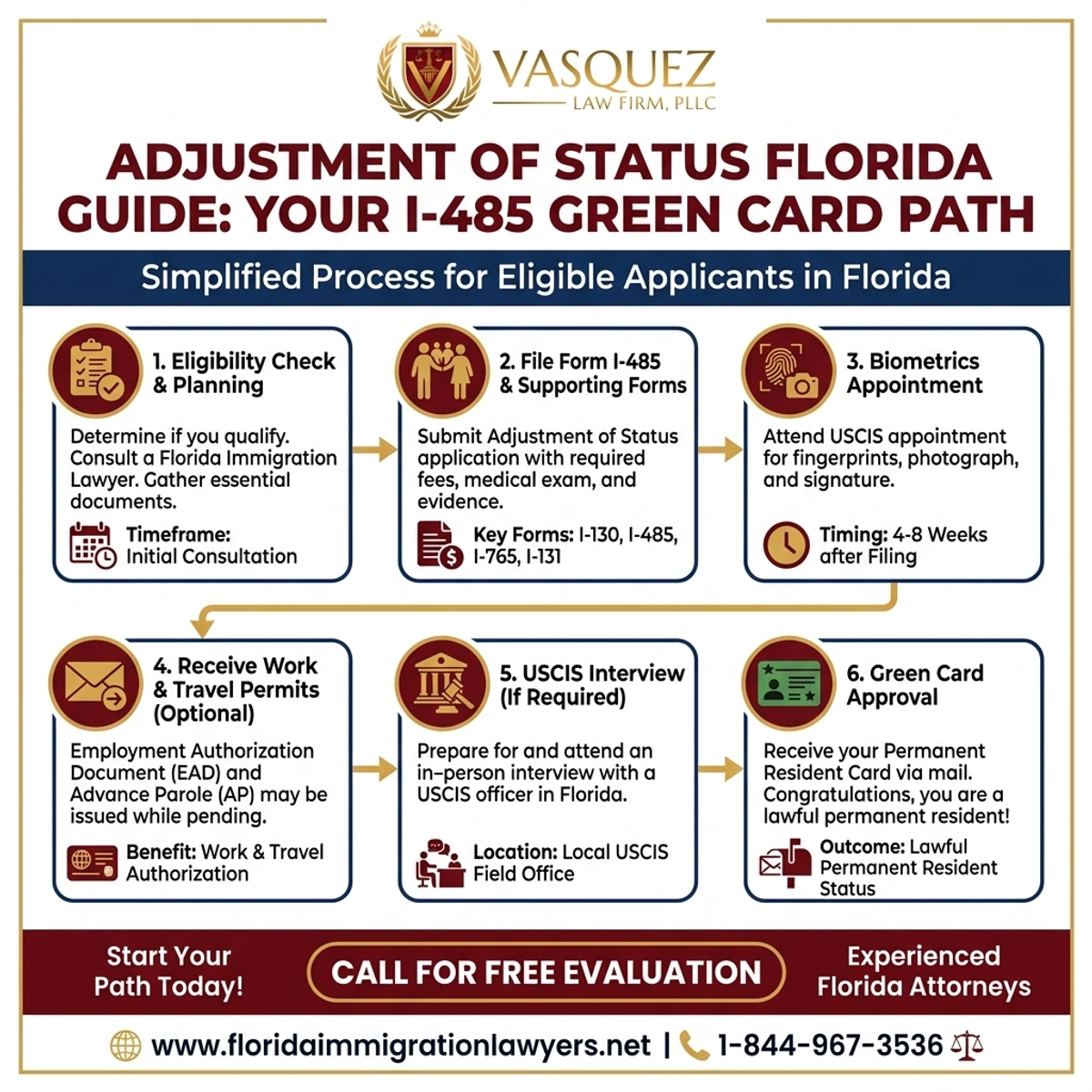
The process for applying for adjustment of status in Florida involves several critical steps. Each step requires careful attention to detail and timely submission of documents. Missing a deadline or submitting incomplete information can lead to significant delays or even denial of your application. Here is a general overview of what you can expect:
-
Determine Eligibility and Underlying Petition: Before filing Form I-485, you must first confirm your eligibility. This typically means having an approved Form I-130, I-140, or being eligible under a special category like asylum status (learn more about asylum). For immediate relatives of U.S. citizens, you can often file the I-130 and I-485 concurrently. For other categories, the I-130 or I-140 must be approved and your priority date current before you can file your I-485.
-
Gather Required Documents: This is a critical and often time-consuming step. You will need a variety of personal, financial, and immigration-related documents. This includes birth certificates, marriage certificates, passports, entry records, and more. We will detail a comprehensive document checklist in the next section.
-
File Forms I-485 and Supporting Applications: You will submit Form I-485, Application to Register Permanent Residence or Adjust Status, along with several other forms. These commonly include Form I-765 (Application for Employment Authorization) to get a work permit, and Form I-131 (Application for Travel Document) for advance parole, allowing you to travel internationally while your I-485 is pending. The entire packet, including the underlying petition (if filed concurrently), is mailed to the appropriate USCIS Direct Filing Address, which depends on your specific category and location in Florida.
-
Attend Biometrics Appointment: After filing, USCIS will send you an appointment notice for biometrics (fingerprints, photos, and signature). This typically occurs at a local Application Support Center (ASC) in Florida, such as those in Miami, Orlando, or Tampa. This step is essential for background checks and identity verification.
Step-by-Step Process — Adjustment of Status Florida Guide: Your I-485 Green Card Path
-
Interview (If Required): Many I-485 applicants, especially those based on family petitions, are required to attend an interview at a local USCIS field office in Florida. This could be in Miami, Orlando, or Tampa. During the interview, an immigration officer will review your application, ask questions about your eligibility, and verify the authenticity of your relationship or employment. Not all cases require an interview, particularly employment-based adjustments.
-
Receive Decision: If your application is approved, you will receive a welcome notice and your green card will be mailed to you. If it is denied, USCIS will provide a reason. A denial can have serious consequences and may lead to deportation proceedings, making professional legal advice crucial for appeal or other options.
Key Documents Required for Your I-485 Application
A complete and accurate submission of documents is vital for a successful adjustment of status application. Preparing these documents thoroughly can prevent requests for evidence (RFEs) and unnecessary delays. While the exact list may vary based on your specific case, here is a general checklist of essential documents for most I-485 applicants:
- Form I-485: Application to Register Permanent Residence or Adjust Status.
- Form I-130/I-140 Approval Notice: If applicable, a copy of the approved immigrant petition (or filed concurrently).
- Form I-864: Affidavit of Support, from your petitioner or a joint sponsor, demonstrating financial sufficiency.
- Form I-693: Report of Medical Examination and Vaccination Record, completed by a USCIS-approved civil surgeon.
- Birth Certificate: Copy of your original birth certificate, with certified translation if not in English.
- Passport and Visa Copies: Copies of your passport pages, visa stamp, and I-94 Arrival/Departure Record.
- Marriage Certificate: If applying based on marriage, a copy of your marriage certificate.
- Photos: Two passport-style photographs meeting USCIS specifications.
- Proof of Lawful Entry: Copies of your visa, I-94, or other documents proving lawful inspection and admission/parole.
- Police Clearances: If you have lived in certain countries for extended periods, you may need police clearances.
- Proof of Relationship: For family-based petitions, evidence of a bona fide relationship (e.g., joint bank accounts, leases, photos).
- Employment Authorization Document (EAD) & Advance Parole (AP): If applying for I-765 and I-131 concurrently.
Organizing these documents meticulously and ensuring all translations are certified is paramount. Any missing or incorrectly prepared document can halt your application process. Our team at Florida Immigration Lawyers can help you compile this crucial paperwork for your family-based or employment-based adjustment of status.
Timeline and Processing Expectations for Florida I-485 Cases
Understanding the timeline for your adjustment of status application is critical for planning your future in Florida. Processing times can vary significantly based on several factors, including the USCIS field office jurisdiction (e.g., Miami, Orlando, Tampa for Florida residents), the specific immigrant visa category, the completeness of your application, and current USCIS caseloads. While it is impossible to provide an exact timeframe, we can discuss general expectations and how to monitor your case.
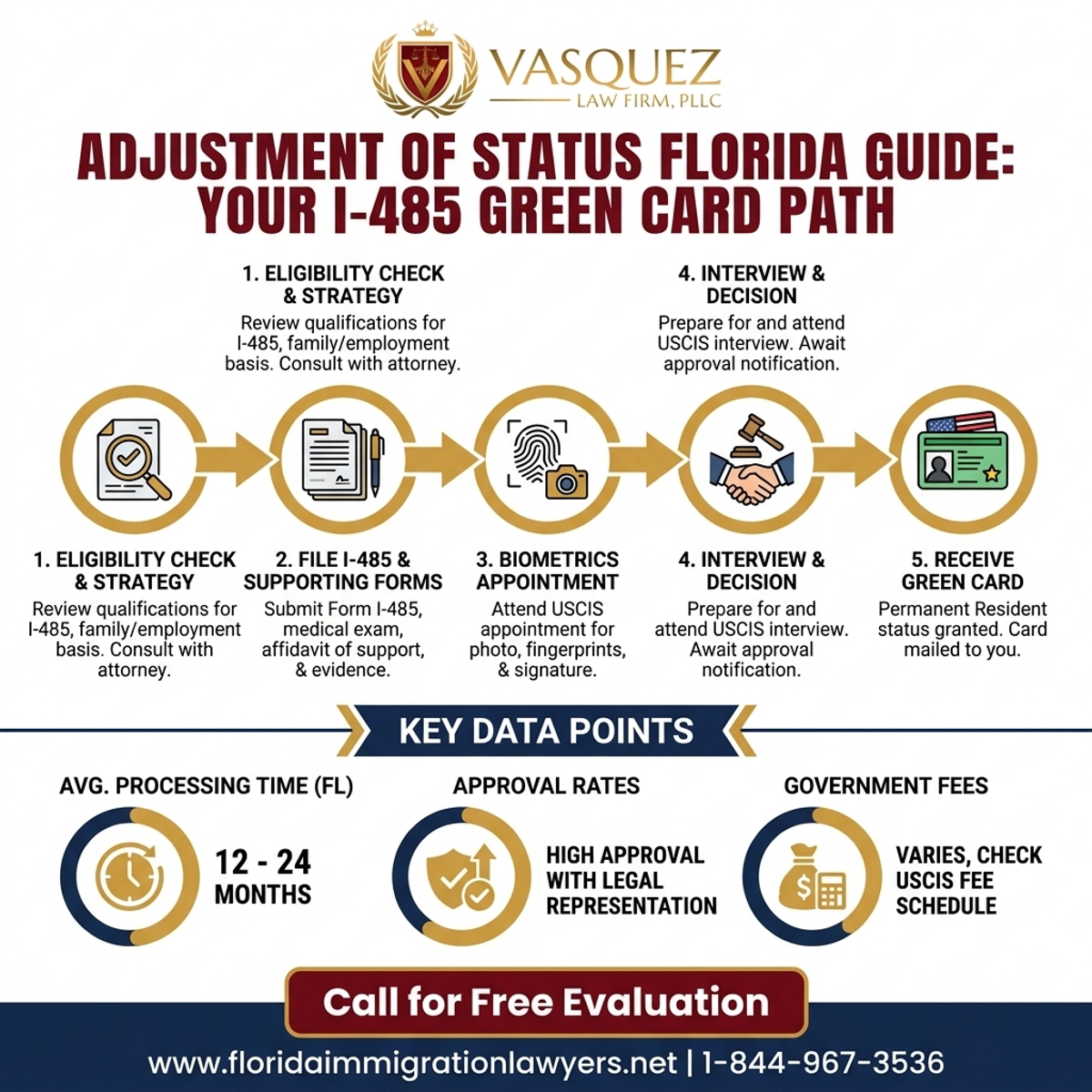
Typically, after filing your I-485 package, you will receive a receipt notice within a few weeks. The biometrics appointment usually follows within 1-3 months. The issuance of an Employment Authorization Document (EAD) and Advance Parole (AP) card, allowing you to work and travel, can take anywhere from 6 to 12 months, or sometimes longer, depending on USCIS processing times. The final interview and decision for family-based cases can take anywhere from 12 months to several years.
Key Statistics — Adjustment of Status Florida Guide: Your I-485 Green Card Path
Employment-based adjustment of status applications, particularly those in certain preference categories, may have different processing timelines, sometimes quicker if an interview is waived. You can check current processing times on the USCIS website by selecting Form I-485 and your specific field office or service center. It is important to remember that these are estimates and not guarantees. Factors like Requests for Evidence (RFEs) or issues during background checks can extend your timeline significantly. Maintaining continuous legal status and not committing any immigration violations during this period is paramount for a successful outcome.
Cost Factors and Fee Breakdown for Adjustment of Status
The financial aspect of applying for adjustment of status is an important consideration for many individuals and families in Florida. The total cost involves several components, and while we cannot provide specific, current fee amounts (as they are subject to change by USCIS), we can outline the general categories of expenses you should anticipate.
- USCIS Filing Fees: This is the most significant portion of the cost. The main fee is for Form I-485 itself. Additionally, there is a biometrics services fee. If you are concurrently filing for an Employment Authorization Document (I-765) and an Advance Parole Document (I-131), these forms may have separate fees, though sometimes they are included with the I-485 fee for certain categories. It is crucial to check the most current fee schedule on the USCIS website.
- Medical Examination Fee: All I-485 applicants must undergo a medical examination by a USCIS-approved civil surgeon. The cost of this exam is paid directly to the civil surgeon's office and can vary depending on the provider, required vaccinations, and specific tests.
- Attorney Fees: While not mandatory, retaining an experienced immigration attorney is highly recommended. Legal fees cover the attorney's expertise in preparing your application, gathering documents, responding to RFEs, preparing you for interviews, and representing you if necessary. The cost of legal representation can vary based on the complexity of your case and the attorney's experience, but it is often a worthwhile investment to ensure accuracy and reduce stress.
- Document Translation and Photocopying: If any of your supporting documents are not in English, you will need certified translations, which incur additional costs. Photocopying, postage, and other administrative expenses should also be factored in.
Planning for these costs is an essential part of preparing your I-485 application. Florida Immigration Lawyers offers transparent fee structures and can discuss the potential costs involved in your specific case during a free consultation. We believe in making quality legal representation accessible to all.
Common Mistakes to Avoid During Your Adjustment of Status Application
Navigating the adjustment of status process can be complex, and even minor errors can lead to significant delays or outright denial of your green card application. Being aware of these common pitfalls can help you avoid them and ensure a smoother journey to permanent residency in Florida.
-
Entering Without Inspection (EWI): One of the most common reasons for I-485 ineligibility is entering the U.S. without inspection. While some limited exceptions exist for immediate relatives of U.S. citizens under specific circumstances (e.g., INA 245(i)), most EWIs cannot adjust status. Attempting to do so without proper legal advice will result in denial and potentially deportation proceedings.
-
Failing to Maintain Lawful Status: For most categories (excluding immediate relatives of U.S. citizens), you must maintain lawful nonimmigrant status up to the point of filing your I-485. Overstaying a visa or violating the terms of your nonimmigrant status can render you ineligible for adjustment, leading to denial.
-
Incomplete or Inaccurate Forms: Submitting forms with missing information, incorrect answers, or unsigned pages is a frequent cause of Requests for Evidence (RFEs) or outright rejection. USCIS is very particular about form completion. Double-check every field.
-
Insufficient Supporting Documentation: Failing to provide all required supporting documents, such as birth certificates, marriage certificates, or financial evidence, will lead to delays. Similarly, submitting documents without certified English translations is a common error.
-
Failing the Medical Examination (I-693): Not completing the medical exam with a USCIS-approved civil surgeon, having an outdated exam, or failing to meet health-related admissibility standards can jeopardize your application. Ensure all required vaccinations are up-to-date.
-
Misrepresenting Information: Any form of misrepresentation, fraud, or making false statements to an immigration officer or on application forms can lead to a permanent bar from the U.S. This is a severe mistake with lasting consequences, potentially leading to deportation.
-
Traveling Without Advance Parole: If you travel outside the U.S. while your I-485 is pending without first obtaining an Advance Parole Document (Form I-131), your I-485 application will generally be considered abandoned. This can lead to significant problems upon your attempted re-entry.
-
Criminal History Issues: Certain criminal convictions can render you inadmissible to the U.S. and ineligible for adjustment of status. Failing to disclose a full criminal history, no matter how minor it seems, can be detrimental. Always consult with an attorney about any past arrests or convictions.
-
Lack of Bona Fide Marriage: For marriage-based adjustment of status, USCIS rigorously scrutinizes the authenticity of the marriage. Insufficient evidence of a bona fide marital relationship can lead to denial and accusations of marriage fraud.
-
Missing Deadlines or Ignoring RFEs: USCIS provides strict deadlines for responding to RFEs or notices. Failing to respond promptly or adequately can result in the denial of your application without further consideration.
When to Call a Lawyer for Your Adjustment of Status Case
While some individuals may attempt to file an adjustment of status application on their own, the complexities of immigration law make professional legal assistance invaluable. The stakes are incredibly high, as an error could lead to denial, loss of fees, or even removal proceedings. You should strongly consider contacting an experienced immigration attorney in Florida, like those at Florida Immigration Lawyers, in several key scenarios:
- Complex Eligibility Issues: If you entered the U.S. without inspection, have a history of overstaying a visa, or have any past immigration violations.
- Criminal Record: Any past arrests or convictions, even minor ones, require careful legal analysis to determine inadmissibility or eligibility for waivers.
- Previous Denials or Deportation Orders: If you have a history of immigration application denials or have been subject to deportation proceedings.
- Medical Inadmissibility: If you have health-related issues that might make you inadmissible.
- Unusual Family Situations: Cases involving step-relationships, adoptions, or previous marriages can add layers of complexity.
- Difficulty Gathering Documents: If you are struggling to obtain necessary documents, especially from abroad, an attorney can offer guidance.
- Responding to RFEs: If USCIS sends a Request for Evidence, an attorney can help you formulate a comprehensive and timely response.
- Interview Preparation: An attorney can prepare you thoroughly for your USCIS interview, ensuring you understand potential questions and how to answer them truthfully and effectively.
- Seeking Citizenship: Once you obtain your green card, our attorneys can also assist you with the path to U.S. Citizenship.
Florida Immigration Lawyers has extensive experience assisting individuals across Florida, from Coral Springs to Fort Myers, with their adjustment of status applications. We understand the unique challenges faced by immigrants in our state and are committed to providing compassionate, effective legal representation. Our team is well-versed in the latest USCIS policies and can help you navigate the process with confidence.
About Florida Immigration Lawyers: Adjustment of Status Florida Guide
Florida Immigration Lawyers is a leading law firm dedicated to providing exceptional immigration legal services to individuals and families throughout the entire state of Florida. With a deep understanding of U.S. immigration law and a commitment to our clients, we offer comprehensive legal solutions for a wide range of immigration matters. Our experienced attorneys are passionate about helping immigrants achieve their dreams of living and working legally in the United States.
We focus on areas including family-based immigration, employment-based visas, adjustment of status, asylum, deportation defense, and citizenship. Our firm prides itself on personalized service, clear communication, and a client-centered approach. We understand that every case is unique, and we tailor our strategies to meet your specific needs and goals. Whether you are in Orlando, or any other part of Florida, our team is ready to serve you.
Choosing Florida Immigration Lawyers means choosing a partner who will stand by you through every step of your immigration journey. We offer free consultations, are available 24/7, and our bilingual team ensures that language is never a barrier to quality legal representation. Our attorneys are not just legal advisors; they are compassionate advocates dedicated to protecting your rights and securing your future. Visit our attorneys page to learn more about our team.
Sources and References: Adjustment of Status Florida Guide
- U.S. Citizenship and Immigration Services (USCIS)
- Executive Office for Immigration Review (EOIR)
- U.S. Department of State - Bureau of Consular Affairs
- Immigration and Nationality Act (INA) Section 245 (8 U.S.C. § 1255) - Adjustment of Status of Nonimmigrant to That of Person Admitted for Permanent Residence.
- 8 CFR Part 245 - Adjustment of Status to That of Person Admitted for Permanent Residence.
- USCIS Policy Manual.
Related services: immigration practice areas, free immigration consultation.
This article provides general legal information and is not intended as legal advice. Every case is unique, and outcomes depend on specific facts and circumstances. Contact an attorney for advice about your particular situation. Immigration laws are subject to change, and this information may not reflect the most current developments.
Your journey to a green card through adjustment of status in Florida is a significant step towards building a stable future. With the right legal support, you can navigate the complexities with confidence and increase your chances of a successful outcome. Do not let uncertainty or fear prevent you from pursuing your dreams.
Florida Immigration Lawyers is here to provide the guidance and compassionate representation you deserve. We serve individuals and families throughout Florida, including Orlando. Take the first step towards your permanent residency today.
Call us now for a free, confidential consultation at 1-844-YO-PELEO. Se Habla Espanol - Estamos aqui para ayudarle.
Other ways people search for this
People look for this help under different names. Related searches include green card immigration attorneys; immigration lawyer for adjustment of status; lpr lawyer; permanent resident lawyer; permanent resident attorney; employment based green card lawyer; lawful permanent resident attorney; lawful permanent resident lawyer; us residency lawyer; adjustment of status immigration lawyer; adjustment of status law firm; adjustment of status lawyers; best immigration lawyer for green card; employment based green card attorney; employment green card lawyer; green card & work visa lawyer; greencard lawyers; immigration lawyer adjustment of status; immigration lawyer for employment based green card; immigration lawyer for permanent residence; adjustment of status law firms; employer-sponsored green card attorney; employer sponsored green card attorney; employment-based green card attorney; find me the best residency lawyer; green card and work visa lawyer; immigration lawyer for permanent residency; immigration lawyer for residency; lawyer for residency; lawyer residency; nvc attorney; nvc attorney contact; attorney/lawyer for adjustment of status; green+card+immigration+attorneys; permanent residency attorneys; permanent resident card attorney; permanent resident card lawyer; top immigration attorneys handling consular processing; adjustment status immigration attorney; attorney for green card application; best green card immigration lawyer; best green card lawyers; best immigration lawyer for adjustment of status; best immigration lawyer green card; consular lawyer; green card application attorney; green card application law firm; green card application lawyers; lawyer for adjustment of status.
Do Not Navigate This Process Alone
Our experienced immigration attorneys are ready to fight for you. Get a free, confidential case review today.
Se Habla Español
Or leave your details and we’ll call you:
Free Evaluation in 24 Hours
Or talk to us right now
AI voice assistant — available 24/7
FreeFrequently Asked Questions

William J. Vásquez
Founding Attorney · Vasquez Law Firm
U.S. Air Force veteran and immigration attorney with years of hands-on U.S. immigration experience. J.D., NCCU School of Law. AILA member. Admitted to the 4th, 5th, and 11th Circuit Courts.
Available 24/7 - Free Evaluations
Reviewed for legal accuracy by William J. Vásquez
Licensed in North Carolina; U.S. immigration is federal practice.
Related Legal Services
Our Florida immigration attorneys can help you with business immigration, deportation defense and family immigration services. Call today at 1-844-YO-PELEO for a free case review.
Related Links
Related Topics
Free Legal Case Review
Discuss your case with our experienced attorneys. We're available 24/7.
Se Habla Español - Estamos aquí para ayudarle.
Related Articles
Immigration Lawyer Orlando Free Consultation in Florida
For individuals and families in Orlando, Florida, navigating the complexities of U.S. immigration law requires expert guidance. An immigration lawyer in Orlando offers crucial support for everything from visa applications and green card processes to naturalization and deportation defense. This comprehensive guide details what a free consultation covers, providing a step-by-step overview of immigration pathways, essential document checklists, and expected timelines in 2026. We also highlight common mistakes to avoid, discuss the critical role of legal counsel in deportation and asylum cases, and explain why choosing a local Orlando immigration attorney is beneficial. Florida Immigration Lawyers is dedicated to serving the diverse community of Orlando with compassionate, effective legal solutions, ensuring you receive personalized advice and robust representation for a successful immigration journey.
Fiance Visa in Miami: 2026 Process Guide for Florida
For U.S. citizens in Florida, bringing a foreign fiancé(e) to the U.S. requires navigating the K-1 Fiance Visa process. This guide details the 2026 requirements, step-by-step application, essential documents, and expected timelines. Learn about filing Form I-129F with USCIS, consular interviews, and the crucial Adjustment of Status after marriage. We cover typical fees, common mistakes to avoid, and when to seek legal assistance. Florida Immigration Lawyers offers expert guidance for couples in Miami, Orlando, and across Florida, ensuring a smooth path to uniting with your loved one. Get a free case review today.
Immigration Lawyer Services in Orlando, Florida
Explore immigration consultation services in Orlando, Florida, with a qualified immigration lawyer. Learn what to expect and understand your options for family and business immigration needs.
Fraud Prevention and Detection Fee: What to Know in Florida
Explore the fraud prevention and detection fee essential for immigration processes in Florida. Discover how it impacts applications like the I-601 waiver and learn key steps to navigate this requirement effectively.