Parole in Place for Military Families Miami 2026
Parole in place (PIP) offers critical relief to military families facing immigration challenges in Florida. Learn about the application process, eligibility, and how Florida Immigration Lawyers can assist you in keeping your family together.

- PIP is available to immediate family members of U.S. military personnel.
- Helps prevent deportation and allows for adjustment of status.
- Applies to those living in Hialeah and throughout Florida.
- Consultation with an immigration lawyer is recommended.
Introduction
For military families living in Miami, navigating the complexities of immigration law can be daunting, especially when family members are undocumented. Fortunately, parole in place (PIP) offers a crucial form of relief, allowing these families to remain together. This article provides a comprehensive guide to understanding PIP, its benefits, and how to apply in Florida.
The sacrifices made by military personnel and their families are immense, and the added stress of potential family separation due to immigration status can be overwhelming. PIP acknowledges these unique challenges, providing a pathway to stability and legal residency for eligible family members. It's a testament to the nation's commitment to supporting those who serve, ensuring their loved ones can build a secure future in the U.S.
Understanding the nuances of PIP is vital for eligible families in Florida, from Miami to Hialeah and beyond. This guide will walk you through the eligibility criteria, the application process, required documentation, and what to expect during the journey. Our goal is to empower you with the knowledge needed to pursue this critical immigration relief, always emphasizing the importance of expert legal guidance from experienced professionals like Florida Immigration Lawyers.
Call Florida Immigration Lawyers at 1-844-967-3536 for a free consultation.
What is Parole in Place for Military Families?
Parole in place (PIP) is a discretionary relief offered by U.S. Citizenship and Immigration Services (USCIS) to undocumented family members of U.S. military personnel. It allows them to legally remain in the U.S. and apply for work authorization.
As of 2026, PIP is especially relevant for families residing in Florida, providing a path to legal status while preventing deportation. It is essential for eligible families to understand the application process and criteria.
At its core, PIP grants a temporary legal status within the United States, effectively 'paroling' an individual into the country even if they initially entered without inspection or overstayed a visa. This parole status is significant because it overcomes a common barrier to adjusting status (applying for a green card) from within the U.S. – specifically, the requirement of lawful entry. With PIP, an individual is considered to have been "paroled" into the U.S., fulfilling the lawful entry prerequisite for certain green card applications.
This relief is specifically tailored to support military families, recognizing the immense contributions and sacrifices of service members. Eligibility extends to immediate relatives – spouses, unmarried children under 21, and parents – of U.S. citizens or lawful permanent residents who are serving in the active U.S. Armed Forces, are in the Ready Reserve, or are veterans who were honorably discharged. This broad eligibility ensures that a wide range of military families can benefit from this crucial program, providing peace of mind and family unity.
Beyond preventing deportation, PIP offers several profound benefits. Once granted, individuals can apply for an Employment Authorization Document (EAD), allowing them to work legally in the U.S. This not only provides financial stability but also integrates family members more fully into society. Crucially, PIP often serves as a stepping stone towards obtaining lawful permanent residency (a green card) through adjustment of status, offering a long-term solution for military families seeking to secure their future in the United States.
How to Apply for Parole in Place in Florida?
To apply for parole in place, eligible family members must submit Form I-131, Application for Travel Document, along with supporting documents to the appropriate USCIS office.
- Gather necessary documents, including proof of relationship to military personnel, military service records, and proof of residence in Florida.
- Complete Form I-131 accurately and attach all supporting documents.
- Submit the application to the appropriate USCIS office for processing.
- Await a decision and, if approved, receive parole status and work authorization.
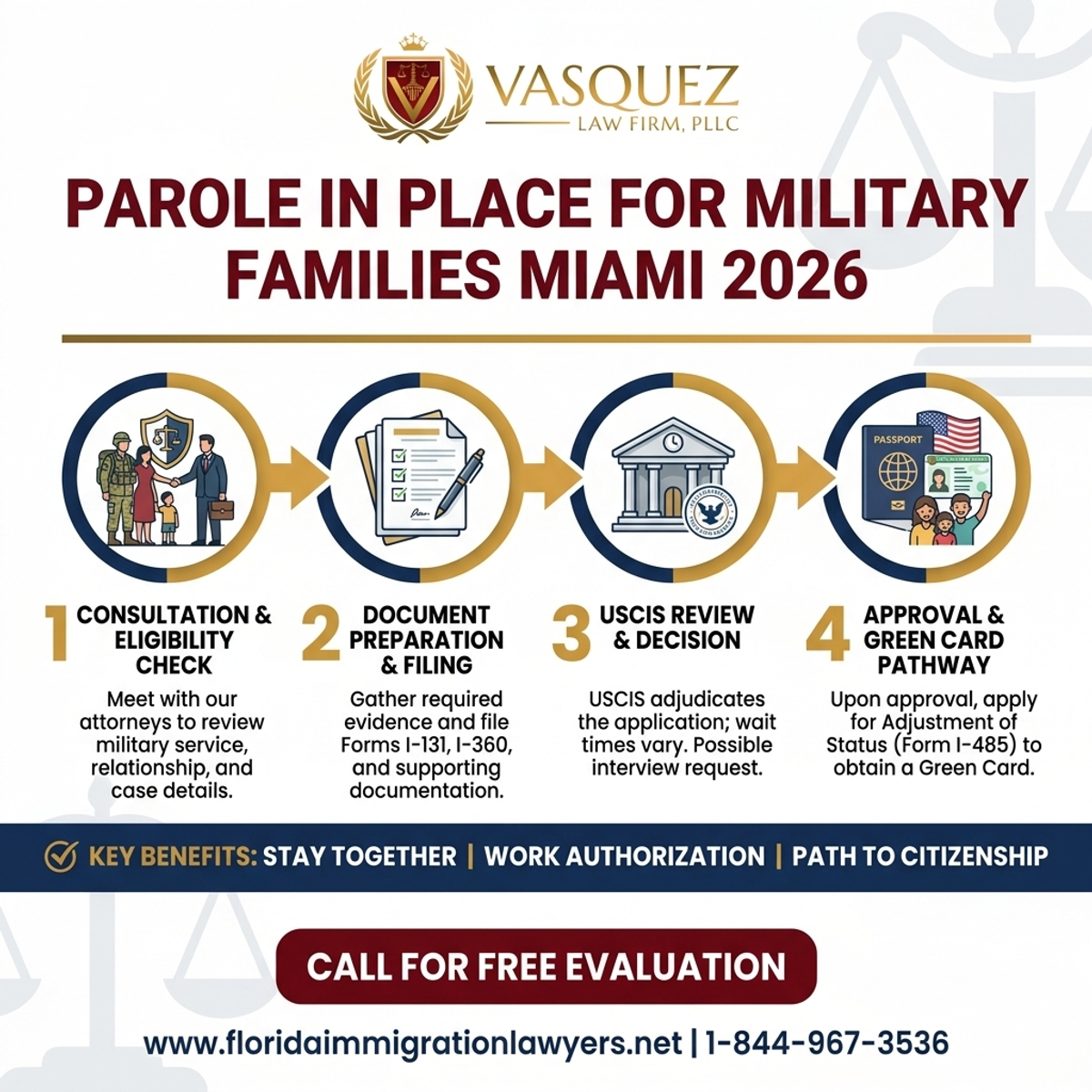
Step-by-Step Process — Parole in Place for Military Families Miami 2026
It is advisable to consult an immigration attorney to ensure a successful application.
Understanding Form I-131 for PIP
While Form I-131 is typically used for applying for a re-entry permit, refugee travel document, or advance parole for travel abroad, it's also the designated form for requesting Parole in Place. When applying for PIP, specific sections of the form must be completed carefully to indicate that you are seeking parole as an immediate relative of a U.S. service member. It's crucial not to confuse PIP with advance parole for travel, as they serve different purposes, though they use the same form. Incorrectly completing this form can lead to delays or even denial, making attention to detail paramount.
Detailed Application Steps and Practical Tips
Beyond the basic steps, a successful PIP application requires meticulous preparation. When gathering documents, ensure all foreign language documents are accompanied by certified English translations. For military service records, a copy of the service member's military ID, deployment orders, or a letter from their commanding officer can further strengthen the application, demonstrating their active duty or veteran status. Proof of relationship, such as marriage certificates or birth certificates, should be be original or certified copies, not just photocopies.
When completing Form I-131, pay close attention to Part 2, "Application Type." You will typically mark "1.b. Parole" and then provide a detailed explanation in Part 7, "Information About Your Request," clearly stating that you are requesting Parole in Place as an immediate relative of a U.S. service member. Include the service member's name, rank, branch of service, and justification for the parole request. Attaching a cover letter summarizing your request and the enclosed documents can also be highly beneficial for USCIS officers reviewing your case. Always make a complete copy of your entire application package before mailing it.
Once submitted, USCIS will send a receipt notice confirming they have received your application. This notice will include a case number that you can use to track the status of your application online. Be prepared for the possibility of a biometrics appointment, where you will provide fingerprints, photographs, and a signature. While interviews are rare for PIP applications, USCIS may request additional evidence (RFE) if they need more information. Responding to an RFE promptly and thoroughly is critical to avoiding delays or denials. Throughout this process, the expertise of Florida Immigration Lawyers can be invaluable, guiding you every step of the way.
Document Checklist for PIP Application
- Proof of relationship to active-duty military personnel or veterans. This includes marriage certificates for spouses, birth certificates for children and parents, and any other official documents establishing the familial link.
- Military service records (e.g., DD Form 214 for veterans, current military ID, enlistment contract, or a letter from the commanding officer for active duty personnel). This verifies the service member's eligibility.
- Proof of residency in Florida (e.g., utility bills, lease agreements, driver's license, bank statements). These documents establish your current domicile within the state, which is important for jurisdictional purposes.
- Completed Form I-131, Application for Travel Document, with all relevant sections filled out accurately and signed. Ensure you specify that you are applying for Parole in Place.
- Affidavit of support from military personnel (Form I-864, if applicable, for future adjustment of status). While not always required for PIP itself, it's crucial for the subsequent green card application.
- Passport-style photographs of the applicant, adhering to USCIS specifications. These are essential for identification purposes and for any subsequent work authorization or travel documents.
- Any previous immigration documents, such as I-94 arrival/departure records, visa stamps, or prior applications, to provide a complete immigration history.
Organizing these documents thoroughly and accurately is paramount to a successful application. Any missing or incorrect information can lead to significant delays or even a denial of your PIP request. Consider creating a detailed index or table of contents for your application package to help USCIS process your submission efficiently. Florida Immigration Lawyers can help you compile a comprehensive and error-free package.
Timeline and Processing Expectations
| Stage | Typical Timeframe | Notes |
|---|---|---|
| Initial Application Review | 2-3 months | Timeframe may vary based on workload and completeness of application. |
| Decision Issuance | 4-6 months | Additional documentation may be requested by USCIS, extending the timeline. |
| Receipt of Parole Status | 1-2 weeks post-decision | Includes work authorization if approved. |
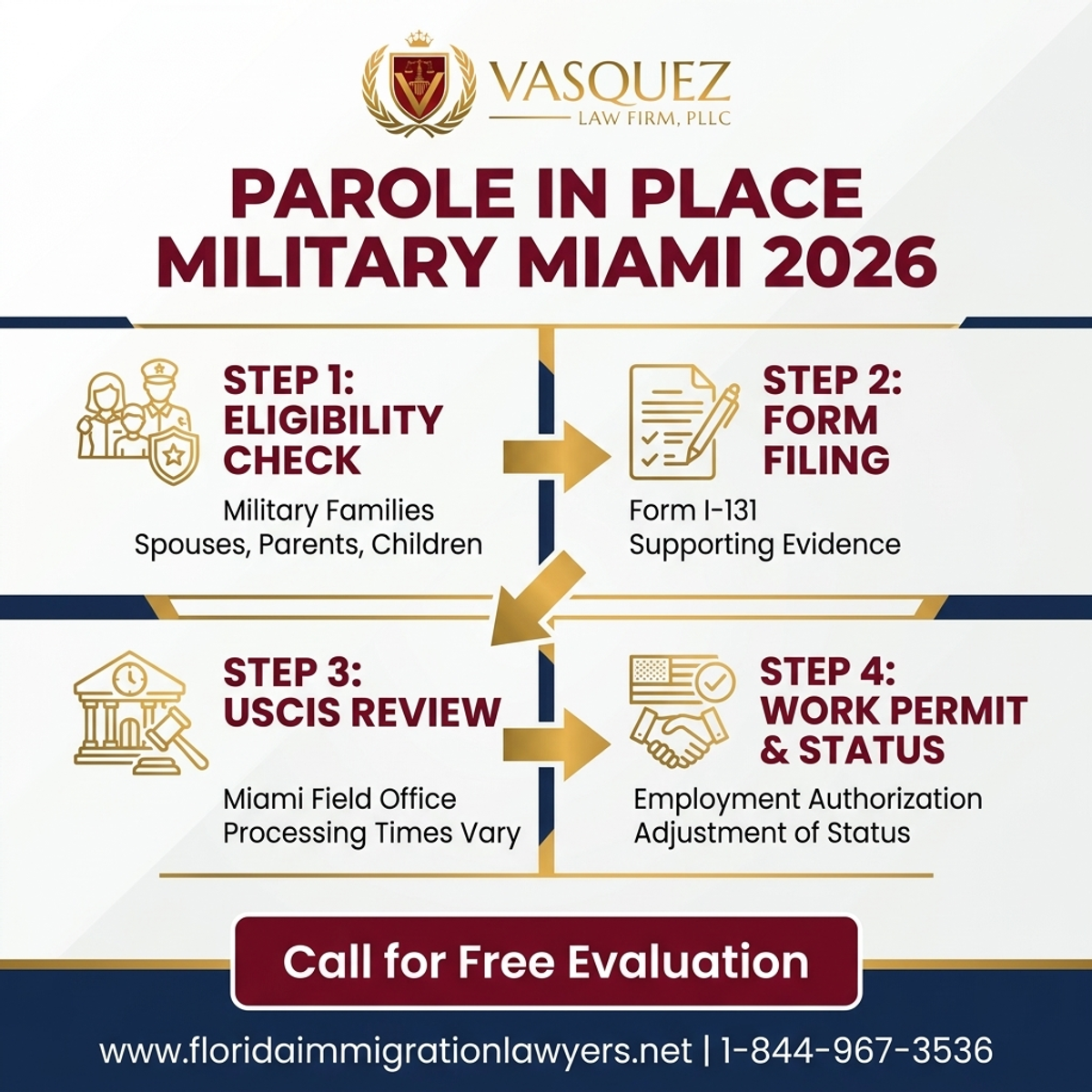
Key Statistics — Parole in Place for Military Families Miami 2026
It's important to understand that the timelines provided are estimates and can fluctuate significantly based on USCIS workload, policy changes, and the complexity of individual cases. Factors such as the volume of applications received, staffing levels at service centers, and the need for additional evidence can all impact processing times. While some cases may be processed more quickly, others might take longer, requiring patience and consistent monitoring of your application status.
To help manage expectations, always refer to the official USCIS processing times tool on their website, which provides the most current data for specific form types and service centers. While you cannot directly expedite a PIP application without extraordinary circumstances, submitting a complete and well-organized application package from the outset can help prevent unnecessary delays. An immigration attorney from Florida Immigration Lawyers can help you prepare a robust application, potentially streamlining the process and addressing any issues proactively.
Cost Factors and Fee Breakdown
| Item | Typical Fee | Notes |
|---|---|---|
| Form I-131 Filing Fee | Varies | Check USCIS for current fees as they are subject to change. |
| Attorney Fees | Varies | Consult with an attorney for an estimate. |
| Document Preparation | Varies | Costs depend on the complexity and amount of documentation required. |
Do not navigate this process alone. Contact Florida Immigration Lawyers today.
Navigating the financial aspects of an immigration application is a crucial part of the planning process. The USCIS filing fee for Form I-131, while subject to change, is a standard cost for most applicants. However, it's important to note that certain applicants, particularly those facing financial hardship, may be eligible for a fee waiver. Eligibility for a fee waiver is determined by USCIS based on specific income guidelines or receipt of means-tested benefits. Exploring this option can significantly reduce the upfront cost of your application.
Beyond the filing fee, consider potential costs for obtaining necessary documents, such as birth certificates, marriage licenses, or certified translations. These seemingly small expenses can add up, so budgeting for them is wise. Investing in legal counsel, while an additional cost, often proves to be invaluable. An experienced immigration attorney can help you avoid costly mistakes, ensure your application is complete and accurate, and represent you effectively, ultimately saving you time and potential future expenses associated with delays or denials. Florida Immigration Lawyers offers transparent fee structures and free consultations to discuss your specific situation.
Common Mistakes to Avoid
- Submitting incomplete applications, leading to delays or denials. Always double-check that every required field is filled, all questions are answered, and every supporting document is attached as specified in the instructions.
- Failing to provide proof of military relationship. This is a foundational requirement; without clear, unambiguous evidence of your relationship to the service member, your application cannot proceed.
- Not updating USCIS with address changes, causing missed correspondences. USCIS sends important notices, requests for evidence, and decisions by mail. A missed letter can lead to a denial without your knowledge.
- Ignoring requests for additional documentation from USCIS. These requests (RFEs) are critical; failure to respond fully and on time will almost certainly result in a denial.
- Missing application deadlines, resulting in ineligibility. While PIP doesn't have a strict deadline, other related immigration processes might, so staying organized is key.
- Incorrectly completing Form I-131, leading to processing errors. Even minor errors can cause your application to be rejected or returned, wasting valuable time.
- Assuming approval is guaranteed; each case is evaluated individually. PIP is a discretionary benefit, meaning USCIS has the final say. A strong, well-supported application increases your chances.
- Not consulting with a legal expert, increasing the risk of errors. An experienced immigration attorney can identify potential issues, ensure compliance, and present your case in the most favorable light.
Avoiding these common pitfalls is crucial for a smooth and successful PIP application process. Many of these mistakes stem from a lack of familiarity with complex immigration regulations or simple oversight. For instance, ensuring that all copies of documents are clear and legible, and that translations are certified, can prevent an RFE. Similarly, maintaining a copy of your entire submitted application package allows you to reference it if USCIS has questions or if you need to appeal a decision.
One often-overlooked mistake is not adequately articulating the discretionary factors that support your request for parole. While the military relationship is paramount, providing a compelling narrative about why parole is warranted – such as the impact on the service member, the family's ties to the community, or humanitarian concerns – can strengthen your case. Florida Immigration Lawyers excels at crafting such compelling arguments, ensuring your application stands out for its completeness and persuasive power, significantly reducing the risk of a denial.
When to Call a Lawyer
Contact an immigration lawyer if you encounter complexities in your PIP application, receive a request for additional evidence, or face possible deportation. Legal expertise is crucial in navigating the intricacies of immigration law, especially for military families in Florida.
While the PIP process aims to be straightforward for military families, real-life situations often present unique challenges that necessitate professional legal guidance. For example, if the applicant has a criminal record, even a minor one, or a history of previous immigration violations, these issues can complicate eligibility and require careful legal analysis. An attorney can assess the impact of such factors and advise on the best course of action, including whether a waiver might be available or if PIP is still a viable option.
Furthermore, if you receive a Notice of Intent to Deny (NOID) or an outright denial, immediate legal intervention is critical. An attorney can help you understand the reasons for the denial, gather additional evidence, and prepare a robust response or appeal. They can also represent you in any necessary hearings or interviews, ensuring your rights are protected. For any questions or concerns regarding your eligibility or the application process, do not hesitate to reach out to Florida Immigration Lawyers at 1-844-967-3536 for expert assistance.
About Florida Immigration Lawyers
Florida Immigration Lawyers is a leading law firm offering comprehensive immigration services across Florida. Our team is dedicated to assisting military families with their parole in place applications. Contact us at 1-844-967-3536 or visit our website at https://www.floridaimmigrationlawyers.net for a free consultation.
With a deep understanding of both immigration law and the specific needs of military families, our attorneys provide compassionate and effective legal representation. We pride ourselves on our client-centered approach, ensuring that each family receives personalized attention and strategic advice tailored to their unique circumstances. Our commitment extends to helping service members and veterans secure a stable future for their loved ones in the U.S., leveraging our expertise to navigate even the most complex cases.
Sources and References
- U.S. Citizenship and Immigration Services (USCIS)
- Executive Office for Immigration Review (EOIR)
- 8 U.S.C. Chapter 12 - Immigration and Nationality Act
Related services: immigration practice areas, family immigration services, citizenship and naturalization, deportation defense.
This article provides general legal information and is not intended as legal advice. Every case is unique, and outcomes depend on specific facts and circumstances. Contact an attorney for advice about your particular situation.
Se Habla Espanol - Estamos aqui para ayudarle.
If you need legal assistance, learn more about our immigration law practice, or call us at 1-844-967-3536 for a free consultation.
Do Not Navigate This Process Alone
Our experienced immigration attorneys are ready to fight for you. Get a free, confidential consultation today.
Se Habla Español
Or leave your details and we’ll call you:
Free Evaluation in 24 Hours
Or talk to us right now

AI voice assistant — available 24/7
FreeFrequently Asked Questions

William J. Vásquez
Founding Attorney · Vasquez Law Firm
U.S. Air Force veteran and immigration attorney with years of hands-on U.S. immigration experience. J.D., NCCU School of Law. AILA member. Admitted to the 4th, 5th, and 11th Circuit Courts.
Available 24/7 - Free Evaluations
Reviewed for legal accuracy by William J. Vásquez
Licensed in North Carolina; U.S. immigration is federal practice.
Related Legal Services
Our Florida immigration attorneys can help you with citizenship and naturalization, family immigration services and immigration practice areas. Call today at 1-844-967-3536 for a free consultation.
Related Links
Related Topics
Free Legal Consultation
Discuss your case with our experienced attorneys. We're available 24/7.
Se Habla Español - Estamos aquí para ayudarle.
Related Articles
Special Immigrant Juvenile Status in Florida: Your 2026
Special Immigrant Juvenile Status (SIJS) in Florida provides a vital immigration pathway for children who have suffered abuse, neglect, or abandonment. This detailed guide for 2026 explains the two-part process: obtaining a predicate order from a Florida state court and then filing with USCIS. We cover eligibility criteria, essential documentation, typical processing timelines, and associated costs. Navigating state juvenile courts and federal immigration procedures requires specific legal expertise. Learn how to protect vulnerable youth in Florida and avoid common mistakes that could jeopardize their Green Card application. Florida Immigration Lawyers offers expert guidance to ensure a secure future for these children.
Consular Processing for Florida Applicants in 2026
Consular processing is the path for individuals outside the U.S. to obtain an immigrant visa at a U.S. embassy or consulate. For Florida residents sponsoring family or employees abroad, understanding this multi-stage process is critical. This guide provides an in-depth look at the steps, required documents, timelines, and costs involved as of 2026. Learn about USCIS petitions, National Visa Center (NVC) processing, and the final embassy interview. We also highlight common mistakes to avoid and when legal assistance from Florida Immigration Lawyers can be invaluable, especially for applicants in Homestead and across Florida.
Immigration Lawyer Orlando Free Consultation: Your Options
Navigating immigration in Florida, especially with potential policy changes in 2026, requires expert legal guidance. An immigration lawyer Orlando free consultation offers a crucial opportunity to assess your situation, understand new rules, and plan your next steps without upfront cost. This comprehensive guide from Florida Immigration Lawyers explores the value of legal counsel, delves into anticipated immigration policy shifts for 2026, and outlines the process of working with an attorney. We cover essential documents, typical timelines, and common mistakes to avoid, all tailored for residents of Orlando and West Palm Beach. Learn how our firm can provide compassionate and effective representation for family visas, asylum, deportation defense, and more. Secure your future by understanding your options with a trusted Florida immigration law firm.
Withholding of Removal in Florida: A 2026 Defense Guide
Withholding of removal is a critical form of protection for non-citizens in Florida facing deportation and fearing persecution or torture in their home country. This comprehensive guide from Florida Immigration Lawyers details the strict eligibility requirements, the distinctions between withholding and asylum, and the unique protections offered under the Convention Against Torture (CAT). Learn about the step-by-step process in Florida immigration courts, essential documentation, and typical timelines as of 2026. We also cover the associated costs and crucial mistakes to avoid, emphasizing the importance of expert legal representation. If you're in removal proceedings and fear for your safety, understanding these options is vital for your defense.