Stem OPT Immigration Lawyer: 2026 Guide for Florida
The STEM OPT extension offers F-1 graduates in science, technology, engineering, and mathematics fields an additional 24 months of work authorization in the U.S. This guide from Florida Immigration Lawyers provides a comprehensive overview for students in Florida, covering eligibility requirements, the step-by-step application process, crucial documentation, typical timelines, and associated costs as of 2026. Understanding these intricate details is vital for a successful application. We highlight the importance of the Form I-983 training plan, E-Verify employer requirements, and strict USCIS deadlines. The article also addresses common mistakes to avoid, such as late filing or incomplete paperwork, and emphasizes the responsibilities of F-1 students to maintain their status. For complex cases or to ensure a seamless process, consulting an experienced stem opt immigration lawyer is highly recommended. Our firm serves all of Florida, offering free case reviews and legal counsel for your immigration journey.
Navigating the STEM OPT extension process in Florida requires careful attention to detail and a deep understanding of USCIS regulations. An experienced stem opt immigration lawyer can provide invaluable assistance to F-1 students seeking to extend their work authorization beyond the initial 12 months. This extension allows eligible graduates of STEM degrees to gain an additional 24 months of practical training, crucial for career development and potential long-term immigration goals. Our firm, Florida Immigration Lawyers, regularly assists students from universities across Florida, including those in Orlando, ensuring their applications are complete and compliant with federal guidelines as of 2026.
- The STEM OPT extension grants eligible F-1 students an additional 24 months of work authorization.
- Eligibility requires a STEM degree from a USCIS-certified school and employment with an E-Verify employer.
- The application involves Form I-765, I-20 endorsement, and a comprehensive training plan (Form I-983).
- Timely filing is critical, typically within 60 days of your initial OPT EAD expiration.
- Consulting a stem opt immigration lawyer is highly recommended to avoid common pitfalls and ensure a smooth process.
For many international students, the journey to a successful career in the United States begins with the F-1 visa and Optional Practical Training (OPT). After completing their academic programs at Florida's esteemed universities, the initial 12 months of OPT often prove insufficient for gaining substantial professional experience or securing long-term employment. This is particularly true for graduates in science, technology, engineering, and mathematics (STEM) fields, where advanced skills are in high demand. Fortunately, the STEM OPT extension provides a critical pathway, offering an additional 24 months of work authorization.
However, the process of applying for a STEM OPT extension is complex, fraught with specific eligibility criteria, strict deadlines, and detailed documentation requirements. Missteps can lead to delays, denials, and even jeopardize your immigration status. This comprehensive guide, crafted by Florida Immigration Lawyers, will walk you through the intricacies of the STEM OPT extension, focusing on the unique considerations for F-1 graduates in Florida as of 2026. We will cover eligibility, the application process, required documents, timelines, and potential costs, arming you with the knowledge you need to navigate this crucial stage of your post-graduation journey. Don't leave your future to chance; understanding these steps is your first line of defense. Call Florida Immigration Lawyers at 1-844-YO-PELEO for a free case review and let our experienced team assist you.
What is the STEM OPT Extension and Who is Eligible in Florida?
The STEM OPT extension allows eligible F-1 students who have earned a bachelor's, master's, or doctoral degree in a STEM field from a U.S. institution to extend their post-completion Optional Practical Training (OPT) for an additional 24 months. This brings their total OPT period to 36 months. To be eligible, students must have an initial 12-month post-completion OPT period, be employed by an E-Verify employer, and have received a qualifying STEM degree from a USCIS-certified school within the last 10 years. As of 2026, the regulations remain largely consistent, emphasizing the importance of a direct link between the STEM degree and the employment.
Eligibility for the STEM OPT extension is a cornerstone of the application process. First and foremost, you must hold a qualifying STEM degree. The U.S. Department of Homeland Security (DHS) maintains a list of eligible STEM fields, identifiable by their Classification of Instructional Programs (CIP) codes. Your degree must be from a U.S. institution that is accredited and certified by the Student and Exchange Visitor Program (SEVP). Many universities across Florida, including the University of Central Florida in Orlando, the University of Florida, and Florida International University, offer numerous SEVP-certified STEM programs. You must also be currently participating in your initial 12-month post-completion OPT and have not previously received a STEM OPT extension for the same degree level.
Furthermore, your employer must be enrolled in and be a participant in the E-Verify program. E-Verify is an internet-based system operated by USCIS in partnership with the Social Security Administration (SSA) that allows participating employers to electronically verify the employment eligibility of their newly hired employees. This requirement is crucial, as unauthorized employment during the extension period can lead to severe immigration consequences. Additionally, your employment must be directly related to your STEM degree, providing practical training that complements your academic studies. A dedicated stem opt immigration lawyer can help you confirm your eligibility and ensure all criteria are met before you apply, minimizing the risk of denial.
How Do I Apply for a STEM OPT Extension in 2026? A Step-by-Step Guide
Applying for a STEM OPT extension in 2026 involves several critical steps, beginning with coordination with your Designated School Official (DSO) and culminating in submitting your application to USCIS. The process is time-sensitive and requires meticulous document preparation. Failing to follow these steps precisely can lead to significant delays or a denial of your work authorization. It is essential to start preparing well in advance of your current OPT EAD expiration date.
- Consult Your DSO and Obtain a New I-20: Your first step is to work closely with your university's International Student Office or DSO. You will need to complete Form I-983, Training Plan for STEM OPT Students, with your employer. This form details your training objectives, how they relate to your STEM degree, and how your employer will provide oversight. Once the I-983 is complete, your DSO will review it, confirm your eligibility, and issue you a new Form I-20 with a STEM OPT recommendation. This I-20 is a critical document for your application.
- Prepare Form I-765, Application for Employment Authorization: This is the primary application form for your STEM OPT extension. Ensure you use the most current version available on the USCIS website. You will need to fill out all sections accurately, including your personal information, immigration history, and the specific category for STEM OPT (c)(3)(C). Pay close attention to question 27, where you must provide your E-Verify company identification number or a valid E-Verify client company identification number.
- Gather Supporting Documentation: Collect all necessary supporting documents. This includes copies of your valid passport, F-1 visa, most recent I-94 arrival/departure record, previous EAD cards (for both CPT and OPT), all previously issued I-20s, diploma or transcript showing your STEM degree, and two passport-style photos taken within 30 days of filing. Also, include a copy of the new I-20 with the STEM OPT recommendation.
- Draft a Cover Letter and Organize Your Application: While not strictly required, a cover letter can help USCIS quickly identify the contents of your application package. Organize your documents in a logical order, often mirroring the USCIS checklist for Form I-765. Ensure all copies are clear and legible.
- Pay the Filing Fee: As of 2026, there is a filing fee for Form I-765. You can pay this fee by money order, personal check, cashier's check, or by credit card using Form G-1450, Authorization for Credit Card Transactions. Verify the current fee amount on the USCIS website to avoid rejection.
- Mail Your Application to USCIS: The application must be mailed to the correct USCIS lockbox facility, which depends on your current residential address. For Florida residents, this typically means the Dallas Lockbox. Check the USCIS website for the most up-to-date mailing addresses. It is highly recommended to send your application via certified mail with a return receipt requested to track delivery. Remember, your application must be received by USCIS before your initial OPT EAD expires, and within 60 days of your DSO issuing your STEM OPT recommended I-20.
Essential Documents for Your STEM OPT Extension Application
A complete and accurately prepared set of documents is paramount for a successful STEM OPT extension application. Missing or incorrect documentation is a leading cause of Request for Evidence (RFE) or outright denial. Ensure every item on this checklist is thoroughly reviewed and included in your submission to USCIS. Our firm, Florida Immigration Lawyers, emphasizes the need for meticulous preparation.
- Form I-765: Application for Employment Authorization, completed and signed.
- Form I-983: Training Plan for STEM OPT Students, completed and signed by both you and your employer.
- Form I-20: Copy of your most recent I-20, endorsed by your DSO for STEM OPT. Include copies of all previous I-20s.
- Passport: Copy of the biographical page of your valid passport.
- F-1 Visa: Copy of your valid F-1 visa stamp (if applicable).
- I-94 Arrival/Departure Record: Copy of your electronic I-94 record, obtained from the CBP website.
- Previous EAD Cards: Copies of all previously issued Employment Authorization Documents (EADs), including for initial OPT and any CPT.
- Academic Transcripts/Diploma: Official or unofficial transcript showing your STEM degree and date of completion, or a copy of your diploma.
- Passport-Style Photos: Two identical, color, passport-style photographs taken within 30 days of filing. Write your name and I-94 number lightly on the back of each photo.
- Payment: Check, money order, or Form G-1450 for the current I-765 filing fee.
- Marriage Certificate (if applicable): If your name has changed or you are applying based on a spouse's status.
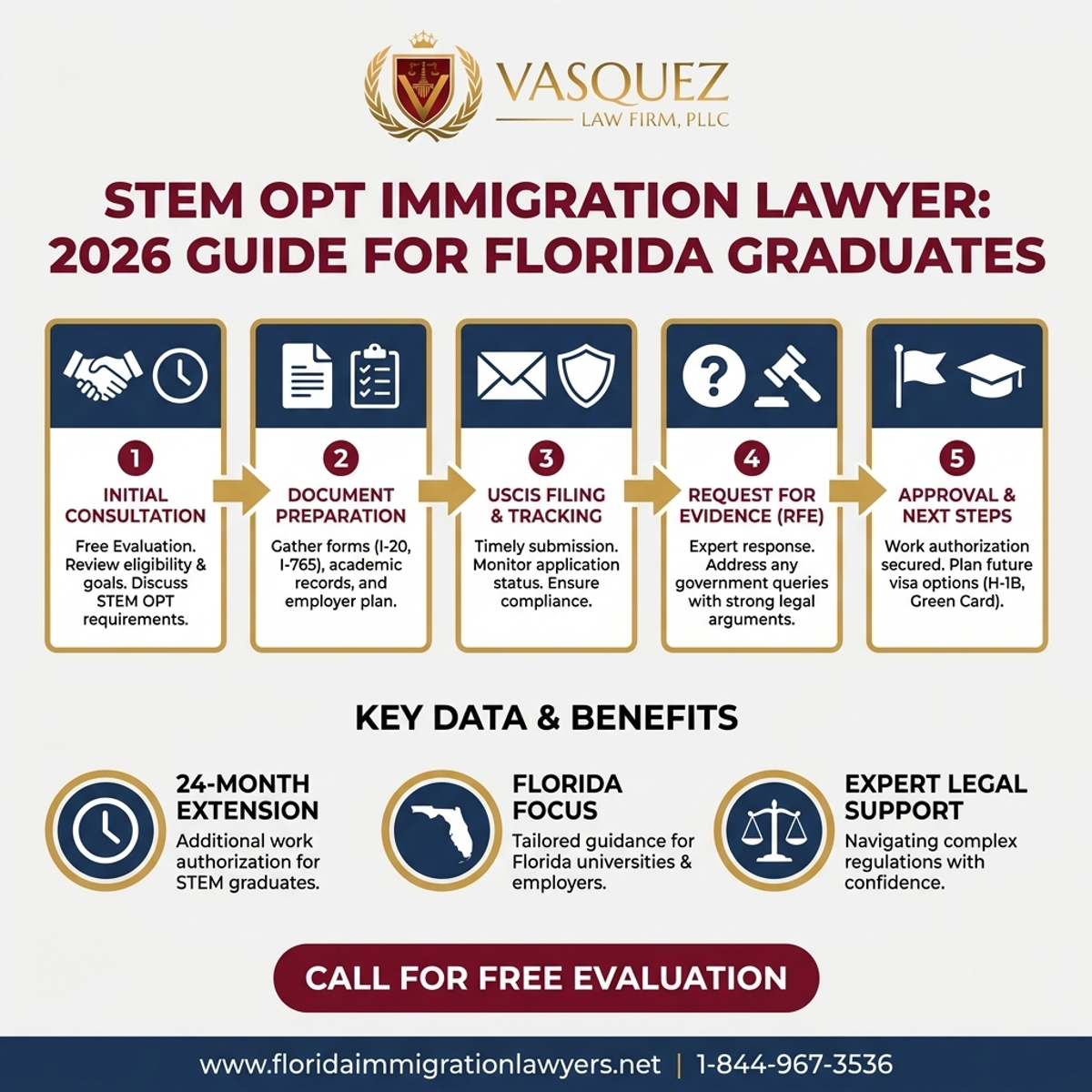
Step-by-Step Process — Stem OPT Immigration Lawyer: 2026 Guide for Florida Graduates
Do not navigate this process alone. Contact Florida Immigration Lawyers today.
STEM OPT Extension Timelines and Cost Factors in 2026
Understanding the typical timelines and associated costs for the STEM OPT extension is crucial for planning your career and financial future. As of 2026, USCIS processing times can vary significantly, and fees are subject to change. It's vital to stay informed and factor these elements into your application strategy. Proactive preparation can help mitigate stress and ensure a smoother transition.
Typical Processing Timelines for STEM OPT Extension
USCIS processing times for Form I-765 (Employment Authorization Document) can fluctuate based on the volume of applications and specific service center workloads. While there's no guaranteed timeline, applicants should generally expect the following as of 2026:
| Stage | Typical Timeframe | Notes |
|---|---|---|
| DSO I-20 Issuance | 1-2 weeks | After submitting I-983 to your university's international office. |
| USCIS Receipt Notice (I-797C) | 2-4 weeks after filing | Confirms USCIS received your application. |
| Biometrics Appointment (if required) | 4-8 weeks after filing | Not always required for I-765; check your notice. |
| Decision & EAD Card Production | 2.5 - 5 months | Varies significantly; check USCIS processing times online. |
| EAD Card Delivery | 1-2 weeks after approval | Mailed to your address on file. |
It's important to remember that you can file your STEM OPT extension application up to 90 days before your current OPT EAD expires, but no later than 60 days after your DSO recommends the STEM OPT on your I-20. Your application must be received by USCIS before your current OPT EAD expires. During the processing period, if your initial OPT EAD expires and your STEM OPT application is still pending, you can continue to work for up to 180 days while awaiting a decision, provided you filed on time.
Cost Factors and Fee Breakdown for STEM OPT Extension
The primary cost associated with the STEM OPT extension is the USCIS filing fee for Form I-765. However, there may be other indirect costs to consider. Here's a breakdown of typical expenses as of 2026:
| Item | Typical Fee | Notes |
|---|---|---|
| USCIS Form I-765 Filing Fee | $470 (subject to change) | Verify current fee on USCIS website before filing. |
| Passport Photos | $15 - $25 | Professional photos meeting USCIS specifications. |
| Postage/Shipping | $10 - $30 | Recommended to use certified mail with tracking. |
| Legal Fees | Varies | If you hire a stem opt immigration lawyer for assistance. |
| Travel for Biometrics | Varies | If a biometrics appointment is required at a local Application Support Center (ASC), such as the one in Orlando. |
Always check the official USCIS website for the most current fee schedule, as fees can change without prior notice. An attorney can help you manage these costs and ensure your application is processed efficiently.
Understanding Your Responsibilities and Maintaining F-1 Status During STEM OPT
Securing a STEM OPT extension is only one part of the equation; maintaining your F-1 nonimmigrant status throughout the extension period is equally critical. There are specific rules and responsibilities that F-1 students on STEM OPT must adhere to, and failing to do so can result in the termination of your status and potential deportation. This is an area where a knowledgeable stem opt immigration lawyer provides crucial guidance.
Key responsibilities include reporting changes to your DSO. You must report any change of name, address, employer, or interruption of employment within 10 days of the change. This reporting is usually done through your university's international student office. Furthermore, you and your employer must complete a new Form I-983 if there are any material changes to your training plan, such as a significant decrease in compensation, a reduction in work hours, or changes in your job duties. Your employer must also agree to a formal evaluation of your progress every 12 months, which is documented on the I-983 form itself.
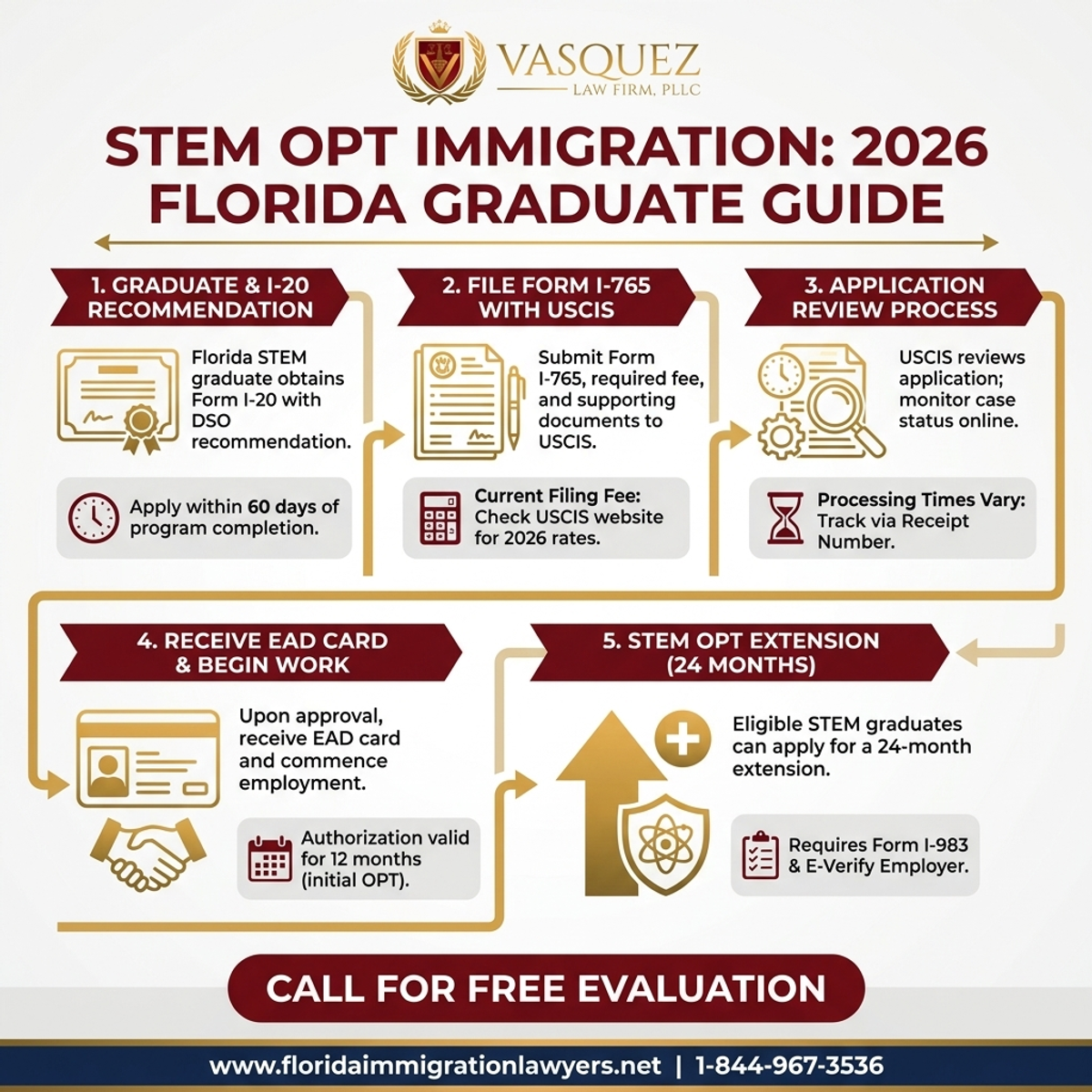
Key Statistics — Stem OPT Immigration Lawyer: 2026 Guide for Florida Graduates
Another crucial aspect is the limitation on unemployment. During the 24-month STEM OPT extension, you are allowed a maximum of 150 days of unemployment. This 150-day limit is cumulative across your entire 36-month OPT period (12 months initial OPT + 24 months STEM OPT). Exceeding this limit can lead to a violation of your F-1 status. If you are struggling to find employment in Florida or elsewhere, it is imperative to consult with an immigration attorney immediately to explore your options and protect your status. The USCIS Orlando Field Office and other Florida-based offices handle many F-1 related inquiries, and maintaining compliance is key.
Common Mistakes to Avoid During Your STEM OPT Extension Application
The STEM OPT extension process is intricate, and even minor errors can lead to significant setbacks, including RFEs, denials, or even loss of status. Being aware of these common pitfalls can help F-1 students in Florida navigate the application more successfully. An experienced stem opt immigration lawyer can help you avoid these costly mistakes.
- Filing Late: The most common mistake is missing the filing window. Your application must be received by USCIS before your initial OPT EAD expires and within 60 days of your DSO issuing your STEM OPT recommended I-20. Filing even one day late will result in a denial.
- Incomplete Form I-983: The Training Plan (Form I-983) is central to your STEM OPT extension. Many applications are denied or delayed because this form is incomplete, lacks required signatures from both student and employer, or doesn't adequately describe the training objectives and their relation to the STEM degree.
- Incorrect E-Verify Information: Your employer must be an E-Verify participant, and you must provide their valid E-Verify company identification number or client company identification number on Form I-765. Providing an incorrect or non-existent number will lead to denial.
- Lack of Direct Relationship Between Job and Degree: Your employment must be directly related to your STEM degree. If USCIS cannot clearly see this connection, your application may be questioned or denied. Ensure your I-983 clearly articulates this link.
- Incorrect Filing Fee or Payment Method: USCIS fees change. Submitting an outdated fee amount or an improper payment method (e.g., unsigned check) will cause your application to be rejected and returned, potentially missing your filing deadline.
- Poor Quality or Missing Photos: Photos must be recent (within 30 days), passport-style, and meet USCIS specifications. Submitting old, blurry, or improperly sized photos can lead to an RFE or rejection.
- Exceeding Unemployment Limits: While on STEM OPT, you are allowed a cumulative total of 150 days of unemployment over your 36-month OPT period. Exceeding this limit is a violation of status.
- Failure to Report Changes: Not reporting changes in name, address, employer, or material changes to the I-983 to your DSO within 10 days can lead to status violation.
- Ignoring USCIS RFEs: If you receive a Request for Evidence, it is critical to respond fully and on time. Failing to do so will almost certainly result in a denial. An attorney can help craft a strong RFE response.
- Applying for a Second STEM OPT at the Same Degree Level: You can only receive one STEM OPT extension per degree level. If you have already used your STEM OPT for a Bachelor's degree, you cannot get another one based on a second Bachelor's, but you could apply for one based on a Master's or PhD.
When to Call a STEM OPT Immigration Lawyer in Florida
While this guide provides comprehensive information, the complexities of immigration law often necessitate professional legal assistance. Engaging a stem opt immigration lawyer from Florida Immigration Lawyers can make a significant difference in the success of your application and your peace of mind. Our team has extensive experience helping F-1 students across Florida, including those from Orlando, Tampa, and Miami, navigate the nuances of the STEM OPT extension.
You should consider contacting an attorney if you encounter any of the following scenarios: you have a complicated academic background or a unique employment situation; you've had previous immigration issues or status violations; your current OPT EAD is expiring soon, and you're worried about missing the deadline; you receive a Request for Evidence (RFE) from USCIS; your employer is unfamiliar with the I-983 or E-Verify requirements; or you simply want the assurance that your application is perfect. Our attorneys are adept at interpreting specific regulations, preparing robust applications, and responding to USCIS inquiries effectively. We also assist with related immigration matters, such as business immigration pathways post-OPT.
At Florida Immigration Lawyers, we understand the stakes involved in maintaining your F-1 status and securing your future in the U.S. We offer personalized guidance, from reviewing your eligibility and preparing your I-983 to compiling your entire application package and monitoring its progress. Our goal is to ensure your STEM OPT extension is approved smoothly, allowing you to focus on your career in Florida. Don't take unnecessary risks with your immigration status. Seek legal counsel.
About Florida Immigration Lawyers: Stem OPT Immigration Lawyer
Florida Immigration Lawyers is an immigration law firm dedicated to serving individuals and families across the entire state of Florida. With our primary office located in Orlando, we are strategically positioned to assist clients from Central Florida and beyond, providing comprehensive legal services for a wide range of immigration matters. Our team of highly skilled and empathetic attorneys understands the unique challenges faced by immigrants and is committed to delivering exceptional legal representation.
We focus on areas such as family immigration, business immigration, deportation defense, asylum, and citizenship. We pride ourselves on offering personalized attention, strategic advice, and aggressive advocacy to achieve the strongest possible outcomes for our clients. Our firm is available 24/7, offering free case reviews, and our bilingual staff ensures that language is never a barrier to receiving quality legal assistance. Choose Florida Immigration Lawyers for dedicated and effective representation.
For a free consultation, contact us at 1-844-YO-PELEO or visit our contact page.
Sources and References: Stem OPT Immigration Lawyer
- U.S. Citizenship and Immigration Services (USCIS)
- Executive Office for Immigration Review (EOIR)
- U.S. Department of State
- 8 U.S.C. § 1101 et seq. - Immigration and Nationality Act (INA)
- 8 CFR § 214.2(f)(10)(ii) - Optional Practical Training (OPT) for F-1 Students
- U.S. Department of Homeland Security (DHS) STEM Designated Degree Program List
- Student and Exchange Visitor Program (SEVP)
Related services: immigration practice areas, experienced immigration attorneys, immigration lawyer cost in Florida.
This article provides general legal information and is not intended as legal advice. Every case is unique, and outcomes depend on specific facts and circumstances. Contact an attorney for advice about your particular situation.
Securing your STEM OPT extension is a pivotal step towards your professional aspirations in the United States. Don't let the complexities of immigration law deter you. Florida Immigration Lawyers is here to provide the guidance and support you need. Take the proactive step today to protect your future. Call 1-844-YO-PELEO for a free case review. Se Habla Espanol - Estamos aqui para ayudarle.
If you need legal assistance, learn more about get immigration legal help today, or call us at 1-844-967-3536 for a free case review.
Do Not Navigate This Process Alone
Our experienced immigration attorneys are ready to fight for you. Get a free, confidential case review today.
Se Habla Español
Or leave your details and we’ll call you:
Free Evaluation in 24 Hours
Or talk to us right now
AI voice assistant — available 24/7
FreeFrequently Asked Questions

William J. Vásquez
Founding Attorney · Vasquez Law Firm
U.S. Air Force veteran and immigration attorney with years of hands-on U.S. immigration experience. J.D., NCCU School of Law. AILA member. Admitted to the 4th, 5th, and 11th Circuit Courts.
Available 24/7 - Free Evaluations
Reviewed for legal accuracy by William J. Vásquez
Licensed in North Carolina; U.S. immigration is federal practice.
Related Legal Services
Our Florida immigration attorneys can help you with citizenship and naturalization, immigration practice areas and free immigration consultation. Call today at 1-844-YO-PELEO for a free case review.
Related Links
Related Topics
Free Legal Case Review
Discuss your case with our experienced attorneys. We're available 24/7.
Se Habla Español - Estamos aquí para ayudarle.
Related Articles
Immigration Lawyer Orlando Free Consultation in Florida
For individuals and families in Orlando, Florida, navigating the complexities of U.S. immigration law requires expert guidance. An immigration lawyer in Orlando offers crucial support for everything from visa applications and green card processes to naturalization and deportation defense. This comprehensive guide details what a free consultation covers, providing a step-by-step overview of immigration pathways, essential document checklists, and expected timelines in 2026. We also highlight common mistakes to avoid, discuss the critical role of legal counsel in deportation and asylum cases, and explain why choosing a local Orlando immigration attorney is beneficial. Florida Immigration Lawyers is dedicated to serving the diverse community of Orlando with compassionate, effective legal solutions, ensuring you receive personalized advice and robust representation for a successful immigration journey.
Fiance Visa in Miami: 2026 Process Guide for Florida
For U.S. citizens in Florida, bringing a foreign fiancé(e) to the U.S. requires navigating the K-1 Fiance Visa process. This guide details the 2026 requirements, step-by-step application, essential documents, and expected timelines. Learn about filing Form I-129F with USCIS, consular interviews, and the crucial Adjustment of Status after marriage. We cover typical fees, common mistakes to avoid, and when to seek legal assistance. Florida Immigration Lawyers offers expert guidance for couples in Miami, Orlando, and across Florida, ensuring a smooth path to uniting with your loved one. Get a free case review today.
Immigration Lawyer Services in Orlando, Florida
Explore immigration consultation services in Orlando, Florida, with a qualified immigration lawyer. Learn what to expect and understand your options for family and business immigration needs.
Fraud Prevention and Detection Fee: What to Know in Florida
Explore the fraud prevention and detection fee essential for immigration processes in Florida. Discover how it impacts applications like the I-601 waiver and learn key steps to navigate this requirement effectively.