Schedule A Nurse Immigration in Florida 2026 Guide
Discover the comprehensive guide to Schedule A nurse immigration in Florida for 2026. This specialized pathway allows foreign registered nurses to bypass the standard labor certification process, leading to an expedited EB-3 Green Card. Learn about eligibility requirements, the step-by-step application process, expected timelines, and associated costs. We also cover unique challenges for foreign nurses in Florida, including state licensing and the vital role of sponsoring hospitals. Avoid common mistakes and understand when professional legal assistance from Florida Immigration Lawyers is essential for a successful permanent residency application. Our firm provides expert guidance for nurses seeking to thrive in Florida's healthcare system.

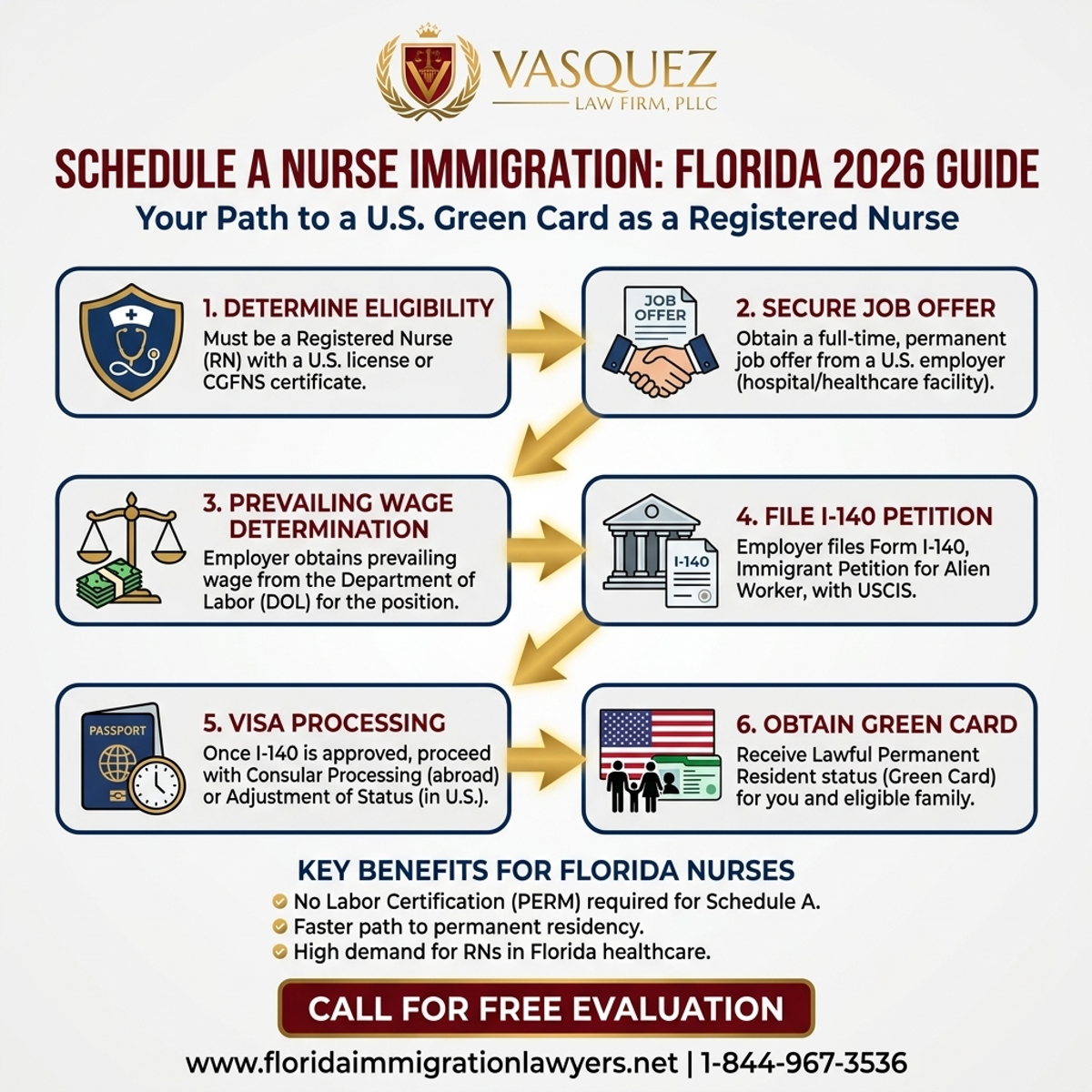
Schedule A nurse immigration offers a streamlined pathway for foreign nurses to obtain permanent residency (a Green Card) in the United States, particularly in high-demand states like Florida. This classification waives the lengthy PERM labor certification process, acknowledging the critical shortage of registered nurses. Eligible nurses with a job offer from a Florida hospital can pursue an EB-3 immigrant visa, leading to a Green Card. The process involves filing Form I-140, followed by either Adjustment of Status or Consular Processing, with timelines varying based on country of origin and current visa bulletin availability. Consulting an experienced immigration attorney is crucial for navigating this complex journey.
- Schedule A waives the PERM labor certification for nurses.
- Eligible nurses pursue an EB-3 immigrant visa for permanent residency.
- A job offer from a U.S. employer, like a Florida hospital, is essential.
- Process involves I-140 petition, then Adjustment of Status or Consular Processing.
- Timelines can range from 1 to 3 years, influenced by visa availability.
Florida's healthcare system is experiencing a significant and growing demand for qualified nursing professionals. This creates a unique opportunity for foreign-trained registered nurses seeking to build a new life and career in the Sunshine State. The U.S. government recognizes this critical shortage through the Schedule A nurse immigration classification, which offers an expedited path to permanent residency. This specialized route allows eligible nurses to bypass a lengthy step in the Green Card process, making it an attractive option for healthcare professionals and Florida hospitals alike.
Navigating the complexities of U.S. immigration law can be daunting, especially when dealing with specific employment-based categories like the EB-3 visa for nurses under Schedule A. From understanding eligibility requirements to managing extensive documentation and adhering to strict deadlines, every step demands precision and expertise. This comprehensive guide will walk you through the Schedule A nurse immigration process, focusing on the unique aspects relevant to Florida, expected timelines, costs, and common pitfalls to avoid as of 2026. Our goal is to empower you with the knowledge needed to make informed decisions about your immigration journey.
Do not attempt to navigate this intricate process alone. For personalized guidance and expert legal representation, call Florida Immigration Lawyers at 1-844-967-3536 for a free consultation. Our dedicated team is here to help you achieve your dream of living and working as a nurse in Florida.
What is Schedule A Nurse Immigration for Florida Hospitals?
Schedule A nurse immigration, as outlined in 20 CFR § 656.5, is a special designation for occupations where the U.S. Department of Labor (DOL) has pre-certified that there are not enough U.S. workers who are able, willing, qualified, and available. This classification removes the requirement for employers to go through the traditional PERM labor certification process, significantly streamlining the path to an employment-based Green Card. For registered nurses and physical therapists, this means that a U.S. employer, such as a Florida hospital, can directly file an Immigrant Petition for Alien Worker (Form I-140) on behalf of the foreign nurse.
This pre-certification is a critical advantage, as the PERM process can be lengthy and challenging. It acknowledges the persistent and widespread shortage of nurses across the United States, a situation particularly pronounced in rapidly growing states like Florida. By qualifying for Schedule A, foreign nurses are generally placed in the Employment-Based Third Preference (EB-3) visa category. The EB-3 category is for skilled workers, professionals, and other workers, and while it may still be subject to visa bulletin backlogs depending on the applicant's country of birth, the Schedule A designation significantly accelerates the initial stages of the Green Card application.
Florida hospitals and healthcare facilities benefit immensely from Schedule A, as it allows them to more efficiently recruit and retain essential nursing talent from abroad. This helps them address staffing shortages and continue providing high-quality patient care to Florida's diverse communities. Understanding this foundational aspect is the first step for any nurse considering this immigration pathway. It underscores the U.S. government's recognition of the vital role foreign nurses play in supporting the nation's healthcare infrastructure.
Who is Eligible for Schedule A Nurse Immigration in 2026?
Eligibility for Schedule A nurse immigration in 2026 primarily requires a licensed registered nurse or physical therapist with a job offer from a U.S. employer, typically a Florida hospital, and passing relevant U.S. nursing exams (NCLEX-RN) or holding a full, unrestricted nursing license. This pathway is specifically designed for foreign nationals who possess the necessary qualifications to fill critical healthcare roles.
To qualify as a Schedule A nurse, you must meet several key criteria. First, you must have a job offer for permanent employment as a registered nurse from a U.S. employer. This sponsor is typically a hospital, clinic, or other healthcare facility in Florida that is willing to support your Green Card petition. Second, you must demonstrate that you are fully qualified to perform the duties of a registered nurse in the United States. This generally means holding a full and unrestricted license to practice professional nursing in the state of intended employment (e.g., Florida) or passing the CGFNS (Commission on Graduates of Foreign Nursing Schools) examination, or passing the NCLEX-RN (National Council Licensure Examination for Registered Nurses).
Additionally, you must have graduated from a nursing school approved in the country where it is located. For nurses who obtained their education outside the U.S., a credential evaluation may be required to confirm that their foreign education is equivalent to a U.S. bachelor's degree in nursing. It is important to remember that these requirements are in place to ensure that all foreign-trained nurses meet the high standards of U.S. healthcare. The sponsoring Florida hospital must also demonstrate its ability to pay the prevailing wage offered to the nurse, a crucial factor USCIS evaluates during the I-140 petition review. Ensuring all these eligibility points are met is vital for a successful application.
What is the Step-by-Step Process for Schedule A Nurse Green Card?
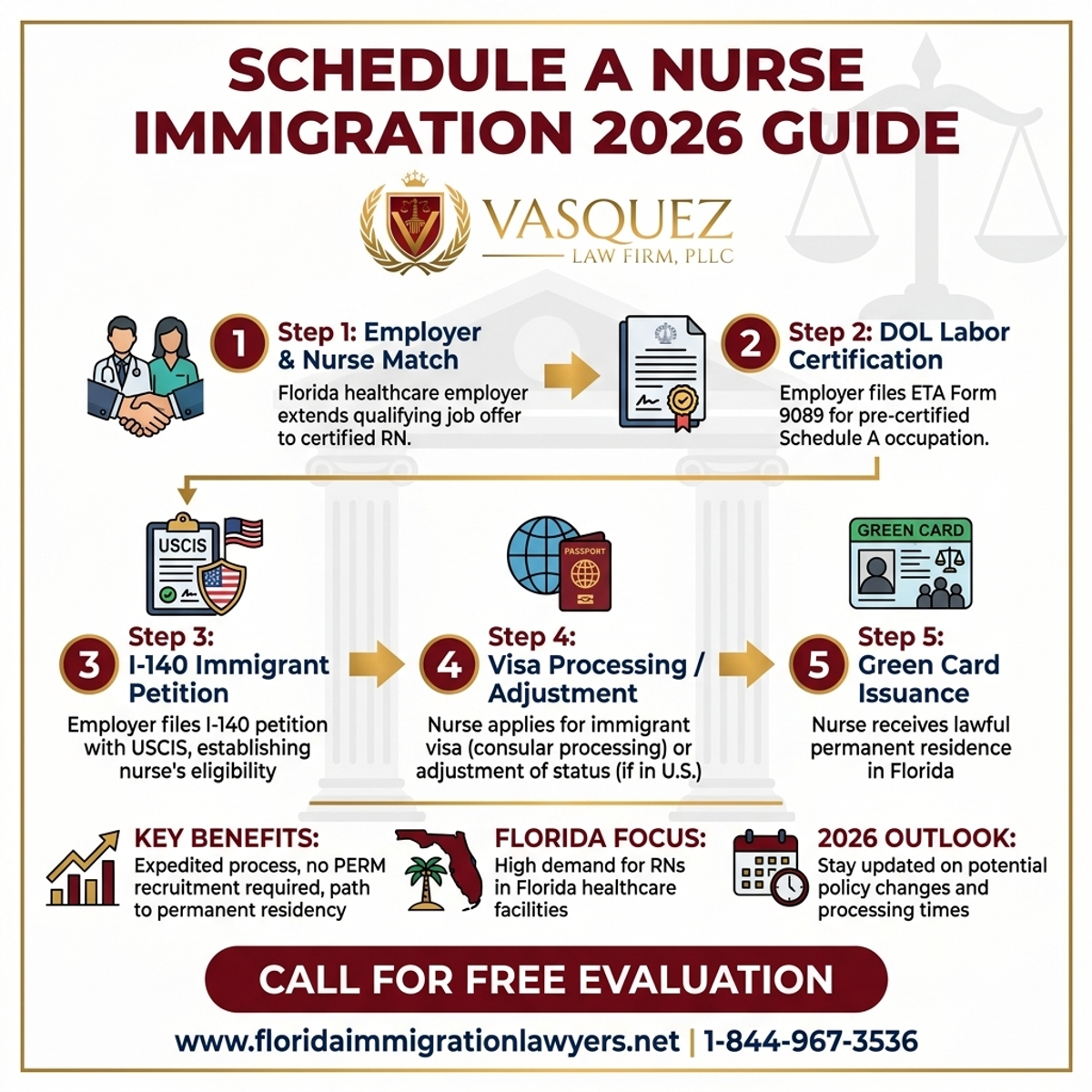
The Schedule A Green Card process for nurses involves the employer filing Form I-140 (Immigrant Petition for Alien Worker) with USCIS, followed by either Adjustment of Status (Form I-485) if in the U.S. or Consular Processing abroad, after visa availability. This multi-stage process requires careful attention to detail and adherence to specific legal procedures.
Here is a detailed breakdown of the steps involved:
-
Employer Files Form I-140 (Immigrant Petition): The sponsoring Florida hospital initiates the process by filing Form I-140 with USCIS. This petition requests that the foreign nurse be classified as an immigrant worker under the EB-3 category, specifically under Schedule A. The I-140 package must include an uncertified ETA Form 9089 (Application for Permanent Employment Certification), evidence of the nurse's qualifications (e.g., CGFNS certificate, NCLEX-RN results, state nursing license), the job offer letter, and documentation proving the employer's ability to pay the offered wage. Premium Processing is often available for the I-140, which can significantly shorten this stage.
-
Visa Bulletin Check & Priority Date: Once USCIS accepts the I-140 petition, a priority date is established (the date USCIS receives the I-140). The applicant must then wait for their priority date to become current according to the Department of State's Visa Bulletin. The Visa Bulletin dictates when immigrant visas are available for different categories and countries of chargeability. For many countries, the EB-3 category may experience backlogs, requiring a waiting period before the next step can commence.
-
Adjustment of Status (AOS) or Consular Processing: Once the priority date is current, the nurse can proceed with the final stage of the Green Card application.
-
Adjustment of Status (Form I-485): If the nurse is already in the U.S. in a lawful nonimmigrant status (e.g., H-1B, F-1 OPT), they may file Form I-485, Application to Register Permanent Residence or Adjust Status. This typically involves a medical examination, biometrics appointment, and an interview at a USCIS field office (such as Miami, Orlando, or Tampa, Florida). In some cases, if the visa is current, Form I-485 can be filed concurrently with the I-140 petition.
-
Consular Processing: If the nurse is outside the U.S. or ineligible for Adjustment of Status, their case will be processed through a U.S. Embassy or Consulate in their home country. After I-140 approval, the case is sent to the National Visa Center (NVC), which collects necessary documents and schedules an interview. Upon successful interview, the immigrant visa is issued, allowing the nurse to enter the U.S. as a lawful permanent resident.
Step-by-Step Process — Schedule A Nurse Immigration in Florida 2026 Guide
-
-
Green Card Approval: After successfully completing either Adjustment of Status or Consular Processing, the nurse's Green Card is approved and mailed. This grants them lawful permanent resident status in the United States.
Required Documents for I-140 (Document Checklist)
- Completed and signed Form I-140, Immigrant Petition for Alien Worker.
- Uncertified ETA Form 9089, Application for Permanent Employment Certification (bearing the Schedule A designation).
- Letter from the sponsoring Florida hospital detailing the job offer, duties, and salary.
- Proof of the employer's ability to pay the offered wage (e.g., annual reports, federal tax returns, audited financial statements).
- Evidence of the nurse's qualifications:
- Copy of a full and unrestricted license to practice professional nursing in the state of intended employment (Florida).
- OR Certificate from the Commission on Graduates of Foreign Nursing Schools (CGFNS).
- OR evidence of passing the National Council Licensure Examination for Registered Nurses (NCLEX-RN).
- Official academic records/transcripts from nursing school.
- Professional credential evaluation (if education was obtained outside the U.S.).
- Copies of passport, visa, and I-94 (if applicable).
Key Stages and Timelines for Schedule A Nurse Immigration
Understanding the typical timeframes for each stage is crucial for planning your immigration journey. These are estimates and can vary significantly.
| Stage | Typical Timeframe (As of 2026) | Notes |
|---|---|---|
| I-140 Petition Filing & Approval | 6-12 months (Regular) / 1-2 weeks (Premium) | Employer files with USCIS. Premium Processing is highly recommended if available and affordable. |
| Visa Bulletin Waiting Period | Variable (0-36+ months) | Depends on country of chargeability and EB-3 demand. Check the Visa Bulletin monthly. |
| NVC Processing (Consular) | 2-6 months | After I-140 approval and visa current. Document collection and review. |
| Consular Interview & Visa Issuance | 1-3 months | Interview at U.S. Embassy/Consulate abroad. |
| I-485 Adjustment of Status (AOS) | 12-24 months | If in U.S. and visa is current. Includes biometrics, medical exam, and interview at a USCIS office in Florida. |
| Green Card Delivery | 2-4 weeks after approval | The final step to receiving your permanent resident card. |
How Long Does Schedule A Nurse Immigration Take in 2026?
As of 2026, the total processing time for Schedule A nurse immigration can range from 1 to 3 years, heavily depending on visa bulletin availability for the EB-3 category, USCIS processing times for Form I-140 and I-485, and whether the applicant is adjusting status or undergoing consular processing. While Schedule A waives the PERM labor certification, other factors can introduce significant delays.
The first major factor is USCIS processing times for Form I-140. While regular processing can take anywhere from six to twelve months, many employers opt for Premium Processing, which guarantees a response within 15 calendar days for an additional fee. This can significantly reduce the initial waiting period. However, the subsequent wait for a priority date to become current on the Visa Bulletin is often the longest and most unpredictable part of the process. For some countries, particularly India and China, there can be significant backlogs in the EB-3 category, extending the wait for years. Other countries may have visas immediately available.
Once the priority date is current, the method of processing also impacts the timeline. Adjustment of Status (Form I-485), processed by USCIS, generally takes 12 to 24 months, including biometrics, potential Requests for Evidence (RFEs), and an interview at a local Florida USCIS office. Consular processing, handled by the National Visa Center (NVC) and a U.S. Embassy or Consulate abroad, typically takes 3 to 9 months after the I-140 approval and visa availability, but this can vary greatly based on the specific consulate and its workload. Proactive preparation of all required documents and prompt responses to any agency requests are crucial for minimizing delays.
What are the Costs for Schedule A Nurse Immigration?
The costs for Schedule A nurse immigration involve various government filing fees for forms like I-140, I-485, medical exams, and attorney fees, typically ranging from a few thousand to over ten thousand dollars, with some employer-sponsored fees. These costs can accumulate across different stages of the immigration process, and it's important to budget accordingly.
Government filing fees are non-refundable and subject to change, so it's always best to check the USCIS website for the most current amounts. For the I-140 petition, the fee is usually paid by the sponsoring employer. If the employer opts for Premium Processing, an additional significant fee is incurred, which is also typically borne by the employer. For the Adjustment of Status (I-485) application, the fee covers the application itself, biometrics, and the employment authorization document (EAD) and advance parole (AP) if filed concurrently. This fee is often paid by the applicant, though some employers may cover it.
Beyond government fees, significant costs include the mandatory medical examination conducted by a USCIS-approved civil surgeon, which can vary widely by provider. Attorney fees for expert legal representation are another major component. While the employer usually covers the I-140 attorney fees, the applicant often bears the cost for the I-485 or consular processing attorney fees, as well as any fees for dependents. Travel expenses for interviews (especially for consular processing) and professional credential evaluation services also contribute to the overall cost. A clear understanding of who is responsible for which fees, as outlined in the employment contract, is essential.
Key Statistics — Schedule A Nurse Immigration in Florida 2026 Guide
| Item | Typical Fee (As of 2026) | Notes |
|---|---|---|
| USCIS Form I-140 Filing Fee | $[Current USCIS Fee] | Paid by the sponsoring employer. |
| USCIS Form I-140 Premium Processing Fee (Optional) | $[Current USCIS Fee] | Paid by the employer for expedited processing. |
| USCIS Form I-485 Filing Fee (includes biometrics, EAD, AP) | $[Current USCIS Fee] | Typically paid by the applicant. Includes fees for dependents. |
| Medical Examination Fee | $200 - $800+ (Varies by provider) | Mandatory for I-485 or consular processing. Paid by applicant. |
| Attorney Fees (I-140) | $3,000 - $7,000+ | Paid by employer, covers petition preparation and filing. |
| Attorney Fees (I-485/Consular Processing) | $2,000 - $5,000+ | Typically paid by applicant, covers final stage of Green Card. |
| DS-260 Immigrant Visa Application Fee (Consular Processing) | $[Current State Dept. Fee] | Paid per applicant for consular processing. |
| USCIS Immigrant Fee (Green Card Production) | $[Current USCIS Fee] | Paid after visa approval and before entering U.S. (Consular Processing). |
| Credential Evaluation Services | $100 - $300+ | Required for foreign education evaluation. |
Navigating Unique Challenges for Foreign Nurses in Florida
Foreign nurses seeking to immigrate to Florida face specific challenges beyond the federal immigration process, including state licensing requirements and adapting to a new cultural and professional environment. Florida's Board of Nursing has its own set of rules and procedures that must be meticulously followed to ensure eligibility to practice in the state. This can involve additional credentialing, examinations, and background checks unique to Florida, which must be completed before or during the immigration process to ensure a seamless transition into employment.
Moreover, INA Section 212(a)(5)(C) specifically addresses health care workers, requiring certain certifications to ensure foreign health care workers meet U.S. standards. This often means obtaining a VisaScreen Certificate from the CGFNS International, which verifies education, license, English proficiency, and passing the NCLEX-RN. Without this, a Green Card cannot be issued. Successfully navigating these state and federal requirements simultaneously is critical. Florida Immigration Lawyers has extensive experience with both federal immigration law and the specific demands of the Florida Board of Nursing, providing comprehensive support to foreign nurses.
Beyond the legal hurdles, foreign nurses must also adapt to the Florida healthcare system, workplace culture, and diverse patient populations. Cities like Miami are vibrant cultural melting pots, offering rich experiences but also requiring adaptability. Finding suitable housing, understanding local transportation, and integrating into the community are practical considerations that can impact a nurse's overall well-being and success. Our firm not only guides you through the legal process but also connects you with resources to help you thrive in your new Florida home.
Florida Board of Nursing Requirements
To practice as a registered nurse in Florida, foreign-trained nurses must meet specific requirements set by the Florida Board of Nursing. This typically involves submitting an application, providing proof of education (often requiring an evaluation of foreign transcripts), passing the NCLEX-RN, and undergoing a criminal background check. Obtaining your Florida nursing license is an independent process from your immigration application but is crucial for employment. It is advisable to begin this process early, even before your Green Card is finalized, to minimize delays in starting your career.
Support for Nurses and Families
Moving to a new country and starting a new job can be challenging, not just for the nurse but for their entire family. Florida Immigration Lawyers understands these challenges and provides support beyond the legal process. We can offer guidance on bringing family members through dependent visas, navigating local resources, and integrating into Florida communities. Our goal is to ensure a smooth transition for you and your loved ones as you establish your new life in Florida.
The Role of Florida Hospitals in Sponsoring Schedule A Nurses
Florida hospitals play a pivotal role in the Schedule A nurse immigration process, acting as the primary sponsor for foreign nurses seeking permanent residency. Given the persistent and escalating nursing shortages across the state, hospitals recognize that recruiting internationally trained nurses is often a vital strategy to maintain adequate staffing levels and ensure continuous, high-quality patient care. This sponsorship is a significant commitment, requiring the hospital to navigate complex immigration regulations and demonstrate its financial stability.
A sponsoring hospital in Florida must not only offer a permanent, full-time nursing position but also attest to its ability to pay the prevailing wage for that position. This financial commitment is rigorously scrutinized by USCIS during the I-140 petition review. Hospitals also bear the responsibility of accurately completing and filing the necessary immigration forms, including the I-140 petition with the uncertified ETA Form 9089. For many hospitals, partnering with an experienced immigration law firm is essential to ensure compliance and efficiency throughout the recruitment and sponsorship process.
Beyond the legal and financial aspects, Florida hospitals often provide crucial support systems for their foreign-trained nurses, helping them acclimate to the U.S. healthcare environment and local community. This can include assistance with housing, transportation, and professional development. For example, hospitals in Miami, a city known for its diverse population, often have robust programs to integrate international staff, recognizing the immense value and cultural richness these nurses bring to their facilities and patient care teams. This commitment fosters a mutually beneficial relationship, allowing nurses to thrive and hospitals to meet their staffing needs.
Do not navigate this process alone. Contact Florida Immigration Lawyers today to ensure your Schedule A nurse immigration application is handled with precision and care. Call us at 1-844-967-3536 for a free consultation.
Common Mistakes to Avoid in Schedule A Nurse Immigration
Navigating the Schedule A nurse immigration process requires meticulous attention to detail. Even minor errors can lead to significant delays or even denial of your petition. Avoiding these common mistakes is crucial for a successful outcome:
-
Incorrectly Completing Forms: Immigration forms are highly complex. Even a small typo or missing signature can result in a Request for Evidence (RFE) or outright denial. Always double-check all information and ensure consistency across all documents.
-
Missing Deadlines: Strict deadlines apply to various stages of the immigration process, from responding to RFEs to filing concurrent applications. Missing a deadline can jeopardize your entire application, potentially requiring you to start over.
-
Lack of Proper Nursing Licensure/Credentials: Failing to meet Florida's specific nursing licensure requirements or not having the necessary credential evaluations (like CGFNS or NCLEX-RN) can halt your application. Ensure all professional qualifications are in order before filing.
-
Not Disclosing Past Immigration Issues: Any prior visa overstays, denials, or other immigration violations must be fully disclosed to USCIS. Attempting to conceal information can lead to severe penalties, including a permanent bar from the U.S.
-
Leaving Previous Employers Too Early: If you are already in the U.S. on a nonimmigrant visa (e.g., H-1B) and your Green Card is pending, changing employers prematurely without proper porting procedures can jeopardize your status. Consult an attorney before any employment changes.
-
Traveling Internationally During I-485 Processing Without Advance Parole: If you have a pending I-485, leaving the U.S. without an approved Advance Parole document can be considered an abandonment of your adjustment of status application. Always secure Advance Parole before international travel.
-
Not Understanding Priority Dates and Visa Bulletin: Misinterpreting the Visa Bulletin or not tracking your priority date can lead to missed opportunities for filing or unnecessary delays. Visa availability is a critical factor for EB-3 applicants.
-
Failing to Maintain Lawful Nonimmigrant Status: If you are in the U.S. during the Green Card process, it is imperative to maintain your underlying nonimmigrant status (e.g., H-1B, F-1 OPT) until your I-485 is filed or approved. Falling out of status can make you ineligible for adjustment.
-
Ignoring Public Charge Considerations: While recent policies have fluctuated, the concept of public charge (INA Section 212(a)(4)) can still be a factor in Green Card applications. Consult an attorney about any use of public benefits, especially given recent news and policy discussions.
-
Attempting to Self-File Complex Petitions: While possible, self-filing employment-based petitions like Schedule A can be risky due to the intricate legal requirements. The nuances of immigration law often require an expert's eye to avoid costly mistakes.
When to Call an Immigration Lawyer for Schedule A Nurse Immigration
The Schedule A nurse immigration process, while offering a streamlined path, is still fraught with legal complexities that can be overwhelming without expert guidance. Knowing when to seek legal counsel can make the difference between a successful application and a lengthy, frustrating ordeal. You should call an immigration lawyer from Florida Immigration Lawyers at the earliest stages of considering Schedule A immigration, ideally before your employer even files the I-140 petition.
Specific scenarios that demand immediate legal attention include if you have any prior immigration history, such as visa denials, overstays, or previous deportations. These issues can trigger complex waivers or inadmissibility grounds that only an experienced attorney can navigate. If your sponsoring Florida hospital has never sponsored a foreign worker before, legal guidance is crucial to ensure they meet all employer obligations and avoid common pitfalls. Furthermore, if you receive a Request for Evidence (RFE) from USCIS or a Notice of Intent to Deny (NOID), an attorney can help you formulate a comprehensive and timely response.
Any changes in your employment situation, marital status, or criminal record during the Green Card process also warrant immediate consultation with an attorney. These changes can significantly impact your eligibility or require new filings. If you are considering international travel while your I-485 is pending, an attorney can advise you on the necessity of Advance Parole. Florida Immigration Lawyers specializes in employment-based immigration, including Schedule A for nurses, and has a deep understanding of Florida's specific requirements. We offer free consultations to assess your unique situation and provide clear, actionable advice.
About Florida Immigration Lawyers
Florida Immigration Lawyers is a leading immigration law firm dedicated to serving individuals, families, and businesses across the entire state of Florida. With a profound understanding of U.S. immigration law and its ever-evolving landscape, our experienced attorneys provide comprehensive legal services tailored to your unique needs. We are committed to helping foreign nurses, like you, navigate the complexities of Schedule A nurse immigration, ensuring a smooth and successful journey to permanent residency in Florida.
Our firm specializes in a wide range of immigration matters, including employment-based visas (like EB-3 for Schedule A nurses), family-based petitions, asylum claims, deportation defense, and naturalization. We pride ourselves on offering compassionate, client-focused representation, always putting your best interests first. Our team understands the challenges immigrants face and works tirelessly to provide strategic, effective solutions.
When you choose Florida Immigration Lawyers, you gain a dedicated advocate who will guide you through every step of the process. We are available 24/7 to answer your questions and provide support. We offer free consultations to discuss your case and explore your options. With offices strategically located and serving all of Florida, including Miami, Orlando, and Tampa, we are always within reach. Trust us to be your partner in achieving your American dream.
Sources and References
- U.S. Citizenship and Immigration Services (USCIS)
- U.S. Department of State - Visa Bulletin
- Executive Office for Immigration Review (EOIR) - General Immigration Information
- 8 U.S.C. Chapter 12 - Immigration and Nationality Act (INA)
- 20 CFR § 656.5 - Schedule A Occupations
- INA Section 212(a)(4) - Public Charge Grounds of Inadmissibility
- INA Section 212(a)(5)(C) - Uncertified Foreign Health Care Workers
- Florida Board of Nursing - Licensing Information
Related services: immigration practice areas, family immigration services, citizenship and naturalization.
This article provides general legal information and is not intended as legal advice. Every case is unique, and outcomes depend on specific facts and circumstances. Contact an attorney for advice about your particular situation.
Your journey to becoming a permanent resident nurse in Florida is an important one, and you don't have to face it alone. The complexities of Schedule A nurse immigration require expert guidance and dedicated support. Let Florida Immigration Lawyers be your trusted partner every step of the way. We are committed to providing the highest quality legal representation to help you achieve your professional and personal goals in Florida.
Ready to take the next step? Contact Florida Immigration Lawyers today for a free, confidential consultation. Call us now at 1-844-967-3536. Se Habla Espanol - Estamos aqui para ayudarle.
If you need legal assistance, learn more about immigration lawyers in Florida, or call us at 1-844-967-3536 for a free consultation.
Do Not Navigate This Process Alone
Our experienced immigration attorneys are ready to fight for you. Get a free, confidential consultation today.
Se Habla Español
Or leave your details and we’ll call you:
Free Evaluation in 24 Hours
Or talk to us right now
AI voice assistant — available 24/7
FreeFrequently Asked Questions

William J. Vásquez
Founding Attorney · Vasquez Law Firm
U.S. Air Force veteran and immigration attorney with years of hands-on U.S. immigration experience. J.D., NCCU School of Law. AILA member. Admitted to the 4th, 5th, and 11th Circuit Courts.
Available 24/7 - Free Evaluations
Reviewed for legal accuracy by William J. Vásquez
Licensed in North Carolina; U.S. immigration is federal practice.
Related Legal Services
Our Florida immigration attorneys can help you with free immigration consultation, experienced immigration attorneys and business immigration. Call today at 1-844-967-3536 for a free consultation.
Related Links
Related Topics
Free Legal Consultation
Discuss your case with our experienced attorneys. We're available 24/7.
Se Habla Español - Estamos aquí para ayudarle.
Related Articles
Orlando Immigration Lawyer: Free Consultation Guide 2026
Discover how an Orlando immigration lawyer can provide essential guidance through complex U.S. immigration processes. This comprehensive guide details the benefits of a free consultation, outlines common immigration services, explains how to prepare for your meeting, and discusses typical timelines and fee structures in Florida for 2026. Learn to avoid common mistakes and understand when professional legal counsel is indispensable, especially amidst evolving immigration policies. Florida Immigration Lawyers offers expert support for visas, green cards, citizenship, and deportation defense across the state.
Removal Conditional Green Card Process in Florida 2026
For individuals with a two-year conditional green card obtained through marriage, the process of removing conditions is a critical next step. This involves filing Form I-751, Petition to Remove Conditions on Residence, within a strict 90-day window before expiration. This guide, relevant for 2026, details the required documentation, filing timelines, potential costs, and crucial waivers for special circumstances like divorce or abuse. It also highlights common mistakes to avoid and emphasizes the importance of demonstrating a bona fide marriage to USCIS. For residents across Florida, from Gainesville to Miami, understanding these requirements is vital to transitioning to permanent residency. Seeking expert legal guidance from Florida Immigration Lawyers can significantly enhance your chances of a successful outcome, providing peace of mind throughout this complex immigration process.
Cancellation of Removal Attorney Fees in Florida 2026
Facing deportation in Florida? Learn about Cancellation of Removal, a vital defense that allows certain non-citizens to remain in the U.S. This guide covers eligibility, the step-by-step process in Florida immigration courts, essential documentation, and typical timelines as of 2026. We delve into the critical differences between LPR and non-LPR cancellation, including the challenging "exceptional and extremely unusual hardship" standard. Understand the factors influencing cancellation of removal attorney fees, common mistakes to avoid, and when to seek expert legal counsel. Florida Immigration Lawyers offers comprehensive deportation defense services to protect your future in Florida.
INA 208(a)(2) One-Year Filing Deadline for Asylum in
Understanding the INA 208(a)(2) one-year filing deadline for asylum is crucial for anyone seeking protection in the U.S., especially in Florida. This strict rule mandates that asylum applications (Form I-589) must generally be filed within one year of your last arrival. However, vital exceptions exist for those who can prove 'changed circumstances' in their home country or personal situation, or 'extraordinary circumstances' that prevented timely filing. Navigating these exceptions requires meticulous evidence, a detailed explanation, and precise legal arguments. This article provides a comprehensive guide to the deadline, its exceptions, a step-by-step process for late filings, required documentation, and expected timelines in 2026. For anyone in Florida facing this complex legal challenge, securing expert legal counsel is paramount to building a strong case and protecting your future.