INA 208(a)(2) One-Year Filing Deadline for Asylum
Understanding the INA 208(a)(2) one-year filing deadline for asylum is crucial for anyone seeking protection in the U.S., especially in Florida. This strict rule mandates that asylum applications (Form I-589) must generally be filed within one year of your last arrival. However, vital exceptions exist for those who can prove 'changed circumstances' in their home country or personal situation, or 'extraordinary circumstances' that prevented timely filing. Navigating these exceptions requires meticulous evidence, a detailed explanation, and precise legal arguments. This article provides a comprehensive guide to the deadline, its exceptions, a step-by-step process for late filings, required documentation, and expected timelines in 2026. For anyone in Florida facing this complex legal challenge, securing legal counsel is paramount to building a strong case and protecting your future.
The INA 208(a)(2) one-year filing deadline mandates that most asylum applications (Form I-589) must be filed with USCIS or an immigration court within one year of the applicant's last arrival in the United States. This strict rule, codified in the Immigration and Nationality Act, aims to ensure timely claims. However, critical exceptions exist for individuals who can demonstrate either changed circumstances materially affecting their eligibility or extraordinary circumstances that prevented timely filing. Navigating these exceptions requires robust evidence and a detailed explanation, making experienced legal counsel essential, especially for those in Florida facing complex situations.
- Asylum applications must generally be filed within one year of U.S. arrival.
- Exceptions exist for changed circumstances or extraordinary circumstances.
- A detailed explanation and strong evidence are required to prove an exception.
- Missing the deadline without an exception can lead to denial and removal proceedings.
- Legal assistance is crucial for navigating the complexities of late filings.
Seeking safety in a new country is a profound and often challenging journey. For those fleeing persecution and looking for refuge in the United States, the asylum process offers a critical pathway. However, one of the most stringent requirements, the INA 208(a)(2) one-year filing deadline, can present a significant hurdle. This rule dictates that you must generally file your asylum application (Form I-589) within one year of your last arrival in the U.S. Missing this deadline without a valid exception can lead to the denial of your application and potential removal from the country.
For individuals in Florida, including those in Jacksonville and other vibrant communities, understanding this deadline and its potential exceptions is paramount. The immigration landscape in Florida is dynamic, and the stakes for asylum seekers are incredibly high. This comprehensive guide will explain the one-year deadline, detail the exceptions for changed and extraordinary circumstances, provide a step-by-step process for late filings, outline necessary documentation, and discuss what to expect regarding timelines and costs in 2026. Do not navigate this complex legal process alone. Call Florida Immigration Lawyers at 1-844-YO-PELEO for a free consultation to discuss your specific situation and understand your options.
What is the INA 208(a)(2) One-Year Filing Deadline for Asylum?
The INA 208(a)(2) one-year filing deadline is a critical provision within U.S. immigration law that governs the submission of asylum applications. Specifically, Section 208(a)(2)(B) of the Immigration and Nationality Act (INA) states that an asylum applicant must demonstrate by clear and convincing evidence that the application was filed within one year after the date of the applicant's arrival in the United States. This rule applies to both affirmative asylum applications filed with USCIS and defensive asylum applications filed in immigration court.
This deadline was established by Congress to encourage prompt filing of asylum claims, aiming to prevent fraudulent claims and ensure that individuals genuinely fearing persecution seek protection without undue delay. The U.S. government views a quick filing as an indicator of a credible fear. Failing to meet this one-year window without a recognized exception creates a strong presumption against eligibility for asylum, making it significantly harder to obtain protection. Understanding this foundational legal requirement is the first step for any asylum seeker.
For asylum seekers in Florida, whether they arrived through Miami, Jacksonville, or other ports of entry, this deadline begins ticking from their last entry date. It is not just a suggestion; it is a strict legal mandate. The consequences of missing this deadline are severe, potentially leading to immediate ineligibility for asylum and placement into removal proceedings. Therefore, timely action and meticulous preparation are essential for anyone considering an asylum claim in the U.S.
What Are the Exceptions to the Asylum One-Year Filing Deadline?
While the INA 208(a)(2) one-year filing deadline is strict, U.S. immigration law provides crucial exceptions for individuals who can demonstrate valid reasons for delayed filing. These exceptions fall into two primary categories: changed circumstances and extraordinary circumstances. If you missed the deadline, proving one of these exceptions is your only path to having your asylum application considered on its merits. It is not enough to simply claim an exception; you must provide clear and convincing evidence, as mandated by 8 CFR 208.4(a)(4).
Successfully arguing an exception requires a detailed explanation of why you could not file within the initial one-year period and how your situation fits the legal definitions. The burden of proof rests entirely on the applicant. This is where the expertise of an immigration attorney, particularly one familiar with Florida immigration courts and USCIS offices, becomes invaluable. They can help you identify if an exception applies to your case and assist in gathering the necessary evidence to support your claim effectively.
Changed Circumstances
Changed circumstances refer to significant developments that materially affect your eligibility for asylum or your ability to file within the one-year period. These changes must be directly related to the conditions in your home country or your personal situation. If you can prove that such circumstances arose after your one-year deadline passed, and you filed your asylum application within a reasonable period after these changes, you may still be eligible for asylum.
Examples of changed circumstances include, but are not limited to:
- Changed conditions in your country of nationality or last habitual residence: This could involve a new civil war, a coup d'état, the rise of a new persecutory regime, or a specific law targeting your social group that was not in place or widely known when you initially arrived. For example, if a new government takes power and begins persecuting a specific ethnic or religious group, and you are a member of that group, this could be a changed circumstance.
- Changed circumstances in your own personal situation: This might include the death of a family member who was protecting you, your marriage to a U.S. citizen or lawful permanent resident (though this typically impacts other immigration avenues more directly than asylum itself, it can sometimes be a factor in the context of eligibility for other relief from removal), or the birth of a child that creates new vulnerabilities. For instance, if you were a victim of domestic violence and your abuser gained significant political power in your home country after your arrival, this personal change could make your return significantly more dangerous.
- Changes in U.S. law or court decisions: While less common, a new legal precedent that significantly expands the definition of a particular social group or political opinion could potentially qualify as a changed circumstance, making you eligible for asylum where you weren't before.
It is crucial to file your application within a "reasonable period" after these changed circumstances arise. What constitutes a "reasonable period" is determined on a case-by-case basis by USCIS or an immigration judge, considering all relevant factors. Delays, even after a change, must be adequately explained and justified.
Extraordinary Circumstances
Extraordinary circumstances refer to severe events or conditions that genuinely prevented you from filing your asylum application within the one-year deadline. These are typically unforeseen and unavoidable situations that temporarily incapacitate an applicant or make filing impossible. Similar to changed circumstances, you must file your application within a "reasonable period" after these extraordinary circumstances cease to exist.
Examples of extraordinary circumstances include:
- Serious illness or mental or physical disability: If you or a close family member experienced a severe illness or disability that prevented you from preparing or filing your application, this could be an exception. Medical records, doctor's notes, and hospital bills would be essential evidence.
- Legal disability: Being an un-emancipated minor or suffering from a severe mental impairment that legally prevents you from filing your application.
- Ineffective assistance of counsel: If a previous attorney or accredited representative provided substandard legal advice or failed to file your application on time, this could be an extraordinary circumstance. This often requires a detailed complaint against the previous counsel and proof of their negligence.
- Death or serious illness of a legal representative or immediate family member: If your attorney or a close family member who was assisting you with your application passed away or became seriously ill, causing an unavoidable delay.
- Maintenance of nonimmigrant status: In some rare cases, if you maintained a valid nonimmigrant status (e.g., student, visitor) and were not aware of your eligibility for asylum until a later event, this might be considered. However, this is a difficult argument to make.
- Other compelling circumstances: This is a catch-all category for situations beyond your control, such as being held in prolonged detention without access to legal counsel, or other significant events that genuinely obstructed your ability to file.
For both types of exceptions, the key is to provide a compelling narrative supported by clear and convincing evidence. The immigration officials at the USCIS Asylum Office in Orlando, which serves Florida, or immigration judges at the Miami or Orlando immigration courts, will scrutinize these claims carefully. It is highly advisable to seek legal representation to gather and present this evidence effectively.
How Do I File for Asylum in Florida if I Missed the Deadline? (Step-by-Step Guide)
If you have missed the INA 208(a)(2) one-year filing deadline for asylum but believe you qualify for an exception, the process for filing your application in Florida is more complex than a standard filing. It requires meticulous preparation and a strong legal strategy to demonstrate that your circumstances warrant an exception. As of 2026, the fundamental steps remain similar, but the emphasis on evidence and explanation for late filing is paramount.
Successfully navigating a late asylum filing in Florida involves not only establishing your fear of persecution but also convincingly demonstrating why you could not file within the initial one-year period. This often means preparing a comprehensive legal brief in addition to your application. Below is a step-by-step guide to help you understand the process:
-
Determine Eligibility for an Exception: The first critical step is to thoroughly assess whether your situation genuinely fits the criteria for "changed circumstances" or "extraordinary circumstances." Review the definitions and examples provided above. Be honest and realistic about the strength of your claim. This initial assessment is best done with an experienced immigration attorney who can provide an objective evaluation of your potential exception.
-
Gather Comprehensive Evidence: You will need two sets of evidence: one to support your asylum claim itself (proof of persecution or fear of persecution) and another to substantiate your reason for missing the deadline. For the exception, collect all relevant documents such as medical records, death certificates, country condition reports, legal documents, affidavits from witnesses, or communications with previous attorneys. The more specific and verifiable your evidence, the stronger your case will be.
-
Complete Form I-589, Application for Asylum and for Withholding of Removal: Fill out Form I-589 accurately and completely. Pay special attention to Part B, Information About Your Application, specifically Question 1, which asks about the one-year filing deadline. You must check the box indicating you are filing after one year and clearly state the exception you are claiming. Do not leave any sections blank; if a question does not apply, write "N/A."
-
Prepare a Detailed Statement Explaining the Delay: This is a crucial component of a late filing. You must write a personal statement, often accompanied by a legal brief from your attorney, explaining in chronological order:
- When you arrived in the U.S.
- When the changed or extraordinary circumstances arose.
- How these circumstances prevented you from filing within the one-year period.
- Why your filing now is within a "reasonable period" after those circumstances ceased or became apparent.
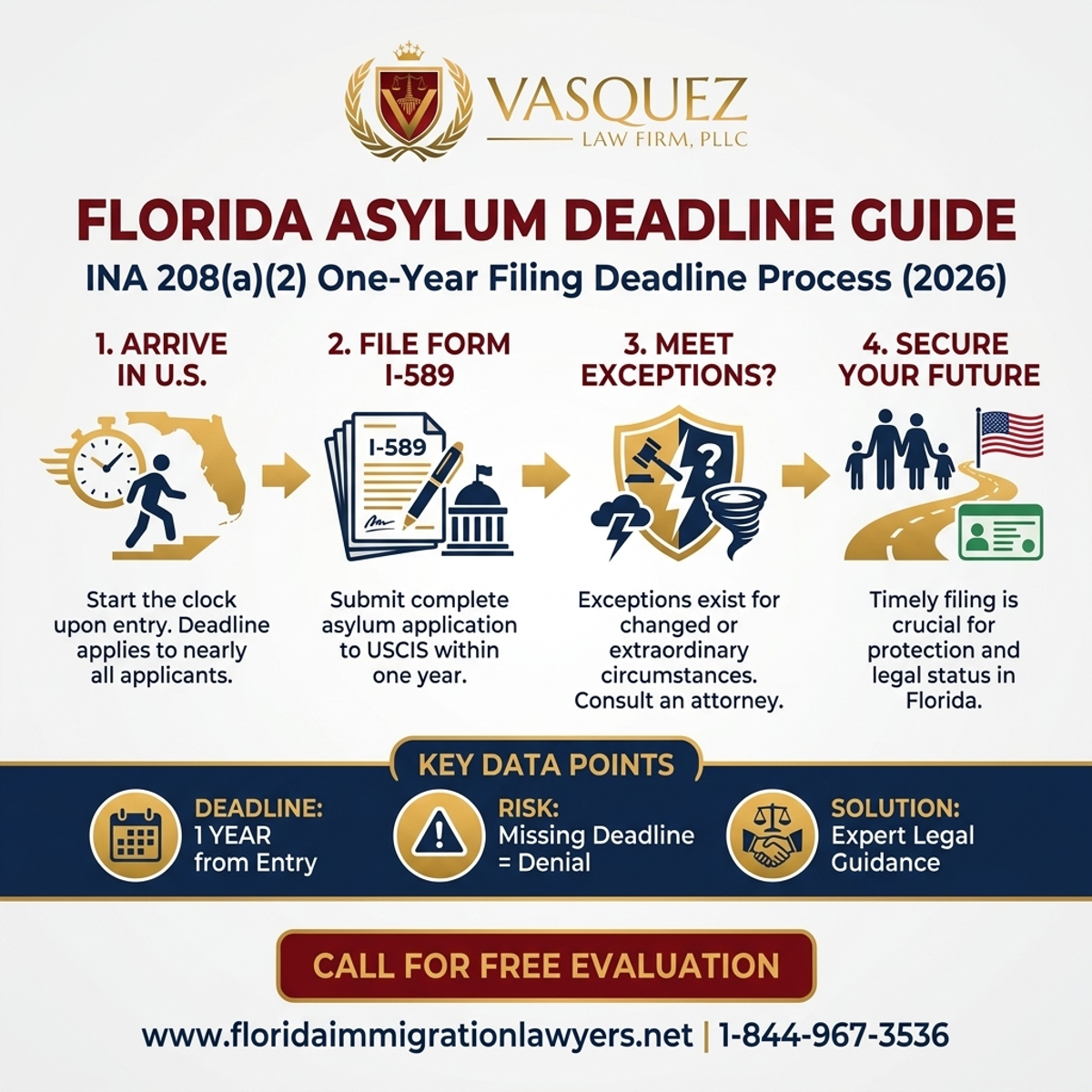
Step-by-Step Process — INA 208(a)(2) One-Year Filing Deadline for Asylum in Florida 2026
This statement must be compelling, consistent, and directly supported by your evidence.
-
Submit Your Application Package: File your complete Form I-589 application, along with all supporting documentation and your detailed statement, with the appropriate USCIS lockbox facility. If you are already in removal proceedings before an immigration judge in Miami or Orlando, you will file your Form I-589 with the immigration court, providing a copy to the Department of Homeland Security (DHS) counsel. Ensure you keep copies of everything you submit for your records.
-
Attend Biometrics Appointment: After filing, USCIS will send you a notice for a biometrics (fingerprinting) appointment at an Application Support Center (ASC). This is a mandatory step for identity verification and security checks. Be sure to attend this appointment promptly.
-
Attend Asylum Interview or Court Hearing: If you filed affirmatively with USCIS, you will be scheduled for an asylum interview at the USCIS Asylum Office in Orlando. If your case is in immigration court, you will present your asylum claim and your exception to an immigration judge. Thorough preparation for these interviews or hearings is critical, including practicing your testimony and reviewing all submitted documents.
-
Receive Decision: After your interview or hearing, you will eventually receive a decision on your asylum application. If granted, you will be eligible for various benefits. If denied by USCIS, your case will typically be referred to an immigration judge for defensive asylum proceedings. If denied by an immigration judge, you may have options to appeal to the Board of Immigration Appeals (BIA).
What Documents Do I Need for a Late Asylum Application in Florida? (Document Checklist)
Preparing a robust asylum application, especially one filed after the INA 208(a)(2) one-year filing deadline, requires a comprehensive collection of documents. Beyond proving your fear of persecution, you must also provide clear and convincing evidence to support your claimed exception. The following checklist outlines the essential documents you will need to gather for your application in Florida, ensuring that both your asylum claim and your reason for late filing are well-supported. Remember that all documents not in English must be accompanied by a certified English translation.
- Form I-589, Application for Asylum and for Withholding of Removal: The primary application form, filled out completely and accurately, with the appropriate box checked for late filing and the specific exception noted.
- Copies of Identity and Nationality Documents: Passport, birth certificate, national identity cards, or any other proof of your identity and citizenship from your home country.
- Proof of Entry into the U.S.: I-94 arrival/departure record, visa, or any other travel documents showing your last date of entry.
- Two Passport-Style Photographs: Meeting USCIS specifications.
- Detailed Personal Statement: A comprehensive narrative explaining your asylum claim (what happened, why you fear persecution, who is persecuting you) AND a separate, equally detailed explanation of why you missed the one-year filing deadline, clearly linking it to your changed or extraordinary circumstances. This statement should be consistent with all other evidence.
- Evidence of Persecution or Fear of Persecution:
- Affidavits from witnesses, family members, or experts.
- Police reports, medical records, hospital bills, or psychological evaluations related to past harm.
- News articles, human rights reports, or country condition reports from reputable sources (e.g., U.S. Department of State, Amnesty International, Human Rights Watch) specific to your home country and your particular social group, political opinion, religion, or race.
- Threat letters, arrest warrants, or court documents from your home country.
- Evidence Supporting Changed or Extraordinary Circumstances:
- For Changed Circumstances: New country condition reports, news articles, expert opinions, or personal affidavits detailing how the situation in your home country or your personal circumstances changed after your arrival, making you eligible for asylum or significantly increasing your fear.
- For Extraordinary Circumstances: Medical records, doctor's notes, hospital bills, or psychological evaluations proving a serious illness or disability. Death certificates of family members or legal representatives. Court documents or complaints filed against previous legal counsel for ineffective assistance. Evidence of prolonged detention or other events that prevented timely filing.
- Marriage Certificate/Birth Certificates: If applicable, for family members included in your application or to demonstrate personal changed circumstances.
- Any Previous Immigration Filings/Decisions: Copies of prior visa applications, denial notices, or other immigration-related documents.
What is the Timeline and Processing Expectation for Asylum Cases in 2026?
As of 2026, the timeline for asylum cases in the United States, particularly those requiring an exception to the INA 208(a)(2) one-year filing deadline, can be extensive and highly variable. The U.S. immigration system, including the USCIS Asylum Office in Orlando and the Executive Office for Immigration Review (EOIR) courts in Miami and Orlando, faces significant backlogs. While the goal is to process cases efficiently, the reality for many asylum seekers in Florida is a lengthy wait. Understanding these typical timeframes can help manage expectations, but it is important to remember that each case is unique.
Late-filed asylum applications often face additional scrutiny, which can contribute to longer processing times as officials carefully review the claimed exception. The table below provides a general overview of the typical stages and expected timeframes for asylum cases, acknowledging that these are estimates and actual times may vary significantly.
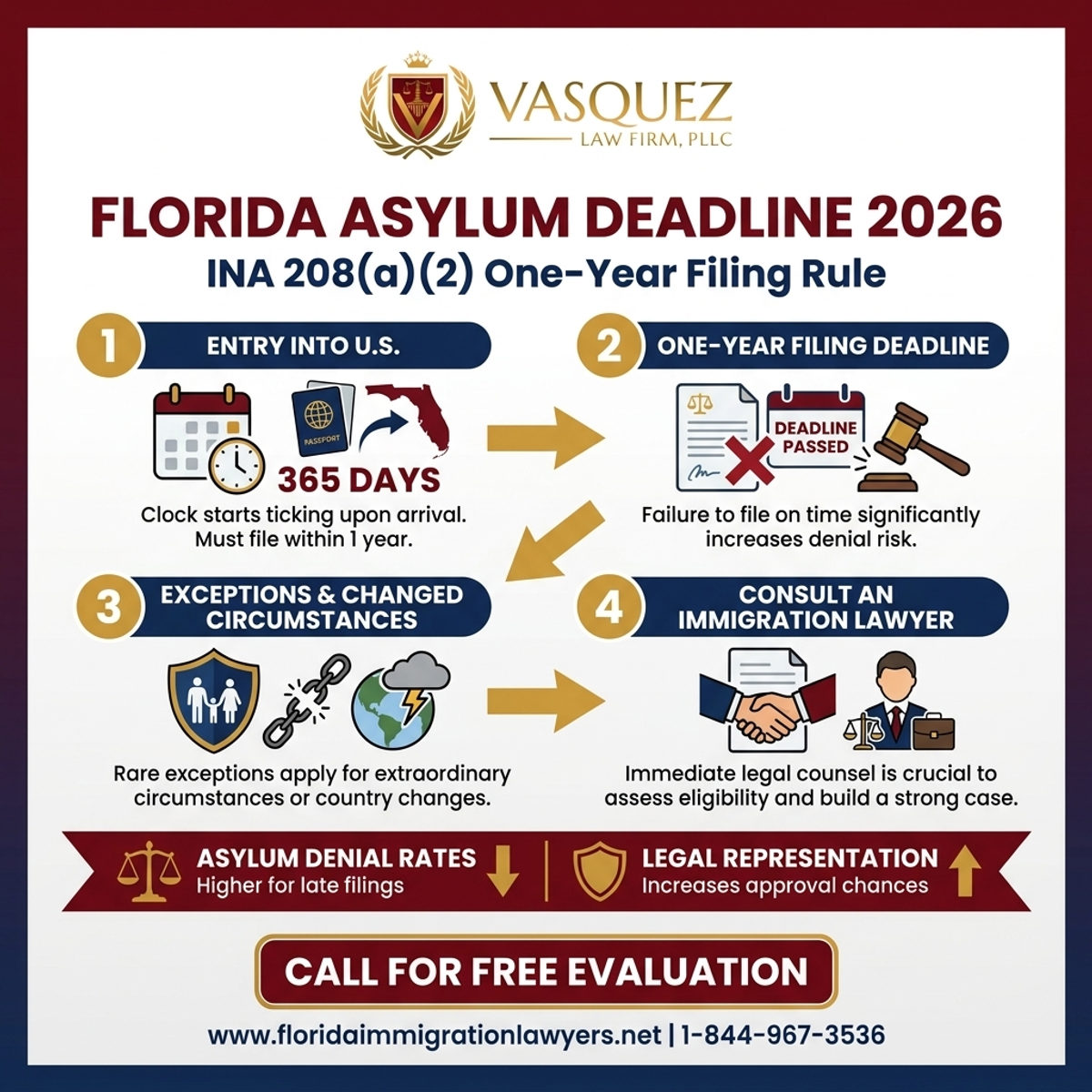
Key Statistics — INA 208(a)(2) One-Year Filing Deadline for Asylum in Florida 2026
| Stage | Typical Timeframe (As of 2026) | Notes |
|---|---|---|
| Filing Form I-589 (with exception) | ASAP after qualifying event | Must be within a "reasonable period" after changed/extraordinary circumstances arise. |
| Biometrics Appointment | 3-8 weeks after filing | Scheduled at an Application Support Center (ASC) for fingerprinting and background checks. |
| Work Authorization Eligibility (EAD) | 150 days after filing, can apply at 180 days. | Processing for EAD (Form I-765) can take 6-12 months after application. |
| Asylum Interview (Affirmative Asylum) | 6 months to several years | Significant backlogs at the USCIS Asylum Office in Orlando. Cases are generally prioritized by filing date, but late filings might take longer due to complexity. |
| Interview Decision | Weeks to months after interview | Can be longer if referred for additional review or to immigration court. |
| Immigration Court Proceedings (Defensive Asylum) | 3-7+ years | Highly variable, depends on the court docket at the Miami or Orlando Executive Office for Immigration Review (EOIR) and judge's schedule. |
| Appeal to Board of Immigration Appeals (BIA) | Months to 2+ years | If asylum is denied by an Immigration Judge, an appeal to the BIA is an option. |
| Federal Circuit Court Appeal | Several years | Further appeals to a U.S. Circuit Court of Appeals are possible after BIA denial. |
What are the Costs Associated with Filing for Asylum in Florida? (Fee Breakdown)
Understanding the financial implications of seeking asylum is crucial for applicants in Florida. While the U.S. government has specific policies to ensure that asylum is accessible to those fleeing persecution regardless of their financial status, there are still associated costs, particularly when navigating a complex case involving the INA 208(a)(2) one-year filing deadline. As of 2026, certain fees are waived for asylum seekers, but other expenses are unavoidable.
The most significant variable cost for many asylum seekers will be legal representation. Given the strictness of the one-year deadline and the necessity of proving an exception, retaining an experienced immigration attorney is often a critical investment. The table below outlines typical costs you might encounter during the asylum process in Florida:
| Item | Typical Fee (As of 2026) | Notes |
|---|---|---|
| Form I-589, Application for Asylum and for Withholding of Removal | $0 | No filing fee for the asylum application itself. |
| Biometrics Fee | $0 | Waived for asylum applicants. |
| Form I-765, Application for Employment Authorization (EAD) | Varies (typically $410-$555) | Required to obtain a work permit. Fee waivers may be available based on income. |
| Medical Examination (for Adjustment of Status) | Varies, typically $200-$500 | Not required for initial asylum application, but necessary if you later apply for a Green Card (Adjustment of Status) after asylum is granted. |
| Translation Services | Varies, $20-$50 per page or hourly | All documents not in English must be professionally translated and certified. This can add up significantly. |
| Document Retrieval Fees | Varies, $10-$100+ | Costs for obtaining police reports, medical records, court documents from your home country or within the U.S. |
| Expert Witness Fees | Varies, $500-$5,000+ | In some complex cases, an expert witness (e.g., country conditions expert, psychologist) may be needed to strengthen the claim or exception. |
| Attorney Fees | Highly Variable, $5,000-$15,000+ | This is often the most significant cost. Fees depend on the complexity of the case, the attorney's experience, and the stages involved (affirmative vs. defensive, appeals). Free or low-cost legal aid may be available through non-profits. |
While the asylum application itself is free to file, the associated costs can still be substantial. Budgeting for translation services, document retrieval, and especially legal fees is important. For those in Florida seeking asylum, exploring all financial aid options and consulting with an attorney about payment plans or pro bono services is a wise first step. Many Florida-based organizations offer assistance to asylum seekers.
Do not navigate this process alone. The complexities of the INA 208(a)(2) one-year filing deadline and its exceptions demand legal guidance. Contact Florida Immigration Lawyers today at 1-844-YO-PELEO for a free consultation to discuss your specific circumstances and learn how we can help you build a strong case.
Common Mistakes to Avoid When Filing for Asylum Late in Florida
Filing for asylum, especially when attempting to overcome the INA 208(a)(2) one-year filing deadline, is fraught with potential pitfalls. A single mistake can jeopardize your entire case and lead to a denial, potentially resulting in removal proceedings. For asylum seekers in Florida, understanding and avoiding these common errors is critical to a successful outcome. Here are some key mistakes to watch out for:
-
Missing the Deadline Without a Valid Exception: The most obvious mistake is simply filing late without a legally recognized "changed" or "extraordinary" circumstance. USCIS and immigration judges strictly adhere to INA 208(a)(2), and without a compelling, well-documented reason for delay, your application will almost certainly be denied.
-
Insufficient Evidence for the Exception: Merely claiming an exception is not enough. Many applicants fail to provide clear and convincing evidence to substantiate their changed or extraordinary circumstances. This includes a lack of medical records for illness, insufficient proof of country condition changes, or vague explanations of why a previous attorney was ineffective. Every claim must be backed by solid documentation.
-
Filing Too Late After the Exception Arose: Even if a valid changed or extraordinary circumstance occurs, you must file your asylum application within a "reasonable period" after that circumstance ceases to exist or becomes apparent. Procrastinating after the qualifying event can lead to a denial, as the delay itself will become a new problem.
-
Inconsistent Testimony or Application Details: Any discrepancies between your written application (Form I-589), your personal statement, and your verbal testimony during an interview or hearing can severely damage your credibility. Immigration officials are trained to spot inconsistencies, which can lead to a finding that you are not credible and a denial of your claim.
-
Not Disclosing All Prior Immigration History: Attempting to conceal previous entries, deportations, arrests, or other immigration interactions is a grave mistake. USCIS and DHS have access to extensive databases. Failure to disclose complete and accurate information can be seen as misrepresentation or fraud, leading to denial and even criminal charges.
-
Failing to Update Your Address: If you move after filing your application, you must promptly notify USCIS and the immigration court (if applicable) using Form AR-11 and by updating your address directly with the court. Missing crucial notices, interview appointments, or hearing dates because of an outdated address can result in your application being denied or your case being ordered closed/removed in absentia.
-
Attempting to Navigate the Process Without Legal Counsel: The complexities of asylum law, particularly regarding the one-year deadline and its exceptions, are immense. Representing yourself significantly reduces your chances of success. An experienced immigration attorney can identify valid exceptions, help gather evidence, prepare compelling arguments, and represent you during interviews or court hearings.
When to Call a Florida Immigration Lawyer for Asylum Assistance
The asylum process is one of the most intricate and high-stakes areas of U.S. immigration law. When you are facing the challenges of the INA 208(a)(2) one-year filing deadline or attempting to prove a complex exception, the decision to seek legal counsel is not just advisable, it is often critical for your success. Florida Immigration Lawyers are dedicated to helping individuals in Jacksonville and across Florida navigate these complex legal waters.
You should consider calling an immigration lawyer immediately if any of the following scenarios apply to you:
- You have missed the one-year filing deadline: If it has been more than one year since your last entry into the U.S. and you wish to apply for asylum, you absolutely need an attorney to assess if you qualify for an exception and to help you build a compelling case.
- You believe you have "changed" or "extraordinary" circumstances: Proving these exceptions requires specific legal arguments and robust evidence. An attorney can help identify if your situation fits the legal criteria and guide you through the documentation process.
- Your case involves complex legal issues: This includes past criminal history, prior immigration violations, prior denials of asylum, or concerns about statutory bars to asylum eligibility.
- You are in removal (deportation) proceedings: If you have been placed in immigration court, you are facing a judge and a DHS prosecutor. An attorney is essential to protect your rights and present your asylum claim defensively.
- You need help gathering evidence or writing your statement: An attorney can assist in identifying the necessary evidence, drafting a comprehensive personal statement, and preparing a legal brief to support your application and your claimed exception.
- You are preparing for an asylum interview or court hearing: Legal representation ensures you are thoroughly prepared for questioning, understand the process, and can present your case effectively to USCIS or an immigration judge.
- You received a Request for Evidence (RFE) or Notice of Intent to Deny (NOID): These notices indicate that USCIS has concerns about your application. An attorney can help you respond appropriately and address the issues raised.
Florida Immigration Lawyers understands the unique challenges faced by asylum seekers in Florida. We offer compassionate and strategic legal representation, ensuring your rights are protected throughout the process. Our team is well-versed in the nuances of INA 208(a)(2) and its exceptions, and we are committed to fighting for your right to seek safety.
About Florida Immigration Lawyers
Florida Immigration Lawyers is a leading law firm dedicated to providing comprehensive and compassionate immigration legal services to individuals and families across the entire state of Florida. With a deep understanding of U.S. immigration law and its constant evolution, we are committed to guiding our clients through even the most complex legal challenges, including asylum applications, deportation defense, family-based petitions, business immigration, and citizenship processes.
Our experienced attorneys are passionate advocates for immigrant rights, offering personalized strategies tailored to each client's unique circumstances. We understand the high stakes involved in immigration matters and strive to provide clear communication, transparent processes, and unwavering support. From our offices, we serve clients in Orlando and every other community in Florida, ensuring that legal help is always within reach. We are available 24/7 and offer free consultations to help you understand your options without financial burden. Our commitment to excellence and our client-centered approach make us a trusted partner in your immigration journey. Visit floridaimmigrationlawyers.net or call us today.
Sources and References
- U.S. Citizenship and Immigration Services (USCIS)
- Executive Office for Immigration Review (EOIR)
- U.S. Department of State
- Immigration and Nationality Act (INA) Section 208(a)(2) - 8 U.S.C. § 1158(a)(2)
- 8 Code of Federal Regulations (CFR) § 208.4 - Application for asylum by an alien physically present in the United States or at a land border or port of entry.
- USCIS Policy Manual, Volume 7, Part A, Chapter 2 - One-Year Filing Deadline.
Related services: asylum application process, refugee status and resettlement, humanitarian protection programs.
This article provides general legal information and is not intended as legal advice. Every case is unique, and outcomes depend on specific facts and circumstances. Contact an attorney for advice about your particular situation.
The INA 208(a)(2) one-year filing deadline is a formidable aspect of asylum law, but it is not an insurmountable barrier if you have valid reasons for a late filing. With the right legal strategy and comprehensive documentation, you can still pursue your right to asylum in the United States. Do not let fear or confusion prevent you from seeking the protection you deserve. Contact Florida Immigration Lawyers today for a free consultation at 1-844-YO-PELEO. Se Habla Español - Estamos aquí para ayudarle.
Do Not Navigate This Process Alone
Our experienced immigration attorneys are ready to fight for you. Get a free, confidential case review today.
Se Habla Español
Or leave your details and we’ll call you:
Free Evaluation in 24 Hours
Or talk to us right now

AI voice assistant — available 24/7
FreeFrequently Asked Questions

William J. Vásquez
Founding Attorney · Vasquez Law Firm
U.S. Air Force veteran and immigration attorney with years of hands-on U.S. immigration experience. J.D., NCCU School of Law. AILA member. Admitted to the 4th, 5th, and 11th Circuit Courts.
Available 24/7 - Free Evaluations
Reviewed for legal accuracy by William J. Vásquez
Licensed in North Carolina; U.S. immigration is federal practice.
Related Legal Services
Our Florida immigration attorneys can help you with experienced immigration attorneys, asylum protection and citizenship and naturalization. Call today at 1-844-YO-PELEO for a free case review.
Related Links
Related Topics
Free Legal Case Review
Discuss your case with our experienced attorneys. We're available 24/7.
Se Habla Español - Estamos aquí para ayudarle.
Related Articles
Immigration Lawyer Orlando Free Consultation in Florida
For individuals and families in Orlando, Florida, navigating the complexities of U.S. immigration law requires expert guidance. An immigration lawyer in Orlando offers crucial support for everything from visa applications and green card processes to naturalization and deportation defense. This comprehensive guide details what a free consultation covers, providing a step-by-step overview of immigration pathways, essential document checklists, and expected timelines in 2026. We also highlight common mistakes to avoid, discuss the critical role of legal counsel in deportation and asylum cases, and explain why choosing a local Orlando immigration attorney is beneficial. Florida Immigration Lawyers is dedicated to serving the diverse community of Orlando with compassionate, effective legal solutions, ensuring you receive personalized advice and robust representation for a successful immigration journey.
Fiance Visa in Miami: 2026 Process Guide for Florida
For U.S. citizens in Florida, bringing a foreign fiancé(e) to the U.S. requires navigating the K-1 Fiance Visa process. This guide details the 2026 requirements, step-by-step application, essential documents, and expected timelines. Learn about filing Form I-129F with USCIS, consular interviews, and the crucial Adjustment of Status after marriage. We cover typical fees, common mistakes to avoid, and when to seek legal assistance. Florida Immigration Lawyers offers expert guidance for couples in Miami, Orlando, and across Florida, ensuring a smooth path to uniting with your loved one. Get a free case review today.
Immigration Lawyer Services in Orlando, Florida
Explore immigration consultation services in Orlando, Florida, with a qualified immigration lawyer. Learn what to expect and understand your options for family and business immigration needs.
Fraud Prevention and Detection Fee: What to Know in Florida
Explore the fraud prevention and detection fee essential for immigration processes in Florida. Discover how it impacts applications like the I-601 waiver and learn key steps to navigate this requirement effectively.