Skip to content
1-844-967-3536Available 24/7
Immigration22 min read

I-360 Widow Self-Petition: Eligibility & Process in Florida

For surviving spouses of U.S. citizens in Florida, the I-360 widow self-petition offers a crucial pathway to permanent residency. This detailed guide, updated for 2026, explores eligibility criteria, the step-by-step application process, required documentation, and typical timelines. We delve into the complexities of proving a bona fide marriage and explain how to avoid common mistakes that could jeopardize your case. Whether your spouse passed away before filing a petition or you need guidance on adjustment of status, understanding this self-petition process is vital. Learn about associated costs, when to seek legal counsel, and how Florida Immigration Lawyers can provide compassionate, expert assistance to secure your future in the United States.

William J. VásquezPublished on July 16, 2026
2 views
I-360 Widow Self-Petition: Eligibility &… — guide from immigration lawyer in Florida

The I-360 widow self-petition allows certain surviving spouses of deceased U.S. citizens to apply for a green card independently, without the need for a petition from a relative. This pathway is crucial for those who were married to a U.S. citizen at the time of their spouse's death, have not remarried, and meet specific eligibility criteria related to the marriage and relationship. It provides a vital immigration avenue, particularly for individuals in Florida who may face unique challenges.

  • File Form I-360 as a surviving spouse of a U.S. citizen.
  • Must have been legally married to the U.S. citizen at the time of death.
  • Must not have remarried since the citizen spouse's death.
  • Petition must be filed within two years of the spouse's death, or before October 28, 2009, if the death occurred prior to that date.
  • Seek legal counsel from a Florida immigration lawyer for guidance.

Losing a loved one is an incredibly difficult experience, and when that loss involves a U.S. citizen spouse, it can create immense uncertainty regarding your immigration status. For many surviving spouses in Florida, the dream of living permanently in the United States may seem shattered. However, the U.S. immigration system provides a compassionate pathway known as the I-360 widow self-petition, allowing eligible individuals to pursue lawful permanent residency despite their profound loss. This critical provision ensures that the tragic death of a U.S. citizen spouse does not automatically end the immigration journey for their surviving partners.

Navigating the complexities of immigration law, especially during a time of grief, can be overwhelming. From understanding eligibility requirements to meticulously gathering documentation and meeting strict deadlines, every step of the I-360 self-petition process demands precision and expertise. This comprehensive guide, updated for 2026, will demystify the I-360 widow self-petition, covering essential criteria, the application process, common pitfalls, and what to expect in Florida. Our goal is to empower you with the knowledge needed to pursue your immigration goals with confidence and clarity.

Do not face this challenging journey alone. The experienced attorneys at Florida Immigration Lawyers are here to provide compassionate and effective legal assistance for surviving spouses throughout Florida. We understand the nuances of the I-360 widow self-petition and are dedicated to protecting your rights and securing your future. For personalized guidance and to discuss your unique situation, call Florida Immigration Lawyers at 1-844-967-3536 for a free consultation today.

What is the I-360 Widow Self-Petition and Who is Eligible in Florida?

The I-360 widow self-petition is an immigration benefit available to certain surviving spouses of U.S. citizens, allowing them to petition for lawful permanent resident status (a green card) on their own behalf. This provision, codified under the Immigration and Nationality Act (INA) Section 204(a)(1)(A)(ii), recognizes the unique vulnerability of these individuals and aims to prevent their immigration process from being terminated due to the death of their U.S. citizen spouse. It is a vital pathway for many in Florida who wish to remain in the U.S. after such a profound loss.

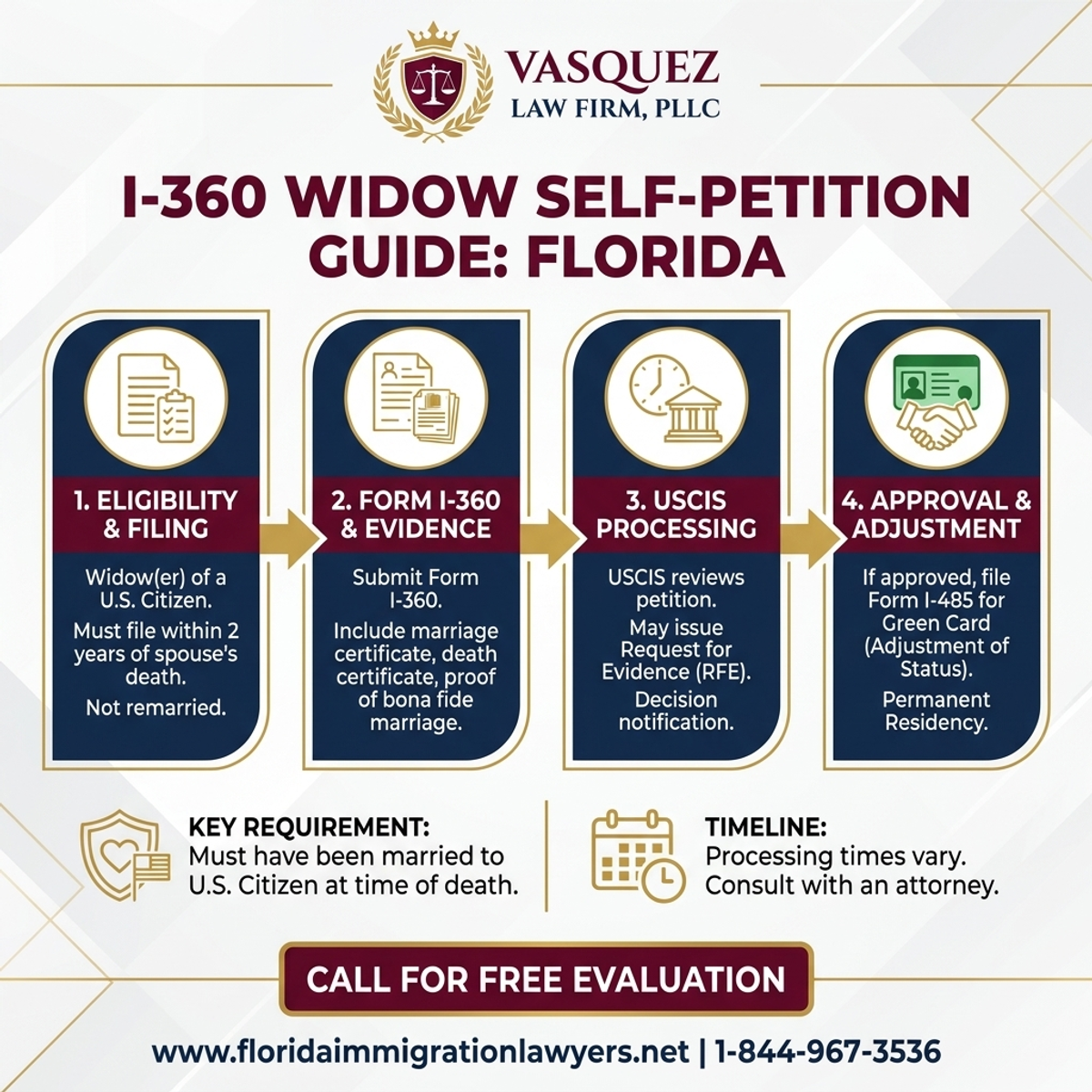
As of 2026, to be eligible for the I-360 widow self-petition, you must meet several strict criteria. First, you must have been legally married to a U.S. citizen at the time of their death. This includes common-law marriages if recognized in the jurisdiction where the marriage occurred. Second, you must not have remarried since the U.S. citizen spouse's death. Remarriage typically disqualifies a surviving spouse, although there are limited exceptions for those who remarry before the age of 18. Third, the petition must generally be filed within two years of your spouse's death. If your spouse passed away before October 28, 2009, there are different filing deadlines. Fourth, you must demonstrate that you and your deceased spouse had a bona fide marriage, meaning it was entered into in good faith and not solely for immigration purposes. USCIS will scrutinize evidence like joint bank accounts, shared property, insurance policies, and birth certificates of shared children. Finally, you must be admissible to the United States, meaning you do not have any criminal history or other factors that would make you ineligible for a green card. Understanding these requirements is crucial for a successful application, and our Coral Springs office frequently assists clients with these complex cases.

The I-360 self-petition is distinct from other family-based petitions because it does not require a living U.S. citizen or lawful permanent resident to sponsor the applicant. This self-sufficiency is a critical aspect, providing a lifeline to those who would otherwise lose their immigration path. USCIS evaluates these petitions with great care, focusing on the legitimacy of the marriage and the applicant's adherence to all filing requirements. For surviving spouses in Florida, especially in diverse areas like Coral Springs, Fort Lauderdale, and Miami, securing legal representation can significantly enhance the likelihood of a positive outcome. An attorney can help compile compelling evidence and address any potential issues that might arise during the review process. This includes demonstrating that the marriage was genuine and that all statutory deadlines are met, which are common points of scrutiny for USCIS adjudicators.

What is the I-360 Self-Petition Application Process in 2026?

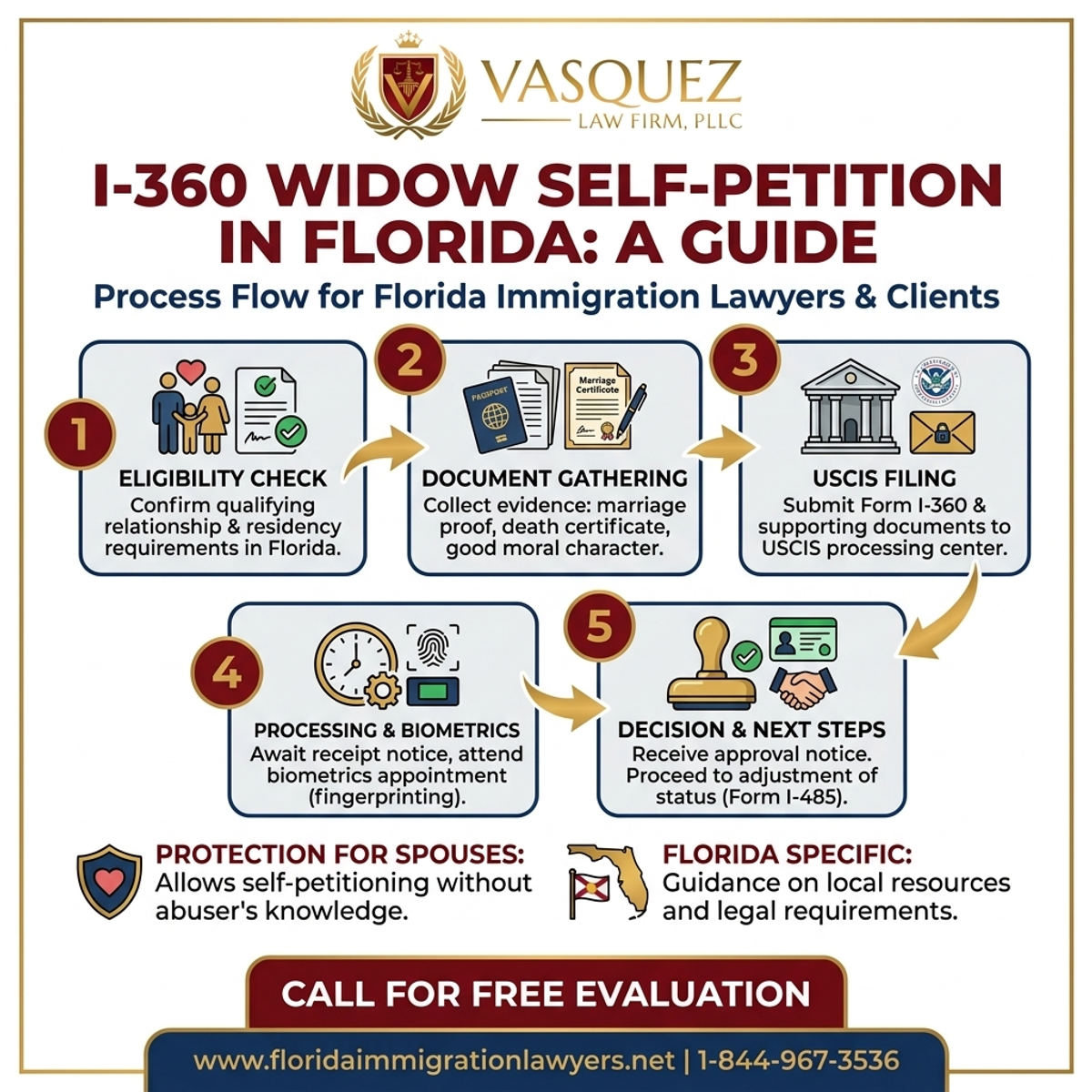
The application process for the I-360 widow self-petition involves several key stages, each requiring meticulous attention to detail and adherence to specific USCIS guidelines. As of 2026, understanding these steps is vital for a successful outcome. The journey begins with preparing and filing Form I-360, Petition for Amerasian, Widow(er), or Special Immigrant, along with extensive supporting documentation. This initial filing sets the foundation for your entire immigration case.

  1. Determine Eligibility and Gather Initial Documents: Before filing, ensure you meet all eligibility criteria, including the two-year filing deadline from your spouse's death. Collect essential documents such as your marriage certificate, your spouse's death certificate, proof of your spouse's U.S. citizenship (e.g., birth certificate or naturalization certificate), and evidence of a bona fide marriage. This evidence can include joint bank statements, utility bills, lease agreements, property deeds, photographs, and affidavits from friends and family who can attest to the legitimacy of your relationship. Start compiling these documents early to avoid delays.

  2. Complete and File Form I-360: Carefully fill out Form I-360. Ensure all sections are accurately completed and that you sign the form. Attach all supporting documents, organized clearly. The petition must be filed with the appropriate USCIS service center. As of 2026, the filing fee for Form I-360 is subject to change, so always check the USCIS website for the most current fee information before submission. Failure to include the correct fee or a valid fee waiver request will result in rejection of your petition.

  3. Receive Receipt Notice and Biometrics Appointment: After filing, USCIS will send a Form I-797C, Notice of Action, confirming receipt of your petition. Subsequently, you will receive an appointment notice for biometrics (fingerprints, photograph, and signature) at an Application Support Center (ASC). It is crucial to attend this appointment, as it is a mandatory step for background checks and identity verification. Missing this appointment without rescheduling can significantly delay your case or even lead to denial.

  4. Interview (if required): While not all I-360 petitioners are interviewed, USCIS may schedule an interview to verify information or request additional evidence. If an interview is required, it will typically take place at a local USCIS field office, such as those in Miami, Orlando, or Tampa for Florida residents. Preparing for this interview with an attorney can be highly beneficial, ensuring you are ready to answer questions about your marriage and eligibility.

  5. Adjustment of Status or Consular Processing: If your I-360 petition is approved, you will then proceed to apply for your green card. If you are already in the U.S. and eligible, you will file Form I-485, Application to Register Permanent Residence or Adjust Status. If you are outside the U.S., or ineligible for adjustment, you will undergo consular processing through a U.S. embassy or consulate abroad. This final step involves another set of forms, fees, and typically a medical examination and interview.

Throughout this entire process, maintaining accurate records of all submissions and communications with USCIS is crucial. The process can be lengthy, and having an organized file will be invaluable if you need to follow up or respond to requests for evidence. An immigration attorney in Florida can help manage this complex process, ensuring all deadlines are met and all documentation is correctly prepared.

What Documents Do I Need for an I-360 Widow Self-Petition?

Preparing a comprehensive and well-organized document package is paramount for a successful I-360 widow self-petition. USCIS relies heavily on documentary evidence to verify eligibility and the bona fides of your marriage. Missing or insufficient documentation is one of the most common reasons for delays or denials. As of 2026, applicants in Florida should meticulously gather the following:

  • Form I-360, Petition for Amerasian, Widow(er), or Special Immigrant: The completed and signed form, along with the appropriate filing fee or fee waiver request.
  • Proof of Your U.S. Citizen Spouse's Death: Original or certified copy of the death certificate.
  • Proof of Your U.S. Citizen Spouse's Citizenship: Copy of birth certificate, naturalization certificate, U.S. passport, or Consular Report of Birth Abroad.
  • Proof of Your Marriage to the U.S. Citizen: Original or certified copy of your marriage certificate.
  • Proof of Termination of Prior Marriages (if any): Divorce decrees or death certificates for any previous marriages for both you and your deceased spouse.
  • Evidence of a Bona Fide Marriage: This is critical. Provide as much evidence as possible to demonstrate that your marriage was legitimate and not entered into solely for immigration purposes. Examples include:
    • Joint bank account statements, credit card statements.
    • Joint utility bills (electricity, water, gas, internet).
    • Joint lease agreements or property deeds.
    • Joint tax returns (IRS Form 1040).
    • Life insurance policies listing each other as beneficiaries.
    • Birth certificates of children born to you and your deceased spouse.
    • Affidavits from friends, family, and employers attesting to the bona fides of your marriage (Form I-130A, Part 5 guidelines can be helpful here).
    • Photographs of your wedding, family events, and daily life together.
    • Correspondence addressed to both spouses at the same address.
    • Travel itineraries or tickets from joint trips.
  • Proof You Have Not Remarried: A sworn statement or affidavit confirming you have not remarried since your spouse's death.
  • Your Birth Certificate: Copy of your birth certificate.
  • Passport or Other Identity Documents: Copy of your passport biographical page and any nonimmigrant visas.
  • Form I-94, Arrival/Departure Record: Copy of your most recent I-94 if you entered the U.S. lawfully.
Step-by-Step Process for I-360 Widow Self-Petition: Eligibility & Process in Florida 2026

Step-by-Step Process — I-360 Widow Self-Petition: Eligibility & Process in Florida 2026

All documents submitted must be in English or accompanied by a certified English translation. For residents of Coral Springs and other Florida communities, gathering these documents can be a daunting task, especially while grieving. An immigration attorney can assist in organizing this evidence, ensuring that your petition is as strong as possible. They can also advise on specific types of evidence that may be particularly persuasive given your unique circumstances, preparing you for any potential Requests for Evidence (RFEs) from USCIS.

How Long Does the I-360 Widow Self-Petition Take in 2026?

The processing time for an I-360 widow self-petition can vary significantly based on several factors, including the specific USCIS service center handling the case, the completeness of the application, and the current workload. As of 2026, petitioners in Florida should be prepared for a multi-stage process that can take a considerable amount of time. While individual experiences differ, here is a general timeline to help manage expectations:

It is important to remember that these are typical timeframes, and actual processing can be shorter or longer. USCIS provides online tools to check current processing times by form type and service center. Delays can occur due to Requests for Evidence (RFEs), interviews, or background check issues. Maintaining communication with your attorney and promptly responding to any USCIS inquiries is crucial for keeping your case moving forward. For those in Florida, particularly in areas like Coral Springs, Tampa, or Orlando, local USCIS field offices may have varying interview backlogs that can impact the overall timeline for adjustment of status.

Stage Typical Timeframe (As of 2026) Notes
Form I-360 Processing 10-24 months Varies by USCIS service center. This is for the initial petition approval.
Biometrics Appointment 3-8 weeks after filing I-360 Mandatory for background checks.
Form I-485 (Adjustment of Status) Processing 8-24 months (after I-360 approval) If filed concurrently or after I-360 approval. Includes interview if required.
Work Authorization (EAD) (if filed concurrently) 5-12 months Filed with Form I-765 concurrently with I-485.
Travel Document (Advance Parole) (if filed concurrently) 5-12 months Filed with Form I-131 concurrently with I-485.
Consular Processing (if applicable) 6-18 months (after I-360 approval) Involves National Visa Center (NVC) and embassy/consulate interview.

What are the Costs Associated with an I-360 Widow Self-Petition?

The financial aspect of an I-360 widow self-petition is an important consideration for applicants in Florida. While USCIS filing fees are standardized across the country, other costs, particularly legal fees, can vary. As of 2026, it is crucial to budget for these expenses to avoid unexpected financial burdens that could disrupt your immigration journey. USCIS fees are subject to change, so always verify the most current amounts directly on the USCIS website.

The primary costs typically include government filing fees for various forms required throughout the process. These fees are non-refundable, regardless of the outcome of your petition. Beyond government fees, applicants should also account for potential expenses related to document translation, obtaining certified copies of records, and medical examinations. Legal representation, while an additional cost, is often an invaluable investment given the complexity and sensitive nature of these cases. An experienced immigration lawyer can help streamline the process, prepare a strong case, and avoid costly mistakes that could lead to delays or denials. For residents of Coral Springs and surrounding areas, understanding the full scope of these costs upfront is essential for planning.

Item Typical Fee (As of 2026, approximate, subject to change) Notes
Form I-360, Petition for Amerasian, Widow(er), or Special Immigrant $0 No filing fee for widow(er) self-petitioners.
Form I-485, Application to Register Permanent Residence or Adjust Status $1,225 (includes biometrics fee) Required for adjustment of status within the U.S.
Form I-765, Application for Employment Authorization (EAD) $0 (if filed with I-485) Allows you to work legally while your I-485 is pending.
Form I-131, Application for Travel Document (Advance Parole) $0 (if filed with I-485) Allows you to travel internationally while your I-485 is pending.
Medical Examination Fee $200 - $500 Paid to an authorized civil surgeon; varies by provider.
Attorney Fees Varies widely ($3,000 - $10,000+) Highly recommended for complex cases; provides expertise and peace of mind.
Document Translation/Certification Varies ($25 - $75 per page) Required for any non-English documents.
Postage/Courier Fees Varies For sending applications and documents securely.
Key Statistics and Data for I-360 Widow Self-Petition: Eligibility & Process in Florida 2026

Key Statistics — I-360 Widow Self-Petition: Eligibility & Process in Florida 2026

While the I-360 form itself has no filing fee for widow(er) self-petitioners, the subsequent application for adjustment of status (Form I-485) does carry a substantial fee. It is important to note that fee waivers may be available for certain low-income applicants for some forms. Discussing your financial situation with an attorney can help determine if you qualify for any fee exemptions. For those considering an I-360 widow self-petition in Florida, transparent legal fee structures and clear communication about all potential costs are hallmarks of a reputable law firm.

Can I-360 Widow Self-Petitioners Get a Green Card if Their Spouse Died Before Petitioning?

Yes, one of the most critical aspects of the I-360 widow self-petition is that it allows surviving spouses to apply for a green card even if their U.S. citizen spouse died before filing any immigration petition on their behalf. This provision is a compassionate recognition that the death of a spouse should not automatically preclude a surviving partner from pursuing their immigration goals. This is a common scenario for many individuals in Florida who may not have had the opportunity to complete the initial immigration steps before their spouse's passing.

Specifically, under INA 204(a)(1)(A)(ii), if you were married to a U.S. citizen for at least two years at the time of their death, and you file the I-360 petition within two years of their passing, you can self-petition. The requirement that the marriage lasted at least two years is generally waived if the marriage was entered into in good faith. This is a key distinction from other family-based petitions where the U.S. citizen must initiate the process. The law effectively treats the surviving spouse as if the deceased citizen spouse had filed an I-130 petition, allowing the surviving spouse to be classified as an immediate relative. This classification is highly advantageous because there are no visa quotas or waiting lists for immediate relatives, meaning a green card is available as soon as the I-360 and subsequent adjustment of status (or consular processing) applications are approved.

This allows for a direct path to permanent residency without the delays often associated with other visa categories. For those in Florida, whether in Coral Springs, Orlando, or Jacksonville, who find themselves in this difficult situation, understanding this provision offers significant hope. It means that even if your spouse tragically passed away before you could begin the formal immigration process, you still have a viable path forward. However, the burden of proof for a bona fide marriage and meeting all other eligibility criteria remains with the applicant. An experienced attorney can help ensure that all necessary evidence is compiled and presented effectively to USCIS, mitigating the risk of denial and facilitating a smoother process. This includes navigating the complexities of proving a legitimate marriage in the absence of the sponsoring spouse, a task that often requires a detailed and persuasive presentation of evidence to avoid scrutiny from immigration officials.

Do not navigate this process alone. The complexities of immigration law, combined with the emotional toll of loss, can be overwhelming. Contact Florida Immigration Lawyers today to ensure your application is handled with the care and expertise it deserves. Our dedicated team is ready to assist you.

Common Mistakes to Avoid When Filing an I-360 Widow Self-Petition

Filing an I-360 widow self-petition is a detailed legal process, and even minor errors can lead to significant delays, Requests for Evidence (RFEs), or even denial. For surviving spouses in Florida, avoiding these common pitfalls is crucial to a successful outcome:

  1. Missing the Two-Year Filing Deadline: The most critical mistake is failing to file Form I-360 within two years of your U.S. citizen spouse's death. This deadline is strict, and missing it almost always results in denial, unless the death occurred before October 28, 2009, which has different rules. Always confirm the exact date of death and plan to file well in advance.

  2. Remarrying Before I-360 Approval: Remarrying before your I-360 petition is approved generally disqualifies you. The law requires you to be an unremarried widow(er) at the time of filing and adjudication. While there are limited exceptions for those who remarry before age 18, it is a significant risk to your petition.

  3. Insufficient Evidence of a Bona Fide Marriage: USCIS meticulously examines whether your marriage was entered into in good faith. Failing to provide robust evidence (joint accounts, leases, photos, affidavits) to prove a legitimate relationship, not just for immigration purposes, can lead to an RFE or denial. Vague or limited evidence is a common issue.

  4. Incomplete or Inaccurate Forms: Any missing information, incorrect dates, or typos on Form I-360 can cause delays or outright rejection. Ensure every field is filled out accurately and completely. USCIS often rejects forms for simple omissions, forcing applicants to restart the process.

  5. Not Providing Certified Translations: If any supporting document is not in English (e.g., a foreign marriage certificate or birth certificate), it must be accompanied by a complete and certified English translation. Failure to do so will result in an RFE and delay your case.

  6. Failure to Prove U.S. Citizenship of Deceased Spouse: You must provide clear, undeniable proof that your deceased spouse was a U.S. citizen at the time of their death. A copy of a U.S. birth certificate, naturalization certificate, or U.S. passport is typically required. Without this, your petition will be denied.

  7. Not Disclosing All Immigration History: Attempting to conceal prior immigration violations, arrests, or deportations can lead to severe consequences, including charges of misrepresentation and permanent bars from the U.S. Always be truthful and disclose all relevant information to your attorney.

  8. Ignoring Requests for Evidence (RFEs): If USCIS sends an RFE, it means they need more information or clarification. Failing to respond fully and within the specified deadline will almost certainly lead to a denial. Understand exactly what is being asked and provide it promptly.

An experienced immigration attorney can help you meticulously prepare your application, review all documents, and ensure you avoid these costly mistakes. This proactive approach is particularly beneficial for those navigating the process in Florida, where local USCIS offices may have specific preferences for documentation.

When to Call a Florida Immigration Lawyer for Your I-360 Self-Petition

While the prospect of self-petitioning for a green card may seem appealing, the complexities of the I-360 widow self-petition often necessitate professional legal assistance. Engaging a Florida immigration lawyer from the outset can significantly improve your chances of success and provide invaluable peace of mind during a difficult time. Our firm, Florida Immigration Lawyers, is dedicated to guiding surviving spouses through every step of this intricate process, offering compassionate and expert counsel.

You should consider calling an attorney if:

  • You are nearing the two-year filing deadline: If your spouse passed away recently and the deadline is approaching, a lawyer can expedite the preparation and filing of your petition to ensure it is submitted on time.
  • Your marriage was relatively short or you have limited joint evidence: Proving a bona fide marriage can be challenging without extensive joint documentation. An attorney can help strategize and gather alternative forms of evidence.
  • You have a complex immigration history: Previous visa overstays, denials, arrests, or other immigration issues can complicate your case. An attorney can assess potential inadmissibility issues and help prepare waivers if necessary.
  • You have remarried (even if briefly) or are considering remarriage: This can be a disqualifying factor. An attorney can advise on potential exceptions or the impact on your petition.
  • You received a Request for Evidence (RFE) or Notice of Intent to Deny (NOID): These notices indicate that USCIS has concerns about your petition. Responding effectively requires legal expertise to address the specific issues raised by USCIS.
  • You are unsure about any aspect of the application: From filling out forms to understanding legal terms, any uncertainty can lead to mistakes. A lawyer provides clarity and ensures accuracy.
  • You are experiencing significant grief: Navigating legal procedures while grieving is incredibly difficult. A lawyer can handle the legal burden, allowing you to focus on healing.

Florida Immigration Lawyers has extensive experience with I-360 self-petitions for widows and widowers across Florida, including Coral Springs, Orlando, and Miami. We understand the specific requirements and challenges faced by applicants in our state and are committed to providing personalized, effective representation. Our team offers free consultations to assess your situation and explain how we can help you achieve your immigration goals.

About Florida Immigration Lawyers

Florida Immigration Lawyers is a leading immigration law firm dedicated to serving individuals and families across the entire state of Florida. With a deep understanding of U.S. immigration law and a compassionate approach, we provide comprehensive legal services to help our clients navigate even the most complex immigration challenges. Our firm is built on a foundation of trust, integrity, and an unwavering commitment to achieving positive outcomes for those seeking to live, work, and thrive in the United States.

We specialize in a wide range of immigration matters, including family-based petitions, asylum claims, deportation defense, naturalization, and business immigration. Our attorneys are highly skilled in handling sensitive cases like the I-360 widow self-petition, offering empathetic guidance during difficult times. We pride ourselves on clear communication, meticulous preparation, and aggressive advocacy, ensuring that every client receives the personalized attention and strategic counsel they deserve. Our team is available 24/7 to answer your questions and provide support.

Choosing Florida Immigration Lawyers means partnering with a firm that genuinely cares about your future. We offer free consultations to discuss your case and explore your legal options without obligation. Our bilingual staff ensures that language is never a barrier to accessing quality legal representation. Whether you are in Coral Springs, Jacksonville, Tampa, or anywhere else in Florida, we are here to provide the expert legal assistance you need. Visit our website or call us at 1-844-967-3536 to learn more about how we can help you.

Sources and References

Related services: family petition process, family-based green cards, fiancé visa (K-1).

Your immigration journey does not have to end with the loss of your spouse. Take control of your future by understanding your options. For a free, confidential consultation regarding your I-360 widow self-petition, contact Florida Immigration Lawyers today. We are available 24/7 to provide the support and legal expertise you need. Call us at 1-844-967-3536. Se Habla Espanol - Estamos aqui para ayudarle.

If you need legal assistance, learn more about how our family immigration attorneys can help, or call us at 1-844-967-3536 for a free consultation.

Do Not Navigate This Process Alone

Our experienced immigration attorneys are ready to fight for you. Get a free, confidential consultation today.

Se Habla Español

Frequently Asked Questions

The I-360 widow self-petition allows an unremarried surviving spouse of a deceased U.S. citizen to apply for a green card independently. This is typically available if the marriage was bona fide and the petition is filed within two years of the citizen spouse's death, ensuring the immigration process can continue despite the tragic loss. It provides a direct path to permanent residency without needing a new sponsor.
To be eligible, you must have been legally married to a U.S. citizen at the time of their death, not have remarried, and generally file the petition within two years of their passing. You must also prove that the marriage was entered into in good faith, not solely for immigration purposes. Your deceased spouse must have been a U.S. citizen. Consulting an attorney can help confirm your specific eligibility.
Yes, absolutely. One of the primary benefits of the I-360 widow self-petition is that it allows you to self-petition even if your U.S. citizen spouse passed away before filing any immigration petition (like an I-130) on your behalf. The law treats you as if your spouse had filed, preserving your path to a green card.
You need extensive evidence to prove your marriage was genuine. This includes joint bank accounts, joint utility bills, joint lease agreements or property deeds, joint tax returns, life insurance policies, birth certificates of shared children, photographs, and affidavits from friends and family. The more compelling evidence you provide, the stronger your case will be.
Generally, if you remarry before your I-360 widow self-petition is approved, you will be disqualified. The law requires you to be an unremarried widow(er) at the time of filing and adjudication. There are very limited exceptions, such as remarrying before age 18, but it is a significant risk to your petition.
The total processing time can range from 1.5 to 4 years or more, depending on the USCIS service center, case complexity, and whether you adjust status in the U.S. or go through consular processing. The I-360 petition itself can take 10-24 months, followed by the adjustment of status or consular processing stage. Checking USCIS processing times online is recommended.
No, there is no filing fee for Form I-360 itself when filed as a widow(er) of a U.S. citizen. However, you will incur fees for the subsequent application for adjustment of status (Form I-485), medical examinations, and potentially for legal assistance. Always verify current fees on the official USCIS website, as they can change.
The general rule is that the I-360 petition must be filed within two years of your spouse's death. If your spouse died more than two years ago, you might be ineligible unless their death occurred before October 28, 2009, which has specific grandfathering provisions. It is crucial to consult an attorney to assess your options if you missed this deadline.
Yes, your unmarried children under the age of 21 can typically be included in your I-360 widow self-petition. They are considered derivative beneficiaries and can apply for permanent residency along with you. They will need to file their own Form I-485 or undergo consular processing once your I-360 is approved.
William J. Vásquez

William J. Vásquez

Founding Attorney · Vasquez Law Firm

U.S. Air Force veteran and immigration attorney with years of hands-on U.S. immigration experience. J.D., NCCU School of Law. AILA member. Admitted to the 4th, 5th, and 11th Circuit Courts.

Available 24/7 - Free Evaluations

Reviewed for legal accuracy by William J. Vásquez

Licensed in North Carolina; U.S. immigration is federal practice.

Related Legal Services

Our Florida immigration attorneys can help you with immigration practice areas, free immigration consultation and experienced immigration attorneys. Call today at 1-844-967-3536 for a free consultation.

Related Topics

#immigration#florida#I-360 widow#self-petition#florida

Free Legal Consultation

Discuss your case with our experienced attorneys. We're available 24/7.

Se Habla Español - Estamos aquí para ayudarle.

Related Articles

Immigration

INA 208(a)(2) One-Year Filing Deadline for Asylum in

Understanding the INA 208(a)(2) one-year filing deadline for asylum is crucial for anyone seeking protection in the U.S., especially in Florida. This strict rule mandates that asylum applications (Form I-589) must generally be filed within one year of your last arrival. However, vital exceptions exist for those who can prove 'changed circumstances' in their home country or personal situation, or 'extraordinary circumstances' that prevented timely filing. Navigating these exceptions requires meticulous evidence, a detailed explanation, and precise legal arguments. This article provides a comprehensive guide to the deadline, its exceptions, a step-by-step process for late filings, required documentation, and expected timelines in 2026. For anyone in Florida facing this complex legal challenge, securing expert legal counsel is paramount to building a strong case and protecting your future.

July 16, 202624 min read