H-2A Visa for Florida Farmers: A 2026 Guide to Farm Labor
Florida's agricultural sector relies heavily on a consistent workforce. The H-2A visa program offers a vital solution for farmers facing temporary labor shortages, allowing them to bring foreign nationals for seasonal agricultural work. This comprehensive guide, updated for 2026, details the multi-step application process, from obtaining labor certification from the Department of Labor to filing petitions with USCIS and consular processing. We cover key employer requirements, including temporary need, U.S. worker recruitment efforts, and the obligation to provide fair wages, housing, and transportation. Additionally, the article breaks down typical processing timelines and the various costs involved, helping Florida growers budget effectively. We also highlight common pitfalls to avoid, such as late filings, non-compliant housing, and wage violations, emphasizing the importance of ongoing compliance. For personalized legal guidance, Florida Immigration Lawyers offers assistance to navigate the H-2A program, ensuring your farm secures the necessary workforce efficiently and legally. Call us for a free consultation.
The H-2A visa program allows Florida farmers and agricultural employers to bring foreign nationals to the U.S. for temporary or seasonal agricultural work when there aren't enough U.S. workers available. As of 2026, the process involves demonstrating a temporary need, obtaining a labor certification from the Department of Labor, and filing a petition with USCIS. This program is crucial for Florida's agricultural sector, which heavily relies on a consistent workforce for planting, cultivating, and harvesting various crops. Compliance with wage, housing, and transportation regulations is strictly enforced.
- H-2A visas address temporary agricultural labor shortages in Florida.
- Employers must prove a temporary need and recruit U.S. workers first.
- The process involves the Department of Labor (DOL) and USCIS.
- Strict compliance with worker protections, wages, and housing is mandatory.
- The program is vital for Florida's diverse agricultural industry.
Florida's agricultural landscape, stretching from the citrus groves of Central Florida to the vegetable fields near West Palm Beach, thrives on consistent, skilled labor. However, finding enough domestic workers for temporary or seasonal agricultural tasks can be a persistent challenge for many Florida farmers. This is where the H-2A visa program becomes an indispensable resource. Designed to address critical labor shortages, the H-2A visa allows agricultural employers to legally bring foreign nationals to the United States for temporary farm work.
Navigating the complexities of immigration law, particularly a specialized program like the H-2A visa, can be daunting. From understanding the Department of Labor's requirements to filing petitions with U.S. Citizenship and Immigration Services (USCIS), every step demands precision and adherence to strict regulations. This comprehensive guide, updated for 2026, will walk Florida growers through the H-2A application process, outlining key requirements, timelines, costs, and common pitfalls to avoid. Our goal is to equip you with the knowledge needed to secure the workforce essential for your agricultural operations.
Don't let the intricate legal framework of the H-2A visa program hinder your farm's productivity. For personalized guidance and assistance, call Florida Immigration Lawyers at 1-844-YO-PELEO for a free consultation. We are here to help Florida farmers secure the labor they need.
What is the H-2A Visa Program for Florida Farmers?
The H-2A temporary agricultural worker program provides a legal pathway for U.S. agricultural employers to bring foreign workers to the United States to perform agricultural labor or services of a temporary or seasonal nature. This program is critical for Florida's agriculture, which is a leading sector in the state's economy, producing a wide array of crops including citrus, tomatoes, sugarcane, and nursery products. The H-2A visa, codified under the Immigration and Nationality Act (INA) Section 101(a)(15)(H)(ii)(a), specifically addresses situations where there are insufficient U.S. workers who are able, willing, qualified, and available to perform the temporary agricultural labor, and where employing foreign workers will not adversely affect the wages and working conditions of similarly employed U.S. workers.
As of 2026, the program continues to serve as a vital lifeline for many Florida growers facing labor shortages, particularly during peak harvest seasons. Employers must demonstrate that their need for workers is temporary, generally defined as one year or less, though extensions are possible. This temporary nature distinguishes H-2A workers from permanent residents. The H-2A program mandates strict protections for workers, including specific wage rates (the Adverse Effect Wage Rate, or AEWR), housing, and transportation. These regulations are designed to prevent the exploitation of foreign workers and ensure fair competition with domestic labor. Understanding these foundational aspects is the first step for any Florida farmer considering the H-2A program.
The program involves multiple federal agencies, primarily the Department of Labor (DOL) and USCIS, working in concert to ensure compliance and proper vetting. For instance, the DOL is responsible for the labor certification process, ensuring that the employer has attempted to recruit U.S. workers and that the employment of H-2A workers will not negatively impact domestic workers. USCIS then reviews the employer's petition to ensure it meets all immigration requirements. This multi-layered process, while rigorous, is designed to protect both the integrity of the U.S. labor market and the rights of the workers involved.
How Do Florida Growers Apply for H-2A Agricultural Workers in 2026?
Applying for H-2A agricultural workers involves a multi-stage process that requires careful planning and strict adherence to federal regulations. For Florida growers in 2026, the journey begins well in advance of the anticipated start date of work, typically several months. This detailed procedure ensures that all legal and ethical obligations are met before foreign workers can be authorized for employment. Successful navigation of this process is crucial for securing a reliable workforce for your agricultural needs.
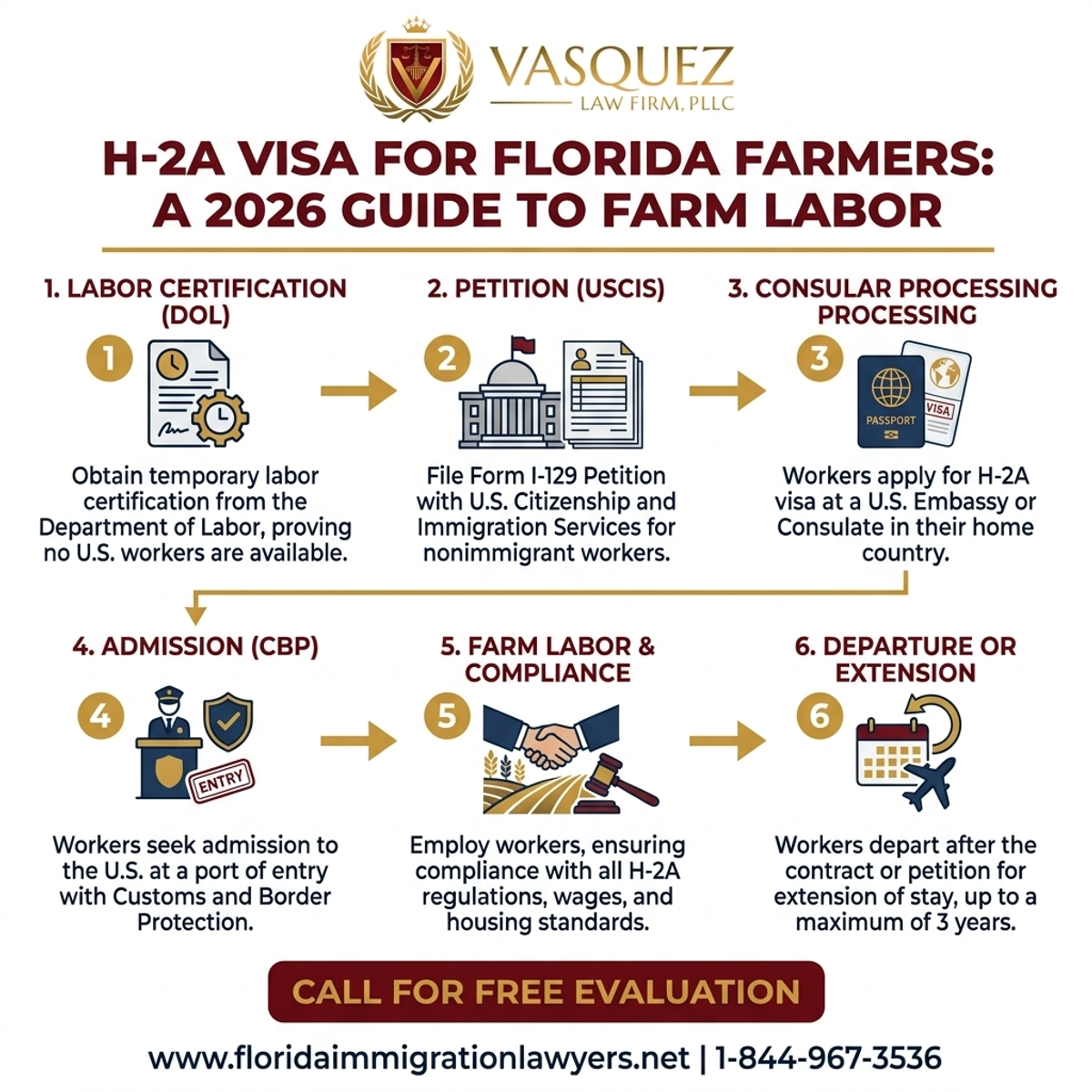
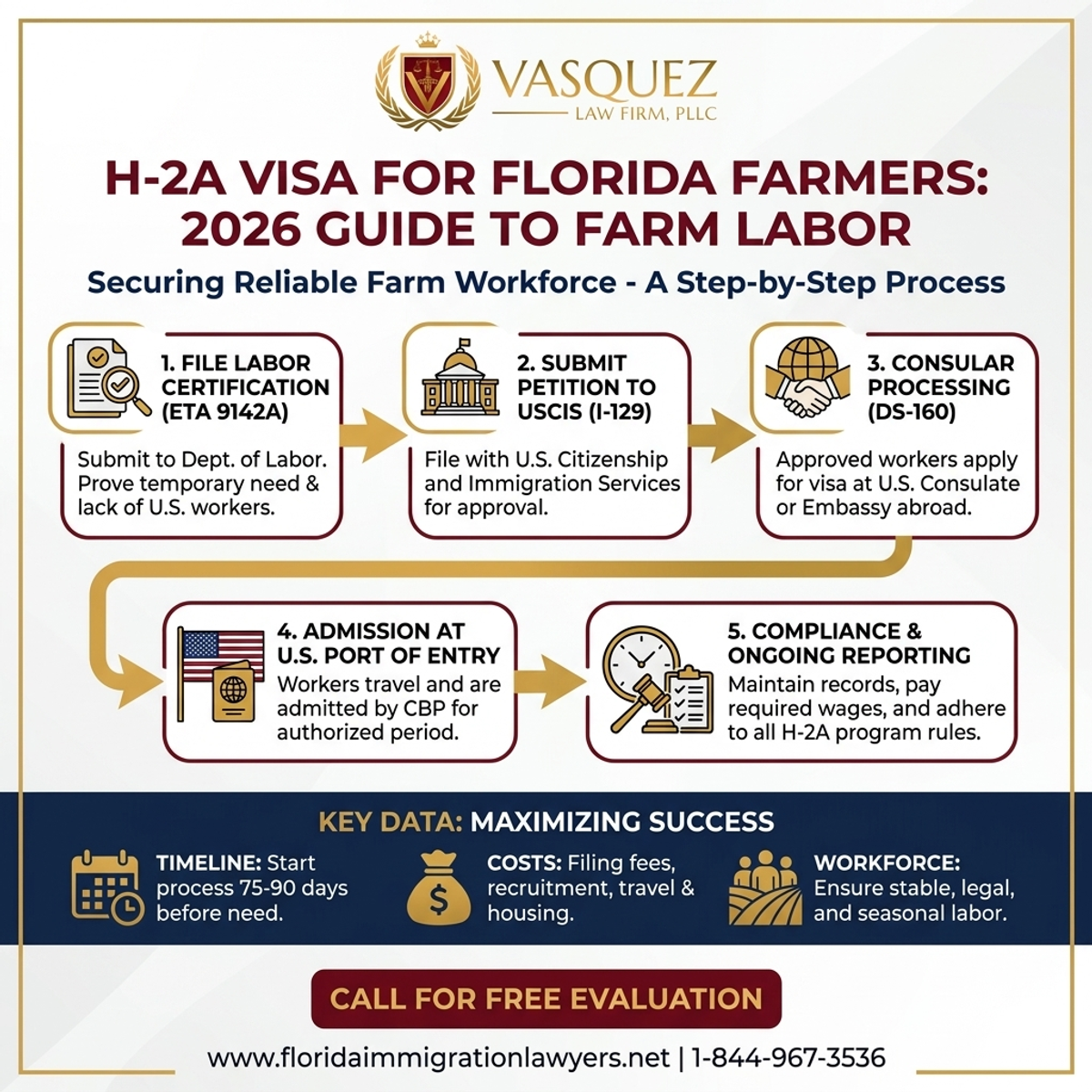
- Step 1: Obtain a Temporary Labor Certification from the Department of Labor (DOL).
This is the initial and often the most time-consuming step. Florida employers must file Form ETA-9142A, Application for Temporary Employment Certification, with the DOL. This application details the job offer, wage rate, working conditions, and housing arrangements. Before filing, employers must engage in a good-faith effort to recruit U.S. workers. This includes placing job orders with the State Workforce Agency (SWA) in Florida and advertising in local newspapers. The DOL reviews these efforts to ensure no qualified U.S. workers are available for the positions.
- Step 2: File Form I-129, Petition for a Nonimmigrant Worker, with USCIS.
Once the DOL certifies the application, the Florida employer must file Form I-129 with U.S. Citizenship and Immigration Services (USCIS). This petition requests approval for the H-2A workers. The certified ETA-9142A and a copy of the job order must be attached. USCIS reviews the petition to ensure the employer meets all eligibility criteria and that the request aligns with the approved labor certification. This stage also involves background checks on the employer and the proposed employment.
- Step 3: H-2A Visa Interview and Issuance at a U.S. Consulate Abroad.
After USCIS approves the I-129 petition, the prospective H-2A workers, if they are outside the U.S., must apply for their visas at a U.S. embassy or consulate in their home country. This typically involves an interview where consular officers verify the workers' eligibility and intent to return to their home country after the temporary work concludes. Upon approval, the H-2A visa is affixed to their passport, allowing them to travel to Florida. For more information, visit the State Department website.
- Step 4: Admission into the United States.
Upon arrival at a U.S. port of entry, H-2A workers are inspected by U.S. Customs and Border Protection (CBP) officers. They must present their valid H-2A visa and passport. CBP officers have the final authority to admit the workers into the U.S. for the period authorized by the H-2A petition. Once admitted, workers can commence their agricultural duties in Florida as specified in the labor certification.
For complex cases or issues arising during the application, such as Requests for Evidence (RFEs) from USCIS or DOL audits, seeking legal counsel is highly advisable. Florida Immigration Lawyers can provide invaluable assistance through every step of this intricate process. Learn more about our business immigration services at our Business Immigration page.
Key Requirements and Documentation for H-2A Petitions in Florida
For Florida farmers considering the H-2A program, understanding the specific requirements and preparing the necessary documentation is paramount to a successful application. The detailed nature of these requirements ensures compliance with federal labor and immigration laws, protecting both employers and workers. Neglecting any element can lead to significant delays or even denial of your petition.
Employer Requirements:
- Temporary Need: The employer must demonstrate that the need for the agricultural services or labor is temporary, generally for a period of less than one year. This cannot be for a permanent or year-round position.
- No U.S. Workers Available: The employer must prove, through a rigorous recruitment process, that there are not enough qualified, willing, and available U.S. workers to perform the job. This involves advertising and coordinating with the Florida State Workforce Agency (SWA).
- Job Offer Standards: The job offer must meet specific criteria, including offering the Adverse Effect Wage Rate (AEWR) or the prevailing wage, whichever is higher, and providing free housing for workers who cannot reasonably return home daily.
- Transportation: Employers are generally responsible for providing or reimbursing workers for transportation costs to and from the place of employment.
- Workers' Compensation: Employers must provide workers' compensation insurance where required by state law, such as in Florida, or equivalent insurance.
Required Documentation Checklist:
Preparing a complete and accurate set of documents is critical for the H-2A petition. Missing or incorrect information is a common reason for processing delays or denials.
Step-by-Step Process — H-2A Visa for Florida Farmers: A 2026 Guide to Farm Labor
- Form ETA-9142A: Application for Temporary Employment Certification (certified by DOL).
- Form I-129: Petition for a Nonimmigrant Worker.
- ETA Form 790: Agricultural and Food Processing Clearance Order (job order filed with the SWA).
- Recruitment Report: Detailed documentation of all efforts to recruit U.S. workers, including advertisements, interview results, and reasons for non-hire of U.S. applicants.
- Proof of Housing: Documentation demonstrating that compliant housing will be provided (e.g., leases, certificates of occupancy, inspection reports). For employers in areas like West Palm Beach or rural Florida, ensuring housing meets DOL and local standards is crucial.
- Employer's Federal Employer Identification Number (FEIN).
- Proof of Workers' Compensation Insurance.
- Any required business licenses or permits.
- Supporting letters or affidavits demonstrating temporary need.
Maintaining meticulous records throughout the application process and the employment period is essential for potential audits or compliance reviews. Our attorneys can assist Florida growers in compiling and reviewing all necessary documents to ensure your H-2A petition is as strong as possible.
Understanding H-2A Visa Processing Timelines and Costs for Florida Farms
For Florida farmers, understanding the typical timelines and financial commitments associated with the H-2A visa program is crucial for effective workforce planning. As of 2026, processing times can vary significantly based on agency workload, the completeness of the application, and any unforeseen issues like Requests for Evidence (RFEs). Similarly, costs encompass various fees and obligations, making it important to budget accurately.
Typical H-2A Visa Processing Timeline for Florida Employers in 2026:
The entire H-2A process can take several months, emphasizing the need for early planning. The following table provides estimated timeframes for each major stage:
| Stage | Typical Timeframe | Notes |
|---|---|---|
| Job Order Placement (SWA) | 60-75 days before need date | Must be placed for 10 days; recruitment efforts follow. |
| DOL Application (ETA-9142A) | 45-60 days before need date | Filed after job order, requires detailed information. |
| DOL Processing & Certification | ~30 days | Can vary; includes review, potential audits, and certification decision. |
| USCIS I-129 Petition Filing | Upon DOL Certification | Filed immediately after receiving certified ETA-9142A. |
| USCIS Processing | 2-3 weeks (Premium Processing) / 2-5 months (Regular) | Premium processing incurs an additional fee but guarantees faster review. Check USCIS processing times for current estimates. |
| Consular Processing (Visa Interview) | 1-3 weeks (after USCIS approval) | Depends on embassy/consulate availability and security checks. |
| Travel to U.S. & Admission | Within validity period of visa | Workers can enter up to 7 days before the start date. |
It is generally recommended for Florida employers to initiate the H-2A process at least 90-120 days before the anticipated start date of work to account for potential delays.
Costs Associated with the H-2A Visa Program for Florida Farms:
The financial investment in the H-2A program extends beyond basic filing fees, including significant costs related to recruitment, housing, and transportation. Employers must factor these into their operational budgets.
| Item | Typical Fee/Cost | Notes |
|---|---|---|
| DOL Application Fee | No direct fee | Costs arise from recruitment advertising. |
| USCIS Form I-129 Filing Fee | Varies (check current USCIS fees) | Mandatory fee for petition processing. |
| USCIS Premium Processing Fee | Varies (check current USCIS fees) | Optional, but significantly speeds up I-129 review. |
| Consular Processing Fee (Visa Application) | Varies (paid by worker, but employer often reimburses) | MRV fee paid at the embassy/consulate. |
| Attorney Fees | Varies significantly by firm and complexity | Highly recommended for guidance and compliance. |
| Recruitment Advertising Costs | Varies by media and duration | Newspaper ads, job board postings. |
| Transportation Costs | Varies by origin country and distance | Employer must pay for inbound and outbound travel. |
| Housing Costs | Varies by location and number of workers | Providing free, compliant housing is mandatory. |
| Workers' Compensation Insurance | Varies by state and coverage | Mandatory in Florida. |
| Adverse Effect Wage Rate (AEWR) | Set annually by DOL; check current rates for Florida | Employer must pay AEWR or prevailing wage, whichever is higher. |
While the initial outlay can seem substantial, the H-2A program offers a reliable, legal solution to critical labor needs, ensuring Florida farms can continue their operations successfully. Consulting with an experienced immigration attorney can help you accurately forecast these costs and manage your budget effectively.
Do not navigate this complex process alone. Contact Florida Immigration Lawyers today at 1-844-YO-PELEO for a free consultation to discuss your H-2A visa needs.
Common Pitfalls and Compliance for H-2A Employers in Florida
Successfully utilizing the H-2A program involves more than just getting an approval; it demands strict ongoing compliance with numerous federal regulations. Florida employers must be vigilant to avoid common pitfalls that can lead to costly penalties, audits, and even future disqualification from the program. Compliance is not a one-time event but a continuous commitment throughout the employment period.
- Late Filing or Incomplete Applications: Failing to submit petitions and certifications within the required timeframes or submitting applications with missing documentation. This often leads to delays, RFEs, or outright denials, jeopardizing the timely arrival of workers for crucial agricultural seasons.
- Inadequate U.S. Worker Recruitment: Not conducting good-faith recruitment efforts as mandated by the DOL, or failing to properly document these efforts. Employers must demonstrate that they genuinely attempted to find U.S. workers before seeking H-2A labor.
- Failure to Pay the Correct Wage: Paying less than the Adverse Effect Wage Rate (AEWR) or the prevailing wage, whichever is higher, for the specific work performed in Florida. Wage violations are a serious offense and can result in significant back pay liabilities and fines.
- Non-Compliant Housing: Providing housing that does not meet federal and state safety and health standards. All H-2A housing must be inspected and certified, and it must be provided free of charge to workers who cannot return home daily.
- Improper Transportation Provisions: Failing to provide or reimburse workers for inbound and outbound transportation costs, or providing unsafe transportation. This includes daily transport to and from work sites if housing is not on-site.
- Failure to Maintain Records: Not keeping accurate and complete records of recruitment, wage payments, hours worked, housing inspections, and transportation costs. These records are critical during DOL audits.
- Adverse Effect on U.S. Workers: Allowing the employment of H-2A workers to negatively impact the wages or working conditions of similarly employed U.S. workers. This can include displacing U.S. workers or lowering their wages.
- Lack of Timely Disclosure of Changes: Not informing the DOL or USCIS of significant changes to the terms and conditions of employment, such as changes in worksite, job duties, or employment period.
- Misunderstanding the 3/4 Guarantee: Failing to guarantee H-2A workers employment for at least three-fourths of the contract period. This is a fundamental protection for workers and a common area of non-compliance.
- Ignoring Worker Rights: Not informing H-2A workers of their rights, or retaliating against workers who raise concerns or seek legal assistance. All H-2A workers have specific rights under U.S. labor laws.
Key Statistics — H-2A Visa for Florida Farmers: A 2026 Guide to Farm Labor
The DOL and other agencies actively monitor H-2A employers, and non-compliance can lead to severe consequences, including civil money penalties, debarment from the H-2A program, and even criminal charges in egregious cases. Regular internal audits and legal reviews can help Florida growers ensure ongoing compliance. For example, the Executive Office for Immigration Review (EOIR) oversees immigration court proceedings, which can be relevant if H-2A workers face issues or allegations. More information can be found at justice.gov/eoir. Our attorneys are well-versed in H-2A compliance and can help you develop robust internal processes to mitigate risks.
When to Call a Lawyer for Your H-2A Visa Needs in Florida
While this guide provides a comprehensive overview, the H-2A visa program is inherently complex, with regulations that frequently change and require nuanced interpretation. For Florida farmers, knowing when to seek professional legal assistance can be the difference between a smooth operation and significant legal challenges. Florida Immigration Lawyers are dedicated to providing support at every stage of the H-2A process.
You should consider calling an immigration lawyer if you:
- Are new to the H-2A program: The initial application can be overwhelming. An attorney can guide you through each step, ensuring all requirements are met from the outset.
- Have received a Request for Evidence (RFE) from USCIS or DOL: An RFE indicates that the agency needs more information or clarification. Responding correctly and completely is critical to avoiding a denial.
- Face an audit or investigation by the DOL or other agencies: Audits can be intense and require meticulous documentation and legal representation to protect your interests.
- Have had an H-2A petition denied: A denial can be devastating for your operations. An attorney can help you understand the reasons for denial and explore options for appeal or re-filing.
- Are experiencing delays in processing: Unexplained delays can impact your planting or harvesting schedule. Legal counsel can help inquire about the status and address potential issues.
- Need to amend an existing H-2A petition: Changes in worksite, job duties, or employment period require proper amendments, which an attorney can handle efficiently.
- Are concerned about compliance with wage, housing, or transportation regulations: Proactive legal advice can help you implement best practices and avoid violations.
- Have questions about worker rights or potential disputes: Understanding your obligations and workers' rights can prevent costly legal battles.
- Operate in a complex agricultural sector: Industries like aquaculture or specific specialty crops may have unique considerations that benefit from specialized legal expertise.
Our experienced attorneys at Florida Immigration Lawyers understand the unique challenges faced by Florida growers. We can help you navigate the intricate H-2A landscape, ensuring compliance and protecting your business interests. Visit our Immigration practice area page to learn more about how we can support your business.
About Florida Immigration Lawyers
Florida Immigration Lawyers is an immigration law firm dedicated to serving the diverse needs of individuals and businesses across the entire state of Florida. Our firm understands the critical role that immigration plays in our state's economy and communities, especially in vital sectors like agriculture. With a deep commitment to our clients, we provide comprehensive legal services, offering strategic guidance and zealous advocacy in all areas of immigration law.
Our team of experienced attorneys focuses on a wide range of immigration matters, including H-2A visas, family immigration, business immigration, deportation defense, asylum, and naturalization. We pride ourselves on our client-focused approach, ensuring that each client receives personalized attention and tailored solutions to their unique circumstances. Whether you are a Florida grower seeking to secure a temporary workforce or an individual pursuing a new life in the U.S., we are here to help.
We offer free consultations and are available 24/7 to address your urgent immigration concerns. Our firm is committed to transparency, integrity, and achieving the strongest possible outcomes for our clients. Trust Florida Immigration Lawyers to be your dedicated legal partner in navigating the complexities of U.S. immigration law. Contact us today at 1-844-YO-PELEO or visit our website at floridaimmigrationlawyers.net. You can also learn more about our team at our Attorneys page.
Sources and References
- U.S. Citizenship and Immigration Services (USCIS)
- Executive Office for Immigration Review (EOIR)
- U.S. Department of State
- 8 U.S.C. § 1101(a)(15)(H)(ii)(a) - Immigration and Nationality Act (INA) Section 101(a)(15)(H)(ii)(a)
- 8 CFR Part 214 - Regulations relating to Nonimmigrant Classes
- 20 CFR Part 655, Subpart B - Labor Certification for Temporary Agricultural Employment of H-2A Aliens in the United States
- U.S. Department of Labor (DOL) - Wage and Hour Division
Related services: immigration practice areas, family immigration services, citizenship and naturalization.
This article provides general legal information and is not intended as legal advice. Every case is unique, and outcomes depend on specific facts and circumstances. Contact an attorney for advice about your particular situation.
Securing the right workforce is vital for the success of Florida's agricultural industry. The H-2A visa program offers a structured and legal pathway to meet those labor demands, but it requires diligent adherence to complex regulations. Don't risk your farm's future by navigating this process alone. For a free, confidential consultation and legal assistance, contact Florida Immigration Lawyers at 1-844-YO-PELEO today. Se Habla Español - Estamos aquí para ayudarle.
Do Not Navigate This Process Alone
Our experienced immigration attorneys are ready to fight for you. Get a free, confidential case review today.
Se Habla Español
Or leave your details and we’ll call you:
Free Evaluation in 24 Hours
Or talk to us right now

AI voice assistant — available 24/7
FreeFrequently Asked Questions

William J. Vásquez
Founding Attorney · Vasquez Law Firm
U.S. Air Force veteran and immigration attorney with years of hands-on U.S. immigration experience. J.D., NCCU School of Law. AILA member. Admitted to the 4th, 5th, and 11th Circuit Courts.
Available 24/7 - Free Evaluations
Reviewed for legal accuracy by William J. Vásquez
Licensed in North Carolina; U.S. immigration is federal practice.
Related Legal Services
Our Florida immigration attorneys can help you with free immigration consultation, business immigration and deportation defense. Call today at 1-844-YO-PELEO for a free case review.
Related Links
Related Topics
Free Legal Case Review
Discuss your case with our experienced attorneys. We're available 24/7.
Se Habla Español - Estamos aquí para ayudarle.
Related Articles
EAD Advance Parole Combo Card in Florida: What You Need
An EAD advance parole combo card allows individuals with pending adjustment applications to both work and travel abroad without jeopardizing their green card application. Learn how to apply in Florida, what documents you need, and common mistakes to avoid.
PERM Labor Certification in Florida: A 2026 Guide
Learn all about the PERM labor certification process in Florida, essential for employers sponsoring green card applicants. Understand the steps, document requirements, and common mistakes to avoid in this 2026 guide.
Dual Citizenship Lawyer in Florida: What You Need to Know
For Florida residents, the concept of dual citizenship, or holding two passports, offers a compelling blend of opportunities and challenges. While the U.S. generally permits dual nationality, the path to achieving this status requires a meticulous understanding of both U.S. immigration laws and the citizenship policies of your country of origin. This guide explores the definition of dual citizenship, the detailed step-by-step process for U.S. naturalization, and the significant benefits and potential pitfalls involved. We cover essential documentation, typical timelines, and cost considerations for 2026, providing crucial insights for anyone in Orlando, Miami, or across Florida considering this important legal step. Learn about common mistakes to avoid and understand when to seek professional legal counsel to navigate this complex process successfully. Florida Immigration Lawyers is here to provide expert, bilingual support for your dual citizenship journey.
Immigration Lawyer Orlando Free Consultation in Florida
For individuals and families in Orlando, Florida, navigating the complexities of U.S. immigration law requires expert guidance. An immigration lawyer in Orlando offers crucial support for everything from visa applications and green card processes to naturalization and deportation defense. This comprehensive guide details what a free consultation covers, providing a step-by-step overview of immigration pathways, essential document checklists, and expected timelines in 2026. We also highlight common mistakes to avoid, discuss the critical role of legal counsel in deportation and asylum cases, and explain why choosing a local Orlando immigration attorney is beneficial. Florida Immigration Lawyers is dedicated to serving the diverse community of Orlando with compassionate, effective legal solutions, ensuring you receive personalized advice and robust representation for a successful immigration journey.