Re-Entry Permit for Green Card Holders in Florida 2026
For green card holders in Florida planning extended international travel, a re-entry permit (Form I-131) is essential to prevent the risk of green card abandonment. This comprehensive guide covers the application process, required documents, typical processing timelines for 2026, and associated costs. Learn how to maintain your Lawful Permanent Resident (LPR) status while abroad, understand the factors that lead to abandonment, and discover common mistakes to avoid. Florida Immigration Lawyers offers expert assistance to ensure your travel plans do not jeopardize your hard-earned residency, serving clients across Jacksonville and all of Florida.

A re-entry permit is a crucial document for U.S. Lawful Permanent Residents (LPRs), also known as green card holders, planning to be outside the United States for an extended period, typically one year or more. It serves as evidence of your intent to return to the U.S. and helps prevent claims of green card abandonment. By applying for Form I-131, Application for Travel Document, LPRs in Florida can protect their status, ensuring a smoother re-entry process and maintaining their permanent residency, even when away for significant durations.
- A re-entry permit is for LPRs traveling abroad for 1-2 years.
- It prevents the presumption of green card abandonment.
- You apply using Form I-131, Application for Travel Document.
- Biometrics are typically required in the U.S. before travel.
- Consulting an immigration lawyer is recommended for complex cases.
Many Lawful Permanent Residents (LPRs) in Florida cherish the flexibility their green card offers, allowing them to live and work in the U.S. while maintaining ties to their home countries or pursuing international opportunities. However, extended stays abroad can jeopardize this precious status, leading to concerns about green card abandonment. Whether you're a retiree enjoying longer visits with family overseas, a business professional with international assignments, or a student pursuing studies abroad, understanding how to protect your permanent residency is vital.
This comprehensive guide will walk you through everything you need to know about securing a re-entry permit, specifically Form I-131, to safeguard your LPR status in 2026. We will cover the application process, required documents, timelines, costs, and common pitfalls to avoid, with a special focus on the unique considerations for Florida residents. Don't let your travel plans put your green card at risk. For personalized guidance on your specific situation, call Florida Immigration Lawyers at 1-844-967-3536 for a free consultation today.
What is a Re-Entry Permit and Why is it Essential for Florida LPRs?
A re-entry permit is a travel document issued by U.S. Citizenship and Immigration Services (USCIS) to Lawful Permanent Residents (LPRs) who plan to remain outside the United States for an extended period, typically between one and two years. It serves as strong evidence that you intend to maintain your U.S. permanent residency, rebutting the presumption that you have abandoned your green card due to prolonged absence. Without it, re-entering the U.S. after an absence of six months to one year can become challenging, and an absence of two years or more can lead to automatic loss of LPR status.
For Florida LPRs, particularly those in areas like Jacksonville, Miami, or Orlando, who may have strong family ties in the Caribbean, Central, or South America, or who engage in international business, a re-entry permit is indispensable. It allows you to travel with peace of mind, knowing that your green card status is protected. The permit can also be used in place of a visa when traveling to certain countries. Critically, it allows U.S. consulates abroad to issue a travel document if your green card is lost or stolen while overseas, simplifying your return. The Immigration and Nationality Act (INA) outlines the requirements for maintaining LPR status, and a re-entry permit is a key tool in demonstrating compliance with these provisions, specifically under 8 U.S.C. § 1101(a)(13)(C).
Possessing a re-entry permit is not just about convenience; it is about preserving your legal right to reside permanently in the U.S. Without it, at the port of entry, a Customs and Border Protection (CBP) officer might question your intent to maintain permanent residency if you have been outside the U.S. for more than 180 days. This could lead to secondary inspection, significant delays, or even initiation of removal proceedings. A re-entry permit clearly signals your commitment to your U.S. residency, making your return to Florida much smoother and less stressful.
How Do I Apply for a Re-Entry Permit (Form I-131) in 2026?
Applying for a re-entry permit involves submitting Form I-131, Application for Travel Document, to USCIS. The process requires careful attention to detail and timely submission. As of 2026, the application procedures remain largely consistent, emphasizing the need for thorough preparation before your departure from the U.S.
Here is a step-by-step guide to applying for your re-entry permit:
- Determine Eligibility: You must be a Lawful Permanent Resident or a conditional permanent resident. You cannot apply for a re-entry permit if you have already been outside the U.S. for an extended period without one, as this suggests a prior intent to abandon residency.
- Complete Form I-131: Fill out Form I-131 accurately and completely. Ensure all sections are answered truthfully. Any misrepresentations could lead to denial and future immigration issues.
- Gather Supporting Documents: This is a critical step. You will need copies of your green card (Form I-551), a government-issued photo identification (like a driver's license from Florida), and two passport-style photographs. If you have previously held a re-entry permit, include a copy of it.
- Write a Statement of Intent (Optional but Recommended): While not strictly required, a letter explaining the reasons for your extended absence and reiterating your intent to return to the U.S. and maintain your residency can strengthen your application. This is particularly useful for complex cases or if your travel history is unusual.
- Pay the Filing Fee: As of 2026, there is a filing fee for Form I-131 and a separate biometrics fee. Always check the USCIS website for the most current fee schedule, as these amounts can change.
- File Your Application: Mail your completed Form I-131, supporting documents, and fees to the USCIS Lockbox facility designated for your filing location. You must be physically present in the U.S. when you file the application.
- Attend Biometrics Appointment: After filing, USCIS will send you an appointment notice for biometrics (fingerprints, photograph, and signature) at an Application Support Center (ASC), such as the one in Jacksonville, Florida. You must attend this appointment before you leave the U.S. If you depart before completing biometrics, your application may be denied.
- Wait for Decision: You generally do not need to be in the U.S. when USCIS makes a decision or mails the re-entry permit. You can arrange for the permit to be sent to a U.S. address or to a U.S. embassy or consulate abroad for pickup.
Required Documents for Your I-131 Application
To ensure a smooth application process for your re-entry permit, gather the following documents:
- Copy of your Permanent Resident Card (Form I-551, green card), front and back.
- Copy of a government-issued identification document (e.g., Florida driver's license or state ID).
- Two identical passport-style photographs taken within 30 days of filing.
- If applicable, a copy of any previous re-entry permit or refugee travel document.
- Proof of payment for the filing fee and biometrics fee.
- Any evidence supporting your reasons for extended travel (e.g., employment letters, school enrollment, family medical needs).
What is Green Card Abandonment and How Can a Re-Entry Permit Prevent It?
Green card abandonment occurs when a Lawful Permanent Resident is deemed to have relinquished their intent to reside permanently in the United States. This is not automatically triggered by a specific length of absence but rather by the intent of the LPR. However, prolonged absences significantly increase the risk of a CBP officer concluding that you have abandoned your residency. An absence of one year or more automatically triggers the presumption of abandonment, placing the burden on you to prove otherwise upon re-entry. Without a re-entry permit, overcoming this presumption can be extremely difficult.
USCIS and CBP consider several factors when assessing intent to abandon, including the length of absence, reasons for the absence, maintenance of ties to the U.S. (e.g., filing U.S. tax returns, maintaining a home, U.S. bank accounts, family in the U.S.), and the existence of a re-entry permit. For example, a Florida resident who sells their home, closes U.S. bank accounts, and moves their entire family abroad for an indefinite period would likely be seen as having abandoned their green card, even if they return occasionally. A re-entry permit, by contrast, is official documentation from the U.S. government acknowledging your intent to return, explicitly designed to counter this presumption of abandonment. It serves as advance permission to be absent for up to two years without jeopardizing your LPR status.
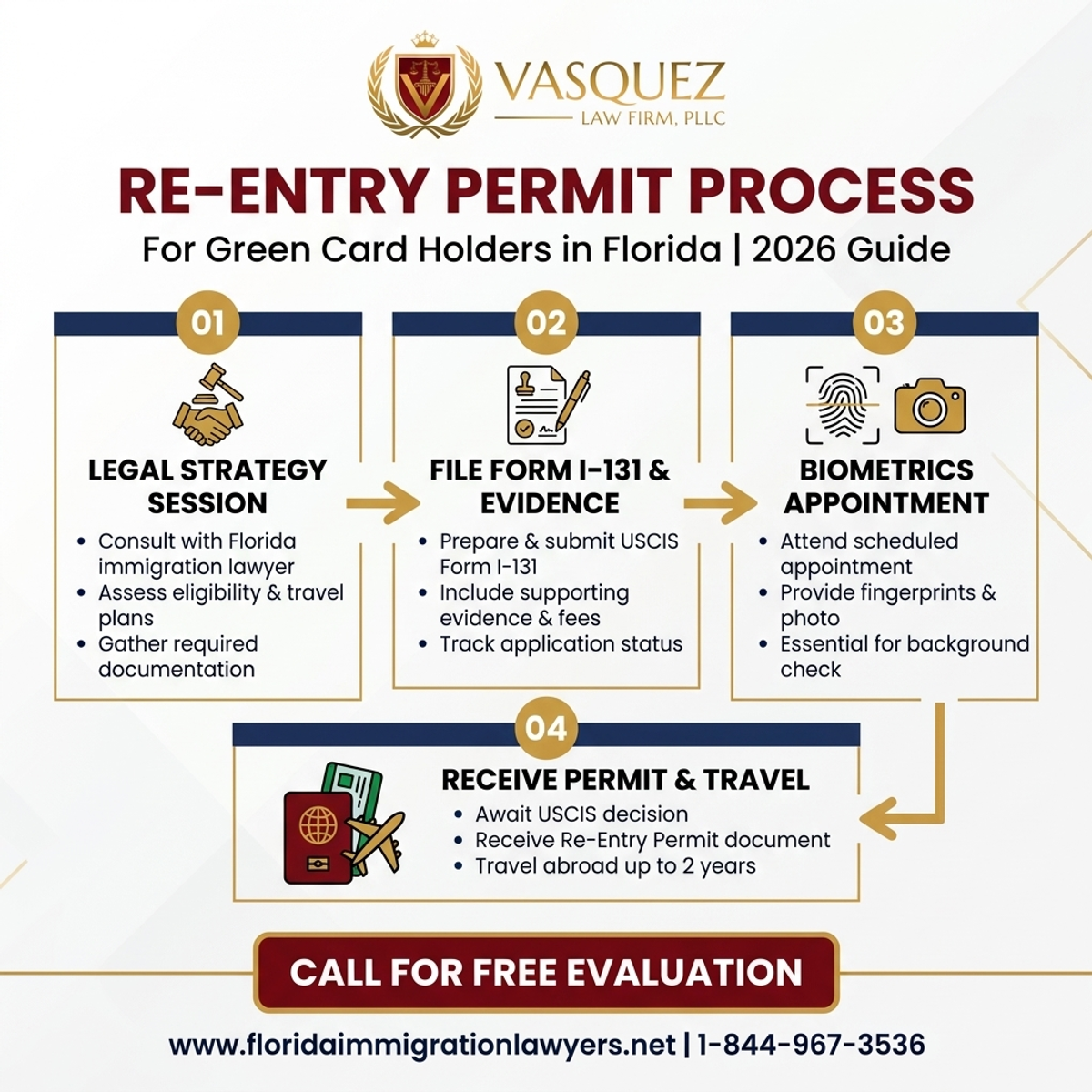
Step-by-Step Process — Re-Entry Permit for Green Card Holders in Florida 2026
While a re-entry permit is a powerful tool, it does not guarantee re-entry if a CBP officer determines that you have, despite the permit, abandoned your U.S. residency. You must continue to demonstrate ties to the U.S. and actively maintain your intent to return as your permanent home. For instance, continuing to file U.S. tax returns as a resident, maintaining property in Florida, and keeping U.S. financial accounts are all actions that reinforce your intent. Without these ongoing ties, even with a re-entry permit, you could face scrutiny. This is particularly relevant for LPRs in high-travel areas like Jacksonville, where international movement is common. Understanding 8 CFR Part 211, which governs the return of LPRs, is crucial.
What is the Typical Timeline for an I-131 Re-Entry Permit Application in 2026?
The processing times for Form I-131, Application for Travel Document, can vary significantly depending on USCIS caseloads and the specific service center handling your application. As of 2026, applicants should anticipate a considerable wait, making early application crucial. It is vital to file your application and complete your biometrics appointment before you plan to depart the United States. While USCIS aims for efficiency, unforeseen delays are always possible.
Here is a general timeline for the I-131 re-entry permit application process:
| Stage | Typical Timeframe (As of 2026) | Notes |
|---|---|---|
| Application Filing | Must be filed while physically present in the U.S. | Submit Form I-131 with all required documents and fees. |
| Receipt Notice (I-797C) | 2-4 weeks after filing | Confirms USCIS received your application. |
| Biometrics Appointment Notice | 4-8 weeks after filing | Schedule your appointment at an ASC (e.g., Jacksonville). You MUST attend this before leaving the U.S. |
| Biometrics Appointment | Within 2-4 weeks of notice | Mandatory for processing. Failure to attend may lead to denial. |
| Application Processing | 8-18 months (can be longer) | Varies greatly by service center. Check USCIS processing times online. |
| Decision / Approval Notice | At the end of processing | You do not need to be in the U.S. for the decision. |
| Permit Issuance / Mailing | 1-2 weeks after approval | Can be mailed to a U.S. address or a U.S. embassy/consulate abroad. |
Given these lengthy processing times, Florida residents planning extended travel should submit their I-131 application well in advance of their intended departure date. It is common for the re-entry permit to be valid for two years from the date of issuance, but it cannot be extended beyond this period. If you need to travel for longer, you would typically need to apply for a new permit, again, while physically present in the U.S.
What Are the Costs Associated with a Re-Entry Permit (Form I-131) Application?
Understanding the financial aspects of applying for a re-entry permit is essential for budgeting and planning your international travel from Florida. The costs primarily include USCIS filing fees and potentially legal fees if you choose to hire an attorney. It is crucial to note that USCIS fees are subject to change, so always verify the latest amounts directly on the official USCIS website before filing your application. As of 2026, the fee structure is as follows:
| Item | Typical Fee (As of 2026) | Notes |
|---|---|---|
| Form I-131 Filing Fee | Approx. $660 | This is the primary fee for processing your application. |
| Biometrics Services Fee | Approx. $85 | Required for fingerprinting, photograph, and signature. This fee is in addition to the filing fee. |
| Total USCIS Fees | Approx. $745 | Sum of filing and biometrics fees. Always confirm with USCIS. |
| Attorney Fees | Varies widely (e.g., $1,000 - $3,000+) | Depends on the complexity of your case and the law firm. A lawyer can ensure proper filing and address any issues. |
| Passport Photos | Approx. $10 - $20 | Cost for two compliant passport-style photographs. |
| Mailing Costs | Approx. $10 - $30 | For secure mailing of your application to USCIS. |
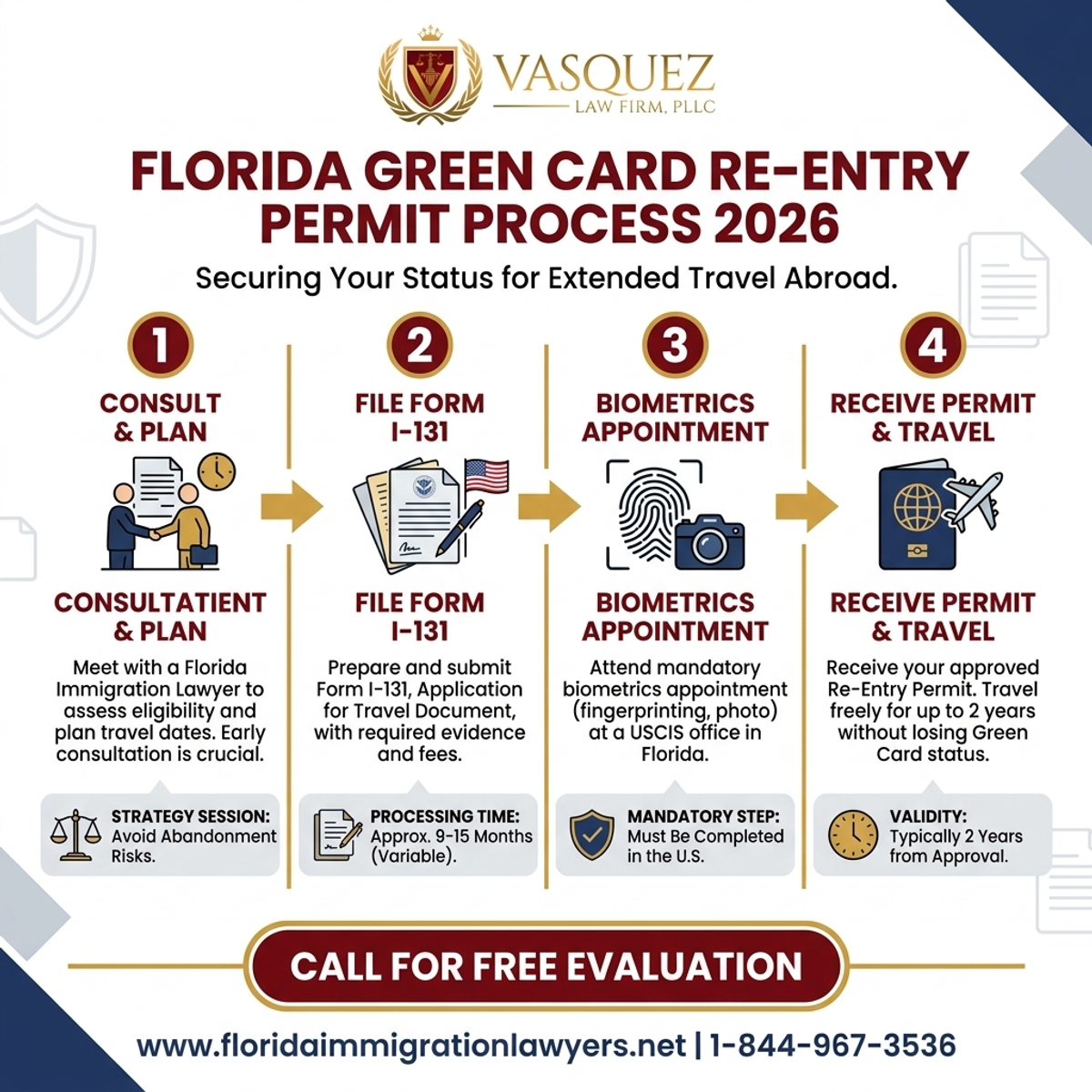
Key Statistics — Re-Entry Permit for Green Card Holders in Florida 2026
The total cost can range from approximately $750 (for self-filers) to over $3,000 if you opt for legal representation. While attorney fees add to the overall expense, the expertise of an experienced immigration lawyer, especially one familiar with Florida-specific scenarios, can be invaluable. They can help you prepare a strong application, avoid common mistakes, and respond effectively to any Requests for Evidence (RFEs) from USCIS. This investment can save you significant time, stress, and potential risks to your green card status in the long run.
Do not navigate this complex process alone. Contact Florida Immigration Lawyers today for expert assistance with your re-entry permit application and to protect your LPR status.
Common Mistakes to Avoid When Applying for a Re-Entry Permit
Applying for a re-entry permit requires precision, and even minor errors can lead to significant delays or outright denial. Being aware of these common mistakes can help Florida LPRs avoid unnecessary complications:
- Filing While Outside the U.S.: You must be physically present in the United States when you file Form I-131. Filing from abroad will result in denial.
- Departing Before Biometrics: It is mandatory to attend your biometrics appointment at a USCIS Application Support Center (ASC) before you leave the U.S. If you depart prematurely, your application will likely be denied.
- Not Providing Sufficient Evidence of Intent to Return: While the permit itself indicates intent, if your U.S. ties are weak (e.g., no property, no U.S. bank accounts, no family), CBP may still question your intent upon re-entry.
- Incorrectly Completing Form I-131: Minor errors, omissions, or inconsistencies on the form can lead to RFEs (Requests for Evidence) or denial, prolonging the process.
- Submitting Incomplete Documentation: Failing to include all required supporting documents, such as copies of your green card or proper passport photos, will cause delays.
- Assuming the Permit Guarantees Re-Entry: A re-entry permit is not an absolute guarantee. It is strong evidence of intent, but a CBP officer still has discretion to determine if you have abandoned your residency.
- Overstaying the Permit's Validity: Re-entry permits are typically valid for two years. Remaining outside the U.S. beyond this period, even with a permit, can lead to issues upon return.
- Failing to Respond to RFEs: If USCIS sends a Request for Evidence, you must respond comprehensively and within the specified timeframe. Ignoring it will lead to denial.
- Misrepresenting Facts: Providing false information on your application can result in severe immigration consequences, including findings of fraud and future inadmissibility.
- Not Seeking Legal Advice for Complex Cases: If you have a criminal history, previous immigration violations, or a very long intended absence, attempting to navigate the process alone is risky.
- Failing to Update Your Address: If your U.S. mailing address changes while your application is pending, you must notify USCIS promptly to ensure you receive all correspondence.
When to Call a Lawyer for Your Re-Entry Permit or Green Card Abandonment Concerns
While some LPRs may successfully navigate the re-entry permit application process on their own, there are many situations where the expertise of an experienced immigration attorney is not just helpful, but absolutely critical. Florida Immigration Lawyers are well-versed in the complexities of U.S. immigration law and can provide invaluable assistance, especially when facing potential issues of green card abandonment or intricate travel plans.
You should strongly consider contacting a lawyer if:
- You have already been outside the U.S. for more than six months without a re-entry permit.
- You have a history of immigration violations, previous denials, or a criminal record.
- Your ties to the U.S. are weak, and you are concerned about proving your intent to maintain residency.
- You need to travel for more than two years, or your travel plans are unusually complex.
- You have received a Request for Evidence (RFE) from USCIS regarding your I-131 application.
- You plan to abandon your U.S. residence and wish to do so formally without jeopardizing future visa applications.
- You are facing questions about green card abandonment at a U.S. port of entry (e.g., Jacksonville International Airport) and are being asked to sign documents.
- You are a conditional permanent resident (CR1/CR2 or IR1/IR2) with specific conditions on your green card.
An immigration attorney can help you assess your eligibility, prepare a robust application, ensure all documentation is correct, and strategically address any potential red flags. We can represent you in communications with USCIS and provide crucial advice if you are questioned by CBP upon re-entry. Protecting your green card is paramount, and proactive legal counsel can make all the difference.
About Florida Immigration Lawyers
Florida Immigration Lawyers is a leading law firm dedicated to providing comprehensive and compassionate immigration legal services across the entire state of Florida. With years of experience and a deep understanding of U.S. immigration law, our attorneys are committed to helping individuals and families navigate the often-complex immigration system. From our base, we proudly serve clients in Jacksonville, Miami, Orlando, Tampa, and all surrounding areas, offering personalized strategies tailored to each unique situation.
Our firm specializes in a wide range of immigration matters, including family-based immigration, employment visas, asylum, deportation defense, citizenship applications, and, critically, protecting permanent residency through processes like the re-entry permit. We understand the anxieties and challenges immigrants face, and our approach is always client-focused, empathetic, and results-driven. We are available 24/7 to answer your questions and offer free consultations to discuss your case. Choose Florida Immigration Lawyers for dedicated advocacy and expert guidance on your immigration journey.
Sources and References
- U.S. Citizenship and Immigration Services (USCIS)
- USCIS Form I-131, Application for Travel Document
- U.S. Department of State
- 8 U.S.C. Chapter 12 - Immigration and Nationality Act (INA)
- 8 U.S.C. § 1101(a)(13)(C) - Definition of "residence" for LPRs
- 8 CFR Part 211 - Documentary Requirements for Immigrants and Waivers of Requirements
- USCIS Policy Manual, Volume 6, Part B, Chapter 5 - Reentry Permits
Related services: immigration practice areas, family immigration services.
This article provides general legal information and is not intended as legal advice. Every case is unique, and outcomes depend on specific facts and circumstances. Contact an attorney for advice about your particular situation.
Protecting your green card status, especially when planning extended travel, is a critical step for any Lawful Permanent Resident in Florida. Don't leave your permanent residency to chance. For expert legal guidance on re-entry permits, potential green card abandonment issues, or any other immigration matter, reach out to our dedicated team. Call Florida Immigration Lawyers at 1-844-967-3536 for a free consultation. Se Habla Espanol - Estamos aqui para ayudarle.
If you need legal assistance, learn more about experienced immigration attorneys in Orlando, or call us at 1-844-967-3536 for a free consultation.
Do Not Navigate This Process Alone
Our experienced immigration attorneys are ready to fight for you. Get a free, confidential consultation today.
Se Habla Español
Frequently Asked Questions

William J. Vásquez
Founding Attorney · Vasquez Law Firm
U.S. Air Force veteran and immigration attorney with years of hands-on U.S. immigration experience. J.D., NCCU School of Law. AILA member. Admitted to the 4th, 5th, and 11th Circuit Courts.
Available 24/7 - Free Evaluations
Reviewed for legal accuracy by William J. Vásquez
Licensed in North Carolina; U.S. immigration is federal practice.
Related Legal Services
Our Florida immigration attorneys can help you with free immigration consultation, experienced immigration attorneys and business immigration. Call today at 1-844-967-3536 for a free consultation.
Related Links
Related Topics
Free Legal Consultation
Discuss your case with our experienced attorneys. We're available 24/7.
Se Habla Español - Estamos aquí para ayudarle.
Related Articles
How to Choose Immigration Attorney in Florida: 2026 Guide
Choosing the right immigration attorney in Florida is a crucial step for anyone navigating the complexities of U.S. immigration law. This comprehensive guide, updated for 2026, offers essential insights into how to choose an immigration attorney, covering everything from verifying credentials and assessing specialization to understanding fee structures and preparing for initial consultations. Whether you are in Hialeah, Miami, or anywhere across the Sunshine State, finding a knowledgeable and trustworthy legal professional is paramount. Learn how to identify qualified counsel, avoid common mistakes, and understand when to seek legal help for visas, green cards, citizenship, or deportation defense. Florida Immigration Lawyers provides expert guidance and compassionate support throughout your immigration journey.
SIJS Process in Florida: What You Need to Know in 2026
Discover how Special Immigrant Juvenile Status (SIJS) can help minors in Florida gain legal status. Learn about the process, necessary documents, and common pitfalls. Call Florida Immigration Lawyers for expert guidance.
Immigration Lawyer Orlando Free Consultation: Your Rights
Navigating immigration law in Florida, especially around Orlando and Pembroke Pines, requires a clear understanding of your rights. This comprehensive guide details the legal protections immigrants have, what to do during an ICE encounter, and a step-by-step overview of the immigration process in 2026. We also cover essential documentation, typical timelines, and a breakdown of legal costs. Learn about common mistakes to avoid and when it's crucial to seek legal counsel. Florida Immigration Lawyers offers free consultations, providing expert guidance for your unique situation across the state.
Facing Visa Denial & Consular Return in Florida? 2026 Guide
A 221(g) visa refusal, often leading to a consular return, is a common but often misunderstood setback in the immigration process. It means your application requires further action, either by you submitting additional documents or by the consulate undergoing administrative processing. This article, tailored for individuals in Florida in 2026, provides a comprehensive guide to understanding 221(g) refusals, the administrative processing timeline, and the step-by-step actions required for resolution. We delve into common mistakes to avoid, potential costs, and crucial scenarios where legal counsel from Florida Immigration Lawyers becomes indispensable. Learn how to navigate these challenges effectively and increase your chances of a successful visa outcome.