I-360 Widow Self-Petition Guide in Coral Springs
This comprehensive guide on the I-360 widow self-petition in Coral Springs, Florida, covers eligibility, filing steps, required documents, common mistakes, and when to seek legal help. Discover the process and understand your options with Florida Immigration Lawyers.
- Eligibility requirements and documentation
- Filing deadlines and procedures
- What to do if facing delays or challenges
Are you a widow or widower of a U.S. citizen residing in Coral Springs, Florida, and wondering about your immigration options? Navigating the complexities of the I-360 self-petition process can be daunting. This guide aims to streamline your understanding and provide clarity on what you need to do.
Filing the I-360 form is a crucial step for widows and widowers seeking to obtain immigration benefits in the United States. It is vital to ensure all documentation is accurate and submitted timely to avoid any setbacks.
Call Florida Immigration Lawyers at 1-844-YO-PELEO for a free consultation to discuss your specific situation and options.
What is Form I-360 and Who Can File It?
Form I-360 is a petition used by several categories of immigrants, including widows and widowers of U.S. citizens, to self-petition for immigration benefits. As of 2026, eligible widows or widowers must have been married to a U.S. citizen at the time of their spouse's death and not have remarried.
The form must be filed within two years of the death of the U.S. citizen spouse. It's essential to demonstrate that the marriage was entered in good faith and not solely for immigration purposes.
Beyond the primary eligibility criteria, it's important to understand the nuances. For instance, if your U.S. citizen spouse passed away while their Form I-130 (Petition for Alien Relative) was pending, you might still be able to benefit from that petition, or you can file your own I-360. This provision ensures that surviving spouses are not penalized by the untimely death of their U.S. citizen partner, offering a pathway to permanent residency.
A critical aspect of the I-360 petition for widows/widowers is proving the bona fide nature of your marriage. USCIS scrutinizes these petitions to prevent marriage fraud. You'll need to provide compelling evidence that your marriage was legitimate and not entered into solely for immigration benefits. This could include shared financial accounts, property deeds, birth certificates of children born to the marriage, joint insurance policies, or affidavits from friends and family.
How to Complete the I-360 Form?
- Download the latest version of Form I-360 from the USCIS website.
- Gather necessary documents such as marriage certificate, death certificate of the spouse, and evidence of a bona fide marriage.
- Carefully fill out the form, ensuring all information is accurate and complete.
- Submit the form and required documents to the appropriate USCIS office. In Florida, this is often the Miami Field Office.
Ensure every section is completed, as any incomplete information can delay the process.
When filling out the I-360, pay close attention to every detail. Even minor errors, such as a misspelled name or an incorrect date, can lead to a Request for Evidence (RFE) or even a denial, significantly prolonging your immigration journey. It's highly recommended to review the form multiple times and have another trusted individual or a legal professional like Florida Immigration Lawyers review it for accuracy before submission.
After completing the form and assembling your supporting documents, organize them meticulously. Create a cover letter listing all submitted documents and arrange them in the order they are listed. This level of organization helps USCIS officers process your application more efficiently and reduces the likelihood of documents being overlooked. Remember to keep a complete copy of everything you submit for your own records.
Document Checklist for I-360 Filing
- Proof of marriage to the deceased U.S. citizen
- Death certificate of the U.S. citizen spouse
- Proof of termination of any prior marriages
- Evidence supporting the bona fide nature of the marriage (e.g., joint bank statements, property leases)
- Photocopy of your passport or other government-issued ID
In addition to the core documents, consider including a personal affidavit detailing the history of your relationship, how you met, significant life events shared, and your genuine love and commitment. This personal narrative can add a powerful human element to your application, complementing the factual evidence of your bona fide marriage.
Gathering comprehensive evidence of a bona fide marriage is paramount. This can include photographs of your wedding, vacations, and daily life together, joint utility bills, shared credit card statements, children's birth certificates showing both parents, and letters from family and friends attesting to the legitimacy of your relationship. The more robust your evidence, the stronger your petition will be, demonstrating to USCIS that your marriage was genuine and not for immigration purposes.
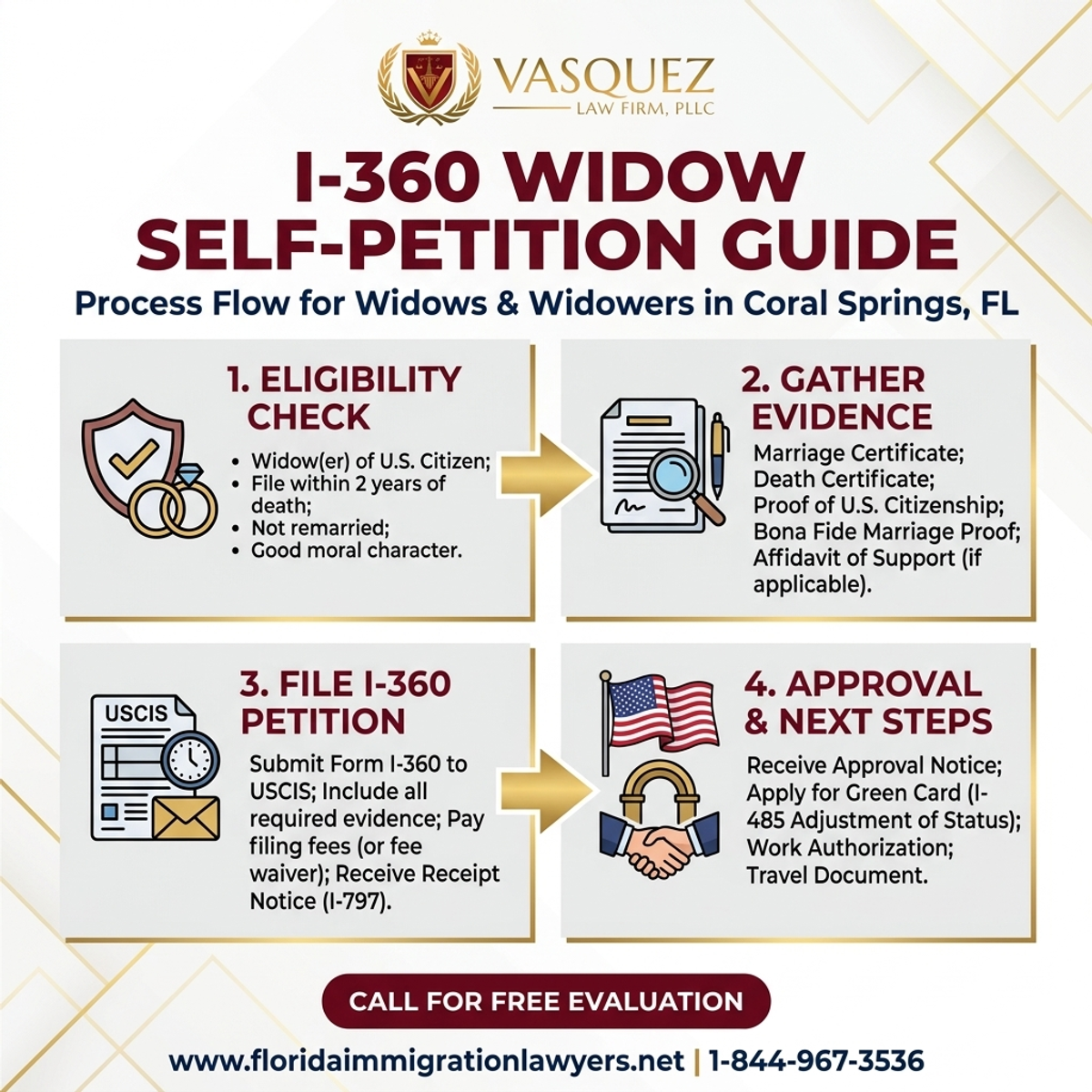
Step-by-Step Process — I-360 Widow Self-Petition Guide in Coral Springs
Typical Timeline and Processing Expectations
| Stage | Typical Timeframe | Notes |
|---|---|---|
| Application Submission | 2-4 weeks | Receipt of application confirmation |
| Initial Review | 3-6 months | USCIS reviews submitted documents |
| Decision | 6-12 months | Final decision on petition |
Processing times can vary based on individual circumstances and the current USCIS backlog.
It's important to understand that the stated timelines are averages and can fluctuate significantly. Factors such as the volume of applications, the complexity of your case, and the specific USCIS service center handling your petition can all influence how long it takes. While waiting, use the USCIS online tools to track your case status using the receipt number provided after submission.
During the waiting period, be prepared for potential Requests for Evidence (RFEs). USCIS may ask for additional documentation or clarification if your initial submission is deemed insufficient. Responding promptly and thoroughly to an RFE is crucial to avoid further delays or a potential denial. Consulting with Florida Immigration Lawyers can ensure you provide a comprehensive and effective response.
Cost Factors and Fee Breakdown
| Item | Typical Fee | Notes |
|---|---|---|
| Form I-360 Filing Fee | Varies | Check current fees on USCIS |
| Attorney Fees | Varies | Depends on complexity of the case |
It is advisable to consult with an immigration attorney to understand all potential costs involved.
While the I-360 itself may have a filing fee (which can sometimes be waived for those with financial hardship, check USCIS guidelines), remember that other costs can add up. These might include fees for obtaining certified copies of documents, translation services for non-English documents, medical examination fees (if applicable for adjustment of status), and biometric services fees. Budgeting for these auxiliary costs is a practical step in your immigration planning.
Engaging an experienced immigration attorney, such as those at Florida Immigration Lawyers, is an investment that can save you significant time, stress, and potential pitfalls. While attorney fees vary based on the complexity of your case and the services required, the peace of mind and increased likelihood of a successful outcome often outweigh the cost. A free consultation can help you understand the full financial scope of your petition.
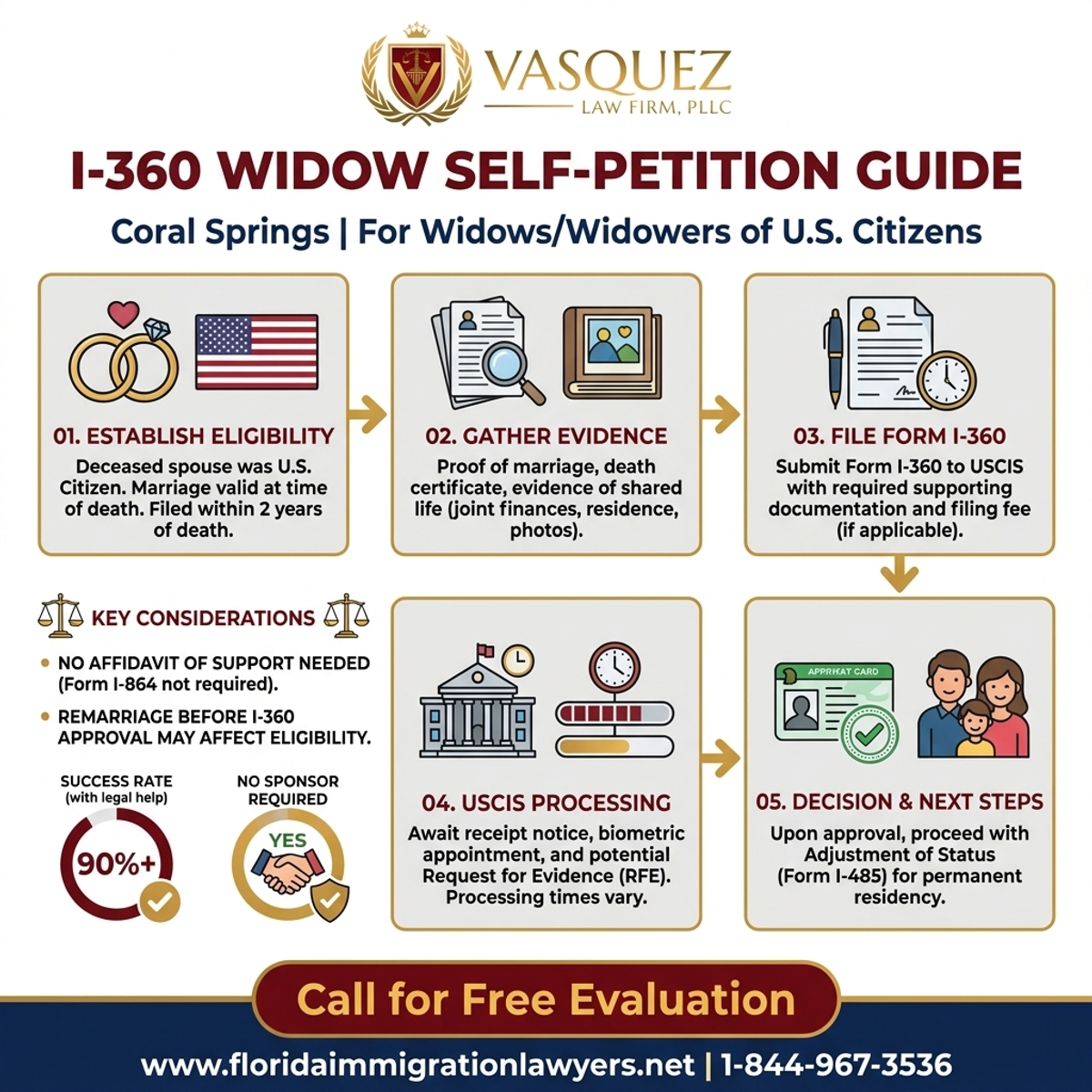
Key Statistics — I-360 Widow Self-Petition Guide in Coral Springs
Do not navigate this process alone. Contact Florida Immigration Lawyers today.
Common Mistakes to Avoid
- Missing the two-year filing deadline can result in denial.
- Providing insufficient evidence of a bona fide marriage can lead to rejection.
- Incorrectly completing the form can cause delays.
- Failing to inform USCIS of address changes can result in lost correspondence.
- Not consulting an attorney for guidance can lead to avoidable errors.
- Ignoring requests for additional information from USCIS.
- Not keeping copies of all submitted documents for your records.
One critical mistake is assuming that because your marriage was genuine, USCIS will automatically recognize it. You must actively and thoroughly prove its legitimacy with robust documentation. A lack of diverse evidence, even for a truly bona fide marriage, can raise red flags for immigration officers. Proactive evidence gathering is key to a smooth process.
When to Call a Lawyer
If you face complications with your I-360 petition, such as receiving a request for evidence (RFE) or a denial, it is crucial to seek legal assistance. An experienced immigration attorney can help address challenges and increase your petition's chances of success.
Florida Immigration Lawyers are here to support you through the process. Call 1-844-YO-PELEO for advice.
Beyond just complications, it's often wise to consult a lawyer from the very beginning. An attorney can help you understand the specific requirements for your situation, identify potential challenges before they arise, and ensure your application is as strong as possible from the outset. This proactive approach can save you time and stress in the long run.
Consider a scenario where you have limited documentation of your bona fide marriage, perhaps due to cultural reasons or a short marriage before your spouse's passing. In such cases, an attorney can advise on alternative forms of evidence, such as affidavits from those who knew you as a couple, and help you present your case in the most compelling way possible. Don't hesitate to reach out to Florida Immigration Lawyers for a free consultation at 1-844-YO-PELEO.
About Florida Immigration Lawyers
Florida Immigration Lawyers is dedicated to assisting individuals with their immigration needs. Our team offers comprehensive services, including asylum, deportation defense, citizenship, family immigration, and business immigration. We are available 24/7 and offer free consultations. Contact us at 1-844-YO-PELEO or visit our website.
Our commitment extends to providing compassionate and culturally sensitive legal support, understanding the unique emotional and legal challenges faced by widows and widowers navigating the U.S. immigration system. We pride ourselves on clear communication and personalized strategies tailored to each client's specific circumstances, ensuring you feel supported every step of the way.
Frequently Asked Questions About the I-360 Self-Petition
Sources and References
- U.S. Citizenship and Immigration Services (USCIS)
- Executive Office for Immigration Review (EOIR)
- 8 U.S.C. Chapter 12 - Immigration and Nationality Act
Related services: family petition process, family-based green cards, fiancé visa (K-1).
This article provides general legal information and is not intended as legal advice. Every case is unique, and outcomes depend on specific facts and circumstances. Contact an attorney for advice about your particular situation.
Se Habla Espanol - Estamos aqui para ayudarle.
For more information on your specific case, call Florida Immigration Lawyers at 1-844-YO-PELEO. We offer a free consultation to discuss your situation.
If you need legal assistance, learn more about experienced family immigration attorneys, or call us at 1-844-YO-PELEO for a free consultation.
Do Not Navigate This Process Alone
Our experienced immigration attorneys are ready to fight for you. Get a free, confidential case review today.
Se Habla Español
Or leave your details and we’ll call you:
Free Evaluation in 24 Hours
Or talk to us right now

AI voice assistant — available 24/7
FreeFrequently Asked Questions

William J. Vásquez
Founding Attorney · Vasquez Law Firm
U.S. Air Force veteran and immigration attorney with years of hands-on U.S. immigration experience. J.D., NCCU School of Law. AILA member. Admitted to the 4th, 5th, and 11th Circuit Courts.
Available 24/7 - Free Evaluations
Reviewed for legal accuracy by William J. Vásquez
Licensed in North Carolina; U.S. immigration is federal practice.
Related Legal Services
Our Florida immigration attorneys can help you with free immigration consultation, business immigration and deportation defense. Call today at 1-844-YO-PELEO for a free case review.
Related Links
Related Topics
Free Legal Case Review
Discuss your case with our experienced attorneys. We're available 24/7.
Se Habla Español - Estamos aquí para ayudarle.
Related Articles
Immigration Lawyer Orlando Free Consultation in Florida
For individuals and families in Orlando, Florida, navigating the complexities of U.S. immigration law requires expert guidance. An immigration lawyer in Orlando offers crucial support for everything from visa applications and green card processes to naturalization and deportation defense. This comprehensive guide details what a free consultation covers, providing a step-by-step overview of immigration pathways, essential document checklists, and expected timelines in 2026. We also highlight common mistakes to avoid, discuss the critical role of legal counsel in deportation and asylum cases, and explain why choosing a local Orlando immigration attorney is beneficial. Florida Immigration Lawyers is dedicated to serving the diverse community of Orlando with compassionate, effective legal solutions, ensuring you receive personalized advice and robust representation for a successful immigration journey.
Immigration Lawyer Services in Orlando, Florida
Explore immigration consultation services in Orlando, Florida, with a qualified immigration lawyer. Learn what to expect and understand your options for family and business immigration needs.
Fraud Prevention and Detection Fee: What to Know in Florida
Explore the fraud prevention and detection fee essential for immigration processes in Florida. Discover how it impacts applications like the I-601 waiver and learn key steps to navigate this requirement effectively.
2026 Diversity Visa Lottery Errors: Avoid Mistakes
Avoid common errors in the 2026 Diversity Visa Lottery. Learn how to apply effectively for the green card lottery in Florida. This comprehensive guide covers the application process, common mistakes, and essential tips to increase your chances of success.