Withholding of Removal in Florida: A 2026 Defense Guide
Withholding of removal is a critical form of protection for non-citizens in Florida facing deportation and fearing persecution or torture in their home country. This comprehensive guide from Florida Immigration Lawyers details the strict eligibility requirements, the distinctions between withholding and asylum, and the unique protections offered under the Convention Against Torture (CAT). Learn about the step-by-step process in Florida immigration courts, essential documentation, and typical timelines as of 2026. We also cover the associated costs and crucial mistakes to avoid, emphasizing the importance of expert legal representation. If you're in removal proceedings and fear for your safety, understanding these options is vital for your defense.

Withholding of removal is a form of protection granted to non-citizens in the United States who face a significant threat of persecution or torture if returned to their home country. Unlike asylum, it does not lead to permanent residency but prevents deportation. To qualify for withholding of removal, an individual must demonstrate a "clear probability" that their life or freedom would be threatened on account of race, religion, nationality, membership in a particular social group, or political opinion, or that they would more likely than not be tortured. This standard is higher than the "well-founded fear" required for asylum. It is a critical defense in deportation proceedings, particularly for those who may be barred from asylum due to certain criminal convictions or other factors.
- Withholding of removal prevents deportation but does not offer a direct path to a green card.
- It requires a higher burden of proof (clear probability) than asylum.
- Protection under the Convention Against Torture (CAT) is a related but distinct form of relief.
- Mandatory bars can prevent eligibility, making legal counsel essential.
- The process typically occurs within immigration court proceedings in Florida.
Facing deportation can be one of the most frightening experiences for an immigrant in Florida. The thought of being forced to return to a country where you fear for your safety, or even your life, is overwhelming. Many individuals believe their options are exhausted, especially if they have been denied asylum or have a criminal record. However, for those with a genuine fear of persecution or torture, withholding of removal offers a critical pathway to protection.
At Florida Immigration Lawyers, we understand the profound anxiety and uncertainty that come with removal proceedings. This comprehensive guide will explain withholding of removal, its distinctions from asylum, the Convention Against Torture (CAT) protection, the application process in Florida, and the common pitfalls to avoid. Our goal is to empower you with knowledge and demonstrate how expert legal representation can make a decisive difference in your case. Do not face this complex legal challenge alone. Call Florida Immigration Lawyers at 1-844-967-3536 for a free consultation and let us help you understand your options and fight for your right to safety.
What is Withholding of Removal and Who is Eligible?
Withholding of removal is a form of protection under Section 241(b)(3) of the Immigration and Nationality Act (INA), specifically 8 U.S.C. § 1231(b)(3). It prohibits the U.S. government from deporting non-citizens to a country where their life or freedom would be threatened due to their race, religion, nationality, membership in a particular social group, or political opinion. This protection is mandatory if you meet the eligibility criteria, meaning an Immigration Judge (IJ) must grant it once the burden of proof is met. However, the burden of proof is exceptionally high: you must demonstrate a "clear probability" that you would be persecuted. This means proving it is "more likely than not" that you would face harm.
Eligibility for withholding of removal is strict. You must show that the persecution would be carried out by the government or by forces that the government is unable or unwilling to control. Unlike asylum, which has a one-year filing deadline from your last arrival in the U.S., withholding of removal can be sought at any time during removal proceedings. However, certain mandatory bars can prevent an individual from receiving this protection, even if they demonstrate a clear probability of persecution. These bars include having committed a particularly serious crime (such as an aggravated felony), having persecuted others, posing a danger to U.S. security, or having committed a serious non-political crime outside the U.S. prior to arrival. Understanding these nuances is crucial, especially in complex cases heard at immigration courts in Florida, such as those in Miami or Orlando. For robust deportation defense, experienced legal counsel is indispensable.
How Does Withholding of Removal Differ from Asylum in Florida?
Withholding of removal offers more limited protection than asylum. It prevents deportation but doesn't lead to a green card or family petitions. Asylum has a lower burden of proof and offers a path to permanent residency. For individuals in Florida, understanding these distinctions is vital for strategizing their defense in immigration court.
The primary difference between withholding of removal (INA 241(b)(3)) and asylum (INA 208, 8 U.S.C. § 1158) lies in the burden of proof and the benefits conferred. For asylum, you must demonstrate a "well-founded fear" of persecution, which means there is a "reasonable possibility" of future harm. For withholding of removal, the standard is a "clear probability" or "more likely than not" that you would be persecuted. This higher standard makes withholding of removal significantly more challenging to obtain. Furthermore, asylum provides a direct path to lawful permanent residency (a green card) after one year of being granted asylum, allowing you to eventually petition for family members. Withholding of removal, conversely, only grants protection from deportation to the specific country where you fear harm. It does not provide a path to a green card, nor does it allow you to petition for family members to join you in the U.S. It simply ensures you cannot be removed to that dangerous country; you could theoretically be removed to a third country if one is willing to accept you and you do not fear persecution there.
Another key distinction involves mandatory bars. While both forms of relief have bars, withholding of removal has fewer and often stricter mandatory bars. For instance, an individual who has committed certain serious crimes might be barred from asylum but could still be eligible for withholding of removal or protection under the Convention Against Torture. This makes withholding a crucial "last resort" option for many. In Florida, individuals apply for asylum with USCIS or in immigration court, while withholding of removal is exclusively adjudicated by an Immigration Judge within the Executive Office for Immigration Review (EOIR). Our firm specializes in asylum cases and understands how to navigate these critical differences to best serve our clients.
What is Convention Against Torture (CAT) Protection in 2026?
CAT protection, under 8 CFR § 208.16(c) as of 2026, prevents deportation if an individual faces a "more likely than not" chance of torture by or with the acquiescence of their government. It's a last resort, even for those barred from asylum or statutory withholding.
The Convention Against Torture and Other Cruel, Inhuman or Degrading Treatment or Punishment (CAT) provides a distinct form of protection for individuals who face torture if returned to their home country. This protection is found in U.S. law through the Foreign Affairs Reform and Restructuring Act of 1998 and is implemented through regulations at 8 CFR § 208.16(c). To qualify for CAT protection, you must prove it is "more likely than not" that you would be tortured if removed to the country in question. The key difference here is the definition of "torture." Torture, under CAT, is defined as any act by which severe pain or suffering, whether physical or mental, is intentionally inflicted on a person for such purposes as obtaining from him or a third person information or a confession, punishing him for an act he or a third person has committed or is suspected of having committed, or intimidating or coercing him or a third person, or for any reason based on discrimination of any kind, when such pain or suffering is inflicted by or at the instigation of or with the consent or acquiescence of a public official or other person acting in an official capacity. It does not include pain or suffering arising only from, inherent in or incidental to lawful sanctions.
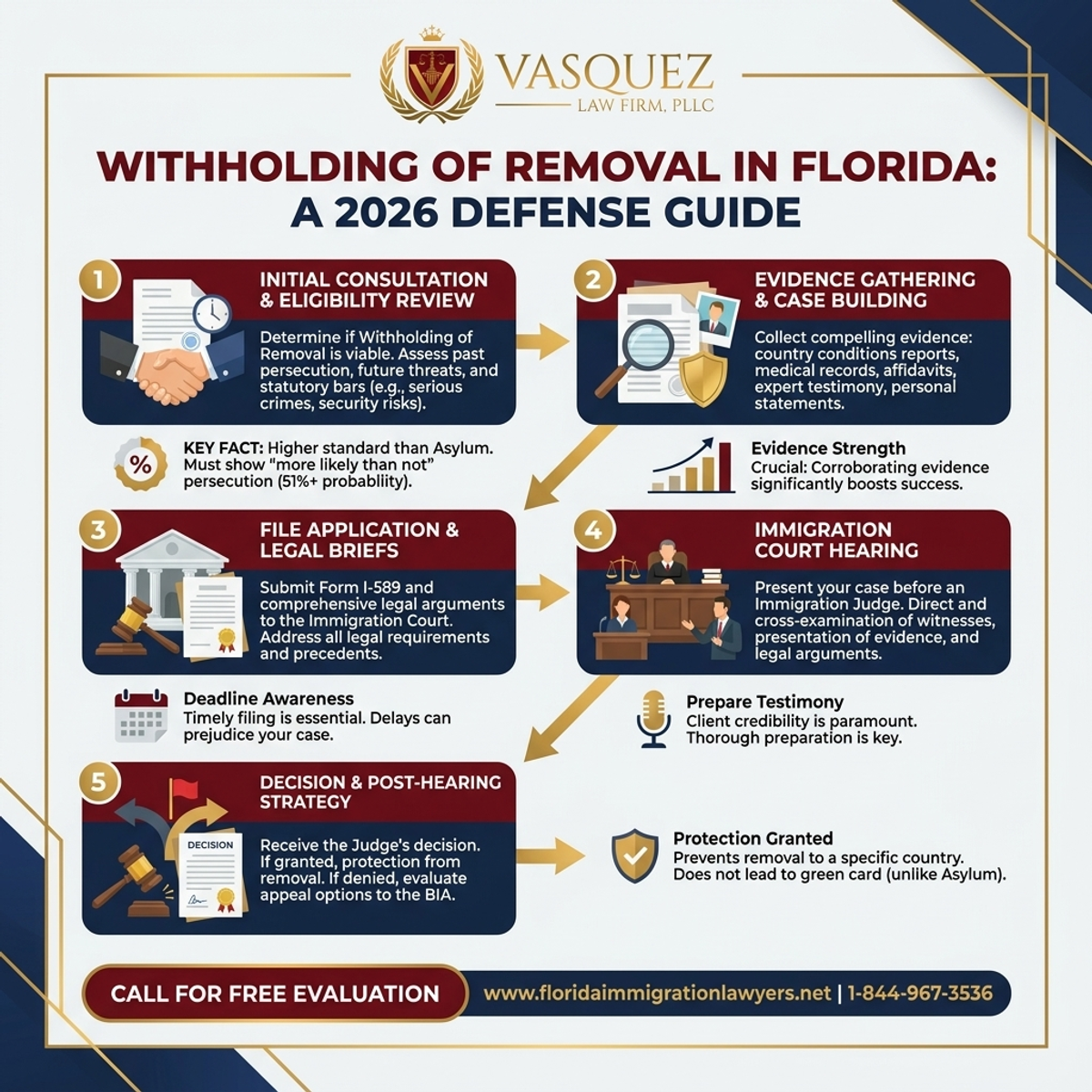
Step-by-Step Process — Withholding of Removal in Florida: A 2026 Defense Guide
A crucial aspect of CAT protection is that it can be granted even if an individual is subject to mandatory bars that would otherwise disqualify them from asylum or statutory withholding of removal. For example, if you have a particularly serious criminal conviction, you might be barred from asylum and withholding of removal under INA 241(b)(3), but you could still be eligible for CAT protection if you meet the "more likely than not" standard for torture. This makes CAT an invaluable tool for deportation defense in complex cases, including those involving individuals detained at facilities like the Krome Service Processing Center near Miami. The focus is strictly on the likelihood of torture and the governmental involvement, not on the reasons for your fear (e.g., political opinion). Proving governmental acquiescence often requires extensive evidence and expert testimony, which Florida Immigration Lawyers are adept at gathering and presenting.
Navigating the Withholding of Removal Process: A Step-by-Step Guide for Florida Residents
The process for seeking withholding of removal primarily occurs within removal proceedings before an Immigration Judge. It begins with filing Form I-589, Application for Asylum and for Withholding of Removal. While the process can be lengthy and intricate, understanding each step is crucial for individuals in Fort Lauderdale and across Florida.
- Filing Form I-589: If you are in removal proceedings, you will typically file Form I-589 with the Immigration Court. This form is used for both asylum and withholding of removal. While asylum has a one-year filing deadline, withholding of removal does not, though it's always best to file as soon as possible.
- Master Calendar Hearing: Your first court appearance is a Master Calendar Hearing. Here, the Immigration Judge will confirm your identity, ensure you received the Notice to Appear (NTA), and set deadlines for filing your I-589 and other documents. In Florida, these hearings occur at courts such as the Miami Immigration Court or Orlando Immigration Court.
- Individual Hearing (Merits Hearing): This is the main hearing where you present your case. You will testify about your fear of persecution or torture, and your attorney will present evidence and call witnesses. The government attorney will cross-examine you and your witnesses.
- Gathering Evidence: Comprehensive evidence is paramount. This includes personal affidavits, country condition reports, expert witness statements, medical records, and any documentation supporting your claim of past persecution or fear of future harm.
- Decision by Immigration Judge: After the Individual Hearing, the Immigration Judge will issue a decision, either orally at the end of the hearing or in writing at a later date. If granted, you will receive protection from removal to the specified country.
- Appeals: If your application for withholding of removal is denied, you have the right to appeal the decision to the Board of Immigration Appeals (BIA) within 30 days. If the BIA denies your appeal, you may be able to appeal to a U.S. Circuit Court of Appeals.
Document Checklist for Withholding of Removal
Preparing a thorough package of evidence is critical for a successful withholding of removal claim. Here is a general checklist:
- Form I-589, Application for Asylum and for Withholding of Removal
- Proof of identity and nationality (e.g., passport, birth certificate, national ID)
- Marriage certificate and birth certificates for dependents included in the application
- Detailed personal affidavit or declaration explaining the basis of your fear
- Evidence of past persecution (e.g., police reports, medical records, photos, witness statements)
- Country condition reports from reputable human rights organizations, the U.S. Department of State, or academic institutions
- Expert witness affidavits (e.g., from country experts, psychologists, or doctors)
- Newspaper articles, scholarly articles, or other publicly available information supporting your claim
- Any other documents corroborating your fear of persecution or torture
- Translations of all non-English documents by a certified translator
Timeline and Processing Expectations for Withholding of Removal
The processing times for withholding of removal cases can vary significantly based on court backlogs, case complexity, and the specific immigration court in Florida (e.g., Miami, Orlando, Bradenton). As of 2026, here is a general overview:
| Stage | Typical Timeframe (As of 2026) | Notes |
|---|---|---|
| Initial Filing of Form I-589 | While in removal proceedings | No one-year deadline for withholding, but prompt filing is advised. |
| Master Calendar Hearing | 1-6 months after NTA issuance | Initial appearance, procedural matters, setting future dates. |
| Individual Hearing (Merits) | 6 months - 3+ years after Master Calendar | Highly variable depending on court docket and case complexity. |
| Immigration Judge Decision | Immediately or within weeks of Individual Hearing | Can be oral or written. |
| Board of Immigration Appeals (BIA) | 6 months - 2+ years for decision | If an appeal is filed within 30 days of IJ decision. |
| Circuit Court of Appeals | 1-3+ years for decision | If further appeal is filed within 30 days of BIA decision. |
What Are the Costs Associated with Withholding of Removal Cases in Florida?
As of 2026, there is generally no USCIS filing fee for Form I-589 when seeking withholding of removal. However, significant costs arise from legal representation, expert witness fees, translation services, and evidence gathering, which can range from several thousands to tens of thousands of dollars.
While the U.S. government does not charge a filing fee for Form I-589 when it's part of an asylum or withholding of removal application, pursuing a withholding of removal case involves other substantial expenses. The most significant cost is typically legal representation. Given the high burden of proof and the complex legal arguments involved, having an experienced immigration attorney is almost always essential. Legal fees can vary widely based on the complexity of your case, the attorney's experience, and the stages of the process involved (e.g., initial court proceedings, appeals). For a firm like Florida Immigration Lawyers, serving clients from Fort Lauderdale to Jacksonville, these fees reflect the dedicated time, expertise, and resources required to build a strong defense. Investing in quality legal representation can greatly increase your chances of a successful outcome.
Beyond legal fees, other potential costs include:
| Item | Typical Fee (As of 2026) | Notes |
|---|---|---|
| Form I-589 Filing Fee | $0 | No fee for asylum/withholding applications. Always check USCIS for current fee schedules. |
| Legal Consultation | Free (with Florida Immigration Lawyers) | Initial assessment to discuss your case and options. |
| Legal Representation | $5,000 - $25,000+ | Varies significantly based on case complexity, court appearances, and appeals. |
| Expert Witness Fees | $1,500 - $7,000+ | For country conditions experts, psychologists, or medical professionals. |
| Document Translation Services | $50 - $250+ per document | For all non-English documents, requires certified translation. |
| Medical or Psychological Evaluations | $500 - $3,500+ | Often crucial for documenting trauma or specific health conditions related to persecution. |
| Travel and Lodging | Varies | If you need to travel to court hearings or meet with your attorney. |
| Copying and Postage | Minor costs | For preparing and mailing extensive evidence packages. |
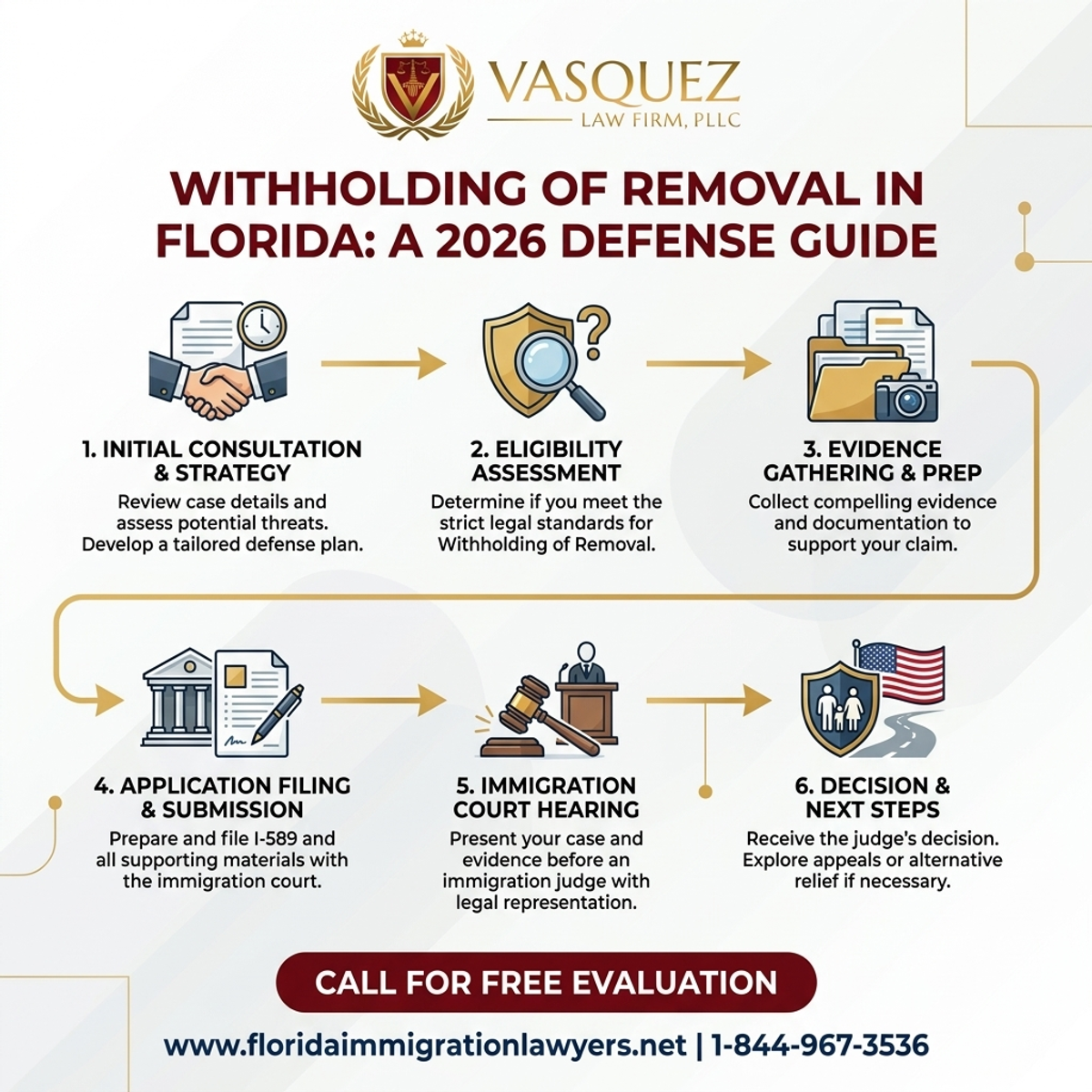
Key Statistics — Withholding of Removal in Florida: A 2026 Defense Guide
These costs highlight the financial commitment required for a robust defense. However, the potential outcome of preventing deportation and securing safety often far outweighs these expenses. Many attorneys offer payment plans, and a free initial consultation can help you understand the potential costs involved in your specific situation.
Do not navigate this complex process alone. Contact Florida Immigration Lawyers today for dedicated support and to understand your options. Our team is ready to provide the compassionate and experienced legal representation you need.
Common Mistakes to Avoid in Withholding of Removal Cases
Navigating the complexities of immigration law requires precision and a deep understanding of the requirements. Even minor errors can have severe consequences, jeopardizing your chances of protection. Here are some common mistakes individuals make in withholding of removal cases:
- Missing Deadlines: Although withholding of removal doesn't have a strict one-year filing deadline like asylum, other deadlines in removal proceedings are critical. Missing a deadline for filing your I-589, submitting evidence, or filing an appeal can lead to an automatic denial or dismissal of your case.
- Insufficient or Uncorroborated Evidence: A weak case with inadequate evidence is a common reason for denial. The "clear probability" standard requires compelling proof. Relying solely on your testimony without corroborating documents, expert reports, or country conditions evidence significantly weakens your claim.
- Inconsistent Testimony: Any inconsistencies in your statements, whether between your written application and oral testimony, or between different interviews, can severely damage your credibility with the Immigration Judge. Thorough preparation with your attorney is essential to ensure consistency and accuracy.
- Failing to Disclose Criminal History: Attempting to conceal past criminal convictions, even minor ones, can lead to charges of misrepresentation and potentially bar you from all forms of relief. It is crucial to be entirely transparent with your attorney about your full background.
- Not Understanding the Burden of Proof: Many applicants misunderstand the high "clear probability" standard for withholding of removal, thinking a "well-founded fear" is sufficient. This misunderstanding can lead to presenting an insufficient case.
- Confusing Asylum with Withholding: While related, these are distinct forms of relief with different eligibility criteria, benefits, and burdens of proof. Presenting a case as if it were an asylum claim when seeking withholding can lead to a misdirected defense.
- Representing Yourself (Pro Se): Immigration law is incredibly complex. Trying to represent yourself without legal training or experience is a significant risk. An attorney understands legal arguments, court procedures, and how to effectively present evidence.
- Not Updating Contact Information: Moving without notifying the immigration court and USCIS of your new address can result in missed notices, including hearing dates or decisions, potentially leading to an in absentia removal order.
- Ignoring Mandatory Bars: Failing to address potential mandatory bars (e.g., particularly serious crimes, persecution of others) can lead to a swift denial. An attorney can help determine if a bar applies and, if so, explore alternative relief like CAT.
- Lack of Country Condition Reports: Up-to-date and specific country condition reports are vital to demonstrate the current risks in your home country. Generic or outdated reports may not be persuasive.
- Not Preparing for Cross-Examination: Government attorneys are skilled at cross-examination. Being unprepared for rigorous questioning about your testimony and evidence can undermine your credibility and the strength of your case.
When to Call a Lawyer for Withholding of Removal in Florida
The decision to seek legal counsel in an immigration matter, especially one as critical as withholding of removal, is paramount. While some individuals might attempt to navigate the system alone, the complexities, high stakes, and stringent legal requirements make professional assistance almost always necessary. You should contact Florida Immigration Lawyers immediately if you:
- Have received a Notice to Appear (NTA): This officially places you in removal proceedings. The clock starts ticking, and you need legal guidance from the very beginning.
- Fear returning to your home country due to persecution or torture: If you genuinely believe your life or freedom would be threatened, an attorney can assess your eligibility for withholding of removal or CAT protection.
- Have been denied asylum or other forms of relief: Withholding of removal often serves as a fallback for those who do not qualify for asylum but still face grave danger.
- Have a criminal record: Certain criminal convictions can bar you from asylum but may not preclude you from withholding of removal or CAT protection. An attorney can analyze your specific situation and explore all available options.
- Are unsure about the evidence required: Gathering and presenting compelling evidence to meet the "clear probability" standard is challenging. An attorney knows what evidence is needed and how to present it effectively.
- Face language barriers or cultural misunderstandings: An attorney can help bridge communication gaps and ensure your story is accurately conveyed to the court.
- Need to appeal a denied decision: Appeals to the Board of Immigration Appeals (BIA) or federal courts are highly technical and require specialized legal knowledge.
Florida Immigration Lawyers has extensive experience representing clients in removal proceedings across Florida, including those in Fort Lauderdale, Miami, Orlando, and Tampa. Our dedicated attorneys are here to provide the strategic defense and compassionate support you need during this challenging time. Do not wait until it's too late; early intervention can significantly impact the outcome of your case.
About Florida Immigration Lawyers
Florida Immigration Lawyers is a leading immigration law firm dedicated to serving individuals and families across the entire state of Florida. With offices strategically located to assist clients from Fort Lauderdale to Jacksonville, we provide comprehensive legal services in all areas of immigration law. Our mission is to offer compassionate, effective, and results-driven representation to those navigating the complex U.S. immigration system. We understand that every client's situation is unique and deserves personalized attention.
Our team of experienced immigration attorneys specializes in a wide range of practice areas, including deportation defense, asylum, family immigration, business immigration, and citizenship. We are committed to protecting the rights and futures of our clients, offering expert guidance through every step of the legal process. Available 24/7, we provide free consultations to assess your case and outline your best path forward. Choose Florida Immigration Lawyers for unparalleled dedication and a proven track record of success.
Sources and References
- U.S. Citizenship and Immigration Services (USCIS)
- Executive Office for Immigration Review (EOIR)
- U.S. Department of State
- 8 U.S.C. § 1231(b)(3) - Withholding of Removal (Immigration and Nationality Act Section 241(b)(3))
- 8 U.S.C. § 1158 - Asylum (Immigration and Nationality Act Section 208)
- 8 CFR § 208.16(c) - Rules for Withholding of Removal and Convention Against Torture (CAT)
- 8 CFR § 1208.16(c) - Rules for Withholding of Removal and Convention Against Torture (CAT) in EOIR proceedings
Related services: immigration waivers, humanitarian protection programs, DACA renewal and applications, temporary protected status (TPS).
This article provides general legal information and is not intended as legal advice. Every case is unique, and outcomes depend on specific facts and circumstances. Contact an attorney for advice about your particular situation.
Your safety and future are too important to leave to chance. If you or a loved one in Florida is facing removal proceedings and fears returning to their home country, do not hesitate to seek expert legal assistance. Florida Immigration Lawyers is here to provide the dedicated and effective representation you need. Contact us today for a free, confidential consultation. Call 1-844-967-3536. Se Habla Espanol - Estamos aqui para ayudarle.
Do Not Navigate This Process Alone
Our experienced immigration attorneys are ready to fight for you. Get a free, confidential consultation today.
Se Habla Español
Or leave your details and we’ll call you:
Free Evaluation in 24 Hours
Or talk to us right now

AI voice assistant — available 24/7
FreeFrequently Asked Questions

William J. Vásquez
Founding Attorney · Vasquez Law Firm
U.S. Air Force veteran and immigration attorney with years of hands-on U.S. immigration experience. J.D., NCCU School of Law. AILA member. Admitted to the 4th, 5th, and 11th Circuit Courts.
Available 24/7 - Free Evaluations
Reviewed for legal accuracy by William J. Vásquez
Licensed in North Carolina; U.S. immigration is federal practice.
Related Legal Services
Our Florida immigration attorneys can help you with free immigration consultation, experienced immigration attorneys and business immigration. Call today at 1-844-967-3536 for a free consultation.
Related Links
Related Topics
Free Legal Consultation
Discuss your case with our experienced attorneys. We're available 24/7.
Se Habla Español - Estamos aquí para ayudarle.
Related Articles
Stem OPT Immigration Lawyer: 2026 Guide for Florida
For Florida graduates, navigating the STEM OPT extension process is crucial for continued work authorization. This comprehensive guide for 2026 details eligibility, step-by-step application procedures, required documents, and typical processing times. Learn about the importance of the Form I-983, E-Verify employers, and how recent policy changes like the public charge rule might affect your long-term immigration goals. Discover common mistakes to avoid and when to consult a <strong>stem OPT immigration lawyer</strong> to ensure a smooth application. Florida Immigration Lawyers offers expert assistance to F-1 students across the state, including Gainesville, helping you secure your future in your chosen STEM field.
Schedule A Nurse Immigration in Florida 2026 Guide
Discover the comprehensive guide to Schedule A nurse immigration in Florida for 2026. This specialized pathway allows foreign registered nurses to bypass the standard labor certification process, leading to an expedited EB-3 Green Card. Learn about eligibility requirements, the step-by-step application process, expected timelines, and associated costs. We also cover unique challenges for foreign nurses in Florida, including state licensing and the vital role of sponsoring hospitals. Avoid common mistakes and understand when professional legal assistance from Florida Immigration Lawyers is essential for a successful permanent residency application. Our firm provides expert guidance for nurses seeking to thrive in Florida's healthcare system.
Orlando Immigration Lawyer: Free Consultation Guide 2026
Discover how an Orlando immigration lawyer can provide essential guidance through complex U.S. immigration processes. This comprehensive guide details the benefits of a free consultation, outlines common immigration services, explains how to prepare for your meeting, and discusses typical timelines and fee structures in Florida for 2026. Learn to avoid common mistakes and understand when professional legal counsel is indispensable, especially amidst evolving immigration policies. Florida Immigration Lawyers offers expert support for visas, green cards, citizenship, and deportation defense across the state.
Removal Conditional Green Card Process in Florida 2026
For individuals with a two-year conditional green card obtained through marriage, the process of removing conditions is a critical next step. This involves filing Form I-751, Petition to Remove Conditions on Residence, within a strict 90-day window before expiration. This guide, relevant for 2026, details the required documentation, filing timelines, potential costs, and crucial waivers for special circumstances like divorce or abuse. It also highlights common mistakes to avoid and emphasizes the importance of demonstrating a bona fide marriage to USCIS. For residents across Florida, from Gainesville to Miami, understanding these requirements is vital to transitioning to permanent residency. Seeking expert legal guidance from Florida Immigration Lawyers can significantly enhance your chances of a successful outcome, providing peace of mind throughout this complex immigration process.