Special Immigrant Juvenile Status in Florida: Your 2026
Special Immigrant Juvenile Status (SIJS) in Florida provides a vital immigration pathway for children who have suffered abuse, neglect, or abandonment. This detailed guide for 2026 explains the two-part process: obtaining a predicate order from a Florida state court and then filing with USCIS. We cover eligibility criteria, essential documentation, typical processing timelines, and associated costs. Navigating state juvenile courts and federal immigration procedures requires specific legal expertise. Learn how to protect vulnerable youth in Florida and avoid common mistakes that could jeopardize their Green Card application. Florida Immigration Lawyers offers guidance to ensure a secure future for these children.
Special Immigrant Juvenile Status (SIJS) in Florida offers a vital pathway to lawful permanent residency for undocumented children who have experienced abuse, neglect, or abandonment by one or both parents. This complex process involves first securing a specific order from a Florida state juvenile or family court, which declares the child dependent, finds reunification with parents not viable, and determines that remaining in the U.S. is in their best interest. Following this, an application is submitted to USCIS. Navigating these dual legal systems requires guidance to protect vulnerable youth and secure their future.
- Eligibility: Unmarried, under 21, present in the U.S., and a victim of abuse, neglect, or abandonment.
- State Court Order: Must obtain a predicate order from a Florida juvenile or family court.
- USCIS Filing: Involves filing Form I-360, followed by Form I-485 for a Green Card.
- Green Card Path: SIJS provides a direct route to lawful permanent residency.
- Help: Legal assistance is crucial for navigating both state and federal requirements.
For many young immigrants in Florida, the journey to a stable future is fraught with unique challenges. Some arrive in the United States after experiencing profound trauma, including abuse, neglect, or abandonment in their home countries or even within the U.S. borders. For these vulnerable children, the legal system offers a crucial lifeline: Special Immigrant Juvenile Status (SIJS). This designation provides a pathway to protection and, ultimately, to lawful permanent residency, offering a chance at a new beginning.
If you are a young person in Florida, or a guardian caring for one, who has faced such hardships, understanding SIJS is paramount. This comprehensive guide, updated for 2026, will demystify the complex process, from securing the necessary state court orders in Florida's juvenile and family courts to filing with U.S. Citizenship and Immigration Services (USCIS). We'll explore eligibility, required documentation, typical timelines, and common pitfalls to avoid, with a specific focus on the unique aspects of applying in Florida.
Navigating these intricate legal waters alone can be overwhelming and intimidating. The stakes are incredibly high, as a child's future and safety depend on correctly following every step. That's why having knowledgeable legal representation is not just beneficial, but often essential. If you believe you or a child you know may qualify for this vital protection, do not hesitate to seek professional help. Call Florida Immigration Lawyers at 1-844-YO-PELEO for a free consultation to discuss your options and begin the process of securing a brighter future.
What is Special Immigrant Juvenile Status (SIJS) in Florida?
Special Immigrant Juvenile Status (SIJS) is a humanitarian immigration classification established by Congress to protect certain noncitizen children in the United States who have been subjected to abuse, neglect, or abandonment by one or both parents. It provides a pathway for these vulnerable youth to obtain a Green Card, offering them safety and stability away from their abusers. This status is outlined in the Immigration and Nationality Act (INA) at Section 101(a)(27)(J), and further detailed in 8 CFR 204.11.
In Florida, the SIJS process is a two-step legal journey involving both state and federal authorities. First, a state juvenile or family court must make specific findings regarding the child's dependency, the impossibility of reunification with their parents, and the determination that it is in the child's best interest to remain in the United States. These court orders, known as "predicate orders," are foundational to the SIJS application. Without a valid predicate order from a Florida court, the federal application cannot proceed.
Once the state court order is secured, the second step involves filing Form I-360, Petition for Amerasian, Widow(er), or Special Immigrant, with USCIS. If the I-360 petition is approved, the child becomes eligible to apply for lawful permanent residency (a Green Card) through Form I-485, Application to Register Permanent Residence or Adjust Status, provided an immigrant visa number is available. This dual legal process underscores the complexity of SIJS and the critical need for experienced legal counsel familiar with both Florida state court procedures and federal immigration law.
The primary goal of SIJS is to shield children from further harm and provide them with a chance to grow up in a safe environment. This includes children who may have been victims of human trafficking, severe domestic violence, or those who have been left without adequate parental care. Florida's legal system, particularly its dependency courts and family courts in areas like Hialeah and Miami-Dade County, plays a crucial role in identifying and protecting these children, laying the groundwork for their immigration relief.
Who is Eligible for Special Immigrant Juvenile Status in Florida?
To be eligible for SIJS in Florida, an individual must be under 21, unmarried, physically present in the U.S., and have a valid juvenile court order from a Florida state court finding them dependent on the court or a state agency, declaring reunification with one or both parents not viable, and determining that it's in their best interest to remain in the U.S. for protection.
Eligibility for Special Immigrant Juvenile Status is highly specific and requires meeting several strict criteria. As of 2026, these conditions remain consistent with long-standing immigration law. First and foremost, the applicant must be an unmarried individual under 21 years of age at the time the Form I-360 is filed. They must also be physically present in the United States when they apply for SIJS and when USCIS makes a decision on their petition. This means that if a child leaves the U.S. during the process, their eligibility may be jeopardized.
The most critical component of SIJS eligibility in Florida is obtaining a predicate order from a state court. This typically comes from a Florida juvenile dependency court or a family court. The court order must contain specific findings that USCIS requires. These findings include:
- A finding that the child is dependent on a juvenile court or has been committed to the custody of a state agency (like the Florida Department of Children and Families, DCF).
- A finding that reunification with one or both of the child's parents is not viable due to abuse, neglect, or abandonment. This often involves detailed testimony and evidence presented to the state court.
- A finding that it is not in the child's best interest to be returned to their or their parent's previous country of nationality or last habitual residence.
These court findings are not automatically granted; they must be specifically requested and supported by evidence in the state court proceeding. For instance, in Hialeah or other Florida jurisdictions, a child protective services investigation or a family law petition might lead to these critical judicial determinations. The involvement of a Florida attorney specializing in both family/dependency law and immigration law is invaluable here, as they can navigate the state court system to secure the necessary predicate order, which is the cornerstone of the SIJS application.
What is the Process for Applying for SIJS in Florida in 2026?
As of 2026, the SIJS application process in Florida typically involves first obtaining a predicate order from a Florida state juvenile or family court, then filing Form I-360, Petition for Amerasian, Widow(er), or Special Immigrant, with USCIS. If approved, eligible individuals can then apply for a Green Card via Form I-485, Application to Register Permanent Residence or Adjust Status, if a visa is immediately available.
The application for Special Immigrant Juvenile Status in Florida is a multi-step journey that requires careful attention to detail and adherence to specific legal procedures. Here is a breakdown of the typical process:
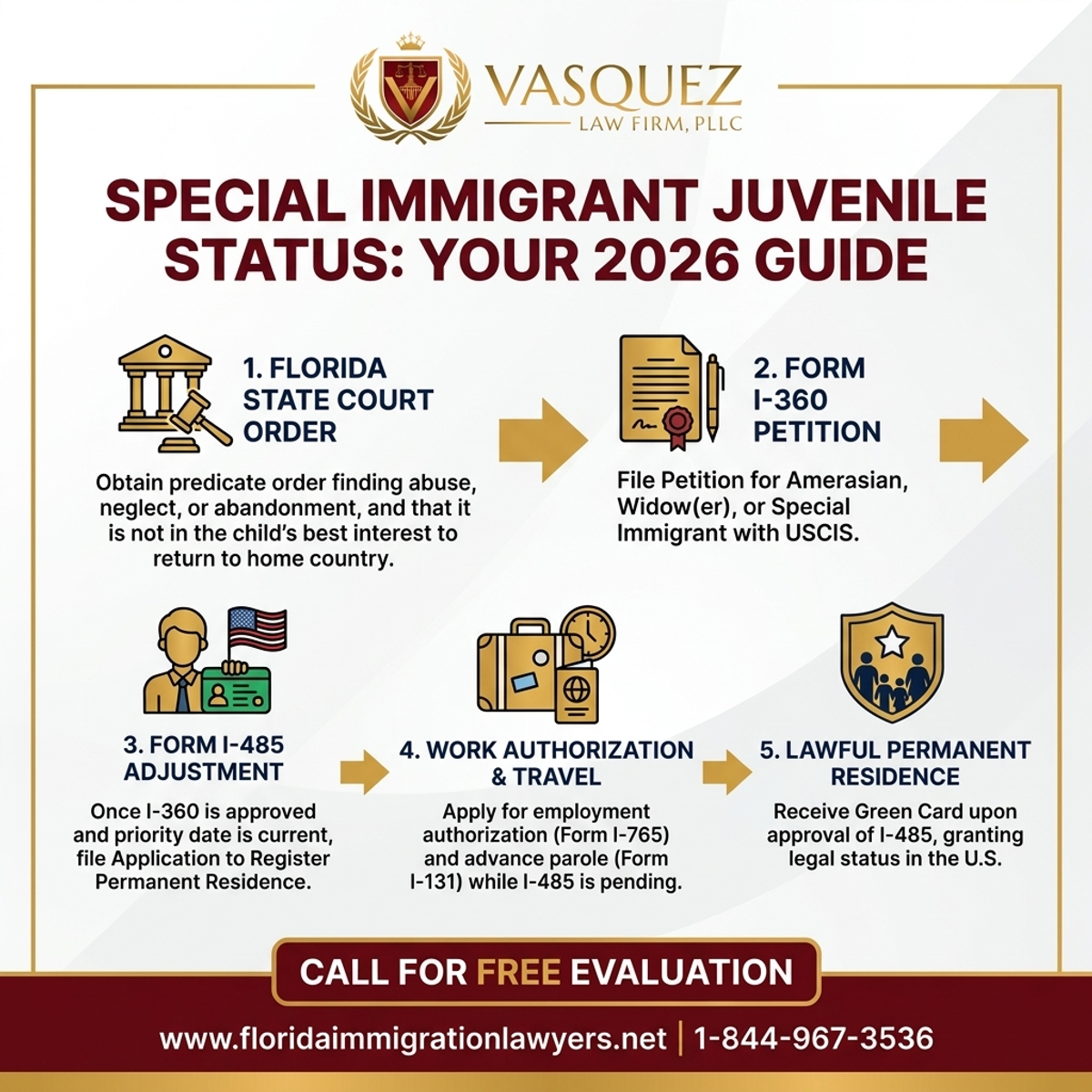
Step-by-Step Process — Special Immigrant Juvenile Status in Florida: Your 2026 Guide
- Obtain a Predicate Order from a Florida State Court: This is the crucial first step. You or your attorney must initiate a proceeding in a Florida state juvenile dependency court or family court. The goal is to obtain a court order that makes the specific findings required for SIJS eligibility, as discussed above. This involves demonstrating to the state court that the child has been abused, neglected, or abandoned, and that it is not in their best interest to return to their home country. This stage can involve investigations by Florida's Department of Children and Families (DCF), hearings, and potentially extensive litigation, especially in complex family situations prevalent in diverse communities like Hialeah.
- File Form I-360, Petition for Amerasian, Widow(er), or Special Immigrant, with USCIS: Once you have the predicate order from the Florida state court, the next step is to file Form I-360 with USCIS. This petition formally requests SIJS classification. It must be accompanied by the certified state court order and all supporting documentation proving eligibility. This form is typically filed at a specific USCIS lockbox facility, and the exact filing location can vary, so it's important to check the USCIS website for the most current instructions.
- Wait for I-360 Approval: After filing, USCIS will review your petition. This stage involves background checks and potentially a Request for Evidence (RFE) if USCIS determines that additional information is needed. If approved, USCIS will send an approval notice, confirming your SIJS classification. This approval is a critical milestone, but it does not yet grant a Green Card.
- File Form I-485, Application to Register Permanent Residence or Adjust Status (or Consular Processing): Once your Form I-360 is approved, you become eligible to apply for a Green Card. For most SIJS recipients, this means filing Form I-485, Adjustment of Status, while remaining in the United States. However, the availability of a Green Card depends on the Visa Bulletin. SIJS typically falls under the Employment-Based Fourth Preference (EB-4) category. If a visa is immediately available (meaning your priority date, established by the I-360 filing date, is current), you can file Form I-485 concurrently or shortly after I-360 approval. If a visa is not immediately available, you will have to wait for your priority date to become current according to the monthly Visa Bulletin issued by the State Department.
- Attend Biometrics Appointment and Interview: For Form I-485, you will be scheduled for a biometrics appointment to capture fingerprints and photos. Later, you may be called for an interview at a USCIS field office, such as those serving Florida residents in Miami or Orlando. After a successful interview and background checks, your Green Card application may be approved.
What Documents Are Needed for a Special Immigrant Juvenile Status Application?
A successful SIJS application hinges on providing comprehensive and accurate documentation to both the Florida state court and USCIS. Missing or incorrect documents can significantly delay or even lead to the denial of your petition. It is crucial to gather all necessary evidence meticulously.
Here is a general checklist of documents commonly required for an SIJS application:
- Certified Florida State Court Order: This is the most critical document, containing all the specific findings required for SIJS eligibility.
- Proof of Age: Birth certificate, passport, or other reliable proof of your date of birth.
- Proof of Identity: Government-issued identification, such as a passport or consular ID.
- Proof of Physical Presence in the U.S.: Entry stamps, I-94 records, school records, medical records, utility bills, or affidavits from individuals who can attest to your presence.
- Form I-360, Petition for Amerasian, Widow(er), or Special Immigrant: Completed and signed.
- Form I-485, Application to Register Permanent Residence or Adjust Status: Completed and signed (if applying for adjustment of status).
- Form I-765, Application for Employment Authorization: (Optional, if you wish to work while your I-485 is pending).
- Form I-693, Report of Medical Examination and Vaccination Record: Completed by a USCIS-approved civil surgeon.
- Photos: Passport-style photographs as per USCIS specifications.
- Evidence of Relationship to Abusive/Neglectful Parent(s): Birth certificate or other documents.
- Evidence of Abuse, Neglect, or Abandonment: Police reports, medical records, school reports, affidavits from teachers, social workers, or other knowledgeable individuals, Florida DCF records, and any other relevant documentation that supports the state court's findings.
- Criminal Background Checks: If applicable, documentation related to any arrests or convictions.
- Fee Waivers: If applicable, Form I-912, Request for Fee Waiver.
Organizing these documents can be daunting, especially when dealing with sensitive personal information and legal jargon. An experienced immigration attorney can help you compile, review, and submit all necessary paperwork, ensuring that your application is as strong and complete as possible. They can also advise on specific Florida-based documents that may be required, such as specific court records from Hialeah or other local jurisdictions.
How Long Do SIJS Applications and Green Cards Take in 2026?
As of 2026, SIJS processing times vary significantly but typically range from several months to a few years for I-360 approval, followed by potential waits for visa availability based on the Visa Bulletin. Adjustment of Status (I-485) can take another 1-2 years once a visa is available.
The timeline for obtaining Special Immigrant Juvenile Status and ultimately a Green Card can be lengthy and varies significantly based on several factors, including the complexity of your case, the specific Florida state court involved, and current USCIS processing backlogs. It's crucial to understand that there are two distinct phases, each with its own timeframe.
Estimated SIJS Processing Timeline (as of 2026):
| Stage | Typical Timeframe | Notes |
|---|---|---|
| Florida State Court Order | 3 - 12 months | Depends on court caseload, complexity of case, and local Florida court procedures (e.g., in Miami-Dade, Broward, or Palm Beach counties). |
| Form I-360 Processing (USCIS) | 6 - 24 months | Varies by USCIS service center; can be longer if a Request for Evidence (RFE) is issued. Check USCIS processing times online. |
| Visa Availability (Visa Bulletin) | Varies (0 - several years) | SIJS falls under EB-4 category. Priority dates for some countries, particularly Mexico, Guatemala, Honduras, and El Salvador, can experience significant backlogs. |
| Form I-485 Processing (USCIS) | 12 - 24 months | After visa becomes available; includes biometrics and interview. Varies by local USCIS field office. |
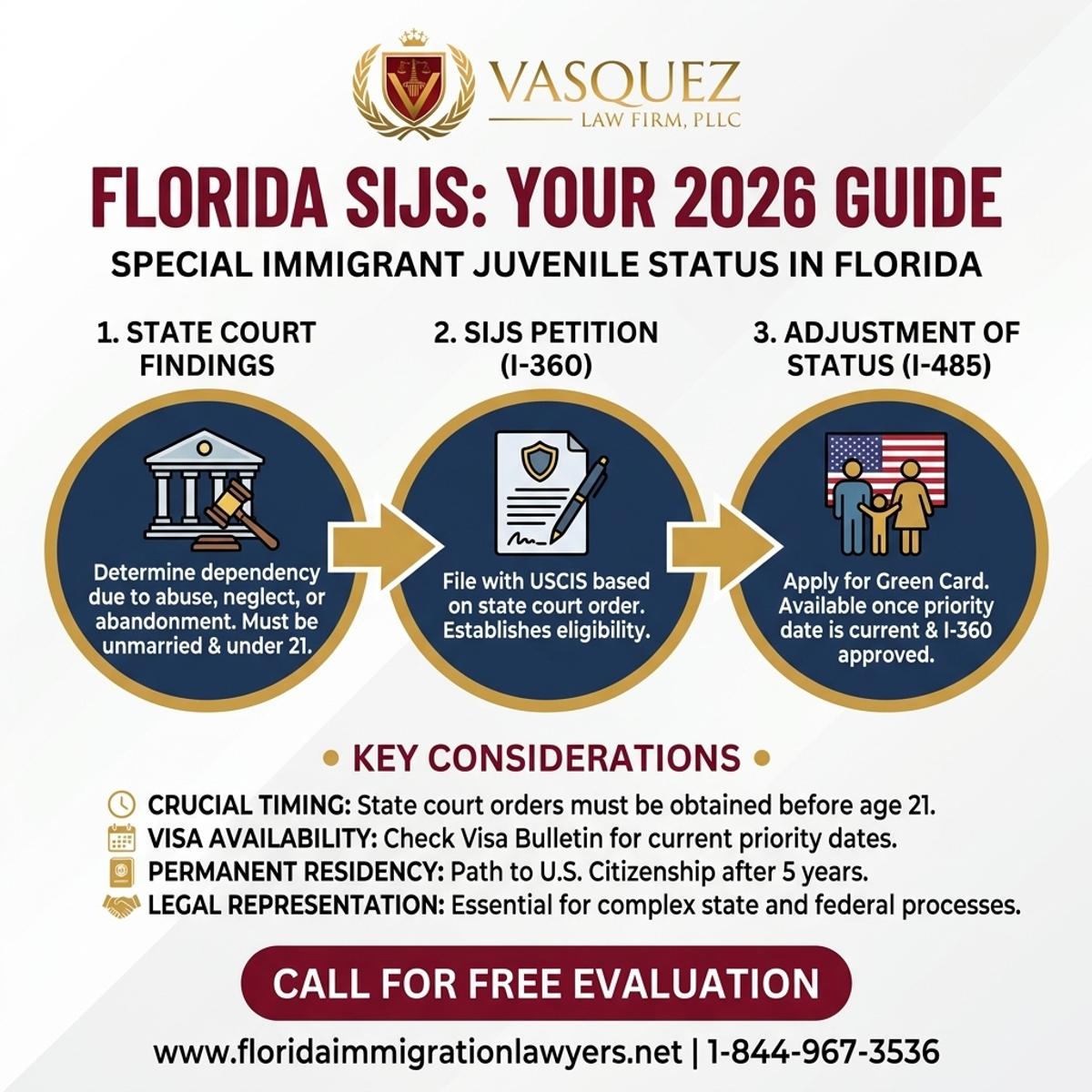
Key Statistics — Special Immigrant Juvenile Status in Florida: Your 2026 Guide
One of the most significant factors influencing the overall timeline is the Visa Bulletin. For certain countries, particularly those with high volumes of immigrants like Mexico and Central American nations, there can be a substantial wait time between I-360 approval and Green Card availability. This is due to annual limits on the number of immigrant visas issued. While this can be frustrating, SIJS applicants generally benefit from age-out protection, meaning they won't lose eligibility if they turn 21 while waiting for a visa, as long as their I-360 was filed before their 21st birthday.
Given these variable wait times and the critical importance of maintaining eligibility, consistent legal guidance is essential. An attorney can help monitor processing times, interpret the Visa Bulletin, and ensure all deadlines are met, especially in the context of Florida's diverse immigrant communities from countries often affected by visa backlogs.
What Are the Costs Associated with SIJS and Green Card Applications?
Understanding the financial implications of applying for Special Immigrant Juvenile Status and a Green Card is an important part of the planning process. While some fees can be waived for SIJS applicants due to their vulnerable circumstances, other costs, particularly legal fees, are typically part of the journey. As of 2026, USCIS fees are subject to change, so it's always best to check the official USCIS website for the most current amounts.
Estimated Costs for SIJS and Green Card Applications (as of 2026):
| Item | Typical Fee | Notes |
|---|---|---|
| Form I-360 Filing Fee | Often Waived | For SIJS applicants, this fee is generally waived. Confirm current policy with USCIS. |
| Form I-485 Filing Fee | Estimated $1,140 - $1,440 | Varies by age. Fee waivers may be available for eligible SIJS applicants. |
| Biometrics Services Fee | Often Included / Waived | Typically included with I-485 fee or waived if I-485 fee is waived. |
| Form I-693 Medical Exam Fee | Estimated $200 - $500 | Paid directly to a USCIS-approved civil surgeon. This fee is generally not waived by USCIS. |
| Attorney Fees | Varies Widely | Depends on the complexity of the case, state court involvement, and the firm's fee structure. Free consultations are often available. |
While USCIS fees can be a concern, it's important to remember that many SIJS applicants are eligible for fee waivers, particularly for Forms I-360 and I-485. This is due to the humanitarian nature of SIJS and the recognition that these children often come from vulnerable financial backgrounds. To apply for a fee waiver, you typically need to file Form I-912, Request for Fee Waiver, with supporting documentation demonstrating financial hardship.
Legal fees, however, are typically separate and not subject to USCIS waivers. These fees cover the attorney's time, expertise, and resources in navigating both the state court system to obtain the predicate order and the federal immigration process. Given the dual nature of SIJS, legal representation often involves expertise in both family/dependency law and immigration law. Many firms, including Florida Immigration Lawyers, offer free initial consultations to discuss your case and provide an estimate of legal costs. Investing in experienced legal counsel can prevent costly mistakes and significantly increase the likelihood of a successful outcome.
Protecting Vulnerable Youth in Florida: Local Resources and Support
Florida's diverse communities, including vibrant areas like Hialeah, Miami, and Orlando, are home to many immigrant families and children. Unfortunately, some of these children face challenging circumstances that necessitate legal protection like Special Immigrant Juvenile Status. The state of Florida has various resources designed to protect children, which can indirectly support the SIJS process.
The Florida Department of Children and Families (DCF) plays a central role in investigating child abuse, neglect, and abandonment. Their findings and involvement in dependency court proceedings are often critical in obtaining the necessary predicate orders for SIJS. Local non-profit organizations also offer invaluable support, including legal aid, social services, and advocacy for immigrant youth. These organizations can provide a network of support for children navigating complex legal and personal challenges.
For children in foster care or under the supervision of state agencies, the SIJS process can be particularly streamlined as the state court already has jurisdiction over their well-being. Attorneys working with these agencies often have experience in securing the required court findings. Even for children not in state custody, the family courts across Florida, from Jacksonville to Tampa, can issue the necessary orders if the criteria for abuse, neglect, or abandonment are met.
Understanding the local landscape of child protection and legal services is key. For instance, in Miami-Dade County, which includes Hialeah, there are specific family and juvenile court divisions that handle these types of cases. An attorney familiar with these local courts and their procedures can significantly expedite the process of obtaining a predicate order. Connecting with local community centers, schools, and social services can also provide access to additional support systems for vulnerable youth, complementing the legal process of securing their immigration status.
Common Mistakes to Avoid in SIJS Applications
Applying for Special Immigrant Juvenile Status is a detailed and sensitive process where even small errors can lead to significant delays or outright denial. Being aware of common pitfalls can help you avoid costly mistakes and protect a child's chance at a secure future.
- Not Obtaining a Valid State Court Order: This is perhaps the most critical mistake. Without a specific, certified order from a Florida state juvenile or family court containing all the required findings (dependency, non-viability of reunification, best interest to remain in U.S.), the I-360 petition will be denied. Ensure the order explicitly states all necessary elements.
- Missing Deadlines and Age-Out Risks: The 21st birthday is a hard deadline for filing Form I-360. If the petition is not filed before the child turns 21, they generally lose eligibility. While there are some age-out protections for those waiting for a visa after I-360 approval, filing on time is paramount.
- Incorrectly Filing Forms or Submitting Incomplete Documentation: USCIS is strict about correctly filled forms and complete evidence. Missing signatures, incorrect information, or failing to submit all required supporting documents (e.g., birth certificates, medical records, court transcripts) will lead to Requests for Evidence (RFEs) or denials, significantly prolonging the process.
- Attempting to Self-Represent in State Court: Navigating Florida's juvenile and family courts to obtain a predicate order is highly complex. These courts deal with state laws and procedures that are distinct from federal immigration law. Attempting to represent oneself without legal expertise can result in an inadequate court order that fails to meet SIJS requirements.
- Not Disclosing All Relevant Information: Failing to disclose past interactions with law enforcement, previous immigration applications, or other relevant personal history can lead to issues during background checks and may be seen as misrepresentation, potentially resulting in denial.
- Not Understanding the Visa Bulletin and Priority Dates: For some SIJS applicants, especially from high-demand countries, there can be a wait for an immigrant visa to become available. Misunderstanding the Visa Bulletin can lead to premature I-485 filings or unnecessary anxiety about delays.
- Leaving the United States During the Process: While an SIJS petition is pending, leaving the U.S. without proper authorization (e.g., advance parole) can be considered abandonment of the application or may trigger inadmissibility grounds upon re-entry, jeopardizing the entire case.
- Assuming SIJS is Automatic After a State Court Order: The state court order is a critical prerequisite, but it does not automatically grant SIJS or a Green Card. It merely makes the child eligible to apply to USCIS, which conducts its own independent review and approval process.
When to Call a Florida Immigration Lawyer for SIJS
The Special Immigrant Juvenile Status process is one of the most complex areas of immigration law, requiring expertise in both state family/dependency law and federal immigration regulations. Knowing when to seek legal counsel is crucial for the success of an SIJS petition, especially for vulnerable children in Florida.
You should immediately contact a Florida Immigration Lawyer if:
- You are a minor or a guardian considering SIJS: An attorney can assess initial eligibility, explain the entire process, and outline potential challenges.
- You need to obtain a predicate order from a Florida state court: Navigating dependency or family court proceedings requires specialized knowledge of Florida law. An immigration lawyer with experience in these courts can guide you through securing the necessary findings.
- The child is approaching their 21st birthday: Time is critical. An attorney can help expedite the I-360 filing to meet the age-out deadline.
- There are complexities in the child's history: This includes previous interactions with law enforcement, prior immigration applications, or any potential inadmissibility issues.
- You received a Request for Evidence (RFE) or Notice of Intent to Deny (NOID) from USCIS: These notices indicate that USCIS requires more information or intends to deny your case. A lawyer can help formulate a strong response.
- You have questions about the Visa Bulletin or priority dates: An attorney can interpret the monthly Visa Bulletin and advise on potential wait times for a Green Card, especially for applicants from countries with backlogs.
- There are language barriers or you feel overwhelmed by the process: An attorney can provide clear communication and manage the legal complexities on your behalf, reducing stress.
Florida Immigration Lawyers has a dedicated team experienced in handling SIJS cases across the state, from Hialeah to Tallahassee. We understand the unique challenges faced by immigrant youth and are committed to providing compassionate, effective representation.
About Florida Immigration Lawyers
Florida Immigration Lawyers is a leading law firm dedicated to providing comprehensive and compassionate immigration legal services throughout the state of Florida. With a deep understanding of the intricacies of U.S. immigration law and a strong commitment to our clients, we strive to achieve the strongest possible outcomes for individuals, families, and businesses navigating the complex immigration system.
Our experienced attorneys focus on a wide range of immigration matters, including Special Immigrant Juvenile Status, family-based immigration, asylum, deportation defense, citizenship, and business immigration. We pride ourselves on offering personalized legal strategies tailored to each client's unique circumstances, ensuring every case receives the attention and experience it deserves. Our firm serves clients across all of Florida, from the bustling communities of Miami and Hialeah to the serene coasts of Tampa and Orlando.
At Florida Immigration Lawyers, we believe that everyone deserves fair and just legal representation. We are available 24/7 to answer your questions and provide support. We offer free consultations, allowing you to discuss your case without financial obligation. Our bilingual staff is ready to assist you in English and Spanish, ensuring clear and effective communication throughout your legal journey. Trust Florida Immigration Lawyers to be your advocate and guide through the immigration process.
Sources and References
- U.S. Citizenship and Immigration Services (USCIS)
- Executive Office for Immigration Review (EOIR)
- U.S. Department of State - Visa Bulletin
- 8 U.S.C. § 1101(a)(27)(J) - Immigration and Nationality Act (INA) Section 101(a)(27)(J)
- 8 CFR § 204.11 - Special Immigrant Juveniles
- USCIS Policy Manual, Volume 6, Part J - Special Immigrant Juveniles
Related services: immigration practice areas, family immigration services.
This article provides general legal information and is not intended as legal advice. Every case is unique, and outcomes depend on specific facts and circumstances. Contact an attorney for advice about your particular situation. Immigration laws are subject to change, and it is essential to consult with a qualified legal professional for the most current and accurate guidance.
Secure Your Future Today with Florida Immigration Lawyers
If you are a young person seeking protection or a guardian looking to secure a child's future through Special Immigrant Juvenile Status in Florida, our dedicated team is here to help. Don't face the complexities of the immigration system alone. Florida Immigration Lawyers offers free, confidential consultations to assess your eligibility and guide you through every step of this critical process. Protect your rights and build a secure future. Call us now at 1-844-YO-PELEO to schedule your free consultation. Se Habla Espanol - Estamos aqui para ayudarle.
If you need legal assistance, learn more about Florida immigration legal team, or call us at 1-844-YO-PELEO for a free consultation.
Do Not Navigate This Process Alone
Our experienced immigration attorneys are ready to fight for you. Get a free, confidential case review today.
Se Habla Español
Or leave your details and we’ll call you:
Free Evaluation in 24 Hours
Or talk to us right now
AI voice assistant — available 24/7
FreeFrequently Asked Questions

William J. Vásquez
Founding Attorney · Vasquez Law Firm
U.S. Air Force veteran and immigration attorney with years of hands-on U.S. immigration experience. J.D., NCCU School of Law. AILA member. Admitted to the 4th, 5th, and 11th Circuit Courts.
Available 24/7 - Free Evaluations
Reviewed for legal accuracy by William J. Vásquez
Licensed in North Carolina; U.S. immigration is federal practice.
Related Legal Services
Our Florida immigration attorneys can help you with immigration lawyer cost in Florida, experienced immigration attorneys and asylum protection. Call today at 1-844-YO-PELEO for a free case review.
Related Links
Related Topics
Free Legal Case Review
Discuss your case with our experienced attorneys. We're available 24/7.
Se Habla Español - Estamos aquí para ayudarle.
Related Articles
Immigration Lawyer Orlando Free Consultation in Florida
For individuals and families in Orlando, Florida, navigating the complexities of U.S. immigration law requires expert guidance. An immigration lawyer in Orlando offers crucial support for everything from visa applications and green card processes to naturalization and deportation defense. This comprehensive guide details what a free consultation covers, providing a step-by-step overview of immigration pathways, essential document checklists, and expected timelines in 2026. We also highlight common mistakes to avoid, discuss the critical role of legal counsel in deportation and asylum cases, and explain why choosing a local Orlando immigration attorney is beneficial. Florida Immigration Lawyers is dedicated to serving the diverse community of Orlando with compassionate, effective legal solutions, ensuring you receive personalized advice and robust representation for a successful immigration journey.
Fiance Visa in Miami: 2026 Process Guide for Florida
For U.S. citizens in Florida, bringing a foreign fiancé(e) to the U.S. requires navigating the K-1 Fiance Visa process. This guide details the 2026 requirements, step-by-step application, essential documents, and expected timelines. Learn about filing Form I-129F with USCIS, consular interviews, and the crucial Adjustment of Status after marriage. We cover typical fees, common mistakes to avoid, and when to seek legal assistance. Florida Immigration Lawyers offers expert guidance for couples in Miami, Orlando, and across Florida, ensuring a smooth path to uniting with your loved one. Get a free case review today.
Immigration Lawyer Services in Orlando, Florida
Explore immigration consultation services in Orlando, Florida, with a qualified immigration lawyer. Learn what to expect and understand your options for family and business immigration needs.
Fraud Prevention and Detection Fee: What to Know in Florida
Explore the fraud prevention and detection fee essential for immigration processes in Florida. Discover how it impacts applications like the I-601 waiver and learn key steps to navigate this requirement effectively.