Consular Processing for Florida Applicants in 2026
Consular processing is the path for individuals outside the U.S. to obtain an immigrant visa at a U.S. embassy or consulate. For Florida residents sponsoring family or employees abroad, understanding this multi-stage process is critical. This guide provides an in-depth look at the steps, required documents, timelines, and costs involved as of 2026. Learn about USCIS petitions, National Visa Center (NVC) processing, and the final embassy interview. We also highlight common mistakes to avoid and when legal assistance from Florida Immigration Lawyers can be invaluable, especially for applicants in Homestead and across Florida.

Consular processing is the procedure for individuals outside the United States to apply for an immigrant visa at a U.S. embassy or consulate in their home country. For Florida residents sponsoring family members or employees abroad, this path is crucial. As of 2026, it involves several stages, including petition approval by USCIS, National Visa Center (NVC) processing, and a final embassy interview. The process ensures applicants meet U.S. immigration requirements before entering the country as lawful permanent residents. Navigating it successfully often requires careful preparation and legal guidance.
- Consular processing is for those applying for immigrant visas from abroad.
- It involves USCIS, NVC, and U.S. embassy or consulate stages.
- Key steps include petition approval, document submission, and an interview.
- Timelines vary significantly based on visa category and country of origin.
- Legal assistance is highly recommended for complex cases.
Florida, a vibrant state with a rich tapestry of cultures, is home to countless families and businesses with ties extending across the globe. For many, the dream of uniting with loved ones or bringing skilled talent to the U.S. begins with understanding the complex landscape of immigration law. If you or a family member is seeking an immigrant visa from outside the United States, consular processing is the primary pathway. This intricate journey, while challenging, is entirely navigable with the right information and support.
As of 2026, the process remains a vital avenue for individuals worldwide to obtain permanent residency in the U.S. from their home countries. Whether you are in Homestead, Miami, Orlando, or anywhere else in Florida, sponsoring an applicant for an immigrant visa through consular processing requires meticulous attention to detail and adherence to strict guidelines set by U.S. Citizenship and Immigration Services (USCIS) and the Department of State. This comprehensive guide will walk you through the essential steps, timelines, costs, and common pitfalls, specifically tailored for Florida applicants and their sponsors.
Understanding each stage, from the initial petition to the final embassy interview, is crucial for a successful outcome. We will explore how these processes unfold, what documents are required, and what to expect during this journey. Do not navigate this complex process alone. For personalized guidance and to ensure your application is handled correctly, call Florida Immigration Lawyers at 1-844-YO-PELEO for a free consultation. Our experienced team is ready to assist you every step of the way.
What is Consular Processing and How Does it Work in 2026?
Consular processing is the method by which an individual applies for an immigrant visa at a U.S. embassy or consulate abroad, rather than adjusting their status from within the United States. This pathway is typically used by beneficiaries who are physically outside the U.S. or who are ineligible for adjustment of status. As of 2026, the core principles remain the same: it ensures that all required background checks, medical examinations, and interviews are conducted in the applicant's home country before they are granted an immigrant visa to enter the U.S. as a lawful permanent resident.
The process generally begins when a U.S. citizen or lawful permanent resident in Florida files a petition (e.g., Form I-130 for family members or Form I-140 for employment-based immigrants) with USCIS on behalf of a foreign national. Once this petition is approved, it is forwarded to the National Visa Center (NVC), which acts as a liaison between USCIS and the U.S. embassy or consulate where the interview will take place. The NVC collects all necessary documents and fees before scheduling the final interview. This structured approach helps manage the high volume of immigrant visa applications and maintains the integrity of the U.S. immigration system, ensuring all legal requirements under the Immigration and Nationality Act (INA) are met.
For Florida sponsors, understanding this initial framework is paramount. Whether you are sponsoring a spouse, child, or employee, the journey starts with a U.S.-based petition and then transitions to an overseas process. This distinction is critical because it dictates where and how different stages of the application will be handled. Our firm frequently assists clients in Homestead and throughout Florida with these initial filings, ensuring they are correctly prepared to avoid delays down the line. We emphasize the importance of accuracy and completeness from the very beginning to streamline the entire consular processing journey for your loved ones or future employees.
How Long Does Consular Processing Take for Florida Applicants?
The typical timeframe for consular processing can vary significantly, ranging from several months to several years, depending on factors such as the visa category, the applicant's country of origin, and current processing backlogs. As of 2026, while some immediate relative petitions may be processed faster, preference categories often involve longer waiting periods due to annual visa limits set by Congress.
For Florida sponsors, it's important to understand that the overall timeline is a sum of several distinct stages. The initial USCIS petition approval can take anywhere from 6 to 18 months, or even longer for certain complex cases or employment-based petitions. Following USCIS approval, the National Visa Center (NVC) processing stage typically adds 2 to 6 months, during which documents are gathered and reviewed. Finally, the waiting period for an embassy interview can range from a few weeks to several months, depending on the specific consulate's workload and the visa bulletin's availability. For example, a family-sponsored petition for a sibling of a U.S. citizen (F4 category) could take over a decade due to extensive backlogs, whereas a spouse of a U.S. citizen (IR1/CR1) might see much faster processing. These varying timelines underscore the need for patience and proactive engagement with the process.
Delays can also arise from incomplete documentation, requests for additional evidence (RFEs), or administrative processing at the embassy. For applicants from areas like Homestead, Florida, sponsoring individuals from countries with high demand, such as Cuba or Haiti, understanding these potential delays is especially critical. Keeping track of the Visa Bulletin published monthly by the Department of State is essential for family preference and employment-based categories, as it indicates when a visa number becomes available. Our attorneys at Florida Immigration Lawyers help clients monitor these developments and prepare for each stage, aiming to minimize any unnecessary waiting periods. Proactive legal support can often help identify and mitigate potential delays before they impact your case.
Typical Consular Processing Timeline (as of 2026)
| Stage | Typical Timeframe | Notes |
|---|---|---|
| USCIS Petition (I-130/I-140) | 6-18+ months | Depends on petition type (family vs. employment) and service center workload. |
| National Visa Center (NVC) Processing | 2-6 months | Collecting documents, fees, and scheduling the interview. Timely submission is key. |
| Embassy Interview Scheduling | 1-4 months | Varies by embassy workload and visa availability (Visa Bulletin). |
| Interview and Visa Issuance | Days to Weeks | If approved, visa typically issued shortly after a successful interview. |
| Total Estimated Time | 12 months to many years | Highly dependent on visa category, country, and individual circumstances. |
What Documents Are Needed for an Immigrant Visa Interview?
Preparing the correct documents is one of the most critical steps in consular processing. A single missing or incorrect document can lead to significant delays or even refusal of the visa. As of 2026, applicants must gather a comprehensive set of personal, financial, and immigration-related documents for their embassy interview. These documents are typically submitted to the National Visa Center (NVC) first, and then original or certified copies must be brought to the interview.
The core documentation includes valid passports for all applicants, birth certificates, marriage certificates (if applicable), and police certificates from all countries where the applicant has lived for certain periods since the age of 16. Additionally, applicants must provide a completed Form DS-260, Immigrant Visa and Alien Registration Application, which is submitted online to the NVC. Financial sponsorship documents, such as Form I-864, Affidavit of Support, along with the sponsor's tax returns and employment letters, are also crucial to demonstrate that the applicant will not become a public charge in the U.S. Medical examination results from an authorized physician are also a mandatory part of the package. Each document must be meticulously prepared and, if not in English, must be accompanied by a certified English translation. For applicants from Homestead or other Florida communities sponsoring individuals from diverse linguistic backgrounds, ensuring accurate translations is paramount.
Furthermore, applicants must provide two identical color photographs meeting specific Department of State requirements. Depending on the visa category, additional documents may be required, such as divorce decrees, adoption papers, or proof of bona fide relationships. It is highly advisable to organize all documents neatly in a folder, distinguishing between originals and copies, and to bring all supporting evidence to the interview, even if previously submitted to the NVC. Our firm helps Florida families compile and review these extensive document checklists, ensuring nothing is overlooked and that all submissions meet the stringent requirements of U.S. immigration law. This meticulous preparation is a cornerstone of a successful family immigration case.
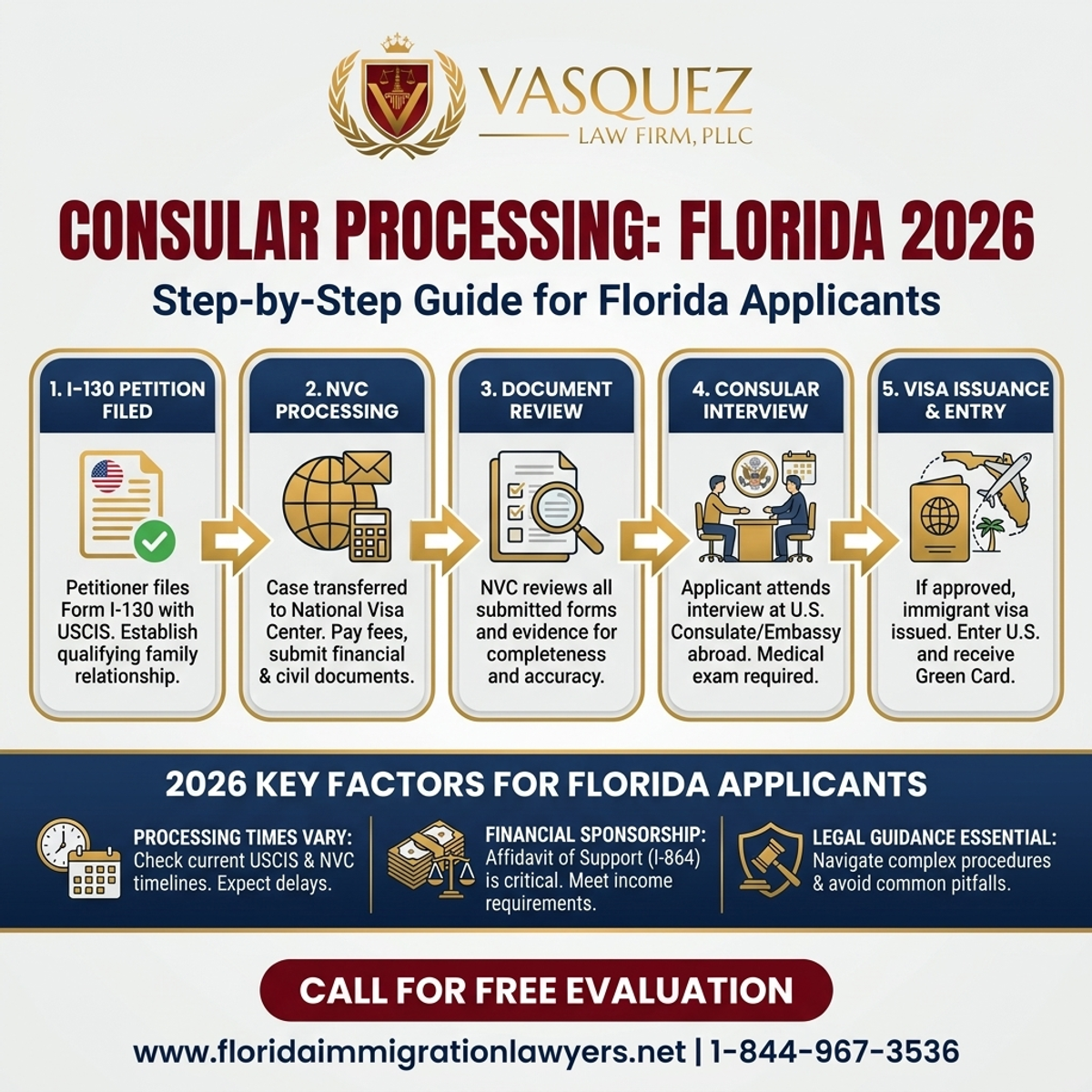
Step-by-Step Process — Consular Processing for Florida Applicants in 2026
Document Checklist for Consular Processing (as of 2026)
- Valid passport (valid for at least six months beyond intended entry into the U.S.)
- DS-260 confirmation page
- Two U.S. visa-style photographs (5x5 cm, white background)
- Birth certificate (original and certified English translation)
- Marriage certificate (if applicable, original and certified English translation)
- Divorce or death certificates of any previous spouses (if applicable)
- Police certificates from all countries of residence since age 16 for six months or more
- Court and prison records (if applicable)
- Military records (if applicable)
- Form I-864, Affidavit of Support, from the petitioner/sponsor
- Sponsor's most recent federal income tax returns and W-2s/1099s
- Proof of sponsor's U.S. domicile (e.g., driver's license, utility bills)
- Medical examination results from a U.S. embassy-approved physician
- Proof of relationship to the petitioner (e.g., photos, correspondence, joint documents)
- Any other documents requested by the NVC or the embassy
Do not navigate this process alone. Contact Florida Immigration Lawyers today to ensure your consular processing application is complete and accurate. Our team is dedicated to providing comprehensive legal support to clients throughout Florida, including Orlando and surrounding areas. Call us at 1-844-YO-PELEO for a free consultation.
How Much Does Consular Processing Cost in Florida?
The total cost of consular processing can be substantial, encompassing various government filing fees, medical examination fees, and potential legal fees. While specific government fees are subject to change, understanding the general categories of expenses is crucial for Florida applicants and their sponsors. As of 2026, these costs typically include fees paid to USCIS, the National Visa Center, and the U.S. embassy or consulate.
The initial cost is the USCIS petition filing fee (e.g., for Form I-130 or I-140), which must be paid by the U.S. petitioner. Following petition approval, the National Visa Center charges an Immigrant Visa Application Processing Fee and an Affidavit of Support Fee. These fees are generally paid online. Separately, applicants must pay for a mandatory medical examination conducted by a panel physician approved by the U.S. embassy or consulate. These medical exam fees vary by country and physician. Additionally, there are costs associated with obtaining necessary documents such as birth certificates, police records, and certified translations. For many Florida families, budgeting for these various fees is a significant part of the planning process. The final fee to consider is the USCIS Immigrant Fee, which must be paid after the visa is issued but before the immigrant enters the U.S., to cover the cost of producing the Green Card.
Legal fees, while not mandatory, are a significant consideration for many. Hiring an experienced immigration attorney can help ensure the process is handled efficiently and correctly, potentially saving time and money by avoiding common mistakes and delays. For example, navigating complex financial requirements for the Affidavit of Support or responding to Requests for Evidence (RFEs) can be challenging without guidance. For residents of Homestead and other Florida communities seeking to sponsor family members, the investment in legal counsel often provides peace of mind and increases the likelihood of a successful outcome. Always confirm current fee amounts on the official USCIS and Department of State websites, as these are subject to change at any time. Our firm provides transparent fee structures and helps clients understand all potential costs involved in their specific consular processing case.
Typical Consular Processing Cost Factors (as of 2026)
| Item | Typical Fee Range (USD) | Notes |
|---|---|---|
| USCIS Petition Filing Fee (e.g., I-130) | $535 - $710 | Paid by the U.S. petitioner. Varies by form type. |
| Immigrant Visa Application Processing Fee (DS-260) | $325 | Paid to NVC per applicant. |
| Affidavit of Support Review Fee (I-864) | $120 | Paid to NVC per affidavit. |
| Medical Examination Fee | $100 - $500+ | Varies by country and panel physician. Paid directly to the doctor. |
| Police Certificates, Birth/Marriage Certificates | Varies | Costs for obtaining official documents from local authorities. |
| Certified English Translations | Varies | Cost per page or document for professional translation services. |
| USCIS Immigrant Fee | $220 | Paid after visa issuance, before U.S. entry, for Green Card production. |
| Legal Fees (Optional but Recommended) | Varies widely | Depends on case complexity and attorney experience. |
What is the Embassy Interview Like for Immigrant Visas?
The embassy interview is the final and often most nerve-wracking stage of consular processing. This interview, conducted by a consular officer at a U.S. embassy or consulate in the applicant's home country, is designed to verify the information provided in the application, assess the applicant's eligibility for an immigrant visa, and ensure they meet all legal requirements under U.S. immigration law (specifically, INA Section 212(a) regarding inadmissibility grounds). For many applicants, particularly those from Homestead, Florida, sponsoring individuals in countries with high demand, preparing thoroughly for this interview is crucial for success.
Before the interview, applicants typically undergo a medical examination with an embassy-approved physician and gather all original civil documents. On the day of the interview, applicants should arrive early with all required documents meticulously organized. The interview itself is generally brief, lasting anywhere from a few minutes to half an hour. The consular officer will ask questions about the applicant's relationship to the petitioner, their background, intentions for coming to the U.S., and details from their application forms. They will review all submitted documents and may ask for additional evidence. It's essential to answer all questions truthfully, directly, and consistently with the information provided in the application. Any discrepancies or evasive answers can lead to further scrutiny or even denial.
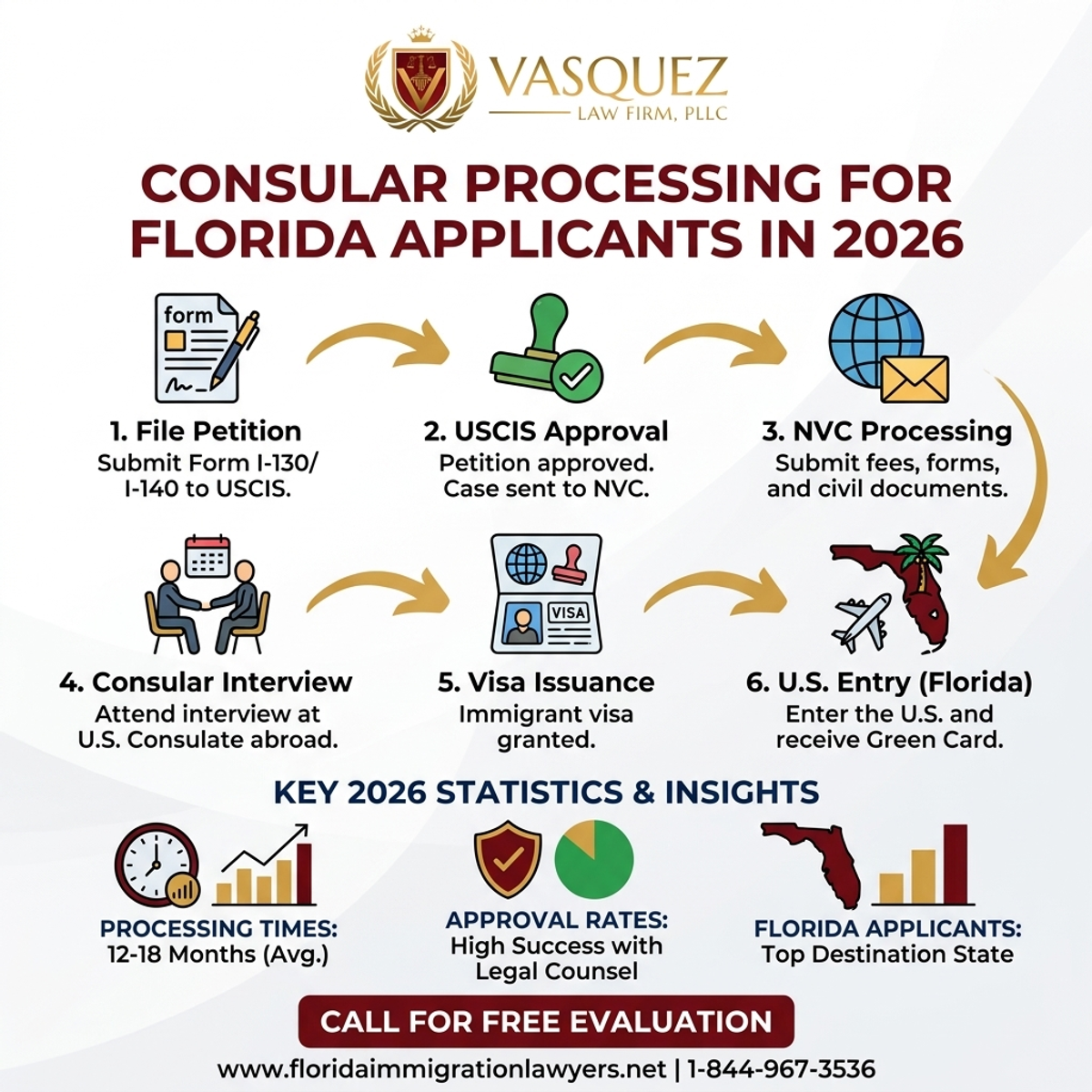
Key Statistics — Consular Processing for Florida Applicants in 2026
The atmosphere can be formal, and consular officers are trained to detect inconsistencies. For Florida sponsors, it's important to prepare the applicant by discussing potential questions and ensuring they understand the purpose of the interview. While the petitioner is not usually present, their role in supporting the applicant is often a topic of discussion. If the interview is successful and no issues arise, the consular officer will typically inform the applicant that their visa has been approved. The visa will then be stamped into their passport, usually within a few days or weeks. In some cases, administrative processing may be required, which can extend the waiting time. Knowing what to expect and being well-prepared can significantly reduce anxiety and increase the likelihood of a positive outcome in this critical final step of obtaining an immigrant visa.
Common Mistakes to Avoid in Consular Processing
Navigating consular processing can be complex, and even minor errors can lead to significant delays or denials. Being aware of common mistakes can help Florida applicants and their sponsors avoid pitfalls and ensure a smoother journey.
- Incomplete or Inaccurate Forms: Failing to fill out forms like the I-130, I-140, or DS-260 completely and accurately is a frequent error. Missing information or inconsistent data can trigger Requests for Evidence (RFEs) or even outright rejection.
- Insufficient Supporting Documentation: Not providing all required civil documents, financial evidence (I-864 Affidavit of Support), or proof of relationship can halt the process. Always double-check the NVC's document checklist.
- Lack of Certified Translations: Any document not in English must be accompanied by a certified English translation. Failing to provide these, or providing uncertified translations, will cause delays.
- Missing Police Certificates: Applicants must obtain police certificates from all countries where they have resided for specific periods since age 16. Overlooking any country is a common mistake.
- Failing the Medical Examination: Not completing the medical exam with an embassy-approved physician or having certain medical conditions that are not properly addressed can lead to inadmissibility.
- Inadequate Financial Sponsorship: The I-864 Affidavit of Support is crucial. If the sponsor's income or assets do not meet the poverty guidelines, the application can be denied. Sometimes, a joint sponsor is needed but not secured.
- Misrepresenting Information: Providing false or misleading information on any form or during the interview can lead to a permanent bar from entering the U.S. Honesty and transparency are paramount.
- Not Responding to NVC Requests Promptly: The NVC has strict deadlines for submitting documents and fees. Missing these deadlines can result in the case being terminated.
- Poor Interview Preparation: Arriving unprepared for the embassy interview, not understanding the application details, or failing to answer questions truthfully and consistently can lead to denial.
- Invalid Passport: The applicant's passport must be valid for at least six months beyond their intended date of entry into the U.S. Many applicants overlook this crucial detail.
- Not Paying the USCIS Immigrant Fee: After visa issuance, but before entry to the U.S., the USCIS Immigrant Fee must be paid. Failure to do so will delay Green Card production.
- Ignoring Changes in Circumstances: Changes such as marriage, divorce, birth of a child, or a change of address must be reported to USCIS and NVC promptly. Failure to do so can invalidate the petition.
When to Call a Florida Immigration Lawyer for Consular Processing
While the steps for consular processing are outlined, the nuances of immigration law can be incredibly complex. There are specific scenarios where the expertise of a Florida immigration lawyer becomes not just helpful, but essential. If you are sponsoring a family member or employee from Homestead, Miami, Fort Lauderdale, or anywhere across Florida, recognizing these red flags early can save you significant time, stress, and potential heartbreak.
You should consider calling Florida Immigration Lawyers if your case involves any complexities such as a prior visa denial, criminal history (even minor offenses), previous deportations, or complex medical conditions that might raise inadmissibility concerns under INA Section 212. If the petitioner's income is borderline for the Affidavit of Support, or if there are difficulties obtaining necessary civil documents from a foreign country, legal assistance is invaluable. Furthermore, if you receive a Request for Evidence (RFE) from USCIS or NVC, or if the case is placed under administrative processing, it's a strong indicator that professional help is needed. Our firm focuses on navigating these intricate situations, providing strategic advice and ensuring all responses are legally sound. We can also assist with deportation defense if an applicant has prior removal orders, or help with waivers of inadmissibility. Don't risk your future or that of your loved ones by attempting to manage a challenging case alone.
About Florida Immigration Lawyers
Florida Immigration Lawyers is an immigration law firm dedicated to serving individuals, families, and businesses across the entire state of Florida. With offices conveniently located and a team of highly experienced attorneys, we are committed to providing compassionate, effective, and results-driven legal representation. We understand that immigration matters are deeply personal and often life-changing, which is why we approach every case with the utmost care and professionalism.
Our comprehensive services cover all aspects of immigration law, including family-based immigration, employment visas, asylum, deportation defense, citizenship, and consular processing. We pride ourselves on clear communication, strategic planning, and vigorous advocacy for our clients. Whether you are in Homestead, Miami, Orlando, or Jacksonville, our firm is available 24/7 to provide support. We offer free consultations to help you understand your options and develop a tailored legal strategy. Choose Florida Immigration Lawyers for a dedicated partner in your immigration journey.
Sources and References
- U.S. Citizenship and Immigration Services (USCIS)
- U.S. Department of State - Bureau of Consular Affairs
- Executive Office for Immigration Review (EOIR)
- 8 U.S.C. Chapter 12 - Immigration and Nationality Act (INA)
- 8 CFR (Code of Federal Regulations)
- INA Section 212(a) - General Classes of Aliens Ineligible to Receive Visas and Inadmissible to United States
Related services: immigration practice areas, business immigration, experienced immigration attorneys.
This article provides general legal information and is not intended as legal advice. Every case is unique, and outcomes depend on specific facts and circumstances. Contact an attorney for advice about your particular situation.
Don't let the complexities of consular processing overwhelm you. With Florida Immigration Lawyers by your side, you can navigate this journey with confidence. We are committed to helping you achieve your immigration goals. Contact us today for a free consultation and let us put our experience to work for you. Call 1-844-YO-PELEO to speak with an attorney. Se Habla Espanol - Estamos aqui para ayudarle.
Do Not Navigate This Process Alone
Our experienced immigration attorneys are ready to fight for you. Get a free, confidential case review today.
Se Habla Español
Or leave your details and we’ll call you:
Free Evaluation in 24 Hours
Or talk to us right now

AI voice assistant — available 24/7
FreeFrequently Asked Questions

William J. Vásquez
Founding Attorney · Vasquez Law Firm
U.S. Air Force veteran and immigration attorney with years of hands-on U.S. immigration experience. J.D., NCCU School of Law. AILA member. Admitted to the 4th, 5th, and 11th Circuit Courts.
Available 24/7 - Free Evaluations
Reviewed for legal accuracy by William J. Vásquez
Licensed in North Carolina; U.S. immigration is federal practice.
Related Legal Services
Our Florida immigration attorneys can help you with family immigration services, immigration lawyer cost in Florida and experienced immigration attorneys. Call today at 1-844-YO-PELEO for a free case review.
Related Links
Related Topics
Free Legal Case Review
Discuss your case with our experienced attorneys. We're available 24/7.
Se Habla Español - Estamos aquí para ayudarle.
Related Articles
Immigration Lawyer Orlando Free Consultation in Florida
For individuals and families in Orlando, Florida, navigating the complexities of U.S. immigration law requires expert guidance. An immigration lawyer in Orlando offers crucial support for everything from visa applications and green card processes to naturalization and deportation defense. This comprehensive guide details what a free consultation covers, providing a step-by-step overview of immigration pathways, essential document checklists, and expected timelines in 2026. We also highlight common mistakes to avoid, discuss the critical role of legal counsel in deportation and asylum cases, and explain why choosing a local Orlando immigration attorney is beneficial. Florida Immigration Lawyers is dedicated to serving the diverse community of Orlando with compassionate, effective legal solutions, ensuring you receive personalized advice and robust representation for a successful immigration journey.
Fiance Visa in Miami: 2026 Process Guide for Florida
For U.S. citizens in Florida, bringing a foreign fiancé(e) to the U.S. requires navigating the K-1 Fiance Visa process. This guide details the 2026 requirements, step-by-step application, essential documents, and expected timelines. Learn about filing Form I-129F with USCIS, consular interviews, and the crucial Adjustment of Status after marriage. We cover typical fees, common mistakes to avoid, and when to seek legal assistance. Florida Immigration Lawyers offers expert guidance for couples in Miami, Orlando, and across Florida, ensuring a smooth path to uniting with your loved one. Get a free case review today.
Immigration Lawyer Services in Orlando, Florida
Explore immigration consultation services in Orlando, Florida, with a qualified immigration lawyer. Learn what to expect and understand your options for family and business immigration needs.
Fraud Prevention and Detection Fee: What to Know in Florida
Explore the fraud prevention and detection fee essential for immigration processes in Florida. Discover how it impacts applications like the I-601 waiver and learn key steps to navigate this requirement effectively.