Understanding the Child Status Protection Act in Florida
The Child Status Protection Act (CSPA) is essential for families in Florida, preventing children from aging out of immigration benefits. Learn how CSPA works, common mistakes to avoid, and when to seek legal help. Contact Florida Immigration Lawyers for expert guidance.

The Child Status Protection Act (CSPA) in Florida helps protect children from "aging out" of eligibility for immigration benefits. It freezes the child's age at a specific point, allowing them to remain a derivative beneficiary. Key takeaways include:
- CSPA prevents children from losing eligibility due to age.
- Applies to various visa categories.
- Significant for families immigrating to Florida.
Introduction
Imagine a family eagerly waiting to reunite in Hialeah, Florida, only to find their child has "aged out" and is no longer eligible for a green card. This is where the Child Status Protection Act (CSPA) becomes crucial. It helps protect children from losing immigration benefits due to aging out. In this article, we'll explore how CSPA works, its importance, and how it impacts families in Florida. Call Florida Immigration Lawyers at 1-844-967-3536 for a free consultation.
The dream of a new life in Florida, with its vibrant communities and opportunities, often hinges on the ability of families to immigrate together. When a child, who is a crucial part of this family unit, faces the risk of losing their immigration eligibility simply because bureaucratic processing times extend beyond their 21st birthday, it can be devastating. This situation, known as "aging out," was a significant barrier for countless families before the CSPA was enacted.
For families across Florida, from Miami to Orlando, understanding the nuances of CSPA is not just a legal technicality; it's about preserving family unity and securing a future together. This act provides a critical safeguard, ensuring that children who were eligible at the time their parent's petition was filed do not lose that eligibility due to factors beyond their control, such as lengthy government processing delays. We'll delve into the specifics of how this vital law operates and what steps families in Florida can take to benefit from its protections.
What is the Child Status Protection Act (CSPA)?
The Child Status Protection Act (CSPA) was enacted to prevent children from losing their eligibility for immigration benefits due to long processing times. Typically, a child "ages out" when they turn 21, losing the status of a "child" under immigration law. CSPA freezes the child's age at a specific point, allowing them to remain a derivative beneficiary under certain conditions.
For example, if a family-based petition is filed before a child turns 21, the CSPA can lock the child's age as under 21, even if the processing takes years. This is crucial for families in Florida, where Hialeah sees a significant number of immigration cases.
Before CSPA's implementation in 2002, the rigid definition of a "child" as someone under 21 years of age created immense hardship. A child could be a beneficiary of a visa petition for years, only to turn 21 before their visa became available, thereby losing their place in line and often having to start an entirely new, much longer immigration process. This often led to heartbreaking family separations, directly contradicting the humanitarian goals of family-based immigration.
CSPA addresses this by providing a mechanism to calculate a "CSPA age" that is often lower than the child's biological age. This calculation varies depending on the specific visa category, such as immediate relatives (unmarried children of U.S. citizens), family preference categories (like F-2A for unmarried children of green card holders), employment-based visas, and even diversity lottery cases. The law's intent is to ensure that children do not bear the brunt of administrative delays within the immigration system.
Understanding how CSPA applies to your situation can be complex, and consulting an experienced attorney is recommended. Florida Immigration Lawyers possess the expertise to analyze your specific circumstances and determine eligibility, helping families navigate these intricate rules to protect their children's immigration future.
How CSPA Works: A Step-by-Step Guide
- Determine Eligibility: The process begins with determining if CSPA applies to the specific visa category, such as family-based, employment-based, or asylum-related cases.
- Calculate CSPA Age: Subtract the number of days the petition was pending from the child's age at visa availability to calculate the CSPA age.
- File Required Documents: Ensure all required documentation is filed promptly to prevent the child from aging out.
- Seek Legal Assistance: Due to the complexity, consulting with immigration experts is advised to ensure accurate calculations and filings.
Navigating the CSPA can feel like solving a complex puzzle, but understanding each step is vital for a successful outcome. The core principle is to ensure that a child's eligibility is preserved, even when the immigration system moves slowly. A common scenario we see at Florida Immigration Lawyers involves a parent filing an I-130 petition for their child. If that child turns 21 while the petition is pending, CSPA might still protect them.
For instance, when determining eligibility, it's crucial to distinguish between immediate relatives (unmarried children of U.S. citizens), for whom CSPA works differently, and preference categories. For immediate relatives, the child's age is locked on the date the I-130 petition is filed. For preference categories, the calculation is more intricate, involving the petition's pending time and the visa availability date from the Visa Bulletin. This distinction is paramount, and a miscalculation can lead to loss of benefits. This is where the expertise of Florida Immigration Lawyers becomes invaluable.
Beyond the calculation, a critical component of CSPA protection is the "sought to acquire" requirement. This means that the child must seek to acquire lawful permanent resident status within one year of a visa becoming available. This typically involves filing an application for adjustment of status (Form I-485) or applying for an immigrant visa at a U.S. consulate abroad. Missing this one-year window, even with a favorable CSPA age, can lead to the loss of CSPA protection, making timely action absolutely essential for families in Florida.
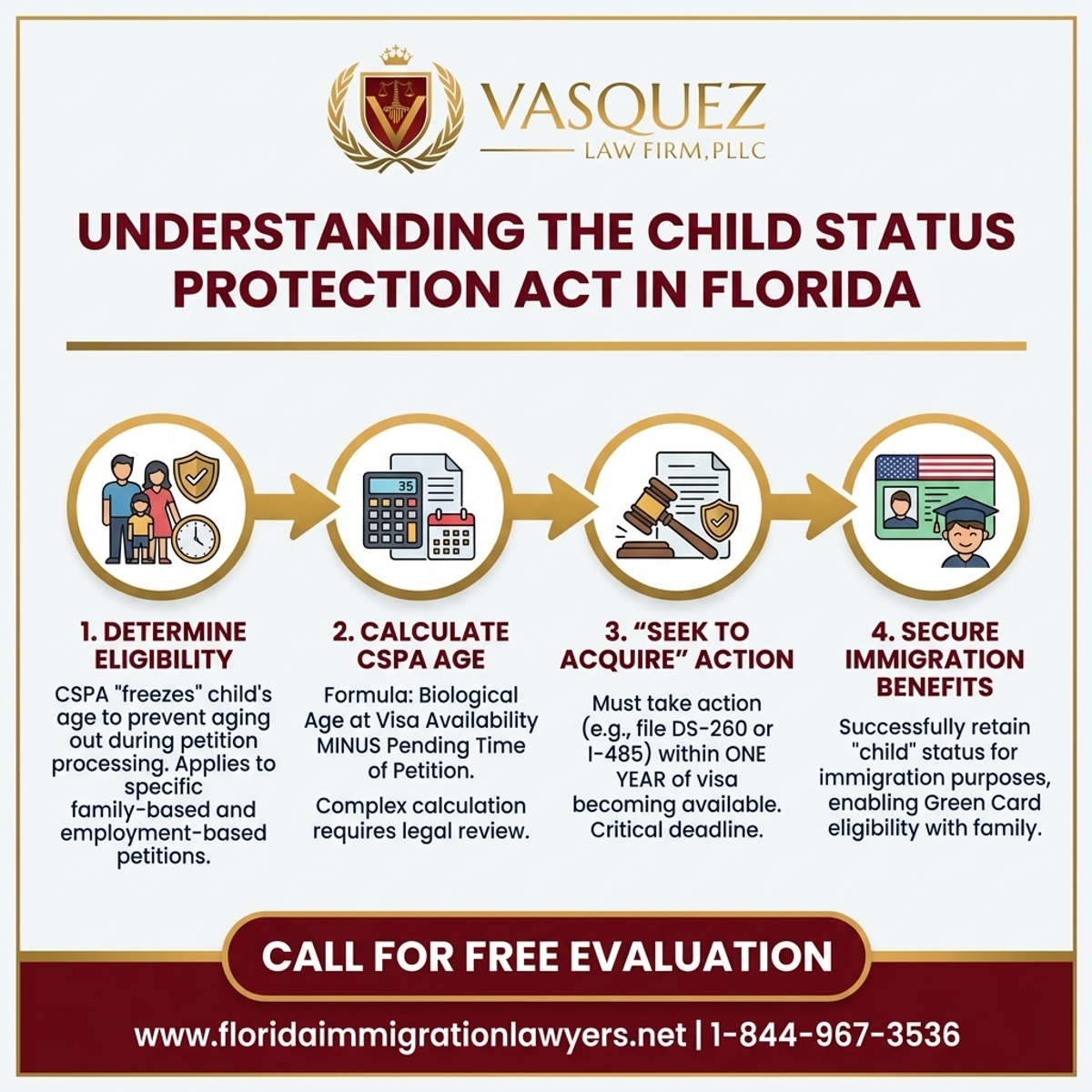
Step-by-Step Process — Understanding the Child Status Protection Act in Florida
Document Checklist for CSPA Cases
- Proof of relationship (birth certificate, adoption papers)
- Original petition and approval notice
- Visa availability notice
- Proof of continuous residence in the U.S., if applicable
- Documentation of any delays in processing
Thorough and accurate documentation is the bedrock of any successful immigration case, and CSPA cases are no exception. Gathering all necessary documents promptly can significantly impact the outcome, preventing delays and ensuring that your child's eligibility is clearly established. For instance, a certified birth certificate is paramount to prove the parent-child relationship, and any discrepancies or missing information can trigger requests for evidence (RFEs) that prolong the process.
Beyond the primary documents, it's wise to keep meticulous records of all communications with USCIS or the National Visa Center, including receipt notices, approval notices (e.g., I-797), and any correspondence related to your visa petition. If there were any unusual delays in processing that you can document, such as a lost file or an administrative error, these might also be helpful in certain CSPA arguments. Florida Immigration Lawyers can assist in organizing these documents and ensuring everything is in order before submission.
Timeline and Processing Expectations
Processing times can vary significantly. The CSPA calculation depends on the visa category and processing time of the initial petition. Typically, calculating the CSPA age and ensuring the correct documentation can take several months. Families in Florida should consider that local immigration offices, such as those in Hialeah, may have specific processing times and requirements.
Several factors influence the overall timeline, including the specific visa preference category, the applicant's country of origin, and the current workload of USCIS and the Department of State. The Visa Bulletin, published monthly by the Department of State, is a critical tool for tracking visa availability, as the "final action date" listed there is used in the CSPA age calculation. Monitoring this bulletin is essential, as retrogressions (when a category becomes unavailable or moves backward) can impact CSPA eligibility.
For families in Florida, understanding these timelines is crucial for strategic planning. For example, if a child is nearing their 21st birthday, and their visa category is close to becoming current, immediate action is required to ensure the "sought to acquire" requirement is met within the one-year window. Florida Immigration Lawyers are adept at tracking these complex timelines and advising clients on the optimal moment to file subsequent applications, helping to mitigate the risk of aging out.
While CSPA provides a safety net, it does not necessarily speed up the overall immigration process. It simply ensures that once a visa becomes available, the child is still considered eligible. Patience is a virtue, but vigilance is a necessity. Regular check-ins with your legal team and monitoring official government websites for updates are recommended to stay informed throughout this often lengthy journey.
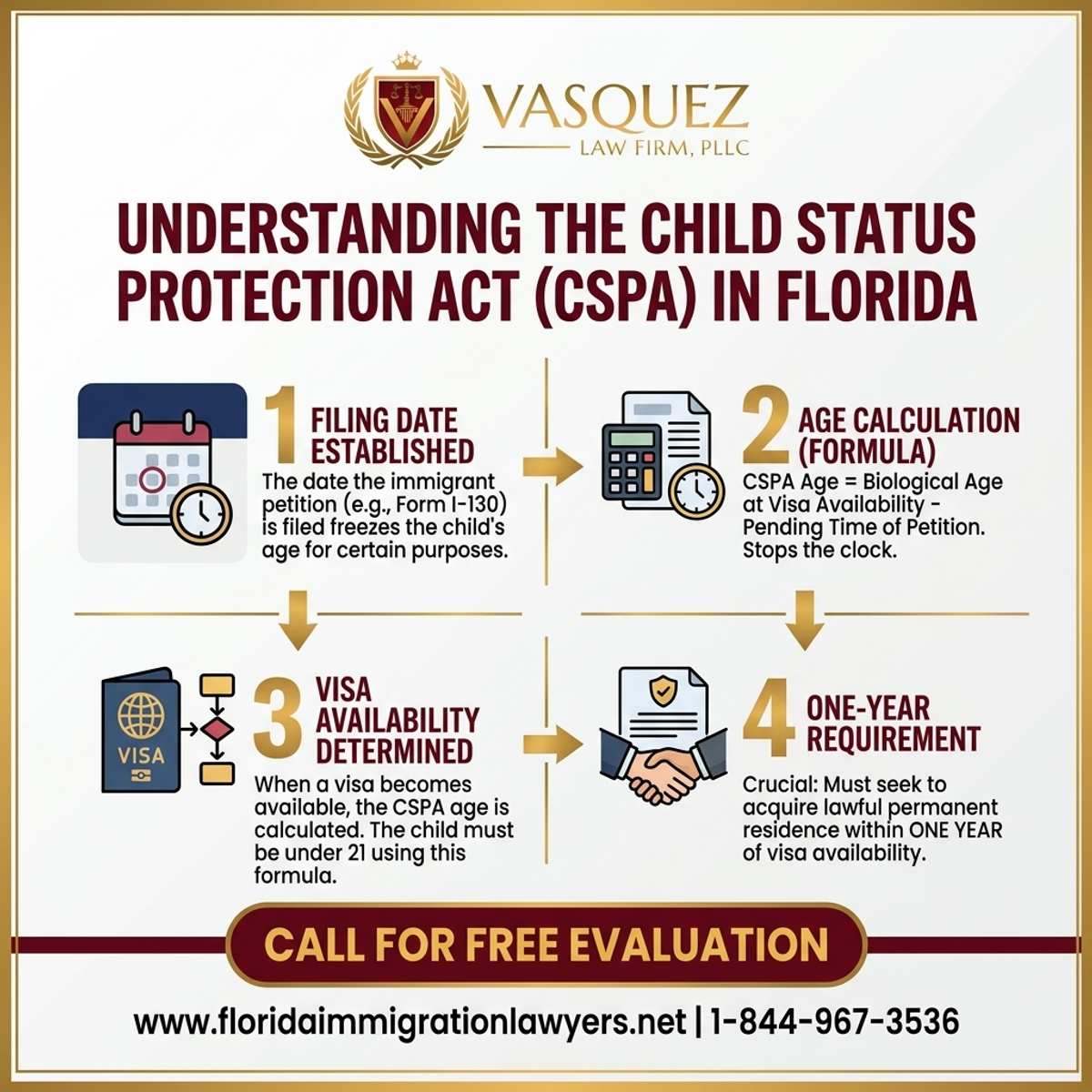
Key Statistics — Understanding the Child Status Protection Act in Florida
Cost Factors and Fee Breakdown
The costs associated with CSPA cases include filing fees, legal consultation fees, and potential additional documentation costs. While exact fees vary, families should anticipate these potential expenses and budget accordingly. Engaging a qualified immigration lawyer can help manage these costs and ensure proper handling of the case.
Filing fees are set by USCIS and can change periodically. For a typical family-based CSPA case, these might include the fee for the initial I-130 Petition for Alien Relative, the I-485 Application to Register Permanent Residence or Adjust Status (if adjusting in the U.S.), or the immigrant visa application fee if processing abroad. Additionally, there are biometric service fees and potentially fees for work permits (I-765) or travel documents (I-131) if filed concurrently with adjustment of status. These fees are non-refundable, making accurate and complete applications vital.
Legal fees for CSPA cases can vary based on the complexity of the case, the attorney's experience, and the scope of services provided. Some firms, like Florida Immigration Lawyers, may offer flat fees for specific services, while others might charge hourly. While legal fees represent an investment, the value of expert guidance in avoiding costly mistakes, ensuring timely filings, and navigating complex calculations often outweighs the initial expense. An experienced attorney can provide a clear breakdown of all anticipated costs, helping families budget effectively and avoid unexpected financial burdens.
Other potential costs could include translation services for foreign documents, fees for obtaining certified copies of birth certificates or marriage licenses, and medical examination fees required for adjustment of status or immigrant visa applications. It's important to factor in all these potential expenses when planning your immigration journey, and a comprehensive consultation with Florida Immigration Lawyers can help you understand the full financial picture.
Common Mistakes to Avoid
- Failing to calculate the CSPA age correctly, risking the child aging out.
- Delaying filing after visa availability, missing the CSPA protection window.
- Ignoring changes in immigration law that may affect CSPA eligibility.
- Not providing complete documentation, leading to processing delays.
- Assuming CSPA applies automatically, without proper legal guidance.
- Failing to track the processing time of the initial petition accurately.
- Overlooking the need for continuous residence documentation.
- Misunderstanding the application of CSPA to different visa categories.
- Not seeking legal assistance when needed, leading to costly errors.
Even a minor oversight in a CSPA case can have significant and irreversible consequences, potentially causing a child to lose their eligibility for a green card. For example, a common pitfall is misunderstanding the "visa availability date" from the Visa Bulletin, which is critical for the CSPA age calculation. Using the wrong date or failing to act within the one-year "sought to acquire" window after a visa becomes available can negate CSPA protection entirely, regardless of a favorable CSPA age calculation.
When to Call a Lawyer
Given the complexities of the CSPA and its implications on your family’s immigration status, consulting an attorney is crucial. If your child is nearing 21, if your visa petition has been pending for an extended time, or if you’re unsure about your eligibility, it’s time to consult a professional. Florida Immigration Lawyers can guide you through the process and help secure your family's future in Florida.
Specific triggers should prompt you to seek legal counsel immediately. These include receiving any communication from USCIS or the National Visa Center that you don't fully understand, if the Visa Bulletin shows a retrogression in your child's category, or if there are any changes in your family's circumstances (e.g., marriage, divorce, or a change in the petitioner's status). Proactive legal advice can identify potential issues early and allow for strategic planning to protect your child's eligibility.
An experienced immigration lawyer, like those at Florida Immigration Lawyers, offers more than just legal advice; they provide peace of mind. They can accurately calculate the CSPA age, ensure all documentation is complete and correctly filed, and represent your interests throughout the entire process. Don't risk your child's future on guesswork or incomplete information. Call 1-844-967-3536 today for a free consultation and let our experts help you navigate these critical immigration matters in Florida.
About Florida Immigration Lawyers
Florida Immigration Lawyers are committed to helping families navigate the complexities of immigration law. Offering services across all of Florida, including Hialeah, we provide expert guidance on CSPA cases and more. Our team is available 24/7 for free consultations. Call us at 1-844-967-3536 or visit our website for more information.
Sources and References
- U.S. Citizenship and Immigration Services (USCIS)
- Executive Office for Immigration Review (EOIR)
- 8 U.S.C. Chapter 12 - Immigration and Nationality Act
Related services: immigration practice areas, family immigration services, citizenship and naturalization, deportation defense.
This article provides general legal information and is not intended as legal advice. Every case is unique, and outcomes depend on specific facts and circumstances. Contact an attorney for advice about your particular situation.
Do not navigate this process alone. Contact Florida Immigration Lawyers today.
FAQ
- What is the Child Status Protection Act? The CSPA is a crucial U.S. law enacted to prevent children from losing their eligibility for immigration benefits due to turning 21, commonly known as "aging out." It addresses the unfairness caused by lengthy visa processing times, ensuring that children who were eligible when their parent's petition was filed retain that eligibility, even if they physically age past 21 during the waiting period.
- Who qualifies for CSPA protection? Children who are derivative beneficiaries of certain visa petitions may qualify. This includes unmarried children under 21 of U.S. citizens (IR-2), unmarried children under 21 of lawful permanent residents (F-2A), and derivative beneficiaries of other family-based, employment-based, and diversity lottery petitions. Each category has specific rules for CSPA application.
- How is the CSPA age calculated? The CSPA age is calculated by subtracting the number of days the visa petition was pending from the child's age on the date the visa becomes available (the "final action date" from the Visa Bulletin). This calculation can be complex, and even a small error can result in an incorrect CSPA age, potentially jeopardizing eligibility.
- Does CSPA apply to all visa categories? No, CSPA applies to specific visa categories. It is most commonly applied to family-based preference categories (F1, F2A, F2B, F3, F4), immediate relatives (IR-2), employment-based petitions, and Diversity Visa lottery cases. It does not apply to all immigration pathways, and understanding its scope is vital for proper application.
- Can CSPA help if my child's petition is still pending? Yes, CSPA is designed precisely for situations where a child's petition is pending for an extended period. It "locks in" the child's age at a specific point, often the date the petition was filed or the date a visa becomes available, preventing them from aging out while waiting for USCIS or consular processing.
- What if my child has already turned 21? If your child has already turned 21, CSPA may still preserve their eligibility. The CSPA calculation might result in a "CSPA age" that is under 21, even if their biological age is over 21. It's critical to perform this calculation accurately and ensure the "sought to acquire" requirement is met within one year of visa availability.
- Do we need a lawyer for CSPA cases? Given the complexity of CSPA calculations, the strict "one year to seek to acquire" rule, and the varying application across visa categories, consulting an experienced immigration lawyer is highly recommended. A lawyer can ensure accurate calculations, timely filings, and proper documentation, significantly increasing the chances of a successful outcome and protecting your child's immigration future.
- How does CSPA impact families in Florida? CSPA is particularly important in Florida due to its large and diverse immigrant population and the high volume of immigration cases. Many families in cities like Hialeah, Miami, and Orlando rely on CSPA to keep their families united. Understanding and correctly applying CSPA is essential for securing derivative benefits for children navigating the U.S. immigration system in Florida.
Se Habla Español - Estamos aquí para ayudarle.
If you need legal assistance, learn more about immigration case consultation, or call us at 1-844-967-3536 for a free consultation.
Do Not Navigate This Process Alone
Our experienced immigration attorneys are ready to fight for you. Get a free, confidential consultation today.
Se Habla Español
Frequently Asked Questions
Florida Immigration Lawyers
Immigration Attorney | Founder, Vasquez Law Firm
U.S. Air Force veteran and immigration attorney with thousands of cases resolved. J.D., NCCU School of Law. AILA member. Admitted to the 4th, 5th, and 11th Circuit Courts.
Available 24/7 - Free Evaluations
Related Legal Services
Our Florida immigration attorneys can help you with business immigration, asylum protection and deportation defense. Call today at 1-844-967-3536 for a free consultation.
Related Links
Related Topics
Free Legal Consultation
Discuss your case with our experienced attorneys. We're available 24/7.
Se Habla Español - Estamos aquí para ayudarle.
Related Articles
Adjustment of Status Florida Guide: Your I-485 Green Card Path
For many immigrants in Florida, adjustment of status (Form I-485) offers a direct pathway to a green card without leaving the U.S. This comprehensive guide from Florida Immigration Lawyers details the eligibility requirements, the step-by-step application process, essential documents, expected timelines, and associated costs. We also highlight common mistakes to avoid and crucial scenarios where legal counsel is indispensable. Serving all of Florida, including Coral Springs, our firm provides expert guidance to help you navigate the complexities of immigration law and secure your permanent residency.
Navigating the Diversity Visa Green Card Lottery | VLF Florida
Explore the Diversity Visa Lottery and how it offers a path to U.S. residency for residents of St. Petersburg, Florida. Understand eligibility, application steps, and common mistakes. Contact Florida Immigration Lawyers for expert guidance.
Citizenship Application Delay in Florida | VLF Florida
Facing a citizenship delay in Florida can be frustrating. Learn about common causes and how to navigate the N-400 process effectively. Call us for a free consultation.
U Visa Crime Victims Florida: Path to Immigration Relief
For many non-citizens in Florida, experiencing a serious crime can be compounded by the fear of immigration consequences. The U visa offers vital immigration relief for victims of certain serious crimes who have suffered substantial physical or mental abuse and are willing to assist law enforcement. This guide provides comprehensive information for U visa crime victims in Florida, covering eligibility, the step-by-step application process, required documents, and processing timelines. Learn about securing law enforcement certification, managing costs, and avoiding common mistakes. Florida Immigration Lawyers offers compassionate and expert legal assistance to help you navigate this complex process, secure protection, and pursue a path to lawful permanent residency. Contact us for a free consultation to understand your options.
