Cancellation of Removal Attorney Fees in Florida 2026
Facing deportation in Florida? Learn about Cancellation of Removal, a vital defense that allows certain non-citizens to remain in the U.S. This guide covers eligibility, the step-by-step process in Florida immigration courts, essential documentation, and typical timelines as of 2026. We delve into the critical differences between LPR and non-LPR cancellation, including the challenging "exceptional and extremely unusual hardship" standard. Understand the factors influencing cancellation of removal attorney fees, common mistakes to avoid, and when to seek legal counsel. Florida Immigration Lawyers offers comprehensive deportation defense services to protect your future in Florida.
Cancellation of Removal attorney fees in Florida for 2026 generally range from $5,000 to $15,000, depending on the complexity of the case, the attorney's experience, and the specific immigration court. This fee typically covers legal representation through all stages of immigration court proceedings, including preparing the application, gathering evidence, and appearing at hearings. Additional costs may include USCIS filing fees, expert witness fees, and translation services. Securing experienced legal counsel is crucial for navigating this challenging deportation defense process.
- Attorney fees typically range from $5,000 to $15,000.
- Factors influencing costs include case complexity and attorney experience.
- Additional expenses cover filing fees, expert witnesses, and translations.
- Legal representation is vital for successful cancellation of removal.
- Costs vary between LPR and non-LPR cancellation cases.
Facing deportation proceedings in Florida can be an incredibly daunting experience, filled with uncertainty and fear. The thought of being removed from your home, family, and community is overwhelming. However, there are forms of relief available, and one of the most powerful is Cancellation of Removal. This legal remedy allows certain non-citizens to remain in the United States, even after being placed in deportation proceedings, provided they meet strict eligibility criteria. Understanding this complex process, especially concerning cancellation of removal attorney fees, is essential for anyone seeking to protect their future in Florida.
This comprehensive guide from Florida Immigration Lawyers will walk you through the intricacies of Cancellation of Removal, from eligibility requirements and the application process to typical timelines and associated costs. We will explore the critical differences between LPR and non-LPR cancellation, highlight common mistakes to avoid, and explain why legal guidance is indispensable. Our goal is to empower you with the knowledge needed to navigate these challenging waters with confidence. Do not face this alone. Call Florida Immigration Lawyers at 1-844-YO-PELEO for a free consultation and let us help you understand your options.
What is Cancellation of Removal and Who is Eligible?
Cancellation of Removal is a form of relief from deportation granted by an Immigration Judge in immigration court. It allows certain non-citizens who are deemed removable from the U.S. to adjust their status to that of a lawful permanent resident (green card holder). This relief is discretionary, meaning the Immigration Judge has the ultimate authority to grant or deny the application, even if all statutory requirements are met. There are two primary types of Cancellation of Removal, each with distinct eligibility criteria under the Immigration and Nationality Act (INA).
The first type is for Lawful Permanent Residents (LPRs), governed by INA Section 240A(a). To be eligible, an LPR must have been a lawful permanent resident for at least five years, have resided continuously in the U.S. for seven years after being admitted in any status, and must not have been convicted of an aggravated felony. This form of relief is often sought by LPRs who committed certain crimes and are now facing deportation. The judge considers the applicant's ties to the community, criminal history, and any rehabilitation efforts. Demonstrating a strong case for remaining in the U.S. is critical, and a knowledgeable attorney can help present compelling arguments.
The second type is for Non-Lawful Permanent Residents (Non-LPRs), outlined in INA Section 240A(b). This is often referred to as the "10-year law." Eligibility for non-LPRs is much more stringent. An applicant must have been physically present in the U.S. for a continuous period of at least 10 years immediately preceding the date of the Notice to Appear (NTA), demonstrate good moral character during that 10-year period, and show that their removal would result in "exceptional and extremely unusual hardship" to a qualifying U.S. citizen or lawful permanent resident spouse, parent, or child. This hardship standard is notoriously difficult to meet, requiring a high degree of proof regarding the severe impact of removal on the qualifying relative. Criminal convictions can disqualify an individual from either form of cancellation, making a thorough review of one's background essential. Florida Immigration Lawyers has extensive experience in evaluating eligibility and building strong cases for clients throughout Florida, including those appearing before the Miami and Orlando immigration courts.
How Does the Cancellation of Removal Process Work in Florida?
The Cancellation of Removal process in Florida begins when an individual is placed into removal proceedings and receives a Notice to Appear (NTA) before an Immigration Judge. This means the government believes you are removable from the United States. Successfully navigating these proceedings, particularly in busy courts like those in Miami or Orlando, requires meticulous preparation and adherence to strict legal procedures.
The process typically unfolds in several key stages. First, you will attend a Master Calendar Hearing (MCH). This is a preliminary hearing where the Immigration Judge addresses procedural matters, confirms your identity, and ascertains your plea to the allegations in the NTA. During the MCH, your attorney will officially inform the court of your intent to apply for Cancellation of Removal. The judge will then set a deadline for filing your application and schedule an Individual Hearing, which is essentially a trial where your case will be heard in detail.
Next, you must formally file your application with the Executive Office for Immigration Review (EOIR). This involves submitting Form EOIR-42B (for non-LPRs) or Form EOIR-42A (for LPRs) along with all required supporting documentation and the appropriate filing fee to the immigration court. It is critical to meet the filing deadlines set by the judge. The period between the MCH and the Individual Hearing is used to gather extensive evidence to support your eligibility, including proof of continuous physical presence, good moral character, and, for non-LPRs, exceptional and extremely unusual hardship. This evidence can include affidavits, medical records, school records, tax documents, and police clearances. Your attorney will help you identify, collect, and organize all necessary documents to present a compelling case to the Immigration Judge. For more detailed information on immigration court procedures, you can visit the Executive Office for Immigration Review (EOIR) website.
What Documents Do I Need for Cancellation of Removal?
A successful Cancellation of Removal application hinges on presenting comprehensive and compelling evidence. The documents you submit must unequivocally demonstrate that you meet all statutory eligibility requirements, including continuous physical presence, good moral character, and, if applicable, exceptional and extremely unusual hardship. Gathering these documents can be a lengthy and challenging process, often requiring requests from various institutions and individuals.
For proving continuous physical presence, you will need a wide array of documents that show your residence in the U.S. over the required period (10 years for non-LPRs, 7 years for LPRs). This includes utility bills, rent receipts, school records, employment records (pay stubs, W-2s, employment letters), medical records, bank statements, tax returns, and any dated photographs. Each document should clearly display your name and the relevant dates, providing an unbroken chain of presence. Gaps in documentation can be problematic, so thoroughness is key.
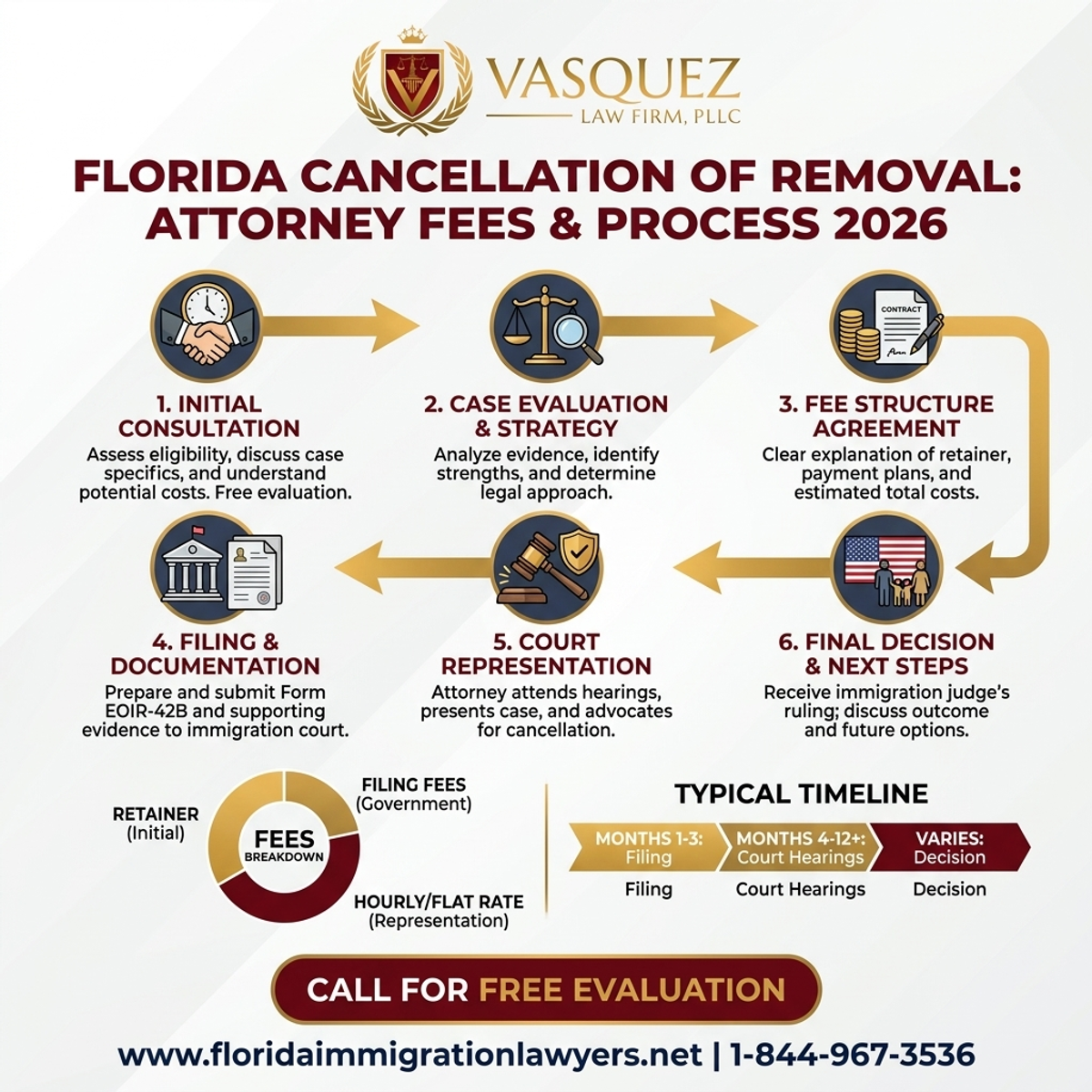
Step-by-Step Process — Cancellation of Removal Attorney Fees in Florida 2026
To establish good moral character, you will need police clearances from all jurisdictions where you have resided for six months or more since the age of 14. This includes local police departments, county sheriff's offices, and state criminal history reports. Additionally, you should provide affidavits from community leaders, employers, and family members attesting to your good character, involvement in community activities, and lack of criminal history. Any minor infractions or arrests must be disclosed and explained, as honesty is paramount. For non-LPRs, proving exceptional and extremely unusual hardship to a qualifying U.S. citizen or LPR spouse, parent, or child is critical. This requires detailed medical records, psychological evaluations, financial statements, school records (especially for children with special needs), and expert witness statements demonstrating the profound and specific harm that would result from your removal. Your attorney will guide you in compiling this extensive list, ensuring no crucial piece of evidence is overlooked.
How Long Does Cancellation of Removal Take in 2026?
The timeline for Cancellation of Removal cases in Florida, as of 2026, can vary significantly depending on the caseload of the immigration court, the complexity of your case, and whether any appeals are filed. Immigration courts, particularly those in high-volume areas like Miami and Orlando, often face substantial backlogs, which can extend processing times considerably. It is important for applicants to understand that this is rarely a quick process and requires patience and persistence.
Typically, the initial stages, from receiving a Notice to Appear (NTA) to your first Master Calendar Hearing, can take several months. After the Master Calendar Hearing, the Immigration Judge will set a date for your Individual Hearing, which is your actual trial. This Individual Hearing might be scheduled anywhere from six months to two or even three years after your initial appearance, depending on court availability. During this period, your attorney will work diligently to gather all necessary evidence and prepare your case. Once your Individual Hearing concludes, the Immigration Judge may issue a decision immediately or take several weeks or months to render a written decision. If the decision is appealed by either party to the Board of Immigration Appeals (BIA), the appeal process can add another one to two years to the overall timeline. Given these variables, a realistic expectation for the entire Cancellation of Removal process, from NTA to a final, unappealable decision, can range from three to five years or even longer in some complex cases. Your Florida Immigration Lawyers team will keep you informed about the expected timeline for your specific case and help manage expectations throughout this extended legal journey. Learn more about general immigration processes on the USCIS website.
| Stage | Typical Timeframe (As of 2026) | Notes |
|---|---|---|
| Notice to Appear (NTA) to First Master Calendar Hearing | 3-12 months | Varies by court caseload; Miami courts can be longer. |
| Master Calendar Hearing to Individual Hearing | 6 months - 3+ years | Significant backlogs in Florida immigration courts impact scheduling. |
| Individual Hearing to Judge's Decision | Immediate to 6 months | Judge may issue a decision on the bench or in writing later. |
| Appeal to Board of Immigration Appeals (BIA) | 1-2+ years | If either party appeals the Immigration Judge's decision. |
| Overall Process (NTA to Final Decision) | 3-5+ years | Highly dependent on case complexity, court schedule, and appeals. |
What Are the Typical Cancellation of Removal Attorney Fees in Florida?
Understanding the financial commitment is a significant concern for individuals pursuing Cancellation of Removal. The cancellation of removal attorney fees in Florida can vary considerably, typically ranging from $5,000 to $15,000 for comprehensive representation. This range reflects several factors, including the complexity of your specific case, whether it involves LPR or non-LPR cancellation, the attorney's experience and reputation, and the specific immigration court where your case is heard (e.g., Miami, Orlando, Pompano Beach). Complex cases involving significant criminal history, multiple entries, or highly contested hardship claims will naturally incur higher legal fees due to the increased time and effort required.
Most immigration attorneys in Florida offer a flat fee for Cancellation of Removal cases, covering all services from initial case assessment and strategy development to preparing and filing the application, gathering evidence, and representing you at all court hearings. This flat fee provides predictability and allows clients to budget accordingly. However, it is crucial to clarify what is included in the fee agreement. Some attorneys may charge hourly for specific tasks or for appeals. Beyond attorney fees, applicants must also account for government filing fees, which, as of 2026, are typically around $100 for the Cancellation of Removal application (Form EOIR-42B or EOIR-42A), though these fees are subject to change and can sometimes be waived for those who can demonstrate inability to pay. Other potential costs include fees for obtaining certified copies of documents, translation services for foreign-language documents, expert witness fees (e.g., psychologists for hardship claims), and travel expenses if the attorney needs to travel extensively. Investing in an experienced attorney for your deportation defense is an investment in your future and dramatically increases your chances of a successful outcome. Contact Florida Immigration Lawyers for a detailed discussion about your specific case and associated costs. We offer free consultations to help you understand your options without initial financial commitment. For more information on fees, you can always consult official government resources or contact us directly.
| Item | Typical Fee (As of 2026) | Notes |
|---|---|---|
| Attorney Fees (Comprehensive Representation) | $5,000 - $15,000+ | Varies by case complexity, attorney experience, and court location. Often a flat fee. |
| Government Filing Fee (EOIR-42B/42A) | ~$100 | Subject to change; fee waivers available for eligible applicants. |
| Fingerprint/Biometrics Fee | Included with filing fee or separate ~$85 (if applicable) | Required for background checks. |
| Translation Services | $20 - $50 per page | For any non-English documents. |
| Expert Witness Fees (e.g., Psychologist) | $500 - $3,000+ | For complex hardship claims, if needed. |
| Document Retrieval/Certification Fees | Varies (e.g., police records, medical records) | Costs to obtain official copies of supporting evidence. |
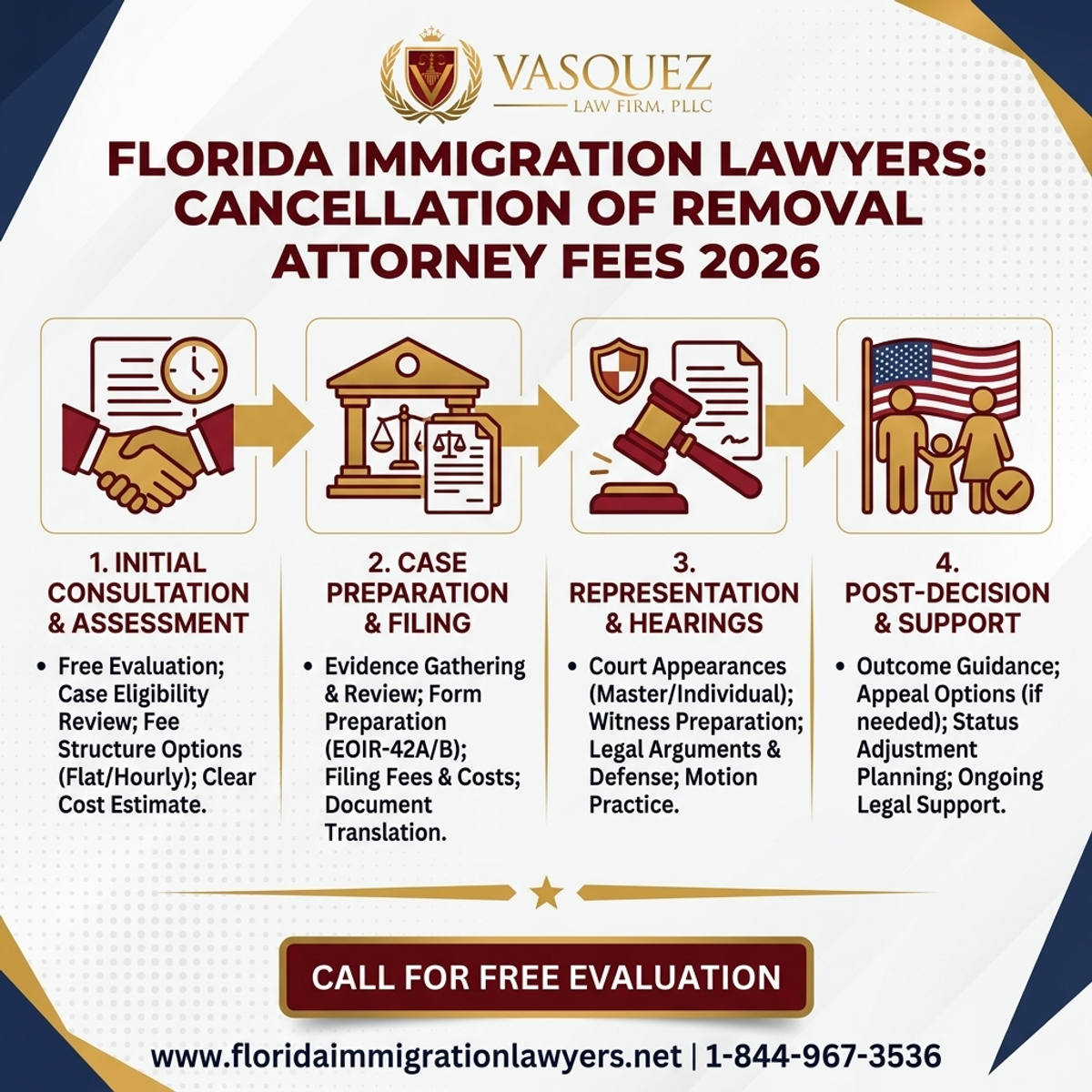
Key Statistics — Cancellation of Removal Attorney Fees in Florida 2026
Understanding "Exceptional and Extremely Unusual Hardship"
For non-LPRs seeking Cancellation of Removal, the most challenging eligibility requirement to meet is demonstrating "exceptional and extremely unusual hardship." This standard, outlined in INA Section 240A(b)(1)(D), is a higher bar than mere "hardship" and requires proof that your U.S. citizen or lawful permanent resident spouse, parent, or child would suffer a degree of hardship substantially beyond that which would ordinarily be expected to result from the alien's deportation. The Board of Immigration Appeals (BIA) and federal courts have provided guidance on what constitutes this level of hardship, emphasizing that it must be truly severe and unique.
To successfully argue exceptional and extremely unusual hardship, you must present compelling evidence of how your removal would specifically impact your qualifying relatives. This often involves demonstrating severe medical conditions that require your care or financial support, significant psychological trauma (such as separation anxiety or depression) that would befall a child, or substantial economic disruption that would leave your family destitute. For instance, if your U.S. citizen child in Miami has a severe medical condition requiring specialized, ongoing treatment that you primarily facilitate and fund, and this treatment is not readily available or affordable in your country of origin, that could be a strong argument. Similarly, if your LPR spouse in Orlando relies entirely on your income and would face extreme poverty without your financial contribution, this could also qualify. The cumulative effect of several factors can also meet the standard, even if no single factor is sufficient on its own. Evidence should include detailed medical reports, psychological evaluations, financial statements, school records, and expert testimony. General claims of emotional or financial distress are typically insufficient. Your attorney will help you gather and present specific, individualized evidence that paints a clear picture of the severe impact your removal would have on your qualifying relatives in Florida, ensuring the immigration court fully understands the gravity of your situation. This is where the expertise of Florida Immigration Lawyers becomes invaluable.
What Are the Key Differences: LPR vs. Non-LPR Cancellation?
While both Lawful Permanent Resident (LPR) and Non-LPR Cancellation of Removal offer a pathway to avoid deportation, they operate under distinct provisions of the Immigration and Nationality Act (INA) and have significantly different eligibility requirements. Understanding these differences is crucial for determining which, if any, form of relief might be available to you.
LPR Cancellation of Removal (INA 240A(a)) is available to individuals who are already green card holders. To qualify, an applicant must have been a lawful permanent resident for at least five years, have resided continuously in the U.S. for seven years after being admitted in any status, and must not have been convicted of an aggravated felony. The key here is the existing LPR status and the length of residency. The Immigration Judge considers all positive and negative factors in the applicant's life, including family ties, employment, community contributions, and criminal history, to determine if discretion should be exercised. There is no specific hardship requirement for LPR cancellation; instead, it's a balancing test of equities. For example, an LPR in Florida facing deportation due to a minor criminal offense after decades of residency might qualify.
In contrast, Non-LPR Cancellation of Removal (INA 240A(b)) is for individuals who are not lawful permanent residents but have been living in the U.S. for an extended period. The eligibility criteria are much stricter: the applicant must demonstrate continuous physical presence in the U.S. for at least 10 years immediately preceding the date of the Notice to Appear, prove they have been a person of good moral character during that 10-year period, and show that their removal would result in "exceptional and extremely unusual hardship" to a qualifying U.S. citizen or LPR spouse, parent, or child. This "10-year law" is significantly more challenging due to the high hardship standard and the strict continuous physical presence requirement (which can be broken by certain departures). An individual in Miami who has lived here for 15 years without status, has U.S. citizen children, and can prove extreme hardship to them, might be eligible. The legal citations for these provisions are found in 8 U.S.C. § 1229b.
Do not navigate this process alone. Contact Florida Immigration Lawyers today for guidance.
Common Mistakes to Avoid in Cancellation of Removal Cases
Seeking Cancellation of Removal is a complex legal battle where even minor errors can have severe consequences. Avoiding these common pitfalls can significantly improve your chances of success:
- Missing Filing Deadlines: Immigration courts operate on strict schedules. Missing a deadline for filing your application (Form EOIR-42B or EOIR-42A) or submitting evidence can lead to a denial without review.
- Incomplete Documentation: Failing to provide all required supporting documents for continuous physical presence, good moral character, or hardship leaves gaps in your case and weakens your claims.
- Lack of Proof for Good Moral Character: Simply stating you have good moral character is not enough. You need concrete evidence like police clearances, tax records, employment history, and affidavits.
- Failing to Meet the Hardship Standard (for Non-LPRs): Many applicants underestimate the "exceptional and extremely unusual hardship" requirement. General claims of emotional or financial difficulty are insufficient; specific, severe impacts must be proven.
- Not Disclosing All Past Issues: Any prior arrests, charges, or immigration violations, even if dismissed or minor, must be disclosed. Failure to do so can be considered a misrepresentation and lead to denial.
- Attending Court Alone: Representing yourself in immigration court is highly risky. An experienced attorney understands the law, court procedures, and how to present your case effectively.
- Not Understanding Court Procedures: Immigration court rules and procedures are unique and complex. Misunderstanding them can lead to procedural errors or missed opportunities to present evidence.
- Failing to Update Your Address: If you move, you must update your address with the immigration court and USCIS. Missing notices due to an outdated address can result in an order of removal in absentia.
- Ignoring a Notice to Appear (NTA): Receiving an NTA is a serious matter. Ignoring it will lead to an order of removal by the Immigration Judge, often without you even being present.
- Not Preparing for Testimony: Your testimony is a crucial part of your case. Being unprepared or inconsistent can undermine your credibility and weaken your claims.
- Underestimating Case Complexity: Cancellation of Removal is one of the most challenging forms of immigration relief. Assuming it's simple or that you can handle it yourself is a grave mistake.
- Not Seeking Legal Counsel Early: The sooner you engage an attorney, the more time they have to prepare a strong defense, gather evidence, and strategize. Early intervention is key.
When to Call a Lawyer for Cancellation of Removal in Florida
The decision to seek legal counsel is paramount when facing deportation proceedings and considering Cancellation of Removal. This area of law is incredibly complex, with intricate eligibility requirements, strict deadlines, and high stakes. You should contact an experienced immigration attorney at Florida Immigration Lawyers immediately if you receive a Notice to Appear (NTA) from the Department of Homeland Security, or if you believe you may be placed into removal proceedings.
Specific scenarios that absolutely warrant legal assistance include having any criminal history, even minor arrests or charges, as these can significantly impact your eligibility for relief. If you have any doubts about your continuous physical presence, good moral character, or your ability to prove "exceptional and extremely unusual hardship" to a qualifying relative, an attorney can help assess your case and identify potential challenges. Individuals who struggle with English, have difficulty gathering extensive documentation, or feel overwhelmed by the court process will greatly benefit from professional representation. An attorney can explain the charges against you, identify all available forms of relief, and guide you through every step of the immigration court process in Florida, from Master Calendar Hearings to Individual Hearings. Do not wait until your court date is imminent; early intervention allows for thorough case preparation and a stronger defense against deportation. Florida Immigration Lawyers offers comprehensive deportation defense services, including specific experience in Cancellation of Removal cases for clients across Florida, including Miami, Orlando, and surrounding areas. We are here to fight for your right to remain in the U.S.
About Florida Immigration Lawyers: Cancellation of Removal Attorney Fees in Florida 2026
Florida Immigration Lawyers is an immigration law firm dedicated to serving individuals and families across the entire state of Florida. Our team of compassionate and highly skilled attorneys possesses extensive experience in all facets of immigration law, with a particular focus on complex deportation defense cases, including Cancellation of Removal. We understand the profound impact immigration challenges have on people's lives and are committed to providing zealous advocacy and personalized legal strategies.
We offer a wide range of services, including family-based immigration, business immigration, asylum claims, naturalization, and, crucially, defending clients against removal. Our attorneys are intimately familiar with the procedures and nuances of immigration courts in Orlando and other Florida jurisdictions. We pride ourselves on clear communication, thorough preparation, and a client-centered approach. When you choose Florida Immigration Lawyers, you gain a dedicated partner who will meticulously analyze your case, gather compelling evidence, and represent your best interests at every stage. We are available 24/7 and offer free consultations to help you understand your options without any initial financial burden. Your future in Florida is our priority.
Sources and References: Cancellation of Removal Attorney Fees in Florida 2026
- U.S. Citizenship and Immigration Services (USCIS)
- Executive Office for Immigration Review (EOIR)
- 8 U.S.C. Chapter 12 - Immigration and Nationality Act (specifically 8 U.S.C. § 1229b)
- Code of Federal Regulations (CFR) - Title 8, Aliens and Nationality
- USCIS Policy Manual
- Board of Immigration Appeals (BIA) Precedent Decisions
Related services: asylum and refugee protection, immigration waivers, humanitarian protection programs, DACA renewal and applications.
This article provides general legal information and is not intended as legal advice. Every case is unique, and outcomes depend on specific facts and circumstances. Contact an attorney for advice about your particular situation.
Do not let the complexities of immigration law dictate your future. If you are facing deportation or have questions about Cancellation of Removal, the time to act is now. Contact Florida Immigration Lawyers for a free, confidential consultation. Our experienced team is ready to provide the guidance and representation you need. Call us today at 1-844-YO-PELEO. Se Habla Espanol - Estamos aqui para ayudarle.
If you need legal assistance, learn more about our deportation defense services, or call us at 1-844-YO-PELEO for a free consultation.
Do Not Navigate This Process Alone
Our experienced immigration attorneys are ready to fight for you. Get a free, confidential case review today.
Se Habla Español
Or leave your details and we’ll call you:
Free Evaluation in 24 Hours
Or talk to us right now

AI voice assistant — available 24/7
FreeFrequently Asked Questions

William J. Vásquez
Founding Attorney · Vasquez Law Firm
U.S. Air Force veteran and immigration attorney with years of hands-on U.S. immigration experience. J.D., NCCU School of Law. AILA member. Admitted to the 4th, 5th, and 11th Circuit Courts.
Available 24/7 - Free Evaluations
Reviewed for legal accuracy by William J. Vásquez
Licensed in North Carolina; U.S. immigration is federal practice.
Related Legal Services
Our Florida immigration attorneys can help you with citizenship and naturalization, immigration practice areas and free immigration consultation. Call today at 1-844-YO-PELEO for a free case review.
Related Links
Related Topics
Free Legal Case Review
Discuss your case with our experienced attorneys. We're available 24/7.
Se Habla Español - Estamos aquí para ayudarle.
Related Articles
EB-5 Investor Green Card in Florida: A 2026 Guide
Explore how to obtain an EB-5 investor green card in Florida. Learn about the investment requirements, processes, and benefits of participating in this program. Discover how Florida's economic landscape can be an ideal setting for your investment. Contact Florida Immigration Lawyers for a free case review.
Certificate of Eligibility for Expungement in Florida 2026
For non-U.S. citizens in Florida, understanding how a state expungement impacts immigration status is critical. A certificate of eligibility for expungement in Florida allows a criminal record to be sealed or expunged under state law. However, federal immigration agencies often disregard such state-level relief, still considering the original criminal offense as a conviction for immigration purposes. This can have severe implications for visa applications, green card eligibility, naturalization, and even lead to deportation. This guide clarifies the Florida expungement process, its limited effect on federal immigration law, and key steps to protect your status in 2026. Learn about common mistakes, required documents, timelines, and when to seek expert legal counsel from Florida Immigration Lawyers to navigate these complex issues effectively.
Immigration Lawyer Orlando Free Consultation in Florida
For individuals and families in Orlando, Florida, navigating the complexities of U.S. immigration law requires expert guidance. An immigration lawyer in Orlando offers crucial support for everything from visa applications and green card processes to naturalization and deportation defense. This comprehensive guide details what a free consultation covers, providing a step-by-step overview of immigration pathways, essential document checklists, and expected timelines in 2026. We also highlight common mistakes to avoid, discuss the critical role of legal counsel in deportation and asylum cases, and explain why choosing a local Orlando immigration attorney is beneficial. Florida Immigration Lawyers is dedicated to serving the diverse community of Orlando with compassionate, effective legal solutions, ensuring you receive personalized advice and robust representation for a successful immigration journey.
Consular Return After Visa Denial in Florida 2026
A 221(g) visa denial is a temporary refusal, not a final rejection, indicating that your application requires additional documents or administrative processing before a final decision. This often leads to a 'consular return' for further review by the U.S. Embassy or Consulate. Understanding the specific reasons for this refusal and how to respond accurately and promptly is vital for applicants in Florida. This comprehensive guide from Florida Immigration Lawyers explains the 221(g) process, outlines necessary documentation, details typical processing timelines, and highlights common mistakes to avoid. We also discuss when legal counsel is essential to navigate complex issues, address potential inadmissibility grounds, and ensure your response is complete and compelling. Our dedicated attorneys in Central Florida are ready to assist you in overcoming these challenges and advancing your immigration journey.