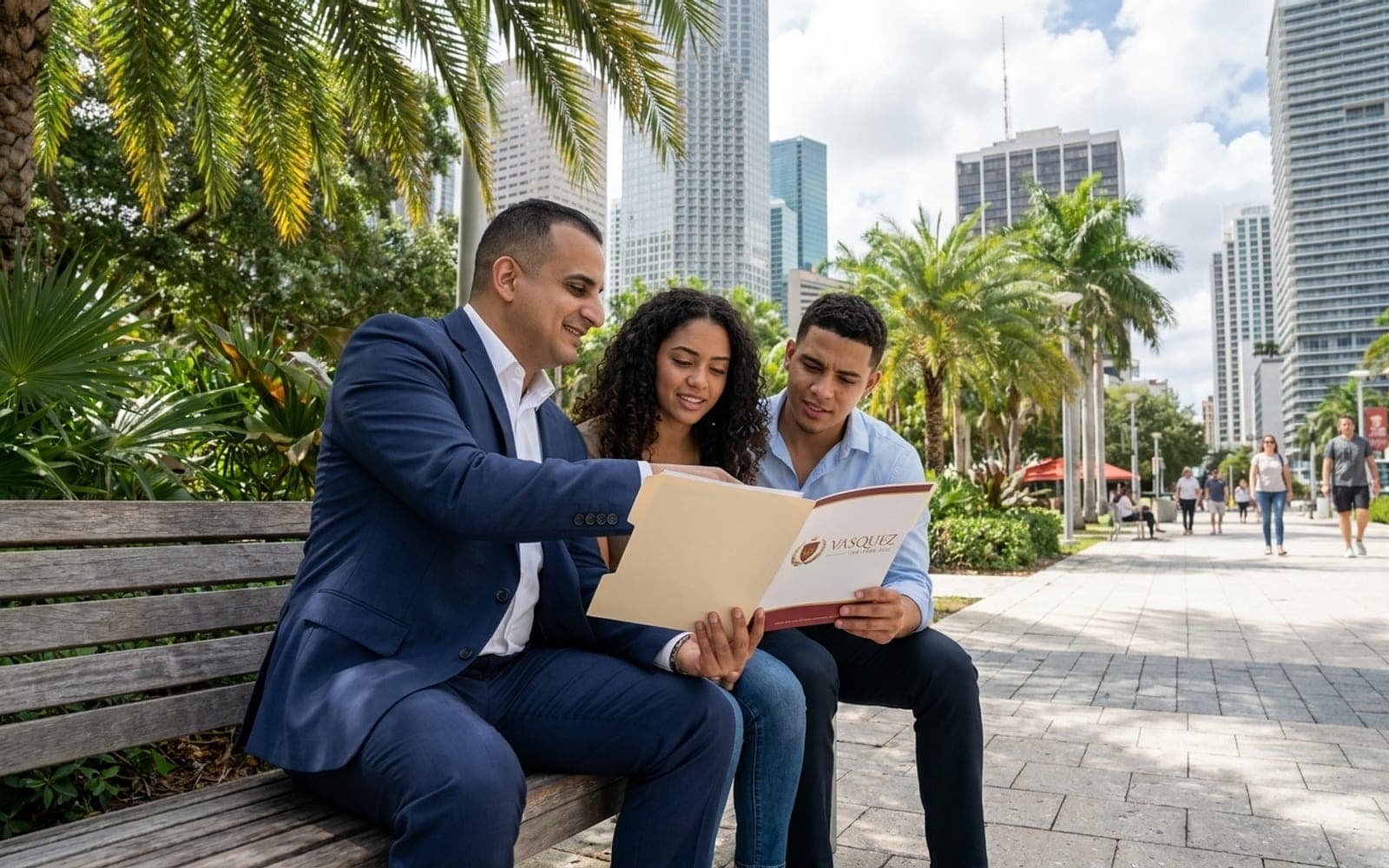
If USCIS has scheduled you for an interview, an attorney can review your file, explain which questions to expect, and go with you if a problem comes up. The most common interviews are adjustment of status interviews with Form I-485, where the officer checks whether the relationship is genuine, and naturalization interviews with Form N-400. Vasquez Law Firm prepares clients across Florida by video consultation or in Orlando, without requiring you to travel.
- Form I-485 is common in family-based green card cases, where the officer checks whether the relationship is genuine.
- Naturalization with Form N-400 includes the English and civics tests.
- Each interview depends on the type of case, the office, and the facts.
- Document review can be done remotely.
Introduction
If USCIS has scheduled you for an interview, having an immigration interview attorney lets you arrive with your file reviewed, know which questions to expect, and have someone at your side if a problem comes up. This guide explains what an immigration interview is like, how to prepare, and how to make sense of the many ways people search for representation in Spanish. It is written for people with a pending appointment for a green card, citizenship, or asylum, and for their families. If you would like your case reviewed, call 1-844-YO-PELEO or contact us.
At Vasquez Law Firm we serve clients throughout Florida from our only office in Orlando and by video consultation, in Spanish and English. We also meet in person in Orlando when that is useful. Remote service lets us review documents and prepare for the interview without requiring you to travel.
This article is general information and not legal advice. Each interview depends on the type of case, the office that schedules it, and the facts of the case. Use this guide to prepare, not to replace a review by an attorney who knows your complete file.
Which immigration interviews are most common
Most of the appointments we see look like one of these:
- Adjustment of status (Form I-485): common in family-based green card cases, where the officer reviews whether the relationship is genuine and whether the person is admissible.
- Naturalization (Form N-400): includes the English and civics tests, plus questions about what you stated in the application.
- Removal of conditions on residence (Form I-751): an interview is not always scheduled, but when it is, it focuses on the couple's life together.
- Affirmative asylum: held before an asylum officer and is usually long and detailed.
Consular interviews, which take place at an embassy or consulate outside the United States, work differently. In general the attorney does not enter the room with you, but can prepare the case and advise you if the visa is placed in additional review or denied.
What your attorney does before, during, and after the appointment
Before the interview we review everything you filed, compare dates and details, look for contradictions, and explain which topics in your case are sensitive, such as an old arrest or a departure from the country. In many USCIS proceedings the attorney can accompany the client to the interview if the appropriate representation form has been filed.
During the appointment the attorney can clarify the procedure, ask that a confusing question be repeated, and take note of what the officer requests. Afterward, if the officer asks for more evidence, the attorney helps you respond within the stated deadline.
A person looking for a lawyer for immigration paperwork usually needs exactly this: someone who does not just fill out forms, but stays with you until the case is finished. And a person looking for a lawyer for immigration matters in general often has several fronts open at once, such as a family petition, a work permit, and a pending appointment.
One point many people overlook is what happens if the officer notices a discrepancy. For example, a travel date that does not match the passport, or an address that changed and was never updated. With enough time, an attorney can explain the discrepancy with documents and keep it from looking like an attempt to hide something. That is why reviewing the file in advance is not a minor step, but one of the most valuable parts of preparation.
If the officer decides the case cannot be resolved at the same appointment, the officer may request more evidence or schedule a second interview. That does not mean the case is lost, but it does require you to respond in an orderly way and within the deadline stated in the notice.
How to prepare for the interview step by step
- Read the entire appointment notice and confirm the exact date, time, and address.
- Go over a copy of everything you filed with your attorney, so that your answers match your forms.
- Gather the originals of the documents the notice asks you to bring, plus copies.
- Prepare the evidence for your case, such as photographs, shared accounts, or contracts, depending on the type of case.
- Practice clear, honest answers to the most likely questions, without memorizing a script.
- Arrive early, bring a valid ID, and follow the building's security instructions.
- After the appointment, keep any document you are given and let your attorney know right away.
In the interview, answer only what you are asked, truthfully, and ask for anything you did not understand to be repeated. If you do not remember a detail, it is better to say so than to invent an answer, because a contradiction can raise doubts about your credibility.
Understanding the names people use to search for a lawyer
Spanish-language immigration vocabulary has many variants. In some countries people say migración and in the United States, inmigración; that is why searches such as abogado de migraciones or abogada migratoria appear. Some people prefer to speak with a female attorney, and that is a legitimate preference. All of these point to the same kind of professional: a licensed attorney who represents people before USCIS, in immigration courts, and before other agencies.
Something similar happens with the word federal. A person searching for a federal immigration lawyer is right on one point: the laws and the agencies are federal. But that does not mean the attorney works for the government. A federal immigration lawyer in that sense is a private, licensed attorney, and you should be wary of anyone who presents themselves as a government official.
Titles, certifications, and recognitions: what to verify
Many people look for an attorney with an official title in immigration law. In Florida, the Florida Bar's rules are strict: an attorney may advertise a credential of that kind only if they meet the formal requirements the Bar sets. You can ask any attorney what credentials they hold and ask them to show proof. Our firm does not use labels of that kind; we say only that we focus on immigration.
It is also wise to be careful with anyone who advertises as recognized or recommended without saying who recognizes or recommends them, because a purchased award guarantees nothing. To verify an attorney in Florida, you can check their license status with the Florida Bar. For an accredited representative, the official information is published by the Department of Justice.
Humanitarian cases, community, and faith
Some people look for an immigration lawyer for humanitarian cases because their situation does not fit a family or employment petition. Depending on the facts, protections may exist such as asylum, certain visas for victims of crime or violence, or relief for minors. Each has its own requirements and deadlines, and an attorney must review your story to know whether any of them applies.
Others look for LGBT immigration lawyers because they fear discussing their orientation or identity with a stranger. Sexual orientation and gender identity can be part of a protection claim, and those cases involve sensitive deadlines and evidence; the most prudent course is to speak with an attorney early and in confidence.
Someone who searches for Christian immigration lawyers is looking to share values, and that is a legitimate preference; what matters is that the attorney is licensed and honestly explains your options. The same goes for those who search for Venezuelan lawyers: we serve people of every nationality, and what matters is how the law applies to your personal history, not the attorney's country of origin.
Ratings, reviews, rankings, and firm size
It is common for people to search for highly rated immigration lawyers expecting a ranking. Ratings come from reviews, which reflect an individual experience and do not promise the outcome of your case. Something similar happens with someone searching for a good immigration lawyer: what each person means by good varies, so it helps to define first what you need, for example clarity, steady communication, and respect for deadlines.
There is no official ranking that answers those searches, and no firm should claim to hold first place, because Florida's attorney advertising rules prohibit it. Read full reviews, compare how each office explains the process, and ask every office the same questions.
Some people look for an immigration law firm with the idea that a large firm resolves cases faster. Not necessarily: size says nothing about who will handle your case or how much time they will give it. Ask who your attorney will be, who answers your calls, and how often you will hear updates.
Document checklist for your consultation or interview
- The USCIS appointment notice or court notice, with date and time.
- Passport, identity documents, and prior immigration papers.
- A copy of everything you filed before, including forms and receipts.
- Evidence of the relationship or case: photos, shared accounts, leases, or letters, depending on the type of case.
- Birth and marriage certificates, with a translation if they are not in English.
- Arrest or criminal case records, if any.
If you do not have something, come anyway. At the consultation we review what is missing and how to get it.
Timelines and expectations
Interview appointments are scheduled after USCIS reviews the application, and the time until that appointment depends on the office, the category, and the workload. USCIS publishes its current processing times and changes to its procedures, and you should check them directly. After the interview, the decision may arrive the same day, within weeks, or with a request for more evidence, and we cannot promise dates.
The appointment notice states the exact location, which usually corresponds to the local office based on your address. If you need to reschedule, do so in advance and following the notice's instructions, and do not skip the appointment without notifying USCIS. The table summarizes the usual stages.
| Stage | What happens | Who acts |
|---|
| Filing | The form is submitted with the evidence | Client, attorney, and USCIS |
| Appointment notice | USCIS sends a letter with the date and place | USCIS |
| Preparation | The file is reviewed and questions are practiced | Client and attorney |
| Interview | An officer reviews the case and asks questions | Client, attorney, and officer |
| Decision or additional evidence | The case is approved, more evidence is requested, or it is denied | USCIS and client |
Online service, proximity, and emergencies
People who search for immigration lawyers near me usually want physical proximity. We have a single office, at 1111 E Amelia Street, Orlando. We serve clients in Miami, Tampa, Jacksonville, and other cities by video call, and the vast majority of steps are handled remotely. People who need online immigration lawyers are usually looking for convenience, or live far away or work difficult hours. For them we offer secure video consultations; before that consultation, gather your documents and key dates.
A search for a lawyer available 24 hours a day often comes from an emergency, such as a detention. We do not promise round-the-clock availability, and you should be skeptical of anyone who does; what we do recommend is contacting us as soon as possible through the contact page or by phone, and stating your deadline or the urgency. You can see the cases we handle on our immigration services page.
Cost factors and fee breakdown
The cost of a case with an interview includes agency fees, document expenses, and attorney fees, and each item depends on the type of case.
| Item | Amount | Notes |
|---|
| USCIS application (I-485, N-400, I-751, or other) | Check USCIS for the current fee | Each form has its own fee |
| Fingerprints or biometric services | Check USCIS for the current fee | May be included depending on the form |
| Translations and copies | Varies by case | Documents in Spanish require translation |
| Medical exam, if required | Varies by case | Applies to certain green card cases |
| Attorney fees | Varies by case | Ask for the agreement in writing before you begin |
Agency fees are updated regularly, and paying the wrong amount can cause your application to be rejected. Always verify the current amount on the official website before sending a payment.
Ask whether the fees include accompanying you to the interview and responding to requests for additional evidence. A written agreement lets you know clearly what you receive in return.
Common mistakes to avoid
- Going to the interview without having reviewed what you filed, and answering differently from what you stated.
- Memorizing a script instead of understanding your own case and answering truthfully.
- Not bringing the originals the appointment notice asks for.
- Missing the appointment without notice or without following the procedure to reschedule.
- Hiding an arrest or a trip that the officer may find in their records.
- Hiring someone who promises a sure approval or presents themselves as a government official.
- Paying notaries or agents who are not attorneys for immigration advice.
When to call an attorney
It is wise to call an attorney as soon as you receive the appointment notice, not the night before. It is also a good time to consult if you have an arrest, a long trip abroad, or a contradiction between documents, if the officer asked for more evidence, if your case moved to immigration court, or if a family member was detained. Call 1-844-YO-PELEO and state the date of your appointment or the urgency, so that we can organize the preparation with the time available.
About Vasquez Law Firm
Vasquez Law Firm practices immigration law only. Our only office is at 1111 E Amelia Street, Orlando, and we serve clients throughout Florida by phone and secure video call, with in-person meetings in Orlando. William J. Vásquez is the founding attorney. Consultations are offered in Spanish and English. Call 1-844-YO-PELEO or write to us here.
Sources and references
Related services: immigration services, immigration lawyers in Florida
Other ways people search for this help
People search for this help using different words. Related searches: immigration lawyer for humanitarian cases in Tampa; female immigration lawyers; highly rated immigration lawyer; immigration law specialist attorney; immigration specialist lawyer; migration specialist lawyer; expert immigration lawyer; migration lawyer; lawyer for migration; certified immigration lawyers; immigration lawyers near me; certified immigration attorneys; good immigration lawyers; immigration law offices; recommended immigration lawyers; well-known immigration lawyers; Venezuelan immigration lawyers; immigration lawyer's office; migration law firm; immigration lawyers online consultation; best female immigration lawyer; best immigration lawyer; best immigration law firm.
This article is general information, not legal advice. Every case is different; speak with an immigration attorney about your situation.