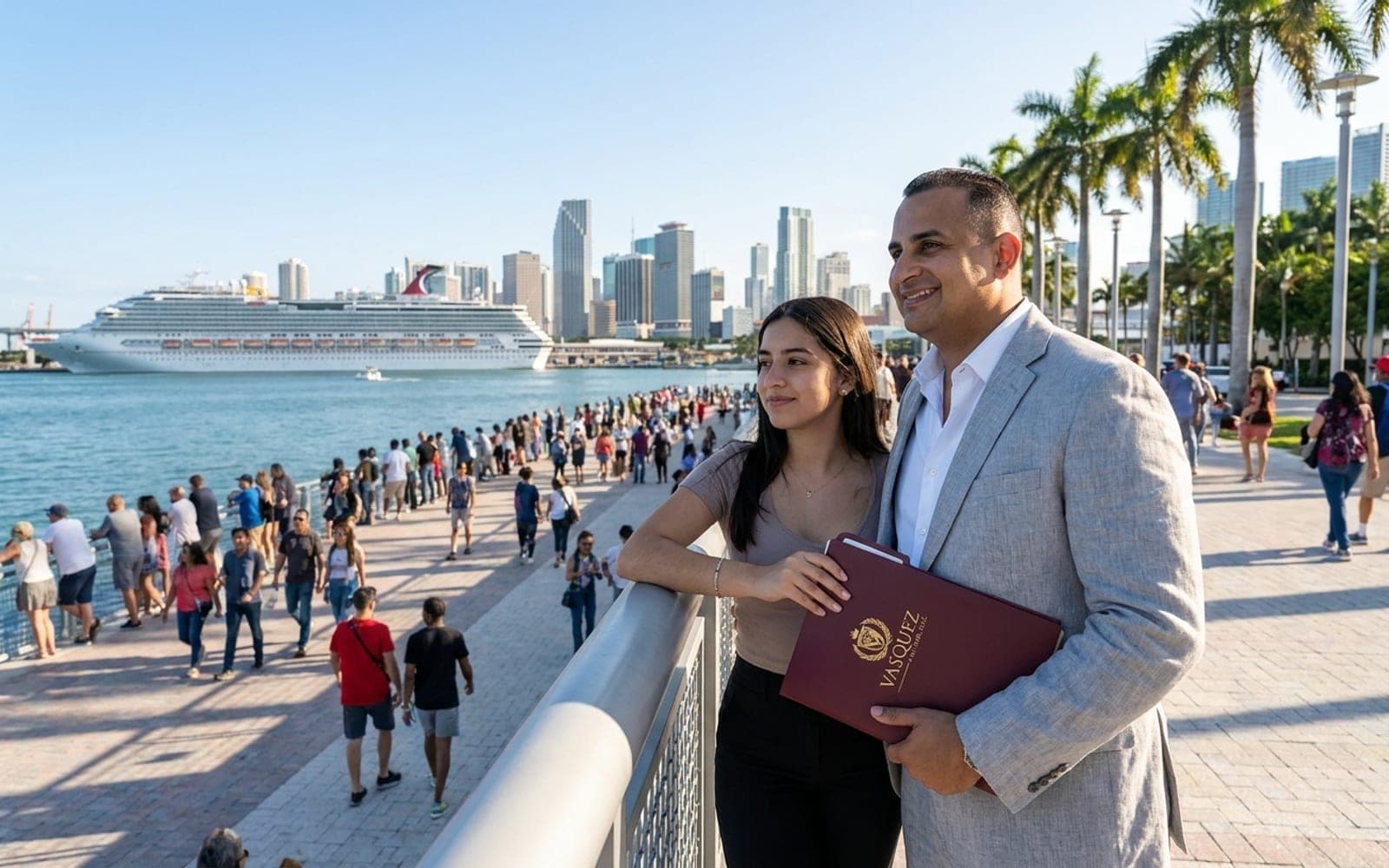
If you live in Miami, you can speak with an immigration attorney in Spanish without an interpreter. Vasquez Law Firm serves clients in Miami-Dade by video call and phone, and in person at its only office, in Orlando. The guide reviews common cases such as the Cuban Adjustment Act, asylum, and options for crime victims, explains how USCIS and immigration court work, and offers criteria for choosing calmly and preparing for the consultation.
- The Cuban Adjustment Act allows many Cubans with one year of presence to apply for residence.
- It explains how USCIS and immigration court work.
- There are options for crime victims, which must be reviewed case by case.
- Service is remote or at the Orlando office.
Introduction
If you live in Miami and need help with an immigration matter, you can speak with a Spanish-speaking immigration attorney for Miami without having to translate your story or depend on an interpreter. At Vasquez Law Firm we serve clients in Miami-Dade County by video call and phone, and in person at our only office, which is in Orlando. To get started, call 1-844-YO-PELEO or contact us.
This guide explains the most common cases among Miami families, how filings with USCIS and immigration court work, what options exist for crime victims, and how to prepare for the first consultation. It also offers practical criteria for choosing an attorney calmly.
The content is general information and does not constitute legal advice. Immigration laws, designations, and policies change, and each case depends on specific facts that only an attorney can evaluate after reviewing your documents.
Common immigration cases in Miami
Miami brings together families from Cuba, Venezuela, Nicaragua, Haiti, Colombia, Honduras, and many other countries, and that shows in the kinds of cases people ask about. Someone looking for an immigration attorney in Miami usually has one of these situations:
- Adjustment under the Cuban Adjustment Act: this law allows many Cubans who were admitted or paroled, with at least one year of physical presence in the United States, to apply for permanent residence. The requirements and exceptions must be reviewed case by case.
- Asylum: for people who fear persecution in their country because of race, religion, nationality, political opinion, or membership in a particular social group. In general, it must be requested within the first year after arrival, with limited exceptions.
- TPS: Temporary Protected Status depends on government designations that change over time, so the current situation for each country must be confirmed.
- Family petitions and residence: citizens and residents petitioning for spouses, children, parents, or siblings.
- Citizenship: permanent residents who meet the requirements to naturalize.
Each of these areas has its own forms, deadlines, and risks. That is why the first consultation serves to identify the right path before filing any application, and to detect whether you have more than one option.
Humanitarian cases: victims and vulnerable people
Many people look for an immigration attorney for humanitarian cases in Miami because they were victims of a crime, domestic violence, or trafficking. The law offers several protections, each with different requirements:
- The U visa is for victims of certain crimes who suffered harm and who have cooperated or are willing to cooperate with the authorities; it requires a certification signed by a law enforcement agency or another qualifying authority.
- The VAWA self-petition allows a spouse, child, or parent abused by a citizen or resident to file their own case without depending on the abuser.
- The T visa protects victims of human trafficking.
- Special Immigrant Juvenile Status exists for certain minors who cannot reunite with one or both parents because of abuse, abandonment, or neglect.
Telling what happened is not easy, and an attorney can help you do so in a trusting setting, in your language. What you share is confidential. You will find more information on our page about asylum and humanitarian protection.
Residence, citizenship, and temporary programs
In addition to humanitarian cases, many Miami families ask about permanent residence through a relative and about citizenship. A citizen can petition for a spouse, children and, if 21 or older, parents and siblings, while a resident can petition for a spouse and unmarried children. Spouses, parents, and unmarried children under 21 of citizens are immediate relatives, and the other categories depend on the Visa Bulletin.
For naturalization, permanent residents must meet requirements of length of residence, physical presence, good moral character, and knowledge of English and civics. A long trip or a criminal record can complicate the application, so it is wise to review your history before filing Form N-400.
As for TPS, protection depends on the government designating or extending the program for a country, and on each person meeting the arrival-date and continuous-presence requirements. Because those decisions change and are sometimes challenged in the courts, check the current situation on the official USCIS website before acting, and do not assume that an expired work card is still valid without confirming it.
How USCIS and immigration court work for Miami residents
Residence and citizenship interviews are held at the local USCIS office that corresponds to your address. There are several in the Miami-Dade area, and your appointment notice will say which one you must go to. People with a deportation case may have it in the Miami Immigration Court or, if detained, in the court that serves the detention center where they are held. The Notice to Appear and hearing notices indicate the court handling your case.
If you received a Notice to Appear, do not ignore it. Missing a hearing can result in a removal order in your absence. An attorney can review whether you qualify for a defense, such as asylum, cancellation of removal, or adjustment of status, and in some cases request a bond. See our page on deportation defense.
- Gather the notice, the envelope, and all the papers you received.
- Write down the date, time, and place of the appointment or hearing.
- Consult an attorney as soon as possible to review your options.
- Prepare the documents and the statement that support your case.
- Attend every appointment and keep your address up to date with the agencies.
How to choose among immigration attorneys in Miami
Many people type phrases into search engines to compare attorneys or look for a list of firms in Miami. Lists often mix advertisements with directories, and The Florida Bar's rules do not allow a firm to claim it is superior to others. To make an informed decision, it is wise to do the following:
- Confirm that the person is a licensed attorney. The Florida Bar has a public directory where you can look up any attorney by name.
- Be wary of "notarios" and agents. In the United States, a notary public is not an attorney and cannot represent you before USCIS or in court.
- Ask for a written explanation of what the service includes and how it is billed.
- Listen to whether the attorney explains the risks clearly. No one can promise you a result.
Whether you compare immigration attorneys in Miami or contact one on a relative's recommendation, what matters is the license, clarity, and that they review your complete history before filing any application.
How we serve Miami clients from Orlando
We do not have an office in Miami. We serve clients in Miami, Hialeah, Doral, Kendall, Homestead, and the rest of the county by secure video call and phone, and we meet with them in person in Orlando when they prefer. Documents are sent electronically and securely.
For many people looking for immigration attorneys in Miami, this means receiving legal guidance without taking a day off work and without driving for several hours. Most of the work, such as reviewing documents, preparing forms, and explaining notices, does not require being there in person. You can see all our services on our page about immigration services.
Document checklist for your immigration consultation in Miami
- Passport, entry documents (I-94, parole, or visa), and any work permit.
- All notices from USCIS or the court, even old ones.
- Birth and marriage certificates for you and your relatives.
- Documents about arrests or criminal cases, even if they were closed.
- Evidence related to your case, such as police reports or medical records in humanitarian cases.
- Documents that show your date of arrival in the country.
- A list of addresses and jobs since your entry.
If you are missing documents, do not wait until you have them all to consult. In the first conversation we identify what is essential, what can be requested from the agencies, and which deadlines are running. To schedule a consultation in Spanish or English, contact our office.
Timelines and expectations for the process
The timelines of a case depend on the type of application, the USCIS office or court handling it, and the workload of each. USCIS and the immigration courts publish their processing times and calendars, and that information changes frequently. For that reason we avoid giving dates.
Some deadlines, however, are strict and do not wait: the general one-year deadline to apply for asylum, hearing dates, and the time limits to respond to a request for evidence. Knowing them from day one is one of the main reasons to consult early.
| Stage | What happens | Who acts |
|---|
| Consultation and review | History, notices, and options are analyzed | Client and attorney |
| Preparation | Statements, forms, and evidence | Attorney and client |
| Filing | Submission to USCIS or filing with the court | Attorney |
| Appointment or hearing | Fingerprints, interview, or hearing, depending on the case | USCIS or immigration judge |
| Decision | Approval, request for evidence, denial, or appeal | Agency or judge |
Asylum and the personal statement
In an asylum case, the personal statement is the center of the file. It must tell the facts with dates, places, and people, explain why you fear returning, and connect those facts to one of the grounds the law protects. A statement with contradictions can harm the case, which is why it is reviewed carefully, based on what you actually lived through and never with invented stories.
In addition to the statement, evidence is gathered: reports on country conditions, identity documents, police reports, medical records, and witness statements. If you already have a court summons, asylum is filed before the judge; if not, it can be filed with USCIS. Each route has different consequences, and it is best to decide it with an attorney.
Remember the general one-year deadline from arrival, which allows limited exceptions. If that deadline has already passed or is about to expire, consult immediately, because some people may still have other forms of protection or relief.
What families can expect at the first consultation
The first conversation is not an exam or a trial. It is about you telling your situation, reviewing your documents, and explaining the options that appear to exist, the information that is missing, and the next steps. If there is an upcoming date, such as a hearing or an interview, that will be the first question, so the work can be organized according to urgency.
After the consultation, you decide calmly whether you want to hire the firm. Before signing, ask for the scope of work in writing and for an explanation of how communication will be maintained. That way you can compare with other options with clear information and without pressure.
Cost factors and fee breakdown
The costs of a case in Miami are divided between official fees and legal fees, and both depend on the type of case.
| Item | Amount | Notes |
|---|
| Asylum or benefit application with USCIS | Check USCIS for the current fee | The agency publishes the current amount |
| Court filings and appeals | Check with the court or agency for current fees | Depends on the type of document |
| Medical exams and biometrics | Varies by case | Depends on the case type |
| Translations and evidence | Varies by case | Depends on the volume of documents |
| Immigration bond | Varies by case | Set by the authority and depends on each case |
| Legal fees | Varies by case | Explained in writing before hiring |
Official fees are updated, so verify the amount on the agency's website before paying. For asylum cases and some humanitarian ones, the fee rules are particular, so review them in the current form instructions.
Always ask that the contract state what work is included and which payments are separate. Be wary of any attorney who guarantees a result, and ask clearly what happens if the case becomes complicated.
Common mistakes to avoid
- Ignoring a Notice to Appear or missing a hearing.
- Letting the general one-year deadline to apply for asylum pass without consulting.
- Trusting a notary or agent for legal immigration matters.
- Submitting a statement with inaccurate or invented details.
- Assuming the TPS or Cuban Adjustment Act rules apply to you without reviewing your case.
- Hiding arrests or criminal cases from your attorney.
- Choosing an attorney only by reviews or ads, without confirming their license.
When to call an attorney
Call an attorney as soon as you receive a court notice, a removal order, a detention, or a USCIS letter you do not understand. You should also consult if you were the victim of a crime, if you fear returning to your country, if you have a deadline coming up, or if a benefit was already denied. In an emergency, do not wait: call, explain the situation, and have the documents you received at hand. You can write to us or call 1-844-YO-PELEO.
About Vasquez Law Firm
Vasquez Law Firm practices immigration law only. Our only office is at 1111 E Amelia Street in Orlando, Florida. We serve clients statewide by phone and secure video call, and in-person meetings take place in Orlando. The firm's founder is attorney William J. Vásquez, and consultations are offered in Spanish and English. We do not have an office in Miami; we serve Miami-Dade County remotely. To speak with our team, call 1-844-YO-PELEO or write to us from our contact page.
Sources and references
Related services: asylum and humanitarian protection, immigration attorneys in Florida
Other ways to search for this help
People search for this help using different words. Related searches: spanish-speaking immigration attorney in hialeah; immigration lawyer in miami; immigration attorney for humanitarian cases miami; immigration lawyer miami; immigration attorneys in miami fl; list of immigration attorneys in miami florida.
This article is general information, not legal advice. Every case is different; speak with an immigration attorney about your situation.