Family Petition Immigration Lawyer in Miami: What to Know
If your father's family is applying for citizenship, understanding the family petition process is crucial. Learn how an immigration lawyer in Miami can assist you.
- Form I-130 initiates the process
- Eligibility depends on your status
- Documents and fees required
- Processing times vary
Introduction: Family Petition Immigration Lawyer in Miami
When your father's family decides to apply for citizenship, understanding the family petition process becomes crucial. Whether you're in Miami or elsewhere in Florida, knowing the steps involved can simplify this complex journey. This article will cover the essentials of filing a family petition, the role of an immigration lawyer, and specific information relevant to Naples and other Florida regions. Call Florida Immigration Lawyers at 1-844-YO-PELEO for a free consultation.
Embarking on the path to U.S. citizenship for family members is a significant life event, often filled with hope and anticipation. It's a journey that can strengthen family bonds across borders, but it also requires meticulous attention to detail and a deep understanding of U.S. immigration law.
The process, while rewarding, can be lengthy and fraught with potential pitfalls. Having a clear roadmap and professional guidance from experts like Florida Immigration Lawyers can make all the difference, ensuring that every step is taken correctly to avoid unnecessary delays or complications for your loved ones.
What is a Family Petition and How Does it Work?
As of 2026, a family petition is a legal process allowing U.S. citizens and lawful permanent residents to sponsor certain relatives for immigration. It begins with filing Form I-130, Petition for Alien Relative, with the U.S. Citizenship and Immigration Services (USCIS).
This form establishes a qualifying relationship between the petitioner and the beneficiary. The approval of Form I-130 does not grant immediate residency but serves as a critical step toward obtaining a family visa.
Eligibility varies: U.S. citizens can petition for spouses, children, parents, and siblings, while permanent residents can only sponsor spouses and unmarried children. Each category has different processing times and visa availability, influenced by the Visa Bulletin published monthly by the State Department.
Understanding the distinction between "immediate relatives" and "preference categories" is vital. Immediate relatives (spouses, unmarried children under 21, and parents of U.S. citizens) do not face visa quotas and can often proceed with their applications more quickly once the I-130 is approved. In contrast, preference categories, such as married children, adult children, and siblings of U.S. citizens, or spouses and unmarried children of lawful permanent residents, are subject to annual numerical limits, leading to potentially long waiting periods.
For instance, a U.S. citizen petitioning for a sibling might face a wait time spanning over a decade due to high demand and limited visa availability. An immigration lawyer from Florida Immigration Lawyers can help you understand these categories and provide a realistic timeline based on the current Visa Bulletin and your specific circumstances.
How to File Form I-130: A Step-by-Step Guide
- Determine Eligibility: Confirm your status as a U.S. citizen or permanent resident and the relationship with the beneficiary.
- Gather Required Documents: Include proof of citizenship or residency, relationship evidence, and identity documents.
- Complete Form I-130: Fill out the form accurately, ensuring all sections are complete.
- Submit the Form: Send the completed form and accompanying documents to the appropriate USCIS lockbox or service center.
- Pay the Filing Fee: Fees vary, so check the current amount on the USCIS website.
- Receive a Receipt Notice: USCIS will send a receipt notice confirming the form's acceptance.
Filing Form I-130 requires meticulous attention to detail. Every question on the form must be answered truthfully and completely. Any omissions or inaccuracies could lead to Requests for Evidence (RFEs) or even denial, significantly prolonging the process. It's crucial to cross-reference all information with supporting documents to maintain consistency.
Beyond the basic steps, preparing a strong petition involves more than just filling out a form. For example, when petitioning for a spouse, you'll need compelling evidence to prove the bona fides of your marriage, such as joint bank accounts, shared leases, photos, and affidavits from friends and family. A well-organized submission package, including a cover letter and clearly labeled tabs for each type of evidence, can greatly assist USCIS officers in reviewing your case efficiently. Seeking assistance from Florida Immigration Lawyers can ensure your petition is robust and complete.
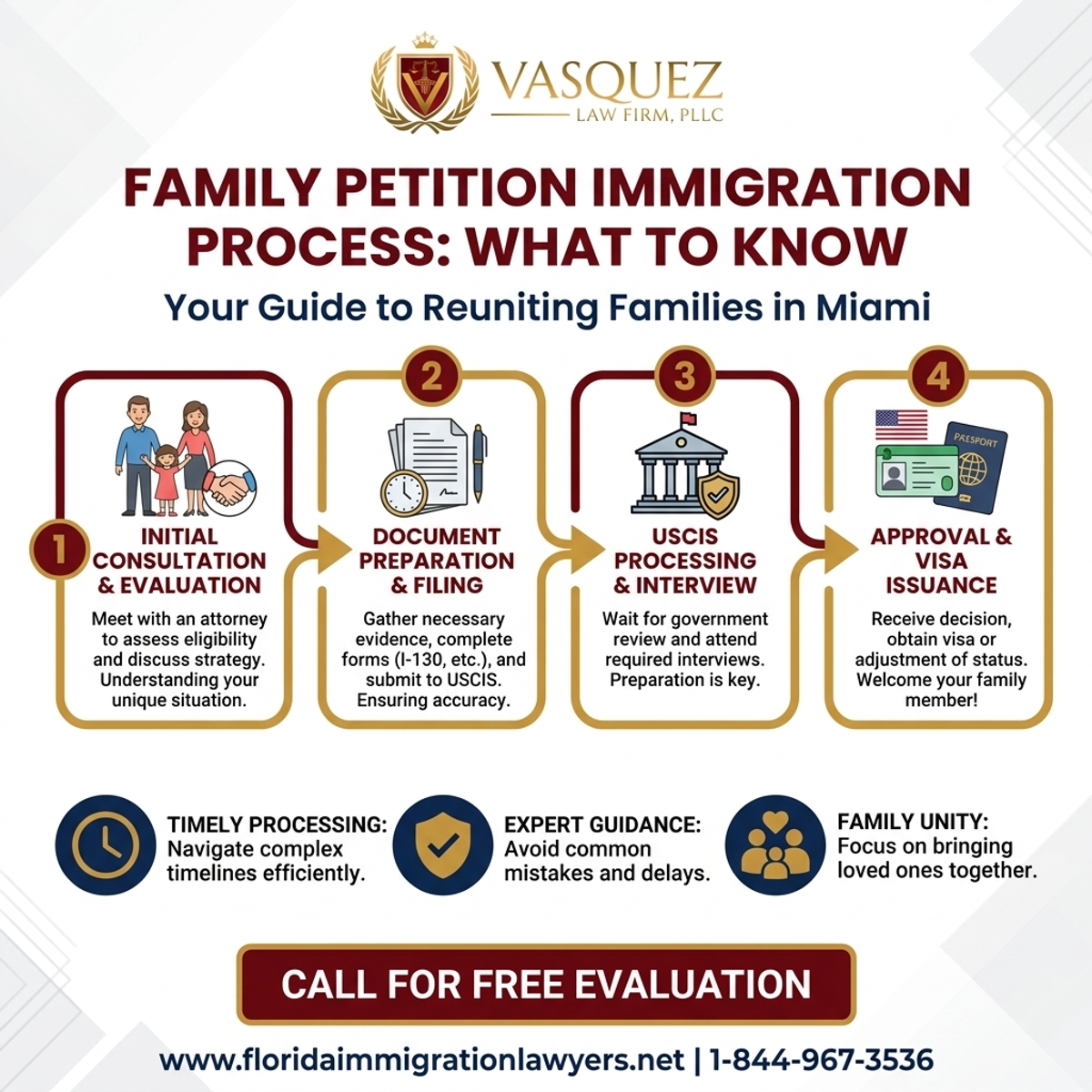
Step-by-Step Process — Family Petition Immigration Lawyer in Miami: What to Know
Processing times can vary significantly depending on the relationship category and USCIS workload.
Checklist of Required Documents for an I-130 Petition
When preparing an I-130 petition, ensure you have the following documents:
- Proof of U.S. citizenship or lawful permanent residency
- Evidence of relationship (e.g., birth certificates, marriage certificates)
- Passport-sized photos of both petitioner and beneficiary
- Filing fee payment
- Form I-130 completed and signed
- Any additional evidence requested by USCIS
Having all documents ready helps prevent delays and complications in the processing of the petition. It's not enough to simply have the documents; they must be current, legible, and, if not in English, accompanied by certified translations. For example, birth certificates should clearly show the names of both parents, establishing the parental relationship. Marriage certificates should be official records from the issuing government authority. Organizing these documents meticulously in a well-indexed package can significantly streamline the review process for USCIS.
How Long Does the Family Petition Process Take?
Processing times for family petitions vary based on several factors as of 2026. Here's a general timeline:
| Stage | Typical Timeframe | Notes |
|---|---|---|
| Receipt Notice | 2-3 weeks | After submission |
| Approval of I-130 | 6-12 months | Varies by category |
| Visa Availability | Varies | Depends on Visa Bulletin |
| Consular Processing | 3-6 months | If applicable |
The total duration of the family petition process is heavily influenced by the specific relationship category and the beneficiary's country of origin. For immediate relatives of U.S. citizens, the primary delay often lies in the I-130 approval itself and subsequent adjustment of status or consular processing. However, for preference categories, the longest wait is typically for a visa number to become available, which can take several years, or even over a decade, depending on the demand from their home country.
For instance, a U.S. citizen petitioning for a married son from Mexico might face a wait time of over 20 years for a visa number. These fluctuating timelines underscore the importance of filing accurately and as early as possible. Staying informed about the monthly Visa Bulletin and consulting with Florida Immigration Lawyers can help manage expectations and plan for the future effectively.
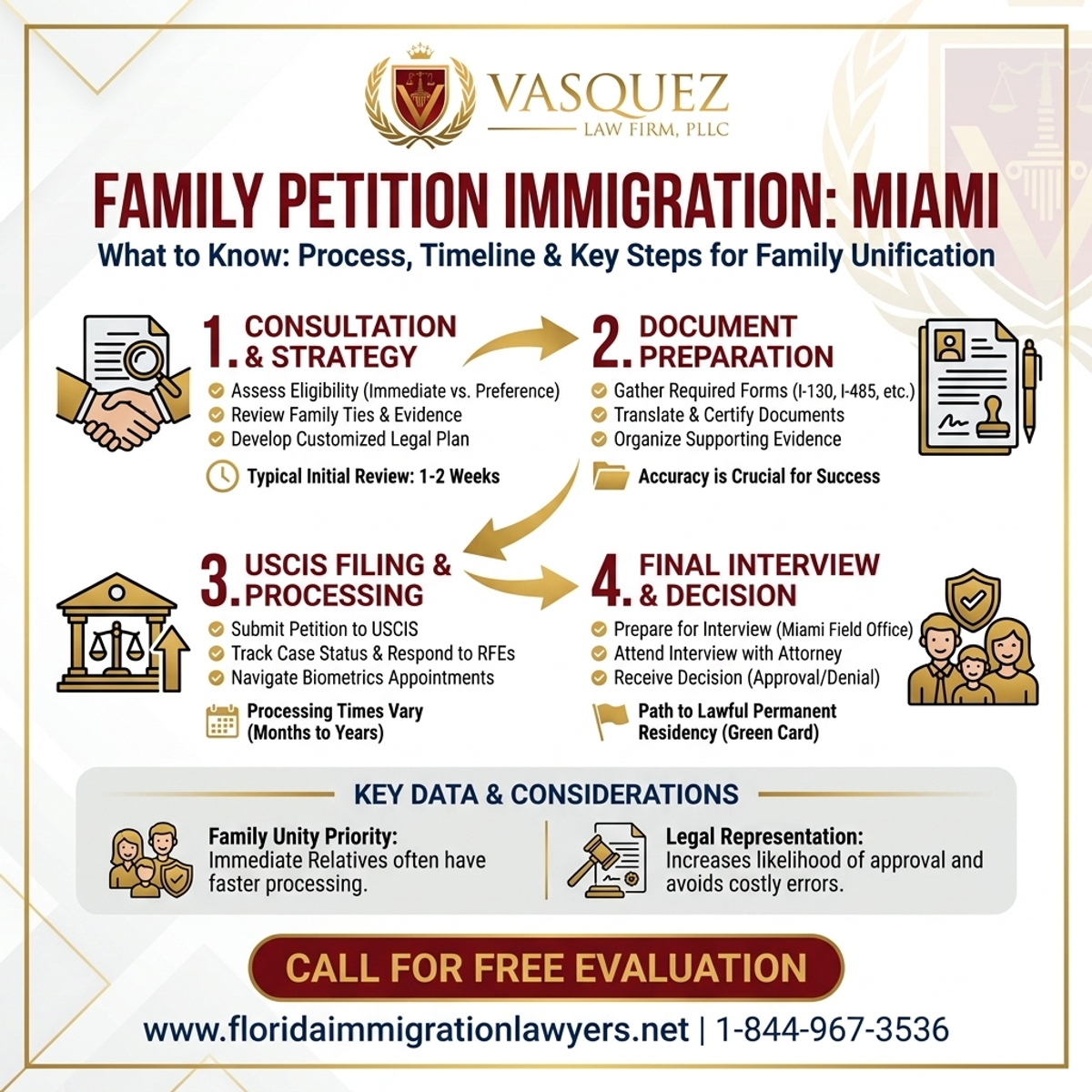
Key Statistics — Family Petition Immigration Lawyer in Miami: What to Know
Consulting with an immigration lawyer can provide a more accurate timeline based on your specific case and circumstances.
Cost Factors and Fee Breakdown for a Family Petition
Costs associated with filing a family petition include USCIS fees and potential legal assistance. Here's a general breakdown:
| Item | Typical Fee | Notes |
|---|---|---|
| I-130 Filing Fee | Check USCIS | Subject to change |
| Biometric Services | Additional | If required |
| Legal Assistance | Varies | Depends on complexity |
Since fees are subject to change, always verify the current amounts on the official USCIS website.
Beyond the direct USCIS filing fees, applicants should budget for other potential costs. These can include fees for required medical examinations, translation services for foreign documents, travel expenses for interviews, and costs for obtaining certified copies of birth or marriage certificates. While legal fees vary, investing in experienced legal counsel from Florida Immigration Lawyers can often prevent costly mistakes and delays, making it a worthwhile expenditure for complex or time-sensitive cases.
Do not navigate this process alone. Contact Florida Immigration Lawyers today.
Common Mistakes to Avoid in Family Petitions
- Incomplete Forms: Missing information, even minor details, can lead to immediate rejection or significant delays in processing. Ensure every required field is filled out, and if a question doesn't apply, mark it as 'N/A' rather than leaving it blank.
- Incorrect Fees: USCIS fees are subject to change, so always verify the current amount on the official website before submission. Submitting an incorrect fee will result in your petition being rejected and returned, causing considerable delays.
- Inadequate Evidence: Insufficient proof of a genuine relationship is a primary reason for I-130 denials, especially for spousal petitions. Provide a robust package of supporting documents, including joint financial records, shared addresses, photos, and affidavits.
- Wrong Filing Location: USCIS has specific lockbox facilities or service centers based on your residence and the type of petition. Sending your application to the wrong address will lead to delays as it gets rerouted or returned.
- Ignoring USCIS Requests: Failing to respond promptly and thoroughly to Requests for Evidence (RFEs) or Notices of Intent to Deny (NOIDs) can halt the process or lead to denial. Read all correspondence carefully and provide requested information within the specified timeframe.
- Missing Deadlines: Whether it's for responding to an RFE, attending an interview, or filing subsequent forms, missing any deadline can jeopardize the petition and potentially lead to its denial or the need to restart the entire process.
- DIY Approach: While seemingly cost-effective, attempting to navigate the complex immigration system without legal guidance often leads to errors. Mistakes are common without legal expertise, and rectifying them can be far more expensive and time-consuming than initial legal fees.
When to Call a Lawyer: Family Petition Immigration Lawyer in Miami
If you encounter issues such as complex family situations, previous visa denials, or questions about eligibility, consulting an immigration lawyer is advisable. They can provide guidance tailored to your specific needs, ensuring that your petition is accurately completed and submitted.
Florida Immigration Lawyers can assist with these challenges, offering experience and support throughout the process.
Specific scenarios where legal counsel becomes invaluable include cases involving criminal histories, previous deportations, beneficiaries who have overstayed a visa, or those with complex family structures like adoptions or step-relationships. An attorney can assess potential inadmissibility issues and advise on available waivers or alternative immigration pathways.
Furthermore, if you are considering concurrent filing (filing Form I-130 and Form I-485, Application to Register Permanent Residence or Adjust Status, simultaneously), or if your case involves consular processing abroad versus adjustment of status within the U.S., a lawyer's expertise is crucial. They ensure compliance with all requirements and help you make informed decisions that align with your long-term immigration goals for your family.
About Florida Immigration Lawyers: Family Petition Immigration Lawyer in Miami
Florida Immigration Lawyers is dedicated to providing comprehensive immigration services throughout Florida. Our experienced attorneys focus on family immigration, asylum, deportation defense, and more. We understand the complexities of immigration law and are committed to assisting you every step of the way. Call 1-844-YO-PELEO for a free consultation. Visit our website at floridaimmigrationlawyers.net.
Sources and References: Family Petition Immigration Lawyer in Miami
- U.S. Citizenship and Immigration Services (USCIS)
- Executive Office for Immigration Review (EOIR)
- 8 U.S.C. Chapter 12 - Immigration and Nationality Act
Related services: family-based green cards
Other ways people search for this
People look for this help under different names. Related searches include family based green card attorney; family visa lawyer consultation; child green card lawyer; family immigration attorney for green cards; family-based green card attorney; family-based green cards attorney.
Do Not Navigate This Process Alone
Our experienced immigration attorneys are ready to fight for you. Get a free, confidential case review today.
Se Habla Español
Or leave your details and we’ll call you:
Free Evaluation in 24 Hours
Or talk to us right now

AI voice assistant — available 24/7
FreeFrequently Asked Questions

William J. Vásquez
Founding Attorney · Vasquez Law Firm
U.S. Air Force veteran and immigration attorney with years of hands-on U.S. immigration experience. J.D., NCCU School of Law. AILA member. Admitted to the 4th, 5th, and 11th Circuit Courts.
Available 24/7 - Free Evaluations
Reviewed for legal accuracy by William J. Vásquez
Licensed in North Carolina; U.S. immigration is federal practice.
Related Legal Services
Our Florida immigration attorneys can help you with free immigration consultation, business immigration and deportation defense. Call today at 1-844-YO-PELEO for a free case review.
Related Links
Related Topics
Free Legal Case Review
Discuss your case with our experienced attorneys. We're available 24/7.
Se Habla Español - Estamos aquí para ayudarle.
Related Articles
EB-5 Investor Green Card in Florida: A 2026 Guide
Explore how to obtain an EB-5 investor green card in Florida. Learn about the investment requirements, processes, and benefits of participating in this program. Discover how Florida's economic landscape can be an ideal setting for your investment. Contact Florida Immigration Lawyers for a free case review.
Certificate of Eligibility for Expungement in Florida 2026
For non-U.S. citizens in Florida, understanding how a state expungement impacts immigration status is critical. A certificate of eligibility for expungement in Florida allows a criminal record to be sealed or expunged under state law. However, federal immigration agencies often disregard such state-level relief, still considering the original criminal offense as a conviction for immigration purposes. This can have severe implications for visa applications, green card eligibility, naturalization, and even lead to deportation. This guide clarifies the Florida expungement process, its limited effect on federal immigration law, and key steps to protect your status in 2026. Learn about common mistakes, required documents, timelines, and when to seek expert legal counsel from Florida Immigration Lawyers to navigate these complex issues effectively.
Immigration Lawyer Orlando Free Consultation in Florida
For individuals and families in Orlando, Florida, navigating the complexities of U.S. immigration law requires expert guidance. An immigration lawyer in Orlando offers crucial support for everything from visa applications and green card processes to naturalization and deportation defense. This comprehensive guide details what a free consultation covers, providing a step-by-step overview of immigration pathways, essential document checklists, and expected timelines in 2026. We also highlight common mistakes to avoid, discuss the critical role of legal counsel in deportation and asylum cases, and explain why choosing a local Orlando immigration attorney is beneficial. Florida Immigration Lawyers is dedicated to serving the diverse community of Orlando with compassionate, effective legal solutions, ensuring you receive personalized advice and robust representation for a successful immigration journey.
How to Choose an Immigration Lawyer in Florida: 2026 Guide
Choosing the right immigration lawyer in Florida is a critical decision that can profoundly impact your future. This guide provides essential tips on how to choose an immigration lawyer, focusing on specialization, experience, communication, and local knowledge. Learn the steps to take, what documents to prepare, and understand the typical timelines and costs involved. We also highlight common mistakes to avoid and specific scenarios where legal representation is indispensable. Florida Immigration Lawyers offers expert guidance and free case reviews to help you navigate the complexities of U.S. immigration law effectively.