VAWA Immigration Relief Florida: Protecting Abuse Victims
Discover how VAWA immigration relief can provide a confidential pathway to a Green Card for non-citizen victims of abuse in Florida. This guide details eligibility for spouses, children, and parents of U.S. citizen or LPR abusers, outlining the step-by-step self-petition process without the abuser's involvement. Learn about essential documents, processing timelines, and cost factors. Florida Immigration Lawyers offers compassionate, confidential support to help you navigate this complex legal journey towards safety and independence. We serve clients statewide, including Kissimmee, Orlando, and Miami, offering free consultations.

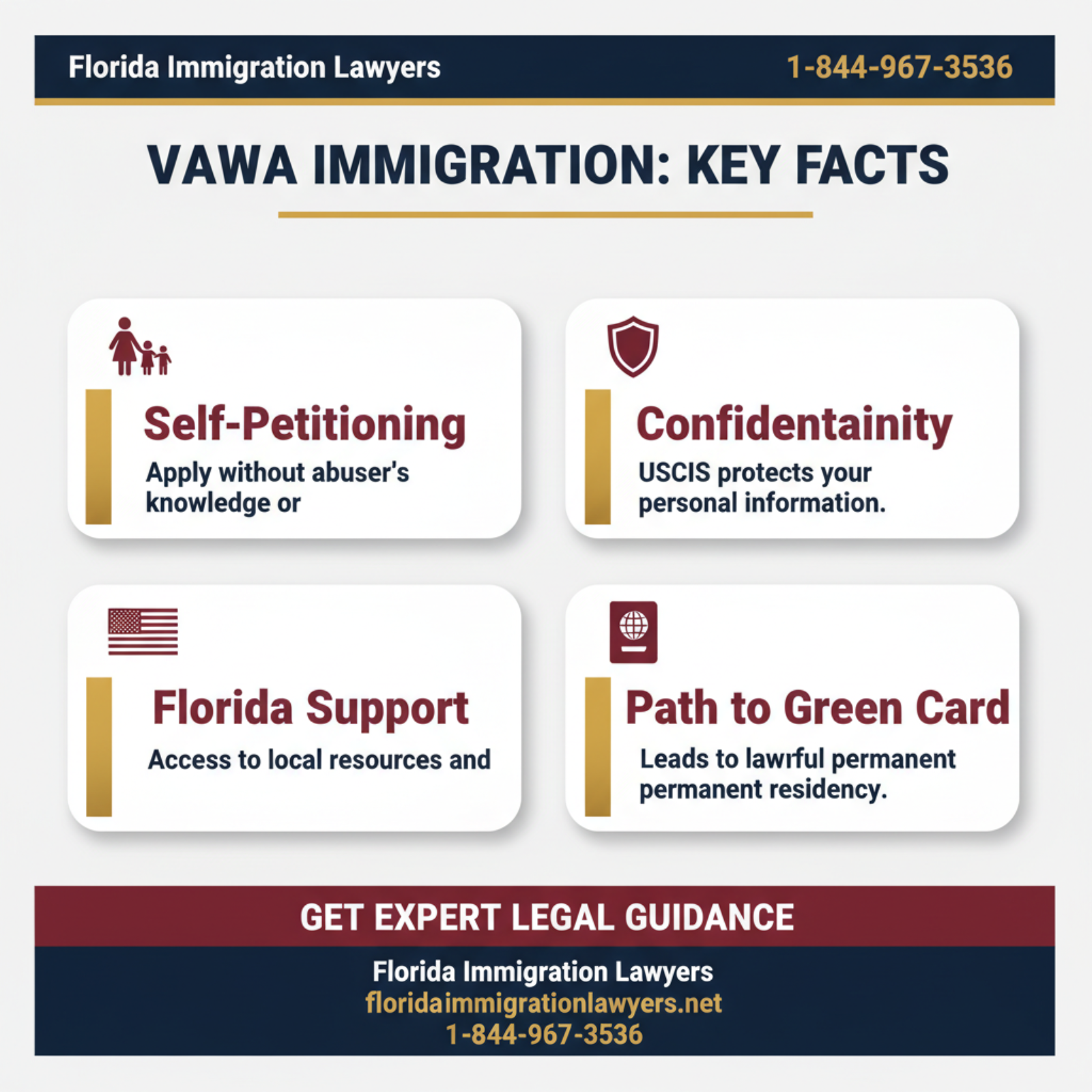
VAWA (Violence Against Women Act) immigration relief allows certain non-citizen victims of abuse by a U.S. citizen or lawful permanent resident spouse, parent, or adult child to self-petition for lawful permanent residency without the abuser's knowledge or cooperation. This vital protection offers a pathway to safety and independence for eligible individuals in Florida.
- VAWA provides a confidential path to a Green Card for abuse victims.
- Eligibility extends to spouses, children, and parents of abusers.
- You can self-petition without the abuser's involvement.
- Proof of abuse and good moral character are key requirements.
- Consulting an attorney is crucial for a successful VAWA petition.
VAWA Immigration Relief Florida: Protecting Abuse Victims
Imagine living in fear, trapped in an abusive relationship, and believing that your immigration status ties you inextricably to your abuser. For many non-citizens across Florida, including those in Kissimmee, this is a painful reality. The thought of seeking help can be overwhelming, especially when fear of deportation or retaliation looms large. However, there is a powerful legal pathway designed to protect you: the Violence Against Women Act (VAWA) immigration relief.
Florida Immigration Lawyers understands the immense courage it takes to seek safety. We are dedicated to helping survivors of abuse in Florida navigate the complex VAWA immigration process. Our compassionate attorneys provide confidential and empathetic legal support. We believe everyone deserves to live free from violence and without fear of their immigration status being used against them.
This comprehensive guide will explain VAWA immigration relief, its requirements, the application process, and how our firm can assist you. If you or a loved one are experiencing abuse and need to understand your immigration options, do not wait. Call Florida Immigration Lawyers at 1-844-967-3536 for a free consultation. Our team is here to help you take the first step towards a safer, more independent future.
Understanding VAWA Immigration Law in Florida: An Overview
The Violence Against Women Act (VAWA), originally enacted in 1994, includes critical provisions for non-citizen victims of domestic violence, extreme cruelty, or other forms of abuse. It allows certain individuals to file an immigration petition on their own behalf, known as a VAWA Self-Petition, without the knowledge or consent of their abusive U.S. citizen (USC) or lawful permanent resident (LPR) spouse, parent, or adult child. This protection is vital for individuals throughout Florida, from Kissimmee to Miami, who might otherwise feel trapped.
The core purpose of VAWA immigration law is to prevent abusers from using a victim's immigration status as a tool of control. It recognizes that victims may be reluctant to report abuse or seek help if doing so jeopardizes their ability to remain in the U.S. VAWA provides a confidential pathway to a Green Card, offering independence from the abuser. This law applies equally to men and women, despite its name, ensuring protection for all eligible abuse victims.
For individuals residing in Florida, understanding VAWA requirements is the first step towards securing this crucial relief. The process involves demonstrating a qualifying relationship, proving the abuse or extreme cruelty, and showing that you are a person of good moral character. Our experienced attorneys at Florida Immigration Lawyers can help you gather the necessary evidence and present a compelling case to USCIS.
Who Is Eligible for VAWA Self-Petitioning?
VAWA immigration relief is available to specific categories of non-citizens who have been subjected to abuse or extreme cruelty. These include:
- Abused Spouses: You are or were married to a U.S. citizen or lawful permanent resident abuser. You must demonstrate that the marriage was entered into in good faith, not solely to obtain immigration benefits, and that you were subjected to battery or extreme cruelty during the marriage. This includes those whose abusive spouse lost their status, died, or where the marriage ended in divorce within two years of the petition due to the abuse.
- Abused Children: You are an unmarried child under 21 who was abused by a U.S. citizen or lawful permanent resident parent. You can self-petition, or your parent can petition for you if they are also a VAWA self-petitioner.
- Abused Parents: You are a parent of an abusive U.S. citizen son or daughter who is at least 21 years old. You must show that you were subjected to battery or extreme cruelty by your child.
Eligibility also generally requires that the abuse occurred in the United States, or that the abuser is a U.S. government employee or member of the U.S. armed forces. Our firm can assess your unique situation and confirm your eligibility for VAWA immigration relief Florida.
The VAWA Self-Petition Process: A Step-by-Step Guide
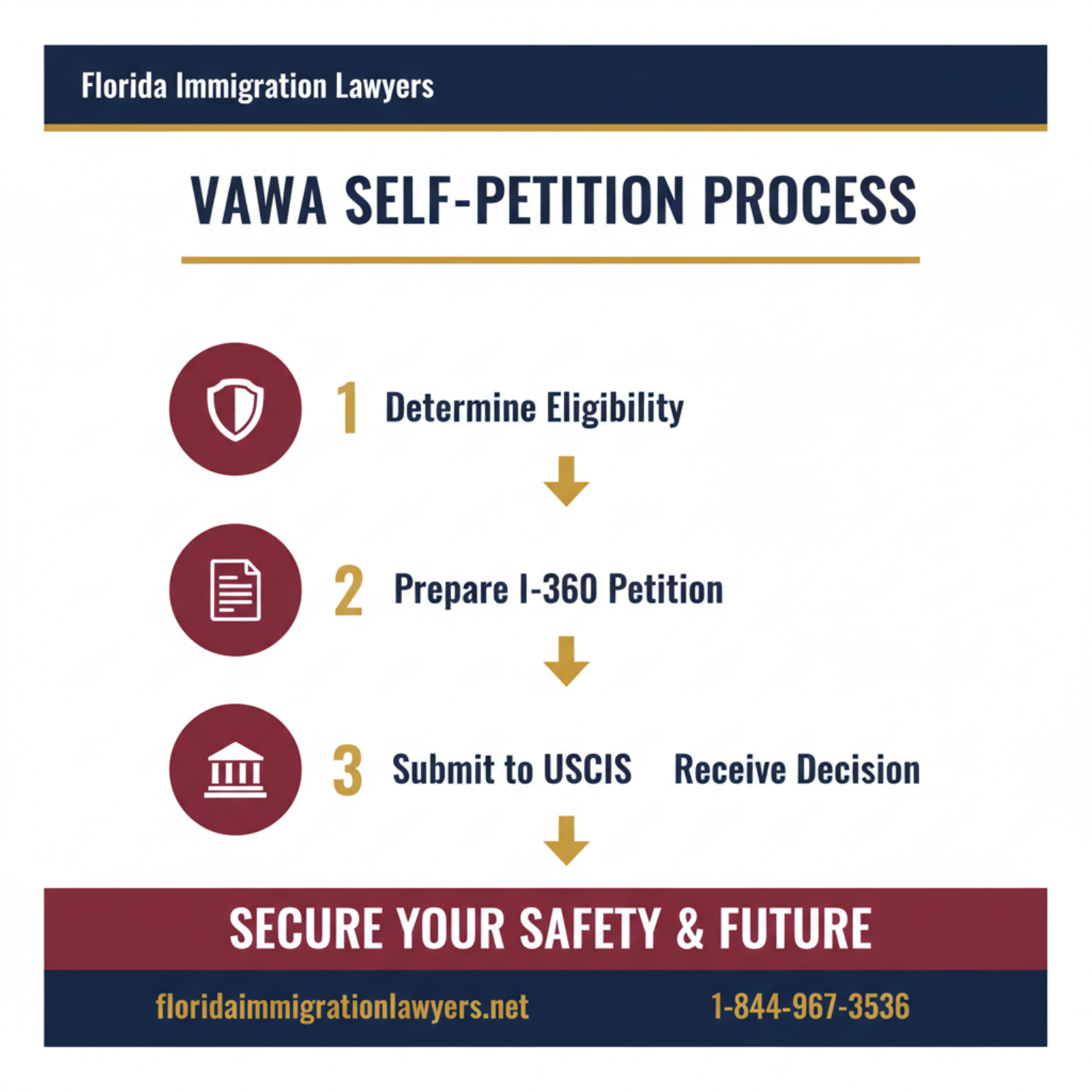
Navigating the USCIS VAWA self-petition process can feel daunting, but breaking it down into manageable steps makes it clearer. Here is a general outline of the process for individuals seeking VAWA immigration law protection in Florida:
-
Step 1: Consult with an Experienced Immigration Attorney. Before filing, it is crucial to speak with a lawyer specializing in VAWA cases. An attorney from Florida Immigration Lawyers can help you determine eligibility, gather evidence, and prepare a strong petition. This initial consultation is vital for understanding the specific nuances of your case.
-
Step 2: Prepare and File Form I-360, Petition for Amerasian, Widow(er), or Special Immigrant. This is the primary form for a VAWA self-petition. You will need to complete it accurately and thoroughly. This form does not require a filing fee for VAWA self-petitioners, which is a significant relief for many victims.
-
Step 3: Compile Supporting Evidence. This is perhaps the most critical step. You must submit compelling evidence to prove your eligibility, the abuse, and your good moral character. This includes personal affidavits, police reports, medical records, court documents, declarations from witnesses, and more. Our attorneys are adept at identifying and organizing the strongest evidence for your case.
-
Step 4: Submit Your Petition to USCIS. Once your Form I-360 and all supporting documentation are complete, they are mailed to the USCIS Vermont Service Center. This center exclusively processes VAWA petitions from across the country, including all applications from Florida.
-
Step 5: Receive a Prima Facie Determination. Within a few months of filing, USCIS may issue a Prima Facie Determination notice. This indicates that your petition appears to be approvable based on the initial evidence. This determination can offer immediate eligibility for certain public benefits in Florida, providing crucial support.
-
Step 6: Biometrics Appointment. USCIS will send you an appointment notice for biometrics (fingerprints, photos, and signature) at an Application Support Center (ASC) in Florida, such as those near Kissimmee or Orlando. This step is for background checks.
-
Step 7: USCIS Review and Request for Evidence (RFE). USCIS will thoroughly review your petition. They may issue a Request for Evidence (RFE) if they need more information or clarification. Responding to an RFE promptly and comprehensively is crucial, and our legal team can assist you with this.
-
Step 8: Petition Approval (I-360). If your petition is approved, USCIS will send an approval notice. This is a significant milestone, confirming your eligibility for VAWA relief.
-
Step 9: Adjustment of Status (Form I-485) or Consular Processing. After I-360 approval, you can apply for a Green Card. If you are in the U.S. and an immigrant visa is available, you can file Form I-485, Application to Register Permanent Residence or Adjust Status. If you are outside the U.S. or prefer, you can apply through consular processing at a U.S. embassy or consulate abroad. For those in Florida, adjustment of status is often the preferred route.
-
Step 10: Green Card Interview (for Adjustment of Status). You may be required to attend an interview at a USCIS field office, such as the one in Orlando or Miami, Florida. Our attorneys can prepare you for this interview and, in many cases, attend with you to provide support.
-
Step 11: Green Card Approval. Upon successful completion of all steps, you will receive your Green Card, granting you lawful permanent resident status in the United States.
Essential Document Checklist for VAWA Petitions
A well-prepared VAWA requirements checklist of documents is essential for a successful petition. Gathering these materials can be challenging, especially while experiencing abuse. Our team at Florida Immigration Lawyers will guide you through this process with sensitivity and discretion. Here are the types of documents typically required:
- Identity and Relationship Proof:
- Your birth certificate, passport, or other identity documents.
- Marriage certificate (if applicable, for spouse petitioners).
- Birth certificates for children (if applicable, for child or parent petitioners).
- Divorce decrees or death certificates (if applicable, proving termination of previous marriages/death of abuser).
- Evidence of the abuser's U.S. citizenship or LPR status (e.g., birth certificate, passport, Green Card).
- Proof of Residence and Good Faith Marriage (if applicable):
- Joint leases, property deeds, utility bills, bank statements.
- Photographs, letters, and affidavits from people who know you and your abuser.
- Children's birth certificates showing both parents' names.
- Evidence of Abuse or Extreme Cruelty:
- Detailed personal declaration (affidavit) describing the abuse, including dates, locations (e.g., Kissimmee, Florida), and specific incidents.
- Police reports, arrest records, or court orders related to domestic violence (e.g., restraining orders).
- Medical records, hospital reports, or psychological evaluations documenting injuries or trauma.
- Statements from witnesses (friends, family, clergy, therapists, social workers) who observed the abuse or its effects.
- Photos of injuries, damaged property, or abusive messages.
- Emails, texts, or other communications from the abuser.
- Evidence of seeking help (e.g., shelter stays, counseling records).
- Proof of Good Moral Character:
- Police clearances from all places you have lived for six months or more since age 16.
- Court records for any arrests or convictions (even if expunged).
- Affidavits from individuals attesting to your good moral character.
- Proof of community involvement or employment.
Step-by-Step Process Guide - Other Documents:
- Your current immigration documents (e.g., I-94, visa, previous petition notices).
- Any previous applications for immigration benefits.
This list is not exhaustive, and the specific documents needed will vary depending on your individual circumstances. Our Florida immigration lawyers will help you compile a comprehensive packet tailored to your case.
Timeline and Processing Expectations for VAWA Petitions
The processing time for a VAWA immigration relief Florida petition can vary significantly. USCIS provides estimated processing times on its website, but these are subject to change and depend on various factors, including the volume of applications and the complexity of individual cases. It is important to manage expectations and understand that this process often takes time.
Generally, after filing Form I-360, you can expect:
- Initial Receipt Notice: Within a few weeks.
- Prima Facie Determination: Typically within 3-6 months. This is a crucial step for accessing certain benefits.
- Biometrics Appointment: Usually 1-2 months after the receipt notice.
- I-360 Adjudication (Approval or RFE): This can take anywhere from 12 to 24 months, or even longer, from the filing date. The USCIS Vermont Service Center processes these petitions.
If your I-360 is approved, and you are filing for Adjustment of Status (I-485), additional processing times will apply. This includes:
- I-485 Adjudication: This can take another 6-18 months, depending on the USCIS field office handling your case (e.g., Orlando, Miami).
- Work Authorization (EAD) and Travel Document (Advance Parole): Often requested concurrently with I-485, these can be approved within 6-12 months, providing crucial interim relief.
Throughout this period, especially for those in Florida, it is essential to keep your contact information updated with USCIS. Our legal team continuously monitors processing times and will keep you informed about the status of your USCIS VAWA petition. Patience and persistence are key.
Cost Factors and Fee Breakdown for VAWA Applications
Understanding the costs associated with VAWA immigration law petitions is important for planning. While the VAWA I-360 self-petition itself does not require a filing fee, there are other potential expenses that applicants in Florida should consider.
- USCIS Filing Fees:
- Form I-360: No filing fee. This is a significant benefit for VAWA self-petitioners.
- Form I-485 (Adjustment of Status): This form generally requires a filing fee, unless you qualify for a fee waiver.
- Form I-765 (Employment Authorization Document - EAD): This form generally requires a filing fee, unless filed concurrently with an I-485 or you qualify for a fee waiver.
- Form I-131 (Advance Parole - Travel Document): This form generally requires a filing fee, unless filed concurrently with an I-485 or you qualify for a fee waiver.
- Biometrics Fee: Required for most applications, including I-485.
- Legal Fees: Hiring an experienced immigration attorney is a significant investment but can greatly increase the likelihood of a successful outcome. Legal fees cover:
- Comprehensive case evaluation and eligibility assessment.
- Assistance in gathering and organizing evidence.
- Preparation and filing of all necessary forms and declarations.
- Communication with USCIS on your behalf.
- Preparation for interviews.
- Responding to RFEs or Notices of Intent to Deny.
- Ancillary Costs:
- Medical Examination: Required for adjustment of status. The cost varies by physician.
- Document Translation: If any supporting documents are not in English, certified translations are required.
- Postage and Mailing: Costs associated with sending documents to USCIS.
- Travel Expenses: For biometrics appointments or interviews at USCIS field offices in Florida.
Key Statistics & Data
Florida Immigration Lawyers understands that financial concerns can be a barrier. We offer free consultations to discuss your case and provide clear information about potential costs. We are committed to making legal assistance accessible to those who need it most in Florida. Do not let financial worries prevent you from seeking the safety and independence you deserve.
Do not navigate this process alone. Contact Florida Immigration Lawyers today. Our team is ready to provide the compassionate and effective legal representation you need.
Common Mistakes to Avoid in Your VAWA Petition
Filing a VAWA petition is a complex legal process that requires meticulous attention to detail. Even small errors can lead to significant delays or even denial. For individuals in Florida seeking VAWA immigration relief, being aware of common pitfalls is crucial.
-
Insufficient Evidence of Abuse: One of the most frequent reasons for denial is failing to provide enough convincing evidence of battery or extreme cruelty. A personal declaration alone may not be enough; it must be corroborated by other documents like police reports, medical records, or witness affidavits. The consequences can be a lengthy RFE process or outright denial, prolonging your vulnerability.
-
Lack of Good Faith Marriage Evidence (for spouses): For spouse petitioners, demonstrating that the marriage was entered into in good faith, not just for immigration purposes, is vital. Insufficient joint documents or a weak narrative can raise red flags. This mistake can lead USCIS to question the legitimacy of your relationship, resulting in denial.
-
Failing to Prove Good Moral Character: VAWA applicants must demonstrate good moral character. Overlooking past minor offenses or failing to provide proper documentation for any arrests or convictions can be detrimental. USCIS conducts thorough background checks, and discrepancies can lead to serious issues, including denial or accusations of misrepresentation.
-
Inconsistent Information: Any inconsistencies between your declaration and supporting documents, or between different statements you've made to authorities, can severely undermine your credibility. USCIS investigators are trained to spot such discrepancies, which can lead to intense scrutiny and potential denial.
-
Not Filing in a Timely Manner: While VAWA generally doesn't have strict deadlines like some other petitions, waiting too long after a divorce (more than two years) or if the abuser loses status can impact eligibility. Delay can also prolong your stay in an unsafe situation. Timeliness, especially regarding the two-year divorce rule, is critical.
-
Incorrectly Filling Out Forms: Simple clerical errors, missing signatures, or incomplete sections on Form I-360 or subsequent forms can cause the petition to be rejected or significantly delayed. This means lost time and the need to resubmit, potentially exposing you to further risk.
-
Failing to Respond to an RFE Promptly and Completely: If USCIS issues a Request for Evidence, you have a limited time to respond. Failing to submit all requested documents or missing the deadline will almost certainly lead to denial. This often happens if applicants try to handle the RFE without legal guidance.
-
Disclosing the Petition to the Abuser: VAWA is designed to be confidential. Informing your abuser of your petition can jeopardize your safety and potentially lead to retaliation. It also creates a risk of the abuser attempting to interfere with your case, which can complicate the process.
-
Not Seeking Legal Counsel: Attempting to navigate the complexities of VAWA immigration law without an experienced attorney is a major risk. An attorney can help identify all forms of abuse, gather strong evidence, accurately complete forms, and respond effectively to USCIS queries. Without legal guidance, you might miss crucial steps or opportunities.
-
Ignoring USCIS Communications: It is vital to open and respond to all mail from USCIS. Missing notices for biometrics, RFEs, or interview appointments can lead to your case being abandoned or denied. Always keep your address updated and check your mail regularly.
When to Call a Lawyer for VAWA Immigration Relief in Florida
The decision to seek VAWA immigration relief Florida is a life-changing one, and it is almost always best undertaken with the guidance of an experienced immigration attorney. While VAWA is a powerful tool, its application is nuanced and complex. Knowing when to call a lawyer can make all the difference in the success of your petition and your journey to safety.
You should contact Florida Immigration Lawyers immediately if any of the following scenarios apply to you:
- You are experiencing abuse or extreme cruelty: If you are a non-citizen and are being abused by a U.S. citizen or lawful permanent resident spouse, parent, or adult child, our attorneys can help you understand your options and begin the process discreetly.
- You fear your abuser will withdraw your petition: If your abuser previously filed an immigration petition for you (e.g., an I-130) and is threatening to withdraw it, VAWA may offer a way to continue your immigration journey independently.
- You are in removal (deportation) proceedings: VAWA can serve as a defense against deportation. If you are facing removal, our deportation defense attorneys can assess if a VAWA self-petition or other forms of relief, like asylum, are appropriate for your case.
- You are unsure if you meet VAWA requirements: The eligibility criteria can be intricate. Our lawyers can evaluate your specific situation, including the nature of the abuse and your relationship to the abuser, to determine if you qualify.
- You have a complicated immigration history: Previous visa overstays, prior denials, or certain criminal convictions can complicate any immigration case. An attorney can help address these issues and strategize the best approach for your VAWA immigration law petition.
- You need help gathering evidence: Documenting abuse can be difficult and emotionally taxing. We can assist you in collecting, organizing, and presenting compelling evidence while minimizing your distress.
- You need assistance with a Request for Evidence (RFE): If USCIS has sent you an RFE, it means they need more information. A skilled attorney can help you formulate a comprehensive and timely response to strengthen your case.
- You need to apply for a Green Card after I-360 approval: Our firm can guide you through the adjustment of status process (Form I-485) or consular processing, ensuring a smooth transition to lawful permanent residency.
Florida Immigration Lawyers serves clients across the entire state of Florida, including Kissimmee, Orlando, Tampa, and Miami. We offer compassionate, confidential, and effective legal representation for all aspects of immigration law, including family-based immigration and citizenship. We are here to be your advocates, providing a safe and supportive environment as you pursue your path to independence.
Frequently Asked Questions About VAWA in Florida
Who is eligible for VAWA immigration relief?
VAWA immigration relief is available to non-citizen spouses, children, and parents who have been subjected to battery or extreme cruelty by a U.S. citizen or lawful permanent resident. Spouses must have entered the marriage in good faith. Children must be unmarried and under 21 (or 25 under certain circumstances) when the petition is filed. Parents must have been abused by an adult U.S. citizen child.
What is the VAWA Act in Florida?
The VAWA Act is federal legislation, so its provisions apply uniformly across all U.S. states, including Florida. For individuals in Florida, it means they can utilize the federal VAWA self-petitioning process through USCIS to seek immigration relief without the abuser's involvement. Florida also has state laws related to domestic violence that can provide supplementary protection and evidence for VAWA petitions.
What is the 2-year rule for VAWA?
The 2-year rule primarily applies to divorced spouses. If your marriage to the abusive U.S. citizen or LPR ended in divorce, you generally must file your VAWA self-petition (Form I-360) within two years of the divorce being finalized. You must also demonstrate that the divorce was connected to the abuse. If the abuser died, you must file within two years of their death. Additionally, if the abuser lost their U.S. citizenship or LPR status, you must file within two years of that event.
Is VAWA still in effect in 2026?
Yes, the Violence Against Women Act (VAWA) is still very much in effect in 2026. VAWA has been reauthorized multiple times since its original enactment in 1994, ensuring its continued protection for victims of domestic violence, sexual assault, dating violence, and stalking, including its immigration provisions. Congress regularly reviews and reauthorizes this critical legislation.
About Florida Immigration Lawyers
Florida Immigration Lawyers is a leading immigration law firm dedicated to serving individuals and families across the entire state of Florida. With offices located strategically to assist clients from Kissimmee to Jacksonville, Miami to Tampa, we are committed to providing exceptional legal representation and compassionate support.
Our firm specializes in a broad range of immigration services, including family-based visas, business immigration, deportation defense, asylum claims, and naturalization. We understand the unique challenges faced by immigrants in Florida and strive to offer personalized solutions tailored to each client's specific needs. Our team of experienced attorneys is known for its zealous advocacy and deep understanding of U.S. immigration law.
Why Choose Florida Immigration Lawyers?
- Experienced Advocates: Our attorneys possess extensive experience in complex immigration matters, including sensitive VAWA cases.
- Client-Centered Approach: We prioritize your safety, well-being, and legal goals, offering empathetic and confidential service.
- Statewide Coverage: Serving all of Florida, we are accessible to clients no matter where they are located.
- Bilingual Services: Our team is fluent in English and Spanish, ensuring clear and effective communication.
- Free Consultations: We offer free, no-obligation consultations to discuss your case and outline your options.
If you need assistance with VAWA immigration relief or any other immigration matter, please do not hesitate to reach out. We are available 24/7 to answer your questions and provide the support you deserve. Visit our website at https://www.floridaimmigrationlawyers.net or call us directly at 1-844-967-3536.
Sources and References
- U.S. Citizenship and Immigration Services (USCIS) - Violence Against Women Act (VAWA)
- Executive Office for Immigration Review (EOIR) - Violence Against Women Act (VAWA)
- 8 U.S.C. § 1154(a)(1)(A)(iii) - Petitions for certain spouses of citizens or lawful permanent residents
- 8 U.S.C. § 1154(a)(1)(A)(iv) - Petitions for certain children of citizens or lawful permanent residents
- 8 U.S.C. § 1154(a)(1)(A)(vii) - Petitions for certain parents of citizens
- 8 CFR § 204.2(c) - Petitions for abused spouses and children of U.S. citizens and lawful permanent residents
- Immigration and Nationality Act (INA) Section 204(a)
This article provides general legal information and is not intended as legal advice. Every case is unique, and outcomes depend on specific facts and circumstances. Contact an attorney for advice about your particular situation.
Taking the step toward safety and independence through VAWA immigration relief is a brave and important decision. You do not have to face this journey alone. Florida Immigration Lawyers is here to provide the expert legal guidance and compassionate support you need, every step of the way. Our dedicated team is ready to listen to your story in confidence and help you build a stronger future in Florida.
For a free and confidential consultation, please call us today at 1-844-967-3536. Se Habla Español - Estamos aquí para ayudarle.
Do Not Navigate This Process Alone
Our experienced immigration attorneys are ready to fight for you. Get a free, confidential consultation today.
Se Habla Español
Frequently Asked Questions
Florida Immigration Lawyers
Immigration Attorney | Founder, Vasquez Law Firm
U.S. Air Force veteran and immigration attorney with thousands of cases resolved. J.D., NCCU School of Law. AILA member. Admitted to the 4th, 5th, and 11th Circuit Courts.
Available 24/7 - Free Evaluations
Related Legal Services
Our Florida immigration attorneys can help you with citizenship and naturalization, family immigration services and immigration practice areas. Call today at 1-844-967-3536 for a free consultation.
Related Links
Related Topics
Free Legal Consultation
Discuss your case with our experienced attorneys. We're available 24/7.
Se Habla Español - Estamos aquí para ayudarle.
Related Articles
Stokes Interview: Navigating Marriage Fraud in Florida
A Stokes interview is a specialized, separate interview conducted by USCIS when there are suspicions of marriage fraud in a green card application. This rigorous process involves individual questioning of spouses, focusing on inconsistencies in their testimonies to determine the authenticity of their marital bond. For couples in Florida, navigating this high-stakes interview requires meticulous preparation, extensive documentation, and often the strategic guidance of an experienced immigration lawyer. Understanding the process, preparing for detailed questions, and presenting a strong case are crucial for overcoming marriage fraud allegations and securing your immigration future. Florida Immigration Lawyers stands ready to assist you.
Immigration Attorney Gainesville: North Florida Legal Help
For those in Gainesville, Alachua County, and throughout North Florida, navigating U.S. immigration law requires expert guidance. An experienced immigration attorney can simplify complex processes, from family-based petitions and employment visas to critical asylum claims and deportation defense. This comprehensive guide outlines the essential services provided by an immigration attorney, details necessary documentation, clarifies processing timelines, and discusses associated costs. We also highlight common mistakes to avoid and crucial scenarios where legal counsel is indispensable. Florida Immigration Lawyers serves all of Florida, including Gainesville and St. Petersburg, providing dedicated legal support to help you achieve your immigration goals. Contact us for a free consultation to discuss your specific needs.
Military Naturalization Expedited at Florida Bases
Explore expedited military naturalization processes for service members at Florida bases like MacDill. Learn about eligibility, steps, and common mistakes. Contact Florida Immigration Lawyers for a free consultation.
Protect Yourself from Immigration Scams in Florida
Learn how to protect against immigration scams in Florida, focusing on St. Petersburg. This guide covers identifying scams, verifying credentials, and getting legal help. Call Florida Immigration Lawyers at 1-844-967-3536 for assistance.
