Vasquez Law Firm: U Visa Certification Law Enforcement
The Vasquez Law Firm provides essential support for U visa certification in Florida, helping crime victims gain stability. Learn about the process, necessary documentation, and how our firm can assist you in navigating these complex procedures.
The Vasquez Law Firm provides critical assistance for U visa certification in Florida, focusing on helping crime victims. The U visa is designed for victims of certain crimes who have suffered mental or physical abuse and are helpful to law enforcement or government officials in the investigation or prosecution of criminal activity. Key points include:
- Understanding U visa requirements and benefits
- The role of I-918 Supplement B in the certification process
- Collaboration with Florida law enforcement agencies
- Legal guidance offered by the Vasquez Law Firm
Introduction
In Florida, victims of crimes often face challenges beyond the immediate harm caused by the crime itself. For many immigrants, the U visa offers a path to safety and stability. The U visa is a nonimmigrant visa that provides legal status to victims of certain crimes who assist law enforcement in investigating or prosecuting those crimes. Understanding the complexities of U visa certification is crucial for those seeking this form of relief. At the Vasquez Law Firm, we specialize in helping Orlando residents navigate the intricacies of the U visa process.
Beyond the physical and emotional trauma, immigrant victims often grapple with unique fears, such as deportation, language barriers, and a deep-seated distrust of authorities stemming from experiences in their home countries. These factors can prevent them from reporting crimes or cooperating with law enforcement, leaving them vulnerable and without recourse. The U visa program directly addresses these challenges, providing a secure pathway to legal status that encourages reporting and collaboration.
For those who have endured severe harm, the U visa represents more than just a legal document; it's a lifeline. It offers a chance to escape abusive situations, secure employment authorization, and eventually apply for lawful permanent residency. The Vasquez Law Firm, through Florida Immigration Lawyers, is committed to guiding victims through this transformative process, ensuring they receive the protection and stability they deserve to heal and rebuild their lives in safety.
Call Florida Immigration Lawyers at 1-844-YO-PELEO for a free case review.
What is U Visa Certification?
U visa certification involves obtaining a form known as I-918 Supplement B, which is crucial for the U visa application process. This form must be completed by a law enforcement agency and confirms the applicant's helpfulness in the investigation or prosecution of a crime. As of 2026, securing this certification is an essential step in demonstrating eligibility for the U visa.
The U visa is intended for victims of specific crimes, such as domestic violence, sexual assault, and human trafficking. To qualify, applicants must demonstrate they have suffered substantial physical or mental abuse and possess information about the crime. Furthermore, the applicant must provide evidence of cooperation with law enforcement, typically documented through the I-918 Supplement B form.
The list of qualifying criminal activities is extensive and includes, but is not limited to, abduction, blackmail, domestic violence, extortion, false imprisonment, felonious assault, female genital mutilation, hostage taking, incest, involuntary servitude, kidnapping, murder, obstruction of justice, peonage, perjury, prostitution, rape, sexual assault, sexual exploitation, slave trade, stalking, torture, trafficking, witness tampering, and unlawful criminal restraint. It's important to note that the crime must have violated U.S. law or occurred in the United States or its territories.
Demonstrating "substantial physical or mental abuse" is a critical component of the U visa application. This isn't merely about documenting the crime itself, but about detailing the profound impact it had on the victim. Evidence can include medical records, psychological evaluations, statements from therapists or social workers, and a detailed personal statement describing the trauma experienced. The severity of the abuse is assessed based on factors like the nature of the injury, the severity of the harm suffered, the duration of the abuse, and the extent of the recovery process.
The I-918 Supplement B, often referred to as the U visa certification, serves as the cornerstone of your application. This document is a testament from a certifying agency—which can be a law enforcement agency, prosecutor's office, judge, or other government official—that confirms you were a victim of a qualifying crime and that you have been, are being, or are likely to be helpful in the investigation or prosecution of that criminal activity. The agency's willingness to sign this form is pivotal, as it directly validates your eligibility for the U visa and underscores the importance of your cooperation.
Steps to Obtain U Visa Certification
Navigating the U visa certification process requires careful attention to detail and proactive engagement with law enforcement. Each step is crucial, and missteps can lead to significant delays or even denial. Understanding this roadmap and having expert legal guidance from Florida Immigration Lawyers can make all the difference in securing your protection.
- Report the Crime: Ensure the crime is reported to law enforcement promptly. Documentation of the report is essential. Prompt reporting is crucial not only for the immediate safety of the victim but also because it establishes a clear timeline for the crime and the subsequent investigation. Without an official police report, it becomes exceedingly difficult to demonstrate that a qualifying crime occurred and that you cooperated.
- Gather Evidence: Collect evidence of the crime and any documentation that shows cooperation with law enforcement. This includes police reports, medical records detailing injuries, psychological evaluations, witness statements, photos of injuries or the crime scene, restraining orders, and any communication with investigators. The more comprehensive your evidence, the stronger your case for substantial abuse and helpfulness.
- Contact Law Enforcement: Reach out to a law enforcement agency to request the completion of the I-918 Supplement B form. Identifying the correct agency and specific officer (e.g., the detective assigned to your case, the victim services unit) is vital. Policies for U visa certification vary widely among agencies in Florida, and some may be more familiar with the process than others. Persistence and respectful follow-up are often necessary.
- Legal Assistance: Consider hiring an immigration attorney to guide you through the process, ensuring all paperwork is correctly filed. An experienced attorney, such as those at Florida Immigration Lawyers, can help you prepare your request for certification, communicate effectively with law enforcement agencies, and advocate on your behalf if an agency is unresponsive or unfamiliar with the U visa process. This significantly increases your chances of obtaining the crucial I-918 Supplement B.
- Submit Application: Once the I-918 Supplement B form is obtained, submit it along with the U visa application to USCIS. Your attorney will ensure that Form I-918, your personal statement, all supporting evidence, and the certified Supplement B are compiled into a complete and compelling application package. This thoroughness is key to avoiding Requests for Evidence (RFEs) and minimizing processing delays.
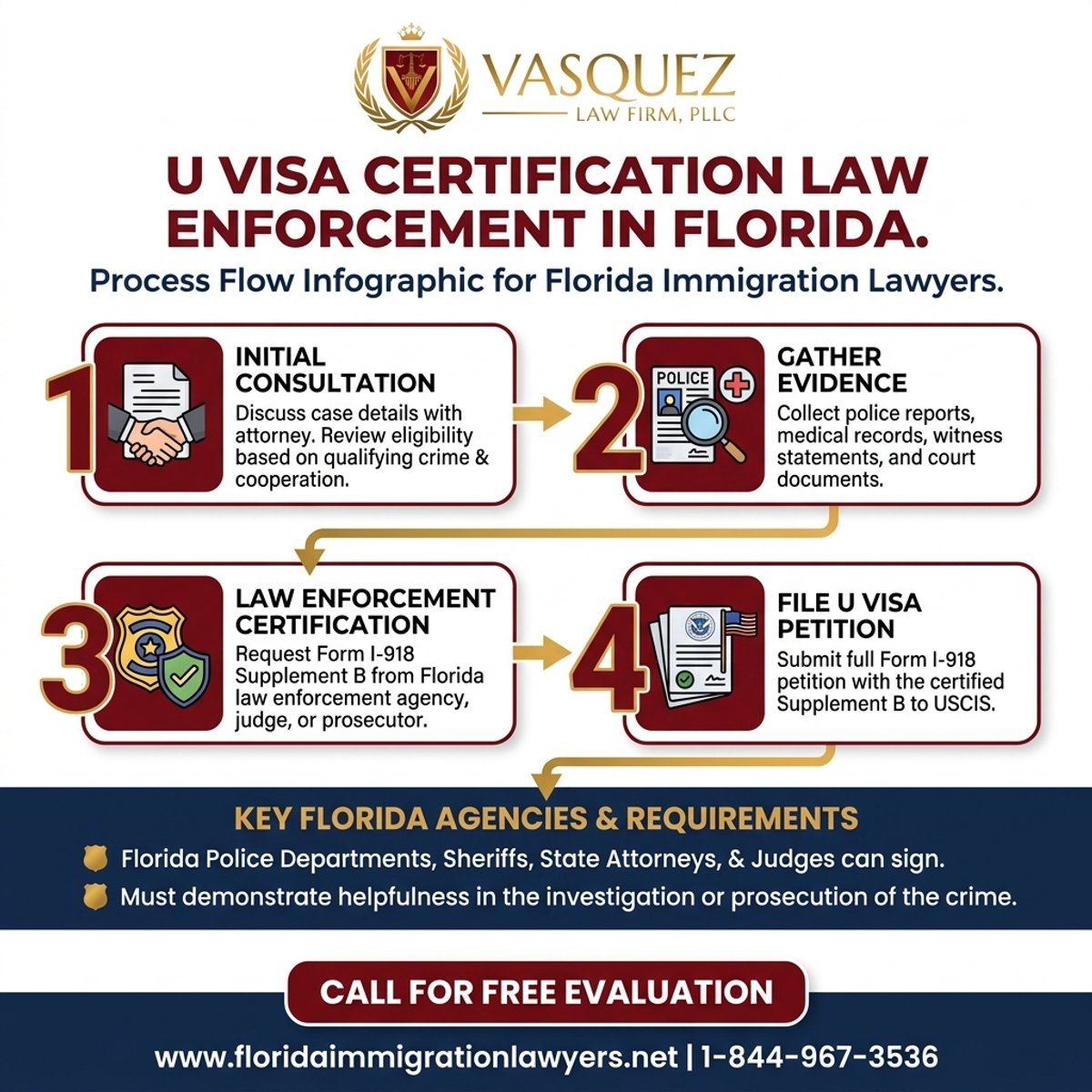
Step-by-Step Process — Vasquez Law Firm: U Visa Certification Law Enforcement in Florida
Document Checklist for U Visa Applicants
A comprehensive and meticulously organized document checklist is paramount for a successful U visa application. Each piece of evidence contributes to building a compelling case, demonstrating your eligibility and the profound impact of the crime.
- Completed Form I-918 and Supplement B
- Personal statement describing the crime and its impact
- Police reports and medical records
- Proof of identity
- Evidence of cooperation with law enforcement
Beyond these core documents, consider including psychological evaluations, affidavits from witnesses or victim advocates, and any evidence of your immigration status prior to the crime. The personal statement is particularly powerful; it should be detailed, heartfelt, and clearly articulate the physical and mental abuse suffered. Ensuring all documents are accurately translated into English and properly organized will streamline the review process for USCIS. Florida Immigration Lawyers can help you compile and review this critical documentation.
Timeline and Processing Expectations
| Stage | Typical Timeframe | Notes |
|---|---|---|
| Crime Reporting | Immediate | Report as soon as possible |
| Law Enforcement Certification | 1-3 months | Varies by agency |
| USCIS Processing | 12-18 months | Subject to change |
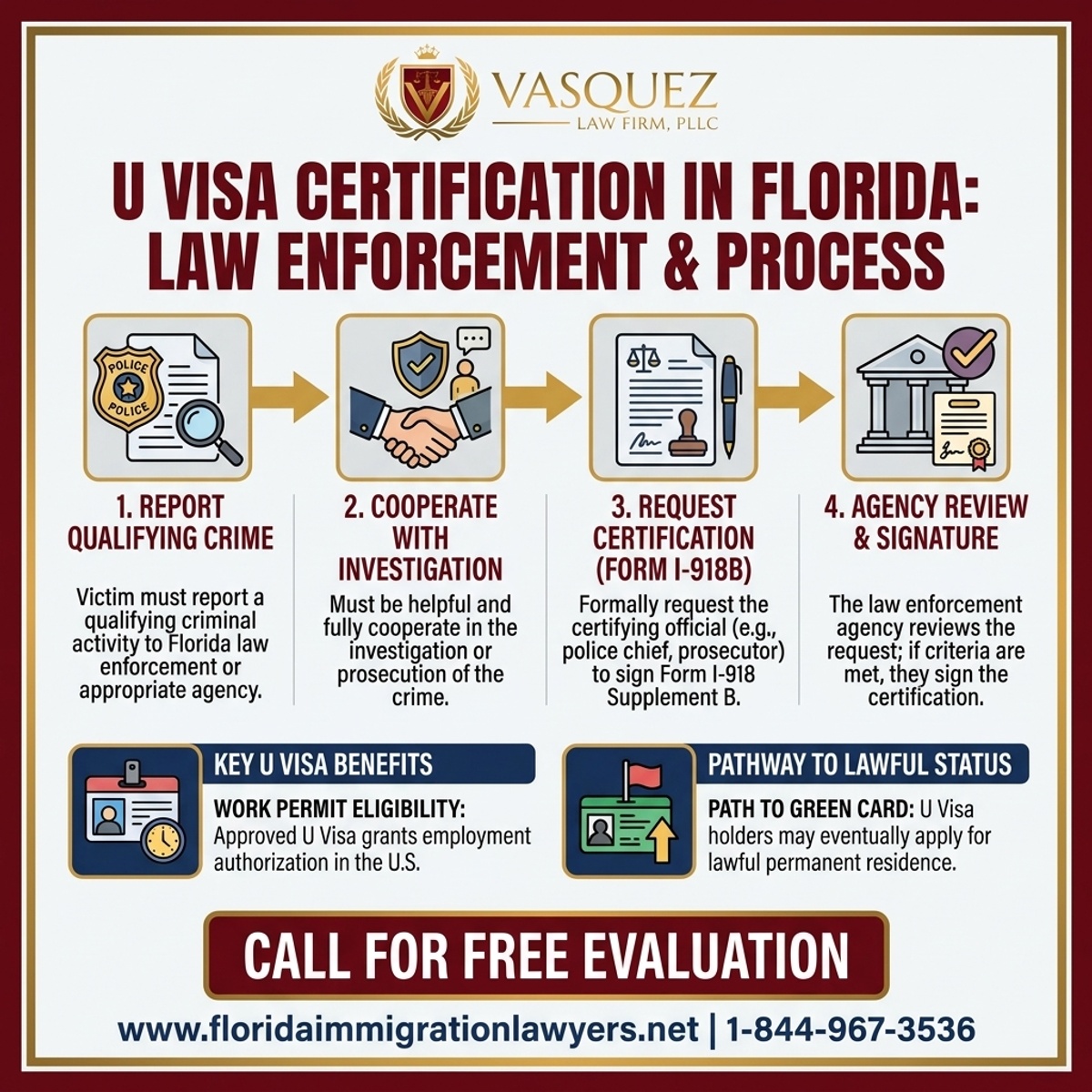
Key Statistics — Vasquez Law Firm: U Visa Certification Law Enforcement in Florida
While the crime reporting stage should be immediate, the subsequent stages can vary significantly. The timeframe for obtaining law enforcement certification (I-918 Supplement B) largely depends on the specific agency's policies, workload, and familiarity with U visa requests. Some agencies in Florida have dedicated victim services units that process these requests efficiently, while others may require more follow-up and education. An attorney from Florida Immigration Lawyers can help navigate these varying agency responses and advocate for timely processing.
Once your complete U visa application is submitted to USCIS, the processing time can be lengthy, often extending beyond the 12-18 month estimate due to high demand and backlogs. During this waiting period, USCIS conducts a Bona Fide Determination (BFD) review, which can grant employment authorization and deferred action to eligible applicants while the full U visa petition is pending. It is crucial to maintain consistent communication with your legal team and USCIS, responding promptly to any Requests for Evidence (RFEs) to avoid further delays.
Patience is a virtue in the U visa process, but proactive legal counsel can significantly streamline your journey. While these timelines are estimates, an experienced immigration attorney can help manage expectations, prepare you for potential delays, and ensure your application is as strong as possible from the outset, potentially reducing the overall processing time by avoiding common errors.
Cost Factors and Fee Breakdown
| Item | Typical Fee | Notes |
|---|---|---|
| Legal Consultation | Varies | Initial consultation may be free |
| Application Filing | See USCIS site | Fees subject to change |
Do not navigate this process alone. Contact Florida Immigration Lawyers today.
For U visa applicants, Form I-918, Petition for U Nonimmigrant Status, is generally fee-exempt. However, there may be associated fees for other forms, such as those for family members (Form I-918 Supplement A) or for employment authorization (Form I-765), although fee waivers are often available for qualifying U visa applicants based on financial hardship. It's essential to consult the USCIS website or your attorney for the most current fee schedule and waiver eligibility.
While legal fees represent an investment, the value of expert guidance in such a complex and high-stakes process cannot be overstated. A skilled immigration attorney can significantly increase your chances of approval, saving you time, stress, and potential costs associated with denials or appeals. Many firms, including Florida Immigration Lawyers, offer initial free consultations to discuss your case and provide transparent information regarding their fee structures, including potential payment plans. Investing in legal representation from 1-844-YO-PELEO is an investment in your future and stability.
Common Mistakes to Avoid
The U visa application process is fraught with potential pitfalls that can jeopardize your chances of approval. Understanding and actively avoiding these common mistakes is as critical as fulfilling the requirements themselves. With so much at stake, precision and thoroughness are paramount.
- Failing to Report the Crime: Without a police report, you cannot obtain a U visa. This is the foundational piece of evidence proving the crime occurred and initiating the investigation.
- Not Gathering Sufficient Evidence: Lack of evidence can lead to denial. This includes comprehensive documentation of the crime, your injuries, and your cooperation with law enforcement.
- Delaying the Application: Timely submission is crucial due to processing times. While there isn't a strict deadline from the date of the crime, prompt action ensures that memories are fresh and evidence is readily available.
- Incorrectly Completing Forms: Errors can result in delays or denial. Even minor mistakes on Form I-918 or Supplement B can trigger Requests for Evidence (RFEs), prolonging your wait.
- Not Seeking Legal Advice: Professional guidance can improve your chances of approval. An experienced attorney can identify potential issues, strengthen your case, and navigate complex legal nuances.
- Ignoring Application Updates: Stay informed about your application status. Failing to respond to USCIS requests or updates can lead to abandonment of your petition.
- Inadequate Communication with Law Enforcement: Keep open lines of communication for certification needs. Building a respectful rapport with the certifying agency is vital for obtaining the I-918 Supplement B.
These mistakes, though seemingly minor, can have significant consequences. Engaging with Florida Immigration Lawyers can provide you with the necessary expertise to sidestep these common errors, ensuring your application is robust and moves forward as smoothly as possible. Don't let procedural missteps prevent you from achieving the safety and legal status you deserve.
When to Call a Lawyer
If you are a victim of a crime in Florida and need guidance on the U visa process, it is critical to seek legal assistance. An attorney can help ensure you meet all requirements, avoid common pitfalls, and effectively communicate with law enforcement. Florida Immigration Lawyers offer expert advice and support in Orlando and throughout the state.
There are specific scenarios where legal counsel becomes not just beneficial, but absolutely essential. If law enforcement agencies are unresponsive or unfamiliar with U visa certification, an attorney can advocate on your behalf, providing the necessary legal context. If you have a past criminal record, or if you are unsure whether the abuse you suffered meets the "substantial physical or mental abuse" threshold, a lawyer can assess your eligibility and strategically prepare your case.
Beyond merely filling out forms, a dedicated immigration attorney from Florida Immigration Lawyers acts as your advocate, preparing a compelling personal statement, gathering robust supporting evidence, and representing you in any interactions with USCIS. They can help you understand complex legal questions, anticipate potential challenges, and respond effectively to Requests for Evidence (RFEs). Don't face the daunting U visa process alone; call 1-844-YO-PELEO for a free case review and secure the expert guidance you need to protect your future.
About Florida Immigration Lawyers
Florida Immigration Lawyers is dedicated to providing compassionate, expert legal services to immigrants in Florida. With a focus on U visa certifications and other immigration matters, our team is here to support you every step of the way. We are available 24/7 and offer free case reviews. Schedule a free consultation or explore our immigration practice areas.
Frequently Asked Questions About U Visa Certification
What types of crimes qualify for a U visa?The U visa covers a wide range of serious criminal activities, including domestic violence, sexual assault, human trafficking, kidnapping, murder, felonious assault, and witness tampering. The key is that you must have been a victim of a qualifying crime that resulted in substantial physical or mental abuse, and the crime must have violated U.S. law. An attorney can help determine if your specific situation meets these criteria, ensuring your case aligns with immigration requirements.How do I prove I was helpful to law enforcement?Proof of helpfulness is typically established through the I-918 Supplement B, signed by a certifying agency. This form confirms your assistance in the investigation or prosecution of the crime. Beyond the form, maintaining records of your communications with law enforcement, providing witness statements, or testifying in court can serve as additional evidence. Your immigration attorney will help compile all necessary documentation to demonstrate your cooperation effectively.Can my family members also get a U visa?Yes, eligible family members can often be included in your U visa petition. This includes your spouse, unmarried children under 21, and in some cases, parents and unmarried siblings under 18 if you are under 21. Specific requirements apply to each family member, and their inclusion depends on your age and relationship. Consulting with Florida Immigration Lawyers is crucial to ensure all eligible family members are properly included in your application.What if law enforcement refuses to certify my I-918 Supplement B?If a law enforcement agency refuses to certify your I-918 Supplement B, it can be a significant hurdle. Reasons for refusal vary, from lack of familiarity with the U visa to agency policy. An experienced immigration attorney can often intervene, educate the agency on their responsibilities, and advocate on your behalf. They may also explore alternative certifying officials or strategies to secure the necessary documentation, ensuring your case doesn't stall.Is there a deadline to apply for a U visa after the crime?While there isn't a strict statutory deadline from the date of the crime to apply for a U visa, it's generally advisable to apply as soon as possible. The sooner you apply, the fresher the evidence and memories will be, which can strengthen your case and make it easier to obtain law enforcement certification. Delays can complicate evidence gathering and law enforcement's ability to confirm your helpfulness. Seek legal counsel promptly.Can I apply for a U visa if I have a criminal record?Having a criminal record does not automatically disqualify you from a U visa, but it can complicate your application. Certain criminal convictions may render you inadmissible, requiring a waiver. The U visa includes specific waiver provisions for many grounds of inadmissibility, recognizing the unique circumstances of crime victims. An experienced attorney can assess your criminal history, advise on potential inadmissibility issues, and prepare a strong waiver application if needed.What happens after my U visa is approved?Upon U visa approval, you will receive nonimmigrant status for four years, along with employment authorization. This allows you to live and work legally in the U.S. without fear. After three years in U status, you typically become eligible to apply for lawful permanent residency (a green card), provided you continue to meet certain conditions, such as continuous physical presence and good moral character. This path offers long-term stability and security.Sources and References
- U.S. Citizenship and Immigration Services (USCIS)
- Executive Office for Immigration Review (EOIR)
- 8 U.S.C. Chapter 12 - Immigration and Nationality Act
Related services: asylum and refugee protection, asylum application process, refugee status and resettlement, withholding of removal.
This article provides general legal information and is not intended as legal advice. Every case is unique, and outcomes depend on specific facts and circumstances. Contact an attorney for advice about your particular situation.
Se Habla Espanol - Estamos aqui para ayudarle.
If you need legal assistance, learn more about experienced immigration attorneys in Orlando, or call us at 1-844-967-3536 for a free case review.
Do Not Navigate This Process Alone
Our experienced immigration attorneys are ready to fight for you. Get a free, confidential case review today.
Se Habla Español
Or leave your details and we’ll call you:
Free Evaluation in 24 Hours
Or talk to us right now

AI voice assistant — available 24/7
FreeFrequently Asked Questions

William J. Vásquez
Founding Attorney · Vasquez Law Firm
U.S. Air Force veteran and immigration attorney with years of hands-on U.S. immigration experience. J.D., NCCU School of Law. AILA member. Admitted to the 4th, 5th, and 11th Circuit Courts.
Available 24/7 - Free Evaluations
Reviewed for legal accuracy by William J. Vásquez
Licensed in North Carolina; U.S. immigration is federal practice.
Related Legal Services
Our Florida immigration attorneys can help you with asylum protection, citizenship and naturalization and immigration practice areas. Call today at 1-844-YO-PELEO for a free case review.
Related Links
Related Topics
Free Legal Case Review
Discuss your case with our experienced attorneys. We're available 24/7.
Se Habla Español - Estamos aquí para ayudarle.
Related Articles
Immigration Lawyer Orlando Free Consultation in Florida
For individuals and families in Orlando, Florida, navigating the complexities of U.S. immigration law requires expert guidance. An immigration lawyer in Orlando offers crucial support for everything from visa applications and green card processes to naturalization and deportation defense. This comprehensive guide details what a free consultation covers, providing a step-by-step overview of immigration pathways, essential document checklists, and expected timelines in 2026. We also highlight common mistakes to avoid, discuss the critical role of legal counsel in deportation and asylum cases, and explain why choosing a local Orlando immigration attorney is beneficial. Florida Immigration Lawyers is dedicated to serving the diverse community of Orlando with compassionate, effective legal solutions, ensuring you receive personalized advice and robust representation for a successful immigration journey.
EAD Advance Parole Combo Card in Florida 2026
For individuals with a pending Form I-485, Application to Register Permanent Residence or Adjust Status, the EAD Advance Parole Combo Card is an essential document. This single card combines the authorization to work legally in the U.S. (Employment Authorization Document - EAD) with permission to travel internationally and re-enter without abandoning your green card application (Advance Parole). This guide from Florida Immigration Lawyers provides a comprehensive overview for applicants in Florida in 2026, covering eligibility, the step-by-step application process, required documents, expected processing times, and associated costs. We also highlight common mistakes to avoid and when to seek legal counsel to ensure a smooth and successful immigration journey. Understanding this vital card is key to maintaining stability while awaiting your permanent residency approval.
EAD Advance Parole Combo Card in Florida: What You Need
An EAD advance parole combo card allows individuals with pending adjustment applications to both work and travel abroad without jeopardizing their green card application. Learn how to apply in Florida, what documents you need, and common mistakes to avoid.
Dual Citizenship Lawyer in Florida: What You Need to Know
For Florida residents, the concept of dual citizenship, or holding two passports, offers a compelling blend of opportunities and challenges. While the U.S. generally permits dual nationality, the path to achieving this status requires a meticulous understanding of both U.S. immigration laws and the citizenship policies of your country of origin. This guide explores the definition of dual citizenship, the detailed step-by-step process for U.S. naturalization, and the significant benefits and potential pitfalls involved. We cover essential documentation, typical timelines, and cost considerations for 2026, providing crucial insights for anyone in Orlando, Miami, or across Florida considering this important legal step. Learn about common mistakes to avoid and understand when to seek professional legal counsel to navigate this complex process successfully. Florida Immigration Lawyers is here to provide expert, bilingual support for your dual citizenship journey.