Find USCIS Field Office Locations in Florida | VLF Florida
Explore USCIS field office locations in Florida, including Tampa. Learn how to schedule appointments and what services are available. Call Florida Immigration Lawyers at 1-844-967-3536 for expert guidance.

- Location details for major USCIS offices.
- How to schedule an appointment.
- Services provided at these locations.
Introduction
Living in Florida and navigating the immigration system can be complex. For many, visiting a USCIS field office is a necessary step. In this guide, we’ll explore the locations and services of USCIS offices in Florida, with a focus on the Tampa area. Whether you need to attend an interview or submit documents, understanding where and how to access these services is crucial. Call Florida Immigration Lawyers at 1-844-967-3536 for a free consultation.
The U.S. Citizenship and Immigration Services (USCIS) is the federal agency that oversees lawful immigration to the United States. Its field offices are the primary points of contact for many immigrants, serving as the sites for critical steps in the immigration journey, from initial interviews for green cards to final naturalization ceremonies. For Florida residents, these local offices are indispensable resources, and knowing how to effectively interact with them can significantly impact the success and timeliness of your immigration process.
This comprehensive guide aims to demystify the process, providing practical advice and detailed information to help you prepare for your visit to a USCIS field office in Florida. We'll cover everything from finding the right office and scheduling an appointment to understanding processing times and avoiding common pitfalls. Our goal is to empower you with the knowledge needed to navigate the system confidently. Should you encounter any complexities, remember that Florida Immigration Lawyers are always ready to provide expert assistance. Don't hesitate to call us at 1-844-967-3536 for personalized guidance.
Overview of USCIS Office Locations in Florida
Florida hosts several USCIS field offices, each serving specific regions. These offices are strategically located to assist with various immigration processes. In Tampa, the USCIS field office is centrally positioned to cater to residents in and around the city.
Beyond Tampa, other significant USCIS field offices in Florida include locations in Miami, Orlando, and Jacksonville. Each office is responsible for processing applications from individuals residing within its designated geographical jurisdiction. This regional structure ensures that services are accessible to the diverse immigrant population across the state. It's vital to confirm which office serves your residential address, as attempting to schedule an appointment or submit documents at the wrong office can lead to delays or rejections.
These field offices offer a range of services, including processing applications for citizenship, green cards, and asylum. They are also where many applicants will attend their naturalization interviews, adjustment of status interviews, and asylum interviews. Additionally, some offices may host oath ceremonies for new citizens, provide information through infopass appointments (though largely replaced by online tools), and handle emergency requests. It is essential to understand that each office may have different operating hours and specific services offered. For more detailed information and to verify the services available at your local office, always visit the official USCIS website and use their 'Find a Field Office' tool. For complex cases or if you're unsure about jurisdiction, contacting Florida Immigration Lawyers at 1-844-967-3536 can provide clarity and peace of mind.
Step-by-Step Guide to Scheduling a USCIS Appointment
- Determine the Service Needed: Identify whether you need biometrics, an interview, or another service.
- Check Office Locations: Use the USCIS Find a Field Office tool to find the nearest office.
- Schedule an Appointment: Most services require an appointment, which can be scheduled online through the USCIS website.
- Prepare Required Documents: Gather all necessary documents, such as identification and appointment notices.
- Attend Your Appointment: Arrive early and follow all security protocols at the field office.
Let's delve deeper into each step to ensure a smooth appointment process. Determining the service needed is often dictated by the type of application you've submitted. For instance, most green card and naturalization applications will involve an interview, while many applications require biometrics (fingerprints, photos, and signatures). Your USCIS receipt notice (Form I-797C) or other correspondence will typically indicate what service is required and if an appointment has been scheduled for you, or if you need to schedule one yourself.
Once you know what service you need, using the USCIS 'Find a Field Office' tool is crucial. This tool helps you locate the correct field office based on your zip code, ensuring you are directed to the office with jurisdiction over your residence. Scheduling an appointment, particularly for services like Infopass (which has largely been replaced by online inquiries and direct mail for specific issues), is now primarily done through your USCIS online account or by calling the USCIS Contact Center. Always look for instructions on your specific notice to determine the correct scheduling method. If you receive an appointment notice, it will specify the date, time, and location, and usually states that rescheduling is difficult and should only be done for compelling reasons.
Preparing your required documents cannot be overstated. This is where many applicants face issues. Always bring the original appointment notice, a valid government-issued photo ID, and all documents requested in your appointment letter. For interviews, this often includes your original birth certificate, marriage certificate, divorce decrees, passports, and any other evidence supporting your application. Make sure to organize these documents clearly and have copies ready, even if not explicitly requested, as a precaution. Finally, attending your appointment means arriving well in advance of your scheduled time to allow for security checks and finding your way. Dress appropriately, be polite, and be prepared to answer questions truthfully. If you have any doubts about what to bring or how to prepare, consider consulting with Florida Immigration Lawyers at 1-844-967-3536 for expert advice tailored to your specific case.
Document Checklist for Your USCIS Office Visit
Ensuring you have all necessary documentation for your USCIS office visit is paramount to avoiding delays and ensuring a smooth process. A missing or incorrect document can lead to rescheduling, requests for evidence, or even denial of your application. Therefore, a meticulous approach to gathering and organizing your paperwork is essential before you even leave your home.
- Appointment notice (Form I-797C)
- Government-issued photo ID (e.g., driver's license, state ID, passport)
- Supporting documentation for your application (e.g., original birth certificate, marriage certificate, divorce decrees, police clearances, medical exam results, school records, tax returns, proof of residence)
- Any correspondence from USCIS (e.g., Request for Evidence, interview rescheduling notices)
- Proof of payment (if applicable, though most fees are paid prior to appointment)
- Photocopies of all original documents (it's always wise to have a set of copies for your records and in case the officer needs them)
- Proof of address (utility bills, lease agreements, etc., especially for biometrics or if your address has recently changed)
Beyond the basic list, consider the specific nature of your application. For a naturalization interview, you might need proof of continuous residence, good moral character, and English/civics proficiency. For an adjustment of status interview, evidence of your qualifying relationship, financial support, and lawful entry will be critical. Always review your original application and any subsequent USCIS notices thoroughly, as they often contain specific instructions regarding required documents. It is better to over-prepare than to arrive with insufficient evidence.
Organizing your documents in a clear, accessible manner—perhaps in a binder with dividers—can make a significant positive impression and streamline the interview process. Make sure all foreign language documents are accompanied by certified English translations. If you are unsure about any specific document or need assistance with translations, Florida Immigration Lawyers can help you prepare comprehensively. Call us at 1-844-967-3536 for assistance in compiling your essential documentation.
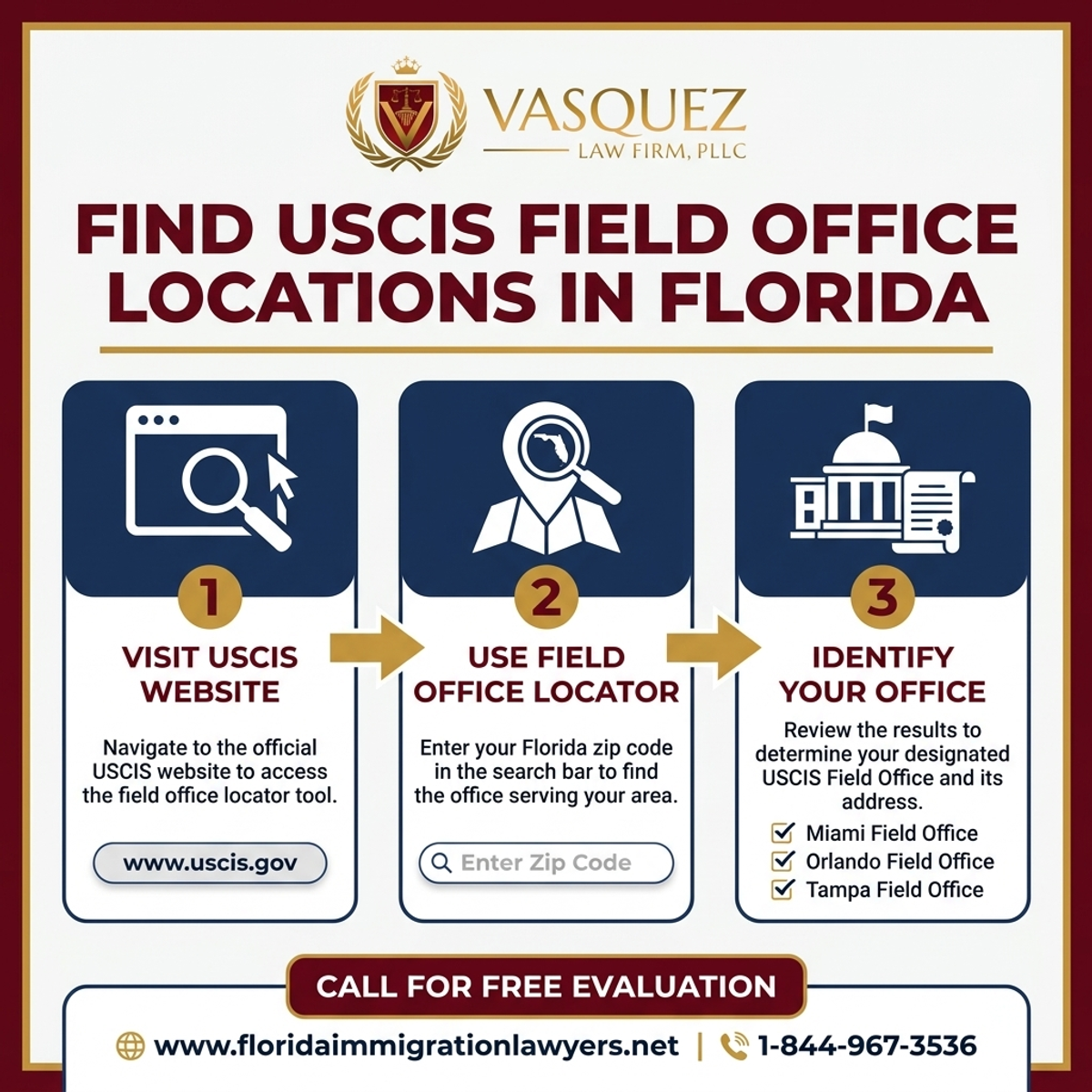
Step-by-Step Process — Find USCIS Field Office Locations in Florida
Timeline and Processing Expectations at USCIS Offices
Processing times at USCIS field offices can vary significantly based on the type of application and current workload. Generally, you can expect:
- Biometrics Appointments: Typically scheduled within a few weeks of application submission.
- Interviews: May be scheduled several months after initial application, depending on the case.
- Application Processing: Can take from several weeks to over a year, depending on the complexity and category.
Understanding these timelines is crucial for managing expectations and planning your immigration journey. Several factors influence how long your application will take, including the specific form filed (e.g., Form I-485 for adjustment of status vs. Form N-400 for naturalization), the USCIS service center initially handling your case, the volume of applications at your local field office, and the complexity of your individual case (e.g., requiring extensive background checks or additional evidence). Global events and policy changes can also impact processing speeds, sometimes leading to unexpected delays or accelerations.
While the USCIS Processing Times page offers a general guide, it's important to check the times specific to your form type and the field office or service center processing your case. You can often find more personalized updates through your USCIS online account, which tracks your application's progress. If your application falls outside the normal processing time frame, you may be eligible to submit an 'e-request' or contact the USCIS Contact Center to inquire about your case status. However, before taking such steps, it's often beneficial to consult with an immigration attorney. Florida Immigration Lawyers can assess whether your delay is abnormal and help you strategize the most effective way to inquire about or expedite your case, ensuring all actions are taken correctly. Call 1-844-967-3536 for assistance with prolonged processing times.
Cost Factors and Fee Breakdown
Understanding the costs associated with USCIS processes is essential. Fees vary depending on the application type. For instance, naturalization applications and adjustment of status have separate fee structures. It is important to check the current fees at the time of application, as they are subject to change. Always refer to the USCIS Fee Schedule for the most accurate information.
Beyond the primary application fees, applicants should also budget for additional potential costs. These might include biometric services fees, which are often bundled with the main application fee but can sometimes be separate. Other expenses could involve obtaining necessary supporting documents, such as birth certificates or marriage licenses from foreign governments, which may incur their own fees. Furthermore, if any of your documents are not in English, you will need to pay for certified translations, which can add to the overall expense. Medical examinations, required for many green card applications, also come with separate costs determined by the authorized civil surgeon.
For individuals who meet specific income guidelines, USCIS offers fee waivers for certain forms. Eligibility for a fee waiver is typically based on receiving a means-tested benefit, having an income at or below 150% of the Federal Poverty Guidelines, or experiencing financial hardship. It's crucial to correctly complete Form I-912, Request for Fee Waiver, and submit all required evidence to support your request. Incorrectly filing for a fee waiver can lead to delays or rejection of your application. Consulting with an experienced attorney from Florida Immigration Lawyers can help you understand all potential costs and determine if you are eligible for a fee waiver, ensuring you navigate the financial aspects of your immigration journey effectively. Reach out to us at 1-844-967-3536 for a detailed discussion on fee structures and financial planning for your immigration case.
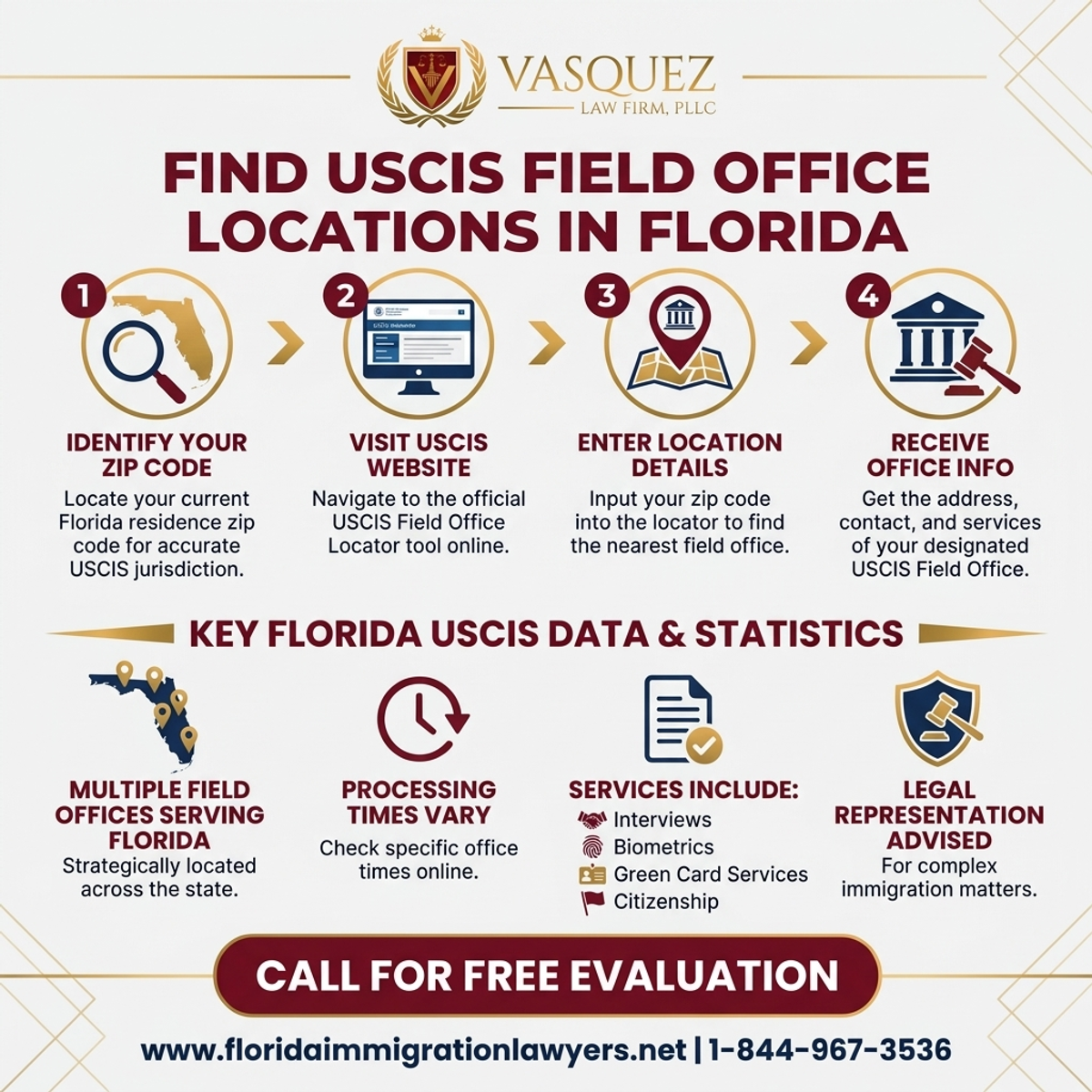
Key Statistics — Find USCIS Field Office Locations in Florida
Common Mistakes to Avoid
Navigating the immigration process is often fraught with potential pitfalls, and even minor errors can lead to significant delays, requests for additional evidence, or even outright denial of your application. Being aware of these common mistakes and taking proactive steps to avoid them is crucial for a successful outcome. The stakes are high, and diligence is your best defense.
- Incorrect Form Submission: Ensure forms are current and properly filled out to avoid delays.
- Missed Appointments: Failing to attend scheduled appointments can result in application denial.
- Insufficient Documentation: Always bring complete and accurate documentation to your appointments.
- Overlooking Deadlines: Pay attention to submission deadlines to avoid missing critical steps.
- Failure to Update USCIS: Notify USCIS of any changes in address or circumstances promptly.
- Ignoring Legal Advice: Consult with a legal expert if unsure about any aspect of your application.
- Assuming All Offices Offer the Same Services: Verify specific services provided at your local office.
Let's elaborate on these critical errors. Submitting an outdated form or one with incomplete or inaccurate information is a frequent cause of rejection. Always download forms directly from the USCIS website on the day you plan to fill them out, as versions are updated regularly. Missing an appointment without a valid reason and proper notification can lead to your case being closed or denied, requiring you to restart the entire process and incur new fees. Insufficient documentation, as discussed earlier, means you might not be able to prove your eligibility, leading to a Request for Evidence (RFE) or denial. Always double-check your checklist and bring originals and copies.
Deadlines imposed by USCIS are strict. Whether it's responding to an RFE, filing an appeal, or submitting an initial application, missing a deadline can have severe consequences, including the abandonment of your case. Furthermore, failing to update your address with USCIS within 10 days of moving via Form AR-11 can result in crucial notices being sent to the wrong address, leading to missed appointments or RFEs you never received. This can jeopardize your entire application. Finally, attempting to navigate complex legal issues without professional guidance is a gamble. An immigration attorney from Florida Immigration Lawyers can help you avoid these common mistakes, ensuring your application is robust and compliant. Don't risk your future; call 1-844-967-3536 for expert assistance.
When to Call a Lawyer
Engaging with USCIS can be overwhelming, particularly if your case involves complex legal issues. While some straightforward applications can be handled independently, many situations warrant the expertise of an immigration attorney. Knowing when to seek legal counsel can make the difference between success and significant setbacks.
- Denied applications or notices of intent to deny.
- Requests for additional evidence that are difficult to satisfy.
- Complex situations like criminal histories or prior immigration violations.
- You have been placed in removal (deportation) proceedings.
- You are applying for a waiver of inadmissibility.
- Your case involves a previous deportation, an order of exclusion, or other adverse immigration history.
- You are seeking asylum or other forms of humanitarian relief.
- You are unsure about which immigration category is best for you or how to gather specific evidence.
- You feel uncomfortable or unprepared for an interview with a USCIS officer.
Consider a scenario where you've received a Notice of Intent to Deny (NOID) because USCIS believes you haven't provided enough evidence of a bona fide marriage. This is a critical juncture where an attorney can help you understand the specific concerns, gather compelling new evidence, and craft a robust response to prevent denial. Similarly, if you have any criminal history, even minor infractions, these can have severe immigration consequences that only an experienced lawyer can properly assess and address. Attempting to explain such issues without legal guidance often leads to unintended admissions or misinterpretations that harm your case.
Florida Immigration Lawyers can provide expert guidance and support through these challenging circumstances. Our attorneys are adept at navigating the intricacies of immigration law, from preparing complex waiver applications to representing clients in interviews and appeals. We understand the nuances of USCIS policies and can advocate effectively on your behalf, ensuring your rights are protected and your case is presented in the strongest possible light. Don't face the immigration system alone when your future is at stake. Call 1-844-967-3536 for a confidential consultation and let our team provide the legal expertise you need.
About Florida Immigration Lawyers
Florida Immigration Lawyers is your trusted partner for navigating immigration processes. Our experienced attorneys offer personalized legal advice, ensuring your case receives the attention it deserves. Whether you're dealing with citizenship, family immigration, or deportation defense, we’re here to help. Contact us at 1-844-967-3536 or visit our website to learn more. Available 24/7, we offer free consultations and serve all of Florida.
Our firm prides itself on a deep understanding of U.S. immigration law and a compassionate approach to client service. We recognize that each immigration journey is unique and often deeply personal, which is why we commit to providing tailored strategies and transparent communication every step of the way. From initial consultations to final decisions, our team works tirelessly to protect your interests and achieve the best possible outcome for your case. We handle a wide array of immigration matters, including but not limited to, family-based petitions, employment visas, naturalization, asylum claims, and complex deportation defense cases.
We believe that everyone deserves access to quality legal representation, regardless of their financial situation or background. That's why we offer free consultations, allowing you to discuss your case with an expert attorney without any upfront cost. Our commitment to being available 24/7 ensures that you can reach us when you need us most, providing peace of mind during often stressful times. With a statewide presence across Florida and a team that is fluent in multiple languages, including Spanish (Se Habla Español), we are equipped to serve the diverse communities throughout the state. Let Florida Immigration Lawyers be your advocate; call 1-844-967-3536 today to start your journey with confidence.
Sources and References
To ensure the accuracy and reliability of the information provided in this guide, we rely on official governmental sources and established legal frameworks. These resources are indispensable for anyone seeking to understand and navigate the complex landscape of U.S. immigration law.
- U.S. Citizenship and Immigration Services (USCIS)
- Executive Office for Immigration Review (EOIR)
- 8 U.S.C. Chapter 12 - Immigration and Nationality Act
- U.S. Department of State
These authoritative sources provide the most current forms, fee schedules, processing times, and legal guidance. Always refer to them for the most up-to-date information, as immigration laws and policies are subject to frequent changes. For personalized interpretation or application of these laws to your specific case, Florida Immigration Lawyers are here to help. Contact us at 1-844-967-3536.
Related services: asylum and refugee protection, immigration waivers, humanitarian protection programs, DACA renewal and applications.
Our firm offers a comprehensive suite of immigration legal services designed to address a wide range of needs. From helping individuals seek safety through asylum and refugee protection to assisting with complex immigration waivers that overcome inadmissibility, our dedicated team provides expert guidance. We also specialize in humanitarian protection programs and DACA renewals and applications, ensuring that vulnerable populations receive the support they need to secure their future in the United States. Each of these services is handled with the utmost care and legal precision by the experienced attorneys at Florida Immigration Lawyers. If you require assistance with any of these practice areas or have related immigration questions, please do not hesitate to reach out for a free consultation at 1-844-967-3536.
This article provides general legal information and is not intended as legal advice. Every case is unique, and outcomes depend on specific facts and circumstances. Contact an attorney for advice about your particular situation.
It is crucial to understand that general information cannot substitute for the personalized counsel of a qualified immigration attorney. Immigration laws are complex and constantly evolving, and what applies to one case may not apply to another due to subtle differences in facts, legal precedents, or policy changes. Relying solely on general information without professional legal review could lead to adverse outcomes for your immigration case. Always seek specific legal advice tailored to your circumstances from a licensed attorney.
For personalized assistance, reach out to Florida Immigration Lawyers at 1-844-967-3536. Se Habla Español - Estamos aquí para ayudarle.
If you need legal assistance, learn more about learn about deportation defense options, or call us at 1-844-967-3536 for a free consultation.
Do Not Navigate This Process Alone
Our experienced immigration attorneys are ready to fight for you. Get a free, confidential consultation today.
Se Habla Español
Frequently Asked Questions
Florida Immigration Lawyers
Immigration Attorney | Founder, Vasquez Law Firm
U.S. Air Force veteran and immigration attorney with thousands of cases resolved. J.D., NCCU School of Law. AILA member. Admitted to the 4th, 5th, and 11th Circuit Courts.
Available 24/7 - Free Evaluations
Related Legal Services
Our Florida immigration attorneys can help you with family immigration services, immigration practice areas and free immigration consultation. Call today at 1-844-967-3536 for a free consultation.
Related Links
Related Topics
Free Legal Consultation
Discuss your case with our experienced attorneys. We're available 24/7.
Se Habla Español - Estamos aquí para ayudarle.
Related Articles
Special Immigrant Juvenile Status in Florida | VLF Florida
SIJS offers a pathway to legal residency for minors in Florida who have faced abuse, abandonment, or neglect. Learn how SIJS can provide legal protection and a brighter future. Call us for a free consultation.
Asylum Interview Preparation in Florida: Key Steps
Prepare for your asylum interview in Florida with expert guidance. Learn about key steps, document requirements, common mistakes, and when to seek legal help.
EB-5 Investor Green Card in Florida: Key Insights | VLF Florida
Explore how the EB-5 investor green card program can help you start a new life in Florida. Learn about the benefits, processes, and common pitfalls of this investment immigration path. Call 1-844-967-3536 for expert guidance.
E-2 Visa for Florida Business Investors | VLF Florida
Learn how the E-2 investor visa can help you start a business in Naples, Florida. We cover eligibility, application steps, common mistakes, and when to seek legal help. Contact Florida Immigration Lawyers for a free consultation.