Special Immigrant Juvenile Status in Florida
SIJS offers a pathway to legal residency for minors in Florida who have faced abuse, abandonment, or neglect. Learn how SIJS can provide legal protection and a brighter future. Call us for a free consultation.

Special Immigrant Juvenile Status in Florida | VLF Florida
Navigating the complex landscape of U.S. immigration law can be particularly challenging for vulnerable children. Special Immigrant Juvenile Status (SIJS) offers a crucial pathway to legal residency for undocumented children in the United States who have been abused, neglected, or abandoned by one or both parents. In Florida, understanding the specific requirements and processes for SIJS is vital for these children to find safety and a stable future. At VLF Florida, our dedicated immigration attorneys are committed to helping minors secure the protection and opportunities they deserve through SIJS.
What is Special Immigrant Juvenile Status (SIJS)?
[EXISTING CONTENT ABOUT WHAT SIJS IS, ITS PURPOSE, AND WHO IT HELPS]
SIJS is a humanitarian form of immigration relief that allows certain undocumented children who are present in the U.S. to obtain lawful permanent resident status (a Green Card). It is designed to protect children who cannot be reunited with one or both parents due to abuse, neglect, or abandonment, and for whom it has been determined that returning to their home country is not in their best interest. This status provides a lifeline, offering not just legal residency but also a pathway to safety and stability away from harmful environments.
Eligibility Requirements for SIJS in Florida
[EXISTING CONTENT ABOUT ELIGIBILITY CRITERIA]
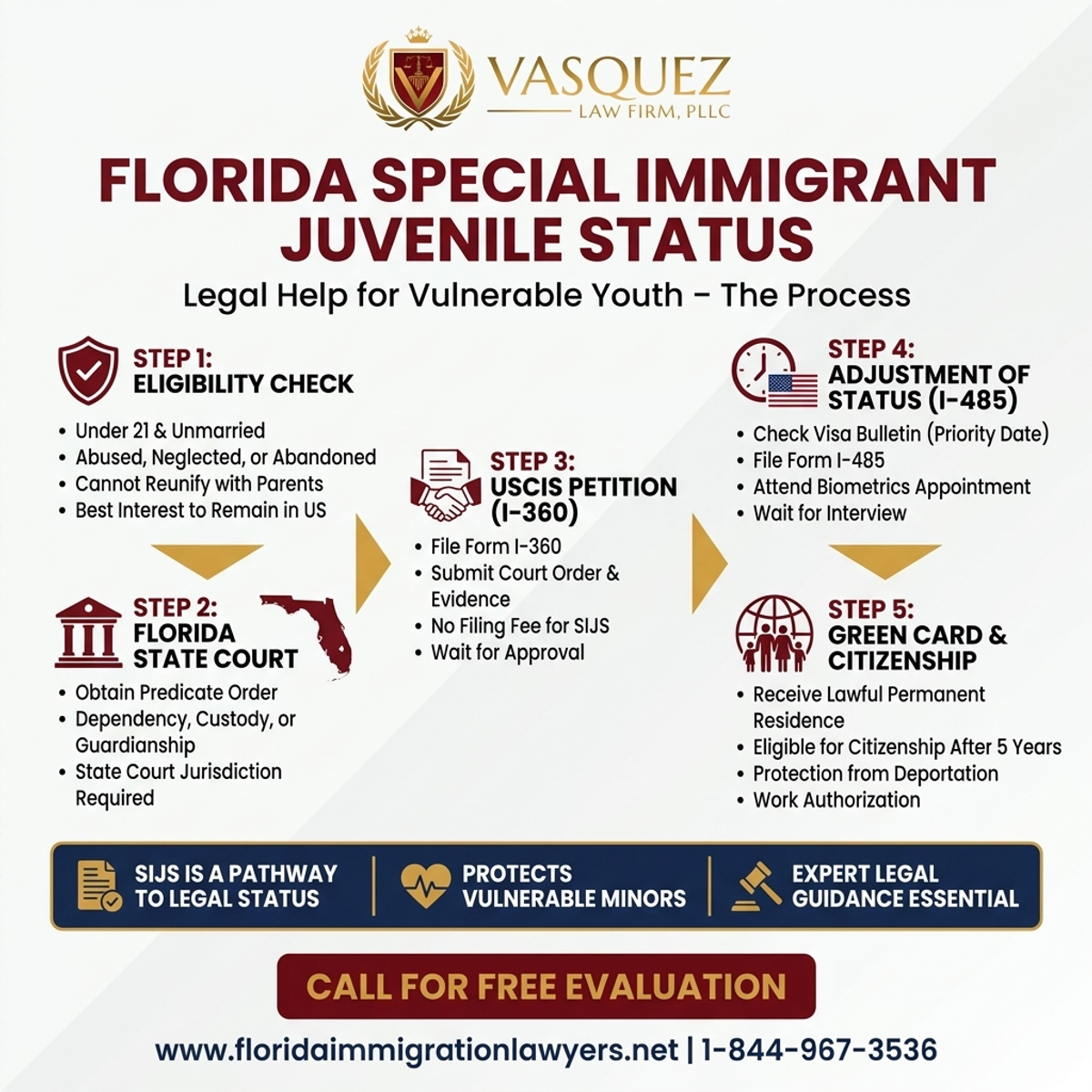
To qualify for SIJS, a child must meet several stringent criteria, which involve both state court findings and federal immigration requirements. The child must be under 21 years old at the time the SIJS petition is filed, unmarried, and physically present in the U.S. Crucially, a state court (such as a family court or dependency court in Florida) must issue an order making specific findings. These findings typically include:
- The child has been declared dependent on a juvenile court, or legally committed to, or placed under the custody of, a state agency or department, or an individual or entity appointed by a state or juvenile court.
- Reunification with one or both parents is not possible due to abuse, neglect, abandonment, or a similar basis found under state law.
- It is not in the child's best interest to return to their or their parent's last habitual residence country.
These state court findings are the bedrock of an SIJS petition. Without a qualifying state court order, the federal immigration agency (USCIS) cannot approve an SIJS petition. The process often involves working with a guardian ad litem and presenting compelling evidence to the state court regarding the child's circumstances. Our team understands the nuances of coordinating between state and federal legal systems to build a strong case for your child.
The SIJS Application Process in Detail
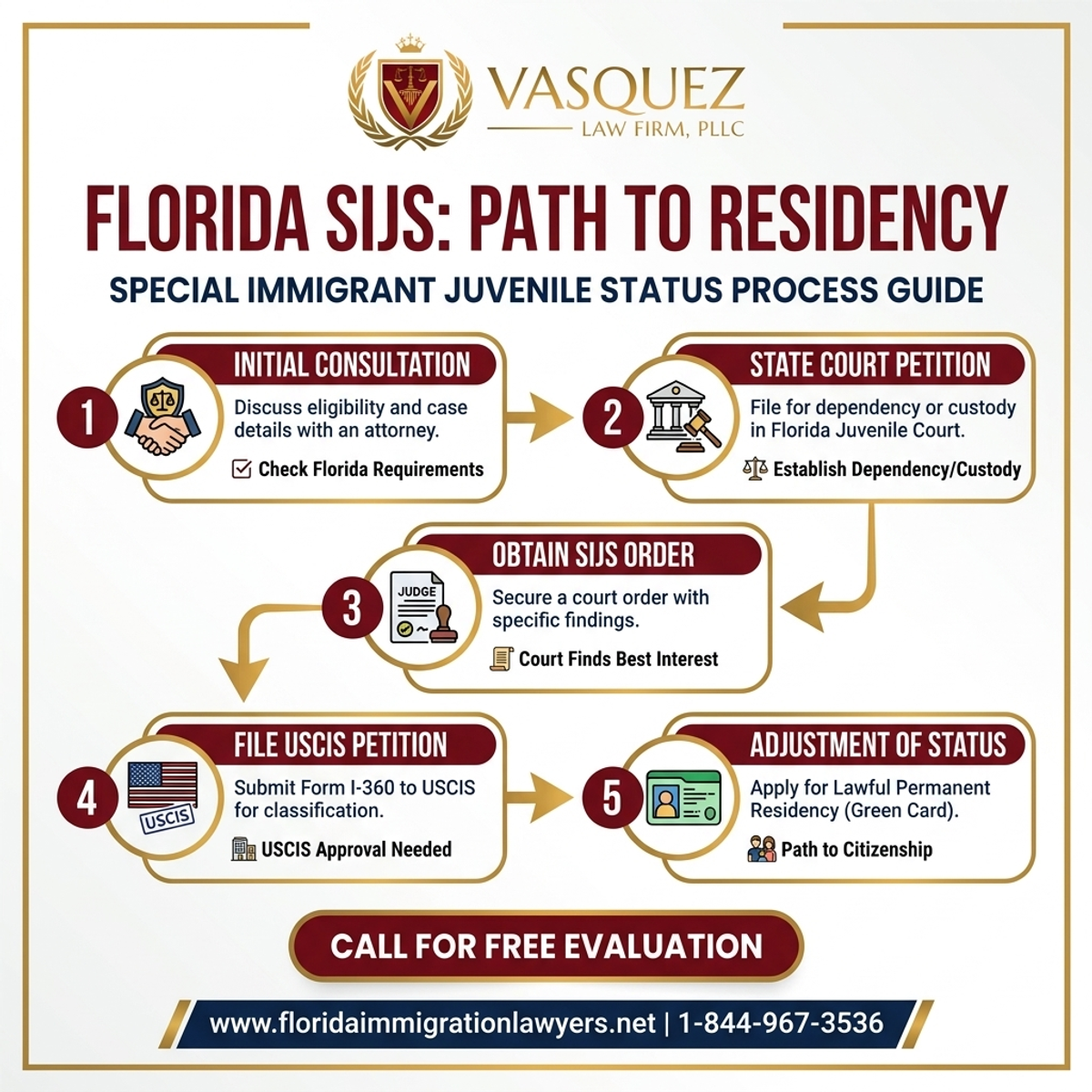
The journey to obtaining Special Immigrant Juvenile Status involves a multi-step process that requires careful attention to detail and a thorough understanding of both state and federal laws. This dual-jurisdiction nature is often the most challenging aspect for applicants and their families, underscoring the importance of experienced legal counsel.
Step 1: Obtaining a Predicate Order from State Court
The first and most critical step is to secure a “predicate order” from a Florida state court. This is typically a juvenile or family court. The court must make specific findings, as outlined in the eligibility section. This involves initiating a dependency, guardianship, or custody proceeding in state court. During these proceedings, evidence must be presented to demonstrate that:
- The child is under the court's jurisdiction.
- The child has been abused, neglected, or abandoned by one or both parents.
- Reunification with one or both parents is not viable.
- It is not in the child's best interest to return to their country of origin.
This state court process can be lengthy and complex, requiring legal representation to navigate family law procedures and present a compelling case. The specific type of state court order (e.g., an order declaring dependency, appointing a guardian, or granting sole custody) can vary, but it must contain all the necessary findings for USCIS to accept it.
Step 2: Filing Form I-360, Petition for Amerasian, Widow(er), or Special Immigrant
Once a qualifying state court order is obtained, the next step is to file Form I-360, Petition for Amerasian, Widow(er), or Special Immigrant, with U.S. Citizenship and Immigration Services (USCIS). This petition is specifically for the SIJ classification. Along with the completed Form I-360, you must submit:
Step-by-Step Process — Special Immigrant Juvenile Status in Florida | VLF Florida
- A copy of the state court order containing all the required findings.
- Proof of the child's age (birth certificate).
- Proof of the child's marital status (unmarried).
- Any other supporting documentation that substantiates the claims made in the petition and the state court order.
USCIS will review the petition and supporting evidence to determine if the child meets the federal SIJS eligibility criteria. If approved, the child is granted SIJ classification, which is a significant step towards obtaining a Green Card.
Step 3: Applying for Adjustment of Status (Form I-485) or Consular Processing
After the I-360 petition is approved, the child can apply for lawful permanent resident status. For most SIJS recipients, this involves filing Form I-485, Application to Register Permanent Residence or Adjust Status, while remaining in the United States. However, SIJS visas are subject to availability based on the Visa Bulletin. While many SIJS applicants from certain countries may face a waiting period due to visa backlogs, others may be able to file their I-485 concurrently with or shortly after their I-360.
The adjustment of status application requires additional documentation, including medical examinations, affidavits of support, and biometric appointments. It is crucial to have an attorney guide you through this final stage to ensure all requirements are met and to prepare for potential interviews with USCIS officers. In rare cases, if the child is outside the U.S. and meets specific criteria, they might undergo consular processing at a U.S. embassy or consulate abroad, though SIJS is primarily designed for children already within the U.S.
Benefits of Special Immigrant Juvenile Status
[EXISTING CONTENT ABOUT BENEFITS]
The benefits of obtaining SIJS extend far beyond simply gaining legal status. It provides a pathway to a Green Card, offering stability, security, and the ability to live and work legally in the U.S. without fear of deportation. SIJS recipients are also eligible for certain public benefits and educational opportunities that are often inaccessible to undocumented individuals. This status offers a critical foundation for children to heal from past trauma and build a brighter future in a safe environment.
Challenges and Common Pitfalls in SIJS Cases
While SIJS offers a vital path to protection, the application process is fraught with complexities and potential pitfalls that can jeopardize a child's future. Understanding these challenges is crucial for a successful outcome.
Navigating Dual Jurisdiction
One of the most significant challenges is the interplay between state juvenile/family courts and federal immigration law. The state court must make specific findings that satisfy federal SIJS requirements. If the state court order lacks even one of the necessary findings, USCIS will deny the I-360 petition. This requires attorneys to be proficient in both family law and immigration law, ensuring that the state court proceedings are tailored to meet federal immigration standards. Coordinating between these two distinct legal systems can be intricate and time-consuming.
Timely Filing and Age Limits
The age limit for SIJS (under 21 at the time of I-360 filing) is a strict deadline. Delays in obtaining the state court order or filing the I-360 can lead to a child aging out, making them ineligible for this crucial relief. This urgency necessitates prompt action and efficient legal strategy from the outset. Furthermore, children who have already turned 18 but are under 21 may face additional challenges in state court, as they are considered adults in many state legal contexts, even if they are still minors for SIJS purposes.
Gathering Evidence and Documentation
Proving abuse, neglect, or abandonment, especially for children who have experienced severe trauma, can be difficult. Gathering sufficient evidence, including police reports, medical records, school records, and testimony, is essential. Many children arrive in the U.S. with little to no documentation, making the evidentiary burden even heavier. Building a compelling narrative supported by credible evidence is paramount for both the state court and USCIS.
Key Statistics — Special Immigrant Juvenile Status in Florida | VLF Florida
Potential for Denial and Appeals
Despite meeting eligibility criteria, SIJS petitions can be denied for various reasons, including insufficient documentation, errors in the application, or misinterpretations of the law. A denial can be devastating, but it is not always the end of the road. Understanding the appeals process or exploring other forms of relief, such as asylum, if applicable, becomes critical. Having experienced legal counsel can help identify and rectify issues, or pursue alternative immigration pathways.
The Importance of Legal Representation
Given these complexities, attempting to navigate the SIJS process without legal representation is highly discouraged. An experienced immigration attorney can ensure all deadlines are met, all necessary documentation is gathered, and the state court order contains the precise language required by federal law. They can also represent the child in both state and federal proceedings, providing a seamless and comprehensive approach to their case.
Beyond SIJS: What Happens After Approval?
Receiving SIJS approval and subsequently a Green Card is a life-changing event, but it's also the beginning of a new chapter. Understanding the long-term implications and opportunities is important for SIJS recipients and their families.
Life as a Lawful Permanent Resident
With a Green Card, the child becomes a Lawful Permanent Resident (LPR) of the United States. This status grants them the right to live and work permanently anywhere in the U.S., travel internationally with fewer restrictions, and access a wider range of educational and professional opportunities. They are protected from deportation, provided they do not commit certain crimes or violate other immigration laws. This stability allows them to focus on their education, personal development, and integration into their communities.
Path to U.S. Citizenship
After holding LPR status for a specific period (typically five years, though there are exceptions), SIJS recipients may become eligible to apply for U.S. citizenship through naturalization. Becoming a U.S. citizen offers even greater rights and protections, including the right to vote and hold public office. Our attorneys can guide SIJS recipients through the naturalization process when they become eligible, ensuring a smooth transition from LPR to citizen.
Family Reunification (Limitations for SIJS Recipients)
It's important to note a specific limitation for SIJS recipients regarding family reunification. Unlike other Green Card holders, SIJS recipients generally cannot petition for their abusive, neglectful, or abandoning parents to immigrate to the United States. This restriction is in place to prevent the very individuals who caused harm from benefiting from the child's humanitarian status. However, once an SIJS recipient becomes a U.S. citizen, they may be able to petition for other eligible family members, such as siblings or a spouse (if they marry as adults), subject to standard immigration laws.
Why Choose VLF Florida for Your SIJS Case?
At VLF Florida, we understand the profound impact that Special Immigrant Juvenile Status can have on a child's life. Our experienced legal team is dedicated to providing compassionate, effective, and comprehensive representation for SIJS applicants in Florida. We pride ourselves on:
- Expertise in Dual Jurisdiction: Our attorneys are proficient in both state family/juvenile law and federal immigration law, ensuring seamless navigation of the entire SIJS process.
- Client-Centered Approach: We prioritize the well-being and best interests of each child, offering personalized legal strategies tailored to their unique circumstances.
- Proven Track Record: We have a history of successfully helping vulnerable children secure SIJS, providing them with the opportunity for a safe and stable future.
- Comprehensive Support: From the initial state court petition to the final adjustment of status application, we guide our clients through every step, alleviating stress and ensuring compliance.
If you are a child, a relative, or a guardian seeking to understand SIJS or begin the application process, do not hesitate to reach out. We offer free consultations to discuss your specific situation and determine the best course of action.
Frequently Asked Questions About SIJS in Florida
[EXISTING FAQ SECTION - 8 QUESTIONS]
Contact VLF Florida Today
The path to Special Immigrant Juvenile Status can be complex, but you don't have to navigate it alone. Our dedicated Florida immigration lawyers are here to provide the expert guidance and support you need. Protect a child's future by exploring their eligibility for SIJS. Contact VLF Florida today for a free, confidential consultation. Call us at 1-844-967-3536 to discuss your case and take the first step towards a brighter future.
Sources and References
- U.S. Citizenship and Immigration Services (USCIS)
- Executive Office for Immigration Review (EOIR)
- U.S. Department of State - Bureau of Consular Affairs
- Immigration and Nationality Act (INA), 8 U.S.C. Chapter 12
Do Not Navigate This Process Alone
Our experienced immigration attorneys are ready to fight for you. Get a free, confidential consultation today.
Se Habla Español
Or leave your details and we’ll call you:
Free Evaluation in 24 Hours
Or talk to us right now

AI voice assistant — available 24/7
FreeFrequently Asked Questions

William J. Vásquez
Founding Attorney · Vasquez Law Firm
U.S. Air Force veteran and immigration attorney with years of hands-on U.S. immigration experience. J.D., NCCU School of Law. AILA member. Admitted to the 4th, 5th, and 11th Circuit Courts.
Available 24/7 - Free Evaluations
Reviewed for legal accuracy by William J. Vásquez
Licensed in North Carolina; U.S. immigration is federal practice.
Related Legal Services
Our Florida immigration attorneys can help you with business immigration, asylum protection and deportation defense. Call today at 1-844-967-3536 for a free consultation.
Related Links
Related Topics
Free Legal Consultation
Discuss your case with our experienced attorneys. We're available 24/7.
Se Habla Español - Estamos aquí para ayudarle.
Related Articles
Stem OPT Immigration Lawyer: 2026 Florida Guide
For F-1 students in Florida, the STEM OPT extension offers a vital 24-month work authorization after their initial OPT. This guide, updated for 2026, covers eligibility, the step-by-step application process, required documents, and critical timelines. Graduates from Florida universities in STEM fields must navigate strict USCIS regulations, including the E-Verify employer requirement. Learn how to avoid common mistakes and when to seek professional legal assistance from a dedicated stem OPT immigration lawyer to ensure a successful application and continued career growth in the U.S. Florida Immigration Lawyers offers expert guidance for students across the state.
Dual Citizenship Lawyer: Navigating Delays in Florida
Facing citizenship delays in Florida can be challenging, but understanding the process and knowing your options is key. Learn how a dual citizenship lawyer can assist you in navigating N-400 processing and USCIS backlogs in Hialeah.
"ina § 208(a)(2)" One-Year Filing Deadline: Florida Asylum
Discover the importance of the "ina § 208(a)(2)" one-year filing deadline for asylum seekers in Florida. Learn about the steps, documents needed, and common mistakes to avoid in your asylum application process.
DV-2027 Registration Period: Your Green Card Lottery Guide
The DV-2027 Diversity Visa (DV) lottery offers a unique pathway to permanent residency for individuals from countries with historically low immigration rates to the U.S. Expected to open in Fall 2025, the registration period requires strict adherence to eligibility criteria, including country of birth and specific education or work experience. This guide from Florida Immigration Lawyers covers the step-by-step application process, essential documents, critical timelines, and associated costs. We highlight common mistakes to avoid and explain when legal counsel is indispensable, especially for residents in Florida. Understanding the nuances of the green card lottery is vital for a successful application. Contact us for expert guidance on your DV-2027 journey.