USCIS Office Near Me: Florida Processing Times 2026
Navigating USCIS processing times in Florida for 2026 can be complex. This guide from Florida Immigration Lawyers demystifies the process, helping you understand how to check your case status, identify factors influencing wait times, and avoid common mistakes. Learn about the functions of local USCIS offices in Orlando and Miami, step-by-step application procedures, essential document checklists, and the typical costs involved. We provide detailed timelines for common applications like Green Cards and naturalization, emphasizing the importance of accurate submissions and timely responses to USCIS requests. Discover when it's crucial to seek expert legal assistance to ensure a smooth and successful immigration journey. Contact Florida Immigration Lawyers for a free case review.
For those searching for a "USCIS office near me" in Florida, the U.S. Citizenship and Immigration Services (USCIS) primarily serves the state through its Field Offices in Orlando and Miami, along with the Asylum Office in Miami and Application Support Centers (ASCs) across various cities like Jacksonville and Hialeah. As of 2026, processing times for immigration applications vary significantly based on the form type, the specific service center, and the applicant's unique circumstances. Utilizing the official USCIS online tool is crucial for obtaining the most current estimates. Understanding these wait times is essential for effective planning and managing expectations throughout your immigration journey in Florida.
- USCIS operates Field Offices in Orlando and Miami for interviews and certain services.
- Processing times are highly variable; check the official USCIS website for current estimates.
- Application Support Centers (ASCs) handle biometrics appointments statewide.
- Factors like case type, service center workload, and RFE responses influence timelines.
- Legal guidance from Florida Immigration Lawyers can help navigate complex processing issues.
Navigating the complex landscape of U.S. immigration can be a daunting experience, especially when you're trying to understand the intricate details of "USCIS processing times Florida 2026." Whether you're applying for a Green Card, naturalization, or a work visa, the question of "how long will it take?" is often at the forefront of applicants' minds. For individuals and families across Florida, from Orlando to Miami, understanding these timelines and knowing where your nearest USCIS office is located is crucial for effective planning and peace of mind.
This comprehensive guide from Florida Immigration Lawyers aims to demystify USCIS processing times specifically for Florida residents in 2026. We will explore how to check your case status, what factors influence delays, common pitfalls to avoid, and when it’s essential to seek professional legal assistance. Our goal is to provide you with actionable insights and clarify the often-confusing immigration process, ensuring you are well-informed every step of the way. If you find yourself overwhelmed or have specific questions about your case, do not hesitate to call Florida Immigration Lawyers at 1-844-YO-PELEO for a free case review.
What is a USCIS Office Near Me in Florida and How Does It Operate?
For residents of Florida, a "USCIS office near me" typically refers to one of the USCIS Field Offices or Application Support Centers (ASCs) located throughout the state. These offices serve different but equally critical functions in the immigration process. The main Field Offices in Florida are situated in Orlando and Miami, where most interviews for adjustment of status, naturalization, and other benefit applications are conducted. The Miami office also houses an Asylum Office, dedicated to processing asylum claims. ASCs, on the other hand, are primarily responsible for collecting biometric data-fingerprints, photographs, and signatures-which are essential for identity verification and background checks for nearly all immigration applications. As of 2026, understanding which office handles your specific application type and geographical jurisdiction is vital for predicting processing times.
The operational scope of these offices directly impacts processing times. Field Offices, for example, are responsible for scheduling and conducting interviews, which can be a significant bottleneck depending on staffing levels and caseloads. The Orlando Field Office serves Central Florida, including applicants from cities like Kissimmee and Sanford, while the Miami Field Office covers South Florida. ASCs, found in various locations such as Jacksonville, West Palm Beach, and Hialeah, operate purely on appointment for biometrics collection and do not handle case inquiries or interviews. The overall efficiency and workload of these local offices, combined with national policy shifts and resource allocation, play a substantial role in the wait times experienced by applicants. For the most accurate information regarding your specific application, always refer to the official USCIS website, which provides tools to locate offices and check processing times.
How Do I Check USCIS Processing Times for Florida Cases in 2026?
To check USCIS processing times for Florida cases in 2026, you should use the official USCIS online tool, which provides the most current estimates based on the specific form type and the service center or field office handling your case. This tool is updated regularly and is the authoritative source for processing time information.
Understanding the current USCIS processing times is a critical step for any immigrant in Florida. USCIS provides an online tool that allows you to check estimated processing times for various forms at different service centers and field offices. As of 2026, here’s a step-by-step guide to accurately check your case status and estimated wait times:
- Visit the Official USCIS Website: Navigate to www.uscis.gov/processing-times. This is the only reliable source for this information.
- Select Your Form: From the dropdown menu, choose the specific immigration form you have filed or plan to file (e.g., I-485 for Adjustment of Status, N-400 for Naturalization, I-130 for Petition for Alien Relative).
- Select Your Field Office or Service Center: This is crucial. If your application typically involves an interview, select the Field Office with jurisdiction over your residence (e.g., Orlando Field Office for Central Florida residents, Miami Field Office for South Florida residents). If your application is processed centrally without an interview, select the appropriate Service Center (e.g., Nebraska Service Center, Texas Service Center).
- Review the Posted Times: USCIS will display a range of processing times for your selected form and office. These times are estimates and represent how long it took USCIS to process cases from the "case inquiry date" up to a certain percentage of completed cases.
- Understand the "Case Inquiry Date": This date indicates when you can inquire about your case if it has exceeded the normal processing time. If your receipt date is before the "case inquiry date," you may be eligible to submit an "Outside Normal Processing Times" service request.
It is important to remember that these times are estimates and can fluctuate. Various factors, including the completeness of your application, responses to Requests for Evidence (RFEs), and changes in USCIS workload or policy, can influence your individual timeline. For instance, a complex family-based petition (Form I-130) might take longer than a straightforward work permit application (Form I-765). Always keep a copy of your receipt notice, as it contains your receipt number, which is essential for tracking your case.
What Factors Impact USCIS Processing Times in Florida?
USCIS processing times in Florida are influenced by a multitude of factors, making it challenging to predict an exact timeline for any given case. These factors can range from the type of application filed to the specific USCIS office handling the case, and even broader policy changes. Understanding these variables can help set realistic expectations for your immigration journey in 2026. One significant factor is the **volume of applications** received by a particular service center or field office. High caseloads naturally lead to longer wait times, a common issue in populous states like Florida.
Another critical element is the **type of immigration benefit** being sought. For example, a family-based adjustment of status (Form I-485, typically filed with a Form I-130 Petition for Alien Relative) often involves more extensive background checks and an interview, leading to longer processing times compared to a standalone work authorization application (Form I-765). The **completeness and accuracy of your application** also play a crucial role; any missing information or errors can result in a Request for Evidence (RFE) or a Notice of Intent to Deny (NOID), significantly extending your timeline. Furthermore, **changes in immigration law or policy**, such as those referenced in recent news regarding filing deadlines or green card applicant protections, can introduce new procedures or backlogs, affecting processing speeds across the board. The specific **adjudicating officer's discretion** and the **efficiency of the local USCIS Field Office** (like Orlando or Miami) also contribute to the variability in wait times. For instance, the USCIS Policy Manual outlines adjudication standards, but individual officer workloads can still cause differences. The Executive Office for Immigration Review (EOIR), which oversees immigration courts, also influences timelines for those in removal proceedings.
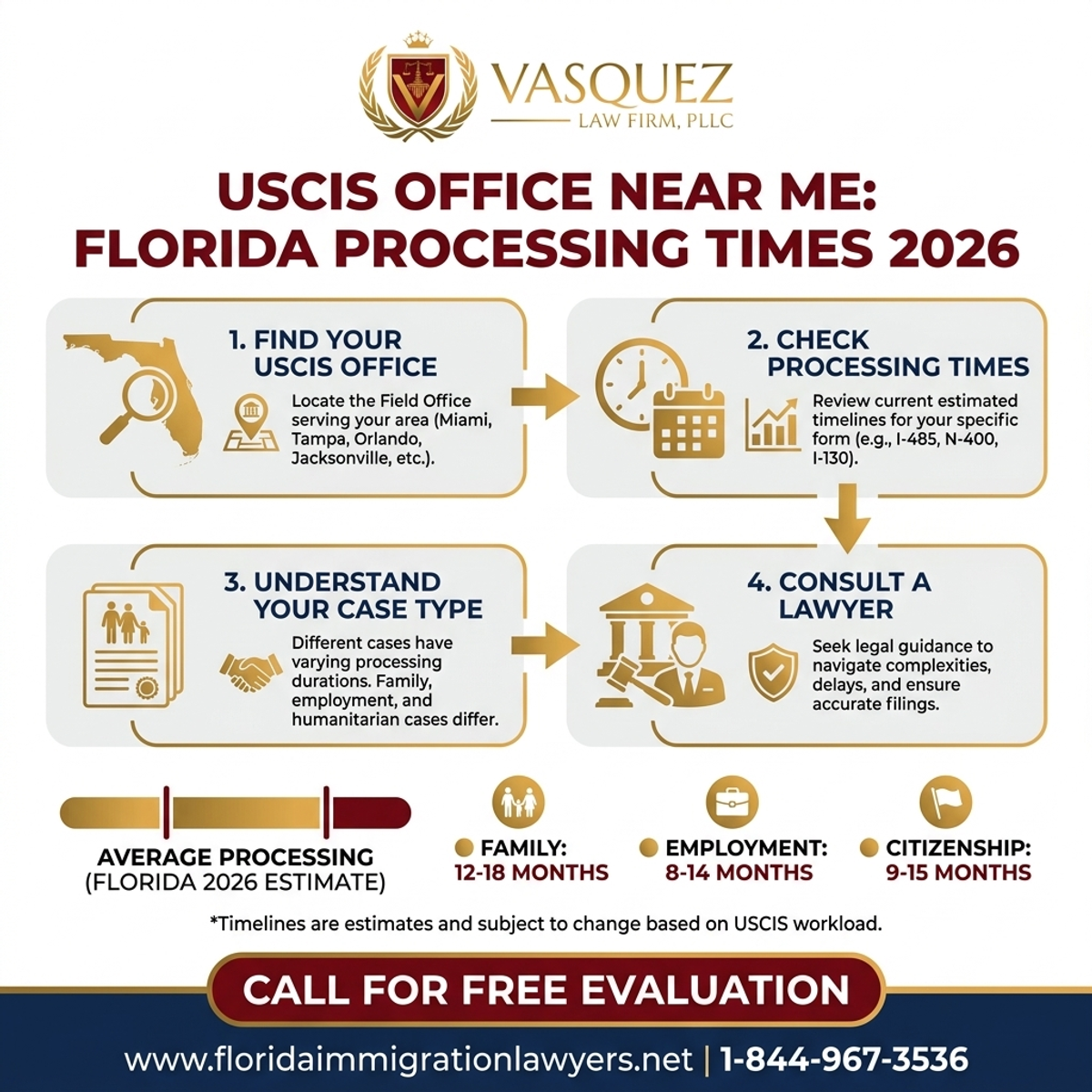
Step-by-Step Process — USCIS Office Near Me: Florida Processing Times 2026
Key Steps for Filing an Immigration Application in Florida (2026)
Filing an immigration application with USCIS in Florida requires careful attention to detail and adherence to specific procedures. As of 2026, while the general steps remain consistent, staying updated on any new forms or requirements is essential. This step-by-step guide outlines the typical process, helping you prepare for your application journey.
- Determine Eligibility and Select the Correct Form: Before anything else, ensure you meet the eligibility criteria for the immigration benefit you are seeking. This involves understanding the relevant sections of the Immigration and Nationality Act (INA), such as INA 245 for adjustment of status or INA 316 for naturalization. Incorrect form selection can lead to delays or denial. For example, a spouse of a U.S. citizen typically files Form I-130 and Form I-485 concurrently.
- Gather Required Documentation: This is a critical phase. Collect all necessary supporting documents, including birth certificates, marriage certificates, passports, financial records, medical examination results (Form I-693), and any other evidence required for your specific application. Ensure all foreign documents are translated into English by a certified translator.
- Complete Forms Accurately and Thoroughly: Fill out all sections of your chosen USCIS form(s) completely and accurately. Any omissions or errors can trigger a Request for Evidence (RFE) or even a denial. It's advisable to type the forms or write legibly in black ink.
- Pay Filing Fees: USCIS charges fees for most applications. Check the current fee schedule on the USCIS website (Form G-1055, Fee Schedule) as fees can change. Payment can typically be made by money order, personal check, cashier's check, or by credit card using Form G-1450.
- Mail Your Application Packet: Send your completed application, supporting documents, and fee payment to the correct USCIS lockbox facility or service center. The mailing address varies by form type and often by the state of residence. Double-check the "Where to File" instructions for your specific form on the USCIS website.
- Attend Biometrics Appointment: After filing, you will typically receive an appointment notice for an Application Support Center (ASC) to have your fingerprints, photograph, and signature taken. This is essential for background and security checks.
- Attend Interview (if required): Many applications, such as adjustment of status and naturalization, require an interview at a USCIS Field Office (e.g., Orlando or Miami). Prepare thoroughly by reviewing your application and supporting documents.
- Receive a Decision: After all steps are completed, USCIS will mail you a decision notice. This could be an approval, a request for more information, or a denial.
Document Checklist for Common Florida Immigration Applications
A thorough document checklist is vital to avoid delays. While specific requirements vary, here's a general list:
- Birth Certificates (applicant and petitioner/sponsor)
- Marriage Certificate (if applicable)
- Passports and Visas (current and expired)
- Medical Examination Report (Form I-693)
- Affidavit of Support (Form I-864) and supporting financial documents (tax returns, employment letters)
- Photographs (passport-style, as per USCIS specifications)
- Police Clearances/Court Records (if applicable)
- Proof of Lawful Entry and Immigration Status (Form I-94, previous visa stamps)
- Proof of Relationship (for family-based petitions: photos, joint bank accounts, leases)
- Translated documents (with certification)
Timeline and Processing Expectations for Florida USCIS Cases (2026)
As of 2026, processing times remain dynamic. Here's a general overview, but always check the USCIS website:
| Stage | Typical Timeframe | Notes |
|---|---|---|
| Application Submission to Receipt Notice | 1-3 weeks | Acknowledgement that USCIS received your application. |
| Biometrics Appointment (after receipt) | 3-8 weeks | Scheduled at an Application Support Center (ASC) near you. |
| Work Authorization (I-765) Processing | 3-12 months | Highly variable by service center; can be filed concurrently with I-485. |
| Travel Document (I-131) Processing | 3-12 months | Highly variable; can be filed concurrently with I-485. |
| Adjustment of Status (I-485) Interview | 8-24 months (after filing) | Interview at Orlando or Miami Field Office; depends on office workload. |
| Naturalization (N-400) Processing | 6-18 months | Includes biometrics, interview, and oath ceremony. |
| Petition for Alien Relative (I-130) Processing | 6-36 months | Varies greatly by relationship category and country of origin. |
| Decision Notification | 1-4 weeks (after interview/final review) | Decision usually mailed; some approvals may be given on the spot. |
What Are the Costs Associated with USCIS Applications in Florida (2026)?
The costs associated with USCIS applications in Florida for 2026 are primarily composed of government filing fees, which are subject to change, and potentially legal fees if you choose to hire an attorney. USCIS fees are standardized across the U.S., but the total cost for an applicant in Florida will depend on the specific forms filed and whether additional services, like a medical exam, are required. Always check the most current fee schedule on the USCIS website (Form G-1055, Fee Schedule) before submitting your application, as fees can be updated periodically. Failure to pay the correct fee will result in your application being rejected or delayed.
Beyond the mandatory USCIS filing fees, applicants should budget for other potential expenses. These include fees for the required medical examination (Form I-693), which must be performed by a USCIS-approved civil surgeon. The cost for this exam varies by provider but typically ranges from $200-$500. Additionally, if you require certified translations of foreign documents, these services will incur separate costs. For those seeking professional legal representation, attorney fees will also be a significant consideration. While not mandatory, hiring an experienced immigration lawyer from Florida Immigration Lawyers can often save time, reduce errors, and increase the likelihood of a successful outcome, especially for complex cases. It's important to discuss all potential costs upfront with your legal team. For certain low-income applicants, fee waivers may be available for specific forms, which can significantly reduce the financial burden. Eligibility for fee waivers is outlined in 8 CFR 103.7(c) and on the USCIS website.
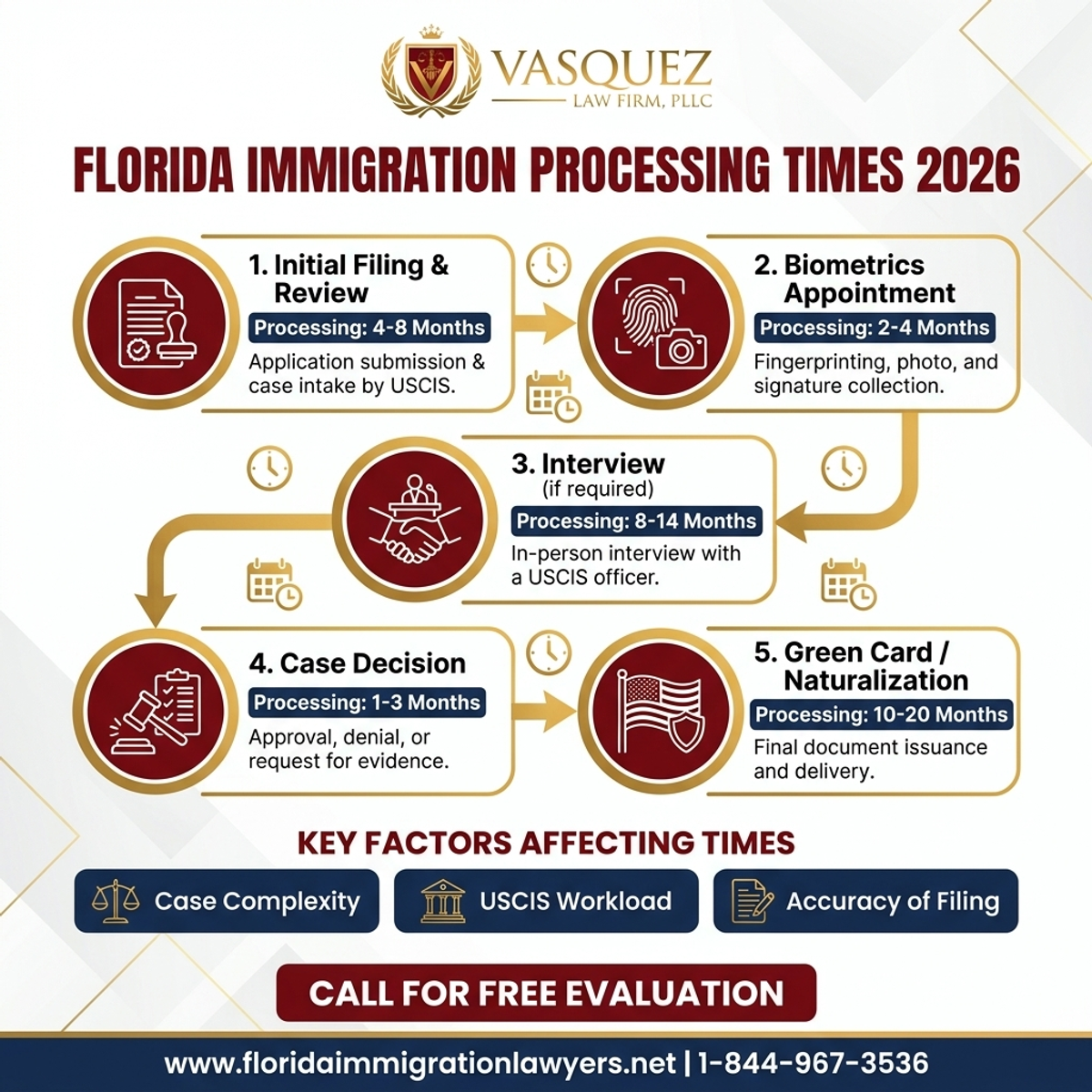
Key Statistics — USCIS Office Near Me: Florida Processing Times 2026
| Item | Typical Fee (2026 Estimate) | Notes |
|---|---|---|
| Form I-485 (Adjustment of Status) | $1,140 - $1,225 | Includes biometric services fee; fee varies by age. |
| Form I-130 (Petition for Alien Relative) | $535 | Paid by the U.S. citizen or LPR petitioner. |
| Form N-400 (Application for Naturalization) | $725 | Includes biometric services fee. |
| Form I-765 (Application for Employment Authorization) | $410 | Often filed concurrently with I-485, sometimes fee waived. |
| Form I-131 (Application for Travel Document) | $575 | Often filed concurrently with I-485, sometimes fee waived. |
| Medical Examination (Form I-693) | $200 - $500 | Paid directly to a USCIS-approved civil surgeon. |
| Attorney Fees | Varies widely by case complexity | Discuss with your legal team for a transparent fee structure. |
| Certified Document Translations | Varies by document volume | Essential for all non-English documents. |
Common Mistakes to Avoid in Your Florida Immigration Case
Navigating the USCIS process can be intricate, and even minor errors can lead to significant delays or even denial of your application. Being aware of these common mistakes, especially for applicants in Florida, can save you time, stress, and money.
- Submitting Incomplete or Incorrect Forms: One of the most frequent reasons for delays is submitting forms that are missing information or contain errors. USCIS will issue a Request for Evidence (RFE) or reject the application outright. Always double-check every field.
- Failing to Provide All Required Supporting Documents: Applicants often overlook specific documents listed in the form instructions. This can include birth certificates, marriage licenses, financial records, or proof of relationship. Missing documents lead to RFEs and prolonged processing times.
- Incorrect Filing Fees or Payment Method: USCIS fees change periodically. Using an outdated fee amount or an incorrect payment method (e.g., a personal check when only a money order is accepted) will cause your application to be returned. Always verify the current fees on the USCIS website.
- Not Responding to RFEs or NOIDs in Time: If USCIS sends a Request for Evidence (RFE) or a Notice of Intent to Deny (NOID), it's crucial to respond within the specified deadline. Failure to do so will almost certainly result in a denial of your application.
- Providing Inconsistent Information: Discrepancies between different forms or previous applications can raise red flags for USCIS and lead to intense scrutiny, interviews, or even accusations of misrepresentation. Ensure all information is consistent and truthful.
- Missing Biometrics Appointments: Your biometrics appointment at an Application Support Center (ASC) is mandatory. Missing it without proper rescheduling can lead to your case being considered abandoned and eventually denied.
- Not Updating Your Address with USCIS: If you move, you must notify USCIS within 10 days using Form AR-11. Failure to do so can result in missed notices, RFEs, or interview appointments, leading to delays or denial.
- Failing to Understand Eligibility Requirements: Some applicants file for benefits they are not eligible for, wasting time and money. Thoroughly review the eligibility criteria for your specific form and category.
- Not Seeking Legal Advice for Complex Cases: While some cases are straightforward, many involve intricate legal issues. Attempting to navigate a complex case (e.g., a criminal record, previous deportation, or complex family structure) without legal counsel can be detrimental.
- Ignoring Public Charge Rule Changes: Although recent changes have impacted the public charge rule, applicants must still understand how financial resources and potential reliance on public benefits might affect their admissibility under INA 212(a)(4).
- Lack of Certified Translations: Any document not in English must be accompanied by a complete and accurate English translation, certified by the translator. Uncertified translations are often rejected.
When to Call a Florida Immigration Lawyer
While many immigration processes appear straightforward, the reality is that they are often complex, with numerous legal nuances that can significantly impact your case. Knowing when to seek professional legal assistance from Florida Immigration Lawyers can be the difference between a successful outcome and prolonged delays or even denial. You should consider contacting an attorney if you encounter any of the following scenarios:
- Complex Case History: If you have a prior deportation, criminal record, previous visa overstays, or any other adverse immigration history, navigating USCIS forms and interviews without legal counsel is highly risky.
- Denied Applications or RFEs: If your application has been denied, or you've received a Request for Evidence (RFE) or Notice of Intent to Deny (NOID), an attorney can help you understand the reasons and formulate an effective response.
- Confusing Legal Requirements: When the eligibility criteria or documentation requirements for your specific application seem unclear or overwhelming, a lawyer can provide clarity and ensure compliance.
- Language Barriers: If English is not your primary language and you struggle to understand legal jargon or communicate effectively with USCIS, a bilingual attorney can bridge this gap.
- Changes in Law or Policy: Immigration laws and policies are constantly evolving. An attorney stays updated on these changes and can advise you on how they might affect your case.
- Desire for Efficiency and Peace of Mind: Even for seemingly simple cases, an attorney can ensure your application is submitted accurately and efficiently, minimizing delays and reducing stress.
Florida Immigration Lawyers specializes in a wide range of immigration services, including family immigration, business immigration, asylum, deportation defense, and citizenship. Our experienced team serving all of Florida, including Central Florida, is here to provide the expert guidance you need to achieve your immigration goals.
About Florida Immigration Lawyers
Florida Immigration Lawyers is a leading law firm dedicated to providing comprehensive and compassionate immigration legal services across the entire state of Florida. With a deep understanding of U.S. immigration law and a commitment to our clients, we empower individuals, families, and businesses to navigate the complexities of the immigration system with confidence. Our firm is based in Central Florida, allowing us to serve clients effectively throughout the region and beyond.
We offer a wide array of services, including assistance with Green Cards, citizenship, family-based petitions, work visas, asylum claims, and deportation defense. Our experienced attorneys are known for their meticulous attention to detail, strategic approach, and unwavering advocacy for our clients' rights. We understand the profound impact immigration matters have on people's lives, which is why we provide personalized attention and clear communication every step of the way. When you choose Florida Immigration Lawyers, you're choosing a team that is available 24/7, offers free case reviews, and is dedicated to achieving the best possible outcome for your case. Schedule a free consultation with us today and let us help you build a brighter future in Florida.
Sources and References
- U.S. Citizenship and Immigration Services (USCIS)
- Executive Office for Immigration Review (EOIR)
- U.S. Department of State
- 8 U.S.C. Chapter 12 - Immigration and Nationality Act (INA)
- 8 CFR Part 103 - Adjudication of Applications
- USCIS Policy Manual
Related services: immigration practice areas, experienced immigration attorneys, immigration lawyer cost in Florida.
This article provides general legal information and is not intended as legal advice. Every case is unique, and outcomes depend on specific facts and circumstances. Contact an attorney for advice about your particular situation.
Understanding "USCIS processing times Florida 2026" is a critical component of any successful immigration journey. While this guide provides a comprehensive overview, individual cases always benefit from personalized attention. Don't leave your future to chance or get lost in the complex legal maze. Florida Immigration Lawyers is here to provide the expert legal support you need. Call us today at 1-844-YO-PELEO for a free, confidential case review. Se Habla Español - Estamos aquí para ayudarle.
If you need legal assistance, learn more about how our immigration attorneys can help, or call us at 1-844-967-3536 for a free case review.
Do Not Navigate This Process Alone
Our experienced immigration attorneys are ready to fight for you. Get a free, confidential case review today.
Se Habla Español
Or leave your details and we’ll call you:
Free Evaluation in 24 Hours
Or talk to us right now

AI voice assistant — available 24/7
FreeFrequently Asked Questions

William J. Vásquez
Founding Attorney · Vasquez Law Firm
U.S. Air Force veteran and immigration attorney with years of hands-on U.S. immigration experience. J.D., NCCU School of Law. AILA member. Admitted to the 4th, 5th, and 11th Circuit Courts.
Available 24/7 - Free Evaluations
Reviewed for legal accuracy by William J. Vásquez
Licensed in North Carolina; U.S. immigration is federal practice.
Related Legal Services
Our Florida immigration attorneys can help you with free immigration consultation, business immigration and deportation defense. Call today at 1-844-YO-PELEO for a free case review.
Related Links
Related Topics
Free Legal Case Review
Discuss your case with our experienced attorneys. We're available 24/7.
Se Habla Español - Estamos aquí para ayudarle.
Related Articles
DUI Immigration Consequences in Florida 2026
A DUI conviction in Florida can have severe immigration consequences, potentially leading to inadmissibility, deportation, or denial of immigration benefits. For non-citizens, a DUI is not just a traffic offense but a serious criminal matter that federal immigration law scrutinizes closely. Factors like multiple offenses, injury, or property damage can escalate a simple DUI to a Crime Involving Moral Turpitude (CIMT) or even an aggravated felony, triggering mandatory detention and removal proceedings. Understanding the specific nature of your Florida conviction and its interpretation under the Immigration and Nationality Act (INA) is crucial. This article outlines how DUIs impact immigration status, the grounds for inadmissibility and deportation, a step-by-step guide to navigating the process, essential documentation, and expected timelines for 2026. We also highlight common mistakes to avoid and when to seek legal counsel from an experienced immigration attorney. Florida Immigration Lawyers offers comprehensive support for individuals facing these challenging situations, providing expert guidance through complex legal landscapes.
PERM Labor Certification in Florida: A 2026 Guide
Learn all about the PERM labor certification process in Florida, essential for employers sponsoring green card applicants. Understand the steps, document requirements, and common mistakes to avoid in this 2026 guide.
Immigration Lawyer Orlando Free Consultation in Florida
For individuals and families in Orlando, Florida, navigating the complexities of U.S. immigration law requires expert guidance. An immigration lawyer in Orlando offers crucial support for everything from visa applications and green card processes to naturalization and deportation defense. This comprehensive guide details what a free consultation covers, providing a step-by-step overview of immigration pathways, essential document checklists, and expected timelines in 2026. We also highlight common mistakes to avoid, discuss the critical role of legal counsel in deportation and asylum cases, and explain why choosing a local Orlando immigration attorney is beneficial. Florida Immigration Lawyers is dedicated to serving the diverse community of Orlando with compassionate, effective legal solutions, ensuring you receive personalized advice and robust representation for a successful immigration journey.
EAD Advance Parole Combo Card in Florida: What You Need
An EAD advance parole combo card allows individuals with pending adjustment applications to both work and travel abroad without jeopardizing their green card application. Learn how to apply in Florida, what documents you need, and common mistakes to avoid.