USCIS Combo Card EAD Advance Parole I-485 in 2026
For individuals with a pending I-485 adjustment of status in Florida, including Gainesville, the USCIS Combo Card is a pivotal document. This card combines an Employment Authorization Document (EAD) with Advance Parole, allowing recipients to work legally and travel internationally without abandoning their green card application. Understanding the application process for Forms I-765 and I-131, associated costs, and critical travel restrictions is essential for a smooth immigration journey. This guide details the benefits, application steps, processing times, and common pitfalls to avoid for those seeking a USCIS Combo Card EAD Advance Parole I-485 in 2026. Florida Immigration Lawyers offers expert guidance to help you navigate these complexities and ensure compliance with all immigration regulations.

The USCIS Combo Card, officially known as Form I-766 Employment Authorization Document (EAD) with an embedded Advance Parole endorsement, is a crucial document for individuals with a pending Form I-485, Application to Register Permanent Residence or Adjust Status. Issued by USCIS, this card allows eligible applicants to lawfully work in the United States and to travel internationally without abandoning their I-485 adjustment of status application. For Florida residents, obtaining this document provides flexibility and peace of mind during the often lengthy immigration process.
- A Combo Card combines work authorization (EAD) and travel permission (Advance Parole).
- It is typically available to applicants with a pending Form I-485.
- The card allows you to work legally and travel outside the U.S. and return without issue.
- Travel on Advance Parole requires careful planning, especially for those with past immigration issues.
- Processing times can vary significantly, so early application is advised.
Navigating the U.S. immigration system can feel like a complex journey, especially when your future in the United States hangs in the balance. For many individuals in Florida, including those residing in Gainesville and surrounding areas, who have a pending Form I-485, Application to Register Permanent Residence or Adjust Status, the ability to work and travel is critically important. This is where the USCIS Combo Card, combining an Employment Authorization Document (EAD) and Advance Parole, becomes a vital tool. Understanding this document is key to maintaining stability while you await a decision on your green card application.
In this comprehensive guide, we will explore what the USCIS Combo Card entails, how it functions as both an EAD and an Advance Parole travel document, and the step-by-step process for applying for it in 2026. We will also delve into important considerations for travel, potential risks, and common mistakes to avoid. Our goal is to provide clear, actionable information to help you navigate this aspect of your immigration journey. If you find yourself overwhelmed or have specific questions about your situation, do not hesitate to contact us. Call Florida Immigration Lawyers at 1-844-967-3536 for a free consultation.
What is a USCIS Combo Card and How Does it Benefit I-485 Applicants in Florida?
A USCIS Combo Card is a single document that serves two primary functions for individuals with a pending Form I-485: it grants employment authorization (EAD) and provides permission to travel internationally (Advance Parole). This document is highly beneficial for I-485 adjustment of status applicants in Florida, allowing them to legally work and travel during the often lengthy processing period without jeopardizing their green card application.
The Combo Card is issued by U.S. Citizenship and Immigration Services (USCIS) after an applicant has filed Form I-485. Without this card, leaving the U.S. while an I-485 is pending generally constitutes an abandonment of the application, as per 8 CFR § 245.2(a)(4)(ii). The Advance Parole portion of the card acts as a waiver for this abandonment rule, permitting the applicant to re-enter the U.S. legally. Simultaneously, the EAD component allows the holder to work for any employer in the U.S. without needing a separate work visa, providing essential financial stability for families across Florida, from Gainesville to Miami.
The ability to work and travel freely provides immense relief and flexibility. For example, an applicant living in Gainesville with family abroad can visit them without fear of their green card application being denied upon return. Similarly, the EAD allows individuals to accept job offers or continue their current employment legally, contributing to Florida's economy and supporting their households. This dual functionality streamlines the process, as applicants only need to carry one card instead of separate documents for work and travel. Understanding these benefits is crucial for planning your life while awaiting permanent residency.
How Do I Apply for Advance Parole and an EAD While My I-485 is Pending in 2026?
To apply for Advance Parole and an EAD (often resulting in a Combo Card) while your I-485 is pending in 2026, you generally need to file Form I-765, Application for Employment Authorization, and Form I-131, Application for Travel Document, with USCIS. These forms can be filed concurrently with your I-485 or at a later date.
The application process for these crucial documents involves several key steps. It is important to complete each step accurately to avoid delays or requests for evidence (RFEs). For residents in Gainesville and other Florida communities, the process is consistent nationwide, but local support from immigration attorneys can be invaluable.
Step-by-Step Guide for Applying for Advance Parole and EAD:
- File Form I-485, Application to Register Permanent Residence or Adjust Status: This is the foundational application. You must have a pending I-485 to be eligible for a Combo Card. Ensure all supporting documents for your I-485 are correctly submitted.
- Complete Form I-765, Application for Employment Authorization: This form requests the EAD. For adjustment of status applicants, you will typically select eligibility category (c)(9).
- Complete Form I-131, Application for Travel Document: This form is for Advance Parole. For adjustment of status applicants, you will select Part 2, Item 1.d. for 'Permission to Reenter the U.S. after temporary foreign travel'.
- Gather Supporting Documents: Collect all necessary evidence for both forms. This includes proof of identity, photos, copies of your I-485 receipt notice (if already filed), and any other documents specified by USCIS.
- Submit Your Applications: You can file Forms I-765 and I-131 concurrently with your I-485, or separately after your I-485 has been accepted. Mail your complete application package to the correct USCIS lockbox facility, which will depend on your specific I-485 category and where you live in Florida.
- Attend Biometrics Appointment: After filing, USCIS will send you a notice to attend a biometrics appointment at an Application Support Center (ASC). This is usually required for both EAD and Advance Parole applications.
- Await Decision: Once biometrics are collected, USCIS will process your application. If approved, you will receive your Combo Card in the mail.
Document Checklist for Advance Parole and EAD Applications:
- Completed and signed Form I-765
- Completed and signed Form I-131
- Two passport-style photos (taken within 30 days of filing)
- Copy of government-issued photo identification (e.g., driver's license, passport identity page)
- Copy of I-94 Arrival/Departure Record
- Copy of your last EAD (if applicable)
- Copy of your I-485 receipt notice (Form I-797C, Notice of Action)
- Copy of birth certificate
- Copy of visa (if applicable)
- If applicable, any evidence supporting an expedited request
Understanding Advance Parole Travel Restrictions and Risks for Florida Residents
While an Advance Parole travel document offers incredible flexibility for I-485 adjustment of status applicants, it is crucial to understand its limitations and potential risks. For Florida residents, especially those in areas like Gainesville that are further from international airports, careful planning is essential before any international travel. Traveling with Advance Parole is not a guaranteed re-entry and certain situations can lead to complications or even inadmissibility.
One of the primary risks involves individuals with a history of immigration violations, criminal convictions, or previous deportation orders. While Advance Parole allows travel, it does not waive grounds of inadmissibility, as defined in INA § 212. If you have any such issues in your past, traveling abroad could trigger a review of your record upon re-entry, potentially leading to denial of re-entry or even being placed in deportation proceedings. It is always best to consult with an immigration attorney before traveling if you have any concerns about your eligibility.
Furthermore, traveling to certain countries or for extended periods can also present issues. While there are typically no restrictions on where you can travel with Advance Parole, staying outside the U.S. for an excessively long time could raise questions about your intent to reside permanently in the U.S. Always ensure your Advance Parole document is valid for the entire duration of your trip, including your return date. If your Advance Parole expires while you are abroad, you will not be able to use it to re-enter the U.S. and may face significant challenges, requiring a new visa to return, which could be problematic if your I-485 is still pending.
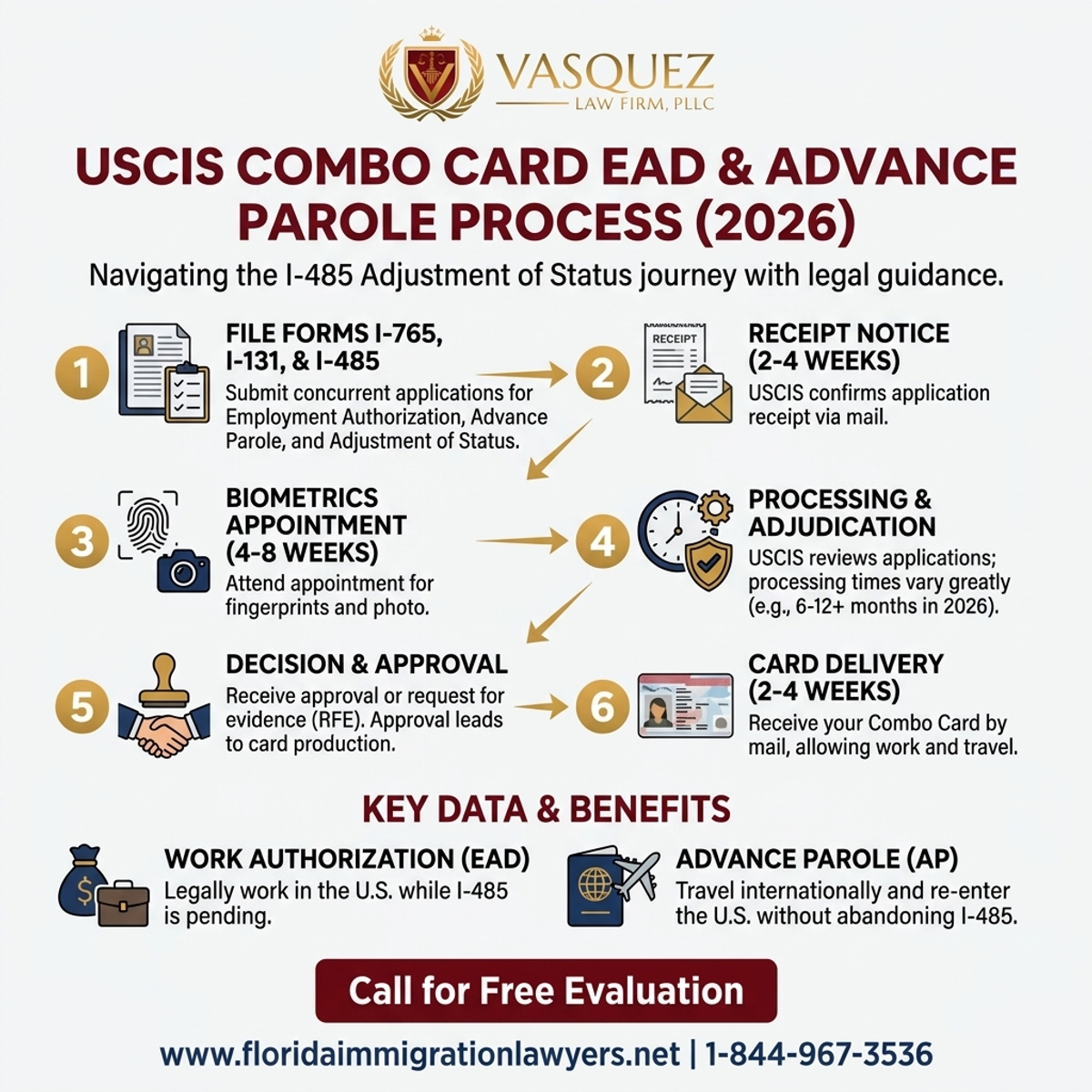
Step-by-Step Process — USCIS Combo Card EAD Advance Parole I-485 in 2026
It is also important to remember that Advance Parole is not a visa. It does not replace a passport, and you may still need a visa to enter other countries, depending on your nationality. Always check the entry requirements of your destination country well in advance of your travel dates. For more information on international travel requirements, you can visit the U.S. Department of State website. Consulting with a knowledgeable attorney at Florida Immigration Lawyers can help you assess your specific risks and plan your travel safely.
What is the Processing Time for an Advance Parole and EAD Combo Card in 2026?
As of 2026, the processing time for an Advance Parole and EAD Combo Card can vary significantly, typically ranging from 6 to 12 months, but it can sometimes extend beyond this timeframe depending on various factors including the specific USCIS service center, current caseloads, and the complexity of your individual case.
Several factors influence how quickly USCIS processes these applications. These include the volume of applications received, staffing levels at service centers, and whether your application requires a Request for Evidence (RFE) or an interview. For applicants in Florida, whether you filed your I-485, I-765, and I-131 concurrently or separately can also impact the timeline. It is always recommended to check the official USCIS website for the most current processing times specific to your form type and filing location. While the timelines below are typical, they are subject to change.
Timeline and Processing Expectations for Combo Card (2026):
| Stage | Typical Timeframe | Notes |
|---|---|---|
| Application Filing & Receipt | 1-4 weeks | USCIS sends I-797C receipt notices for Forms I-485, I-765, I-131. |
| Biometrics Appointment | 4-8 weeks after receipt | Appointment notice sent for fingerprinting and photo at an Application Support Center (ASC). |
| Case Review & Adjudication | 6-12 months (or more) | Varies significantly by service center and individual case factors. |
| Card Production & Delivery | 1-2 weeks after approval | Once approved, the Combo Card is printed and mailed to your address. |
It is important to note that these are estimates. Delays can occur, and it is crucial not to make irreversible travel plans until you have the physical Combo Card in hand. You can check your case status online using the receipt number provided on your I-797C notice on the USCIS Case Status website.
What Are the Fees and Costs Associated with an I-131 Advance Parole Application in Florida?
As of 2026, the fees for Form I-131, Application for Travel Document (for Advance Parole), and Form I-765, Application for Employment Authorization (for EAD), are generally waived if you file them concurrently with or after a Form I-485, Application to Register Permanent Residence or Adjust Status. However, if you are filing Form I-131 or I-765 as standalone applications without a pending I-485, separate fees will apply. It is always critical to check the official USCIS website for the most current fee schedule, as fees are subject to change.
The fee structure for these applications can be a significant consideration for many families across Florida, including those in Gainesville. When filed with Form I-485, the fees for the EAD and Advance Parole applications are typically included in the I-485 filing fee. This is a substantial benefit for adjustment of status applicants, as it reduces the overall cost of obtaining these crucial documents. However, if you previously filed your I-485 and now need to apply for or renew your EAD or Advance Parole, you may need to pay the individual filing fees for Forms I-765 and I-131.
Beyond the filing fees, applicants should also budget for other potential costs. These can include fees for passport-style photos, medical examinations required for the I-485 (which indirectly impacts the Combo Card eligibility), and legal fees if you choose to retain an immigration attorney. While legal fees are an additional expense, the expertise of a lawyer can often prevent costly mistakes and delays, providing significant value. Always ensure you are using the correct payment method and sending the exact amount, as incorrect fees can lead to your application being rejected.
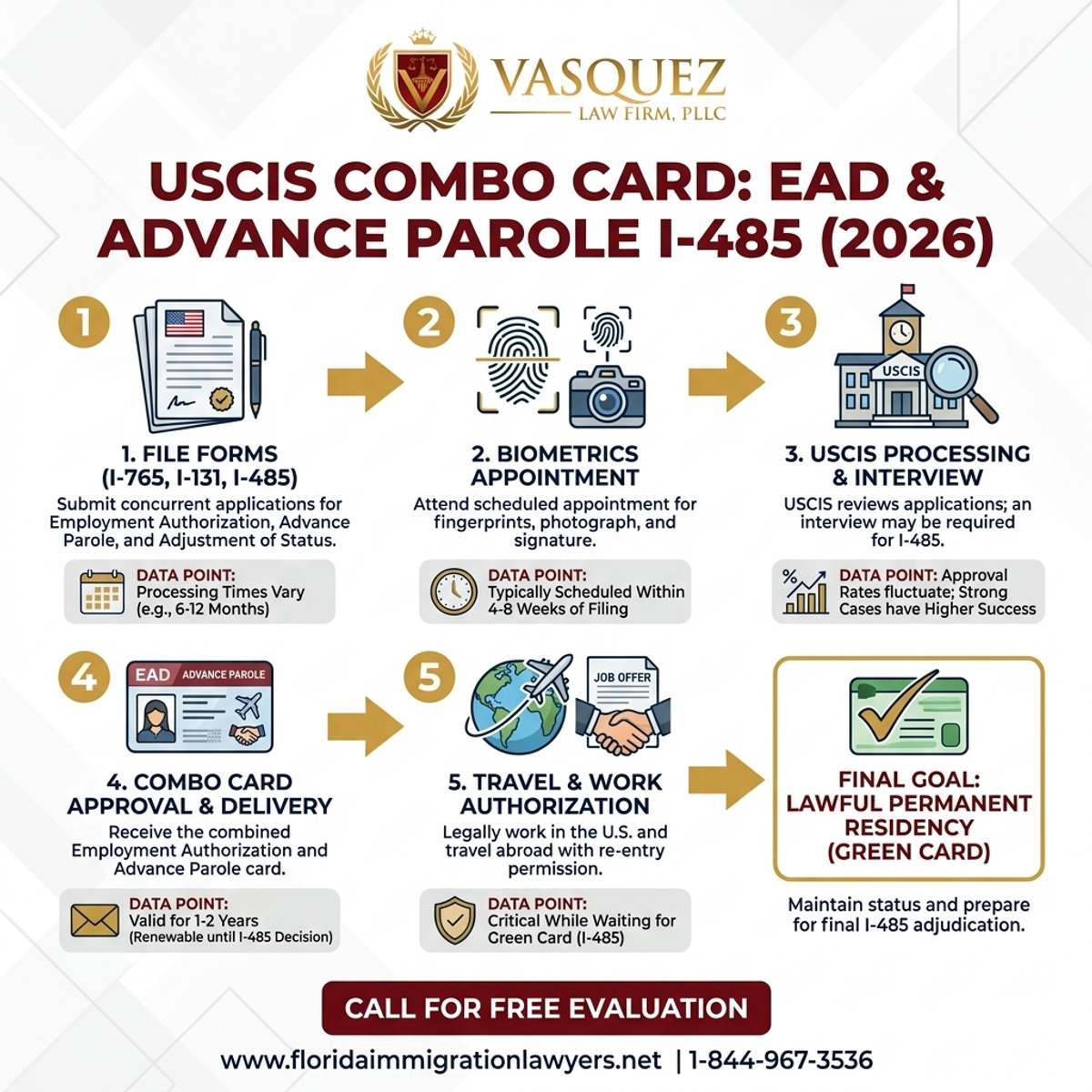
Key Statistics — USCIS Combo Card EAD Advance Parole I-485 in 2026
Cost Factors and Fee Breakdown for Combo Card Applications (2026):
| Item | Typical Fee (as of 2026) | Notes |
|---|---|---|
| Form I-485 Filing Fee | Check USCIS website | Includes EAD and Advance Parole if filed concurrently. This is the primary fee. |
| Form I-765 (EAD) Standalone | Check USCIS website | Only applicable if I-485 is not pending or if renewing separately. |
| Form I-131 (Advance Parole) Standalone | Check USCIS website | Only applicable if I-485 is not pending or if renewing separately. |
| Biometrics Services Fee | Check USCIS website | Typically included in the I-485 fee or separate for standalone applications. |
| Passport Photos | $10-$20 per set | Required for both I-765 and I-131. |
| Attorney Fees | Varies | Highly recommended for complex cases or to ensure accuracy. |
Remember to always verify current fees directly on the USCIS website to ensure accurate payment. Fee waivers may be available for certain low-income applicants, so inquire about eligibility if applicable.
Navigating Complexities: When Your Advance Parole Application Faces Challenges
Even with careful preparation, applications for Advance Parole travel document can sometimes encounter challenges. These can range from requests for evidence (RFEs) to outright denials, each requiring a specific and timely response. For individuals in Florida, including those in Gainesville, understanding how to navigate these complexities is crucial to keeping your I-485 adjustment of status application on track.
An RFE from USCIS indicates that they require additional information or documentation to make a decision on your I-131 or I-765 application. It is vital to respond to an RFE promptly and thoroughly, providing all requested information. Failure to do so, or providing insufficient evidence, can lead to a denial. Denials can be particularly disheartening and may require filing a new application or, in some cases, an appeal or motion to reconsider, depending on the grounds for denial.
Complex situations often arise when an applicant has specific immigration history issues. For example, individuals who have been unlawfully present in the U.S., have certain criminal convictions, or have previously been ordered removed may face heightened scrutiny. While Advance Parole may be granted, these underlying issues could still lead to problems upon re-entry or affect the ultimate outcome of the I-485. In such scenarios, the guidance of an experienced immigration attorney is not just helpful, but often essential to assess risks and formulate the best strategy. Our attorneys at Florida Immigration Lawyers are adept at handling such intricate cases, providing tailored advice to protect your interests.
Long processing times can also present a significant challenge, especially if you have urgent travel needs. While there are limited circumstances under which USCIS may expedite an Advance Parole application (such as severe financial loss, urgent humanitarian reasons, or national interest), meeting these criteria is difficult. Documenting the need for expedited processing requires compelling evidence. Understanding these potential roadblocks and knowing when to seek professional legal assistance can make a substantial difference in the success and timeliness of your application.
Do not navigate this process alone. Contact Florida Immigration Lawyers today.
Common Mistakes to Avoid with Your Advance Parole and EAD Application
Applying for an Advance Parole travel document and EAD while your I-485 adjustment of status is pending requires precision. Mistakes can lead to significant delays, RFEs, or even denial. Avoid these common pitfalls:
- Traveling Before Receiving Advance Parole: This is perhaps the most critical mistake. Leaving the U.S. without a valid Advance Parole document will almost certainly lead to the abandonment of your pending I-485 application, as per 8 CFR § 245.2(a)(4)(ii). Always wait until you have the physical Combo Card or separate Advance Parole document in hand before departing.
- Incomplete or Inaccurate Forms: Filing forms I-131 and I-765 with missing information, incorrect dates, or unsigned sections is a common reason for rejection or delay. Double-check all entries and ensure signatures are present.
- Submitting Insufficient Supporting Documentation: Failing to include all required evidence, such as passport photos, copies of identification, or I-485 receipt notices, will result in an RFE and prolong processing times.
- Ignoring Requests for Evidence (RFEs): If USCIS sends an RFE, you must respond within the specified timeframe with the requested information. Failing to do so will likely lead to a denial of your application.
- Assuming Automatic Re-entry: Advance Parole is not a guarantee of re-entry. Customs and Border Protection (CBP) officers at ports of entry, including Florida's international airports like Orlando and Miami, have the final say. If you have any inadmissibility issues, you could be denied entry.
- Misunderstanding Eligibility for Advance Parole: Not all non-immigrant statuses are eligible for Advance Parole. For example, K-1 visa holders who apply for adjustment of status cannot obtain Advance Parole before their I-485 is approved.
- Letting Advance Parole Expire While Abroad: Ensure your Advance Parole travel document is valid for the entirety of your trip, including your return date. If it expires while you are outside the U.S., you will not be able to use it to re-enter.
- Not Carrying Your Documents: Always carry your Combo Card (or separate EAD and Advance Parole documents) along with your passport and any other necessary travel documents when re-entering the U.S.
- Failing to Update Address with USCIS: If you move within Florida, or anywhere else, and do not update your address with USCIS, you may miss important notices or your Combo Card.
- Providing False Information: Any misrepresentation or fraudulent information on your application can lead to severe immigration consequences, including denial of current and future benefits.
When to Call a Lawyer for Your Advance Parole and EAD Application
While the process for obtaining a USCIS Combo Card may seem straightforward for some, there are many situations where the expertise of an immigration lawyer becomes invaluable. For Florida residents, particularly those in Gainesville, understanding when to seek legal counsel can prevent costly errors and safeguard your I-485 adjustment of status journey.
You should strongly consider contacting Florida Immigration Lawyers if you have any history of criminal convictions, prior deportations, or previous immigration violations, as these factors can complicate your eligibility for Advance Parole and risk inadmissibility upon re-entry. Similarly, if you have received a Request for Evidence (RFE) or a Notice of Intent to Deny (NOID) for your I-485, I-765, or I-131, a lawyer can help you formulate a comprehensive and timely response to address USCIS concerns. Navigating these complex legal responses without professional guidance can be detrimental to your case.
Furthermore, if you have urgent or complex international travel plans, or if you are unsure about the specific implications of your current immigration status on your ability to travel, an attorney can provide tailored advice. For example, certain non-immigrant statuses or specific types of travel might have unique restrictions. If your application has been pending for an unusually long time, exceeding the posted processing times, an attorney can help inquire with USCIS and explore potential avenues for resolution. Our firm specializes in immigration law, including family-based immigration and business immigration, and we are ready to assist you. Don't take chances with your future; consult with an expert.
About Florida Immigration Lawyers
Florida Immigration Lawyers is a leading immigration law firm dedicated to serving individuals and families across the entire state of Florida. With a deep understanding of U.S. immigration laws and policies, our experienced attorneys provide compassionate and effective legal representation for a wide range of immigration matters. From assisting with I-485 adjustment of status applications, including EAD and Advance Parole travel document requests, to complex deportation defense and citizenship cases, we are committed to achieving the best possible outcomes for our clients.
Our firm prides itself on its client-centered approach, ensuring that every individual receives personalized attention and clear, honest advice. We understand the challenges and anxieties that come with navigating the immigration system, which is why we offer comprehensive support throughout the entire process. We are available 24/7 to answer your questions and provide guidance. With free consultations, we make it easy for you to understand your options without financial commitment. Choose Florida Immigration Lawyers for dedicated advocacy and proven expertise.
Sources and References
- U.S. Citizenship and Immigration Services (USCIS)
- Executive Office for Immigration Review (EOIR)
- U.S. Department of State
- 8 U.S.C. Chapter 12 - Immigration and Nationality Act (INA)
- INA § 212(d)(5) - Advance Parole Authority
- INA § 245 - Adjustment of Status of Nonimmigrant to That of Person Admitted for Permanent Residence
- 8 CFR § 245.2(a)(4)(ii) - Effect of travel on adjustment application
- 8 CFR § 274a.12(c)(9) - Employment authorization for adjustment applicants
Related services: immigration practice areas, citizenship and naturalization, asylum protection, free immigration consultation.
This article provides general legal information and is not intended as legal advice. Every case is unique, and outcomes depend on specific facts and circumstances. Contact an attorney for advice about your particular situation.
Your journey through the U.S. immigration system doesn't have to be a solitary one. With the right legal guidance, you can navigate the complexities of applications like the USCIS Combo Card, EAD, and Advance Parole travel document with confidence. Our team at Florida Immigration Lawyers is here to provide the expert assistance you need, offering clear advice and steadfast support every step of the way. Don't leave your future to chance.
Contact us today for a free, confidential consultation. Call 1-844-967-3536. Se Habla Espanol - Estamos aqui para ayudarle.
Do Not Navigate This Process Alone
Our experienced immigration attorneys are ready to fight for you. Get a free, confidential case review today.
Se Habla Español
Or leave your details and we’ll call you:
Free Evaluation in 24 Hours
Or talk to us right now

AI voice assistant — available 24/7
FreeFrequently Asked Questions

William J. Vásquez
Founding Attorney · Vasquez Law Firm
U.S. Air Force veteran and immigration attorney with years of hands-on U.S. immigration experience. J.D., NCCU School of Law. AILA member. Admitted to the 4th, 5th, and 11th Circuit Courts.
Available 24/7 - Free Evaluations
Reviewed for legal accuracy by William J. Vásquez
Licensed in North Carolina; U.S. immigration is federal practice.
Related Legal Services
Our Florida immigration attorneys can help you with immigration lawyer cost in Florida, experienced immigration attorneys and asylum protection. Call today at 1-844-967-3536 for a free case review.
Related Links
Related Topics
Free Legal Case Review
Discuss your case with our experienced attorneys. We're available 24/7.
Se Habla Español - Estamos aquí para ayudarle.
Related Articles
Immigration Lawyer Orlando Free Consultation in Florida
For individuals and families in Orlando, Florida, navigating the complexities of U.S. immigration law requires expert guidance. An immigration lawyer in Orlando offers crucial support for everything from visa applications and green card processes to naturalization and deportation defense. This comprehensive guide details what a free consultation covers, providing a step-by-step overview of immigration pathways, essential document checklists, and expected timelines in 2026. We also highlight common mistakes to avoid, discuss the critical role of legal counsel in deportation and asylum cases, and explain why choosing a local Orlando immigration attorney is beneficial. Florida Immigration Lawyers is dedicated to serving the diverse community of Orlando with compassionate, effective legal solutions, ensuring you receive personalized advice and robust representation for a successful immigration journey.
Immigration Medical Exam in Florida: What to Expect
Learn about the immigration medical exam process in Florida, including the role of civil surgeons and necessary documents. Understand your options with the help of Florida Immigration Lawyers.
I-864 Affidavit of Support in Florida: 2026 Guide
The I-864 Affidavit of Support is vital for sponsoring family immigrants in Florida. Learn the 2026 requirements, steps to complete the form, and when to seek legal help. Contact Florida Immigration Lawyers for expert guidance.
Derived Citizen Status: Your Guide in Florida 2026
Derived citizenship offers a pathway for children to automatically become U.S. citizens through their parents, a crucial process for many families in Florida. This comprehensive guide details the eligibility requirements under INA Section 320, emphasizing that children must be under 18, lawful permanent residents, and in the legal and physical custody of a U.S. citizen parent. We provide a step-by-step application process for Form N-600, including a document checklist, typical timelines, and cost factors as of 2026. The article also addresses complex scenarios like adoptions and out-of-wedlock births, highlighting common mistakes to avoid. Florida Immigration Lawyers serves as a vital resource for families navigating these intricate laws, offering expert guidance to ensure a smooth and successful application. Understanding these nuances is key to securing a Certificate of Citizenship and confirming your child's place in the United States.