U Visa Crime Victims in Florida: Your Guide | VLF Florida
Discover how the U visa can help crime victims in Florida. Learn about eligibility, application steps, and common pitfalls. Contact Florida Immigration Lawyers for expert assistance.

- Eligibility requires certification by law enforcement.
- It offers work authorization and protection from deportation.
- Victims must demonstrate substantial physical or mental abuse.
- Applicants can include certain family members.
Introduction
If you are a crime victim in Gainesville, Florida, navigating the complexities of immigration relief can be daunting. The U visa provides a lifeline for eligible victims, offering a pathway to safety and stability. This article will cover the essentials of the U visa, its benefits, and how you can apply. Call Florida Immigration Lawyers at 1-844-967-3536 for a free consultation.
Being a victim of a serious crime can leave individuals feeling vulnerable, traumatized, and unsure of their future, especially when immigration status adds another layer of complexity. The U visa program acknowledges these challenges, offering a unique form of humanitarian relief designed to protect victims and empower them to assist in bringing criminals to justice without fear of deportation.
This comprehensive guide aims to demystify the U visa process, providing clear, actionable information for victims and their families in Florida. From understanding the stringent eligibility criteria to preparing a robust application and navigating the lengthy processing times, we will illuminate each step, ensuring you are well-equipped to pursue this vital immigration pathway. Our goal is to offer clarity and hope, reinforcing that you do not have to face this journey alone.
Understanding the U Visa
The U visa is designed for victims of certain crimes who have suffered substantial physical or mental abuse and are willing to assist law enforcement in the investigation or prosecution of criminal activity. This visa not only provides temporary legal status in the U.S. but also a potential path to permanent residency.
To qualify, an applicant must obtain certification from a law enforcement agency confirming their helpfulness in the case. This certification is a crucial step and can be one of the more challenging aspects of the application process.
This nonimmigrant visa category was created by Congress with the passage of the Victims of Trafficking and Violence Protection Act (VTVPA) in October 2000. Its primary purpose is twofold: to strengthen the ability of law enforcement agencies to investigate and prosecute serious crimes, and to protect victims of such crimes who have suffered substantial physical or mental abuse and are willing to help law enforcement.
The U visa provides a critical tool for local and federal authorities by encouraging undocumented immigrants, who might otherwise be afraid to report crimes due to their immigration status, to come forward. By offering legal protection and a path to stability, the U visa helps ensure that perpetrators of serious crimes can be held accountable, making our communities safer for everyone. This humanitarian relief is a testament to the U.S. commitment to protecting vulnerable individuals and upholding justice.
Eligibility Requirements
Eligibility for the U visa includes being a victim of qualifying criminal activity, such as domestic violence, sexual assault, or trafficking. In addition to experiencing substantial abuse, the victim must possess information about the criminal activity and be willing to cooperate with authorities.
Family members of the victim may also be eligible for derivative visas, offering protection and work authorization to spouses, children, and in some cases, parents or unmarried siblings under 18.
Delving deeper into the eligibility criteria, the list of qualifying criminal activities is extensive and includes crimes like rape, torture, kidnapping, false imprisonment, blackmail, felonious assault, murder, manslaughter, incest, prostitution, sexual exploitation, female genital mutilation, hostage-taking, peonage, involuntary servitude, slave trade, trafficking, abduction, unlawful criminal restraint, witness tampering, obstruction of justice, perjury, fraud in foreign labor contracting, and attempt, conspiracy, or solicitation to commit any of these crimes. It's crucial that the crime occurred in the U.S. or violated U.S. law.
The requirement of "substantial physical or mental abuse" means the victim must have suffered significant harm. This isn't limited to visible injuries; psychological trauma, severe emotional distress, and long-term mental health impacts are also considered. Medical records, psychological evaluations, and personal affidavits are vital in demonstrating this abuse. For instance, a victim of domestic violence might present evidence of physical injuries, but also testimony from a therapist detailing PTSD and anxiety resulting from the abuse. The willingness to cooperate with law enforcement is paramount. This means actively participating in interviews, providing statements, testifying in court, and generally assisting in the investigation or prosecution of the crime when requested.
Derivative eligibility extends protection to the immediate family members of the principal U visa applicant. For victims under 21, eligible derivatives include their spouse, children, parents, and unmarried siblings under 18. For victims 21 or older, only their spouse and children are eligible. This provision is critical for keeping families together and ensuring that the entire family unit can find safety and stability. For example, if a mother is a victim of a qualifying crime, her children can also receive U visas, allowing them to remain in the U.S. legally, attend school, and obtain work authorization.
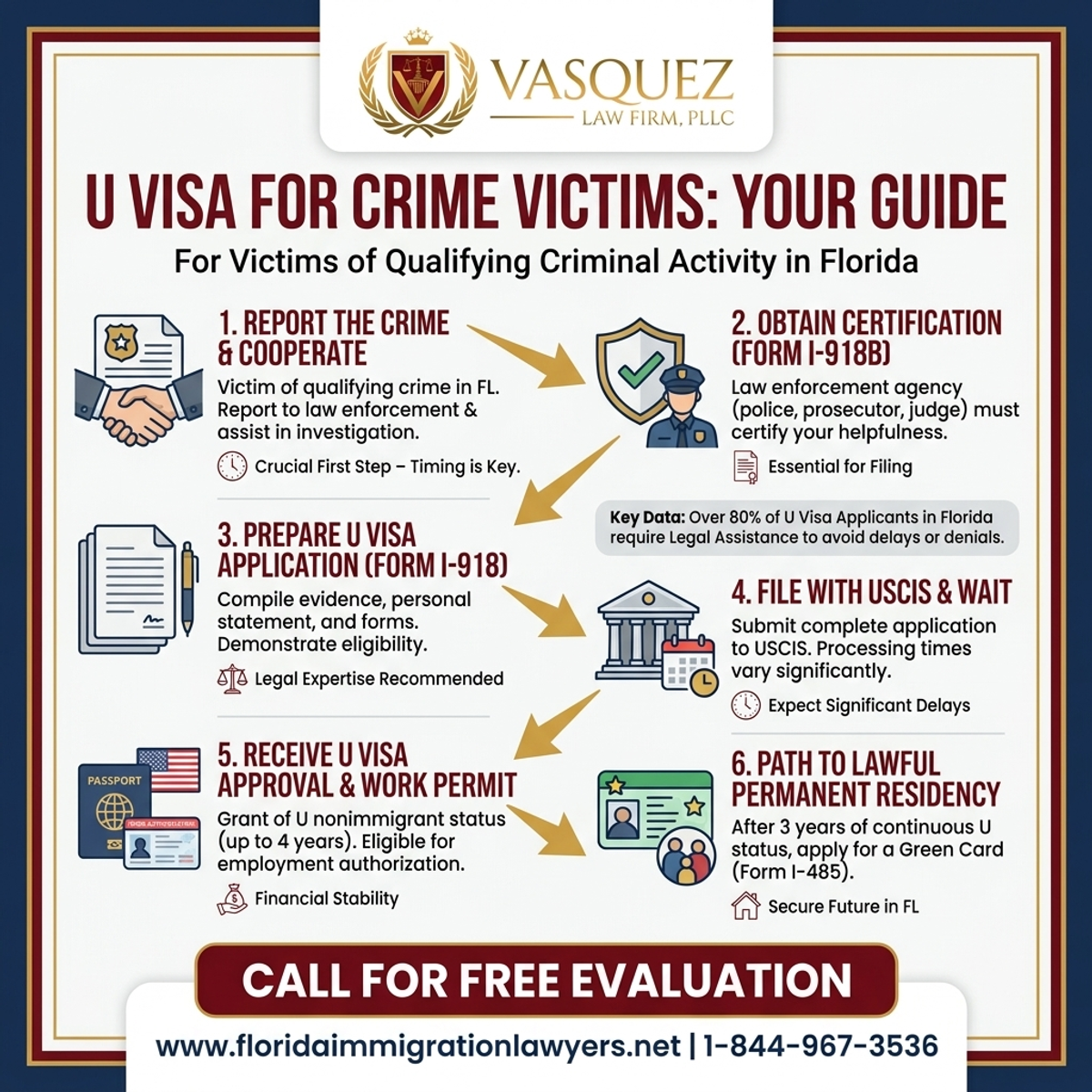
Step-by-Step Process — U Visa Crime Victims in Florida: Your Guide
Step-by-Step Application Process
- Obtain Law Enforcement Certification: Secure a signed Form I-918B from a law enforcement agency.
- Complete the Application: Fill out Form I-918, Petition for U Nonimmigrant Status.
- Gather Supporting Documents: Include evidence of victimization, abuse, and helpfulness, along with personal identification documents.
- Submit the Application: Send your completed application to USCIS for review.
- Await Decision: Processing times can vary, so patience is essential.
Navigating the U visa application process can feel overwhelming, but breaking it down into manageable steps can help. The initial and often most challenging step is securing Form I-918B, the U Nonimmigrant Status Certification. This form must be signed by an authorized official from a qualifying law enforcement agency, such as a police department, sheriff's office, prosecutor's office, or even a judge. It confirms that you were a victim of a qualifying crime and have been, are being, or are likely to be helpful in the investigation or prosecution of that crime. Obtaining this certification often requires direct communication with the investigating officer or prosecutor, which can be daunting without legal assistance.
Once the certification is secured, the next critical step is completing Form I-918, Petition for U Nonimmigrant Status. This form requires detailed personal information, a comprehensive description of the qualifying criminal activity, and how you suffered substantial physical or mental abuse. It’s vital to be as thorough and accurate as possible, as any inconsistencies or missing information can lead to delays or even denial. This is where the expertise of Florida Immigration Lawyers can be invaluable, ensuring every detail is correctly presented.
The third step involves meticulously gathering all supporting documentation. This includes not only the certified Form I-918B but also extensive evidence of the crime, your victimization, the substantial abuse suffered, and your helpfulness to law enforcement. This can range from police reports, court documents, and medical records to affidavits from witnesses, therapists, or even your own detailed personal statement. For derivative family members, proof of relationship, such as birth certificates or marriage licenses, is also required. Organizing these documents clearly and accurately is essential for a strong application.
After assembling a complete package, you will submit your application to U.S. Citizenship and Immigration Services (USCIS). It is crucial to make copies of everything you send for your records. USCIS will then review your application, and if they determine you meet the initial requirements, they may issue a bona fide determination (BFD). This BFD is a significant milestone, as it can grant you deferred action and eligibility for work authorization while you await final processing, offering immediate relief and stability.
Document Checklist
- Form I-918 and Form I-918B Certification
- Police reports or court documents
- Medical records and mental health evaluations
- Identification documents (passport, birth certificate)
- Proof of relationship for derivative family members
Beyond the core forms, a robust U visa application hinges on compelling evidence. Police reports and court documents serve as primary evidence of the qualifying criminal activity and your involvement as a victim. Medical records and mental health evaluations are critical for demonstrating the substantial physical or mental abuse you endured, providing objective evidence of your suffering. These documents should ideally be recent and clearly link your condition to the criminal incident.
Identification documents, such as copies of your passport, birth certificate, or any other government-issued ID, are necessary to establish your identity. For derivative family members, providing clear proof of relationship, such as marriage certificates for spouses or birth certificates for children, is essential to ensure their inclusion in your petition. All documents submitted in a foreign language must be accompanied by a certified English translation, a detail that is often overlooked but critical for USCIS review. Organizing these documents clearly and logically, perhaps with tabs and a table of contents, can significantly aid USCIS officers in processing your application efficiently.
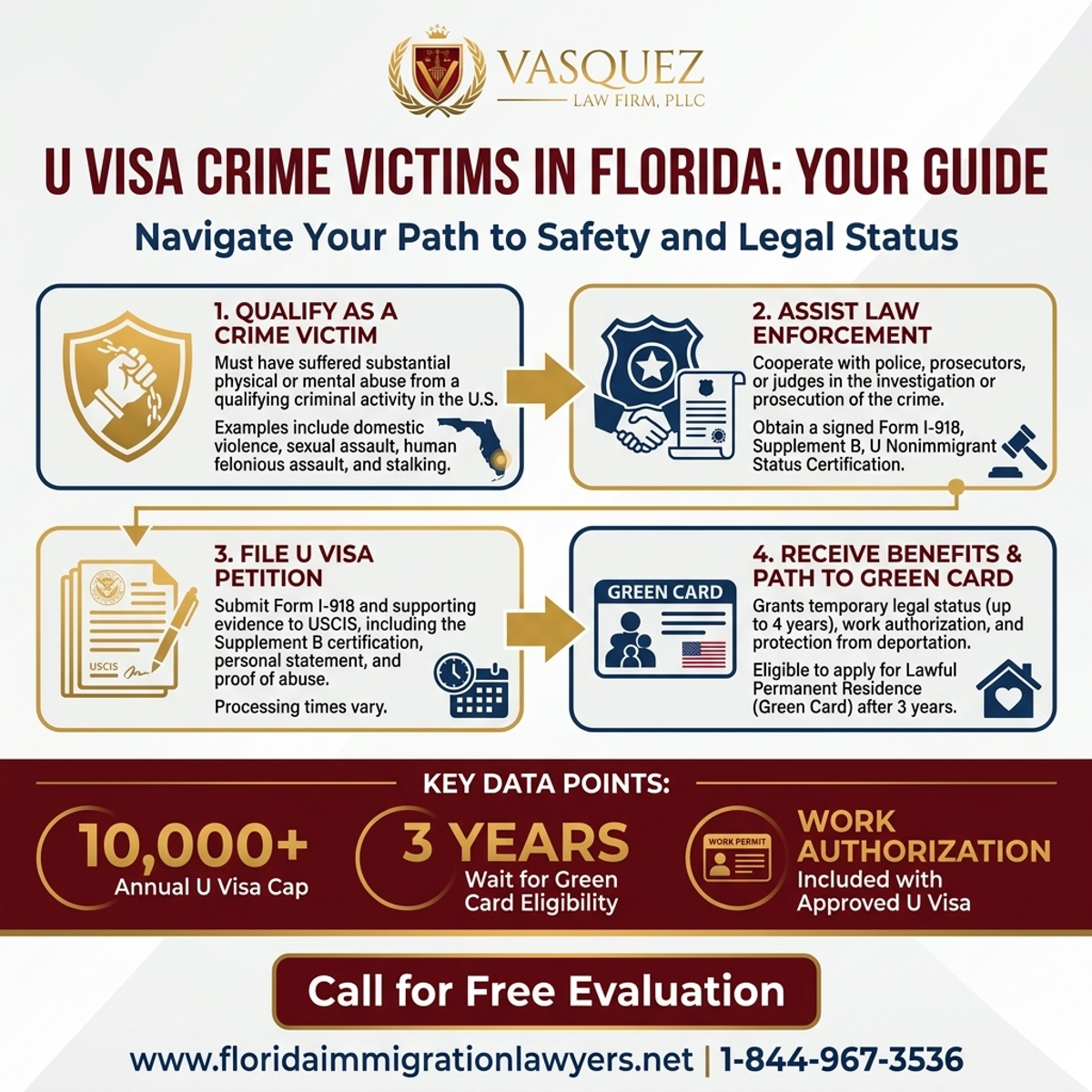
Key Statistics — U Visa Crime Victims in Florida: Your Guide
Timeline and Processing Expectations
The timeline for U visa processing can be lengthy, often taking several years due to the annual cap on visas. Once approved, the U visa is valid for four years, after which visa holders may apply for adjustment of status to become permanent residents.
During the waiting period, applicants may receive deferred action status, allowing for work authorization and protection from deportation.
The U visa program is subject to an annual cap of 10,000 principal visas per fiscal year, not including derivative family members. This cap, coupled with a high volume of applications, has led to significant backlogs, meaning applicants often wait several years for a final decision. USCIS processes applications in the order they are received, and while waiting, many applicants receive a "bona fide determination" (BFD). This BFD signifies that USCIS has reviewed the application and determined that the applicant meets the basic eligibility requirements and warrants deferred action.
Deferred action is a discretionary grant that allows an individual to remain in the U.S. temporarily and can provide eligibility for work authorization (Employment Authorization Document or EAD). This is a crucial benefit, offering stability and the ability to legally earn a living while awaiting the final U visa approval. Once the U visa is approved, it is typically granted for a period of four years. During this time, U visa holders can live and work legally in the U.S. and travel internationally with appropriate documentation.
After three years of continuous physical presence in the U.S. in U nonimmigrant status, and if certain other conditions are met (such as not unreasonably refusing to assist law enforcement), U visa holders become eligible to apply for adjustment of status to become lawful permanent residents (Green Card holders). This path to permanent residency is one of the most significant benefits of the U visa, offering long-term security and a future in the United States. Given these extensive timelines and critical milestones, continuous legal guidance from Florida Immigration Lawyers is highly recommended to ensure all deadlines are met and requirements are satisfied.
Cost Factors and Fee Breakdown
The U visa application does not require a filing fee, which makes it accessible for many victims. However, applicants may incur costs related to obtaining required documents, translations, and legal assistance. While legal representation is not mandatory, it is highly recommended to navigate the complexities of the application process effectively.
Do not navigate this process alone. Contact Florida Immigration Lawyers today.
While USCIS does not charge a fee for filing Form I-918, Petition for U Nonimmigrant Status, or for the associated Form I-765, Application for Employment Authorization, applicants should be prepared for other potential expenses. These can include fees for obtaining official documents like birth certificates, marriage licenses, police reports, and medical records. Certified translations for any documents not in English are also a necessary expense, and these costs can accumulate quickly depending on the volume of foreign language documents.
Furthermore, if a medical examination is required, which is often the case when applying for adjustment of status later, there will be associated physician fees. Travel costs to attend interviews or collect documents can also add up. The most significant, yet often most valuable, investment for many applicants is legal assistance. An experienced immigration attorney, like those at Florida Immigration Lawyers, can provide invaluable support in compiling a strong application, dealing with law enforcement agencies, and responding to USCIS requests for evidence.
Considering the high stakes and intricate nature of U visa applications, investing in legal counsel can be a wise decision. An attorney can help identify all qualifying crimes, gather comprehensive evidence of abuse, navigate the process of obtaining law enforcement certification, and ensure all forms are completed accurately and submitted on time. This professional guidance can significantly increase the likelihood of a successful outcome and alleviate much of the stress associated with the process, ultimately saving time and preventing costly mistakes in the long run. Call 1-844-967-3536 for a free consultation.
Common Mistakes to Avoid
Applying for a U visa is a complex process with significant implications for your future. Even minor errors can lead to substantial delays or even denial. Being aware of common pitfalls can help you prepare a stronger application and increase your chances of success.
- Not Securing Certification: Without Form I-918B, your application cannot proceed.
- Incomplete Application: Missing information or documents can lead to delays or denials.
- Ignoring Deadlines: Failing to submit requests for evidence or other documents on time can jeopardize your case.
- Providing Inconsistent Information: Ensure all statements and documents are accurate and consistent.
- Not Seeking Legal Advice: The application process is complex, and professional guidance can be crucial.
- Overlooking Derivative Benefits: Failing to apply for family members can miss opportunities for their protection.
- Assuming Immediate Approval: Understand that processing times are long, and patience is needed.
- Failing to Report Address Changes: Keep USCIS informed to avoid missing critical correspondence.
- Submitting Documents in a Foreign Language: Provide certified English translations of all necessary documents.
- Ignoring USCIS Instructions: Carefully read and follow all application instructions and notices.
Avoiding these common mistakes requires meticulous attention to detail and a thorough understanding of immigration law. Consulting with an experienced immigration attorney from Florida Immigration Lawyers can provide the necessary guidance to navigate these complexities, ensuring your application is as robust and error-free as possible. Proactive preparation and professional support are your best defense against common application pitfalls.
When to Call a Lawyer
If you are considering applying for a U visa, it is advisable to consult with an immigration attorney. They can assist with the application process, help gather necessary documentation, and ensure that all forms are completed correctly. Florida Immigration Lawyers offer expert guidance and support, ensuring your case is presented in the best possible light.
Whether you're facing difficulties obtaining certification or have questions about eligibility, do not hesitate to seek legal assistance. Our experienced attorneys are here to help you navigate this complex process.
There are several critical junctures where legal counsel becomes not just advisable, but essential. If you are struggling to obtain the law enforcement certification (Form I-918B) because the agency is unresponsive or unfamiliar with the U visa, an attorney can advocate on your behalf. Similarly, if you have a complex immigration history, such as a prior deportation order, criminal record, or previous immigration violations, an attorney can assess how these factors might impact your U visa eligibility and advise on potential waivers.
Furthermore, if you receive a Request for Evidence (RFE) from USCIS, a lawyer can help you understand what additional information is needed and how to best respond to strengthen your case. For victims dealing with severe trauma, an attorney can also help articulate the "substantial physical or mental abuse" in a clear and compelling manner, ensuring all necessary medical and psychological evidence is properly presented. Don't hesitate to reach out to Florida Immigration Lawyers at 1-844-967-3536 for a free consultation; their expertise can make a profound difference in the outcome of your application.
About Florida Immigration Lawyers
Florida Immigration Lawyers is a dedicated law firm providing comprehensive immigration services across Florida. Our experienced team offers assistance with U visas, asylum, deportation defense, citizenship applications, family immigration, and business immigration. We are committed to advocating for your rights and offering the support you need. Call us at 1-844-967-3536 or visit our website for a free consultation. We are available 24/7 to assist you. Se Habla Español.
Our firm understands the unique vulnerabilities faced by crime victims and approaches each U visa case with compassion, diligence, and a deep understanding of the law. We pride ourselves on providing personalized attention, guiding clients through every step of the process, from initial consultation to final resolution. Our commitment extends beyond legal representation; we aim to be a steadfast advocate for your safety, stability, and future in the United States, ensuring your voice is heard and your rights are protected.
Sources and References
- U.S. Citizenship and Immigration Services (USCIS)
- Executive Office for Immigration Review (EOIR)
- State Department
- 8 U.S.C. Chapter 12 - Immigration and Nationality Act
- 8 CFR Section 214.14
Related services: asylum and refugee protection, asylum application process, refugee status and resettlement.
This article provides general legal information and is not intended as legal advice. Every case is unique, and outcomes depend on specific facts and circumstances. Contact an attorney for advice about your particular situation.
For expert guidance on U visas and other immigration matters, contact Florida Immigration Lawyers at 1-844-967-3536 for a free consultation. Se Habla Español - Estamos aqui para ayudarle.
If you need legal assistance, learn more about speak with an immigration lawyer, or call us at 1-844-967-3536 for a free consultation.
Do Not Navigate This Process Alone
Our experienced immigration attorneys are ready to fight for you. Get a free, confidential consultation today.
Se Habla Español
Frequently Asked Questions
Florida Immigration Lawyers
Immigration Attorney | Founder, Vasquez Law Firm
U.S. Air Force veteran and immigration attorney with thousands of cases resolved. J.D., NCCU School of Law. AILA member. Admitted to the 4th, 5th, and 11th Circuit Courts.
Available 24/7 - Free Evaluations
Related Legal Services
Our Florida immigration attorneys can help you with business immigration, asylum protection and deportation defense. Call today at 1-844-967-3536 for a free consultation.
Related Links
Related Topics
Free Legal Consultation
Discuss your case with our experienced attorneys. We're available 24/7.
Se Habla Español - Estamos aquí para ayudarle.
Related Articles
L-1 Visa Intracompany Transfer in Florida | VLF Florida
Explore the L-1 visa process for intracompany transfers to Florida. Understand eligibility, application steps, and common mistakes to avoid. Contact Florida Immigration Lawyers for assistance.
Biometrics Appointment in Florida: What to Expect | VLF Florida
Learn everything you need to know about biometrics appointments in Florida. From preparing for your ASC visit to understanding the importance of biometrics in your immigration process, this guide covers it all. Call Florida Immigration Lawyers for expert assistance.
TN Visa for USMCA Professionals in Florida | VLF Florida
Explore the TN visa for USMCA professionals in Florida. Learn about eligibility, application steps, and common mistakes. Contact our team for a free consultation today!
How to Choose an Immigration Lawyer in Florida | VLF Florida
Choosing the right immigration lawyer in Hialeah, Florida is vital for navigating complex immigration processes. Learn how to make an informed decision with our detailed guide. Call 1-844-967-3536 for a free consultation.