L-1 Visa Intracompany Transfer in Florida | VLF Florida
Explore the L-1 visa process for intracompany transfers to Florida. Understand eligibility, application steps, and common mistakes to avoid. Contact Florida Immigration Lawyers for assistance.

- Eligibility requires a qualifying relationship between the U.S. and foreign company.
- This visa is often used by companies expanding into the U.S.
- It can lead to permanent residency through adjustment of status.
- Processing can vary, so timing is crucial.
- Legal guidance is highly recommended for a successful application.
Introduction
Imagine you are a key manager in a multinational company with a bustling office in Kissimmee, Florida, and an equally thriving branch overseas. The company wants you to transfer to Florida to lead an important project. How do you make this happen? The L-1 visa, designed for intracompany transfers, is your gateway to working in the U.S. Understanding this process can be complex but crucial for your career and the growth of your company.
This article covers everything you need to know about the L-1 visa process, including eligibility, application steps, required documents, and common pitfalls to avoid. We also discuss the importance of professional legal assistance in ensuring a smooth transition to your new role in Florida. Call Florida Immigration Lawyers at 1-844-967-3536 for a free consultation.
The L-1 visa serves as a vital tool for global businesses looking to leverage their existing talent pool across international borders. For companies with a presence in Florida, this visa category facilitates seamless transitions for essential personnel, supporting strategic growth and operational efficiency in a dynamic market like Kissimmee.
Navigating the intricacies of U.S. immigration law can be daunting, but with the right preparation and expert guidance, securing an L-1 visa is an achievable goal. Our aim is to demystify this process, providing you with a clear roadmap to ensure your transfer, or that of your employee, is successful and compliant with all regulations.
Understanding the L-1 Visa and Eligibility
The L-1 visa is a non-immigrant visa that allows foreign workers to transfer to a U.S. office of their current employer. There are two types of L-1 visas: L-1A for managers and executives, and L-1B for those with specialized knowledge. To qualify, you must have worked for the company abroad for at least one year continuously within the last three years.
Key eligibility criteria include a qualifying relationship between the U.S. and foreign company, such as a parent, branch, affiliate, or subsidiary relationship. The transferred employee must be coming to the U.S. to work in a managerial or executive role, or a position requiring specialized knowledge.
The L-1 visa offers several advantages, such as dual intent, allowing visa holders to apply for a green card without jeopardizing their status. Additionally, spouses of L-1 visa holders can apply for work authorization in the U.S.
For L-1A applicants, the managerial or executive capacity must involve directing the organization, a department, subdivision, function, or component of the organization, supervising other supervisory, professional, or managerial employees, or managing an essential function within the organization at a high level. For example, a Regional Sales Manager from a UK branch transferring to oversee all Florida operations would typically qualify for an L-1A.
L-1B specialized knowledge refers to an employee's special knowledge of the company's product, service, research, systems, proprietary techniques, management, or procedures. This knowledge must be significantly advanced beyond the ordinary and not readily available in the U.S. labor market. An engineer with unique expertise in a company's proprietary software development, crucial for a new project in the Kissimmee office, would be a strong L-1B candidate.
The requirement of one year of continuous employment abroad within the preceding three years is strict. This ensures that the employee has a substantial and established relationship with the foreign entity before transferring. Brief interruptions in employment might be overlooked, but extended breaks could disqualify an applicant. It's essential to provide clear documentation, such as employment contracts, pay stubs, and organizational charts, to prove this continuous employment and the nature of the role.
Step-by-Step Guide to the L-1 Visa Process
- Determine Eligibility: Ensure that both the employee and the company meet the criteria for an L-1 visa.
- File Form I-129: The U.S. employer must file Form I-129, Petition for a Nonimmigrant Worker, with USCIS.
- Submit Supporting Documents: Include proof of the qualifying relationship, employment, and the employee's credentials.
- Pay Fees: Submit the required visa fees. Exact amounts can be found on the USCIS website.
- Attend Visa Interview: Once the petition is approved, the employee must attend an interview at a U.S. consulate or embassy.
- Receive Decision: The consulate will issue the visa upon approval.
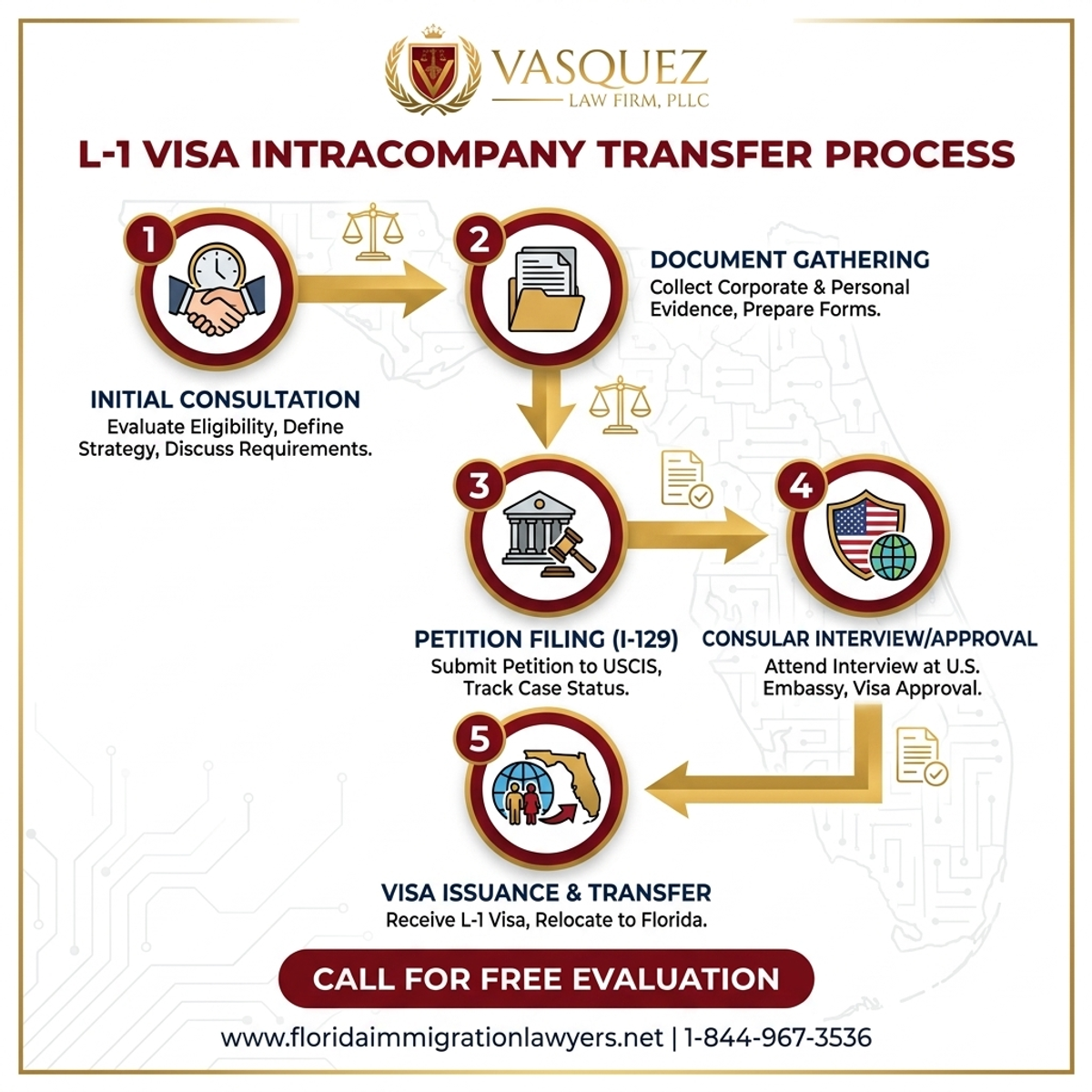
Step-by-Step Process — L-1 Visa Intracompany Transfer in Florida
The initial step, determining eligibility, is critical and often where companies benefit most from legal counsel. An experienced attorney from Florida Immigration Lawyers can help assess the specific roles, company structures, and employee qualifications to ensure they align with USCIS requirements, preventing costly rejections.
Once eligibility is confirmed, the U.S. employer takes the lead by filing Form I-129. This comprehensive petition requires meticulous attention to detail and robust supporting evidence to demonstrate the qualifying relationship between the U.S. and foreign entities, as well as the employee's managerial, executive, or specialized knowledge capacity. A well-prepared petition is the cornerstone of a successful L-1 application.
After USCIS approves the I-129 petition, the foreign national applies for the L-1 visa stamp at a U.S. consulate or embassy in their home country. This final stage involves an interview where the applicant must demonstrate their intent to comply with visa terms and confirm the information provided in the petition. Preparing for this interview, often with the help of legal counsel, can significantly boost confidence and the likelihood of approval.
Document Checklist for L-1 Visa Application
- Form I-129, filed by the U.S. employer
- Proof of qualifying relationship between companies
- Evidence of continuous employment for at least one year
- Detailed job description
- Proof of specialized knowledge (for L-1B)
- Valid passport
Beyond the basic checklist, comprehensive documentation is vital. For proof of a qualifying relationship, you'll need corporate registration documents, stock certificates, organizational charts clearly showing ownership and control, and financial statements for both the U.S. and foreign entities. This demonstrates a clear parent, subsidiary, affiliate, or branch relationship.
When providing evidence of continuous employment, include an employment verification letter from the foreign employer detailing the start and end dates of employment, job title, duties, and salary. Supplement this with pay stubs, tax records, and potentially performance reviews to paint a complete picture of the employee's tenure and role abroad.
For L-1A applicants, the detailed job description for the U.S. role must clearly outline managerial or executive duties, emphasizing supervisory responsibilities over professional staff or management of essential functions. For L-1B applicants, specific training certificates, project documentation, or letters from previous employers attesting to the unique nature of their knowledge are crucial. Remember, the more thoroughly you document each aspect, the stronger your petition will be.
Timeline and Processing Expectations
The processing time for an L-1 visa can vary. Typically, it takes several months from filing Form I-129 to receiving a decision. However, premium processing is available for an additional fee, which expedites the decision to within 15 calendar days. It's important to account for any potential delays and coordinate with the company's HR department to ensure a timely application.
Once the visa is approved, employees can begin working in the U.S. immediately. The initial stay is up to three years, with the possibility of extensions depending on the visa type.
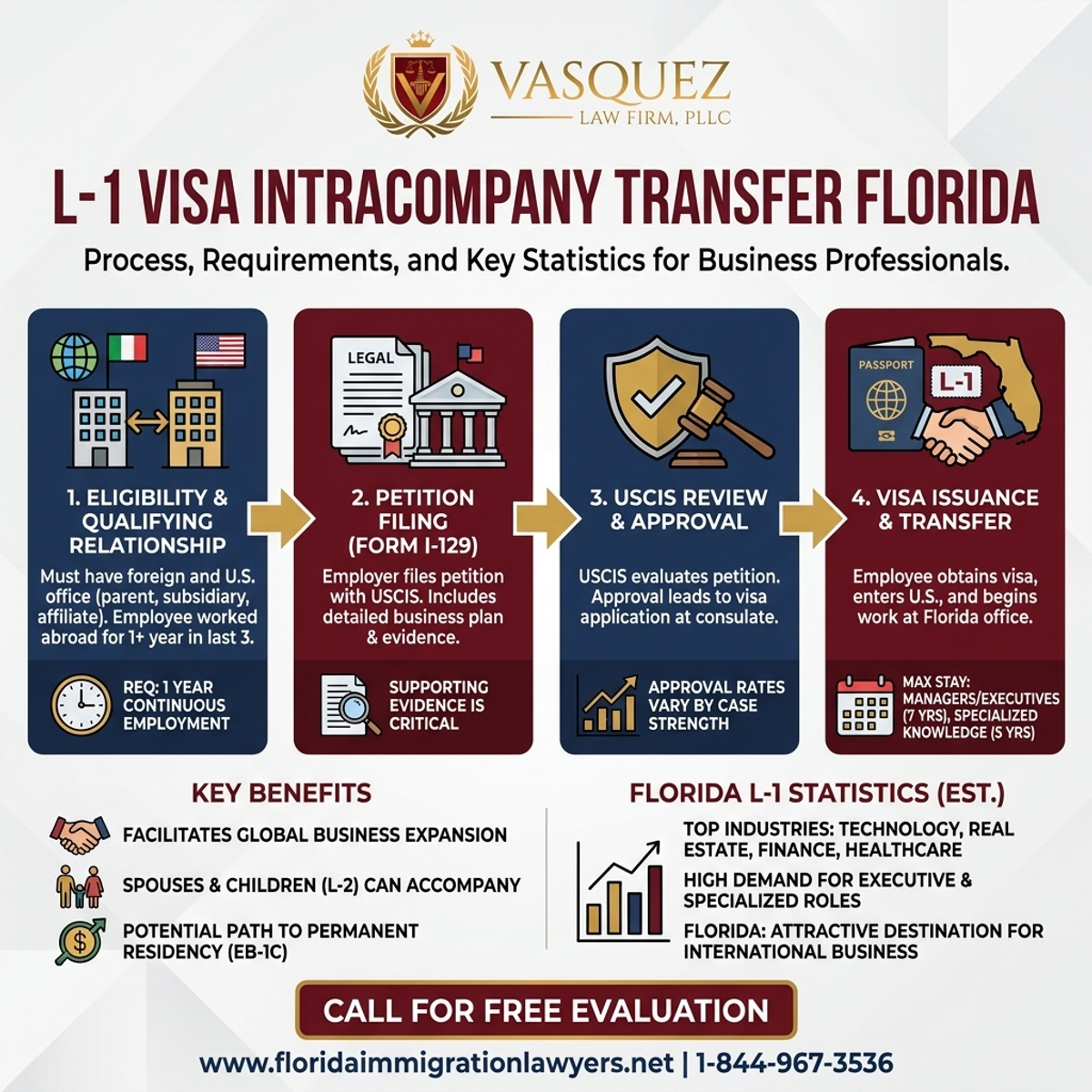
Key Statistics — L-1 Visa Intracompany Transfer in Florida
Factors influencing processing times include the specific USCIS service center handling the petition, the volume of applications, and the completeness of the submitted documentation. Any Request for Evidence (RFE) from USCIS will significantly extend the timeline, making it crucial to submit a robust and error-free petition from the outset.
Premium processing, while incurring an additional fee, can be invaluable for companies needing to quickly transfer key personnel to their Florida operations. It guarantees a response from USCIS within 15 calendar days, which can be critical for urgent business needs or project deadlines. However, it's important to note that premium processing only expedites the I-129 petition approval; the subsequent visa interview at the consulate will still depend on their scheduling availability.
The initial three-year stay for L-1A visa holders can be extended in increments of up to two years, for a maximum total stay of seven years. L-1B visa holders can also extend their stay, but their maximum total stay is five years. Planning for these extensions well in advance is crucial to ensure uninterrupted employment and compliance with immigration regulations. Florida Immigration Lawyers can assist in managing these timelines and preparing extension petitions.
Cost Factors and Fee Breakdown
Applying for an L-1 visa involves several costs, including the petition filing fee and potential premium processing fees. While specific amounts can fluctuate, consulting with a legal expert can help manage these costs effectively. Consider additional expenses related to relocation, such as travel and accommodation.
It's advisable to work with a qualified immigration lawyer to navigate these costs and ensure compliance with all filing requirements. Contact Florida Immigration Lawyers today.
The primary fees include the base I-129 filing fee, which is typically paid by the U.S. employer. Additionally, there's a Fraud Prevention and Detection Fee and, for certain companies, an American Competitiveness and Workforce Improvement Act (ACWIA) fee. These fees are non-refundable, regardless of the petition's outcome.
If premium processing is elected, an additional fee is required to guarantee expedited review. While this adds to the overall cost, the benefit of a rapid decision often outweighs the expense for businesses with time-sensitive needs. Beyond government fees, applicants should budget for legal consultation fees, which cover the attorney's expertise in preparing and filing the petition, responding to RFEs, and preparing the employee for the consular interview.
Relocation costs can also be substantial, especially for employees moving to a vibrant region like Kissimmee, Florida. These can include flights, temporary housing, shipping household goods, and initial living expenses. Companies often cover these costs as part of the transfer package, but it's important to factor them into the overall budget for an L-1 transfer.
Common Mistakes to Avoid
- Incomplete Documentation: Missing documents can delay or result in the denial of your application.
- Incorrect Visa Type: Applying for the wrong visa type can lead to unnecessary complications.
- Filing Errors: Errors in Form I-129 can result in rejection or processing delays.
- Not Understanding Dual Intent: Misunderstanding the dual intent provision can affect your green card process.
- Ignoring Timeline: Failing to account for processing time can disrupt business operations.
- Not Consulting Legal Experts: Lack of professional advice can lead to costly mistakes.
- Overlooking Spouse Work Authorization: Forgetting to apply for spouse work authorization can impact family livelihood.
- Ignoring Local Immigration Offices: Not considering local USCIS office processing times can affect plans.
- Misinterpreting L-1B Specialized Knowledge: Incorrectly defining specialized knowledge can lead to application denial.
- Forgetting Visa Renewal: Not tracking visa expiration can lead to unlawful presence.
Avoiding these common pitfalls is paramount for a smooth L-1 visa process. Many of these mistakes stem from a lack of understanding of complex immigration regulations, which is precisely why expert legal guidance is so valuable. Proactive preparation and thorough review can prevent significant delays and potential denials.
For instance, misinterpreting L-1B specialized knowledge is a frequent issue. USCIS scrutinizes these claims heavily, requiring clear evidence that the knowledge is proprietary and not easily transferable. Similarly, failing to adequately document the qualifying relationship between the U.S. and foreign entities can lead to a Request for Evidence (RFE) or even outright denial. Working with Florida Immigration Lawyers ensures that every aspect of your application is meticulously prepared and compliant.
Another critical area is managing timelines, especially for new office petitions. If a company is establishing a new U.S. office, the initial L-1A visa is typically granted for one year. Before this year expires, the company must demonstrate that it has established a viable U.S. operation, including securing office space, hiring employees, and generating revenue, to qualify for an extension. Overlooking this crucial deadline can jeopardize the employee's status and the company's U.S. expansion plans.
When to Call a Lawyer
If you are considering an intracompany transfer to Kissimmee, Florida, working with an immigration lawyer is crucial. Legal assistance is vital when facing complex eligibility issues, preparing for audits, or dealing with potential denials. Our team at Florida Immigration Lawyers can provide personalized guidance and ensure compliance with U.S. immigration laws.
Whether you're handling intricate paperwork or preparing for a visa interview, professional legal support can make a difference. Call us at 1-844-967-3536 for expert advice.
You should contact an immigration attorney as soon as you begin contemplating an L-1 transfer, even before an official decision is made. Early engagement allows for a thorough assessment of eligibility for both the company and the employee, helping to identify and mitigate potential issues before they become problems. This proactive approach saves time, money, and stress in the long run.
Specific situations that warrant immediate legal consultation include establishing a new U.S. office (new office L-1 petitions have stricter requirements), if the employee's role or the company structure is atypical, or if there have been previous immigration challenges for the employee or company. An attorney can also help prepare a robust response to any Requests for Evidence (RFEs) from USCIS, which are common and require detailed legal arguments and additional documentation.
Furthermore, if you are considering the L-1 visa as a pathway to permanent residency, understanding the dual intent provision and strategizing the green card application process requires specialized legal knowledge. Florida Immigration Lawyers can guide you through these complex pathways, ensuring your current L-1 status is protected while pursuing long-term immigration goals for you and your family.
About Florida Immigration Lawyers
At Florida Immigration Lawyers, we specialize in helping clients navigate the complexities of U.S. immigration law. Our experienced attorneys provide comprehensive services covering intracompany transfers, asylum, deportation defense, and more. We are committed to offering personalized, empathetic support to clients throughout Florida.
Contact us at 1-844-967-3536 or visit our website for a free consultation. We are available 24/7 and offer services in English and Spanish.
Our team understands the unique challenges faced by individuals and businesses in the immigration process, especially when dealing with international transfers. We pride ourselves on our meticulous approach to case preparation, ensuring that every detail is handled with precision to maximize the chances of a successful outcome for our clients in Kissimmee and beyond.
With a deep understanding of both federal immigration laws and local Florida business contexts, we provide strategic advice tailored to your specific needs. From the initial eligibility assessment to the final visa approval and beyond, Florida Immigration Lawyers is your trusted partner in achieving your U.S. immigration objectives. Let us put our expertise to work for you.
Sources and References
- U.S. Citizenship and Immigration Services (USCIS)
- Executive Office for Immigration Review (EOIR)
- 8 U.S.C. Chapter 12 - Immigration and Nationality Act
- 9 CFR § 214.2 - L classification
Related services: H-1B specialty occupation visas, L-1 intracompany transfer visas, work visas for professionals, investment and entrepreneur visas.
This article provides general legal information and is not intended as legal advice. Every case is unique, and outcomes depend on specific facts and circumstances. Contact an attorney for advice about your particular situation.
If you need legal assistance, learn more about learn about business immigration options, or call us at 1-844-967-3536 for a free consultation.
Do Not Navigate This Process Alone
Our experienced immigration attorneys are ready to fight for you. Get a free, confidential consultation today.
Se Habla Español
Frequently Asked Questions
Florida Immigration Lawyers
Immigration Attorney | Founder, Vasquez Law Firm
U.S. Air Force veteran and immigration attorney with thousands of cases resolved. J.D., NCCU School of Law. AILA member. Admitted to the 4th, 5th, and 11th Circuit Courts.
Available 24/7 - Free Evaluations
Related Legal Services
Our Florida immigration attorneys can help you with asylum protection, deportation defense and citizenship and naturalization. Call today at 1-844-967-3536 for a free consultation.
Related Links
Related Topics
Free Legal Consultation
Discuss your case with our experienced attorneys. We're available 24/7.
Se Habla Español - Estamos aquí para ayudarle.
Related Articles
U Visa Crime Victims in Florida: Your Guide | VLF Florida
Discover how the U visa can help crime victims in Florida. Learn about eligibility, application steps, and common pitfalls. Contact Florida Immigration Lawyers for expert assistance.
Biometrics Appointment in Florida: What to Expect | VLF Florida
Learn everything you need to know about biometrics appointments in Florida. From preparing for your ASC visit to understanding the importance of biometrics in your immigration process, this guide covers it all. Call Florida Immigration Lawyers for expert assistance.
TN Visa for USMCA Professionals in Florida | VLF Florida
Explore the TN visa for USMCA professionals in Florida. Learn about eligibility, application steps, and common mistakes. Contact our team for a free consultation today!
How to Choose an Immigration Lawyer in Florida | VLF Florida
Choosing the right immigration lawyer in Hialeah, Florida is vital for navigating complex immigration processes. Learn how to make an informed decision with our detailed guide. Call 1-844-967-3536 for a free consultation.
