U Visa for Crime Victims in Florida: Key Insights | VLF Flor
Discover the potential of the U visa for crime victims in Florida. Gain insights into eligibility, the application process, and how Florida Immigration Lawyers can assist you. Call us today for a free consultation.

The U visa offers crucial immigration relief for victims of certain crimes in Florida, including Coral Springs. This visa not only helps those who have suffered but also encourages them to assist law enforcement in investigating and prosecuting criminal activities. Key takeaways include:
- Eligibility requires being a victim of a qualifying crime.
- Cooperation with law enforcement is necessary.
- Certification from a law enforcement agency is required.
Introduction
Imagine living in Coral Springs, Florida, and becoming a victim of a crime. The fear and uncertainty can be overwhelming, especially for those without legal status. Fortunately, the U visa provides a pathway for these individuals to gain protection and stability. This article will explore the U visa process, eligibility criteria, and the benefits it offers to crime victims. Call Florida Immigration Lawyers at 1-844-967-3536 for a free consultation to discuss your case.
For many non-citizens, the aftermath of a crime is compounded by the fear of deportation or further victimization, making them hesitant to report incidents to the authorities. The U visa was specifically designed to address this vulnerability, offering a shield of protection that empowers victims to seek justice without fear of immigration consequences. It recognizes the immense courage it takes for a victim to come forward and provides a tangible incentive for their cooperation.
Navigating the complex landscape of immigration law while simultaneously recovering from a traumatic event can be incredibly challenging. This is where the expertise of a dedicated legal team becomes invaluable. Florida Immigration Lawyers understand the sensitive nature of U visa cases and are committed to providing compassionate and effective representation to victims in Coral Springs and across Florida, helping them rebuild their lives and secure their future in the United States.
Understanding the U Visa and Its Background
The U visa was established under the Victims of Trafficking and Violence Protection Act of 2000 to help non-citizen victims of crimes who have suffered substantial mental or physical abuse. This visa encourages victims to cooperate with law enforcement, aiding in the investigation and prosecution of criminal activities. In Florida, with its diverse population and numerous communities, including Coral Springs, the U visa serves as a vital tool for ensuring justice and safety.
The legislative intent behind the U visa was twofold: to protect vulnerable non-citizen victims and to enhance the ability of law enforcement agencies to investigate and prosecute serious crimes. Before the U visa, many undocumented victims were reluctant to report crimes due to fear of deportation, which allowed criminals to operate with impunity within certain communities. The U visa bridges this gap, creating a safer environment for everyone by fostering trust between immigrant communities and law enforcement.
This humanitarian relief provides a critical pathway for individuals who have endured profound trauma. Beyond simply offering legal status, the U visa provides an opportunity for victims to heal, work legally, and eventually pursue permanent residency. For communities like Coral Springs, the U visa is more than just an immigration benefit; it's a mechanism for upholding human dignity and ensuring that justice is accessible to all, regardless of immigration status.
Eligibility Criteria for the U Visa
To qualify for a U visa, certain conditions must be met:
- **Victim of a Qualifying Crime**: The applicant must have been a victim of a crime listed under the U visa guidelines, such as domestic violence, sexual assault, or human trafficking.
- **Suffered Substantial Abuse**: The victim must have experienced significant physical or mental abuse due to the crime.
- **Cooperation with Law Enforcement**: The victim must be willing to assist law enforcement in the investigation or prosecution of the crime.
- **Certification Required**: A law enforcement certification (Form I-918, Supplement B) must be obtained to confirm the victim's helpfulness to authorities.
This category includes a wide range of serious criminal activities designed to inflict harm or exploit individuals. Examples of qualifying crimes extend to abduction, blackmail, felonious assault, false imprisonment, hostage taking, involuntary servitude, kidnapping, murder, manslaughter, obstruction of justice, perjury, prostitution, rape, sexual assault, torture, and witness tampering. It's crucial that the crime occurred in the U.S. or violated U.S. law.
Substantial abuse refers to a significant level of harm, not merely minor discomfort or injury. This can include severe emotional distress, psychological trauma, or physical injuries that require medical attention or have long-term effects. The abuse must be a direct result of the qualifying criminal activity.
This means actively participating in the investigative process, which may include providing statements, testifying in court, or assisting in identifying perpetrators. Simply reporting the crime is often not enough; ongoing and helpful cooperation is key. This cooperation must be certified by a relevant agency.
This certification is a critical component of the application. It must be signed by an authorized official from a qualifying law enforcement agency, prosecutor's office, judge, or other specified entities. The certification attests that the victim has been, is being, or is likely to be helpful in the investigation or prosecution of the qualifying criminal activity.
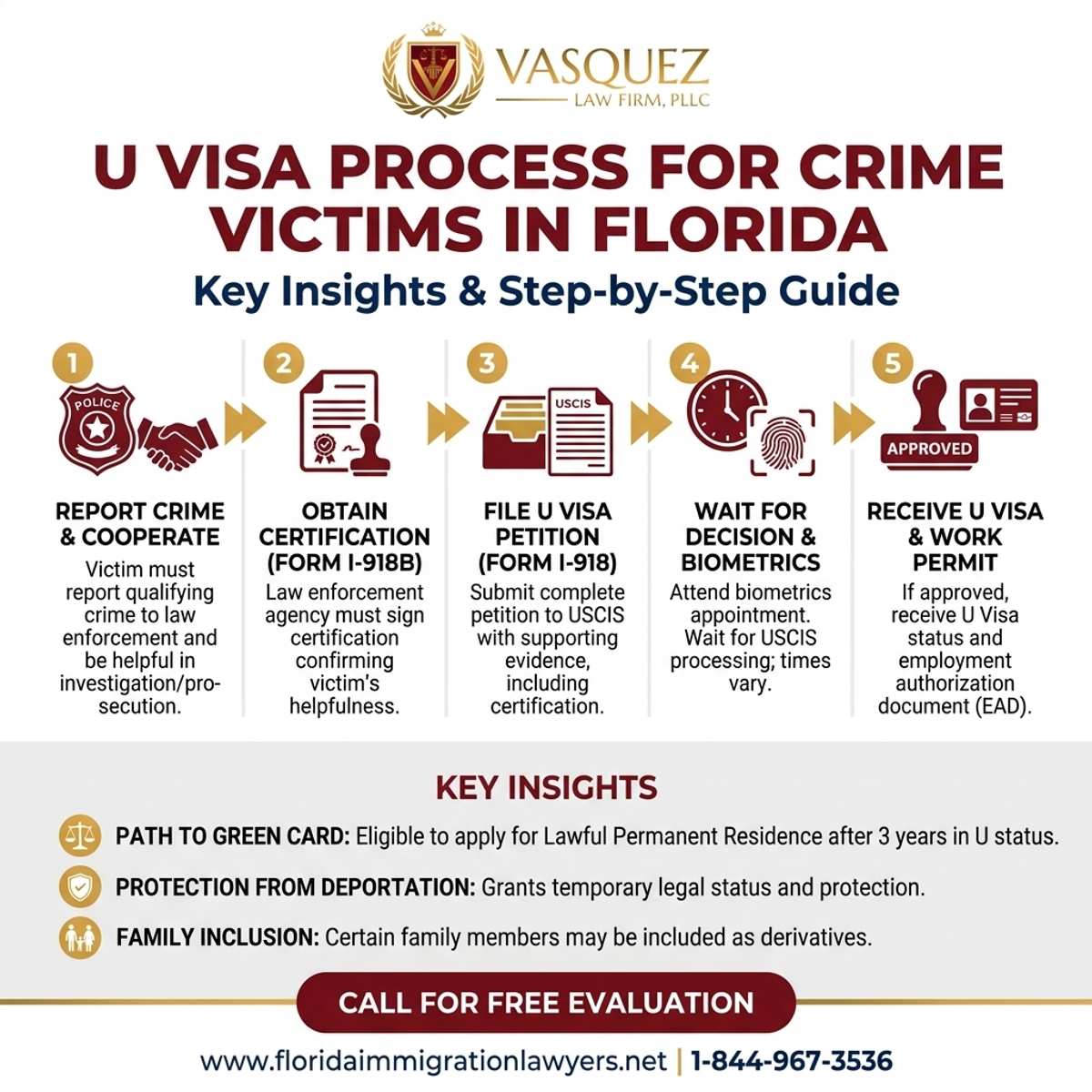
Step-by-Step Process — U Visa for Crime Victims in Florida: Key Insights
Step-by-Step Guide to Applying for a U Visa
- **Gather Necessary Documentation**: Collect evidence of the crime and its impact, including police reports, medical records, and witness statements.
- **Obtain Law Enforcement Certification**: Secure a signed Form I-918, Supplement B from a qualifying law enforcement agency.
- **File Form I-918**: Complete and submit Form I-918, Petition for U Nonimmigrant Status, along with the certification and supporting documents.
- **Biometrics Appointment**: Attend a biometrics appointment for fingerprinting and security checks.
- **Await Decision**: USCIS will review the application and make a decision. Processing times can vary, often taking several months.
This initial step is crucial for building a strong case. Beyond official reports, gather any personal evidence such as photographs of injuries, text messages, emails, or journals that document the abuse or the crime's aftermath. Medical records detailing physical or psychological treatment are particularly impactful in demonstrating substantial abuse.
This can often be the most challenging part of the process. You or your attorney, like those at Florida Immigration Lawyers, will need to contact the specific agency involved in your case and explain the purpose of the certification. Persistence and clear communication about your cooperation are vital.
Ensure that Form I-918 is meticulously filled out, along with all necessary supplements, including Form I-918 Supplement A for qualifying family members and Form I-918 Supplement B (the law enforcement certification). Include any required waivers of inadmissibility, such as Form I-192, Application for Advance Permission to Enter as a Nonimmigrant, if applicable.
After your application is submitted, USCIS will send you a notice to attend a biometrics appointment at an Application Support Center (ASC). This appointment is mandatory and involves collecting your fingerprints, photograph, and signature for background and security checks. Missing this appointment without rescheduling can delay or even jeopardize your application.
During this waiting period, USCIS may issue a Request for Evidence (RFE) if they need more information or clarification. It's important to respond promptly and thoroughly to any such requests. While waiting, many applicants receive deferred action and work authorization while on the U visa waiting list, providing crucial temporary relief.
Document Checklist for U Visa Applicants
- Completed Form I-918
- Law enforcement certification (Form I-918, Supplement B)
- Evidence of the crime and its impact
- Personal statement describing the crime and its effects
- Proof of identity (passport, birth certificate)
- Form I-765, Application for Employment Authorization (optional, but highly recommended)
This is the primary application form for U nonimmigrant status. Ensure all sections are accurately completed and signed, as incomplete forms are a common reason for delays.
This document is indispensable, confirming your helpfulness to law enforcement. It must be signed by an authorized official from the investigating or prosecuting agency.
This includes police reports, court documents, medical records, psychological evaluations, and any other evidence that corroborates the crime and the substantial abuse you suffered.
Your personal statement is a powerful tool to convey the details of the crime, the abuse you endured, and how it has affected your life. Be as detailed and honest as possible, as this helps USCIS understand your unique circumstances.
Submit copies of government-issued identification documents. If you have any criminal history or immigration violations, you may also need to file Form I-192, Application for Advance Permission to Enter as a Nonimmigrant, to waive certain grounds of inadmissibility.
While not strictly part of the U visa petition itself, filing Form I-765 concurrently allows you to apply for a work permit, which is essential for financial stability while your U visa is pending or if you are granted deferred action.
Key Statistics — U Visa for Crime Victims in Florida: Key Insights
Timeline and Processing Expectations
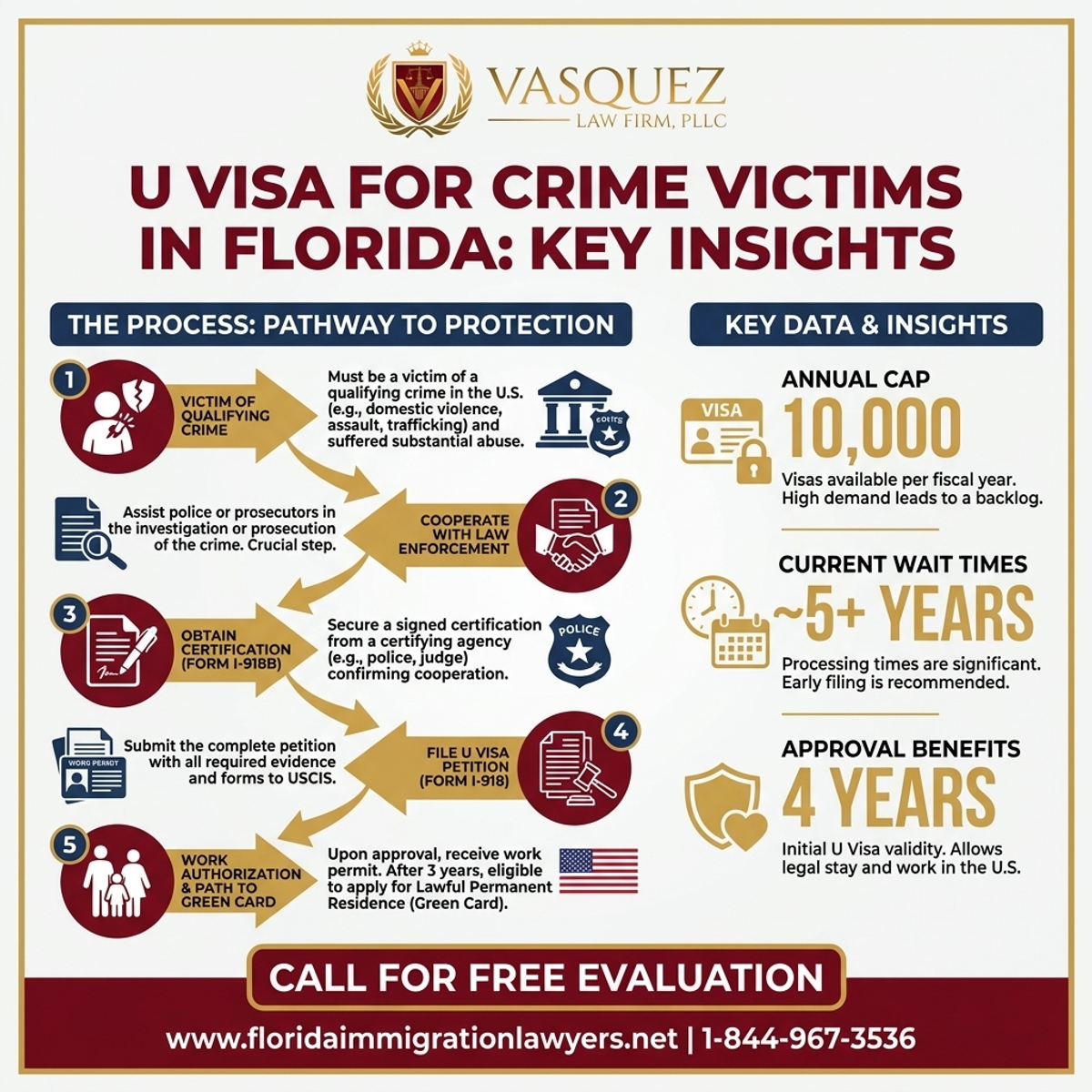
The U visa application process can be lengthy, often taking several months to years due to the high volume of applicants and limited number of visas available annually. It's crucial to submit a complete and accurate application to avoid unnecessary delays. Once approved, U visa holders can remain in the United States for up to four years, with the possibility of applying for permanent residency after three years.
USCIS processes U visa petitions in stages. Initially, applications are reviewed to determine if they meet the basic eligibility requirements, including the receipt of a valid law enforcement certification. If the application appears prima facie (on its face) eligible, USCIS may grant deferred action and issue an Employment Authorization Document (EAD) to the principal applicant and eligible family members. This provides critical temporary protection from deportation and the ability to work legally while awaiting a final decision.
A significant factor in the extended timeline is the annual cap. Congress limits the number of U visas issued to 10,000 principal applicants each fiscal year. Due to the overwhelming demand, USCIS maintains a waiting list for eligible petitioners. Once you are placed on the waiting list, you will typically remain in deferred action status with work authorization until a U visa becomes available. The wait for a final U visa approval can often span several years.
After holding U nonimmigrant status for three continuous years, and provided certain conditions are met, U visa holders become eligible to apply for lawful permanent residency (a green card) by filing Form I-485, Application to Register Permanent Residence or Adjust Status. This typically requires demonstrating continued physical presence in the U.S. and that remaining in the U.S. is warranted on humanitarian grounds, to ensure family unity, or is otherwise in the public interest. This pathway to a green card is one of the most significant benefits of the U visa, offering long-term stability and security.
Cost Factors and Fee Breakdown
While there is no filing fee for the U visa application itself, there may be costs associated with obtaining necessary documentation, translations, and legal assistance. It's recommended to consult with an attorney to understand potential expenses and explore fee waivers if applicable.
It's important to differentiate between direct USCIS filing fees and other associated costs. While Form I-918 itself does not have a filing fee, related applications, such as Form I-765 for employment authorization or Form I-485 for adjustment of status to a green card, do typically incur fees. However, U visa applicants may be eligible for fee waivers for these associated forms, which can significantly reduce the financial burden. Discussing these options with Florida Immigration Lawyers is highly recommended.
Beyond government fees, applicants should anticipate costs for obtaining certified copies of police reports, medical records, and expert evaluations. If documents are not in English, certified translations will be required, which also adds to the expense. Legal fees for an experienced immigration attorney are often the most substantial cost, but this investment can be invaluable in ensuring a complete, accurate, and compelling application that maximizes your chances of approval. Florida Immigration Lawyers offer free consultations to help you understand potential costs upfront.
Do not navigate this process alone. Contact Florida Immigration Lawyers today.
Common Mistakes to Avoid
- **Incomplete Applications**: Missing documents or incomplete forms can lead to delays or denials.
- **Not Obtaining Proper Certification**: Failing to secure a law enforcement certification can invalidate the application.
- **Ignoring Deadlines**: Missing important deadlines can negatively impact the application process.
- **Inconsistent Information**: Discrepancies between documents can raise red flags.
- **Lack of Evidence**: Insufficient evidence of the crime or abuse can weaken the case.
- **Not Following Up**: Failing to respond to USCIS requests for additional information can result in denial.
- **Misunderstanding Eligibility**: Applying without meeting all eligibility criteria wastes time and resources.
Always double-check that every question on every form is answered and that all required supporting documents are included. A checklist provided by your attorney, like those at Florida Immigration Lawyers, can be invaluable in preventing this common error.
This certification is the cornerstone of a U visa petition. If you encounter difficulties, an experienced attorney can help advocate on your behalf with law enforcement agencies, explaining the importance and requirements of Form I-918, Supplement B.
Keep a meticulous record of all communication from USCIS and any deadlines provided. Promptly responding to Requests for Evidence (RFEs) or notices for biometrics appointments is critical to keeping your application on track.
Ensure that all information provided across your application, personal statement, and supporting documents is consistent and accurate. Any contradictions can lead to suspicion and may require extensive clarification, delaying your case.
Gather as much corroborating evidence as possible, including police reports, medical records, photos, and witness statements. A strong body of evidence significantly strengthens your claim of being a victim of a qualifying crime and having suffered substantial abuse.
Regularly check the status of your case online and ensure USCIS has your current mailing address. If you receive an RFE, work immediately with your attorney to gather and submit the requested information before the deadline.
Before investing time and effort, consult with an immigration attorney to thoroughly assess your eligibility. An expert can identify potential issues, advise on waivers of inadmissibility, and determine the strongest path forward for your specific situation.
When to Call a Lawyer
It's advisable to consult an immigration lawyer if you're unsure about your eligibility, need help gathering evidence, or require assistance in navigating the application process. Legal experts can provide insight into potential challenges and improve your chances of approval. Florida Immigration Lawyers offer expert guidance and support to ensure your application is complete and accurate.
You should particularly consider legal counsel if you have a complex immigration history, such as prior deportations, criminal convictions, or previous denials of immigration benefits. These factors can significantly complicate your U visa application and may require specific waivers of inadmissibility, which an experienced attorney can expertly handle.
Furthermore, if you are struggling to obtain the necessary law enforcement certification, or if you have language barriers that make communication with authorities or USCIS difficult, a lawyer can act as your advocate and intermediary. Florida Immigration Lawyers are available at 1-844-967-3536 to provide comprehensive support, ensuring no detail is overlooked and your rights are protected throughout this critical process.
About Florida Immigration Lawyers
Florida Immigration Lawyers is dedicated to assisting individuals with their immigration needs, offering services in Coral Springs and throughout Florida. Our team of experienced attorneys provides personalized support for a range of cases, from U visas to citizenship applications. Contact us at 1-844-967-3536 for a free consultation. We are available 24/7 to help you navigate the complexities of immigration law.
Our firm prides itself on a client-centric approach, understanding that each U visa case involves profound personal stories of trauma and resilience. We combine legal acumen with compassionate advocacy, ensuring that victims feel heard, supported, and confident in their pursuit of justice and legal status. Our deep understanding of Florida's legal landscape and federal immigration policies positions us as a leading resource for U visa applicants.
We are committed to empowering our clients to rebuild their lives free from fear. From the initial consultation to the final decision, Florida Immigration Lawyers stands by your side, providing clear guidance, meticulous preparation, and robust representation. Your safety and future are our priority, and our 24/7 availability ensures that help is always just a phone call away at 1-844-967-3536.
Frequently Asked Questions (FAQ) about the U Visa
Sources and References
- U.S. Citizenship and Immigration Services (USCIS)
- Executive Office for Immigration Review (EOIR)
- 8 U.S.C. Chapter 12 - Immigration and Nationality Act
Related services: asylum and refugee protection, asylum application process, refugee status and resettlement, withholding of removal.
This article provides general legal information and is not intended as legal advice. Every case is unique, and outcomes depend on specific facts and circumstances. Contact an attorney for advice about your particular situation.
Seize the opportunity to secure your future. Contact Florida Immigration Lawyers at 1-844-967-3536 for a free consultation. Se Habla Español - Estamos aquí para ayudarle.
If you need legal assistance, learn more about speak with an immigration lawyer, or call us at 1-844-967-3536 for a free consultation.
Do Not Navigate This Process Alone
Our experienced immigration attorneys are ready to fight for you. Get a free, confidential consultation today.
Se Habla Español
Frequently Asked Questions
Florida Immigration Lawyers
Immigration Attorney | Founder, Vasquez Law Firm
U.S. Air Force veteran and immigration attorney with thousands of cases resolved. J.D., NCCU School of Law. AILA member. Admitted to the 4th, 5th, and 11th Circuit Courts.
Available 24/7 - Free Evaluations
Related Legal Services
Our Florida immigration attorneys can help you with asylum protection, deportation defense and citizenship and naturalization. Call today at 1-844-967-3536 for a free consultation.
Related Links
Related Topics
Free Legal Consultation
Discuss your case with our experienced attorneys. We're available 24/7.
Se Habla Español - Estamos aquí para ayudarle.
Related Articles
How to Choose an Immigration Lawyer in Florida | VLF Florida
Choosing the right immigration lawyer in Hialeah, Florida is vital for navigating complex immigration processes. Learn how to make an informed decision with our detailed guide. Call 1-844-967-3536 for a free consultation.
Green Card Through Marriage in Florida | VLF Florida
Considering a green card through marriage in Florida? Discover the steps, common mistakes, and when to consult a lawyer. Call 1-844-967-3536 today!
Understanding Stokes Interview for Marriage Fraud in Florida
If you're facing a Stokes interview in Hialeah, Florida, understanding the process is crucial. This interview assesses the authenticity of your marriage to prevent fraud in I-130 petitions. Learn more about preparation and common pitfalls. Call Florida Immigration Lawyers for expert guidance.
Family Petition Immigration Lawyer Miami: Florida Guide
Dreaming of reuniting your family in Florida? The family petition process, starting with Form I-130, is the crucial first step. This guide covers eligibility, step-by-step filing, essential documents, and navigating complex timelines for a family visa. Learn about the costs involved and the critical role an immigration lawyer plays in Miami, Jacksonville, and across Florida. Avoid common mistakes and understand when to seek legal counsel to ensure a smooth journey towards a green card. Florida Immigration Lawyers offers expert guidance for your family's future, providing free consultations and unwavering support.