Green Card Through Marriage in Florida | VLF Florida
Considering a green card through marriage in Florida? Discover the steps, common mistakes, and when to consult a lawyer. Call 1-844-967-3536 today!

Green Card Through Marriage in Florida | VLF Florida
Navigating the U.S. immigration system can be a profoundly complex and often overwhelming journey, especially when the path to permanent residency is through marriage. For couples residing in Florida, understanding the specific requirements, procedures, and potential pitfalls is crucial for a successful application. This comprehensive guide aims to demystify the process of obtaining a green card through marriage in the Sunshine State, offering insights into eligibility, application steps, required documentation, and how to overcome common challenges. At VLF Florida, our mission is to provide clear, actionable information and robust legal support to help you achieve your immigration goals.
Eligibility Requirements for a Marriage-Based Green Card
The foundation of any marriage-based green card application is eligibility. To qualify, several key conditions must be met:
- Valid Marriage: The marriage must be legally recognized in the place it occurred. This means both spouses must have been legally free to marry at the time of the ceremony, and the marriage must not be a sham or entered into solely for immigration benefits. USCIS scrutinizes marriages to ensure they are 'bona fide' – entered into in good faith with the intent to establish a life together.
- Sponsor Status: One spouse must be a U.S. citizen or a lawful permanent resident (LPR), commonly known as a green card holder. The U.S. citizen or LPR spouse acts as the petitioner and sponsor for their foreign national spouse.
- Financial Sponsorship: The U.S. citizen or LPR spouse must demonstrate the financial capacity to support their foreign national spouse by filing Form I-864, Affidavit of Support. This ensures the immigrant will not become a 'public charge' and rely on government assistance. The sponsor’s income must meet or exceed 125% of the Federal Poverty Guidelines for their household size. If the primary sponsor’s income is insufficient, a joint sponsor may be required.
- Admissibility: The foreign national spouse must be admissible to the United States. Certain factors, such as criminal history, past immigration violations, or specific health conditions, can render an individual inadmissible. In some cases, waivers may be available.
Understanding these initial requirements is the first critical step. Any misstep here can lead to significant delays or even denial of the application. Our immigration services are designed to help you navigate these complex eligibility criteria.
The Application Process: Step-by-Step
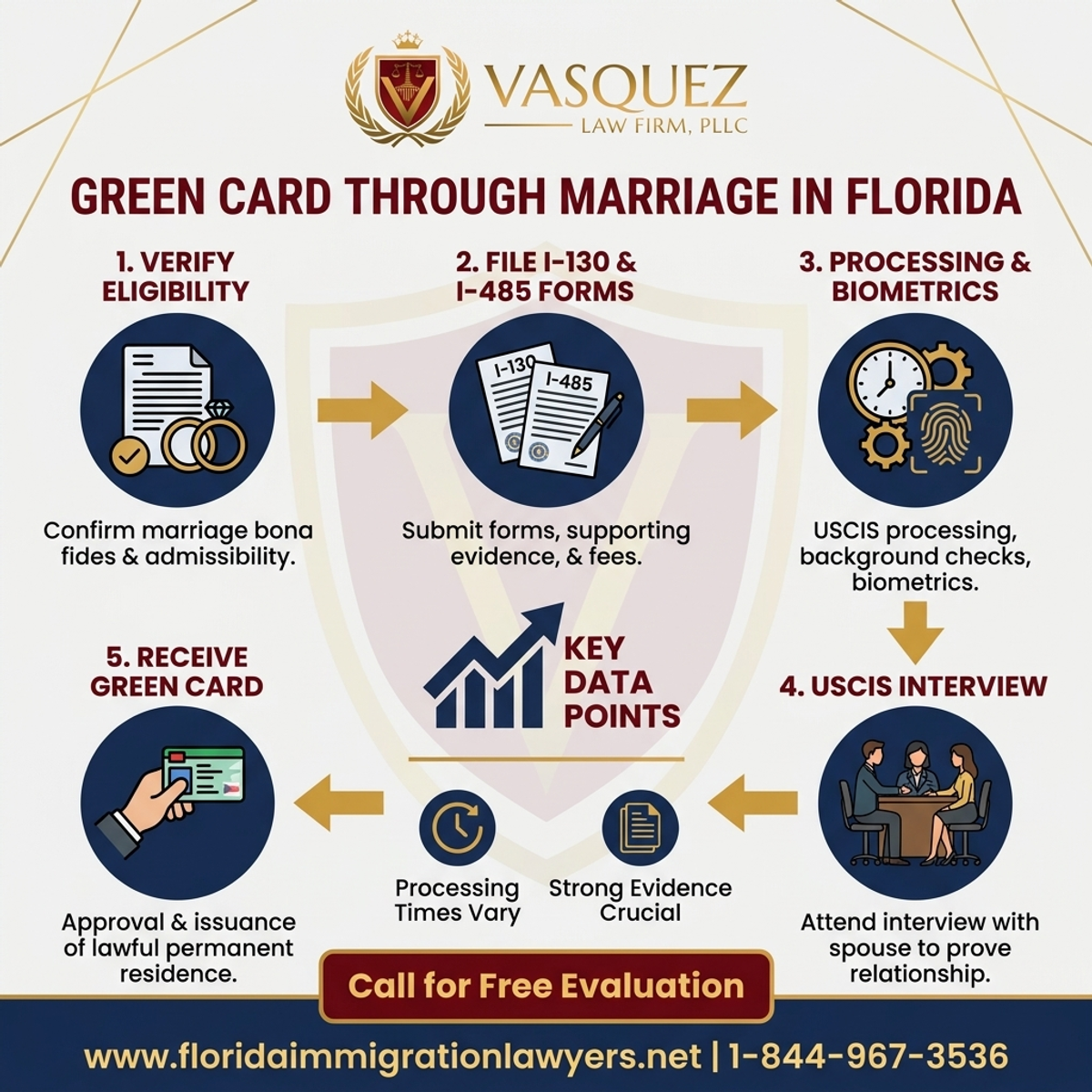
The journey to a marriage-based green card typically involves two main phases, depending on whether the foreign national spouse is already in the U.S. or abroad:
Phase 1: Petition for Alien Relative (Form I-130)
The U.S. citizen or LPR spouse initiates the process by filing Form I-130, Petition for Alien Relative, with U.S. Citizenship and Immigration Services (USCIS). This form establishes the legitimate relationship between the petitioner and the beneficiary (the foreign national spouse). Supporting documents, such as marriage certificates, birth certificates, and evidence of the petitioner's U.S. citizenship or LPR status, must accompany the petition. Evidence of a bona fide marriage, such as joint bank accounts, leases, utility bills, photos, and affidavits from friends and family, is crucial at this stage.
Phase 2: Adjustment of Status (AOS) or Consular Processing
Adjustment of Status (If in the U.S.)
If the foreign national spouse is already lawfully present in the United States (e.g., on a visa that allows for adjustment, like a K-1 fiancé visa, or entered legally and is an immediate relative of a U.S. citizen), they can apply for Adjustment of Status (AOS). This involves filing Form I-485, Application to Register Permanent Residence or Adjust Status, concurrently with or after the I-130 petition (if the petitioner is a U.S. citizen). If the petitioner is an LPR, the foreign spouse must wait for a visa to become available based on their priority date. Along with Form I-485, applicants typically file Form I-765 (Application for Employment Authorization) and Form I-131 (Application for Travel Document), allowing them to work and travel while the green card application is pending. A medical examination (Form I-693) is also required.
Consular Processing (If Outside the U.S.)
If the foreign national spouse is living outside the United States, or is in the U.S. but ineligible for adjustment of status, they will undergo Consular Processing. Once the I-130 petition is approved by USCIS, it is sent to the National Visa Center (NVC). The NVC collects necessary documents and fees, and then forwards the case to the appropriate U.S. embassy or consulate in the foreign national's home country. The foreign national will then attend an interview at the embassy or consulate. Upon successful interview and approval, a visa is issued, allowing them to enter the U.S. as a permanent resident.
Required Documents for Your Application
The success of your application heavily relies on the thoroughness and accuracy of your documentation. While specific requirements may vary, common documents include:
- Proof of Relationship: Marriage certificate, birth certificates of children born to the marriage, joint leases or property deeds, joint bank account statements, joint credit card statements, utility bills in both names, life insurance policies naming each other as beneficiaries, photographs of the couple together over time, affidavits from friends and family attesting to the bona fide nature of the marriage.
- Identity and Nationality: Passports, birth certificates, national identity cards.
- Financial Support: Form I-864 (Affidavit of Support), tax returns (past three years), W-2s, pay stubs, employment verification letters, bank statements.
- Medical Examination: Form I-693 completed by a USCIS-approved civil surgeon.
- Background Checks: Police certificates from countries where the foreign national has lived, court and prison records (if applicable), military records (if applicable).
- Immigration History: Copies of all previous visa stamps, I-94 records, and any prior immigration applications or decisions.
Step-by-Step Process — Green Card Through Marriage in Florida | VLF Florida
Organizing these documents meticulously is paramount. Missing or incorrect documentation is a leading cause of delays and Requests for Evidence (RFEs) from USCIS. Our experienced attorneys can assist in compiling and reviewing your documentation package.
The Interview Process: What to Expect
Both spouses will typically be required to attend an interview with a USCIS officer (for AOS) or a consular officer (for consular processing). The primary purpose of this interview is to verify the legitimacy of your marriage and to confirm the information provided in your application forms. Officers are trained to detect marriage fraud and may ask detailed questions about your relationship, daily routines, shared life, and future plans. Questions can range from how you met, what you did on your first date, details about your wedding, to your spouse's favorite color or what you had for breakfast that morning. It's crucial to be honest, consistent, and prepared. Bring all original documents, even if you submitted copies with your application. Remaining calm and answering truthfully are your best strategies.
Conditional vs. Permanent Green Card
The type of green card you receive initially depends on the length of your marriage at the time of approval:
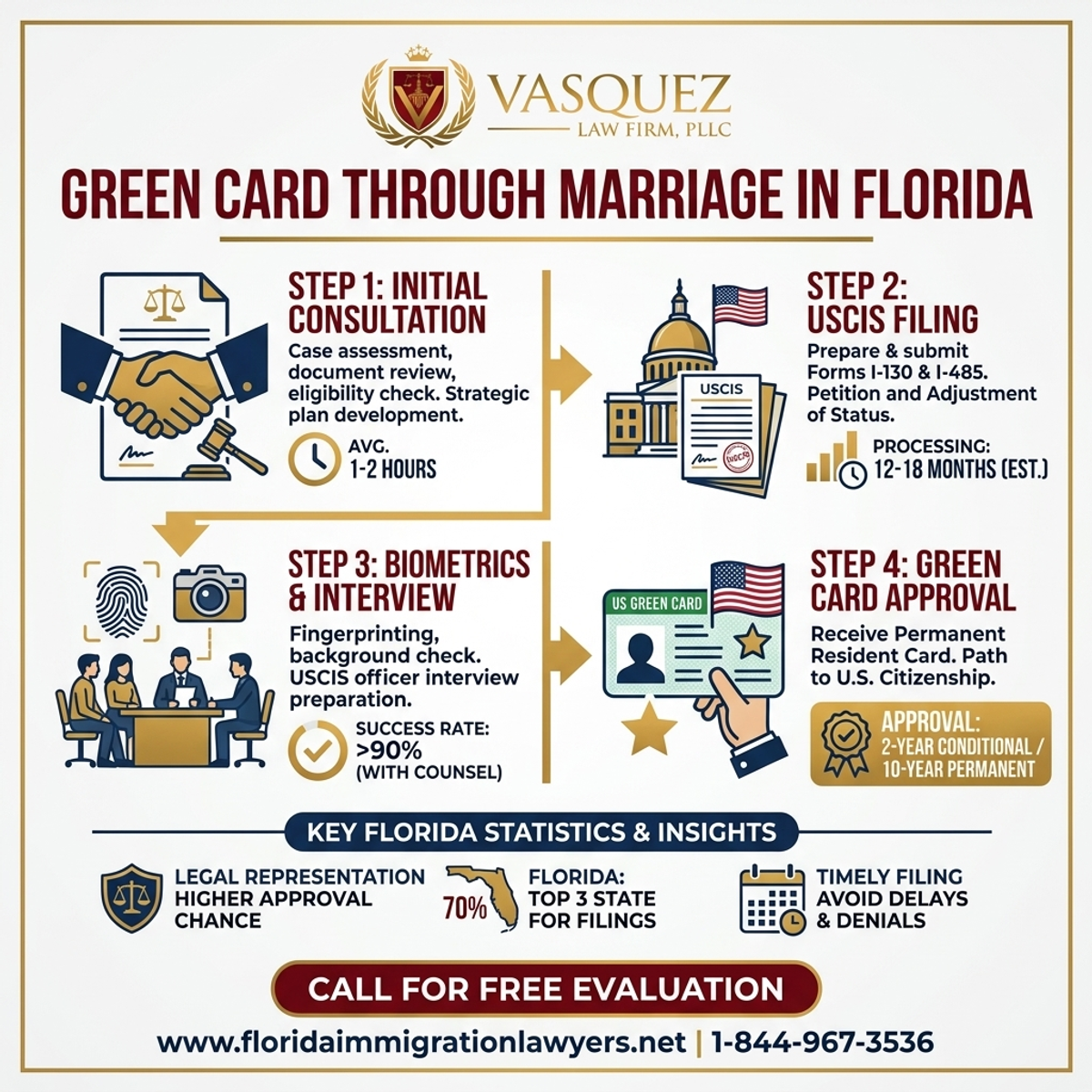
- Conditional Green Card: If your marriage is less than two years old on the day your green card is approved, the foreign national spouse will receive a conditional green card, valid for two years. This is a probationary period designed to further verify the legitimacy of the marriage.
- Removing Conditions: Approximately 90 days before the conditional green card expires, the couple must jointly file Form I-751, Petition to Remove Conditions on Residence. This petition requires updated evidence of the ongoing bona fide marriage. If approved, the foreign national receives a 10-year permanent green card.
- Permanent Green Card: If the marriage is two years old or more at the time of green card approval, the foreign national spouse will directly receive a 10-year permanent green card.
Key Statistics — Green Card Through Marriage in Florida | VLF Florida
Common Challenges and How to Overcome Them
The marriage-based green card process is not without its hurdles. Common challenges include:
- Requests for Evidence (RFEs): USCIS may issue an RFE if they believe your application is incomplete or lacks sufficient evidence. Responding promptly and thoroughly is critical.
- Delays: Processing times can vary significantly due to caseloads, policy changes, or individual case complexities. Patience is key, but consistent follow-up can sometimes help.
- Accusations of Marriage Fraud: If USCIS suspects your marriage is not legitimate, they may conduct a more rigorous investigation, including separate interviews (Stokes interviews) or home visits. Strong, consistent evidence of a bona fide marriage from the outset is your best defense.
- Prior Immigration Violations: Past overstays, unlawful entries, or other immigration infractions can complicate the process, potentially requiring waivers or making the applicant inadmissible.
Proactive preparation and seeking expert legal advice can significantly mitigate these challenges. Our firm specializes in helping clients navigate these intricate situations.
Navigating Complexities: What Happens If Your Marriage Ends or You Face Deportation?
Life can be unpredictable, and sometimes marriages unfortunately dissolve before the foreign national spouse obtains a permanent green card. This situation introduces significant complexities, but it does not automatically mean the end of your immigration journey. If your marriage ends through divorce or annulment before you file Form I-751, Petition to Remove Conditions on Residence, or before it is approved, you may still be able to remove the conditions on your green card by filing a waiver. There are several grounds for a waiver:
- Bona Fide Marriage, but Divorce: You can demonstrate that you entered the marriage in good faith, but the marriage was terminated through divorce or annulment. You must provide substantial evidence that the marriage was real and not for immigration purposes.
- Battery or Extreme Cruelty: If you or your child were subjected to battery or extreme cruelty by your U.S. citizen or LPR spouse, you may file a waiver. This is a critical protection for victims of domestic violence.
- Extreme Hardship: If the termination of your status and removal from the United States would result in extreme hardship.
Filing an I-751 waiver is a highly sensitive and document-intensive process. It requires compelling evidence and a clear legal argument to convince USCIS that you qualify. Without proper legal guidance, the chances of success can be significantly reduced. Furthermore, if your marriage ends and your conditional green card expires without a successful I-751 filing, you could find yourself in removal proceedings. Facing deportation is a daunting prospect that requires immediate and expert legal intervention. Our attorneys are skilled in defending individuals against deportation, analyzing all potential avenues for relief, including waivers, cancellation of removal, and other forms of protection. Individuals with complex immigration histories, such as those who have sought asylum in the past or have prior deportation orders, face even greater challenges. It is imperative to consult with an attorney experienced in these specific areas to understand your options and protect your rights.
The Indispensable Role of an Immigration Attorney
While it is technically possible to navigate the marriage-based green card process independently, the intricacies of U.S. immigration law, the volume of required documentation, and the potential for complex issues make professional legal assistance invaluable. An experienced immigration attorney can:
- Assess Eligibility: Determine your specific eligibility and identify any potential red flags or inadmissibility issues early on.
- Prepare Documentation: Help you gather, organize, and prepare all necessary forms and supporting documents, ensuring accuracy and completeness.
- Craft a Strong Case: Present your case in the most favorable light, highlighting the bona fide nature of your marriage and addressing any concerns USCIS might have.
- Prepare for Interviews: Provide thorough preparation for your USCIS or consular interview, including mock interviews and guidance on what to expect.
- Respond to RFEs: Formulate comprehensive and timely responses to Requests for Evidence, preventing delays or denials.
- Navigate Challenges: Address complex issues such as previous immigration violations, criminal records, or waivers for conditional green card removal.
- Represent You: Act as your legal representative throughout the process, communicating with USCIS or the NVC on your behalf.
For individuals seeking comprehensive immigration guidance in Florida, our dedicated team at VLF Florida offers personalized and strategic legal solutions. We understand the profound impact immigration decisions have on families and are committed to providing compassionate and effective representation.
Contact VLF Florida for Expert Immigration Legal Help
Securing a green card through marriage is a life-changing event, and ensuring a smooth, successful process is paramount. From the initial petition to the final interview and beyond, having knowledgeable legal counsel by your side can make all the difference. If you are considering applying for a green card through marriage in Florida, or if you are facing any immigration challenges, don't hesitate to seek professional assistance. Our attorneys are here to provide the guidance and support you need.
For a free consultation and to discuss your specific situation, please contact VLF Florida today. Let us help you navigate the path to permanent residency with confidence.
FAQs About Green Cards Through Marriage
- What is a green card through marriage?
- Who is eligible to apply?
- How long does the process take?
- What documents are needed?
- Is an interview always required?
- What is the difference between conditional and permanent green cards?
- Can I apply if my spouse is a U.S. citizen but we live abroad?
- What if my marriage ends before I get a permanent green card?
Sources and References
- U.S. Citizenship and Immigration Services (USCIS)
- Executive Office for Immigration Review (EOIR)
- U.S. Department of State - Bureau of Consular Affairs
- Immigration and Nationality Act (INA), 8 U.S.C. Chapter 12
Do Not Navigate This Process Alone
Our experienced immigration attorneys are ready to fight for you. Get a free, confidential consultation today.
Se Habla Español
Frequently Asked Questions
Florida Immigration Lawyers
Immigration Attorney | Founder, Vasquez Law Firm
U.S. Air Force veteran and immigration attorney with thousands of cases resolved. J.D., NCCU School of Law. AILA member. Admitted to the 4th, 5th, and 11th Circuit Courts.
Available 24/7 - Free Evaluations
Related Legal Services
Our Florida immigration attorneys can help you with citizenship and naturalization, family immigration services and immigration practice areas. Call today at 1-844-967-3536 for a free consultation.
Related Links
Related Topics
Free Legal Consultation
Discuss your case with our experienced attorneys. We're available 24/7.
Se Habla Español - Estamos aquí para ayudarle.
Related Articles
Understanding Stokes Interview for Marriage Fraud in Florida
If you're facing a Stokes interview in Hialeah, Florida, understanding the process is crucial. This interview assesses the authenticity of your marriage to prevent fraud in I-130 petitions. Learn more about preparation and common pitfalls. Call Florida Immigration Lawyers for expert guidance.
Family Petition Immigration Lawyer Miami: Florida Guide
Dreaming of reuniting your family in Florida? The family petition process, starting with Form I-130, is the crucial first step. This guide covers eligibility, step-by-step filing, essential documents, and navigating complex timelines for a family visa. Learn about the costs involved and the critical role an immigration lawyer plays in Miami, Jacksonville, and across Florida. Avoid common mistakes and understand when to seek legal counsel to ensure a smooth journey towards a green card. Florida Immigration Lawyers offers expert guidance for your family's future, providing free consultations and unwavering support.
Immigration Lawyer Fort Lauderdale: Your Florida Guide 2026
Navigating immigration law in Fort Lauderdale, Broward County, and across Florida requires expert legal guidance. This comprehensive guide from Florida Immigration Lawyers explores key pathways like family-based visas, employment opportunities, and critical deportation defense strategies. Learn about essential documents, processing timelines, and common mistakes to avoid. Our experienced immigration lawyers provide personalized support, helping you understand the complex federal laws and local procedures, including those at the Miami Immigration Court and the Oakland Park USCIS Field Office. Protect your rights and ensure a smoother process by securing professional legal assistance for your immigration goals in 2026. Contact us for a free consultation.
Fraud Waiver Immigration Florida: Navigating I-601
Facing inadmissibility due to misrepresentation or fraud in Florida? The I-601 fraud waiver offers a path to overcome these challenges and secure your immigration future. This comprehensive guide from Florida Immigration Lawyers explains eligibility, the crucial 'extreme hardship' requirement, the detailed application process, and essential documentation. We delve into processing times, costs, and specific considerations for applicants in Fort Lauderdale and across Florida. Learn how to avoid common mistakes and when expert legal counsel is indispensable to build a strong, persuasive case for your I-601 waiver. Discover how our dedicated attorneys can help you navigate these complex legal waters with confidence and aim for a successful outcome.
