Fraud Waiver Immigration Florida: Navigating I-601
Facing inadmissibility due to misrepresentation or fraud in Florida? The I-601 fraud waiver offers a path to overcome these challenges and secure your immigration future. This comprehensive guide from Florida Immigration Lawyers explains eligibility, the crucial 'extreme hardship' requirement, the detailed application process, and essential documentation. We delve into processing times, costs, and specific considerations for applicants in Fort Lauderdale and across Florida. Learn how to avoid common mistakes and when expert legal counsel is indispensable to build a strong, persuasive case for your I-601 waiver. Discover how our dedicated attorneys can help you navigate these complex legal waters with confidence and aim for a successful outcome.
A fraud waiver, specifically Form I-601 Application for Waiver of Grounds of Inadmissibility, is a critical legal tool for individuals seeking to overcome certain immigration violations, particularly those involving misrepresentation or fraud. In Florida, this waiver allows applicants to request forgiveness for past actions that would otherwise make them inadmissible to the United States. It is often required for those who have misrepresented material facts to gain an immigration benefit. Successfully obtaining an I-601 waiver typically hinges on demonstrating “extreme hardship” to a qualifying U.S. citizen or lawful permanent resident relative, such as a spouse or parent. Navigating this complex process without legal guidance can be incredibly challenging and often leads to denials. Consulting with an experienced Florida immigration lawyer is essential to build a strong case.
- An I-601 waiver addresses inadmissibility due to misrepresentation or fraud.
- Applicants must prove “extreme hardship” to a qualifying U.S. relative.
- The process is complex and requires meticulous documentation.
- Legal assistance significantly increases approval chances.
- It’s crucial for those seeking permanent residency or other benefits in Florida.
Navigating the complex landscape of U.S. immigration law can feel overwhelming, especially when past mistakes or misunderstandings come to light. If you or a loved one in Fort Lauderdale or anywhere in Florida has been deemed inadmissible to the United States due to an alleged misrepresentation or fraud, you are likely facing significant hurdles. The good news is that a legal path often exists to overcome these challenges: the fraud waiver, formally known as Form I-601, Application for Waiver of Grounds of Inadmissibility. This crucial waiver offers a second chance for many individuals who might otherwise be barred from obtaining visas, adjusting status, or returning to the U.S.
Understanding the intricacies of the fraud waiver process is not just about filling out forms; it involves demonstrating compelling circumstances, gathering extensive evidence, and presenting a persuasive legal argument. For families across Florida, from Miami to Jacksonville, the prospect of separation due to an immigration misrepresentation can be devastating. This comprehensive guide from Florida Immigration Lawyers aims to demystify the I-601 waiver, explaining who needs it, the eligibility requirements, the application process, and what you can expect. We will delve into the critical concept of “extreme hardship” and highlight why expert legal counsel is indispensable for a successful outcome. Do not face this daunting challenge alone. Call Florida Immigration Lawyers at 1-844-YO-PELEO for a free consultation today and let us help you understand your options.
Overview of Fraud Waivers: I-601 and Misrepresentation
Immigration law is designed to protect national security and ensure fair processes, but it also provides mechanisms for forgiveness and humanitarian relief. One of the most significant barriers to obtaining immigration benefits is a finding of inadmissibility due to fraud or willful misrepresentation of a material fact. Under USCIS regulations, specifically Section 212(a)(6)(C)(i) of the Immigration and Nationality Act (INA), an individual who seeks to procure, or has sought to procure, a visa, other documentation, or admission into the United States, or other benefit provided under the INA by fraud or willful misrepresentation of a material fact, is inadmissible. This broad definition can encompass various actions, from false statements on visa applications to presenting fraudulent documents.
The I-601 fraud waiver is designed to provide relief from this specific ground of inadmissibility. It allows certain applicants to request that U.S. Citizenship and Immigration Services (USCIS) forgive their past misrepresentation, thereby removing the bar to their immigration benefit. It's important to distinguish the I-601 from the I-601A provisional unlawful presence waiver, which addresses unlawful presence only. The I-601 specifically targets inadmissibility related to misrepresentation, criminal grounds, health-related grounds, and other issues. In Florida, particularly with its diverse immigrant population, understanding when and how to apply for this waiver is crucial for many families. A successful waiver can pave the way for permanent residency, family reunification, and a stable future in the U.S.
The consequences of a misrepresentation finding are severe, often leading to visa denials, adjustment of status denials, or even deportation proceedings. Therefore, identifying whether an I-601 waiver is necessary and preparing a robust application is paramount. This waiver is discretionary, meaning USCIS has the authority to approve or deny it based on the evidence presented and the overall equities of the case. Having a skilled immigration attorney in Fort Lauderdale, Florida, can make a significant difference in navigating these complex legal waters, ensuring that all aspects of your case are properly presented to highlight your eligibility and the compelling reasons for approval. The stakes are incredibly high, making professional legal guidance an investment in your future.
Eligibility and "Extreme Hardship" for an I-601 Fraud Waiver
Eligibility for an I-601 fraud waiver is a stringent process centered on the concept of "extreme hardship." To qualify, applicants must generally demonstrate that their refusal of admission to the U.S. would result in extreme hardship to a qualifying relative. This qualifying relative must be a U.S. citizen (USC) or a Lawful Permanent Resident (LPR) spouse or parent. It is critical to note that hardship to the applicant themselves, or to U.S. citizen children, generally does not count unless it also directly impacts the qualifying USC or LPR spouse or parent. The burden of proof rests entirely on the applicant to provide clear and convincing evidence of this extreme hardship, which goes beyond normal family separation or financial difficulties.
What constitutes "extreme hardship"? USCIS considers a wide range of factors, including the health of the qualifying relative (e.g., serious medical conditions requiring specialized care in the U.S.), financial impact (e.g., loss of income, significant debt, inability to find comparable employment abroad), educational disruption for children, psychological impact, and cultural assimilation challenges if the qualifying relative were forced to relocate. The totality of the circumstances is evaluated, and no single factor is usually determinative. For families in Florida, demonstrating the unique impacts of potential separation or relocation can be particularly challenging. For instance, a qualifying relative in Fort Lauderdale might face specific economic pressures or access to healthcare that would be severely compromised if their spouse or parent were denied admission.
Preparing a compelling extreme hardship claim requires meticulous documentation and a well-structured narrative. This includes medical records, financial statements, affidavits from family members and professionals, psychological evaluations, and country condition reports if relocation is considered. The legal standard for "extreme hardship" is notoriously high, and USCIS adjudicators exercise significant discretion. Understanding the nuances of this standard and how to effectively present your case is where the expertise of a Florida immigration attorney becomes invaluable. They can help you identify all potential hardship factors, gather the necessary evidence, and articulate a persuasive argument that meets USCIS's exacting requirements, significantly improving your chances of securing the fraud waiver approval.
The I-601 Application Process and Required Documentation
The application process for an I-601 fraud waiver is detailed and demands careful attention to every form and piece of evidence. It typically begins after an applicant has been found inadmissible, often during a consular interview abroad or an adjustment of status interview within the U.S. The primary form is Form I-601, Application for Waiver of Grounds of Inadmissibility. This form must be completed accurately and accompanied by a substantial packet of supporting documents that prove eligibility and demonstrate extreme hardship. The specific filing location depends on where the inadmissibility finding occurred – either with USCIS domestically or at a U.S. Embassy or Consulate abroad, often processed through the National Visa Center (NVC).
Essential Documents for Your I-601 Waiver Petition:
- Form I-601: The completed and signed application form.
- Proof of Qualifying Relationship: Marriage certificates, birth certificates demonstrating the relationship to the U.S. citizen or LPR spouse or parent.
- Evidence of Extreme Hardship: This is the most crucial component. It includes, but is not limited to:
- Medical records, doctor's letters, and therapy reports for any health conditions of the qualifying relative.
- Financial documents: tax returns, bank statements, mortgage statements, utility bills, debt statements, employment letters demonstrating financial dependence or hardship.
- Psychological evaluations for the qualifying relative, detailing emotional and mental health impacts of separation or relocation.
- Affidavits from the qualifying relative, other family members, and community leaders describing the hardship.
- Country condition reports from reputable sources outlining dangers, lack of medical care, or economic instability in the applicant's home country if the qualifying relative were to relocate.
- Evidence of the qualifying relative's ties to the U.S.: property ownership, community involvement, long-term residency.
- Applicant's Biographical Information: Birth certificate, passport copies, previous visa applications, and any relevant immigration history documents.
- Legal Brief/Argument: A detailed letter from your attorney summarizing the facts, applying the law, and arguing why the waiver should be approved based on the submitted evidence and the "extreme hardship" standard.
- Filing Fees: The appropriate fee must be submitted with the application.
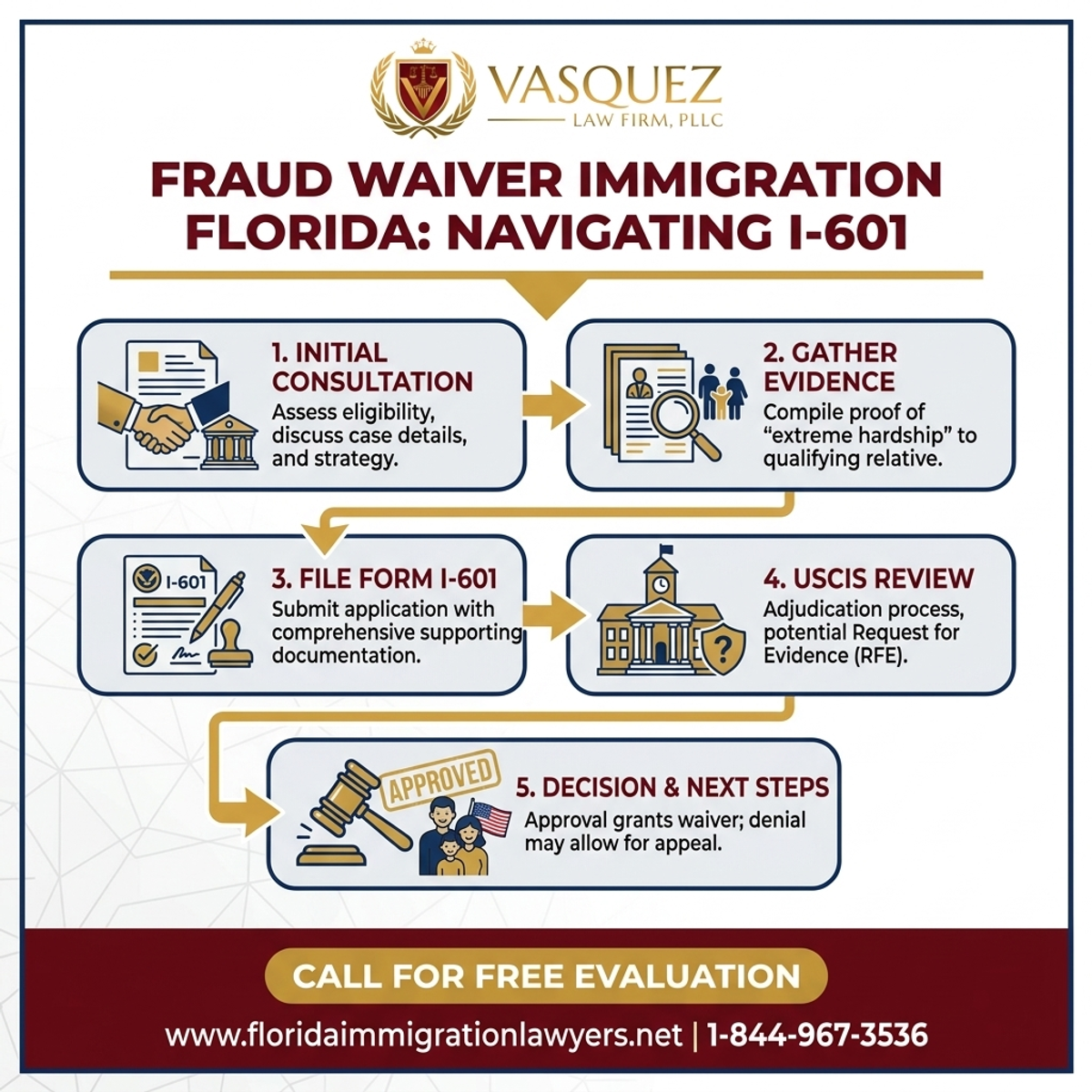
Step-by-Step Process — Fraud Waiver Immigration Florida: Navigating I-601
Each document must be meticulously organized, translated if not in English, and presented clearly. USCIS reviews these packets thoroughly, and any missing information or poorly presented evidence can lead to requests for evidence (RFEs), delays, or even denial. For individuals in Fort Lauderdale, Florida, preparing this extensive documentation can be a daunting task. An immigration attorney will guide you through each step, ensuring that your application is complete, compelling, and compliant with all legal requirements, significantly increasing your chances of a favorable outcome for your fraud waiver.
Do not navigate this process alone. Contact Florida Immigration Lawyers today to ensure your I-601 fraud waiver application is as strong as possible.
Understanding Processing Times, Costs, and Florida Considerations
The processing times for an I-601 fraud waiver can vary significantly based on the USCIS service center or the U.S. Embassy/Consulate handling the case, as well as the complexity of the application itself. Generally, applicants should prepare for a waiting period that can range from several months to over a year. USCIS publishes average processing times on its website, but these are estimates and can change without notice. Factors such as the volume of applications, staffing levels, and whether a Request for Evidence (RFE) is issued can all impact the timeline. Patience and proactive follow-up are essential during this period. For those in Florida, particularly individuals whose cases might be handled by the USCIS National Benefits Center or a consular post abroad, understanding these timelines is crucial for planning your future.
Regarding costs, the I-601 waiver involves a non-refundable filing fee paid directly to USCIS. This fee is subject to change, so applicants should always check the most current fee schedule on the USCIS website before filing. Beyond the government filing fee, applicants should budget for additional expenses. These typically include legal fees for an experienced immigration attorney, which vary based on the complexity of the case and the attorney's expertise. Other potential costs might involve obtaining certified translations of documents, professional evaluations (e.g., psychological assessments), medical examinations, and travel expenses for interviews. While the costs can be substantial, investing in professional legal assistance for a fraud waiver is often invaluable given the high stakes involved.
Florida presents unique considerations for I-601 applicants. As a state with one of the largest immigrant populations, Florida residents often interact with USCIS field offices in Miami, Orlando, and Tampa, or the Executive Office for Immigration Review (EOIR) immigration courts in Miami and Orlando. These offices and courts handle a high volume of cases, which can sometimes influence local processing dynamics. Additionally, the cultural diversity and community support networks within Florida can be crucial in gathering evidence for extreme hardship, such as affidavits from community leaders or specialized healthcare providers. Understanding the local context and having an attorney familiar with Florida-specific procedures and resources can provide a distinct advantage. Our firm has extensive experience representing clients throughout Florida, ensuring that your application is tailored to meet all requirements effectively.
Navigating Complexities: When Misrepresentation is Alleged
The allegation of misrepresentation is a serious matter in immigration law, often leading to a finding of permanent inadmissibility unless a fraud waiver is granted. The complexity arises not only from proving "extreme hardship" but also from the initial determination of whether a misrepresentation actually occurred and if it was "willful" and "material." A misrepresentation is willful if the applicant knew the information was false or misleading and intended to deceive. It is material if it was a fact that would have influenced the decision of the immigration officer. For instance, lying about a prior marriage to obtain a visa or falsely claiming U.S. citizenship is clearly material misrepresentation. However, sometimes an applicant might unknowingly provide incorrect information, or the interpretation of a statement can be ambiguous.
Contesting the allegation of misrepresentation itself can be a critical first step. An experienced immigration attorney can review the facts of your case, the questions asked, and the answers provided to determine if USCIS or a consular officer correctly applied the law in finding you inadmissible. There are instances where an applicant genuinely misunderstood a question, or the information provided, while inaccurate, was not "material" to the immigration benefit sought. In such situations, arguing against the finding of inadmissibility might negate the need for a waiver altogether. This requires a thorough understanding of immigration statutes and case law, as well as the ability to present a strong legal defense.
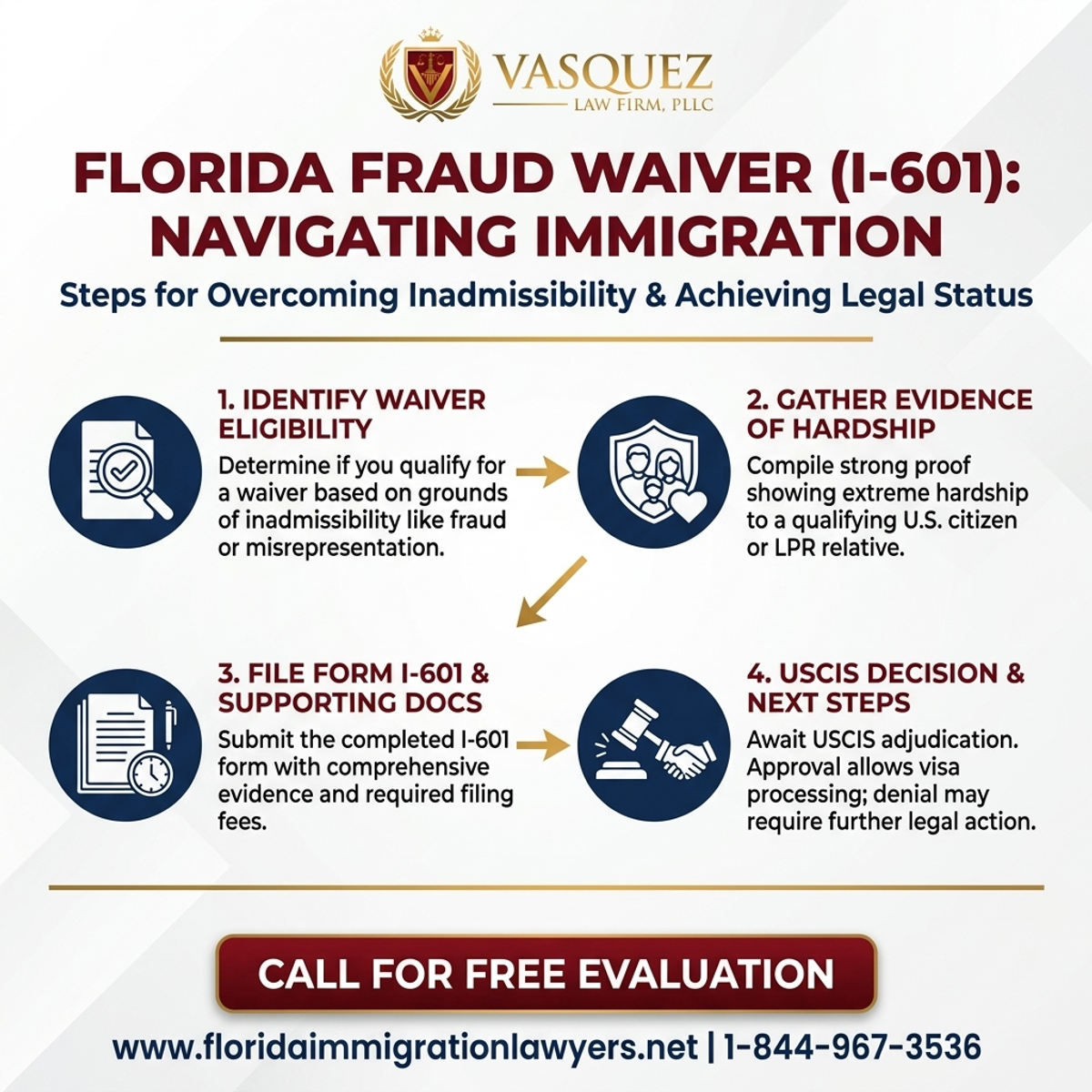
Key Statistics — Fraud Waiver Immigration Florida: Navigating I-601
Even when a misrepresentation is clear, the discretionary nature of the I-601 fraud waiver means that the applicant’s overall equities and positive factors play a significant role. Factors such as a long period of residence in the U.S., strong family ties, community contributions, good moral character, and a demonstrated rehabilitation from past errors can all weigh in favor of a waiver approval. USCIS considers the "totality of the circumstances." This holistic review requires presenting a comprehensive picture of the applicant's life and their contributions, alongside the extreme hardship to their qualifying relative. Successfully navigating these complexities, especially in the context of a prior finding of misrepresentation, underscores the absolute necessity of skilled legal representation. Florida Immigration Lawyers are adept at dissecting these intricate cases and crafting compelling arguments for our clients.
Common Mistakes to Avoid When Applying for a Fraud Waiver
Applying for an I-601 fraud waiver is a high-stakes process where even minor errors can lead to significant delays or outright denial. Avoiding common pitfalls is crucial for a successful outcome. Here are some of the most frequent mistakes applicants make and their potential consequences:
- Failing to Prove "Extreme Hardship" Adequately: Many applicants underestimate the high legal standard for extreme hardship. Simply stating that separation would be difficult is not enough. Without robust, documented evidence of severe medical, financial, or psychological impact on the qualifying U.S. citizen or LPR spouse or parent, the waiver will likely be denied. This often results in prolonged family separation or permanent inadmissibility.
- Incomplete or Inaccurate Forms: Submitting a Form I-601 with missing information, incorrect dates, or typographical errors can lead to immediate rejection or a Request for Evidence (RFE), causing significant delays. An RFE requires further documentation and extends the processing time, adding stress and uncertainty.
- Lack of Supporting Documentation: A waiver application without comprehensive supporting documents, such as medical records, financial statements, and psychological evaluations, is weak. USCIS needs tangible evidence to support every claim made. A lack of evidence often results in denial, forcing applicants to restart the entire process, incurring more fees and time.
- Not Providing Certified Translations: Any document submitted that is not in English must be accompanied by a certified English translation. Failing to do so renders the document unusable and can lead to RFEs or denial, as USCIS cannot evaluate the evidence.
- Misunderstanding the Grounds of Inadmissibility: Applying for an I-601 when the actual ground of inadmissibility is different (e.g., unlawful presence instead of fraud) will lead to denial. It's crucial to correctly identify the specific reason for inadmissibility to apply for the appropriate waiver, or you risk wasting time and money.
- Filing Without Legal Counsel: While technically possible, navigating the complex I-601 process without an experienced immigration attorney dramatically lowers the chances of approval. Attorneys understand legal nuances, evidentiary requirements, and how to present a persuasive case, which laypersons often miss. Denials due to lack of legal expertise are common and costly.
- Submitting Disorganized or Unclear Evidence: USCIS adjudicators review thousands of applications. A disorganized packet that is difficult to navigate can frustrate the officer and make your case harder to understand. This can lead to a less favorable review or a denial, even if the evidence itself is strong.
- Failing to Address All Allegations of Misrepresentation: If there are multiple instances or different aspects of an alleged misrepresentation, each must be thoroughly addressed and supported by evidence. Overlooking even one allegation can leave a critical gap in your waiver request, leading to denial.
- Not Preparing for Interviews: If an interview is required, being unprepared to discuss your application, the hardship, or the circumstances of the misrepresentation can negatively impact your case. Inconsistent statements can raise red flags and lead to a denial.
- Ignoring Deadlines and Follow-Ups: Missing deadlines for RFEs or appeals, or failing to follow up on the case status, can lead to your application being considered abandoned or denied. Staying on top of the process is vital.
When to Call a Florida Immigration Lawyer for Your Fraud Waiver
The I-601 fraud waiver process is one of the most complex and discretionary areas of immigration law. While you might be tempted to handle it yourself, the stakes are incredibly high, often involving the permanent separation of families. There are several critical scenarios where consulting with an experienced Florida immigration lawyer is not just recommended, but absolutely essential. If you have been found inadmissible due to an alleged misrepresentation or fraud, your first call should be to a legal professional. An attorney can review the basis of the inadmissibility finding to ensure it is legally sound and advise if an I-601 is indeed the correct path.
You should also seek legal counsel if you are struggling to gather the extensive documentation required to prove "extreme hardship." An attorney can help identify all potential hardship factors, guide you on collecting compelling evidence, and work with experts for evaluations (e.g., psychological assessments). Furthermore, if your case involves complex legal issues, such as multiple grounds of inadmissibility, prior deportations, or criminal history, a lawyer's expertise is invaluable. They can identify potential conflicts and strategize the best approach. If you receive a Request for Evidence (RFE) or a Notice of Intent to Deny (NOID), immediate legal intervention is crucial to respond effectively and prevent a final denial.
Finally, if you are simply overwhelmed by the sheer volume of paperwork, legal terminology, and the emotional toll of the immigration process, a Florida Immigration Lawyer can provide much-needed support and clarity. We can help you understand your options, meticulously prepare your application, and represent you throughout the process, ensuring your rights are protected. Our firm, Florida Immigration Lawyers, specializes in these intricate cases, including deportation defense and general immigration matters, and we are committed to helping families in Fort Lauderdale and across Florida achieve their immigration goals.
About Florida Immigration Lawyers
Florida Immigration Lawyers is an immigration law firm dedicated to serving individuals and families throughout Florida. With a deep understanding of U.S. immigration law and a compassionate approach, we provide exceptional legal representation for a wide range of immigration matters. Our experienced attorneys focus on complex cases, including family-based immigration, asylum applications, deportation defense, and waivers such as the I-601 fraud waiver. We are committed to protecting our clients' rights and helping them achieve their American dreams.
Our firm prides itself on personalized service, meticulous attention to detail, and a relentless pursuit of favorable outcomes. We understand the challenges and anxieties that come with navigating the immigration system, which is why we offer accessible, responsive, and effective legal solutions. Available 24/7, we provide free consultations to discuss your unique situation and develop a tailored legal strategy. Trust Florida Immigration Lawyers to be your steadfast advocates. Call us today at 1-844-YO-PELEO or visit floridaimmigrationlawyers.net to learn more about how we can assist you.
Sources and References
- U.S. Citizenship and Immigration Services (USCIS)
- Executive Office for Immigration Review (EOIR)
- U.S. Department of State - Bureau of Consular Affairs
- 8 U.S.C. Chapter 12 - Immigration and Nationality Act (INA)
- INA Section 212(a)(6)(C)(i) - Misrepresentation
- INA Section 212(i) - Waivers for Misrepresentation
- 8 CFR Part 212.7 - Waiver of certain grounds of inadmissibility
- USCIS Policy Manual, Volume 9, Part P, Chapter 3 - Waivers of Inadmissibility
Related services: immigration practice areas, family immigration services, citizenship and naturalization, business immigration.
This article provides general legal information and is not intended as legal advice. Every case is unique, and outcomes depend on specific facts and circumstances. Contact an attorney for advice about your particular situation. Immigration laws are subject to frequent changes, and this information may not reflect the most current legal developments.
Do not let past immigration issues define your future. Take the first step towards resolving your inadmissibility by contacting Florida Immigration Lawyers. We offer free, confidential consultations to discuss your fraud waiver case. Call us today at 1-844-YO-PELEO. Se Habla Espanol - Estamos aqui para ayudarle.
Do Not Navigate This Process Alone
Our experienced immigration attorneys are ready to fight for you. Get a free, confidential case review today.
Se Habla Español
Or leave your details and we’ll call you:
Free Evaluation in 24 Hours
Or talk to us right now

AI voice assistant — available 24/7
FreeFrequently Asked Questions

William J. Vásquez
Founding Attorney · Vasquez Law Firm
U.S. Air Force veteran and immigration attorney with years of hands-on U.S. immigration experience. J.D., NCCU School of Law. AILA member. Admitted to the 4th, 5th, and 11th Circuit Courts.
Available 24/7 - Free Evaluations
Reviewed for legal accuracy by William J. Vásquez
Licensed in North Carolina; U.S. immigration is federal practice.
Related Legal Services
Our Florida immigration attorneys can help you with deportation defense, family immigration services and immigration lawyer cost in Florida. Call today at 1-844-YO-PELEO for a free case review.
Related Links
Related Topics
Free Legal Case Review
Discuss your case with our experienced attorneys. We're available 24/7.
Se Habla Español - Estamos aquí para ayudarle.
Related Articles
Immigration Lawyer Orlando Free Consultation in Florida
For individuals and families in Orlando, Florida, navigating the complexities of U.S. immigration law requires expert guidance. An immigration lawyer in Orlando offers crucial support for everything from visa applications and green card processes to naturalization and deportation defense. This comprehensive guide details what a free consultation covers, providing a step-by-step overview of immigration pathways, essential document checklists, and expected timelines in 2026. We also highlight common mistakes to avoid, discuss the critical role of legal counsel in deportation and asylum cases, and explain why choosing a local Orlando immigration attorney is beneficial. Florida Immigration Lawyers is dedicated to serving the diverse community of Orlando with compassionate, effective legal solutions, ensuring you receive personalized advice and robust representation for a successful immigration journey.
EAD Advance Parole Combo Card in Florida 2026
For individuals with a pending Form I-485, Application to Register Permanent Residence or Adjust Status, the EAD Advance Parole Combo Card is an essential document. This single card combines the authorization to work legally in the U.S. (Employment Authorization Document - EAD) with permission to travel internationally and re-enter without abandoning your green card application (Advance Parole). This guide from Florida Immigration Lawyers provides a comprehensive overview for applicants in Florida in 2026, covering eligibility, the step-by-step application process, required documents, expected processing times, and associated costs. We also highlight common mistakes to avoid and when to seek legal counsel to ensure a smooth and successful immigration journey. Understanding this vital card is key to maintaining stability while awaiting your permanent residency approval.
Fiance Visa Lawyer in Florida 2026: Your K-1 Guide
For U.S. citizens in Florida, the K-1 fiance visa is the primary path to bring their foreign partners to the U.S. to marry. This comprehensive guide from Florida Immigration Lawyers details the intricate K-1 process, from initial petition to adjustment of status, for 2026. We cover eligibility, a step-by-step application guide, essential document checklists, typical timelines, and associated costs. Learn about common pitfalls to avoid and crucial scenarios when legal counsel is indispensable. Our firm focuses on family-based immigration, offering guidance to navigate USCIS and Department of State requirements. Ensure a smooth and successful journey to reunite with your loved one in Florida with the help of a dedicated immigration attorney.
I-601 Waiver Lawyer Florida: Your Guide
Facing inadmissibility issues in Florida? Learn how an I-601 waiver can help you overcome these challenges with the guidance of an experienced lawyer. This guide provides a detailed overview of the process, eligibility requirements, and common pitfalls to avoid. Call Florida Immigration Lawyers at 1-844-YO-PELEO for assistance today.