K-3 Visa Timeline in Florida: What to Expect
Learn the K-3 visa timeline process in Florida, including steps, costs, and documentation. Understand your options in 2026 with guidance from Florida Immigration Lawyers.

- Eligibility requires a pending I-130 petition.
- Processing times vary, typically 6-12 months.
- Consult an immigration attorney for guidance.
Introduction
Navigating the immigration process can be challenging, especially when trying to reunite with family. The K-3 spouse visa allows nonimmigrant spouses of U.S. citizens to enter the U.S. while awaiting green card approval. This article will guide you through the K-3 visa timeline in Florida, including steps, requirements, and common pitfalls to avoid. Call Florida Immigration Lawyers at 1-844-967-3536 for a free consultation.
The K-3 visa serves as a crucial bridge for families, offering a pathway for international spouses to join their U.S. citizen partners much sooner than if they were to wait for the entire I-130 petition and subsequent consular processing to be completed from abroad. This can significantly reduce the emotional and financial strain of long-term separation, allowing couples to begin their life together in the United States while the permanent residency application progresses.
Understanding the intricacies of the K-3 visa process, especially within Florida's specific context and as of 2026, is vital for a smooth application. From gathering the correct documentation to preparing for consular interviews, each stage demands careful attention to detail. This guide aims to demystify the process, providing clear, actionable insights to help you and your spouse navigate this journey successfully, potentially with the expert assistance of Florida Immigration Lawyers.
What is a K-3 Visa and How Does It Work?
A K-3 visa is a nonimmigrant visa for spouses of U.S. citizens who are waiting for their I-130 petition to be processed. It allows the spouse to enter the U.S. and remain with their partner while the immigration application is completed.
To be eligible, you must have a valid marriage to a U.S. citizen and a pending I-130 petition. The K-3 visa is initiated by filing Form I-129F. It's important to note that the K-3 visa process is only applicable if the I-130 petition is pending.
The K-3 visa was specifically created by the Legal Immigration Family Equity (LIFE) Act to address long processing delays for spousal immigrant visas. While the I-130 petition establishes the familial relationship, the K-3 allows the foreign spouse to enter the U.S. as a nonimmigrant. Once in the U.S., the K-3 visa holder can apply for work authorization and then adjust their status to a lawful permanent resident (green card holder) once the I-130 petition is approved.
This dual-application approach means you're essentially pursuing two paths simultaneously: the immigrant visa (green card) through the I-130, and the nonimmigrant visa (K-3) to facilitate earlier entry. It's a strategic option for many couples, particularly when I-130 processing times are lengthy. For instance, if a U.S. citizen in Miami marries a foreign national, filing both I-130 and I-129F concurrently can prevent prolonged separation, allowing the spouse to live and work in Florida much sooner.
It's crucial to understand that while the K-3 visa allows entry, it does not automatically grant permanent residency. It's a stepping stone. Upon arrival, the K-3 visa holder must file Form I-485, Application to Adjust Status, to complete the green card process. This subsequent application, along with an interview, will finalize their journey to becoming a lawful permanent resident in the U.S.
Step-by-Step Guide to Obtaining a K-3 Visa
- File Form I-130 with USCIS on behalf of your spouse.
- Submit Form I-129F for the K-3 visa application.
- After approval, attend the interview at a U.S. consulate.
- Upon visa approval, travel to the U.S. to reunite with your spouse.
How Long Does the K-3 Visa Process Take in 2026?
As of 2026, the K-3 visa process in Florida typically takes 6-12 months, depending on the case specifics and USCIS workload.
The timeline can be influenced by several factors, including the completeness of the application and the current processing times at the USCIS Miami office. It's advisable to check the latest processing times on the USCIS website.
Factors such as the specific service center handling your I-130 petition, the volume of applications USCIS is receiving, and any requests for additional evidence (RFEs) can significantly impact your timeline. For example, a meticulously prepared application submitted by Florida Immigration Lawyers is less likely to encounter delays due to missing information compared to one filed without professional guidance. Staying updated on USCIS processing timeframes is essential, as they can fluctuate based on policy changes and operational efficiencies.
It's also important to consider the consular processing stage, which occurs after USCIS approves the I-129F. The U.S. consulate or embassy in your spouse's home country will have its own schedule for interviews and visa issuance. Some consulates are busier than others, potentially adding a few weeks or months to the overall process. Proactive preparation for the interview, including gathering all necessary civil documents and financial evidence, can help prevent further delays at this critical stage.
While the K-3 visa was designed to be faster than direct I-130 consular processing, its relevance has shifted over time due to fluctuating I-130 processing speeds. In some instances, I-130 processing has become efficient enough that the K-3 offers less of a time advantage. However, it still provides a valuable option for many, especially when facing unpredictable delays. Consulting with Florida Immigration Lawyers can help determine if the K-3 visa remains the most strategic path for your specific situation in 2026.
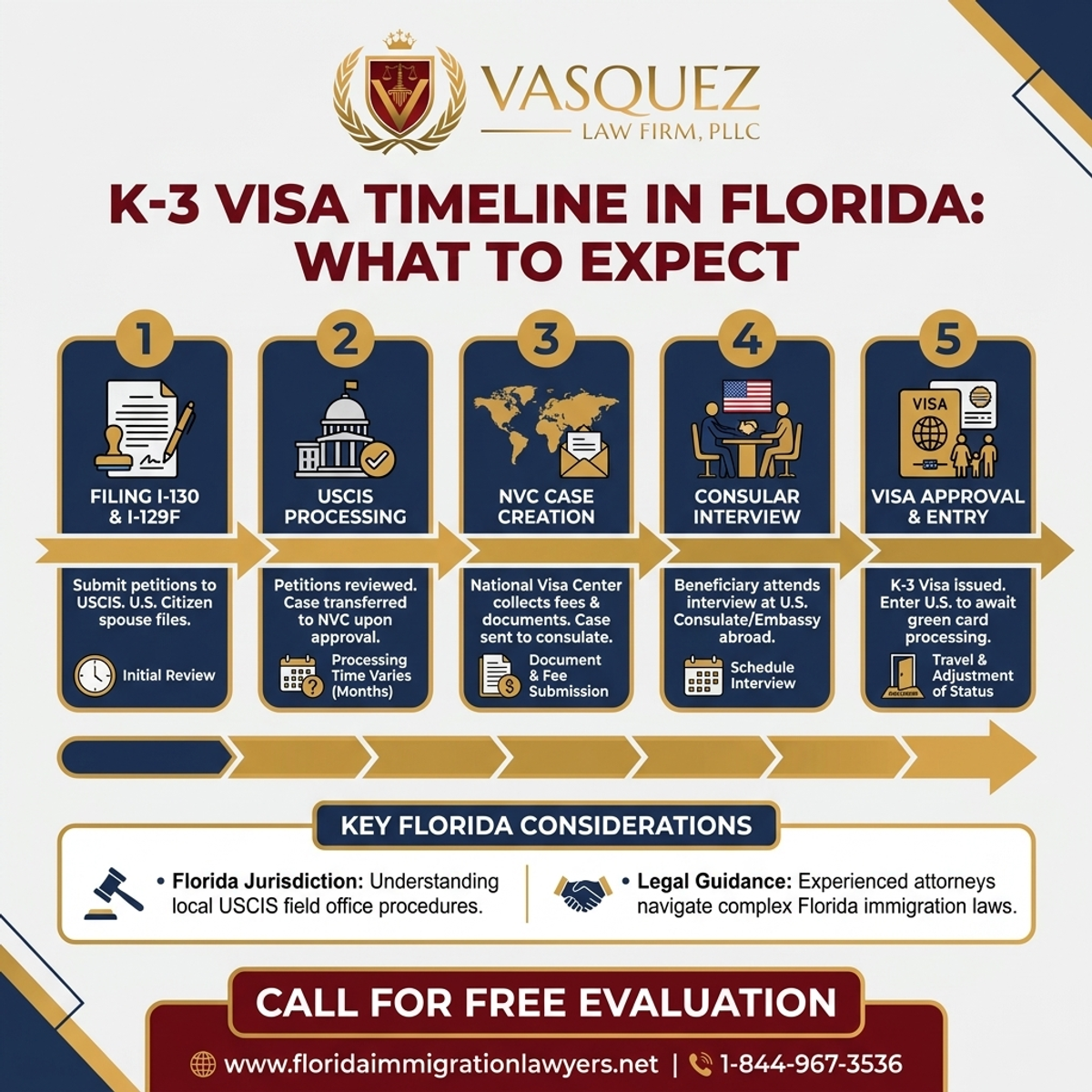
Step-by-Step Process — K-3 Visa Timeline in Florida: What to Expect
Timeline and Processing Expectations
| Stage | Typical Timeframe | Notes |
|---|---|---|
| I-130 Petition | 6-9 months | Initial petition filed by U.S. spouse |
| I-129F Filing | 4-6 months | For K-3 visa processing |
| Consular Processing | 1-3 months | Interview and visa issuance |
Document Checklist for K-3 Visa Application
- Completed Form I-130
- Completed Form I-129F
- Marriage certificate
- Proof of U.S. citizenship of the petitioner
- Recent photographs of the applicant and petitioner
- Any required fees
Ensure that all documents are up-to-date and submitted as per the USCIS guidelines. Missing documents can lead to delays.
Beyond the basic list, it's crucial to understand the specifics. For instance, the marriage certificate must be an official, certified copy, not just a photocopy. If it's not in English, it must be accompanied by a certified translation. Proof of U.S. citizenship can include a copy of the petitioner's U.S. passport, birth certificate, or naturalization certificate. Photographs must meet strict USCIS specifications regarding size, background, and facial expression, so it's often best to use a professional passport photo service.
You will also need to provide evidence of a bona fide marriage, which can include joint bank accounts, property deeds, shared utility bills, photographs together, affidavits from friends and family, and correspondence. While the K-3 is a nonimmigrant visa, the underlying I-130 requires this proof, and it will be reviewed during the consular interview. Having robust evidence of your genuine relationship from the outset can significantly strengthen your application and prevent RFEs or denials.
Additionally, while not strictly for the K-3 *application* itself, be prepared for the Affidavit of Support (Form I-864) and supporting financial documents that will be required later for the adjustment of status or immigrant visa process. This demonstrates the U.S. citizen spouse's ability to financially support the incoming spouse. Gathering these financial documents early, such as tax returns, W-2s, and employment verification letters, can streamline the subsequent stages of the immigration process.
Cost Factors and Fee Breakdown
| Item | Typical Fee | Notes |
|---|---|---|
| Form I-130 Filing | Varies | Check USCIS for current fees |
| Form I-129F Filing | Varies | Filing fee for the K-3 visa application |
| Consular Processing | Varies | Fees for the visa interview |
Fees are subject to change, so it is important to verify the current amounts with USCIS or a qualified immigration attorney.
Beyond the primary filing fees for Forms I-130 and I-129F, applicants should budget for several other potential expenses. These can include medical examination fees, which are mandatory for all immigrant visa applicants and must be performed by a USCIS-approved physician. Translation costs for any documents not in English, travel expenses for the consular interview, and postage for submitting applications are also common additional expenditures.
Furthermore, many applicants choose to invest in legal assistance, recognizing the complexity of the immigration process. While attorney fees are an additional cost, the expertise provided by Florida Immigration Lawyers can save applicants from costly mistakes, delays, or even denials, ultimately proving to be a wise investment. It's advisable to create a comprehensive budget that accounts for all these potential costs to avoid financial surprises during the K-3 visa journey.
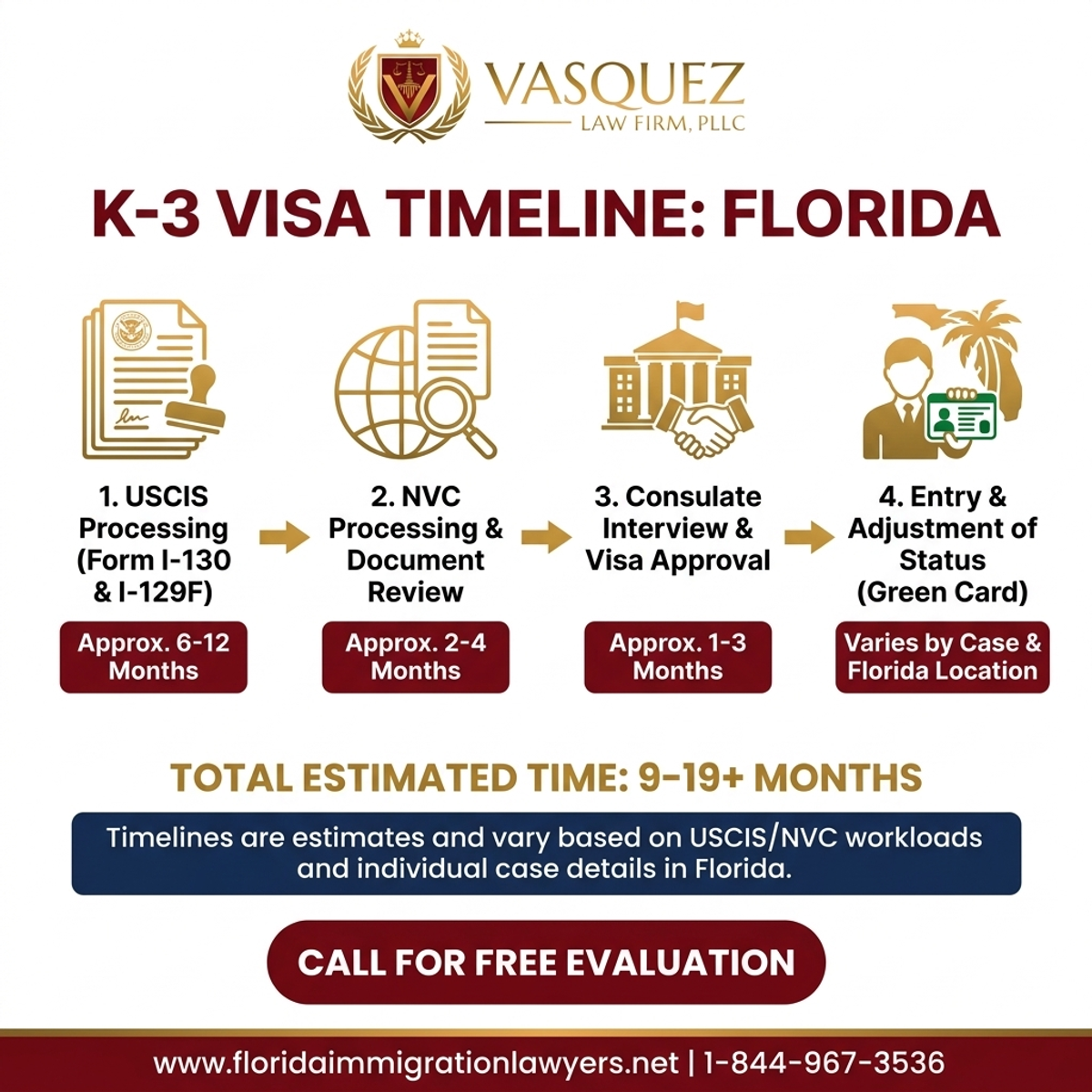
Key Statistics — K-3 Visa Timeline in Florida: What to Expect
Common Mistakes to Avoid
- Filing the wrong form: Ensure you submit both I-130 and I-129F forms.
- Incomplete documentation: Missing documents can cause delays.
- Incorrect fee payment: Always check the latest fees on the USCIS website.
- Not preparing for the interview: Failing to prepare can lead to visa denial.
- Misunderstanding eligibility: The K-3 is only for nonimmigrant spouses with pending I-130.
- Ignoring updates: USCIS processing times and requirements can change.
- Not consulting an attorney: Professional guidance can prevent costly errors.
Each of these mistakes can have significant repercussions, ranging from lengthy delays and requests for evidence (RFEs) to outright denial of your visa petition. For example, submitting an incomplete Form I-129F could add months to your processing time while USCIS sends an RFE, or even reject the application, forcing you to refile and pay fees again. Similarly, not preparing for the consular interview by failing to gather sufficient proof of a bona fide marriage can lead to suspicion and a visa denial.
To mitigate these risks, always double-check all forms for accuracy and completeness, cross-reference required documents with official USCIS checklists, and verify current fees directly on the USCIS website. A proactive approach, including diligent preparation for the interview with all supporting evidence, can significantly increase your chances of a successful outcome. When in doubt, seeking clarification from Florida Immigration Lawyers at 1-844-967-3536 can provide invaluable peace of mind and prevent these common, yet avoidable, errors.
When to Call a Lawyer
Complex immigration processes often require professional assistance. If you're unsure about any part of the K-3 visa process, facing delays, or have received a notice of denial, it's time to consult an immigration attorney. Florida Immigration Lawyers can provide guidance and representation to navigate these challenges effectively.
There are several specific scenarios where legal counsel becomes particularly critical. If either spouse has a history of immigration violations, criminal convictions, or previous denials for other visa applications, navigating the K-3 process without an attorney can be extremely risky. Additionally, if you have a complex marital history, issues proving the legitimacy of your marriage, or difficulty gathering required documentation from abroad, an experienced attorney can offer strategic advice and help compile a strong case.
Furthermore, if you receive a Request for Evidence (RFE) from USCIS or a Notice of Intent to Deny (NOID), an attorney can help you understand the specific issues and formulate a comprehensive and timely response. Attempting to address these complex legal notices without expertise can jeopardize your application. Florida Immigration Lawyers are adept at handling such challenges, offering personalized guidance and representation to ensure your K-3 visa application has the best possible chance of success.
About Florida Immigration Lawyers
Florida Immigration Lawyers is a dedicated firm providing comprehensive immigration services across Florida. With a focus on personalized service, we assist with visas, deportation defense, citizenship, and more. Contact us at 1-844-967-3536 or visit our website for a free consultation. We are available 24/7 and offer bilingual services.
Sources and References
- U.S. Citizenship and Immigration Services (USCIS)
- Executive Office for Immigration Review (EOIR)
- 8 U.S.C. Chapter 12 - Immigration and Nationality Act
Related services: family petition process, family-based green cards, fiancé visa (K-1).
This article provides general legal information and is not intended as legal advice. Every case is unique, and outcomes depend on specific facts and circumstances. Contact an attorney for advice about your particular situation.
Final CTA
For expert assistance with your immigration process, contact Florida Immigration Lawyers at 1-844-967-3536 for a free consultation. Se Habla Español - Estamos aquí para ayudarle.
If you need legal assistance, learn more about how our family immigration attorneys can help, or call us at 1-844-967-3536 for a free consultation.
Do Not Navigate This Process Alone
Our experienced immigration attorneys are ready to fight for you. Get a free, confidential consultation today.
Se Habla Español
Or leave your details and we’ll call you:
Free Evaluation in 24 Hours
Or talk to us right now
AI voice assistant — available 24/7
FreeFrequently Asked Questions

William J. Vásquez
Founding Attorney · Vasquez Law Firm
U.S. Air Force veteran and immigration attorney with years of hands-on U.S. immigration experience. J.D., NCCU School of Law. AILA member. Admitted to the 4th, 5th, and 11th Circuit Courts.
Available 24/7 - Free Evaluations
Reviewed for legal accuracy by William J. Vásquez
Licensed in North Carolina; U.S. immigration is federal practice.
Related Legal Services
Our Florida immigration attorneys can help you with business immigration, asylum protection and deportation defense. Call today at 1-844-967-3536 for a free consultation.
Related Links
Related Topics
Free Legal Consultation
Discuss your case with our experienced attorneys. We're available 24/7.
Se Habla Español - Estamos aquí para ayudarle.
Related Articles
Immigration Lawyer Orlando Free Consultation 2026
Discover how to find an immigration lawyer in Orlando offering a free consultation. Understand the services available and why choosing Florida Immigration Lawyers can make a difference in your case.
Military Naturalization Expedited in Florida Bases
Explore military naturalization options for families at Florida bases, including parole in place benefits in Miami. Learn how to expedite your application with expert guidance from Florida Immigration Lawyers.
Orlando Immigration Lawyer: Free Consultation 2026
Navigating immigration law in Orlando requires expert guidance. This comprehensive guide provides essential information on visa applications, Green Card processes, naturalization, and deportation defense in Florida for 2026. Discover common mistakes to avoid, when to seek legal counsel, and how a free consultation with an Orlando immigration lawyer can clarify your path. Florida Immigration Lawyers offers compassionate and effective legal support for all your immigration needs, serving Orlando, Kissimmee, and the entire state.
Immigration Lawyer Orlando Free Consultation & BIA Appeals
Explore the process of filing an immigration appeal with the BIA in Florida. Learn about the Board of Immigration Appeals, common mistakes to avoid, and when to seek legal assistance. Contact Florida Immigration Lawyers for a free consultation.