BIA Appeals: The 30-Day Deadline You Cannot Miss
Explore the process of filing an immigration appeal with the BIA in Florida. Learn about the Board of Immigration Appeals, common mistakes to avoid, and when to seek legal assistance. Contact Florida Immigration Lawyers for a free consultation.
- The Board of Immigration Appeals (BIA) handles appeals from immigration court decisions.
- Appeals must be filed within 30 days of the decision.
- Having experienced legal representation can significantly affect the outcome.
Introduction
Facing an immigration appeal can be daunting, especially if your case is before the Board of Immigration Appeals (BIA). Many individuals in Tallahassee and throughout Florida find themselves in this situation, seeking clarity and assistance. This article will guide you through the BIA appeal process, provide insight into common mistakes, and explain when it's crucial to contact a lawyer. For personalized advice, call Florida Immigration Lawyers at 1-844-YO-PELEO for a free consultation.
The stakes in a BIA appeal are incredibly high, often determining an individual's future in the United States. Whether it's a decision impacting your ability to remain with family, pursue educational opportunities, or avoid deportation, the emotional and practical implications are profound. Understanding the intricate legal framework and procedural requirements is paramount, yet incredibly challenging without specialized legal knowledge.
This comprehensive guide aims to demystify the BIA appeal process, offering practical steps and crucial insights to help you navigate this complex journey. From the initial filing to understanding the BIA's decision, we'll cover essential aspects that can empower you to make informed decisions. Remember, timely and accurate action is critical, and the support of experienced legal counsel, like Florida Immigration Lawyers, can make a significant difference in advocating for your rights and achieving a favorable outcome.
What is the Board of Immigration Appeals?
The Board of Immigration Appeals (BIA) is the highest administrative body for interpreting and applying immigration laws. It reviews decisions made by immigration judges and some Department of Homeland Security (DHS) rulings.
As of 2026, the BIA reviews cases involving deportation orders, visa denials, and motions to reopen or reconsider cases. Understanding the BIA's role can help you determine how it might impact your case.
Comprised of 23 Board Members, the BIA operates under the Executive Office for Immigration Review (EOIR) within the Department of Justice. Unlike immigration judges who hear cases directly, the BIA primarily reviews the record of proceedings from the immigration court below. This means their decisions are based on the evidence presented to the immigration judge, the judge's findings, and the legal arguments submitted by both parties. Their rulings are binding on all DHS officers and immigration judges unless modified or overturned by the Attorney General or a federal court.
The BIA's jurisdiction extends to a wide array of immigration matters. This includes appeals from orders of removal (deportation), decisions on applications for asylum, adjustments of status, waivers of inadmissibility, and bond determinations. They also handle appeals from certain DHS decisions, such as those denying petitions for alien relatives. Given the breadth of cases they oversee, the BIA plays a pivotal role in shaping immigration policy and ensuring consistent application of the law across the nation. Engaging with such a powerful body requires a deep understanding of precedent and procedure, which is precisely where the expertise of Florida Immigration Lawyers becomes invaluable.
How to File an Immigration Appeal with the BIA?
To file an appeal with the BIA, you must submit a Notice of Appeal to the BIA within 30 days of the immigration judge's decision. This is a strict deadline, and missing it can result in losing your right to appeal.
- Complete Form EOIR-26, Notice of Appeal from a Decision of an Immigration Judge.
- Pay the required filing fee or request a fee waiver.
- Submit supporting documents and legal arguments.
It's crucial to ensure all paperwork is accurate and submitted on time to avoid delays or dismissals.
The 30-day deadline is calculated from the date the immigration judge rendered their oral decision or, if a written decision was issued, from the date of the mailing of the written decision. This timeframe is not subject to extensions, highlighting the urgent need for prompt action. Even a single day late can lead to the dismissal of your appeal, making it imperative to seek immediate legal counsel from professionals like Florida Immigration Lawyers if you receive an unfavorable decision.
When completing Form EOIR-26, it's not enough to simply check boxes. You must clearly articulate the specific reasons for your appeal, identifying the precise errors of law or fact made by the immigration judge. Vague or generalized statements are often insufficient and can weaken your case significantly. This form serves as your initial argument, setting the stage for the detailed legal brief that will follow.
The filing fee, while varying, can be a barrier for some. However, the BIA offers fee waivers for individuals who can demonstrate an inability to pay. This typically involves submitting Form EOIR-22, Motion to Waive Filing Fee, along with supporting financial documentation. Successfully obtaining a fee waiver requires careful preparation, ensuring all criteria are met. Whether paying the fee or requesting a waiver, this step must be completed concurrently with the Notice of Appeal.
Following the initial filing, you will typically be given a deadline to submit a comprehensive written brief outlining your legal arguments and referencing the record of proceedings. This brief is your primary opportunity to persuade the BIA. It should meticulously analyze the immigration judge's decision, cite relevant statutes, regulations, and case law, and explain why the decision should be reversed or remanded. This is where the strategic thinking and legal research skills of an experienced immigration attorney are indispensable. They can craft compelling arguments that address the nuances of your case and maximize your chances of success.
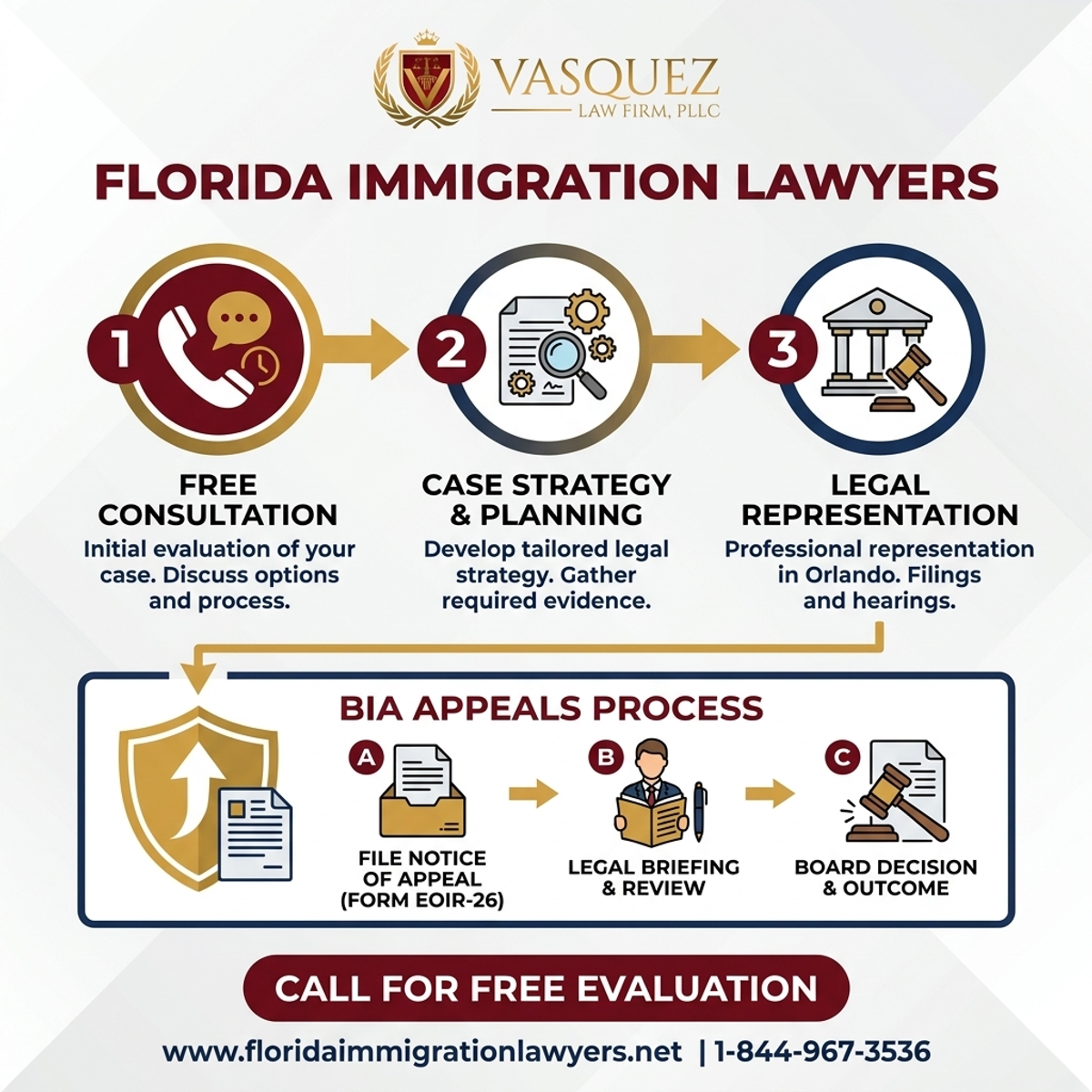
Step-by-Step Process — Immigration Lawyer Orlando Free Consultation & BIA Appeals
Document Checklist for BIA Appeals
To ensure a comprehensive and timely appeal, meticulous attention to detail is paramount. Missing even a single required document can lead to delays, requests for further information, or even the dismissal of your appeal.
- Completed Form EOIR-26: This is the foundational document for your appeal. Ensure all sections are filled out accurately, especially the grounds for appeal, clearly stating why you believe the immigration judge's decision was incorrect.
- Copy of the immigration judge's decision: Include both the oral decision transcript (if available) and any written decision. This allows the BIA to quickly reference the exact ruling you are appealing.
- Proof of payment or fee waiver request: Attach the receipt for your filing fee or a fully completed Form EOIR-22 with supporting financial documents. Without this, your appeal may not be processed.
- Supporting legal documents and evidence: While new evidence is generally not accepted at the BIA level, ensure all evidence presented to the immigration judge that supports your case is properly referenced and, if necessary, included in an appendix to your brief. This could include affidavits, expert testimonies, country condition reports, or personal documents.
- Written arguments outlining your case: This is your legal brief, a critical component where you present a detailed analysis of the errors made by the immigration judge, citing relevant statutes, regulations, and case precedents. Florida Immigration Lawyers excel at crafting persuasive and well-researched briefs.
- Certificate of Service: A document confirming that you have properly served a copy of your appeal and all accompanying documents to the opposing party (usually DHS counsel). This is a procedural requirement that ensures fairness.
- Proof of Mailing: While not always explicitly required by the BIA, retaining proof of mailing (e.g., certified mail receipt) can be crucial in demonstrating timely submission, especially if there's a dispute over the filing date.
Ensuring every item on this checklist is not only present but also correctly completed and organized is a hallmark of a strong appeal. An immigration lawyer from Florida Immigration Lawyers can meticulously review your documentation to prevent any procedural missteps.
Typical Timeline for BIA Appeals
Understanding the typical timeline for BIA appeals can help manage expectations, though it's important to remember that individual case complexities and BIA backlogs can significantly influence these estimates.
| Stage | Typical Timeframe | Notes |
|---|---|---|
| File Notice of Appeal | Within 30 days | Strict deadline, no extensions. |
| BIA Review | 6-18 months | Varies based on case complexity. |
| Decision Issued | Varies | Further appeal to federal court if necessary. |
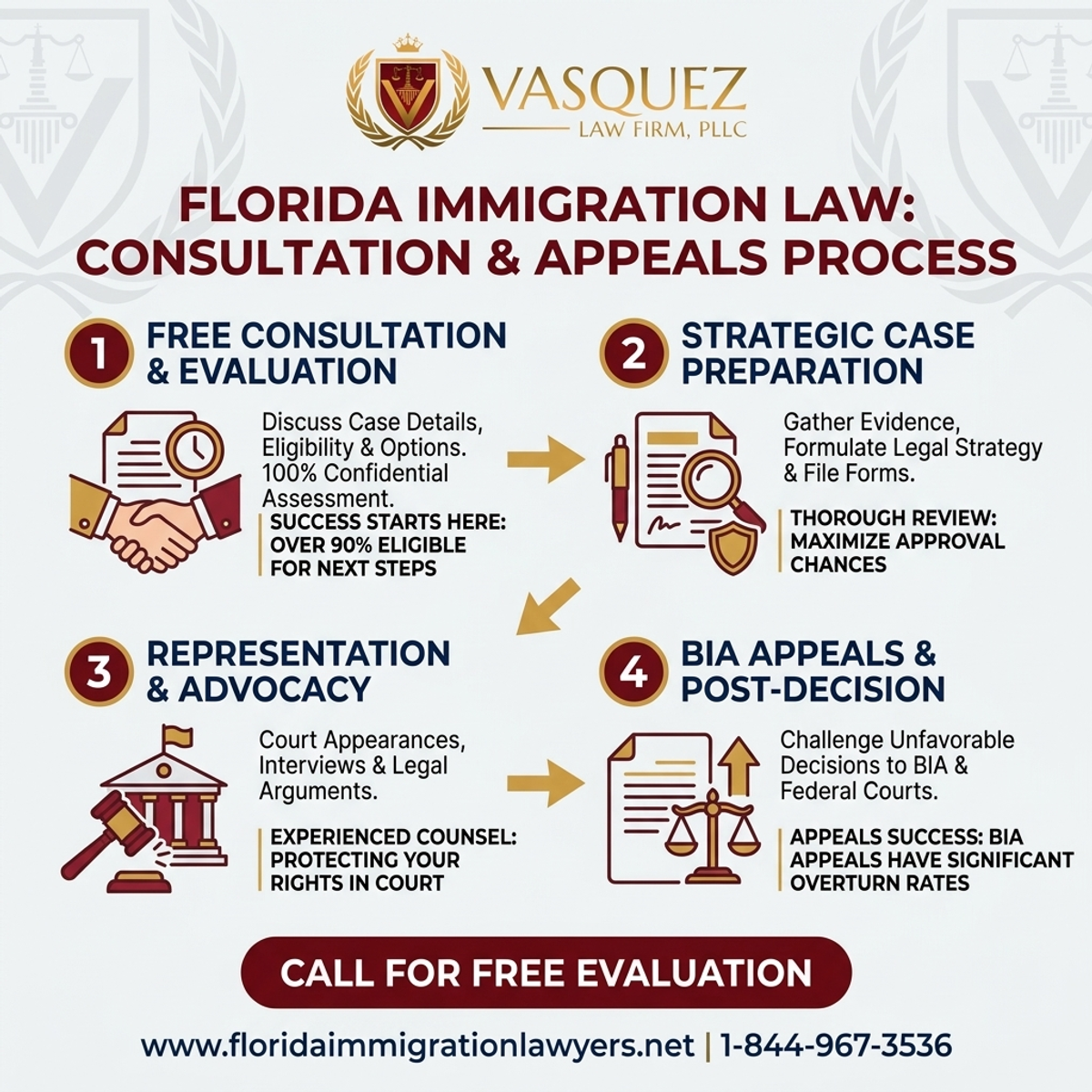
Key Statistics — Immigration Lawyer Orlando Free Consultation & BIA Appeals
The initial step, filing the Notice of Appeal within 30 days, is the most critical and unforgiving deadline. As mentioned, failure to meet this can result in an automatic dismissal. It is during this crucial period that many individuals benefit most from immediate consultation with Florida Immigration Lawyers to ensure proper and timely submission.
Once the Notice of Appeal is filed, the BIA will establish a briefing schedule. Both you (or your attorney) and the Department of Homeland Security (DHS) will have the opportunity to submit written briefs. The BIA review period, typically spanning 6-18 months, involves a thorough examination of the entire record of proceedings from the immigration court, including transcripts, exhibits, and the immigration judge's decision. While oral arguments are rare, the BIA may request them in exceptionally complex or novel cases. Factors influencing the review duration include the volume of cases before the BIA, the complexity of the legal issues involved, and whether the BIA decides to remand the case back to the immigration judge for further proceedings.
Upon completion of its review, the BIA will issue a written decision. This decision could affirm the immigration judge's ruling, reverse it, or remand the case back to the immigration judge for additional hearings or consideration. If the BIA affirms the immigration judge's decision, and the outcome is still unfavorable, you may have the option to appeal to a federal circuit court of appeals, adding another layer of complexity and time to the process. Each stage requires precise legal strategy and adherence to strict deadlines, making professional legal guidance indispensable.
Cost Factors and Fee Breakdown
Navigating a BIA appeal involves various costs, both administrative and legal. Transparency about these factors is important for proper financial planning.
| Item | Typical Fee | Notes |
|---|---|---|
| Filing Fee | Varies | Fee waivers available for those who qualify. |
| Legal Representation | Varies | Depends on attorney and case complexity. |
Do not navigate this process alone. Contact Florida Immigration Lawyers today.
The BIA filing fee, while subject to change, is a mandatory administrative cost. For individuals facing financial hardship, the option to request a fee waiver is a vital safety net. To qualify, you typically need to demonstrate that your income is below a certain poverty threshold or that you receive means-tested public benefits. Providing thorough documentation to support your fee waiver request is crucial to avoid delays or rejection.
Legal representation is often the most significant cost factor, but it represents an investment in your future. Attorney fees can vary widely based on several elements: the complexity of your case (e.g., whether it involves novel legal issues, extensive evidentiary review, or multiple legal arguments), the experience and reputation of the attorney, and the amount of time anticipated for brief writing, research, and communication. Some attorneys may offer flat fees for BIA appeals, while others may charge hourly.
While the financial aspect is a serious consideration, the potential consequences of handling a BIA appeal without expert legal guidance can far outweigh the cost of an attorney. An experienced immigration lawyer can identify crucial legal arguments, prepare a compelling brief, and ensure all procedural requirements are met, significantly increasing your chances of success. Florida Immigration Lawyers understands these concerns and offers free consultations to discuss your case and potential fee structures, providing clarity and peace of mind.
Common Mistakes to Avoid in BIA Appeals
The BIA appeal process is fraught with potential pitfalls, and even minor errors can have severe consequences, including dismissal of your appeal. Being aware of these common mistakes is the first step toward avoiding them.
- 1. Missing the 30-day filing deadline: This is perhaps the most critical error. The deadline is strictly enforced, and late filings almost invariably result in automatic dismissal, effectively ending your right to appeal. There are very limited exceptions, such as motions to reopen based on changed circumstances, which are incredibly difficult to win.
- 2. Incomplete documentation: Failing to submit all required forms, supporting evidence, or fee payments/waiver requests can lead to your appeal being rejected or significantly delayed. The BIA requires a complete record to make a decision.
- 3. Not providing sufficient legal argumentation: A successful appeal hinges on demonstrating specific errors of law or fact made by the immigration judge. Simply disagreeing with the decision is not enough; you must present well-reasoned legal arguments supported by statutes, regulations, and case law.
- 4. Ignoring previous decisions' impact: Failing to address the immigration judge's specific findings or previous BIA/federal court precedents relevant to your case can weaken your arguments and suggest a lack of understanding of the legal landscape.
- 5. Lack of evidence: While new evidence is generally not permitted at the BIA level, appeals rely heavily on the evidence presented to the immigration judge. If that evidence was insufficient, the BIA may not have grounds to reverse the decision. It's crucial that the record below was robust.
- 6. Poorly organized submissions: A disorganized appeal brief or supporting documents can make it difficult for the BIA to understand your arguments, potentially leading to a less favorable review. Clarity and professionalism are key.
- 7. Not consulting an attorney: Attempting to navigate the complex BIA appeal process without legal representation significantly increases your risk of making critical errors. Immigration law is highly specialized, and an experienced attorney can identify nuances and craft effective strategies.
- 8. Failing to preserve issues for appeal: Many BIA appeals are lost because the legal arguments were not properly raised or preserved during the proceedings before the immigration judge. The BIA generally will not consider issues that were not initially presented to the immigration judge.
- 9. Introducing new evidence without proper procedure: The BIA's role is to review the record created by the immigration judge. Submitting new evidence directly to the BIA is rarely allowed unless it meets very specific, stringent criteria (e.g., evidence that was unavailable and could not have been discovered previously).
- 10. Misunderstanding the standard of review: The BIA reviews questions of law de novo (from scratch) but reviews findings of fact under a "clearly erroneous" standard. Misapplying these standards in your arguments can undermine your entire appeal.
Avoiding these common mistakes requires a thorough understanding of immigration law and appellate procedure. This is precisely why engaging with a knowledgeable legal team, such as Florida Immigration Lawyers, is not just beneficial but often essential for a successful BIA appeal.
When to Call a Lawyer for a BIA Appeal
Consider contacting a lawyer if you're unsure about the appeal process, facing complex legal issues, or require assistance gathering evidence. Florida Immigration Lawyers can provide the guidance needed to navigate these challenges effectively.
The decision to appeal an unfavorable immigration judge's ruling is significant, and the stakes are often life-altering. While it might seem tempting to try and manage the process yourself to save costs, the complexity of immigration law and the strict procedural requirements of the BIA make legal representation almost indispensable. You should immediately call Florida Immigration Lawyers at 1-844-YO-PELEO for a free consultation if:
- You've received an unfavorable decision: The 30-day deadline starts ticking immediately. A lawyer can help you quickly assess the grounds for appeal and prepare the necessary documents.
- Your case involves complex legal issues: This includes nuanced interpretations of statutes, constitutional questions, or situations where there are conflicting legal precedents. An experienced attorney can identify the strongest legal arguments.
- You need help identifying and preserving evidence: While new evidence is generally not allowed at the BIA, a lawyer can ensure that all relevant evidence from the immigration court record is properly presented and referenced in your appeal brief.
- There are language barriers or communication challenges: An attorney can act as your advocate, ensuring your arguments are clearly articulated and understood by the BIA.
- You are facing deportation or removal: These cases carry the most severe consequences, and a skilled lawyer can be your best defense against removal from the U.S.
- You believe the immigration judge made errors of law or fact: Pinpointing these errors and constructing a compelling argument requires legal expertise.
Engaging with Florida Immigration Lawyers provides you with an experienced team dedicated to protecting your rights and advocating on your behalf. Our attorneys are adept at dissecting complex immigration decisions, identifying appealable errors, and crafting persuasive legal briefs. Don't leave your future to chance; a free consultation can illuminate your options and provide a clear path forward.
About Florida Immigration Lawyers
Florida Immigration Lawyers is a dedicated team of immigration attorneys serving all of Florida. We offer comprehensive services in immigration appeals, deportation defense, and more. Call us at 1-844-YO-PELEO or visit our website for a free consultation. Available 24/7, we are here to help.
Our firm is built on a foundation of deep legal expertise, unwavering client advocacy, and a profound understanding of the challenges individuals and families face within the U.S. immigration system. We pride ourselves on offering personalized, compassionate, and effective legal solutions tailored to the unique circumstances of each client. From our offices, we serve clients not just in Orlando, but across the entire state of Florida, ensuring that expert legal help is always within reach.
Specializing in the intricate landscape of immigration appeals, our attorneys possess a proven track record of meticulously preparing and presenting cases before the Board of Immigration Appeals. We understand that a BIA appeal is often a last resort, and we approach each case with the gravity and dedication it deserves. Beyond appeals, our comprehensive practice areas include deportation defense, asylum and refugee protection, family-based immigration, and various visa applications, providing a holistic approach to your immigration needs. Our commitment extends to offering accessible support, which is why we provide free consultations and are available 24/7, ready to assist you in English or Spanish. Your future in the U.S. is our priority.
Frequently Asked Questions About BIA Appeals
Q: Can I appeal if I missed the 30-day deadline?
A: Generally, no. The 30-day deadline to file a Notice of Appeal is strictly enforced, and missing it usually results in an automatic dismissal of your appeal rights. However, in very limited circumstances, you might be able to file a motion to reopen or reconsider your case, but these motions have their own strict deadlines and high evidentiary burdens. Consulting with Florida Immigration Lawyers immediately after a decision is crucial to explore any potential, albeit narrow, avenues for relief.
Q: What happens after the BIA makes a decision?
A: The BIA can affirm, reverse, or remand the immigration judge's decision. If affirmed, the original decision stands. If reversed, the BIA issues a new decision in your favor. If remanded, the case is sent back to the immigration judge for further proceedings consistent with the BIA's instructions. If the BIA's decision is still unfavorable, you may have the option to appeal to a U.S. Circuit Court of Appeals, a federal court that reviews BIA decisions.
Sources and References
- U.S. Citizenship and Immigration Services (USCIS)
- Executive Office for Immigration Review (EOIR)
- U.S. Department of State - Bureau of Consular Affairs
- Immigration and Nationality Act (INA), 8 U.S.C. Chapter 12
Do Not Navigate This Process Alone
Our experienced immigration attorneys are ready to fight for you. Get a free, confidential case review today.
Se Habla Español
Or leave your details and we’ll call you:
Free Evaluation in 24 Hours
Or talk to us right now

AI voice assistant — available 24/7
FreeFrequently Asked Questions

William J. Vásquez
Founding Attorney · Vasquez Law Firm
U.S. Air Force veteran and immigration attorney with years of hands-on U.S. immigration experience. J.D., NCCU School of Law. AILA member. Admitted to the 4th, 5th, and 11th Circuit Courts.
Available 24/7 - Free Evaluations
Reviewed for legal accuracy by William J. Vásquez
Licensed in North Carolina; U.S. immigration is federal practice.
Related Legal Services
Our Florida immigration attorneys can help you with free immigration consultation, business immigration and deportation defense. Call today at 1-844-YO-PELEO for a free case review.
Related Links
Related Topics
Free Legal Case Review
Discuss your case with our experienced attorneys. We're available 24/7.
Se Habla Español - Estamos aquí para ayudarle.
Related Articles
Immigration Lawyer Orlando Free Consultation in Florida
For individuals and families in Orlando, Florida, navigating the complexities of U.S. immigration law requires expert guidance. An immigration lawyer in Orlando offers crucial support for everything from visa applications and green card processes to naturalization and deportation defense. This comprehensive guide details what a free consultation covers, providing a step-by-step overview of immigration pathways, essential document checklists, and expected timelines in 2026. We also highlight common mistakes to avoid, discuss the critical role of legal counsel in deportation and asylum cases, and explain why choosing a local Orlando immigration attorney is beneficial. Florida Immigration Lawyers is dedicated to serving the diverse community of Orlando with compassionate, effective legal solutions, ensuring you receive personalized advice and robust representation for a successful immigration journey.
EAD Advance Parole Combo Card in Florida 2026
For individuals with a pending Form I-485, Application to Register Permanent Residence or Adjust Status, the EAD Advance Parole Combo Card is an essential document. This single card combines the authorization to work legally in the U.S. (Employment Authorization Document - EAD) with permission to travel internationally and re-enter without abandoning your green card application (Advance Parole). This guide from Florida Immigration Lawyers provides a comprehensive overview for applicants in Florida in 2026, covering eligibility, the step-by-step application process, required documents, expected processing times, and associated costs. We also highlight common mistakes to avoid and when to seek legal counsel to ensure a smooth and successful immigration journey. Understanding this vital card is key to maintaining stability while awaiting your permanent residency approval.
Fiance Visa Lawyer in Florida 2026: Your K-1 Guide
For U.S. citizens in Florida, the K-1 fiance visa is the primary path to bring their foreign partners to the U.S. to marry. This comprehensive guide from Florida Immigration Lawyers details the intricate K-1 process, from initial petition to adjustment of status, for 2026. We cover eligibility, a step-by-step application guide, essential document checklists, typical timelines, and associated costs. Learn about common pitfalls to avoid and crucial scenarios when legal counsel is indispensable. Our firm specializes in family-based immigration, offering expert guidance to navigate USCIS and Department of State requirements. Ensure a smooth and successful journey to reunite with your loved one in Florida with the help of a dedicated immigration attorney.
I-601 Waiver Lawyer Florida: Your Guide
Facing inadmissibility issues in Florida? Learn how an I-601 waiver can help you overcome these challenges with the guidance of an experienced lawyer. This guide provides a detailed overview of the process, eligibility requirements, and common pitfalls to avoid. Call Florida Immigration Lawyers at 1-844-YO-PELEO for expert assistance today.