U Visa for Crime Victims in Florida: A 2026 Guide
For non-citizen crime victims in Florida, the U visa offers a critical pathway to safety and legal status. This specialized immigration relief is available to individuals who have suffered substantial physical or mental abuse as a result of certain criminal activities and have been, or are willing to be, helpful to law enforcement in the investigation or prosecution of those crimes. Understanding the eligibility criteria, the intricate application process with USCIS, and the vital role of law enforcement certification is paramount for a successful application. This guide provides a detailed overview for 2026, including step-by-step instructions, expected timelines, and cost considerations, emphasizing the importance of legal assistance to navigate the complexities and avoid common pitfalls. Florida Immigration Lawyers stands ready to assist victims across the state, ensuring they receive the protection and justice they deserve.
What is a U Visa and Who Qualifies in Florida?
The U nonimmigrant status, commonly known as a U visa, is a humanitarian immigration benefit designed to protect non-citizen victims of certain crimes who have suffered substantial physical or mental abuse as a result of the crime. Furthermore, these victims must be helpful, or likely to be helpful, to law enforcement or government officials in the investigation or prosecution of the criminal activity. This relief is particularly important in a diverse state like Florida, where many communities include non-citizens who might otherwise be reluctant to report crimes due to their immigration status.
To qualify for a U visa in Florida, you generally must meet four core criteria, as outlined in 8 U.S.C. § 1101(a)(15)(U). First, you must be the victim of a qualifying criminal activity. The list of qualifying crimes is extensive and includes offenses such as domestic violence, sexual assault, trafficking, abduction, felonious assault, murder, and witness tampering. Second, you must have suffered substantial physical or mental abuse as a direct result of having been a victim of one of these qualifying crimes. This abuse can manifest in various ways and is assessed based on the severity of the harm. Third, you must possess information concerning the criminal activity and have been helpful, are being helpful, or are likely to be helpful to a federal, state, or local law enforcement official, prosecutor, judge, or other authority in the investigation or prosecution of the crime. This often requires obtaining a U visa certification from the investigating agency. Fourth, the criminal activity must have violated the laws of the United States or occurred in the United States or its territories, including anywhere within Florida. Understanding these criteria is the first step toward securing your future. For tailored advice, consider contacting our dedicated team at Florida Immigration Lawyers, serving individuals throughout Central Florida and beyond.
How Do I Apply for a U Visa as a Crime Victim in Florida?
Applying for a U visa is a multi-step process that requires careful attention to detail and a thorough understanding of immigration law. As of 2026, the procedure remains complex, making professional legal assistance highly advisable. Here's a step-by-step guide to the U visa application process for crime victims in Florida:
-
Obtain a Law Enforcement Certification (Form I-918, Supplement B): This is perhaps the most critical component of your application. You must obtain a signed certification from a qualifying law enforcement agency (LEA) or prosecuting authority (e.g., local police departments in Orlando, sheriff's offices, state attorneys, or federal agencies like the FBI or ICE). This document confirms that you were a victim of a qualifying crime and have been, are being, or are likely to be helpful in the investigation or prosecution. Without this certification, your U visa application cannot proceed. It's crucial to approach the LEA respectfully and provide any requested information to demonstrate your cooperation.
-
Gather Supporting Documents: Collect all necessary evidence to support your claim. This includes personal identification documents (passport, birth certificate), evidence of the crime (police reports, court documents, medical records, affidavits from witnesses), evidence of substantial harm (medical evaluations, psychological assessments, personal statements), and proof of your helpfulness (letters from law enforcement, court transcripts). You will also need to provide evidence of your presence in the U.S.
-
Complete Form I-918, Petition for U Nonimmigrant Status: This is the main application form for the U visa. Fill it out accurately and completely. Any errors or omissions can lead to delays or even denial. Be prepared to provide detailed personal information, a comprehensive account of the crime, and how it affected you. This form also allows you to include eligible family members (derivative beneficiaries) such as your spouse, children, and, in some cases, parents or unmarried siblings under 18.
-
Prepare Personal Statement: A detailed personal statement explaining the crime, the harm you suffered, and your assistance to law enforcement is crucial. This narrative helps USCIS understand the full scope of your experience and how you meet the eligibility criteria. Be honest and thorough, providing specific dates and events.
Step-by-Step Process — U Visa for Crime Victims in Florida: A 2026 Guide
-
Submit the Application Package to USCIS: Once all forms and supporting documents are prepared, submit the complete package to the U.S. Citizenship and Immigration Services (USCIS) Vermont Service Center. This center exclusively processes U and T visa petitions. Ensure you keep copies of everything you submit for your records. USCIS will send you a receipt notice confirming they received your application.
-
Attend Biometrics Appointment: After submitting your application, USCIS will send you a notice to attend a biometrics appointment at an Application Support Center (ASC), such as the one in Orlando. Here, your fingerprints, photograph, and signature will be collected for background checks.
-
Await Decision: The processing times for U visas can be lengthy due to statutory caps and high demand. During this period, USCIS may issue a Request for Evidence (RFE) if they need more information. Respond promptly and comprehensively to any RFEs to avoid further delays. If your petition is approved, you will receive U nonimmigrant status for four years. After three years in U status, you may be eligible to apply for a Green Card.
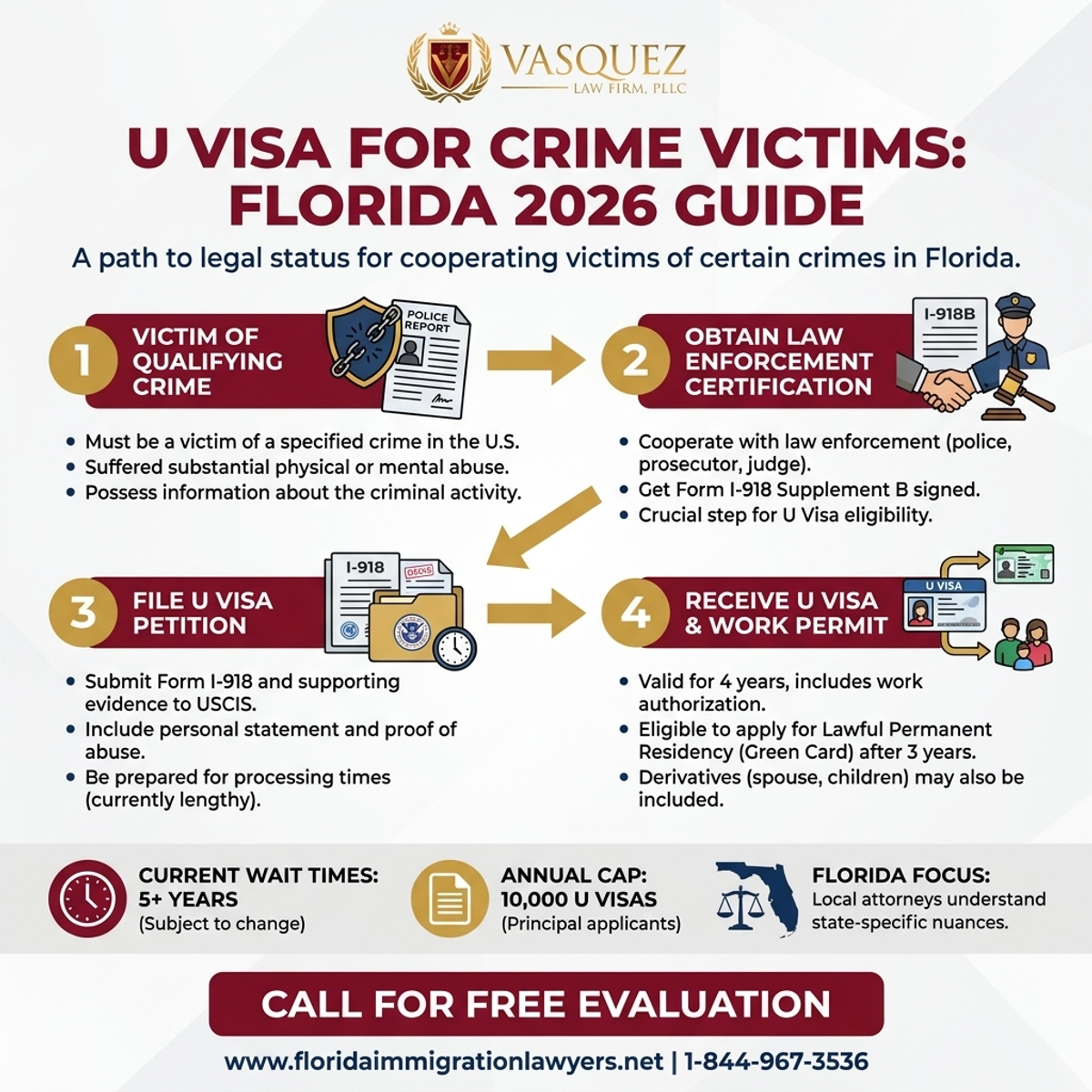
U Visa Processing Timeline and Associated Costs in 2026
Understanding the processing timeline and potential costs for a U visa application in Florida is essential for managing expectations. As of 2026, the U visa process is known for its lengthy waiting periods, primarily due to a statutory cap of 10,000 principal U visas issued annually. This cap does not include derivative family members, but it does mean that even after approval, applicants may be placed on a waitlist.
Typical U Visa Processing Timeline (As of 2026)
The timeframes below are estimates and can vary significantly based on individual case complexity, USCIS workload, and policy changes. Applicants should always check the official USCIS processing times for the most current information.
| Stage | Typical Timeframe | Notes |
|---|---|---|
| Law Enforcement Certification (Form I-918B) | Varies (weeks to months) | Depends heavily on the specific agency and their internal review process. Some agencies have dedicated units; others may take longer. |
| USCIS Receipt Notice (I-918 Submission) | 1-2 months | Confirmation that your application package has been received by the Vermont Service Center. |
| Biometrics Appointment | 3-6 months after receipt | Scheduled at a local Application Support Center (ASC), such as the one serving Central Florida residents. |
| Prima Facie Determination | 12-24 months | An initial review where USCIS determines if the petition has sufficient evidence to establish eligibility. Grants deferred action and work authorization. |
| Waitlist Placement | 3-5+ years after Prima Facie | Due to the annual cap of 10,000 U visas, approved petitions are placed on a waitlist. |
| Final U Visa Approval | Total: 5-8+ years | Once a U visa becomes available, final approval is issued for a four-year period. |
| Adjustment of Status (Green Card) Application | After 3 years in U status | Eligible to apply for lawful permanent residency (Green Card) once certain conditions are met. |
U Visa Application Cost Factors (As of 2026)
While there is no USCIS filing fee for Form I-918, Petition for U Nonimmigrant Status, or Form I-918, Supplement A/B, applicants should be aware of other potential costs associated with the process. It's important to budget for these expenses.
| Item | Typical Fee (Estimate) | Notes |
|---|---|---|
| USCIS Filing Fee (Form I-918) | $0 | No filing fee for the U visa petition itself. |
| Biometrics Services Fee | $85 (approx.) | Required for background checks. |
| Medical Examination (Form I-693) | $200-$500 | Required for adjustment of status, but can be submitted earlier. Must be performed by a USCIS-approved civil surgeon. |
| Translation Services | Varies | If any documents are not in English, certified translations are required. Costs depend on the volume of documents. |
| Postage/Courier Fees | Varies | For mailing application packages and responding to RFEs. |
| Attorney Fees | Varies significantly | Highly recommended for navigating the complex U visa process, including preparing forms, gathering evidence, and communicating with agencies. |
| Adjustment of Status (I-485) Fee | $1,225 (approx.) | Required when applying for a Green Card after receiving U visa status. This fee is subject to change. |
It is crucial to consult with an immigration attorney to get an accurate estimate of costs for your specific situation and to ensure all forms are filed correctly. Florida Immigration Lawyers offers comprehensive assistance for U visa applications.
Do not navigate this process alone. The complexities of immigration law, particularly for sensitive cases like the U visa, demand expert guidance. Contact Florida Immigration Lawyers today for a free case review and let us help you pursue the protection you deserve.
Understanding U Visa Certification for Crime Victims in Florida
The U visa certification, primarily Form I-918, Supplement B, is arguably the most critical component of a U visa application. This document serves as official confirmation from a qualifying law enforcement agency (LEA) that you are a victim of a qualifying crime and that you have been helpful, are being helpful, or are likely to be helpful in the investigation or prosecution of that crime. In Florida, various agencies can provide this certification, including local police departments (e.g., Orlando Police Department, Miami-Dade Police Department), county sheriff's offices, state attorneys' offices, and federal agencies like the FBI or Homeland Security Investigations (HSI).
The process of obtaining U visa certification can vary greatly depending on the specific agency and jurisdiction. Some agencies in Florida have established protocols and even dedicated personnel for handling U visa certification requests, recognizing the importance of this immigration relief for crime victims and public safety. Others may require more extensive outreach and education. When requesting certification, it is essential to provide the agency with all relevant information about your case, including police reports, court documents, and a personal statement detailing your cooperation. The agency's decision to certify is discretionary, meaning they are not legally obligated to sign the form, but many recognize the value of immigrant cooperation in solving crimes and building safer communities.
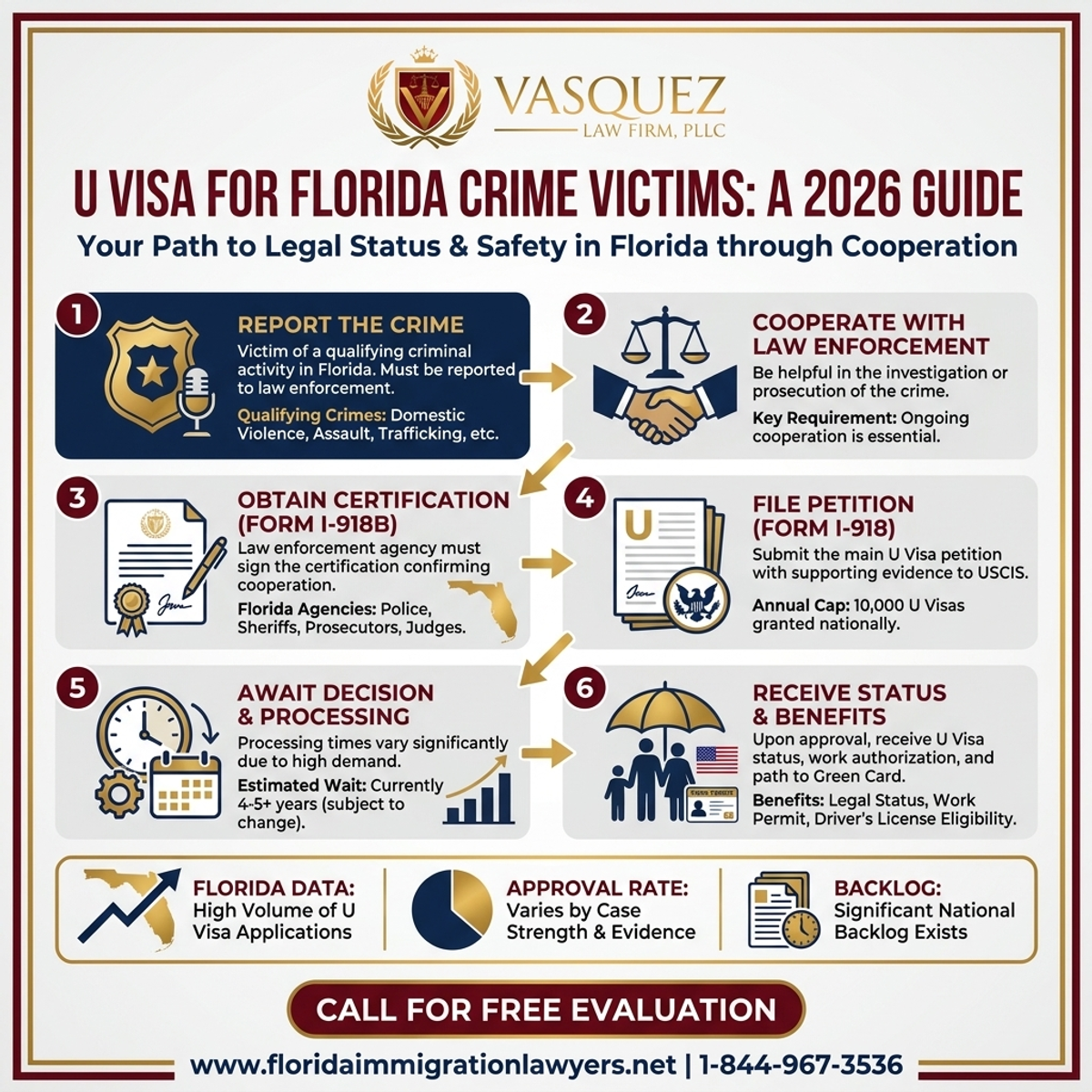
Key Statistics — U Visa for Crime Victims in Florida: A 2026 Guide
It is important to understand that the certification itself does not grant U visa status; it merely fulfills a key eligibility requirement for your petition to USCIS. The certification should be signed by an authorized official from the LEA, such as the head of the agency, a prosecuting attorney, or a designated official. This document must be submitted with your Form I-918 to USCIS. A well-prepared request for certification, often facilitated by an experienced immigration attorney, can significantly increase your chances of obtaining this crucial document. Florida Immigration Lawyers has extensive experience working with law enforcement agencies across the state to secure these vital certifications for crime victims seeking immigration relief.
Common Mistakes to Avoid When Applying for a U Visa
The U visa application process is intricate, and even small errors can lead to significant delays or denial. Being aware of common mistakes can help you navigate this path more smoothly:
-
Failing to Obtain Law Enforcement Certification: This is the most common and critical error. Without a signed Form I-918, Supplement B from a qualifying agency, your U visa petition will be rejected. Many applicants struggle with approaching law enforcement directly; legal counsel can facilitate this.
-
Submitting an Incomplete Application: Missing forms, unsigned documents, or lack of crucial evidence will lead to a Request for Evidence (RFE) or outright denial. Ensure every required field is filled and all supporting documents are included.
-
Inconsistent Information: Discrepancies between your personal statement, police reports, and other evidence can raise red flags for USCIS, casting doubt on your credibility. All information must be consistent and accurate.
-
Not Demonstrating 'Substantial Harm': Simply being a victim is not enough; you must show you suffered substantial physical or mental abuse. Provide medical records, psychological evaluations, and detailed personal statements illustrating the impact of the crime.
-
Lack of 'Helpfulness' Evidence: You must prove you cooperated with law enforcement. This can be challenging if your interactions were minimal. Letters from officials, court transcripts, or documented interviews can serve as proof.
-
Misidentifying a Qualifying Crime: Not all crimes qualify for a U visa. Ensure the crime you were a victim of is explicitly listed in the U visa statute. For instance, a simple theft typically does not qualify.
-
Failing to Include Derivative Family Members: If you wish for eligible family members (spouse, children, etc.) to also receive U status, they must be included in your initial petition or applied for separately with Form I-918, Supplement A. Missing this step can complicate their future immigration.
-
Missing Deadlines for RFEs: If USCIS sends a Request for Evidence, you must respond within the specified timeframe. Failing to do so will almost certainly result in a denial of your petition.
-
Not Updating USCIS on Address Changes: Moving without notifying USCIS via Form AR-11 can lead to missed notices and critical communications, jeopardizing your application.
-
Failing to Disclose Criminal History (if any): Even minor offenses should be disclosed to USCIS. While certain criminal history can make you inadmissible, some waivers are available for U visa applicants. Hiding information is far worse than disclosing it.
When to Call a Florida Immigration Lawyer for Your U Visa
The U visa process is inherently complex and emotionally taxing, making legal representation not just beneficial, but often essential for success. You should strongly consider contacting an experienced immigration attorney from Florida Immigration Lawyers if you encounter any of the following scenarios:
- Difficulty Obtaining Law Enforcement Certification: If a local police department or sheriff's office in Central Florida is unresponsive or unwilling to sign your U visa certification, an attorney can advocate on your behalf, explain the law, and provide necessary documentation to the agency.
- Complex Criminal Case: If the crime you were a victim of involved multiple jurisdictions, unclear reporting, or complex legal proceedings, an attorney can help piece together the evidence and articulate your case effectively.
- Prior Immigration Issues: If you have a history of deportations, previous visa denials, or other immigration violations, these can complicate your U visa application. An attorney can assess potential inadmissibility issues and apply for necessary waivers.
- Language Barriers: Navigating legal documents and communicating with government agencies can be daunting with language barriers. Our bilingual team can assist you every step of the way.
- Fear of Retaliation: If you fear the perpetrator or face threats, an attorney can help ensure your safety and confidentiality throughout the process.
- Desire to Include Family Members: Properly including derivative family members requires careful planning and documentation. An attorney ensures all eligible family members are included correctly.
Florida Immigration Lawyers has extensive experience representing crime victims throughout Florida in their U visa applications. We understand the unique challenges faced by immigrants and are dedicated to providing compassionate, effective legal assistance. Our firm is committed to helping you secure the immigration relief you need to rebuild your life safely and legally.
About Florida Immigration Lawyers
Florida Immigration Lawyers is a leading law firm dedicated to providing comprehensive and compassionate immigration legal services across the entire state of Florida. With a deep understanding of U.S. immigration law and its impact on individuals and families, our experienced attorneys are committed to helping clients navigate even the most complex immigration challenges. From our office in Orlando, we serve clients from all walks of life, offering personalized strategies and unwavering support.
Our firm specializes in a wide range of immigration matters, including U visas for crime victims, asylum claims, deportation defense, family-based petitions, citizenship applications, and business immigration solutions. We pride ourselves on our client-focused approach, ensuring that each individual receives the attention and dedicated representation they deserve. We understand the stakes involved in immigration cases and work tirelessly to achieve the best possible outcomes for our clients.
Available 24/7, Florida Immigration Lawyers offers free case reviews, making expert legal advice accessible when you need it most. We are here to fight for your rights and guide you through every step of your immigration journey. Call us today at 1-844-YO-PELEO or schedule a free consultation to learn how we can assist you.
Sources and References
- U.S. Citizenship and Immigration Services (USCIS)
- Executive Office for Immigration Review (EOIR)
- U.S. Department of State
- 8 U.S.C. § 1101(a)(15)(U) - Definition of U Nonimmigrant Status
- Victims of Trafficking and Violence Protection Act of 2000 (VTVPA), Public Law 106-386
- 8 CFR § 214.14 - Nonimmigrant classes; U nonimmigrant classification
Related services: asylum application process, refugee status and resettlement, withholding of removal, humanitarian protection programs.
This article provides general legal information and is not intended as legal advice. Every case is unique, and outcomes depend on specific facts and circumstances. Contact an attorney for advice about your particular situation.
Take the First Step Towards Safety and Legal Status
If you are a crime victim in Florida seeking the protection and opportunities offered by a U visa, time is of the essence. Do not face the complexities of the immigration system alone. The dedicated team at Florida Immigration Lawyers is ready to provide the expert legal guidance and compassionate support you need. We offer free, confidential case reviews and are available 24/7 to answer your questions and help you understand your options. Call us today at 1-844-YO-PELEO. Se Habla Espanol - Estamos aqui para ayudarle.
If you need legal assistance, learn more about speak with an immigration lawyer, or call us at 1-844-967-3536 for a free case review.
Do Not Navigate This Process Alone
Our experienced immigration attorneys are ready to fight for you. Get a free, confidential case review today.
Se Habla Español
Or leave your details and we’ll call you:
Free Evaluation in 24 Hours
Or talk to us right now
AI voice assistant — available 24/7
FreeFrequently Asked Questions

William J. Vásquez
Founding Attorney · Vasquez Law Firm
U.S. Air Force veteran and immigration attorney with years of hands-on U.S. immigration experience. J.D., NCCU School of Law. AILA member. Admitted to the 4th, 5th, and 11th Circuit Courts.
Available 24/7 - Free Evaluations
Reviewed for legal accuracy by William J. Vásquez
Licensed in North Carolina; U.S. immigration is federal practice.
Related Legal Services
Our Florida immigration attorneys can help you with business immigration, deportation defense and family immigration services. Call today at 1-844-YO-PELEO for a free case review.
Related Links
Related Topics
Free Legal Case Review
Discuss your case with our experienced attorneys. We're available 24/7.
Se Habla Español - Estamos aquí para ayudarle.
Related Articles
EB-5 Investor Green Card in Florida: A 2026 Guide
Explore how to obtain an EB-5 investor green card in Florida. Learn about the investment requirements, processes, and benefits of participating in this program. Discover how Florida's economic landscape can be an ideal setting for your investment. Contact Florida Immigration Lawyers for a free case review.
Certificate of Eligibility for Expungement in Florida 2026
For non-U.S. citizens in Florida, understanding how a state expungement impacts immigration status is critical. A certificate of eligibility for expungement in Florida allows a criminal record to be sealed or expunged under state law. However, federal immigration agencies often disregard such state-level relief, still considering the original criminal offense as a conviction for immigration purposes. This can have severe implications for visa applications, green card eligibility, naturalization, and even lead to deportation. This guide clarifies the Florida expungement process, its limited effect on federal immigration law, and key steps to protect your status in 2026. Learn about common mistakes, required documents, timelines, and when to seek expert legal counsel from Florida Immigration Lawyers to navigate these complex issues effectively.
What to Expect at Your First Immigration Consultation in Orlando
What happens at a first immigration consultation in Orlando, which documents to bring, and how to prepare for questions about visas, green cards, citizenship and court cases.
EAD Advance Parole Combo Card Benefits in Florida
Explore the benefits and application process of the EAD advance parole combo card for immigrants with an I-485 pending in Florida. Learn how this dual-purpose document facilitates work and travel while waiting for a green card. Contact Florida Immigration Lawyers for expert assistance.