EAD Advance Parole Combo Card Benefits in Florida
Explore the benefits and application process of the EAD advance parole combo card for immigrants with an I-485 pending in Florida. Learn how this dual-purpose document facilitates work and travel while waiting for a green card. Contact Florida Immigration Lawyers for expert assistance.

What is an EAD Advance Parole Combo Card?
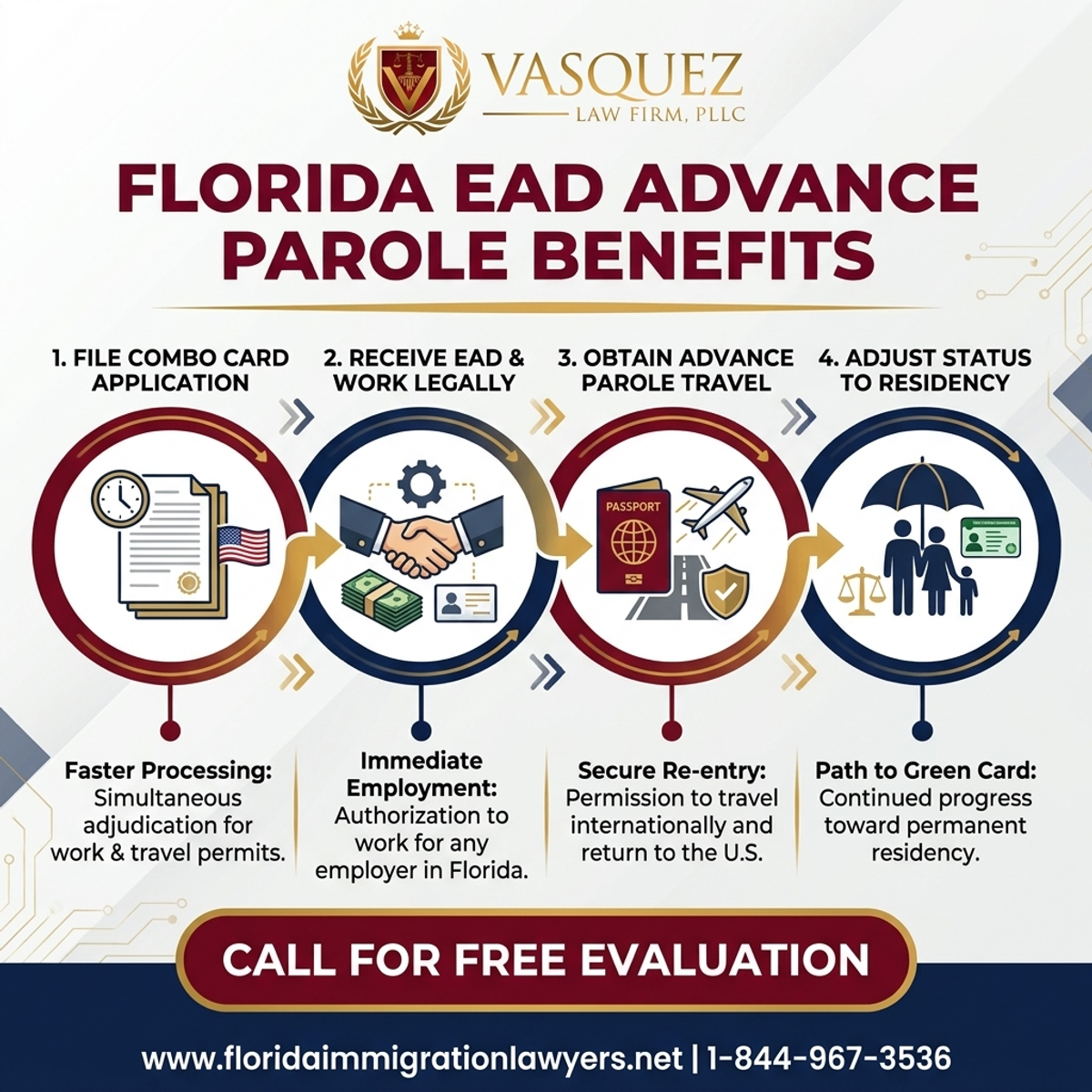
As of 2026, the EAD advance parole combo card serves as both an Employment Authorization Document (EAD) and an advance parole document. This dual-purpose card is particularly beneficial for those with an I-485 pending application, as it allows holders to work legally in the U.S. and travel abroad without risking their adjustment of status application.
The combo card simplifies the process by eliminating the need for separate applications for work and travel permits, thereby saving time and reducing costs for applicants.
To fully appreciate the combo card, it's helpful to understand its two components. The Employment Authorization Document (EAD), often referred to as a work permit, grants foreign nationals permission to work legally in the United States. This is vital for maintaining financial stability and contributing to the economy while their long-term immigration status is being determined. Without an EAD, working without authorization can have severe consequences for future immigration prospects.
Advance Parole, on the other hand, is a travel document that allows certain foreign nationals to re-enter the U.S. after traveling abroad, without jeopardizing their pending adjustment of status application (Form I-485). Traveling internationally without advance parole while an I-485 is pending typically leads to the abandonment of that application, forcing individuals to start the entire green card process over. The combo card eliminates this risk, offering essential flexibility for emergencies, family visits, or business travel.
The consolidation of these two critical functions into a single card is a significant advantage. It streamlines the administrative burden for applicants, requiring only one physical card to carry and present. This not only reduces paperwork but also provides a clear, unambiguous document for employers and border officials, ensuring a smoother experience for the applicant. Florida Immigration Lawyers frequently assist clients in understanding these benefits and securing their combo cards efficiently.
How Do You Apply for a Combo Card in Florida?
To apply for a combo card in Florida, you must file Form I-765 for employment authorization and Form I-131 for advance parole concurrently with your I-485 application. Ensure that you include all necessary supporting documents to avoid delays.
- Complete and submit Form I-765 and Form I-131 along with Form I-485.
- Include copies of your current immigration status documents.
- Submit two passport-style photographs.
- Provide a copy of your photo ID and current EAD, if applicable.
- Pay the required filing fees, if not already included with Form I-485.
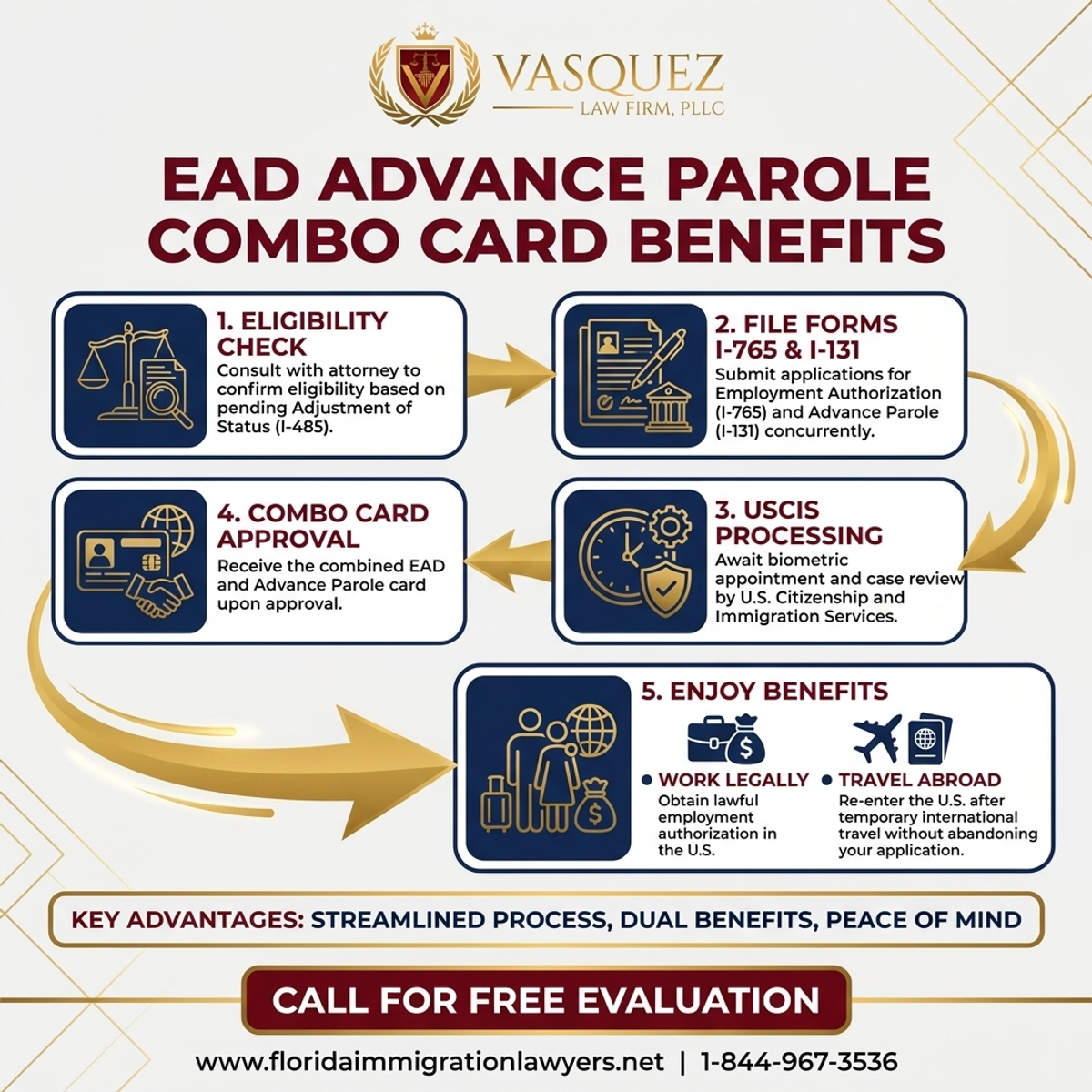
Step-by-Step Process — EAD Advance Parole Combo Card Benefits in Florida
Once submitted, USCIS will process your application, and you can expect to receive your combo card within approximately 3 to 5 months.
The key to a smooth application process in Florida is meticulous preparation and accurate submission. Filing Forms I-765 (Application for Employment Authorization) and I-131 (Application for Travel Document) simultaneously with your Form I-485 (Application to Adjust Status) is crucial. This concurrent filing strategy often allows for fee waivers for the I-765 and I-131, as their fees are typically covered when filed with the I-485. Always download the latest versions of these forms directly from the USCIS website to ensure compliance with current regulations.
Each form requires specific information and supporting evidence. For instance, Form I-765 will ask for your eligibility category, which for I-485 pending applicants is typically (c)(9). Form I-131 will inquire about your travel plans and reasons for needing advance parole. Providing clear, consistent, and truthful information across all forms is paramount. Any discrepancies can lead to Requests for Evidence (RFEs) or even denials, significantly delaying your ability to work or travel.
After submission, you will likely receive a biometrics appointment notice. This appointment, usually held at a local Application Support Center (ASC) in Florida, involves fingerprinting and photographing to verify your identity and conduct background checks. Attending this appointment is mandatory and a critical step in the processing of your combo card. Missing it without proper rescheduling can halt your application entirely. Florida Immigration Lawyers can guide you through each of these steps, ensuring all forms are correctly filled and all supporting documents are precisely organized.
What Documents Do You Need for the Application?
- Completed Form I-765 and Form I-131
- Two passport-style photos
- Copy of current immigration status documents
- Copy of photo ID and current EAD (if applicable)
- Proof of pending I-485 application
Having the correct documentation is crucial for a smooth application process. Missing or incorrect documents can lead to delays or denials.
Beyond the primary forms, the supporting documentation acts as the backbone of your application. For the two passport-style photos, ensure they meet USCIS specifications: recent, unretouched, with a white background, and correctly sized. These photos are used for both your EAD and advance parole card. Your current immigration status documents, such as your I-94 arrival/departure record, visa stamp, or previous I-797 approval notices, establish your legal presence in the U.S. and eligibility for adjustment of status.
Providing a clear copy of your photo ID, such as a driver's license or passport, helps USCIS verify your identity. If you have a current EAD, including a copy of it is important for renewal applications or demonstrating continuous work authorization. Proof of your pending I-485 application, typically the I-797C Notice of Action receipt, links your combo card request directly to your green card petition, demonstrating your eligibility for these interim benefits.
It's also wise to include copies of your birth certificate, marriage certificate (if applicable), and any previous immigration applications or decisions. For any documents not in English, certified translations are required. Organizing your application package with cover letters, tabs, and in the order requested by USCIS can significantly aid the processing officer. A well-prepared application package, often reviewed by an expert from Florida Immigration Lawyers, can prevent common pitfalls and expedite approval.
How Long Does It Take to Get a Combo Card?
Typically, the processing time for a combo card is between 3 to 5 months. As of 2026, processing times can vary depending on the workload of USCIS service centers.
| Stage | Typical Timeframe | Notes |
|---|---|---|
| Application Submission | 1-2 weeks | Initial review by USCIS |
| Biometrics Appointment | 3-4 weeks | Fingerprinting process |
| Application Processing | 3-5 months | USCIS processing period |
| Card Issuance | 1-2 weeks | Mailing of combo card |
Key Statistics — EAD Advance Parole Combo Card Benefits in Florida
Applicants should regularly check their case status online at USCIS for updates.
While the typical timeframe is 3 to 5 months, it's essential to understand that these are estimates. Factors such as the specific USCIS service center handling your case, the volume of applications they are receiving, and the completeness of your application can all influence actual processing times. For example, a Request for Evidence (RFE) due to missing documents can significantly extend the waiting period. USCIS regularly updates its processing time charts on its website, which can provide more current estimates for your specific application type and service center.
During the waiting period, patience is key. However, proactive monitoring of your case status through the USCIS online tool is highly recommended. You will need the receipt number provided on your I-797C Notice of Action. If your application falls outside the normal processing times, or if you have an urgent need (e.g., a medical emergency requiring international travel), it may be possible to request an expedited processing. Such requests require strong supporting evidence and are granted at USCIS's discretion.
It is also important to plan for the renewal of your combo card well in advance of its expiration. USCIS recommends filing for renewal approximately 120-180 days before your current card expires. This proactive approach helps prevent any lapse in your work authorization or travel privileges, ensuring continuous stability while your I-485 remains pending. Florida Immigration Lawyers can assist with monitoring processing times and strategizing for timely renewals.
What Are the Costs Associated with a Combo Card?
The cost of obtaining a combo card includes the filing fees for Form I-765 and Form I-131. Typically, these fees are bundled with the I-485 filing fee if filed concurrently.
| Item | Typical Fee | Notes |
|---|---|---|
| Form I-765 | Included with I-485 | When filed together |
| Form I-131 | Included with I-485 | When filed together |
Fees are subject to change, so it's important to verify current fees on the USCIS website.
The fee structure for the combo card is one of its attractive benefits. When Form I-765 and Form I-131 are filed concurrently with or after a Form I-485, the filing fees for the EAD and Advance Parole are generally waived. This means you only pay the I-485 application fee, which covers the associated work and travel permits. This policy significantly reduces the financial burden on applicants, making the adjustment of status process more accessible.
However, it is critical to note that USCIS fees are not static and can change. Always consult the official USCIS website or an immigration attorney, like those at Florida Immigration Lawyers, for the most up-to-date fee schedule before preparing your application. Incorrect filing fees can lead to rejection of your entire application package, causing significant delays. Additionally, while the core filing fees might be bundled, applicants should budget for other potential costs, such as passport-style photos, postage, and if desired, legal fees for professional assistance.
For individuals facing financial hardship, USCIS offers the possibility of a fee waiver for certain forms, though eligibility criteria are strict. If you believe you might qualify for a fee waiver, you would need to file Form I-912, Request for Fee Waiver, along with your application. Discussing your financial situation with an experienced immigration attorney can help determine if you are eligible and how to properly submit such a request, ensuring you don't miss out on potential savings.
Middle CTA
Do not navigate this process alone. Contact Florida Immigration Lawyers today.
Common Mistakes to Avoid
Navigating the immigration process requires precision. Even minor errors can lead to significant setbacks, from prolonged waiting periods to outright denials. Being aware of these common pitfalls can help you avoid them.
- **Failing to file Form I-765 and Form I-131 concurrently** with your I-485 application is a frequent error. This oversight can lead to separate processing queues, potentially incurring additional fees, and significantly delaying your ability to work or travel while your green card is pending. Always aim for concurrent filing if eligible.
- **Submitting outdated forms** is a critical mistake. USCIS frequently updates its forms, and using an old version will result in your application being rejected and returned. Always download forms directly from the USCIS website on the day you plan to complete them.
- **Not providing sufficient supporting documentation** is a major cause of Requests for Evidence (RFEs). An RFE prolongs processing times by months and adds stress. Ensure every required document, from birth certificates to marriage licenses, is included and properly translated if not in English.
- **Overlooking the need for a valid passport when traveling internationally** can leave you stranded. While the combo card grants travel permission, your country of origin may still require a valid passport for entry and exit. Always check both U.S. and foreign country requirements.
- **Not updating your address with USCIS** promptly after moving is a serious misstep. USCIS communicates important notices, biometrics appointments, and even your approval card via mail. A lost notice can lead to missed appointments or delays, potentially jeopardizing your application.
- **Missing the biometrics appointment** without rescheduling can halt your application process entirely. Biometrics are essential for background checks. If you cannot attend, contact USCIS immediately to reschedule, providing a valid reason.
- **Filing incorrect filing fees** is another common reason for application rejection. Fees change periodically. Always verify the exact amount on the USCIS website or consult with Florida Immigration Lawyers before sending your application.
- **Waiting too long to apply for renewal** of your combo card risks a lapse in your work authorization and travel privileges. USCIS recommends filing for renewal several months before expiration to ensure continuous coverage.
- **Traveling without the physical combo card** can lead to denial of re-entry to the U.S. The advance parole document must be presented at the port of entry. Do not assume a pending application is sufficient.
- **Ignoring case status updates** means you could miss crucial notifications, such as RFEs or appointment notices. Regularly checking your case status online and responding promptly to any USCIS communication is vital.
- **Not consulting with an immigration attorney for complex situations** can lead to irreversible errors. If you have a complicated immigration history, criminal record, or previous denials, an attorney can provide expert guidance, mitigate risks, and significantly improve your chances of success. ol>
Sources and References
- U.S. Citizenship and Immigration Services (USCIS)
- Executive Office for Immigration Review (EOIR)
- U.S. Department of State
- Immigration and Nationality Act (INA), 8 U.S.C. Chapter 12
Do Not Navigate This Process Alone
Our experienced immigration attorneys are ready to fight for you. Get a free, confidential case review today.
Se Habla Español
Or leave your details and we’ll call you:
Free Evaluation in 24 Hours
Or talk to us right now

AI voice assistant — available 24/7
FreeFrequently Asked Questions

William J. Vásquez
Founding Attorney · Vasquez Law Firm
U.S. Air Force veteran and immigration attorney with years of hands-on U.S. immigration experience. J.D., NCCU School of Law. AILA member. Admitted to the 4th, 5th, and 11th Circuit Courts.
Available 24/7 - Free Evaluations
Reviewed for legal accuracy by William J. Vásquez
Licensed in North Carolina; U.S. immigration is federal practice.
Related Legal Services
Our Florida immigration attorneys can help you with deportation defense, family immigration services and immigration lawyer cost in Florida. Call today at 1-844-YO-PELEO for a free case review.
Related Links
Related Topics
Free Legal Case Review
Discuss your case with our experienced attorneys. We're available 24/7.
Se Habla Español - Estamos aquí para ayudarle.
Related Articles
EB-5 Investor Green Card in Florida: A 2026 Guide
Explore how to obtain an EB-5 investor green card in Florida. Learn about the investment requirements, processes, and benefits of participating in this program. Discover how Florida's economic landscape can be an ideal setting for your investment. Contact Florida Immigration Lawyers for a free case review.
Certificate of Eligibility for Expungement in Florida 2026
For non-U.S. citizens in Florida, understanding how a state expungement impacts immigration status is critical. A certificate of eligibility for expungement in Florida allows a criminal record to be sealed or expunged under state law. However, federal immigration agencies often disregard such state-level relief, still considering the original criminal offense as a conviction for immigration purposes. This can have severe implications for visa applications, green card eligibility, naturalization, and even lead to deportation. This guide clarifies the Florida expungement process, its limited effect on federal immigration law, and key steps to protect your status in 2026. Learn about common mistakes, required documents, timelines, and when to seek expert legal counsel from Florida Immigration Lawyers to navigate these complex issues effectively.
What to Expect at Your First Immigration Consultation in Orlando
What happens at a first immigration consultation in Orlando, which documents to bring, and how to prepare for questions about visas, green cards, citizenship and court cases.
U Visa for Crime Victims in Florida: A 2026 Guide
For non-citizen crime victims in Florida, the U visa offers a critical pathway to safety and legal status. This specialized immigration relief is available to individuals who have suffered substantial physical or mental abuse as a result of certain criminal activities and have been, or are willing to be, helpful to law enforcement in the investigation or prosecution of those crimes. Understanding the eligibility criteria, the intricate application process with USCIS, and the vital role of law enforcement certification is paramount for a successful application. This guide provides a detailed overview for 2026, including step-by-step instructions, expected timelines, and cost considerations, emphasizing the importance of legal assistance to navigate the complexities and avoid common pitfalls. Florida Immigration Lawyers stands ready to assist victims across the state, ensuring they receive the protection and justice they deserve.