U Visa for Crime Victims in Florida: Key Information
Explore how the U Visa can help crime victims in Florida achieve immigration relief. Learn about the qualifications, application process, and common pitfalls to avoid. Florida Immigration Lawyers offer comprehensive assistance to navigate this complex path.
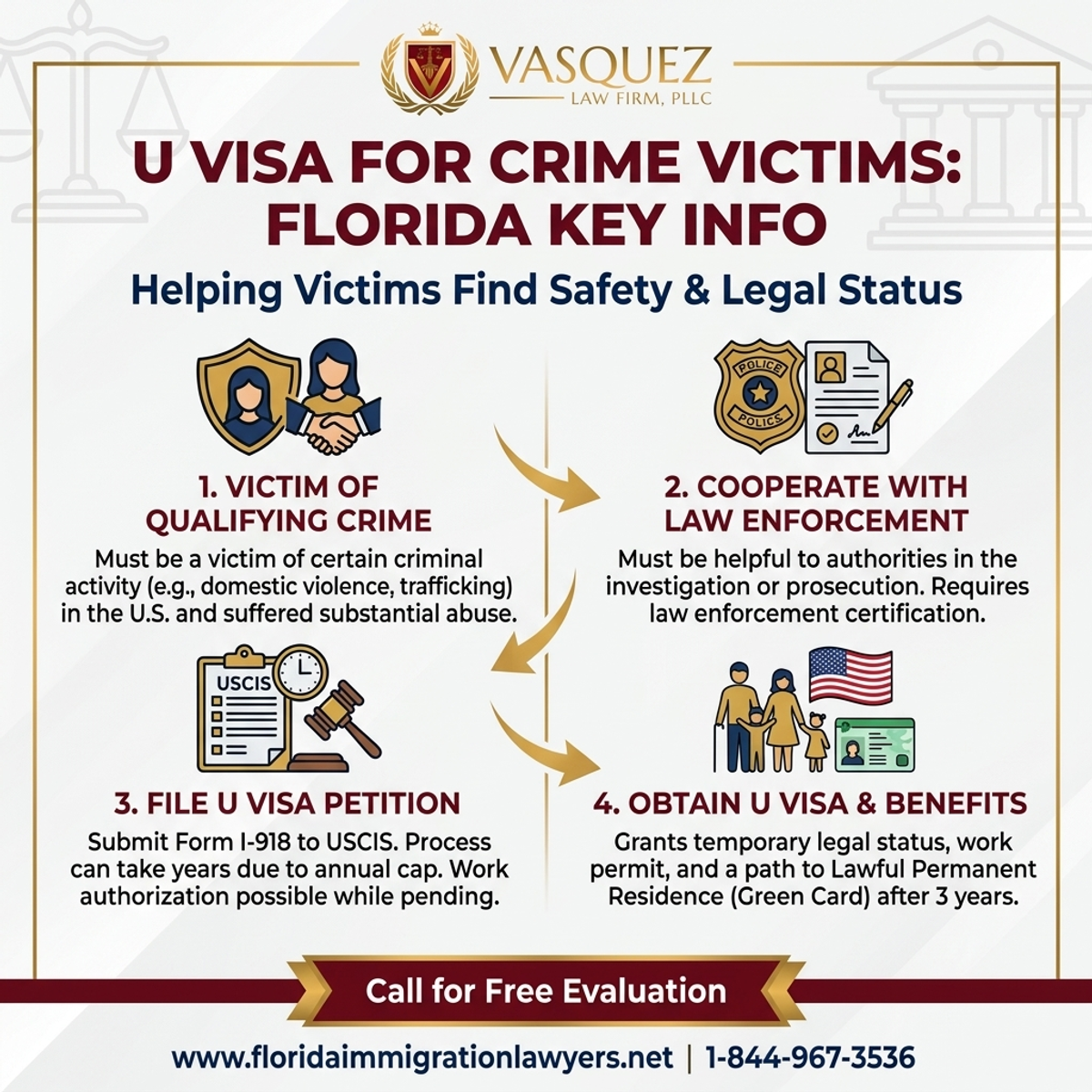
The U Visa offers immigration relief to victims of certain crimes who assist law enforcement in investigations or prosecutions. This visa provides a path to lawful status in the U.S. for eligible applicants. Key points include:
- Eligibility requires being a crime victim and assisting law enforcement.
- Applicants must obtain a certification from a law enforcement agency.
- This visa can lead to a green card after three years.
Introduction
Imagine being a victim of a crime in Orlando, Florida, while also facing the complexities of immigration status. The U Visa provides a lifeline to victims of crimes, offering a pathway to legal status while assisting law enforcement in their investigations. This article explores the U Visa process, from eligibility to application steps, and provides insights specifically for those in Florida. Call Florida Immigration Lawyers at 1-844-YO-PELEO for a free case review.
What is a U Visa and Who Qualifies?
The U Visa is a nonimmigrant visa designated for victims of certain crimes who have suffered substantial mental or physical abuse and are helpful to law enforcement in investigating or prosecuting criminal activity.
To qualify for a U Visa, applicants must demonstrate:
- Victimization of a qualifying criminal activity.
- Substantial physical or mental abuse as a result.
- Possession of information about the crime.
- Helpfulness to law enforcement during investigation or prosecution.
- Certification from a law enforcement agency.
Common qualifying crimes include domestic violence, sexual assault, and human trafficking.
The U Visa provides a unique opportunity for non-citizen victims to step forward without fear of deportation, fostering trust between immigrant communities and law enforcement. This critical program not only aids in bringing criminals to justice but also offers a pathway to safety and legal stability for those who have endured severe harm. Understanding the nuances of "qualifying criminal activity" and "substantial abuse" is paramount for a successful application.
Qualifying criminal activities are specifically defined by immigration law and include, but are not limited to, abduction, blackmail, domestic violence, extortion, false imprisonment, felony assault, female genital mutilation, hostage taking, incest, involuntary servitude, kidnapping, murder, manslaughter, obstruction of justice, peonage, perjury, prostitution, rape, sexual assault, sexual exploitation, slave trade, torture, trafficking, and unlawful criminal restraint. It's crucial that the crime occurred in the U.S. or violated U.S. law, and that the victim suffered directly as a result. For instance, if you were a victim of a severe assault in Orlando, Florida, the local police department's involvement would be key.
The requirement of "substantial physical or mental abuse" means the harm must be significant, not minor. This can be evidenced through medical records, psychological evaluations, police reports, and personal statements detailing the trauma experienced. While physical injuries are often straightforward to document, mental abuse, such as severe PTSD, anxiety, or depression resulting from the crime, is equally valid and can be substantiated through professional assessments. Demonstrating this link between the crime and the abuse is a critical component of the U Visa petition.
Furthermore, the applicant's "helpfulness to law enforcement" is a cornerstone of the U Visa. This doesn't necessarily mean testifying in court, though it can. It encompasses providing information, cooperating with investigators, participating in interviews, and being available for future assistance in the investigation or prosecution of the crime. The law enforcement agency must certify this cooperation using Form I-918, Supplement B, confirming that the victim has been, is being, or is likely to be helpful. This certification is a powerful endorsement of your cooperation and is indispensable for the U Visa process.
How to Apply for a U Visa in Florida?
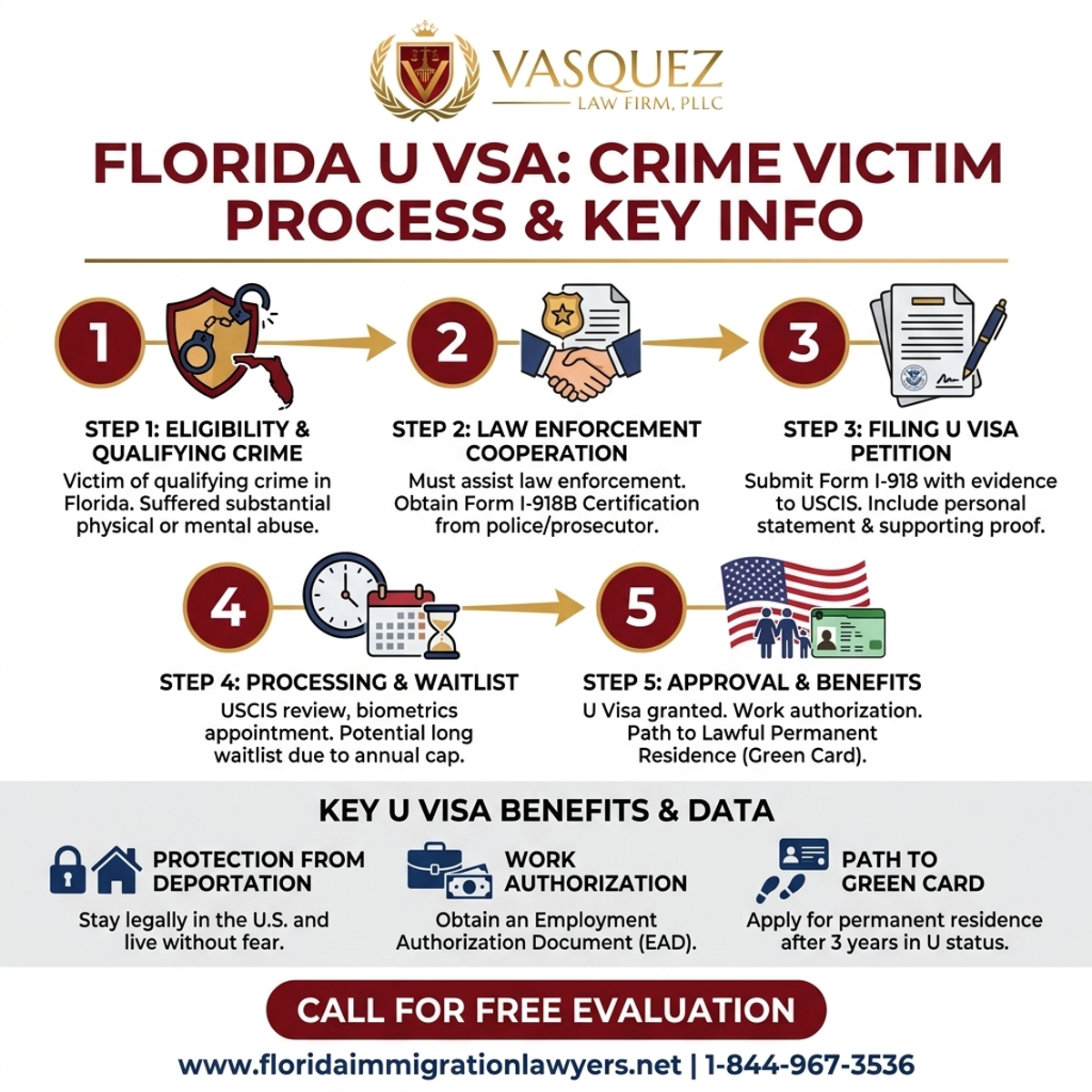
Applying for a U Visa involves several steps. As of 2026, these steps remain consistent across the United States.
- Obtain a signed certification from a law enforcement agency using Form I-918, Supplement B.
- Complete Form I-918, Petition for U Nonimmigrant Status.
- Prepare additional required documentation, including personal statements and evidence of the crime and cooperation.
- Submit the application to U.S. Citizenship and Immigration Services (USCIS).
Post-submission, applicants may need to attend an interview or provide additional documentation as requested by USCIS.
The application process, while consistent nationwide, can present unique challenges depending on your location and the specific law enforcement agencies involved. In Florida, navigating local police departments, sheriff's offices, or state attorney's offices to secure the crucial Form I-918, Supplement B can be daunting. This certification is the official document where a qualifying law enforcement agency attests to your helpfulness. It can be signed by a judge, prosecutor, or any official with authority to investigate or prosecute the qualifying criminal activity. Securing this certification often requires persistent communication and a clear demonstration of your cooperation, which is where the guidance of experienced legal counsel like Florida Immigration Lawyers can be invaluable.
Once you have the signed Supplement B, the next step is meticulously completing Form I-918, Petition for U Nonimmigrant Status. This form requires detailed personal information, a comprehensive account of the crime, and how you meet all eligibility criteria. Accuracy and thoroughness are paramount, as any discrepancies or missing information can lead to delays or even a Request for Evidence (RFE) from USCIS. It’s not uncommon for applicants to overlook critical details or misunderstand complex legal questions, making professional review of this form essential.
Beyond the forms, compiling "additional required documentation" is a significant undertaking. This includes a detailed personal statement describing the crime, its impact on you, and your cooperation with law enforcement. You'll also need evidence of the crime itself, such as police reports, court documents, news articles, and medical records. Proof of substantial abuse can come from psychological evaluations, therapist notes, and affidavits from witnesses. Demonstrating your cooperation might involve letters from officers, transcripts of interviews, or records of your willingness to assist. Organizing these documents clearly and concisely can significantly strengthen your petition.
After submitting your comprehensive application package to USCIS, the waiting period begins. During this time, USCIS may issue a Request for Evidence (RFE) if they need more information or clarification. It is also possible that you may be called for an interview, though this is less common for U Visa petitioners. Responding promptly and accurately to any USCIS requests is critical. Many applicants also apply for employment authorization (Form I-765) concurrently, allowing them to work legally while their U Visa petition is pending, especially after a "bona fide determination" is made. This interim relief can be life-changing for victims seeking to rebuild their lives.
Document Checklist for U Visa Applicants
A meticulously prepared document checklist is your best defense against delays or denials. Each piece of evidence tells a part of your story and validates your eligibility. Florida Immigration Lawyers can help you organize and present your case effectively.
- Form I-918, Petition for U Nonimmigrant Status: This is the primary application form. Ensure all sections are completed accurately and truthfully. Any blank spaces should be marked "N/A" if not applicable.
- Form I-918, Supplement B, U Nonimmigrant Status Certification: This is the cornerstone of your application, signed by a law enforcement official. It must confirm that you were a victim of a qualifying crime and were helpful in the investigation or prosecution.
- Personal statement describing the crime: Your narrative is powerful. Detail the events of the crime, how it affected you, and how you cooperated with authorities. Be specific, honest, and provide dates and locations where possible.
- Evidence of substantial abuse: This includes medical records, psychological evaluations, hospital bills, and therapist notes. Photos of injuries, if available and relevant, can also be compelling.
- Proof of cooperation with law enforcement: Provide police reports, court documents, affidavits from police officers, prosecutors, or judges, and any correspondence demonstrating your assistance. Even call logs or emails can be helpful.
- Identification documents (e.g., passport): Include copies of your passport, birth certificate, national ID, or any other government-issued identification. If you have a visa or entry stamp, include those as well.
- Proof of relationship for derivative family members (if applicable): If applying for family members (spouse, children, parents for child victims), you'll need marriage certificates, birth certificates, and other documents to prove the relationship.
- Form I-192, Application for Advance Permission to Enter as a Nonimmigrant (Waiver of Inadmissibility): If you have any inadmissibility issues (e.g., prior immigration violations, certain criminal history), this waiver is crucial. Discuss this with Florida Immigration Lawyers to determine if it's needed.
- Photographs: Recent passport-style photographs are required for both the principal applicant and any derivative family members.
- Biometric Services Appointment Notice: After submission, you will receive a notice for a biometric appointment (fingerprints, photo, signature). Ensure you attend this appointment.
Gathering these documents can be overwhelming, but a systematic approach, often guided by legal professionals, ensures nothing is missed.
Step-by-Step Process — U Visa for Crime Victims in Florida: Key Information
U Visa Timeline and Processing Expectations
The processing time for U Visas can be lengthy due to high demand and limited visa numbers.
| Stage | Typical Timeframe | Notes |
|---|---|---|
| Certification by Law Enforcement | Varies by agency | Must be obtained before applying |
| USCIS Processing | 12-18 months | Initial review and RFE responses |
| Waitlist Due to Cap | Unknown | Dependent on annual cap |
| Issuance of U Visa | Upon availability | After waitlist clearance |
The U Visa program, while vital, is subject to an annual cap of 10,000 visas for principal applicants. This statutory limit, coupled with overwhelming demand, is the primary reason for the extended processing times. It's not uncommon for applicants to wait several years from the initial submission of their petition to the final adjudication. Understanding this timeline is crucial for managing expectations and planning your future.
After USCIS receives your application, they first conduct an initial review to determine if the petition is "bona fide." This "bona fide determination" (BFD) process typically takes several years. If USCIS determines your petition is bona fide and meets the eligibility requirements, you may be granted deferred action and employment authorization (work permit) while you wait for a U Visa to become available. This interim relief is a significant benefit, allowing victims to legally work and live in the U.S. during the lengthy wait for a final visa.
The "waitlist due to cap" is the longest and most unpredictable stage. Once your petition is deemed bona fide, you are placed on a waitlist. The length of this wait depends entirely on how many other applicants are ahead of you and the annual availability of visa numbers. While on the waitlist, maintaining your current address with USCIS is critical, as any communication regarding your case will be sent to the address on file. Missing important notices can lead to significant setbacks.
Finally, when a U Visa number becomes available, USCIS will issue the visa, typically for a period of four years. During this time, U Visa holders can live and work in the U.S. and can eventually apply for lawful permanent residency (a Green Card) after three years of continuous physical presence in the U.S. and continued cooperation with law enforcement. Navigating these stages requires patience and diligent record-keeping, and the support of Florida Immigration Lawyers can help ensure you meet all requirements at each step.
Costs Associated with a U Visa Application
While there is no application fee for the U Visa itself, there may be costs associated with gathering documents, legal assistance, and other related expenses.
| Item | Typical Fee | Notes |
|---|---|---|
| Medical Examination | Varies | Only if required |
| Legal Fees | Varies | Consultation recommended |
| Document Translation | Varies | Required for non-English documents |
While USCIS does not charge a filing fee for Form I-918, Petition for U Nonimmigrant Status, or for Form I-918, Supplement B, applicants should be prepared for various indirect costs. These expenses, though not directly paid to USCIS for the U Visa itself, are essential for a complete and robust application. Budgeting for these items is a practical step in preparing your U Visa petition.
The "Medical Examination" is typically required when an applicant adjusts status to a Green Card, but can sometimes be requested during the U Visa process, especially if there are health-related inadmissibility grounds. This examination must be performed by a USCIS-approved civil surgeon, and costs can vary significantly depending on the provider and any required vaccinations or tests. It’s important to keep all receipts and records from these appointments.
"Legal Fees" represent an investment in your future and can cover a wide range of services, from initial consultations and eligibility assessments to comprehensive application preparation, representation in interviews, and responses to RFEs. While some individuals attempt to navigate the process alone, the complexities of immigration law, the need for meticulous documentation, and the potential for inadmissibility issues often make legal representation invaluable. Florida Immigration Lawyers offer free case reviews to help you understand the potential costs and benefits of professional assistance for your U Visa application.
"Document Translation" is a critical expense if any of your supporting documents are not in English. All non-English documents must be accompanied by a complete and certified English translation. This means the translator must certify that they are competent to translate and that the translation is accurate. The cost for translation services can vary based on the length and complexity of the documents. Additionally, you might incur costs for obtaining certified copies of police reports, court records, birth certificates, or marriage certificates, which are often necessary to prove eligibility and relationships for derivative family members. These seemingly small expenses can add up, so it's wise to account for them from the outset.
Key Statistics — U Visa for Crime Victims in Florida: Key Information
Do not navigate this process alone. Contact Florida Immigration Lawyers today.
Common Mistakes to Avoid When Applying for a U Visa
The U Visa application process is intricate, and even minor missteps can have significant consequences, leading to delays, Requests for Evidence (RFEs), or outright denial. Being aware of common pitfalls and actively working to avoid them is paramount for a successful outcome. This is where the expertise of Florida Immigration Lawyers becomes particularly beneficial, helping you navigate these complexities with confidence.
- Failing to Obtain Certification: This is arguably the most critical step. Without a signed Form I-918, Supplement B from a qualifying law enforcement agency, your U Visa petition will not be accepted. If you're struggling to obtain this, a lawyer can help by communicating with agencies, explaining the U Visa requirements, and advocating on your behalf.
- Incomplete Documentation: Submitting an application with missing forms or insufficient evidence is a common reason for delays or RFEs. Always double-check your checklist and ensure every required document is included, properly labeled, and in the correct order.
- Ignoring Legal Advice: While you can file independently, immigration law is complex. An experienced attorney can identify potential issues, advise on waivers of inadmissibility, and present your case in the strongest possible light. Seeking professional guidance, especially from firms like Florida Immigration Lawyers, can save you time, stress, and prevent costly errors.
- Missing Deadlines: USCIS provides strict deadlines for responding to RFEs or other requests. Failing to meet these can result in the denial of your application. Keep a meticulous record of all correspondence and deadlines.
- Providing Inaccurate Information: Honesty is the best policy. Any false statements or misrepresentations can lead to severe immigration consequences, including findings of fraud and permanent bars to future immigration benefits.
- Not Showing Sufficient Evidence of Abuse: Merely stating you were abused is not enough. You need concrete evidence such as medical reports, psychological evaluations, and detailed personal statements to demonstrate the "substantial physical or mental abuse" required for eligibility.
- Overlooking Language Barriers: All documents not in English must be translated by a certified translator. Failing to provide proper translations, or submitting inaccurate ones, can invalidate your evidence.
- Misunderstanding Eligibility Criteria: Not all crimes or victimizations qualify for a U Visa. Ensure you thoroughly understand the specific qualifying criminal activities and the other requirements before investing time and resources into an application.
- Failing to Update Address: USCIS communicates important updates and requests via mail. If your address changes, you must notify USCIS promptly using Form AR-11 to ensure you receive all critical correspondence.
- Lack of Follow-Up: After submission, it's vital to monitor your application status online or through your attorney. Proactive follow-up can help you identify any issues early and respond accordingly.
Avoiding these common mistakes can significantly improve your chances of a successful U Visa application.
When to Call a Lawyer for Your U Visa Application
Engaging an immigration lawyer can be crucial in navigating the complexities of the U Visa application. Consider seeking legal assistance if:
- You are unsure about eligibility.
- You need help obtaining law enforcement certification.
- Your application has been delayed or denied.
- You face language barriers or need document translation.
- You require guidance on gathering evidence or completing forms.
Florida Immigration Lawyers offer comprehensive services to guide you through the U Visa process, ensuring your application is complete and timely. Explore our immigration practice areas.
While the U Visa program is designed to help victims, its legal and administrative intricacies can be overwhelming, especially for individuals who have already experienced trauma. Deciding when to seek legal counsel can be a pivotal moment in your application journey.
Consider reaching out to an immigration lawyer if you find yourself in any of the following situations:
- You are unsure about eligibility: The criteria for a U Visa can be complex, involving specific definitions of "qualifying criminal activity" and "substantial abuse." An attorney can assess your unique circumstances, review your criminal incident, and determine if you meet all the statutory requirements, potentially saving you significant time and effort.
- You need help obtaining law enforcement certification: Securing Form I-918, Supplement B, is often the most challenging part of the U Visa process. Law enforcement agencies may be unfamiliar with the form or hesitant to sign it. A lawyer can effectively communicate with these agencies, explain the legal basis for the certification, and advocate for your cooperation to be recognized.
- Your application has been delayed or denied: If your petition has encountered unexpected delays, received a Request for Evidence (RFE), or worse, been denied, an attorney can review your case, identify the issues, and help you strategize the best course of action, whether it's responding to an RFE or filing an appeal.
- You face language barriers or need document translation: Communication with USCIS and understanding legal documents can be difficult without fluency in English. An attorney can ensure all your documents are accurately translated and that you understand every step of the process.
- You require guidance on gathering evidence or completing forms: Collecting all necessary evidence—from police reports and medical records to personal statements—can be daunting. An attorney can guide you on what specific documents are needed, how to obtain them, and how to present them effectively to USCIS. They can also meticulously prepare your forms, minimizing errors.
- You have a criminal record or other inadmissibility issues: If you have any past immigration violations, certain criminal convictions, or other grounds of inadmissibility, you will likely need to file a waiver (Form I-192). Navigating waivers is highly complex and almost always requires legal expertise to ensure they are properly filed and supported.
- You are applying with derivative family members: Including family members (spouse, children, and sometimes parents or siblings) in your U Visa petition adds another layer of complexity. An attorney can ensure all family members meet the derivative eligibility criteria and that their applications are correctly prepared and submitted.
The team at Florida Immigration Lawyers is dedicated to providing compassionate and expert legal assistance to
Sources and References
- U.S. Citizenship and Immigration Services (USCIS)
- Executive Office for Immigration Review (EOIR)
- U.S. Department of State
- Immigration and Nationality Act (INA), 8 U.S.C. Chapter 12
Do Not Navigate This Process Alone
Our experienced immigration attorneys are ready to fight for you. Get a free, confidential case review today.
Se Habla Español
Or leave your details and we’ll call you:
Free Evaluation in 24 Hours
Or talk to us right now

AI voice assistant — available 24/7
FreeFrequently Asked Questions

William J. Vásquez
Founding Attorney · Vasquez Law Firm
U.S. Air Force veteran and immigration attorney with years of hands-on U.S. immigration experience. J.D., NCCU School of Law. AILA member. Admitted to the 4th, 5th, and 11th Circuit Courts.
Available 24/7 - Free Evaluations
Reviewed for legal accuracy by William J. Vásquez
Licensed in North Carolina; U.S. immigration is federal practice.
Related Legal Services
Our Florida immigration attorneys can help you with immigration lawyer cost in Florida, experienced immigration attorneys and asylum protection. Call today at 1-844-YO-PELEO for a free case review.
Related Links
Related Topics
Free Legal Case Review
Discuss your case with our experienced attorneys. We're available 24/7.
Se Habla Español - Estamos aquí para ayudarle.
Related Articles
DUI Immigration Consequences in Florida 2026
A DUI conviction in Florida can have severe immigration consequences, potentially leading to inadmissibility, deportation, or denial of immigration benefits. For non-citizens, a DUI is not just a traffic offense but a serious criminal matter that federal immigration law scrutinizes closely. Factors like multiple offenses, injury, or property damage can escalate a simple DUI to a Crime Involving Moral Turpitude (CIMT) or even an aggravated felony, triggering mandatory detention and removal proceedings. Understanding the specific nature of your Florida conviction and its interpretation under the Immigration and Nationality Act (INA) is crucial. This article outlines how DUIs impact immigration status, the grounds for inadmissibility and deportation, a step-by-step guide to navigating the process, essential documentation, and expected timelines for 2026. We also highlight common mistakes to avoid and when to seek legal counsel from an experienced immigration attorney. Florida Immigration Lawyers offers comprehensive support for individuals facing these challenging situations, providing expert guidance through complex legal landscapes.
Dual Citizenship Lawyer in Florida: What You Need to Know
For Florida residents, the concept of dual citizenship, or holding two passports, offers a compelling blend of opportunities and challenges. While the U.S. generally permits dual nationality, the path to achieving this status requires a meticulous understanding of both U.S. immigration laws and the citizenship policies of your country of origin. This guide explores the definition of dual citizenship, the detailed step-by-step process for U.S. naturalization, and the significant benefits and potential pitfalls involved. We cover essential documentation, typical timelines, and cost considerations for 2026, providing crucial insights for anyone in Orlando, Miami, or across Florida considering this important legal step. Learn about common mistakes to avoid and understand when to seek professional legal counsel to navigate this complex process successfully. Florida Immigration Lawyers is here to provide expert, bilingual support for your dual citizenship journey.
Immigration Lawyer Orlando Free Consultation in Florida
For individuals and families in Orlando, Florida, navigating the complexities of U.S. immigration law requires expert guidance. An immigration lawyer in Orlando offers crucial support for everything from visa applications and green card processes to naturalization and deportation defense. This comprehensive guide details what a free consultation covers, providing a step-by-step overview of immigration pathways, essential document checklists, and expected timelines in 2026. We also highlight common mistakes to avoid, discuss the critical role of legal counsel in deportation and asylum cases, and explain why choosing a local Orlando immigration attorney is beneficial. Florida Immigration Lawyers is dedicated to serving the diverse community of Orlando with compassionate, effective legal solutions, ensuring you receive personalized advice and robust representation for a successful immigration journey.
EAD Advance Parole Combo Card in Florida: What You Need
An EAD advance parole combo card allows individuals with pending adjustment applications to both work and travel abroad without jeopardizing their green card application. Learn how to apply in Florida, what documents you need, and common mistakes to avoid.