U Visa for Crime Victims in Florida 2026 Guide
For crime victims in Florida, the U visa offers a critical pathway to immigration relief and protection. This non-immigrant visa is designed for individuals who have suffered substantial physical or mental abuse from certain qualifying crimes and are willing to assist law enforcement. As of 2026, understanding the detailed eligibility requirements, the multi-step application process, and the necessary documentation is vital. This guide covers everything from obtaining law enforcement certification to navigating processing timelines and managing costs. With specific focus on Florida, it highlights common mistakes and emphasizes when legal counsel from Florida Immigration Lawyers can make a significant difference in securing your future and safety.

The U visa provides critical immigration relief for victims of certain crimes who have suffered substantial physical or mental abuse and are willing to assist law enforcement in the investigation or prosecution of criminal activity. In Florida, this non-immigrant visa offers a pathway to legal status, protection from deportation, and eventually, a green card. Eligibility hinges on several factors, including the type of crime, the victim's cooperation, and a certification from a qualifying law enforcement agency. Navigating the application process in 2026 requires precise documentation and adherence to specific legal guidelines to ensure a successful outcome for crime victims.
- The U visa protects crime victims willing to cooperate with law enforcement.
- It offers a path to legal status and eventual permanent residency in the U.S.
- Eligibility requires a qualifying crime, substantial abuse, and law enforcement certification.
- The application process is complex and benefits from legal guidance.
- Victims in Florida can seek this vital immigration relief.
U Visa for Crime Victims in Florida 2026 Guide
Experiencing a crime can be a deeply traumatic event, leaving lasting physical and emotional scars. For non-citizen victims in Florida, the fear of deportation or lack of legal status can compound this trauma, making it difficult to come forward and seek justice. However, a vital form of immigration relief exists to protect and empower these individuals: the U non-immigrant visa, commonly known as the U visa.
The U visa was created by Congress to encourage immigrant crime victims to report crimes and cooperate with law enforcement without fear of removal. It offers a pathway to legal status, work authorization, and eventually, a green card, providing a beacon of hope for many in communities like Coral Springs and across Florida. Understanding the U visa process, eligibility requirements, and the specific challenges faced by victims in Florida is crucial for those seeking protection and a new beginning.
This comprehensive guide, updated for 2026, will walk you through everything you need to know about the U visa for crime victims in Florida. We will cover eligibility, the application process, required documents, timelines, potential costs, and common pitfalls to avoid. If you or a loved one are a crime victim in Florida and believe you may qualify for a U visa, do not navigate this complex journey alone. Call Florida Immigration Lawyers at 1-844-967-3536 for a free consultation today. Our experienced attorneys are here to help you understand your options and protect your rights.
What is the U Visa and Who is Eligible in Florida?
The U non-immigrant status, established under INA Section 101(a)(15)(U), provides protection to victims of certain criminal activities who have suffered substantial physical or mental abuse as a result of the crime. Furthermore, these victims must possess information about the crime and be willing to assist law enforcement officials in the investigation or prosecution of the criminal activity. This visa is a powerful tool for justice, ensuring that victims, regardless of their immigration status, can contribute to public safety without fear.
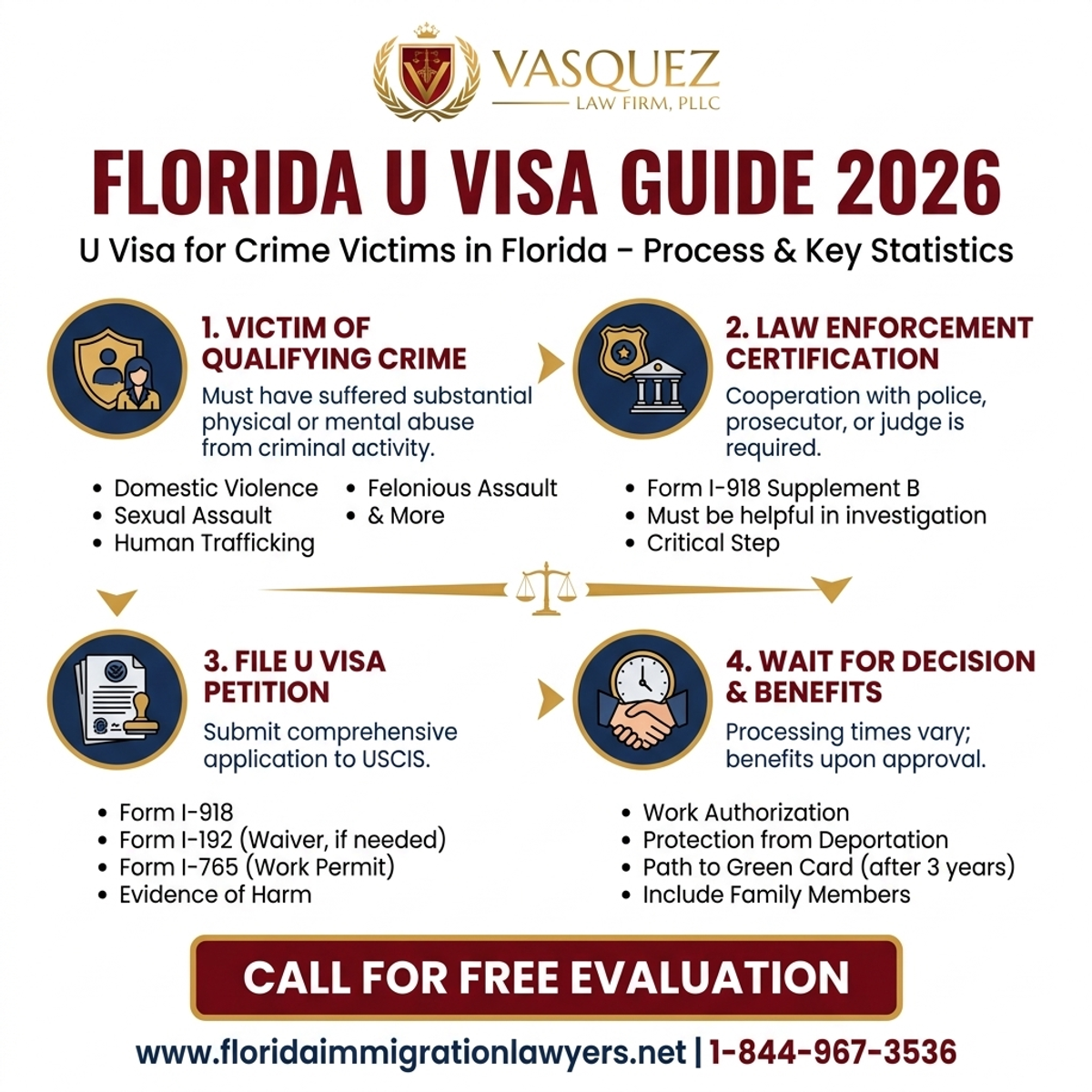
To be eligible for a U visa in Florida, applicants must meet several key criteria. First, they must be the victim of a qualifying criminal activity, which includes crimes such as rape, torture, trafficking, domestic violence, sexual assault, abduction, and other related offenses, as listed in the statute. Second, the victim must have suffered substantial physical or mental abuse due to the crime. This abuse is evaluated based on factors like the nature of the injury, severity, duration, and the extent of the impairment of the victim's daily life. Third, the victim must have information concerning the qualifying criminal activity and be helpful, is being helpful, or is likely to be helpful to a certifying law enforcement agency in the investigation or prosecution of that crime. Lastly, the crime must have occurred in the U.S. or violated U.S. law.
For victims in Florida, cooperation with local law enforcement agencies, such as the Coral Springs Police Department, Miami-Dade Police Department, or the Florida Department of Law Enforcement (FDLE), is paramount. These agencies issue the necessary law enforcement certification (Form I-918, Supplement B), which is a critical component of the U visa petition. Without this certification, the U visa application cannot proceed. Florida Immigration Lawyers can help you understand if your specific situation meets these stringent requirements and guide you through the process of obtaining the necessary certification from the appropriate authorities. Exploring all available immigration relief options, including asylum, is essential for comprehensive protection.
How Do I Apply for a U Visa as a Crime Victim in Florida?
Applying for a U visa in Florida involves several critical steps, starting with obtaining law enforcement certification and culminating in submitting a comprehensive petition to USCIS. The process requires meticulous attention to detail and a thorough understanding of immigration law, making legal representation highly advisable. As of 2026, applicants must be prepared for detailed scrutiny of their claims and supporting evidence.
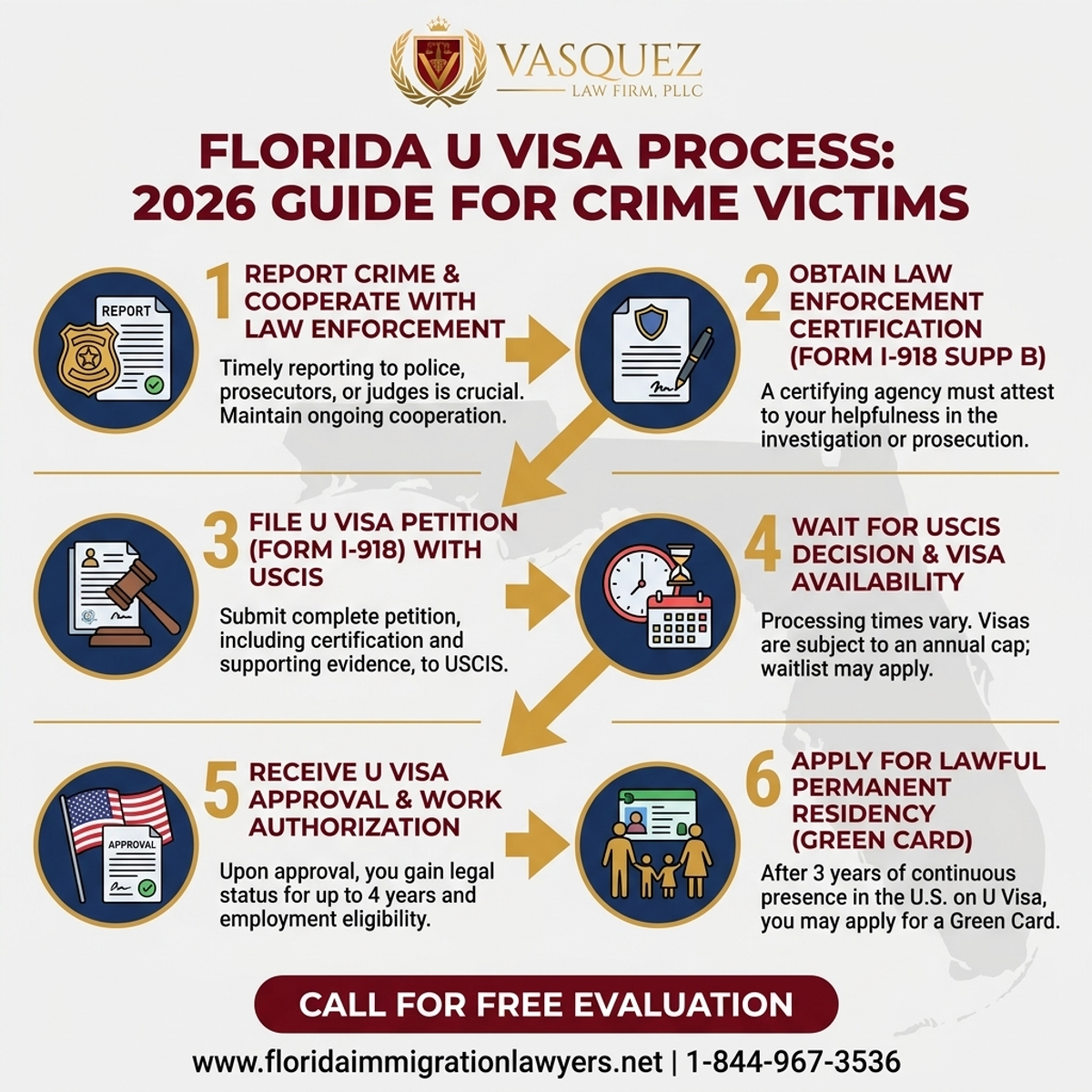
The application process for a U visa in Florida typically involves the following steps:
-
Obtain Law Enforcement Certification (Form I-918, Supplement B): This is arguably the most crucial step. You must request and obtain a certification from a qualifying law enforcement agency (LEA) or prosecutor's office that investigated or prosecuted the qualifying criminal activity. This form confirms that you were a victim of a qualifying crime and have been, are being, or are likely to be helpful to their investigation or prosecution. Local agencies in Florida, such as the Broward County Sheriff's Office or the State Attorney's Office, are familiar with this process.
-
Gather Supporting Evidence: Collect all documents proving the crime occurred, your victimization, the substantial abuse you suffered, and your helpfulness to law enforcement. This includes police reports, medical records, psychological evaluations, court documents, affidavits from witnesses, and any communication with law enforcement.
-
Complete Form I-918, Petition for U Nonimmigrant Status: Fill out the primary application form accurately and completely. This form details your personal information, the nature of the crime, and how you meet the U visa eligibility criteria. Include all required biographical information and addresses.
-
Prepare Form I-192, Application for Advance Permission to Enter as Nonimmigrant (Waiver of Inadmissibility): Many U visa applicants have immigration violations that would otherwise make them inadmissible to the U.S. The U visa statute includes a provision to waive most grounds of inadmissibility. This form is filed concurrently with Form I-918, requesting a waiver for any applicable inadmissibility grounds.
-
Submit the Petition to USCIS: Mail the complete package, including Form I-918, Form I-918 Supplement B, Form I-192 (if needed), and all supporting documentation, to the USCIS Vermont Service Center. Ensure all forms are signed and dated, and copies are kept for your records. The mailing address can be found on the USCIS website.
-
Attend Biometrics Appointment: After filing, USCIS will send you an appointment notice to attend a biometrics (fingerprinting) appointment at an Application Support Center (ASC) in Florida, such as those in Orlando, Miami, or Tampa. This data is used for background and security checks.
-
Await Decision: USCIS will review your petition. Due to annual caps on U visas (10,000 per fiscal year), eligible applicants are often placed on a waiting list. While on the waiting list, you may be granted deferred action and work authorization. If your case is strong, you may receive a bona fide determination, which can lead to work authorization more quickly.
What Documents and Evidence are Required for a U Visa Petition?
A robust U visa petition relies heavily on comprehensive documentation and compelling evidence. Gathering these materials meticulously is critical for demonstrating eligibility to USCIS. Missing or insufficient documentation can lead to delays or even denial of your application. As of 2026, USCIS continues to emphasize the need for clear and credible evidence. This is particularly important for victims in Florida who may have interacted with various local and state agencies.
A comprehensive U visa application package typically includes, but is not limited to, the following:
Step-by-Step Process — U Visa for Crime Victims in Florida 2026 Guide
- Form I-918, Petition for U Nonimmigrant Status: The primary application form.
- Form I-918, Supplement B, U Nonimmigrant Status Certification: The certification from law enforcement, signed by a qualifying official.
- Form I-918, Supplement A, Petition for Qualifying Family Member of U-1 Recipient (if applicable): For eligible family members seeking derivative U status.
- Form I-192, Application for Advance Permission to Enter as Nonimmigrant: If you have any grounds of inadmissibility that require a waiver.
- Personal Statement/Declaration: A detailed narrative from the victim explaining the crime, the abuse suffered, and their helpfulness to law enforcement. This statement is a cornerstone of the petition.
- Police Reports and Criminal Records: Official documents from the investigating agency (e.g., Coral Springs Police Department, Miami-Dade Police) detailing the crime, the victim's involvement, and any arrests or charges.
- Court Documents: Records from any criminal proceedings related to the qualifying crime, including indictments, plea agreements, and sentencing orders.
- Medical and Psychological Records: Documentation from doctors, hospitals, or therapists detailing physical injuries or psychological trauma suffered as a direct result of the crime. This is crucial for proving substantial abuse.
- Affidavits/Letters from Witnesses: Statements from individuals who witnessed the crime or the abuse, or who can attest to the victim's helpfulness to law enforcement.
- Evidence of Cooperation: Any documentation proving your helpfulness, such as letters from detectives, emails, interview transcripts, or court testimonies.
- Identity and Nationality Documents: Copies of passports, birth certificates, national identity cards, or any other documents proving identity and nationality.
- Proof of Relationship (for derivative family members): Marriage certificates, birth certificates, or other documents demonstrating the familial relationship.
- Photographs: Passport-style photographs for all applicants.
What are the Timelines and Processing Expectations for a U Visa in 2026?
The U visa process is known for its lengthy processing times, primarily due to the annual cap of 10,000 visas. As of 2026, applicants should anticipate a multi-year waiting period between filing and final adjudication. While specific timelines can vary greatly depending on USCIS caseloads and the complexity of individual cases, understanding the typical stages can help manage expectations for applicants in Florida.
Here is a typical timeline for U visa processing:
| Stage | Typical Timeframe (As of 2026) | Notes |
|---|---|---|
| Law Enforcement Certification Request | 1-6 months | Varies widely by agency; some Florida agencies are faster than others. |
| Petition Preparation & Filing | 2-6 months | Depends on complexity and availability of documents. |
| USCIS Receipt Notice | 2-4 weeks | Confirmation that your petition has been received. |
| Biometrics Appointment | 3-6 months after filing | Mandatory fingerprinting and photo at an ASC in Florida. |
| Initial Review & Bona Fide Determination | Up to 5 years or more | USCIS reviews for prima facie eligibility. If bona fide, deferred action and work authorization may be granted. |
| Placement on Waiting List | After bona fide determination | Due to the annual cap of 10,000 U visas. |
| Final Adjudication & U Visa Grant | Several years on waiting list | Once a U visa number becomes available. |
| Adjustment of Status (Green Card) | 3 years after U visa approval | U visa holders can apply for permanent residency after 3 years in U status. |
During the waiting period, USCIS may grant deferred action and employment authorization to eligible applicants, which provides temporary protection from deportation and the ability to work legally in the U.S. This is a critical interim benefit for many victims in Florida. It is important to remember that these timelines are estimates and can change. For accurate processing times, always check the USCIS website. If you are facing deportation defense, a U visa application can be a powerful tool to prevent removal.
What are the Costs and Fees Associated with a U Visa Application?
Understanding the financial aspects of a U visa application is crucial for planning. While some forms have fees, certain waivers are available for U visa applicants, which can significantly reduce the out-of-pocket expenses for government filing fees. As of 2026, it is important to verify the most current fee schedule directly from USCIS, as fees can change.
The primary costs associated with a U visa application typically include:
| Item | Typical Fee (As of 2026) | Notes |
|---|---|---|
| Form I-918, Petition for U Nonimmigrant Status | $0 | No filing fee required for the principal U visa petition. |
| Form I-918, Supplement A (for family members) | $0 | No filing fee required for qualifying family members. |
| Form I-192, Application for Advance Permission (Waiver) | Typically $930 | This fee can be waived for U visa applicants. A fee waiver (Form I-912) should be filed concurrently. |
| Biometrics Fee | $85 | This fee is typically required for all applicants, but a fee waiver (Form I-912) can be submitted. |
| Medical Examination (for Adjustment of Status) | Varies ($200-$500+) | Required later when applying for a green card (Form I-485). Not required for the initial U visa petition. |
| Attorney Fees | Varies widely | Legal fees depend on the complexity of the case and the attorney's experience. This is often the most significant cost. |
| Translation Services | Varies | If documents are not in English, certified translations are required. |
| Postal/Courier Fees | Minor | Costs for mailing documents to USCIS. |
Key Statistics — U Visa for Crime Victims in Florida 2026 Guide
While USCIS waives the filing fee for Form I-918 and its Supplement A, and a fee waiver can be requested for Form I-192 and the biometrics fee, the costs associated with legal representation are often the most substantial. Investing in experienced legal counsel from Florida Immigration Lawyers can save you significant time, stress, and potential errors, ultimately leading to a more successful outcome. We offer flexible payment options to assist our clients across Florida, including those in Coral Springs, Miami, Orlando, and Tampa. After receiving your U visa, you may eventually be eligible for citizenship or family immigration benefits.
Do not navigate this process alone. Contact Florida Immigration Lawyers today at 1-844-967-3536 for a free consultation to discuss your specific U visa case. Our dedicated team is ready to provide the compassionate and effective legal assistance you deserve.
Common Mistakes to Avoid in Your U Visa Application
The U visa application process is intricate, and even minor errors can lead to significant delays or outright denial. Being aware of common pitfalls can help you avoid costly mistakes and improve your chances of success. Here are some of the most frequent errors applicants make:
-
Failing to Obtain Law Enforcement Certification: This is the most common reason for denial. Without a signed Form I-918, Supplement B from a qualifying agency, the petition cannot proceed. Many victims mistakenly believe a police report is sufficient.
-
Submitting an Incomplete Application: Missing forms, unsigned documents, or lack of crucial evidence will lead to a Request for Evidence (RFE) or denial. Always double-check every item on the USCIS checklist.
-
Not Proving "Substantial Physical or Mental Abuse": Applicants sometimes fail to provide sufficient medical records, psychological evaluations, or detailed personal statements to demonstrate the severity of the abuse suffered.
-
Insufficient Evidence of Helpfulness: Simply reporting a crime is often not enough. You must demonstrate active and ongoing cooperation with law enforcement, such as providing testimony, attending interviews, or assisting in identifying perpetrators.
-
Failing to Disclose All Inadmissibility Grounds: It is critical to disclose all past immigration violations or criminal history on Form I-192, even if you believe they are minor. USCIS will uncover them, and failure to disclose can be seen as misrepresentation.
-
Missing Deadlines: Responding to RFEs or other USCIS requests within the specified timeframe is crucial. Missing a deadline can result in automatic denial.
-
Inaccurate or Inconsistent Information: Providing conflicting dates, names, or details across different forms or statements can raise red flags and undermine your credibility.
-
Not Providing Certified Translations: Any document not in English must be accompanied by a complete and accurate English translation certified by a competent translator.
-
Filing with an Agency Not Qualified to Certify: Only specific types of law enforcement agencies or prosecutors can sign the U visa certification. Filing with a non-qualifying agency will result in denial.
-
Assuming All Crimes Qualify: The U visa is only for victims of specific qualifying criminal activities listed in the INA. Not all crimes meet the statutory definition.
When to Call a Florida Immigration Lawyer for Your U Visa Case
While the U visa offers immense hope, its application process is fraught with complexities that can be overwhelming for victims already dealing with trauma. Knowing when to seek legal counsel is paramount to protecting your rights and maximizing your chances of success. If you are a crime victim in Florida, particularly in areas like Coral Springs, Miami, or Orlando, and are considering a U visa, contacting an attorney early in the process is highly recommended.
You should call Florida Immigration Lawyers if any of the following scenarios apply to you:
- You are unsure if the crime you experienced qualifies for a U visa.
- You need assistance requesting or obtaining certification from a law enforcement agency.
- You have past immigration violations or a criminal history that might make you inadmissible.
- You have received a Request for Evidence (RFE) from USCIS.
- You are in removal proceedings or have an order of deportation.
- You are having difficulty gathering necessary evidence or preparing your personal statement.
- You fear retaliation from the perpetrator or have safety concerns.
- You need to include family members in your application.
- You are simply overwhelmed by the complexity of the forms and legal requirements.
Our experienced attorneys at Florida Immigration Lawyers understand the unique challenges faced by immigrant crime victims. We provide compassionate, confidential, and strategic legal guidance tailored to your specific situation. We can help you navigate interactions with law enforcement, prepare a robust petition, and advocate on your behalf with USCIS, ensuring your story is heard and your rights are protected.
About Florida Immigration Lawyers
Florida Immigration Lawyers is a leading immigration law firm dedicated to serving individuals and families across the entire state of Florida. With a deep understanding of U.S. immigration law and a commitment to our clients, we provide comprehensive legal services, specializing in U visas, VAWA, asylum, deportation defense, family-based petitions, and citizenship. Our mission is to offer compassionate, effective, and results-driven representation to help our clients achieve their immigration goals.
Our firm is available 24/7 to provide immediate assistance and guidance. We offer free consultations to discuss your case and outline your best legal options without any obligation. We pride ourselves on our bilingual services, with a team ready to assist clients in both English and Spanish, ensuring clear and effective communication. Whether you are in Coral Springs, Miami, Orlando, Tampa, or any other part of Florida, Florida Immigration Lawyers is your trusted partner in navigating the complexities of immigration law. Call us today at 1-844-967-3536 to take the first step towards securing your future.
Sources and References
- U.S. Citizenship and Immigration Services (USCIS)
- Executive Office for Immigration Review (EOIR)
- 8 U.S.C. Chapter 12 - Immigration and Nationality Act (INA) Section 101(a)(15)(U)
- 8 CFR 214.14 - Regulations governing U nonimmigrant status
- INA Section 245 - Adjustment of Status of Nonimmigrant to That of Person Admitted for Permanent Residence
- USCIS Policy Manual
Related services: asylum application process, refugee status and resettlement, withholding of removal, humanitarian protection programs.
This article provides general legal information and is not intended as legal advice. Every case is unique, and outcomes depend on specific facts and circumstances. Contact an attorney for advice about your particular situation.
If you are a crime victim seeking justice and protection in Florida, do not hesitate to reach out. Florida Immigration Lawyers is here to help you navigate the U visa process with confidence and care. Contact us for a free consultation at 1-844-967-3536 today. Se Habla Espanol - Estamos aqui para ayudarle.
If you need legal assistance, learn more about speak with an immigration lawyer, or call us at 1-844-967-3536 for a free consultation.
Do Not Navigate This Process Alone
Our experienced immigration attorneys are ready to fight for you. Get a free, confidential consultation today.
Se Habla Español
Or leave your details and we’ll call you:
Free Evaluation in 24 Hours
Or talk to us right now
AI voice assistant — available 24/7
FreeFrequently Asked Questions

William J. Vásquez
Founding Attorney · Vasquez Law Firm
U.S. Air Force veteran and immigration attorney with years of hands-on U.S. immigration experience. J.D., NCCU School of Law. AILA member. Admitted to the 4th, 5th, and 11th Circuit Courts.
Available 24/7 - Free Evaluations
Reviewed for legal accuracy by William J. Vásquez
Licensed in North Carolina; U.S. immigration is federal practice.
Related Legal Services
Our Florida immigration attorneys can help you with asylum protection, deportation defense and citizenship and naturalization. Call today at 1-844-967-3536 for a free consultation.
Related Links
Related Topics
Free Legal Consultation
Discuss your case with our experienced attorneys. We're available 24/7.
Se Habla Español - Estamos aquí para ayudarle.
Related Articles
ICE Locator: Understanding Check-ins in Florida 2026
Understanding ICE check-ins and the ISAP program is vital for non-detained immigrants in Florida. These mandatory appointments with U.S. Immigration and Customs Enforcement (ICE) ensure compliance with release conditions, monitor an individual's status in the U.S., and track progress in their immigration case. From preparing necessary documents to understanding supervision timelines and avoiding common mistakes, the process can be complex. Florida Immigration Lawyers provides expert attorney representation to guide you through every step, protecting your rights and advocating for your best interests. Learn about the step-by-step process, key documents, and when to seek legal counsel to navigate your ICE supervision successfully in West Palm Beach and across Florida.
2026 I-539 H-4 Change of Status Processing Time
Navigating the I-539 H-4 change of status process in 2026 is crucial for Jacksonville families. Learn about processing times, application steps, and common pitfalls. Contact Florida Immigration Lawyers for expert guidance.
SIJS in Florida 2026: Special Immigrant Juvenile Status
Special Immigrant Juvenile Status (SIJS) offers a vital pathway to legal residency for immigrant children in Florida who have suffered abuse, neglect, or abandonment. This comprehensive guide, updated for 2026, delves into the eligibility requirements, the multi-stage application process involving both Florida state courts and federal immigration agencies, and the critical documents needed. We also cover the associated costs, the profound benefits SIJS provides, and common pitfalls to avoid. Understanding the nuances of SIJS is essential for securing a stable future for vulnerable minors. Florida Immigration Lawyers stands ready to assist families in Coral Springs and across Florida.
SIJS Process for Minors in Florida: What You Need to Know
Special Immigrant Juvenile Status (SIJS) offers a path to legal residency for minors in Florida who have been abused, abandoned, or neglected. This comprehensive guide covers eligibility requirements, application steps, and common mistakes to avoid. Our expert team at Florida Immigration Lawyers is here to assist you through this complex process. Learn more about how SIJS can help secure your future.