2026 I-539 H-4 Change of Status Processing Time
Navigating the I-539 H-4 change of status process in 2026 is crucial for Jacksonville families. Learn about processing times, application steps, and common pitfalls. Contact Florida Immigration Lawyers for expert guidance.

- Processing times can range from 4 to 12 months.
- Delays may occur due to missing documents.
- Jacksonville USCIS office handles many local cases.
Introduction
For many families in Jacksonville, Florida, navigating the complexities of H-4 EAD and spouse work permits is essential. The I-539 form, used for changing status to H-4, is a critical step in this process. In 2026, understanding the processing times and requirements is more important than ever. Call Florida Immigration Lawyers at 1-844-967-3536 for a free consultation and get personalized guidance.
The H-4 visa allows spouses and dependent children of H-1B visa holders to reside in the U.S. While the H-4 status itself permits legal stay, the H-4 Employment Authorization Document (EAD) grants the spouse the ability to work, providing crucial financial stability and professional fulfillment. This authorization has been a game-changer for countless families, particularly in vibrant economic hubs like Jacksonville, where H-1B professionals contribute significantly to various industries.
As we look to 2026, the landscape of immigration policies and processing efficiencies continues to evolve. Staying informed about the latest regulations, potential fee adjustments, and expected processing delays is paramount. This guide aims to provide a comprehensive overview for H-4 visa holders in Florida, ensuring they are well-prepared for their EAD application journey. With the right information and expert legal support from Florida Immigration Lawyers, you can navigate this process with confidence.
What is the H-4 EAD and Who Qualifies?
The H-4 EAD, or Employment Authorization Document, allows H-4 visa holders, typically spouses of H-1B visa holders, to work in the U.S. As of 2026, eligibility requires that the H-1B spouse has an approved Form I-140 or has been granted H-1B status beyond the usual six years due to pending green card applications.
For many families in Jacksonville, the H-4 EAD provides essential financial support. With the growing number of H-1B professionals in the area, understanding these qualifications is vital.
The H-4 EAD was introduced in 2015 to address the challenges faced by H-4 spouses, many of whom were highly educated professionals unable to work. This policy change recognized the significant contributions these individuals could make to the U.S. economy and the well-being of their families. To qualify, the primary H-1B holder must have initiated the green card process, specifically by having an approved Form I-140, which is the Immigrant Petition for Alien Worker. This indicates that the H-1B worker is on the path to becoming a lawful permanent resident.
Alternatively, eligibility extends to H-4 spouses whose H-1B partner has extended their H-1B status beyond the standard six-year limit under sections 104(c) or 106(a) and (b) of the American Competitiveness in the Twenty-First Century Act (AC21). This typically happens when their PERM labor certification or I-140 petition has been pending for a certain period. Understanding these specific criteria is crucial for any H-4 applicant. For example, consider Maria, an H-4 spouse in Jacksonville, whose husband, an H-1B software engineer, has an approved I-140. With her H-4 EAD, Maria can now pursue her career as a nurse, contributing significantly to her family's income and the local economy. It's a real-world example of how the H-4 EAD empowers families.
It is important to note that the H-4 EAD is specifically for spouses, not dependent children, of H-1B visa holders. Verifying the H-1B spouse's status and I-140 approval is a critical first step. Any discrepancies or pending issues with the H-1B status could directly impact the H-4 EAD application. Consulting with Florida Immigration Lawyers can help clarify these intricate eligibility requirements and ensure your application is built on a solid foundation.
How to Apply for an H-4 EAD in Florida?
Applying for an H-4 EAD involves several steps: obtaining an H-4 visa, applying for the EAD, and awaiting approval. As of 2026, applicants must file Form I-765 and provide supporting documents such as the H-1B spouse's I-797 approval notice.
- Prepare and file Form I-765.
- Include necessary documents: marriage certificate, H-1B approval notice.
- Submit the application to the designated USCIS office.
- Await processing, which can take several months.
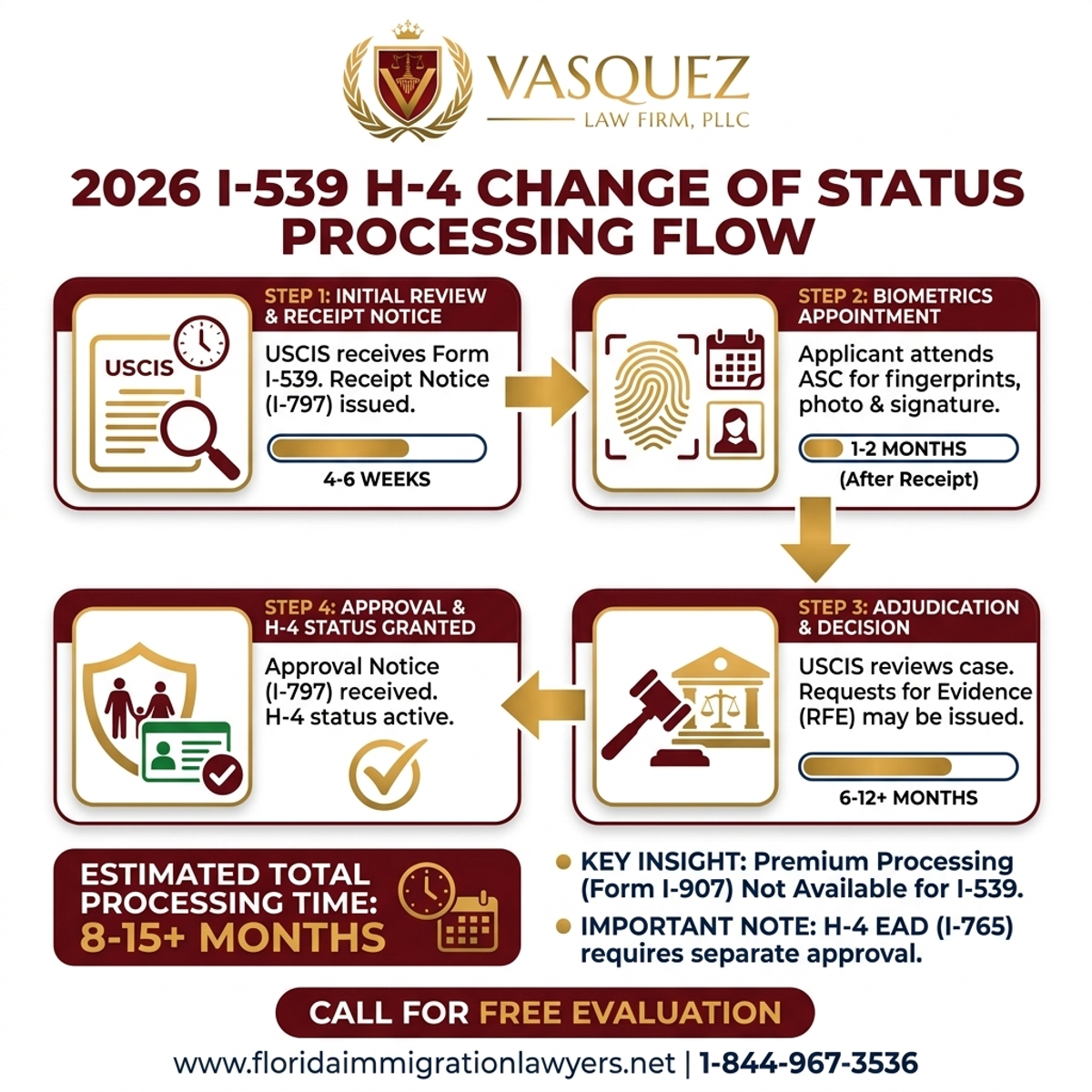
Step-by-Step Process — 2026 I-539 H-4 Change of Status Processing Time
In Jacksonville, submitting complete and accurate information is crucial due to the high volume of applications.
The first step in this journey is to ensure you have a valid H-4 visa status. If you are changing your status to H-4 from another non-immigrant status, you would concurrently file Form I-539. Once your H-4 status is established, or if you already hold it, you proceed with the H-4 EAD application by meticulously preparing Form I-765, Application for Employment Authorization. It's imperative to download the latest version of Form I-765 directly from the USCIS website to avoid using outdated forms, which can lead to rejection.
Beyond the form itself, a comprehensive package of supporting documents is required. This includes a certified copy of your marriage certificate, demonstrating your spousal relationship to the H-1B holder. If your marriage certificate is not in English, it must be accompanied by a certified English translation. You will also need copies of your H-1B spouse's most recent I-797 approval notice, which confirms their valid H-1B status, and their I-140 approval notice, which establishes their eligibility for EAD purposes. Additionally, two recent passport-style photos meeting USCIS specifications are a must. A practical tip for all applicants is to create a detailed cover letter listing all enclosed documents and to make a complete copy of the entire application package for your records before mailing. Using certified mail with a return receipt can provide proof of submission.
Given the high volume of applications processed by USCIS, especially from populous areas like Jacksonville, accuracy and completeness are paramount. Any missing information or incorrect fees can lead to delays, Requests for Evidence (RFEs), or even outright rejection. While online filing options are becoming more prevalent for various USCIS forms, it's essential to check the official USCIS website for the most current filing instructions for Form I-765 for H-4 EAD applicants in 2026. For personalized assistance and to ensure every detail is correct, don't hesitate to contact Florida Immigration Lawyers at 1-844-967-3536.
2026 I-539 H-4 Change of Status Processing Time
In 2026, the processing time for the I-539 H-4 change of status varies, typically ranging from 4 to 12 months. Factors such as application accuracy, USCIS workload, and specific office processing times, like the ones at the Jacksonville office, impact this timeline.
| Stage | Typical Timeframe | Notes |
|---|---|---|
| Application Submission | 1-2 weeks | Initial review |
| USCIS Processing | 4-12 months | Depends on workload |
| Approval/Denial | 2-4 weeks | Notification sent |
Applicants should be prepared for potential delays and ensure their submissions are complete.
Several critical factors contribute to the variability in I-539 processing times. Application accuracy is perhaps the most significant; even minor errors or omissions can trigger a Request for Evidence (RFE), which can add several months to the overall timeline. The USCIS workload is another major determinant, influenced by the volume of applications, staffing levels, and policy changes. Seasonal peaks, such as those often seen towards the end of the fiscal year, can also lead to increased backlogs. While local USCIS offices like Jacksonville may handle initial inquiries, the actual processing of I-539 forms for H-4 status is typically done at designated USCIS service centers.
To mitigate potential delays, proactive applicants often submit their I-539 applications well in advance of their current H-4 status expiration, ideally 5-6 months prior. This foresight helps avoid gaps in legal status or work authorization, especially if an H-4 EAD is filed concurrently. For instance, Sarah, an H-4 applicant in Jacksonville, submitted her I-539 just two months before her status expired. Due to unexpected USCIS backlogs, her application extended beyond her expiration date, causing temporary anxiety about her legal presence. Had she filed earlier, she would have had more peace of mind and potentially avoided a period of uncertainty. Regularly checking the USCIS website for the most current processing times for your specific service center is a practical tip, as these times are updated monthly.
It's important to understand that premium processing, which offers expedited adjudication for an additional fee, is generally not available for I-539 H-4 change of status applications. This underscores the need for careful planning and timely submission. While the table above provides a general timeframe, individual cases can vary. Consulting with Florida Immigration Lawyers can help you understand the current processing climate and develop a strategy to submit the strongest possible application, minimizing the risk of delays.
Document Checklist for H-4 EAD Application
Assembling a complete and accurate document package is arguably the most
Sources and References
- U.S. Citizenship and Immigration Services (USCIS)
- Executive Office for Immigration Review (EOIR)
- U.S. Department of State - Bureau of Consular Affairs
- Immigration and Nationality Act (INA), 8 U.S.C. Chapter 12
Do Not Navigate This Process Alone
Our experienced immigration attorneys are ready to fight for you. Get a free, confidential consultation today.
Se Habla Español
Or leave your details and we’ll call you:
Free Evaluation in 24 Hours
Or talk to us right now

AI voice assistant — available 24/7
FreeFrequently Asked Questions

William J. Vásquez
Founding Attorney · Vasquez Law Firm
U.S. Air Force veteran and immigration attorney with years of hands-on U.S. immigration experience. J.D., NCCU School of Law. AILA member. Admitted to the 4th, 5th, and 11th Circuit Courts.
Available 24/7 - Free Evaluations
Reviewed for legal accuracy by William J. Vásquez
Licensed in North Carolina; U.S. immigration is federal practice.
Related Legal Services
Our Florida immigration attorneys can help you with experienced immigration attorneys, business immigration and asylum protection. Call today at 1-844-967-3536 for a free consultation.
Related Links
Related Topics
Free Legal Consultation
Discuss your case with our experienced attorneys. We're available 24/7.
Se Habla Español - Estamos aquí para ayudarle.
Related Articles
SIJS in Florida 2026: Special Immigrant Juvenile Status
Special Immigrant Juvenile Status (SIJS) offers a vital pathway to legal residency for immigrant children in Florida who have suffered abuse, neglect, or abandonment. This comprehensive guide, updated for 2026, delves into the eligibility requirements, the multi-stage application process involving both Florida state courts and federal immigration agencies, and the critical documents needed. We also cover the associated costs, the profound benefits SIJS provides, and common pitfalls to avoid. Understanding the nuances of SIJS is essential for securing a stable future for vulnerable minors. Florida Immigration Lawyers stands ready to assist families in Coral Springs and across Florida.
SIJS Process for Minors in Florida: What You Need to Know
Special Immigrant Juvenile Status (SIJS) offers a path to legal residency for minors in Florida who have been abused, abandoned, or neglected. This comprehensive guide covers eligibility requirements, application steps, and common mistakes to avoid. Our expert team at Florida Immigration Lawyers is here to assist you through this complex process. Learn more about how SIJS can help secure your future.
BIA Remand Order: Your 2026 Guide in Florida
A BIA remand order means the Board of Immigration Appeals has sent your immigration case back to an Immigration Judge for further review. This crucial development requires immediate and strategic action, as it indicates a need to address legal errors, consider new evidence, or develop the factual record. For individuals in Florida, navigating a BIA remand can be complex, involving new hearings, strict deadlines, and the potential need for updated documentation. Understanding the reasons for the remand, preparing comprehensive evidence, and securing experienced legal representation are vital steps to achieving a favorable outcome. This guide explains the process, potential outcomes, and common mistakes to avoid in 2026, emphasizing the importance of professional legal assistance from Florida Immigration Lawyers.
I-360 Widow Petition: Guide for Surviving Spouses
For non-citizen surviving spouses of U.S. citizens in Florida, the I-360 Widow Petition offers a vital pathway to permanent residency. This self-petition allows eligible individuals to apply for a green card independently, without requiring another sponsor. You must generally file within two years of your spouse's death, prove a bona fide marriage, and ensure you have not remarried. As of 2026, understanding the strict eligibility criteria, detailed filing process, and potential costs is crucial. Florida Immigration Lawyers provides expert guidance, helping you gather necessary documentation, navigate USCIS requirements, and address any complexities, ensuring your application is strong and complete for a secure future in Florida.